Dr. Dennis Zeitlin, Clinical Professor of Psychiatry at the University of California/San Francisco and practicing Psychiatrist, is also Denny Zeitlin, pianist, composer, arranger, and improvisor––the latter has been playing and recording since the early 1960s when he was a Graduate Student at Johns Hopkins in Baltimore, MD. He continued his career and began teaching after moving to the West Coast. The pianist recorded four LPs for Columbia from 1963-67, the first in a trio with bassist Cecil McBee and drummer Freddie Waits; other ensembles featured bassist Charlie Haden and drummer Jerry Granelli. In 1969, he met percussionist George Marsh (who, like Dr. Zeitlin, was born in Chicago) forming a trio with bassist Mel Graves. Together, they recorded two albums, one ("The Name of This Terrain") recorded in 1969 that was issued in 2022, and the other ("Expansion") issued in 1973––Dr. Zeitlin had added electronic keyboards and synthesizers to his repertoire and the musical results still sound fascinating. In 1978, he composed the soundtrack to the first remake of "Invasion of the Body-Snatchers"; that immersive electronic experiment sent him back to the acoustic piano.
In the late-2000s, after issuing on labels such as Windham Hill, Palo Alto Jazz, Concord, and one smashing Trio session on the Japanese Venus label, Dr. Zeitlin began his association with Sunnyside Records. Since that time, he has released four Trio albums (featuring bassist Buster Williams and drummer Matt Wilson), three totally-improvised electronics-laden albums with George Marsh, and six solo piano albums (one of which, 2013's "Both/And", features electronics as well). Album #14 for Sunnyside is "Crazy Rhythms: Exploring George Gershwin" (the Doctor's seventh solo album and third recorded at the Piedmont Piano Company in Oakland, CA). The package includes 11 Gershwin works that range from "standards" to show tunes to one fascinating find (the lovely waltz "By Strauss"). Dr. Zeitlin chose these pieces several months before the December 2018 concert, playing through and with them. He then sat in the concert space in front of the audience and proceeded to play through the program following no set format and improvising, in his estimation, 95% of the concert.
What a treat this album is. From the opening zither-like sound of "Summertime" to the playful "I Was Doing All Right" that closes the album, the music goes in many directions. In conversation with Dr. Zeitlin, I compared the improvisor to a person diving into the water, going deep down and coming back up to touch on the melody. Right from the start, the music does not move the way one might expect; instead, these performances are an open door into the musician's creativity. While you sing along to "How Long Has This Been Going On?", the pianist changes the tempo now and then, creating a joyful solo. "Fascinating Rhythm" bounces forward yet there are moments when the two-handed approach sounds like a JS Bach exercise before swinging away on the power of right-hand single note runs. Listen below to "The Man I Love"–is the opening a bow to fellow pianist McCoy Tyner's use of modal chords before the music dances away?
The three pieces from "Porgy and Bess"––"Bess You Is My Woman Now", "It Ain't Necessarily So", and "My Man's Gone Now"––could be an album on its own. The pianistic explorations on each piece not only honor the melody but the "heart and soul" in each tune. "Bess" is just gorgeous, emotionally rich and rewarding in numerous ways. "It Ain't...." moves far from its melodic home for a powerful journey inside the questions at the heart of faith and beliefs, not settling for a laugh. At nearly 13 minutes, "My Man's Gone Now" is, at times, an elegy, a celebration, and a angry fist waving at the heavens, a journey inward and out again with a renewed resilience.
That's my take. "Crazy Rhythms: Exploring George Gershwin", if you are willing to give the music the time it deserves, is quite an album. Denny Zeitlin makes George Gershwin come alive, illuminating the universality of the composer's music as well as the joy (try and sit still listening to "S'Wonderful"). Pay attention and get lost; let this music take you away from the mundane, from the troubles, for the rewards are many!
Like many musicians from Eastern Bloc countries (in this instance, Ukraine) pianist and composer Vadim Neselovskyi first studied classical music before he and his family moved to Dortmund, Germany. Yet, the pianist had already been turned on to jazz by sailors visiting his home city of Odesa, a port city on the Black Sea. In Germany, Neselovskyi continued his classical studies while working as a jazz musician at night. He moved to the United States to study at the Berklee College of Music where he came into contact with Pat Metheny and Gary Burton. In fact, it was Metheny who produced a promotional recording that featured the pianist alongside bassist Esperanza Spalding and trumpeter Christian Scott aTunde Adjuah. Neselovskyi moved on to the Thelonious Monk Institute (now the Herbie Hancock Institute) in Los Angeles, CA, where he played alongside Mr. Hancock as well as Terence Blanchard, Wayne Shorter, Dee Dee Bridgewater, and many others. He came back to the East Coast to work with his former Professor Gary Burton, appearing on, composing for, and arranging for the vibraphonist band and for recordings.
His new album, "Odesa: A Musical Walk Through a Legendary City" (Sunnyside Records), is a tribute to the city he was born in. Recorded before the current invasion, the music is, nevertheless, filled with passion, with emotions such as joy, anger, defiance, good and bad memories both from Neselovskyi's lifetime and before. Not surprisingly, there's a classical feel to much of this music––in interviews, the pianist mentions being inspired by Russian composer Modest Mussorgsky's "Pictures at an Exhibition", especially in form and focus. Over the course of the 13-song program, this music covers a wide swath of musical territory. What stories this music tells! Whether it's the "Potemkin Stairs" (photo below) or the blooming "Acacia Trees" or playing the "Waltz of Odesa Conservatory" of the memories of "My First Rock Concert", the passion and emotions stand out.
Start "Odesa" at the beginning and don't stop until the final notes of "The Renaissance of Odesa" fade away. Listen in the morning at dawn and, with the birds singing, you could be sitting on those stairs. Vadim Neselovskyi has created a masterpiece and it's not just because of the current war raging in his homeland. In fact, the bulk of the album was recorded in
August of 2020 and finished a year later. While some of the music is elegiac, there are pieces that explode out of the speakers, songs that rock, roar, and dance. "Odesa" is both a celebration of a great city but also the story of Vadim Neselovskyi as he is finding his place in the world. Brilliant music and performance like this should not, must not, be missed.
While studying and living in New York City, German-born pianist/ composer Florian Hoefner had become a busy composer and bandleader. But, his wife got a tenure-track position at a university in Newfoundland and he willingly followed. Eventually, Hoefner also was offered a teaching position and they settled into their new home. The pianist still manages to maintain his Quartet (three albums on Origin Records) and ties with Subtone, a quintet he co-founded while living in Germany; but since moving up North, he organized a trio with two well-established Canadian musicians, bassist Andrew Downing and drummer Nick Fraser. Hoefner made the time to study the rich world of Canadian folk and maritime music to fit into his surroundings as well as to make new musical connections.
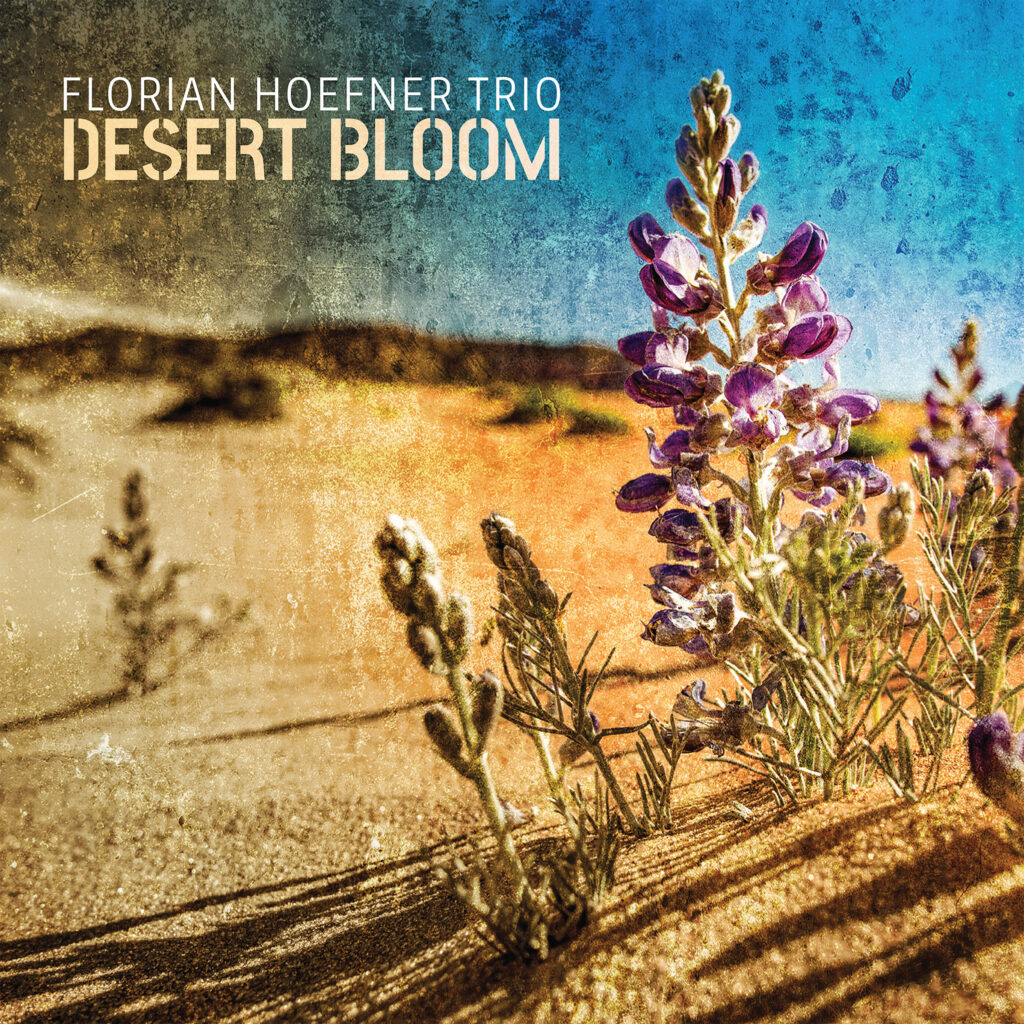
The Canadian trio issued its debut album "First Spring" (Alma Records) in 2019. The pianist's immersion into the folk music of his new community was evident on several tracks––even more evident was how comfortable the trio delving into Hoefner's music and arrangements. The pandemic began in earnest after the trio finished its first full-length tour. The three musicians retreated to their "safe homes" and the lockdown gave the pianist time at home with his young family and more time to read, to listen, and practice. The results of his pandemic hiatus can be heard throughout the Trio's second Alma release "Desert Bloom". Named for the rare occurrence when a desert area gets a lot of rain and the vegetation, which has lain dormant for many years, erupts in all its beauty (see photo below). That's how the pianist felt during COVID with his ensemble projects on hold and teaching relegated to ZOOM. He returned to composing with renewed energy especially after he watched a television program about desert bloom. His thoughts turn to re-creation, reemergence, and new life.
Photo: Martin Bernetti Atacama desert, Chile
The album opens quietly with "Between The Lines"––Downing plays the opening verse supported by the ostinato piano and the swirling cymbals. Hoefner takes the first solo, his bluesy yet expansive lines rising over the powerful bass counterpoint and the driving drums. The title track opens with bowed bass and soft cymbal taps as the leader introduces the theme. Downing's arco solo is richly melodic (his lower notes pull at the heart). When he's done, the pianist the piece into gear, playing a repetitive figure with with the pizzicato bass. The music is filled with interplay, with melodic and rhythmic invention, it pulls the listener in.
Two songs speak to the pandemic experience. The rubato opening of "The Day Everything Stopped" imitates the stasis one felt as the world closed down; that leads to a powerful ballad noted for the splendid ensemble work, a probing bass solo, and the thunderous (even angry) drum spotlight. The piece ends with a return to the main melody which now sounds contemplative. "The End Of the Tunnel" follows––not surprising, the piece has a sense of urgency, of the joy of the possibility of normalcy. There are moments during Downing's solo when the music becomes pensive but that does not last long thanks to the power in Fraser's drumming and the energetic piano.
"Desert Bloom" is often bright, sometimes shy to open up but ultimately a delightful way to spend 65 minutes. The music opens even further as one listens again and again; concentrate on each instrument and then listen again to the collective. There has been a large amount of excellent piano trio music released in the first six months of 2022 and much more to come. This album by the Florian Hoefner Trio is certainly one of the best of this or any year!
Newvelle Records, the American-French collaboration that has created an amazing series of modern jazz vinyl albums over the past six years, is just beginning to release some of those albums on their new digital label. Earlier in 2021, the label released three albums (two new) including the brilliant 61-track tribute to the late pianist Frank Kimbrough plus two duo albums, one by bassist Skúli Sverisson and guitarist Bill Frisell (which had been released on vinyl in 2018) as well as one by vocalist Becca Stevens with label co-owner/ pianist Elan Mehler.
Now, as the year closes, the label has chosen to release three more of the original vinyl albums in a digital format, one from each of their first three "seasons". Note that the musicians own the rights to the music after two years –– artists who the label has recorded have issued their Newvelle Lps on their own labels including bassist Ben Allison, saxophonist Tim Berne, and guitarist Lionel Loueke (in both a trio session and a duo date with pianist Kevin Hays).
Let me also state here that when you visit the label's website –– www.newvelle-records.com –– you'll also see that there are recordings of artists from New Orleans (among them, the late Ellis Marsalis as well as vocalist Irma Thomas) plus an "international artists" collection that includes vinyl releases by guitarist Gilad Hekselman (Israel) and trumpeter/flugelhornist Nadje Noordhuis (Australia).
The label's first vinyl release was "Meantime" featuring pianist Frank Kimbrough in a quartet/quintet setting with tenor saxophonist Andy Zimmerman, bassist Chris Van Vorst Van Beest, drummer R.J. Miller, and, on several tracks, trumpeter Riley Mulherkar. The program, expanded from nine to 12 tracks on the new release, features both new and older originals plus several standards. Zimmerman is a new voice for me –– he's been based in Chicago for several decades and made his debut as a leader on Newvelle in Season Three, a quartet setting with trumpeter Dave Douglas, pianist Kevin Hays, and bassist Matt Penman. The saxophonist and leader work well together really nicely (check out "Alabama Song" below), his subdued attack on the sax similar to the gentle explorations of Kimbrough. Adding Mulherkar to the mix, especially on the swing take of Andrew Hill's "Laverne", is a treat as the trumpeter gets to display his delightful bop chops. The rhythm section is responsive throughout while the pianist's inventiveness, as usual of his albums, shines brightly.
There's much more –– if you are a fan of Frank Kimbrough's music and did not spring for the vinyl (mea culpa), this is a very welcome addition to your collection. Go to https://newvellerecords.bandcamp.com/album/meantime and purchase this delightful album.
Here's the opening cut:
From Newvelle's second season comes "Cuban Nocturne", a solo piano release featuring the impressive Cuban-born now American artist Aruán Ortiz. The pianist, a native of Santiago de Cuba, started out on violin and viola as a youth but switched to the keyboard after moving to Havana in his late teens to attend school. He went on to study in Barcelona, Spain, before moving to the Berklee school in Boston, Ma, on a full scholarship. Ortiz has recorded nine albums as a leader or co-leader but "Cuban Nocturne" is his first program of classical Cuban music. Pieces from the composers Ignacio Cervantes (1847-1905), Antonio María Romeu (1876-1955), Ernesto Lecouna (1895-1963), and Catalan composer Federico Mompou (1893- 1987) plus the title track which Ortiz created for the 2015 movie "Sin Alas (Without Wings)" as well as two short original "Interludes". It's a stunning, delightfully impressionistic, 38+ minutes of splendid musicianship, lovely even stately melodies, and certainly well worth your time and money!
From Newvelle's third season comes "Charlie & Paul", an tribute to bassist Charlie Haden (1937-1914) and drummer Paul Motian (1931-2011) created by guitarist Steve Cardenas with a ensemble that features Loren Stillman (alto saxophone), bassist Thomas Morgan, and drummer Matt Wilson. The program includes five compositions from Motian (three of which are premiered on this album) and five from Haden (one of which, "There In a Dream", is not on the vinyl version). All four musicians had worked with one or both of the two Masters (Cardenas is the only one who played with both) and the listener can tell that by the way they dig into the material with love, passion, respect, and joy. The music runs the gamut from Country-rock ("Prairie Avenue Cowboy") to a Spanish-Latin feel ("La Passionara") to "freer" associations ("Riff Raff") to a gentle acoustic guitar driven folkish tune ("For Turiya") to "electric bebop ("For the Love of Sarah") and elsewhere. The music is a treat from start-to-finish and the digital sound quality is first class! The crisp, clean, tones of Cardenas's acoustic guitar as well as Morgan's soulful bass work stand out as do the delightful percussion play of Wilson and Stillman's melodic, cool, alto sax lines. Such an excellent ensemble, splendid material, and enchanting musicianship.
Over the decades of his career, Steve Coleman, alto saxophonist, composer, conceptualist, MacArthur Fellow, has taken his curiosity far afield, creating music that blends rhythm and melody in ways that are hypnotic and highly appealing. The Chicago, IL, native has absorbed the musical lessons of Charlie Parker, the live lessons of fellow alto player Bunky Green, and tenor master Von Freeman, what he learned in the bands of Cecil Taylor, Sam Rivers, and Dave Holland (to name but three) and created music whose home is in the African Diaspora and the streets of American cities. Since signing with Pi Recordings in 2010, Coleman has issued six albums that feature several different-sized ensembles. His main musical vehicle is Five Elements, an ensemble that now features Jonathan Finlayson (trumpet) and the amazing rhythm section of Anthony Tidd (electric bass) and Sean Rickman (drums).
In 2018, Pi released "Live at the Village Vanguard Volume I: the Embedded Sets", and two-CD set recorded in May of 2017. That album featured a fifth Fifth Element, guitarist Miles Okazaki. 12 months later, the band returned to the Vanguard with the spoken word genius Kokayi in the place of the guitar. 11 songs from that three-night stay can now be heard on Coleman's seventh album for the label "Live at the Village Vanguard Volume II (Mdw Ntr)". The combination of the vocals and instrumental voices is, at times, astonishing as Kokayi is right on the rhythm, interacting with Coleman and Finlayson's melody lines, Tidd's thunderous yet melodic bass lines, and Rickman's powerful, conversational, drums. Coleman's alto leads the way but everybody's voice is heard. Finlayson has developed into an excellent front-line partner; whether the piece is totally improvised (such as disc #1's "Unit Fractions" or Bunky Green's "Little Girl I'll Miss You"), the trumpeter builds delightful solos off of the leader's rapid-fire solo phrases. Another highlight of the Green piece is Kokayi's interaction with the leader's alto.
Thanks to the rhythm section, this music is always moving. Not only do Tidd and Rickman act as the foundation but they both, at times, interact with the soloists. Because Coleman builds these pieces around shapes and symbolism (from Egyptian hieroglyphics), the melodies the sax and trumpet create often sound static but the bassist and drummer keep the music interesting. Kokayi is often the spark plug –– his social commentary on "Pad Thai –– Mdw Ntr" locks in with the bass line and the solid drumming and making one leap out of their seat!
Happily, there's no let up on disc 2. In fact, "Rumble Young Man, Rumble" may be the best cut on the entire album. Not only is the rapid-fire groove irresistible but Kokayi's lyrics have moments of sheer hilarity (something to do with "bichon frieses in the jungle with labradoodles") as well as social commentary about how dangerous walking the streets is for young Black men as well as the description of a boxing match. All the while, Rickman is a thundering presence; like rush hour in downtown Manhattan, there's no escaping his presence. (Notice how Coleman uses the repeated 12-note phrase of the song as the opening salvo of "Khet & Kaba" and variations of the same for the melody).
"Steve Coleman and Five Elements: Live at the Village Vanguard Vol. II (Mdw Ntr)" is powerful modern music. Steve Coleman utilizes ancient codes and artwork to create explorations of 21st Century Black Music that is as intelligent as it is funky.
Here's the afore-mentioned "Rumble Young Man, Rumble":
Pianist and composer Matthew Shipp is one of the busiest musicians you'll ever meet. Even though he has cut down his live appearances (as did the pandemic), he records with his own group, co-leads other ensembles, and appears on other people's recordings. When he records a solo piano album, one can hear a dizzying number of musical references, from 20th Century Classical music to avant-garde jazz to blues to, by his own admittance, the influences of Bud Powell and Bill Evans. Critics and reviewers call it jazz but that word is not quite right –– you can call it Black creative music or just music.
His new album, "Codebreaker" comes to us via TAO Form, the label started last year by drummer (and Shipp collaborator) Whit Dickey. 11 songs spread across 45 minutes, all but one under five minutes. The music blends melody, rhythm, hypnotic phrases, introspective moments, and more into a mesmerizing program. Recorded in late July of 2020 in Brooklyn NY's Park West Studios, Shipp creates a world all his own –– this is not background music but a program to explore from beginning to end. There is a science-fiction motif to several of the song titles, e.g "Letter From the Galaxy", Raygun", and "Stomp To the Galaxy". Yet, the pianist has a sly edge in not giving away any real hint through the names. What is enjoyable is how the music can shift in a heartbeat or stop your heart with its gentle quality; the "blues stomp" that shows up in "Green Man" and the lyrical tenderness of "Suspended".
Find a comfortable chair, put on "Codebreaker", and let the sounds wash over you as well as enter your soul. If you are a fan of the recorded music of Matthew Shipp, you know to do that. If you are new to his music, you become the person in the album's title, exploring the piano language he creates on eleven pieces. Don't hurry to crack any codes, just take in these sounds, these luminous creations, and enjoy.
For more information, go to www.akamu.net/shipp.htm. To purchase the album, go to
How do our personal experiences affect the music we make, the music we listen to? Can one truly describe those experiences through music? I believe most of us would say yes.
Photo: Steven Shreiber
In early 2019, composer, vocalist, and multi-instrumentalist Jen Shyu was in the midst of creating a long-form composition/ performance work, "Zero Grasses". She was in Japan on a research mission for the project when she received an email to tell her that her 78-year father had died in his sleep. Needless to say, Ms. Shyu returned home and, as she and her mother were cleaning out her father's closet, they found her childhood diaries. That discovery changed the arc of her project (which debuted in October 2019) –– the importance of living one's life, the racism in our society, how the Music industry treats women, and more became the subject of her songs. As did the Pandemic and the death of Breonna Taylor in the months before finishing her new album.
"Zero Grasses: Ritual for the Losses" (Pi Recordings) is the result of two studio sessions (January 11, 2019 and August 11-12, 2020). Accompanying Ms. Shyu (who plays percussion, piano, Taiwanese moon lute, Japanese biwa) is Jade Tongue which consists of Ambrose Akinmusire (trumpet), Mat Maneri (viola), Thomas Morgan (bass), and Dan Weiss (drums), the same quartet that appeared on her 2015 Pi Recording "Sounds and Cries of the World" (Maneri, Morgan, and Weiss also appear on 2017's "Song of Silver Geese"). The album (her eighth) opens with the 4-part, nine minute "Living's a Gift"; the lyrics for the piece were composed by choir students (grades 6-8) from the MS 51 William Alexander Middle School in Brooklyn, NY. The songs speak on the strangeness of living in the Pandemic. Listening to how Ms. Shyu multi-tracks her voice and how the quartet move along with her, never playing over here but as partners.
She writes and sings about her Father's loss on the somber, dark, "Body of Tears". How Ms. Shyu uses her voice to portray shock and sorrow as well as the matter-of-fact quality of the email notifying of her Father's death. Meanwhile, the trumpet shouts, the viola wails until the music calms a bit at the close. "Lament for Breonna Taylor" starts with quiet percussion into a couplet from a poem by pianist Armen Nahlbandian. Soon, one hears long notes from Morgan (bowed bass), Maneri, and Akinmusire before the piano plays chords. As the music rises slowly in intensity, Ms. Shyu sings lyrics from two different interviews with Ms.Taylor's mother, Tamika Palmer. That piece melts into Ms. Shyu's "The Human Colour", a jazzy ballad about hope and how even in war, we are more like than dissimilar.
Photo: Marco Giugliarelli
"When I Have Power" utilizes an incident related in the composer's teen years when she was called a "chink". Her 15-years old self does not understand, the music created behind her goes from "free-form" into rhythms from Timor-Leste and Ms. Shyu breaks into a chant which emboldens her and she says she will change the world. The final two tracks, "With Eyes Closed You See All" and "Life As You Envision", speak to lessons learned with the passing of her father. The gentle interactions of the musicians on the former serve as a counterpoint to the piano-driven melody under the vocal. Ms. Shyu leads the group playing a trance-like melody on biwa (see picture above). As she sings on love and loss, Akinmusire often plays long tones until the final verse when he and the music becomes turbulent.
The best way to experience "Zero Grasses" Ritual for the Losses" is to play it over and over. This is not "conventional" music; instead, Jen Shyu shatters genres yet stays true to the folk traditions that underlie her incredible music. Her voice is so supple, easily changing timbre but never sacrificing emotion. This is music that adheres itself to your soul and to your heart!
Pianist Masabumi Kikuchi (1939-2015), the Japanese native, played with so many great American Jazz artists over the 40+ years of his career (from Billy Harper to Gary Peacock to Paul Motian to Gil Evans). 18 months before he died, Kikuchi entered Klavierhaus in New York City and recorded the sessions that comprise his new album. "Hanamichi" is the first recording to be released on Red Hook Records and is the last session "Poo", as Kikuchi was affectionately called, recorded. It's his fifth solo piano album and quite unlike others in that producer Sun Chung pushed him to play "songs" instead of mostly improvising in the studio.
The 42-minute program opens with "Ramona", a Mabel Wayne composition from 1928, that the pianist slows down. Like his friend and associate Paul Motian, Kikuchi never rushes his way through a ballad. After a formless opening, the pianist lovingly moves into the melody, relishing each note. "Summertime" follows –– it, too, opens ever-so-slowly but the pianist dives into the George Gershwin melody and, like the previous track, is in no hurry. It's the longest track –– 11:23 –– never bogs down or becomes boring. A meditation on the classic, the music is comfortable and comforting. There are two versions of "My Favorite Things"; "I" opens in a wistful mood then notes begin falling like rain, splintering the melody into fragments, never returning to the melody. The feel of Erik Satie inhabits "II" at the onset before the pianist drops into a deliberate yet stunning reading of the melody. Kikuchi creates a new melody after the first verse, never in a hurry, relying on the sustain of heavy chords to move the music forward.
Photo: Hiroyuki Ito
The final two tracks include the aptly-titled "Improvisation" and the pianist's tune for his daughter "Little Abi." The former rumbles forward in the style of Matthew Shipp and Cecil Taylor. Kikuchi does not startle one with terrific technique but displays how one create melody out of dissonant phrases and how, when he slows down, the music gently comes together. "...Abi" is a piece the pianist recorded several times but first on a trio date led by drummer Elvin Jones. While it seemed in later years that Kikuchi would just improvise throughout his concerts, he always returned to this song. It's "pretty" without being saccharine, a slow, pensive, memory of a young child who captivated the artist, innocent and gentle.
If "Hanamichi" leads you to discover more music by Masabumi Kikuchi, you will be richly rewarded. If you are already a fan, you will be pleased that the pianist continued exploring up to the end of his life. This is music out of the ordinary and you should let yourself surrender to its whimsical beauty.
Canadian-born vibraphonist Dan McCarthy has been a mainstay on the North American jazz scene for over two decades. Before moving to the United States, he played with artists such as drummer Ted Warren, vocalist Laila Biali, guitarist Lorne Lofsky, and drummer Terry Clarke. After his move to the States, McCarthy played alongside and/or with bassist Steve Swallow, guitarist Ben Monder, saxophonist Myron Walden, and drummer Gerald Cleaver plus many more. He's recorded and self-released several albums (which you can find at Bandcamp –– https://vibraphonedan.bandcamp.com/) plus two albums released by the Seattle, WA- based label Origin Records.
His new album, "A Place Where Once We Lived", was recorded in February of 2019 the day before McCarthy moved back to Toronto (and three months before his second Origin release "City Abstract", a musical tribute to Gary Burton, featuring his Canadian quartet). A trio date with bassist Thomas Morgan and drummer Rudy Royston, "A Place...."sparkles with ideas, excellent musicianship, intelligent interactions, and strong solos from all. The first sounds you hear at the onset of "Sonder" is Morgan's rich bass tones anticipating the ballad that follows. The full-sounding vibes mesh well with bass sound. Royston plays with subtle power as he links his "swing" with Morgan's ambling phrases. One can hear the influence of Burton but the music is reminiscent of Pat Metheny's debut on ECM "Bright Sized Life." Pieces such as "Trail Marker" and "Desert Roads" have an airiness that allows the music to breathe plus they seem to encourage and suggest lyrics or poems.
There are three "Short Stories" in the 11-song program. None are over 1:24 and each seems like an introduction yet all stand nicely on the own. The first, "A Short Story About Birds", has a slow melody for bass and vibes but also one hears Royston's "nervous" fills. Next is "A Short Story About Distance" with its hypnotic vibes and drum opening, and the melody played by Morgan's bass. The third and shortest (54 seconds), "A Short Story About Quiet", seems to hover in the sound space as if waiting for the next track "Go Berserk" to erupt. While the trio never really gets loud, the urgency and intensity of the music is palpable.
The ballads McCarthy composes stand out for their emotional power as well as their musical intelligence. The title track spotlights Morgan as he leads the tune in and takes a richly melodic solo near the close (his work beneath the vibraphonist's solo is also impressive. "Somber Sleep" moves gently with moments where the musicians are in conversation with each other (note how Royston's splendid brush work interacts with the melody and how McCarthy's vibes in the middle of the piece sound like a marimba). "I'm Your Pal" (listen below) features more fine brush work, yet another melodic bass solo, and a jazzy vibes solo that reverberates gently through the soundscape.
"A Place Where We Once Lived" closes with "Goodnight Sweet Cat", another handsome ballad. Once again, the conversation between vibes and bass is the heart of the song while the ever-so-gentle drumming of Royston puts a fine frame around the piece. With this sessions and these songs, Dan McCarthy says "goodbye" to the United States in the nicest fashion. The music on this album does not point to any one era or genre but is just that –– music. Good music. Honest music. Music that just asks you to listen, to submerge under the sounds and come out refreshed.
At first, listeners may be put off by the sounds of "Facets" (Pi Recordings), the new album from the fertile imagination of tenor saxophonist and composer Hafez Modirzadeh. Those of us who live in the United States, Canada, Great Britain, basically north of the Equator, are used to the 12-tone scale whereas elsewhere in the world, you will hear alternative scales, microtones, and more. Often, those sounds puzzle us, sound dissonant (they are, to our ears), and just plain wrong. Yet, stay with what Modirzadeh is doing, listen all the way through, and then go back again.
Chances are good your curiosity will lead you to consult the liner notes by the time you reach the second or third piece. For the 18 songs on "Facets", Modirzadeh has retuned eight specific pitches on the piano. Those changes alter the resonances of the piano but allows the composer and performers (pianists Craig Taborn, Kris Davis, and Tyshawn Sorey play on six tracks each) to create music that grabs our attention and never lets go. There are two songs from Thelonious Monk ("Pannonica" and "Ask Me Now" - listen above) and "Facet 34 Defracted" deconstructs both songs in one piece. "Facet 32 Pearl" is based on "Variation No. 25" from J.S. Bach's"Goldberg Variations". Both Taborn and Sorey play an improvisation and both tracks fit into the scope of Modirzadeh's visions.
Do take the time to bathe in these sounds. Pieces such as "Facet 31 Wake" (Ms. Davis playing solo) is emotionally as it mesmerizing while "Flow Facet" (Ms. Davis solo again) feels like hypnotic Southeast Asian marimba, Chinese folk music, and a touch of boogie-woogie in the left hand. The keening tenor sax creates creates a wordless prayer with the piano (Ms. Davis) on "Facet 28 Nora" while the following track,"Facet 29 Night" is a duo for tenor sax and Sorey's sparse piano chords. The latter track also has a dream-like quality, creating a slow-moving set of mental pictures. Taborn and Modirzadeh create a stop-and-start feel from the outset of "Facet 35 Ode B'kongofon" –– after a moment, the fluttering tenor sax solo flows over the stumbling rhythm. Quiet piano chords (Taborn) usher in the saxophonist on "Facet 39 Mato Paha", a slow-moving tribute to a geological formation in South Dakota (the mountain's name comes from the Lakota tribe and translates to "Bear Butte"). Neither musician hurries, both the trance-like melody to resonate, to sink in.
The music on "Facets" is slow, at times meditative and trance-like, yet the deliberate tempi allow you time to digest and get accustomed to the sounds. Hafez Modirzadeh had previously used retunings on his 2112 Pi album "Post-Chromodal Out!", tying it closer to the Persian melodies of his ancestors than he does here by employing different instrumentation. Both albums are fascinating and both are unique!
Speaking of creating one's own language, saxophonist, trumpeter, composer, and conceptualist Ornette Coleman (1930-2015) hit the ground running in the late 1950s and did not stop once in his long career. Not only did the Texas-born Coleman change saxophone language but also how different rhythms can be utilized in acoustic and electric music. Saxophonist and composer Miguel Zenón was first introduced to Coleman's music as a teenage student in his native Puerto Rico. Later, as a member of the SF Jazz Collective, the ensemble created its inaugural program and tour (in 2004!) around the music of Coleman (arranged by Gil Goldstein). Yet, Zenón remains curious about the music and how it relates to the music he creates as well as the sound of his saxophone.
In May of 2019, Zenón assembled a quartet of musicians that he knew but who had never recorded together for a Coleman 91st Birthday Celebration in Basel, Switzerland. Joining the alto saxophonist was tenor saxophonist Ariel Bringuez (Cuba), bassist Demian Cabaud (Argentina), and Jordi Rossy (Catalan). Without much rehearsal, the band took the stage and the results can be heard of "Law Years: The Music of Ornette Coleman" (Miel Music). Instead of picking really familiar tunes, such as the oft-recorded "Lonely Woman" and "Una Muy Bonita", the quartet explores "Giggin'" (from 1959's "Tomorrow Is The Question", Coleman's second Lp), "Dee Dee" (from 1966's "At The Golden Circle Stockholm"), "Free" (from 1960's "Change of the Century"), "Street Woman" and the title track (from 1972's "Science Fiction"), "Tribes of New York" (from a 2016 release of unissued tracks from the 1960s Atlantic sessions), and "Toy Dance" (from 1968's "New York Is Now").
Photo: Chris Sweda 2016
The quartet have a ball with this music, getting in to the joy of playing Coleman's playful melodies while creating solos that rise out of the pieces organically. Check out "Free" –– I've not heard Bringuez before but he brings the fire as he and Zenón literally fly over the frantic rhythm section. "Giggin'" blends the joy of bebop with the blues; Zenón sounds like he's having a blast as he dances his way through a four-minute solo. Bringuez, who has worked with pianist Chuco Valdes and guitarist Hugo Fernandez, also solos with abandon. The title track opens with a short but powerful bass solo before the quartet lays down the melody. Their approach is reminiscent to that of the Atlantic Records Coleman Lps of the early 1960s. Cabaud, who has worked with the Lee Konitz-Ohad Talmor Big Band and vocalist Sara Serpa (among others) gets a longer spotlight right after the initial verse. Both the alto and tenor solos have tinges of flamenco music as well as moments of "free blowing".
Photo: Nuccio DiNuzzo 2015
The only ballad on the album, "Broken Shadows", shines from the opening moment. The interaction of the saxophonists (Zenón's keening tone and Bringuez's deep "blue" notes), the splendid bowed bass, and Rossy's intelligent cymbal coloring, all blend into a splendid performance.
"Law Years" closes with the medley of "Toy Dance/ Street Woman". The opening chorus and the subsequent solos swing with delight. After a short drum break, the saxophonists return to the opening melody go right into "Street Woman". This song has a darker feel and the rhythms more forceful. Bringuez's solo has a great sense of urgency and provides the power for Rossy's thumping drum solo. The waves of energy that come at you from the speakers as the pieces powers to is close makes you at to go right back to the beginning. Even as the various vaccines bring relief to millions of people all around the world, it might be number of years before musicians get to have a gig as loose and freewheeling as Miguel Zenón did on this May night in 2019. Pour a drink, turn down the lights, turn up the volume, and enjoy!
January 24th was the 83rd birthday anniversary of saxophonist, composer, arranger, conceptualist, and story-teller Julius Hemphill (1938-1995). Before forming the World Saxophone Quartet, the Fort Worth, Texas, native had co-founded the Black Artists Group (BAG) in St. Louis and, upon moving to New York City in the early 1970s had recorded with trumpeter Lester Bowie and fellow saxophonist Anthony Braxton. The WSQ began in 1977 and was an ensemble that originally included Oliver Lake, Hamiet Bluiett, and David Murray –– Hemphill stayed with the ensemble for 13 years, touring and making albums for Black Saint and Nonesuch Records. After leaving that group, he formed an "electric" band, a saxophone sextet, and composed for big band and string quartet plus works for solo piano performed by long-time companion, Ursula Oppens, an opera, and several works for dance companies. Hemphill created two truly fascinating solo albums "Roi Boyé and the Gotham Minstrels" (Sackville Records) and "Blue Boyé" (Mbari Records) both issued in 1977. Both "solo" recordings feature multiple tracks of alto and soprano saxophones plus flute, and, like the vast majority of Hemphill's original music, blurred (often obliterated) the lines between blues, folk, and jazz. "Roi Boyé", as well, is noted for Hemphill's use of overdubbed voices and poetry.
New World Records has just issued the seven-CD "THE BOYÉ MULTI-NATIONAL CRUSADE FOR HARMONY" with the subtitle "Archival Recordings 1977-2007". One hears the composer-saxophonist in numerous lineups as well as one solo track. Especially fascinating are the duos with cellist Abdul Wadud, bassist Jerome Harris, and with poet K.C. Lyle and Malinké Elliott. The seventh CD "Live at Joyous Lake" features a quartet including Hemphill, trumpeter Baikida Carroll, bassist Dave Holland, and drummer Jack DeJohnette. Each of the seven runs over 60 minutes with three running more than 73 minutes. One ensemble, The Janus Company ––a trio with Hemphill, Carroll, and drummer Alex Cline –– is featured on the third disk. Two of the three trio tracks come from a studio while the third piece comes from a live gig recorded by the trumpeter in Berkeley, CA. Two more live performances recorded by Carroll in Philadelphia, PA, feature cellist Wadud with the trio; one gets to hear a powerful performance of "Dogon A.D." that is filled with roaring and soaring solos.
Photo: George Rose/ Getty
Not only are there previously unheard compositions of Hemphill's but also the "Chamber Music" disk features "Mingus Gold", three pieces by bassist Charles Mingus that Hemphill arranged for the Daedalus String Quartet. Included in the set, recorded in the Isabella Stewart Gardner Museum in Boston, MA, is a rollicking rendition of "Better Get Hit In Yo' Soul."
One could write that "THE BOYÉ MULTI-NATIONAL CRUSADE FOR HARMONY" is a collection for Julius Hemphill completists. That is somewhat false in that these 52 tracks are not a collection of alternate takes but truly a deep dive into the many ensembles that Hemphill wrote for, organized, and played with. Many of these pieces are issued here for the first time. There are several pieces on which the leader stretches out, letting loose, showing his mastery of his reeds as well as how he is such a delightful "conversationalist" when he plays. Those who purchase this set (information below) should take the time to read producer Marty Ehrlich's incisive and expansive essay on the person and the music you're listening to.
To whet your appetite, here's Julius Hemphill and Abdul Wadud from the 1993 album "Oakland Duets":
Photo: Jason Andrew
Bassist, composer, conceptualist William Parker (born January 10, 1952) has been a mainstay of Black Creative Music since 1971. In those days and nights of the New York City "Loft Jazz" scene, Parker played alongside luminaries such as drummers Ed Blackwell and Sunny Murray, trumpeters Don Cherry and Bill Dixon, and in 1980, pianist Cecil Taylor. He was an original member of saxophonist David S. Ware's Quartet, playing with that ensemble from 1988 through Ware's untimely death in 2012. He's also played extensively with pianist Matthew Shipp in several of his ensembles, with saxophonist Peter Brötzmann, with guitarist/ bassist Joe Morris, with trumpeter Roy Campbell (in the group Other Dimensions in Music) and many others. Parker has been issuing albums as a leader and co/leader since the early 1990s on labels such as FMP, AUM Fidelity, Eremite, Thirsty Ear, Centering Records, and other independent outlets. As a bassist, Parker can be solid, foundational, holding down the bottom in the style of Wilbur Ware and Charles Mingus; like the latter musician, he's also a powerful, melodic, soloist.
2021 brings, perhaps, the most impressive set of recordings in Parker's career. "Migration of Silence Into and Out of the Tone World (Volumes 1–10)" (AUM Fidelity) is a 10-CD box, 10 very different settings of the bassist's music ranging from small groups to solo piano to a chamber ensemble and beyond; (notably missing is Parker's Little Huey Creative Music Orchestra which has been on hiatus since 2006). Seven of the CDs feature vocalists; included are sessions with Fay Victor (with Parker and percussionist Hamid Drake), Raina Sokolov-Gonzalez (with a chamber octet), Ellen Christie (in a trio setting with Parker and trumpeter Jalulu-Kalvert Nelson), Kyoko Kitamura (in a quintet session with Parker), Jean Carla Rodea (with Parker and 10 other musician), Lisa Sokolov (solo voice), and Andrea Wolper (with Parker in a septet session dedicated to Italian movie directors).
Photo: Peter Ganushkin
The remaining three recordings are instrumental. Pianist Eri Yamamoto, who has often performed and recorded with the bassist, plays 14 solo Parker piano pieces on "Child of Sound", an impressive display of melody, emotion, and rhythmic variation. "The Fastest Train" (CD #9) features Parker on a variety of flutes in a trio setting with Coen Aalberts (flutes, percussion, bird sounds, cricket sounds, drum set) and Klaas Hekman (flutes, piccolo, shakuhachi). Even though there are no vocals, every one of the 13 songs has a poem associated with the music. "Manzanar" is the 10th album and features Parker (various flutes, mouth organ) with the Universal Tonality String Quartet (violinists Jason Kao Hwang and Gwen Laster, violist Melanie Dyer, and cellist Dara Bloom). On the final track, "On Being Native", Parker is replaced by alto saxophonist Daniel Carter.
All but one of the albums that comprise "Migration of Silence Into and Out of the Tone World" was recorded between November 2018 and February 2020, the exception being "The Majesty of Jah" that was originally recorded in Autumn of 2010. In 2019, vocalist and conceptualist Ellen Christi took the original tapes, adding voices, sound snippets, and reassembled the album. 10 albums, 10+ hours of music, each ensemble has fascinating stories to tell, all coming from the fertile imagination of William Parker. He endows his musicians and vocalists with the power to use their imaginations, to listen and interact, to make each ensemble unique and each track worth exploring. Spend a good amount of time with each one of these albums, find the pieces that speak to you, explore the ones that make you uncomfortable, read the copious notes but not until after you listen at least once, and then listen again.
It's endlessly fascinating what music can do for the curious/ avid listener. On one hand, we have a great pianist spending time away from the city to play through the scourge of the pandemic. On the other, a stunning sextet of musicians joined on three tracks by one of the forefathers of British "art rock" exploring a variety of approaches to creative music with words that have many meanings.
Sixteen years ago, pianist Fred Hersch and his life partner Scott Morgan celebrated their union by building a house in the Pennsylvania woods. It is the place they go to escape the craziness of New York City and to rest in the midst of their very busy schedules. When the pandemic closed down all opportunities to play to a live audience, Hersch began releasing a "Song of the Day" on his Facebook page; after a month, he decided to do a short concert once a week but that only lasted for two weeks. In August of this year, the pianist left Morgan in the city, traveled to their second dwelling, and spent a week recording "Songs From Home" (Palmetto Records). With help from fellow pianists Benoit Delbecq (co-producer and mixing engineer) and Dan Tepfer plus two piano technicians (Greg Graham and Chris Solliday), the music will certainly warm your heart and soul.
Anyone who follows Fred Hersch knows his programs are always an eclectic mix of standards, "pop" tunes", Thelonious Monk, and originals. "Songs From Home" is different as there's no Monk and only one original. It's a mix of standards, jazz works, and delightful interpretations of Joni Mitchell (listen below), Jimmy Webb, and Lennon & McCartney. The album opens with an introspective take on "Wouldn't It Be Loverly" (from "My Fair Lady")––one could say that this performance is a comment on the lockdown and the desire to get back to some semblance of "normal". Webb's "Wichita Lineman", one of the finest songs he composed, is filled with love, longing, a prayer for people separated by their jobs. The one Hersch original "West Virginia Rose" is paired with the traditional "The Water is Wide"; the first melody has the feel of a Randy Newman ballad while the traditional is filled with hope. Kenny Wheeler's handsome "Consolation (a Folk Song)" follows and, like many of the late Canadian-born trumpeter's pieces, has a lovely and expansive melody. Duke Ellington's "Solitude" is an apt choice for this program. One can picture the pianist at the keyboard sifting through memories as he slowly plays the memorable melody..
Fred Hersch turned 65 on October 21; the program closes with a jaunty reading on "When I'm Sixty-Four" (he certainly was at the time). Playful and expansive, the performance reminds us all we have much to be thankful for. Yes, times are troublesome, the pandemic rages on, but music is wonderful medicine for the trouble soul. "Songs From Home" may be viewed by some as a response to the pandemic. So be it. To these ears and heart, it's a timeless, highly emotional, and deeply satisfying album that resonates long after the final note rings out.
Listen to Fred Hersch play Joni Mitchell's "All I Want":
Photo: Reuben Radding
One should always expect the unexpected when listening to the many different recordings, ensembles, and pairings that guitarist/ composer Mary Halvorson posits herself in. Code Girl started as a quintet to create settings for the poems she had been writing. With long-time associates Tomas Fujiwara (drums, percussion) and Michael Formanek (acoustic bass), the guitarist built a front line with vocalist Amirtha Kidambi and trumpeter Ambrose Akinmusire. The quintet's self-titled debut album was issued in early 2018 garnering critical acclaim for its mysterious blend of improvisational music, "progressive rock", the often-impressionistic lyrics, and the spellbinding vocals.
The group's second album, "Artlessly Falling" (Firehouse 12 Records), finds Akinmusire replaced by Adam O'Farrill plus the addition of Maria Grand (tenor saxophone, vocals) and, on three of the eight pieces, the voice of Robert Wyatt. Mr. Wyatt first came onto the British music scene in the mid-1960s as the drummer of Soft Machine, a quartet that created a beguiling mix of jazz, rock, minimalism, and more. When that group splintered, he helped form Matching Mole and embarked on a solo career, his soft vocals blending with his embrace of "free jazz." After an accident in 1973 left him paralyzed from the waist down, Wyatt regrouped creating a series of albums featuring his idiosyncratic compositions, often-political lyrics, and voice. He came out of retirement to record his vocals for Code Girl, fitting seamlessly into the beguiling, swirling, sounds.
Among the first sounds you hear on the album opener, "The Lemon Trees", are the sweet harmonies of Ms. Kidambi and Ms. Grand. Quiet brush work and simple, foundational, bass notes plus O'Farrill sharp trumpet lines serve to introduce Wyatt's first vocal. He sings one verse before the trumpeter creates a his own "sing-song" solo. Fujiwara steps out next with a pounding solo before the sextet falls back into the song, Wyatt now double-tracked. "Last Minute Smears" follows with lyrics taken directly from Judge Brett Kavanaugh's testimony during his Senate confirmation hearing. The dark ballad, replete with martial drumming and breathy tenor sax solo, is not farcical but does condemn the process with its own words.
Wyatt (pictured left) returns for "Walls and Roses"; he starts off the piece then Ms. Halvorson kicks the piece into a more "hard rock" direction dropping for Ms. Kibambi's verse. After one more "guitar shredding", Wyatt returns and then Ms. Grand sings a verse. The different voices, tempo and dynamic changes, keep the listener engaged. His third and final appearance comes on "Bigger Flames", an Impressionistic "word painting" with slightly askew strummed guitar chords and trumpet/ saxophone counterpoint. Despite being recorded in England, Wyatt sounds as if he sitting in front of the band.
Photo: James Wang
Tracks such as "Mexican War Streets (Pittsburgh)", "Muzzling Unwashed", and "A Nearing" show the influence of not only Wyatt but also the "freer" side of the late bassist Jack Bruce. The rhythm section is insistent throughout those songs, pulling the ensemble forward urgently. Note how the voices fit seamlessly into the mix of instruments. There are moments in "Mexican War..." that feel influenced by by both Kurt Weill and Black Sabbath! The lyrics speak to the history and the present in a city ever-changing. Formanek's percussive then melodic unaccompanied bass sets the tone for "A Nearing" which also stands out for Ms. Kidambi splendid vocal as well as O'Farrill's interactions with Ms. Halvorson, his inventive lines, and how he negotiates the dynamic rhythm section. Ms. Grand also creates a potent solo that is impressive for her in the maelstrom created by the guitar and drums.
Photo: James Wang
The album closes with the title track. Ms. Halvorson's modulated guitar accompanies Ms. Kidambi with the rhythm section swirling up a storm. Soon, one notices the trumpet and tenor saxophone creating their own swirling lines in their respective corners of the sound spectrum. Note the change near the end when the rhythm section kicks into a forward gear. The vocalist holds her own in the sonic storm singing right up to the abrupt ending. One should go right back and listen again as there is too much to take in in one sitting.
Mary Halvorson's Code Girl creates its own genre, taking from so many streams of contemporary music. Is it Jazz, is it Rock, Progressive, Art-Rock? Ms. Halvorson's lyrics are all in different poetic forms e.g the title song is a sestina and the opening track a double tanka. Call "Artlessly Falling" whatever you want but don't dare ignore it. The music and words are much too beguiling and thought-provoking to be typecast.

 Posts
Posts