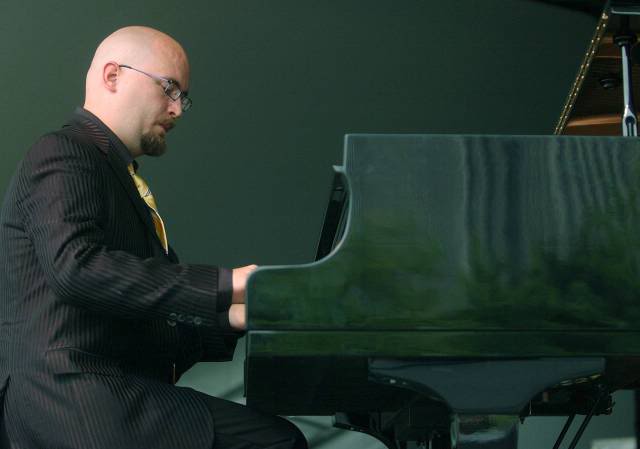
The New England Conservatory in Boston, MA, just issued the video of Ethan Iverson premier performance of his first "Piano Sonata" which took place in Jordan Hall in the Spring of this year. Countless music fans know his work with The Bad Plus, dance aficionados know of his long association with choreographer Mark Morris, and then there is his excellent blog "Do The Math".
Mr. Iverson has absorbed a myriad of influences during his time as a performer, composer, writer, and educator; you can hear some of those influences and much more in the video below! Enjoy!
Canadian-born (Montreal, Quebec) Chet Doxas plays tenor saxophone, composes, plays in bands with his drummer brother Jim, and has co-leads the quartet Riverside with trumpeter Dave Douglas. He has played alongside Carla Bley, Rufus Wainwright, the late John Abrecrombie, and Maria Schneider (to name just four) and plays in the Brooklyn, NY-based quartet LandLine. He's got a "classic" tenor saxophone sound meaning one hear the influences of Coleman Hawkins, Lester Young, Ben Webster, Jimmy Giuffre, and others.
Doxas was on tour with Ms. Bley and her partner, bassist Steve Swallow, when they suggested he take one month each per composition for a project he was creating. As the songs took shape, the saxophonist kept hearing a drummer-less trio in his head. He recruited bassist Thomas Morgan and pianist Ethan Iverson and, in September of 2019, they recorded the program that one can hear on Doxas's new Whirlwind recording "You Can't Take It With You". The results are fascinating, playful, adventurous, melodic, and highly interactive.
The title track leads off the album; the first sounds you hear are Morgan's richly melodic bass lines (at times, the melody one hears sounds like the "Sesame Street Theme" before the piano and tenor enter. The music settles in to a bluesy groove which the pianist jumps in and plays a delightful, playful, Thelonious Monk-inspired solo. When the leader comes in for his solo, he starts with fluttering lines that sound Middle-Eastern before diving into a playful solo filled with circular lines, jabs, and feints. Watch out for the false endings.
"Lodestar (for Lester Young)" has a bouncy riff played by sax and bass while the pianist plays inside his instrument creating all sorts of dissonant tones before decided turn towards melody. Doxas's long-held tenor notes connects the song to the next one, "Cheryl and George". Dedicated to the saxophonist's mother and father, the song starts with the tenor leading the way before Doxas and Iverson play together while Morgan solos. After a short break, the trio comes back in and improvise in and around each other.
There's plenty to enjoy here. "The Twelve Foot Blues" (inspired by Mark Twain) is another playful tune whose rhythm has a New Orleans-feel in its danceable bounce. "Soapbox" was built on the rhythms of the speech patterns of late-night politicos. Doxas not only creates melodic lines, he also "speaks" through his sax. "All The Roads" is inspired by a speech by the late Fred Rogers; the music is contemplative asking the listener to think of all the people "who have helped to shape you."
The program closes with "View From a Bird." Composed in response to viewing a painting by Joan Miró (see left), there is a formality yet playful that hints at the influence of Ms. Bley's writing. Iverson's piano lines have a classical feel while Morgan plays counterpoint off the pianist's left hand. As the tenor solo flies above his partners, he does come back to land. The piano solo is delightful (is that James P. Johnson we hear for four bars?)
You can take "You Can't It With You" with you as a recording but make sure to sit and contemplate on what you have heard before going back and listening again. It's obvious Chet Doxas put a lot of thought and work into these 10 pieces, that he chose the right musical partners, and that they too worked hard to make this music sound so good, so effortless, so alive.
The life story of Earl "Bud" Powell (1924-1966) is not easy to read. A child prodigy, he was in the forefront of the Bebop movement in the 1940s but a run-in with the police left him battered, bruised, and unconscious. From that time on, at various stages of his musical career, Powell would be institutionalized. Yet, his musical output rarely suffered. It was as if a switch would turn on when he sat down to the keyboard. He could be a dazzling stylist, was an adventurous composer, and, up to the final years of is life, Powell was often a splendid soloist. Unlike his contemporary Thelonious Monk, his compositions and his recordings have not garnered the same scrutiny, examination, and tributes. Enter Ethan Iverson. The busy musician, composer, writer, and performer began a comprehensive study of Powell's ouevre and began writing a piece for quintet and orchestra. The result is "Bud Powell In the 21st Century" (Sunnyside Records) recorded live on the final days of December 2018 at Umbria Jazz Winter #26.
The 16-piece ensemble includes Ingrid Jensen (trumpet), Dayna Stephens (tenor saxophone), Ben Street (bass), Lewis Nash (drums), and Iverson (piano, conduction) plus the brass and reed sections of the Umbria Jazz Orchestra. The program includes seven Powell compositions, one by Monk ("52nd Street Theme"), plus eight Iverson originals, several based on motifs that the composer based on Powell's improvisations. The album opens with the two-part title track –– "Chorale" has a somber theme but when you listen to the reed and brass interjections, it may remind you of the sounds of Powell's "Parisian Thoroughfare" while "Continuity" jumps out on the strength of Iverson's dancing piano lines. That leads to a delightful romp from Stephens as the backing sections call-and-respond.
The Bud Powell pieces ("Celia", "Tempus Fugit", "Bouncing With Bud", "Wail", "Dance of the Infidels", "I'll Keep Loving You", and "Un Poco Loco") all stand out. "Celia" swings sweetly and the arrangement with the trumpets playing the theme over Nash's splendid drumming is a treat. The drummer leads off "Tempus Fugit" with a militaristic take before breaking into a powerful rhythm and we're off. The reeds play the theme, the brass answers, and the musicians romp away. Sparkling solos from Iverson and Ms. Jensen add more sizzle to this sauce. The bebop jump of "Dance of the Infidels" has the tenor and trumpet play the theme while Street and Nash build a swinging foundation. "I'll Keep Loving You" opens with a long, lovely, French Horn feature for Giovanni Hoffer who, after the solo intro, leads the ensemble through the lovely melody (pay attention to the short "breaths" of the reeds during the verses).
The final two tracks, "Nobile Paradiso" and "Un Poco Loco", are the longest pieces on the program (11:08 and 6:21) and both have great power. The former, an Iverson original, takes ideas from Powell and wraps them in a gentle swing rhythm, bouncy piano, and delightful, melodic, counterpoint from the brass and reeds. The latter track, one of Powell's most covered originals, has a forceful rhythm track –– it's a forceful example of the "conduction" method where Iverson cues the different musicians to step out of the ensemble and make short musical statements. Over the course of the tune, the reeds play first and, after a brief respite, the brass get their moment. It's fascinating to hear the musicians play off each other, climaxing in a glorious cacophony above Nash's splashing cymbals. The return to the theme is downright enjoyable!
Don't know much about Bud Powell? Go find his classic Blue Note recording "The Amazing Bud Powell Vol. I" (you'll end up wanting more but start here) and then come back and listen to "Bud Powell In the 21st Century". Not only does Ethan Iverson pay his respects, he does what all forward thinking musicians; he breathes new life into the ideas, themes, and musicianship of the originals. Everyone plays great and the music shines!
For more information and to purchase the album, go to https://sunnysiderecords.bandcamp.com/album/bud-powell-in-the-21st-century.
Here's a taste:
Personnel:
Ingrid Jensen - trumpet Dayna Stephens - tenor saxophone Ethan Iverson - piano, conduction (two tracks) Ben Street - bass Lewis Nash - drums Giovanni Hoffer - French horn (on "Un Poco Loco") Daniele Tittarelli - alto saxophone Manuele Morbidini - alto saxophone, conduction (six tracks) Pedro Spallati - tenor saxophone Rossano Emili - baritone saxophone Mirco Rubegni - trumpet Francesco Lento - trumpet Francesco Fratini - trumpet Massimo Morganti - trombone Roberto Rossi - trombone Federico Pierantoni - trombone Rosario Liberti - bass trombone
Here's a fascinating combination. "This Land" (Westerlies Records) posits the expressive voice of Theo Bleckmann in a collaboration with the brass quartet The Westerlies (trumpeters Riley Mulherkar and Chloe Rowlands plus trombonists Andy Clausen and Willem de Koch) . Original material mixed with compositions by Woody Guthrie (four of his pieces), Bertolt Brecht, Joni Mitchell, Phil Kline, a gospel tune and one traditional make the listener sit and think about the power of music to illuminate the human condition. The expansive musical arrangements allow the brass to "paint the scene" alongside the vocals and the songs often soar.
Opening with Ms. Mitchell's "The Fiddle and the Drum" (composed in 1969), the song's anti-war message, originally sung by a Canadian looking across the border, reverberates in this time of internal unrest. Bleckmann's vocal has just the right emotion and does not sound accusatory while the horns rise and fall behind. While the title track sounds like it could be a Woody Guthrie tune, the music comes from trombonist Clausen who set the words of the late Kashmiri poet Agha Shahid Ali (1941-2001). Note how Bleckmann uses electronics to create a vocal wind behind the strident horns. The vocalist contributes "Another Holiday", a song inspired by the mass shooting at Pulse nightclub in 2016. Without mentioning the horrific event, the lyrics speak of how the world passes by as events unwind, as one's family grows up in uncertain times. The horns move from bell-like figures to drones as Bleckmann's electronically modified voices float through the sound.
While each song is notable, there are several beyond the ones mentioned already that really stand out. The traditional "Wade in the Water" is given a dark, mysterious, feel by the horns as they push the vocal to the background. "In the Sweet By and By", a Gospel tune from the 19th, is linked with Joe Hill's "The Preacher and The Slave" (the satirical lyrics comes from the latter). The "oom-pah" waltz adds to the comic effect as do the "Salvation Army" trumpets behind the penultimate verse. Bleckmann translates the lyrics of Bertolt Brecht's "Das Bitten der Kinder", an anti-war song, that is first presented as a recitation and then sung in the original German with the brass playing the role of a string quartet (Bleckmann first recorded the piece in 2008 on the Winter & Winter album "Berlin: Songs of Love & War, Peace & Exile")
All the Woody Guthrie pieces ("Two Good Men", "Tear The Fascists Down", "The Jolly Banker", and "I Ain't Go No Home in This World Anymore") are instrumentals with only one over 51 seconds long (the rollicking "...Men"). They serve as joyful slices of Americana.
The album closes with Phil Kline's "Thoughts and Prayers" (from his "Florida Man" song cycle) – the piece is an elegy for the victims of the Parkland, FL, mass shooting and was originally composed for Bleckmann. The title reminds us that that's the most politicians have offered after the multitude of gun tragedies that have occurred over the past decade.
"This Land" is powerful music in these crazy days. Conceived and recorded before the pandemic but in the midst of the Trump administration, the music reminds that the United States has always been somewhat off-center. Theo Bleckmann and The Westerlies make all 15 tracks worth listening to time and again.
"Suno Suno", the new recording by guitarist-composer Rez Abbasi, is his first for ENJA Records and second with his formidable quintet known as Invocation. Here, as on 2009's "Things to Come" (Sunnyside Records), Abbasi creates a fascinating program of music for Vijay Iyer (piano), Rudresh Mahanthappa (alto saxophone), Johannes Weidenmueller (bass) and the splendid drummer Dan Weiss. The percussionist has been a mainstay of Abbasi's groups (save for the Acoustic Quartet) for over 5 years is the lynchpin of this music. The compositions are informed by the guitarist's love of Qawwali music from his native Pakistan (he was born in Karachi but raised in Southern California). Pieces such as "Thanks for Giving" and "Onus On Us" (the title of the CD backwards but also Hindi for "listen") have rhythms that may remind some listeners electric jazz-rock from the 1970s. Yet, it is never bombastic nor static and the solos are very good. Mahanthappa displays a fuller tone than on his recent "Samdhi" project (released on ACT Records), still playing in that vigorous style of his - on more than one occasion, his solos sounds like a fusion of Indian music and Charlie Parker riffs. Listen to the way Iyer weaves blues riffs and Cecil Taylor-like power into his solo on "Onus On Us." "Monuments" has a similar feel in its rhythmic drive and bounce - Weidenmueller's thick bass and Iyer's single-note left hand lines create a solid bottom while Mahanthappa and Abbasi play the melody. Things get both fiery and funky during the guitar solo, with Abbasi playing off Weiss's pulsing percussion. The forward motion of "Part of One" is irresistible and the way the melody plays against then with the beat makes the piece stand out; then again, the solos by Abbasi, Iyer and Mahanthappa and the way that Weiss spurs them to intense playing is also quite glorious.
It's a treat to get lost in this music. Played loud, the rafters shake - even on lower volume, one can not miss the intensity of the interplay and the joyous work of the rhythm section. To find out more, go to www.reztone.com.
British-born pianist John Escreet creates music that has myriad influences and, for such a young person, sounds like no one else. His debut recording, "Consequences" (Posi-Tone Records), recorded when he was 24 (he's now 27), displayed a musician with great technique and burgeoning compositional talent - by the time "Don't Fight the Inevitable" (Mythology) hit the racks in 2010, there was no doubt Escreet was a force to be reckoned with. "Exception To The Rule" is his first for Gerry Teekens' Criss Cross Jazz label and features his compatriot (and mentor) David Binney (alto saxophone, electronics), drummer Nasheet Waits (he's appeared on 3 of the pianist's 4 CDs) and bassist Eivind Opsvik. Unlike many of the releases on Teekens' label, there is an experimental edge to this music (several of the shorter tracks feature electric piano and synthesizers) - "The Water Is Tasting Worse" has such a complex rhythmic patterns that the execution of it creates great tension. Binney's billowing alto solo over Escreet's accompaniment ( a swirl of pounding chords alternating with swift, single-note, runs) is a highlight of the program. "Escape Hatch" opens with a rapid-fire melody line and then, after a piquant alto solo (over impressive percussion), the pianist plays impressionistic figures while synthesizer sounds erupt around him(and the rhythm section colors the background.) The multi-sectioned "Wayne's World" (a piece from Escreet's debut CD) goes in many directions with the interplay of Waits and Opsvik with Escreet particularly impressive. Binney's solo is filled with melodic twists, a percussive attack that moves the track forward and, at times, "out." After the solo reaches its climax, Escreet takes a short, unaccompanied, solo that starts quietly but picks up fire, leading the rhythm section back in for more fiery interplay (Binney rejoins the trio to take piece out.)
"Exception to the Rule" is an excellent program that should be listened to in one sitting. If you only check out the shorter electronic pieces or the longer, up-tempo romps, you will not get the full effect of the project. John Escreet is an exciting composer and Messrs. Binney, Opsvik and Waits make his writing come alive. He is also an exciting musician as well as a person who has no fear of experimentation, crossing genres and avoiding cliches. What more can an adventurous listener ask for? To find out more, go to www.johnescreet.com.
The week after drummer-composer Paul Motian's passing on November 22, Ottawa-based journalist Peter Hum posted a series of remembrances from a dozen musicians who either worked with or were influenced by the master of understatement and supreme musicality. Veteran players, such as Lee Konitz and Marc Copland, share their thoughts along with his long-time band-mates Bill Frisell and Joe Lovano as well as younger collaborators like Dan Tepfer and Jerome Sabbagh. If you start with the comments of Larry Goldings, you can find links to the other musicians at the bottom of the page. Go to http://blogs.ottawacitizen.com/2011/11/27/musicians-on-motian-xi-larry-goldings-writes/ - the tributes are heartfelt, honest, touching, and giving the often irascible Mr Motian a sweet sendoff.
Pianist-composer-journalist Ethan Iverson (keeper of the keyboard in The Bad Plus) weighs in on the life and appeal of Paul Motian on his blog, "Do The Math." Read it and you'll learn even more why this drummer was such a influential and inspiring musician (with a wicked sense of humor). Go to http://dothemath.typepad.com/dtm/the-paradox-of-continuity.html - once you finish reading, find some Motian music and be thankful for his long, fascinating, career.
Noneto Ibérico - Alexis Cuadrado (BJU Records) - Composer/bassist/co-founder of BJU Records Cuadrado's new CD (which I previewed in January - read it here) goes into general release on March 1 (digitally) or March 15 (physically). If you like large ensemble music, Spanish rhythms, excellent arrangements, strong improvisations, and variety, buy this and you should not be disappointed. Besides the leader, the nonet includes saxophonists Perico Sambeat (doubles on flute) and Loren Stillman, trumpeter Avishai Cohen (doubles on flugelhorn), trombonist Alan Ferber, guitarist Brad Shepik, the sterling keyboard work of Dan Tepfer, percussionist Marc Miralta, and drummer Mark Ferber plus the Flamenco handclaps of Israel Suarez, Tomas Moreno and Blas Cordoba (on 4 of the 8 tracks.)
While the music is based on traditional Flamenco song forms, the results are a striking blurring of styles. After a handsome bowed bass solo that opens "Very Well" (the first track on the disk) and the richly toned alto sax solo from Sambeat, one gets pulled in by the fandango rhythm and the rising melody line. The tension is palpable yet the way the reeds and horns are arranged give the piece warmth. Listen to the drive and forward motion on "Sólo El Sol Sale Siempre Solo" (Solea), another piece that opens slowly and, in this instance, with angular saxophone lines from Stillman and Shepik's distorted guitar lines. There's a blues feeling in the bass line (which is doubled, at times, by Tepfer's acoustic piano.) The "heaviness" of that work stands in sharp contrast to the dancing melody lines of "Tocar Y Parar" (Alegrias), the saxophones moving easily over the handclaps and Mark Ferber's sharp drum work. The solo section features fine solos from Tepfer and Cohen - they both "swing" but not in an American context but in the declarative Spanish sense (Cohen's growth as a soloist over the past few years in impressive.) The longest track, "Por la Minima" (Bulerias) clocking in at 17:36), opens with insistent guitar chords, chattering electric piano lines, and a rhythm section in a different tempo. The tension that interaction creates does not subside when the reeds and brass enter and Cuadrado creates a swift line for one to play off the falling phrases of the other. Halfway through the piece, Sambeat rises out of the insistent chords with a sharply defined solo. There's a lot to absorb at this point, from the saxophonist's rising intensity to the splendid drum work to the staccato horn lines to the burbling piano.
I'd be happy to talk about the rest of the tracks but you should discover the musical treats for yourself. The musicianship is as impressive as the expansive compositions; there are harder edges mixed with softer, intensely romantic, flourishes (the ballad "A Tientas" (Tientos) strikes me as a cross between Chico O'Farrill and Gil Evans.) This project, created thanks to a grant from Chamber Music America/"New Works" with support from the Catalan Center at NYU, photographer Dixi Carrillo, and released with the help from investors through Kickstarter, is really quite special. To find out more, go to www.alexiscuadrado.com.
Here's "Te Sigo (Seguiriya)" courtesy of BJU Records and IODA Promonet: Te Sigo (Seguiriya) (mp3)
Pianist/composer Ethan Iverson, best known for his work with The Bad Plus, is also a fine writer. His blog, "Do The Math", is a real pleasure to read for many reasons, especially his interviews and musical observations. Lately, he's been writing (copious amounts) about the hub-bub over the new book by trumpeter Randall "Randy" Sandke. (Check it by going to http://dothemath.typepad.com.) Titled "Where the Dark and the Light Folks Meet: Race and the Mythology, Politics, and Business of Jazz" (Scarecrow Press), the book looks at the relationships in jazz that go right back to the turn of the 20th Century especially between Black and Caucasian musicians. Did African Americans get too much credit for the creation of the music? I first read of the controversy on saxophonist/critic Chris Kelsey's fine blog (http://chriskelsey.com/blog/) when he took umbrage to critic Howard Mandel's highly critical response to the book. Both Kelsey and Iverson write well, with reasoned arguments. Kelsey pointed me to the Richard Sudhalter's "Lost Chords: White Musicians and Their Contributions to Jazz, 1915-1945" (Oxford University Press), an exhaustive and often exhausting tome that covers similar ground to Sandke's book (which, in all fairness, I have yet to get to read.)
Nevertheless, both musicians are worth reading.
That's Nick Lloyd standing in front of Firehouse 12, 45 Crown Street in New Haven, CT. (photo courtesy of Improvised Communications.) The recording studio/performance space has just announced its Spring 2011 Concert series and it looks just wonderful. 13 shows on 13 consecutive Friday evenings and it all begins on March 18th with guitarist Adam Rogers' Trio featuring bassist Matt Brewer and drummer Clarence Penn for 2 shows (8:30 and 10 p.m.) Subsequent shows feature the Donny McCaslin Group (3/25), the Jeremy Pelt Quintet (4/01), the Ullmann/Swell Quartet (4/08), the Daniel Levin Quartet 4/15), Shane Endsley and The Music Band (4/22), Amir ElSaffar's Two Rivers (4/29), the Tom Rainey Trio with Ingrid Laubock and Mary Halvorson (5/06), the Rob Brown Quartet (5/13), Anthony Braxton Septet: Echo Echo Mirror House (5/20), the Ben Wolfe Quartet (5/27), Gretchen Parlato with pianist Taylor Eigsti (6/03) and the Scott Colley Trio (6/10). Now, that's a lot of good music. Prices are reasonable, there's a good watering hole in the basement (though, no drinks in the performance space) and the sound is exceptional. To find out more and/or buy tickets, go to www.firehouse12.com.
Finally, saxophonist/flutist/composer/conceptualist Henry Threadgill seems to be all over the media lately. He's on the cover of the March 2011 issue of JazzTimes (and, inside, is the subject of a fine article by David R. Adler - read it here) while Jason Crane devoted a recent episode of "The Jazz Session" to critic Hank Shteamer and the liner notes he wrote to the Mosaic boxset "The Complete Novus & Columbia Recordings of Henry Threadgill & Air." You can hear the episode by clicking here.
In April of 2010, Crane sat down with Mr. Threadgill to chat about many things Zooid and much more - it's also worth a listen, which you can do by clicking here.

 Posts
Posts