In 2015, guitarist, composer, and conceptualist Miles Okazaki built a new ensemble which, ultimately, took its name Trickster from its 2017 eponymous debut Pi Recordings. Utilizing the brilliant rhythm section, bassist Anthony Tidd and drummer Sean Rickman, from Steve Coleman's Five Elements plus pianist Craig Taborn (replaced in 2018 by Matt Mitchell). The music couldn't help but be affected by the guitarist's many appearances with Coleman's group. But, the music has matured.
Tuesday, May 3, 2022
A Sonic Taste of "Thisness" + Classic "Thatness"
Thursday, March 4, 2021
Workshops, Concerts, Album, Guitar!
![]() |
| Photo: Mark Coehlo |
Saturday, December 19, 2020
Twenty Recordings for 2020 (Part 1)
At the beginning of this year, many of us knew that we would have to suffer through the Presidential Election cycle, that the amount of money spent on Federal and State elections would reach epic heights, and the possibility of lies and half-truths flying through the air might rent this country asunder. We did, it did, but hardly anyone predicted that a deadly virus would kill so many people, close up so many businesses, turn cities into deserts, and touch so many families around the country and the world.
Here at the cusp of 2021, there are now vaccines to fight the virus beginning to be distributed around the world, there will be a new administration in Washington, D.C., and we will soon be able to venture outdoors to begin the process of healing our communities. On a personal note, my older sister passed in April and my wife's brother in September; like many older people, our family is spread around the country and we only see them on FaceTime or via ZOOM. Our friends suffer in the hospital and we cannot visit to help buoy their spirits. Even worse, unless we can go outside, there's no breaking of bread, no sharing of wine and desserts, no going to plays or concerts or galleries.
Yet, music remains a constant and 2020 was a sparkling time for Black American Music. Whereas many of the albums that topped the "Critics List" were recorded in 2019 or before, by the end of the year we were hearing music produced in the pandemic months. The spirit of creativity has not suffered even as so many musicians, who depend on live performances to pay the rent and feed their families, often have to apply for grants and gifts to stay afloat. As a reviewer, I am blessed with plenty of promotional CDs and audio files; artists appreciate reviews but the only money they will see form that are the royalties when the album is sold. Many of them have turned to Bandcamp, perhaps the fairest of all the music sellers in the world (the website's "First Fridays", a day when over 90% of the money paid for a music file or album goes directly to the artist)––you'll see links to the artist's Bandcamp page at the bottom of nearly all the albums in Step Tempest. Listen when you can, purchase what you can. Music brings hope, solace, awakens our senses and emotions, and makes our blood flow.
Below are albums that I reviewed this year and that stand out from the rest.
Chad Taylor Trio - The Daily Biological (Cuneiform Records) – This album arrived several weeks after my sister's passing. The energy and beauty in the music reminded me that music has the power to cut through grief, to amplify emotions, and to soothe us in times of loss. Listening to the music created by drummer and composer Chad Taylor, tenor saxophonist Brian Settles, and pianist Neil Podgurski wafting through our house as the Spring breezes danced through now-open windows shook me from my lethargy and mourning to confront and savor how these three musicians tackled diversity, melody, and rhythm over the course of nine songs in 61 minutes. Sounds fresh each time I listen and it remains a "go-to" recording. To listen and purchase, go to https://cuneiformrecords.bandcamp.com/album/the-daily-biological.Doxas Brothers - "The Circle" - (Justin Time Records) - This recording snuck up on me, quietly but stealthily invading my brain and my heart. Brothers Chet (tenor saxophone) and Jim (drums), along with Adrian Vedady (drums) and the magnificent Marc Copland (piano) present a nine-song program (eight originals, one standard––Gordon Jenkin's "Goodbye") that is rich in melody, inventiveness, and, when called for, great fire. Copland's solos and support are fascinating to listen to throughout, eschewing cliches for thoughtful interaction and melody. The Brothers, who play with Dave Douglas and Steve Swallow in Riverside, are mighty impressive players who do not overplay. For more information and to purchase the recording, go to https://doxasbrothers.bandcamp.com/album/the-circle.
Max Bessesen - "Trouble" - (Ropeadope Records) – There were a number of debut albums this year (Aubrey Johnson, for instance) but none that captured my imagination more than young Mr. Bessesen's recording. The Denver, CO, native began playing alto saxophone as a teenager and mentored by great cornettist Ron Miles. He attended Oberlin Conservatory and, after traveling the world through a Fellowship, he settled in Chicago and started his own band. The death of one of the band members––guitarist Zac Nunnery––spurred the saxophonist to bring the his (now) quartet into the studio. The resulting album is quite exciting, musical, and well worth exploring. An added bonus is the presence of Mr. Miles on six of the 10 tracks!
Monday, November 23, 2020
Guitars Galore (Part 2)
Three more albums which feature guitars in different settings are featured in this post––each one has its own strengths and should interest the curious listener.
Will Vinson (saxophones, electric piano), Gilad Hekselman (guitars), and Antonio Sanchez (drums) have created an album for Whirlwind Recordings with the punning title Trio Grande. All three have crossed borders to make New York City their base with Vinson coming from Great Britain, Hekselman from Israel, and Sanchez from Mexico. They are at the top of their game; this album illustrates how each brings different styles and how they have so much fun "playing" with melody, sound, dynamics, and more.
Even though there is no bassist, the first sounds one hears is the keyboard bass on the drummer's "Northbound". The feel and sound of the piece may remind some of Marc Johnson's Bass Desires but with a soprano sax in place of one of the guitars in that group. The joy is in the interplay, the chuckling as well as expansive playing of Hekselman juxtaposed with Sanchez's dancing drums. The opening moment of the guitarist's "Elli Yeled Tov" (Good boy, Elli) sound like a piece by Lionel Loueke, especially the tone of the guitar. Again, it's Sanchez playful drums that capture one's attention as does Vinson's delightful alto sax solo. Vinson's "Oberkampf" is a melancholy ballad with the feel of a Joni Mitchell piece. The soprano sax solo near the end of the piece has a more optimistic feel, lifting the energy of all involved.
Other highlights include Hekselman's super-funky "Scoville" which bops along atop Sanchez's conversational drums. The raucous guitar solo features stop-and-go rhythms which the drummer executes like a race car driver. The drummer's "Firenze" (the Italian name for Florence, Italy) is a handsome ballad, its fine melody lines pushed forward by the alto saxophonist who dashes off into an energetic solo. Sanchez's spare solo is a treat, he interjects silence into the spot while the sax and guitar move melodically behind him."Trio Grande" closes with the guitarist's "Will You Let It", a lovely ballad with an emotional melody, a splendid guitar solo which has a touch of Bill Frisell in Hekselman's solo. The sparkling cymbal work surrounds the other instruments with a glowing effect. The really fine aspect of this album from Will Vinson, Gilad Hekselman, and Antonio Sanchez is that the music defies categorization––is it Americana, jazz, rock or is it all that and more? Go with the latter and just listen and enjoy!
For more information and to purchase the album, go to https://triogrande-whirlwind.bandcamp.com/album/trio-grande.
Drummer John Hanrahan (born December 9, 1966–two years to the day that the Coltrane Quartet recorded the album) had interviewed the group's drummer Elvin Jones in 2003 who led him to Ashley Kahn's incisive history of the album. That whetted the younger drummer's appetite and when he moved back to Chicago, he formed A Love Supreme Quartet. In 2017, Hanrahan met guitarist and conceptualist Henry Kaiser who introduced the drummer to Coltrane's 1966 album "Meditations" which many people, including the guitarist, feel is the "spiritual follow-up" to "A Love Supreme." The newer Lp, recorded nearly a year to the day after "...Supreme", added the musical voices of saxophonist Pharoah Sanders and drummer Rashied Ali to the Quartet––the sessions would the last time Coltrane recorded with Elvin Jones and pianist McCoy Tyner.
Kaiser and Hanrahan formed a quintet with saxophonist![]() |
| Photo: R.R.Jones |
Wednesday, April 22, 2020
Sing The Songs of Drummers and Others
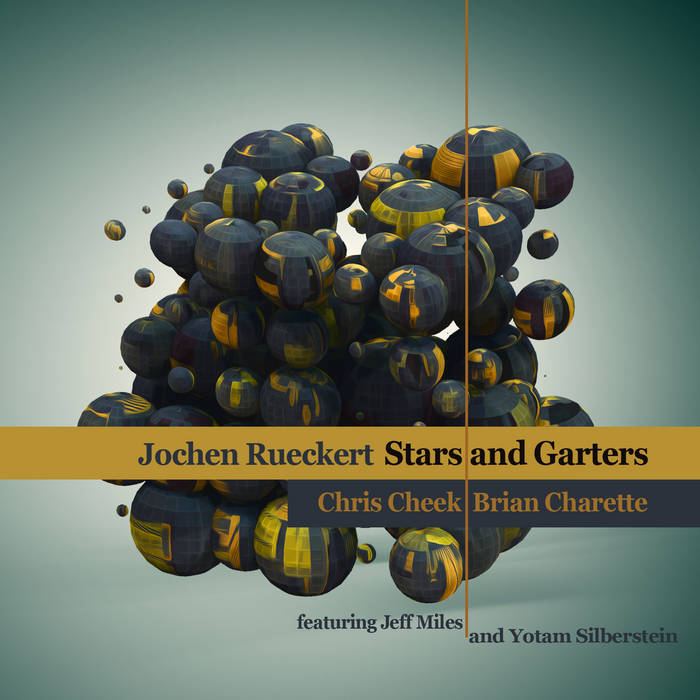
Drummer, composer, and devilish wit Jochen Rueckert has assembled a small group for his latest album "Stars and Garters" (self-released). The basic band is drums, tenor saxophone (Chris Cheek), and organ (Brian Charette) with guest guitarists Jeff Miles (on three tracks) and Yotam Silberstein (on two tracks)
The 11-song program has its share of swingers, rockers, and ballads. Opening with the easy-grooving "Corey and Trevor" and then moving right into "Finger Finger", one might expect the album to be a late-night set at a downtown bar. Cheek plays with controlled abandon in the style of Hank Mobley, especially on the latter track. Silberstein joins the trio and bounces along atop the dancing drums. Next the band (with Miles on guitar) rips into "Mind Parasite", a tune by Ryan Power –– it's a rip-roaring rocker that, at high volume, shakes the speakers to their core. Of course, the next track, "Radioland", is a quiet, Latin-esque, medium-tempo treat with soft burbling organ, delight drumming on the toms, and a pleasing tenor solo.
The title track brings one right back to the 1950s and 60s organ trio. Charette keeps a steady bass line –– when he solos, he and Rueckert have a swinging interaction. They don't rush, don't settle for cliches, they just play. In another unexpected move, the trio (plus Miles) interprets The Deftones' 1997 tune "My Own Summer", keeping the melody and chord structure but toning does the punk-rock mayhem save for the hard-edged guitar sounds.
"Stars and Garters" closes with one more cover. "Cannonball" was a hit in the mid-1990s for The Breeders; The trio (plus Silberstein) capture the nervous quality of the original yet also make the piece swing like mad. Even if you don't know the original, this version is a lot of f-u-n! And we all need a big dose of that these days...actually, just about any time. Hats to Jochen Rueckert and his gang who knocked the album out in a couple of hours just this past March 5, before the world went into lockdown.
To find out more and to purchase, go to jochenrueckert.bandcamp.com/album/stars-and-garters.
Here's a swinger!:
Drummer Phil Haynes (pictured left) can be heard in a number of different groups, several of which he leads. His saxophone trio with Dave Liebman as well as a duo with the NEA Jazz Master, Free Country (his radical and fascinating interpretations of Country songs), organ trios, and more plus solo drum programs, all point to a person for whom borders are meant to be crossed if not ignored all together. Haynes also performs in a piano trio with bassist Drew Gress and pianist Steve Rudolph, an ensemble for whom melody and improvisation, swing and flow, are of the utmost important.
In 2009, the trio recorded its debut album under the three musicians names with the title "Day Dream". That's now their collective name and their second album, "Originals" (CornerStore Jazz), is just that; 10 new compositions, four by Rudolph and three each by Gress and Haynes. The music and performances are reminiscent of the work of Bill Evans, Fred Hersch, and Frank Kimbrough. What stands out is both the musicianship and the lyricism –– you can hum these melodies but the joy of the music is hearing how the trio interacts. Solos grow intelligently out of the melody, easily flowing from composition to improvisation and back. If you take your time to listen deeply, each song stands out.
There's the Evans-esque beauty of Rudolph's "Wedding Waltz" (listen to how Gress underlines the melody and Haynes color with his cymbals) as well as Gress's mysterious, hypnotic, "Afterwards" with its ascending then descending bass line over a steady 4/4 beat. One of Haynes's three contributions, "Spell", opens with a swinging brushes solo, dramatic piano chords as well as a bluesy bass line. Gress goes right through the melody into his solo and an impressive one it is. He dances atop the funky rhythm turning the spotlight over to Rudolph who gets in the groove and does not let it go! The drummer also composed "Beloved Refracted" (listen below), a melody built on a two-handed piano theme and powerful interaction between Rudolph and Gress.
"Originals" closes with the bassist's "Let Fly", a bopping tune with both a bluesy feel and a delightful swing. Day Dream will not put you to sleep –– instead, it's an album that you can listen to in one sitting and then listen again. Steve Rudolph, Drew Gress, and Phil Haynes are a trio of equals and the music they create together is powerful, music with a heart!
Here's a taste:
![]() |
| Photo: Peter Gasnnushkin |
![]() |
| Photo: Paul de Lucena |
The album, composed of all originals pieces by the trio members, is startling, music that verges on "free" yet there are times when the beat is so powerful it feels as if the drums could knock you off your feet. The opening track, "The Shepherd", roars out of the gate driven by Taylor's conversational drums, Settles' powerful tenor (he's the composer), and Podgurski's thunderous attack. Because the drums are so well-miked and up front in the mix and the pianist has such a strong left hand, one does not miss a bassist. Depending on your speakers, the bass drum thump is quite noticeable. The pianist's "Resistance" starts quietly, the piano chords and crisp cymbal sound leading to Settles and Podgurski reading the theme. Settles stays with the poignant theme while the pianist takes a powerful solo with Taylor ramping up the intensity. The trio calls down for just a second when the saxophonist begins his solo but soon he's being pushed by the drums and insistent piano.
![]() |
| Photo: Paul de Lucena |
![]() |
| Photo: Paul de Lucena |
"The Daily Biological", if you listen deeply, will change your idea of "power trios." No over-amped guitars, fuzzy bass lines, no ponderous drums; instead, this is music teeming with ideas, interactions, inventive solos, intelligent writing, and more. Such an auspicious recorded debut for the Chad Taylor Trio that one can just imagine how great they must sound in a live setting. In the meantime, find this album and let the music play. Play it loud!!
For more information, go to www.chadtaylordrums.net –– purchase the album by going to cuneiformrecords.bandcamp.com/album/the-daily-biological.
Here's one of the great tracks:
Tuesday, October 1, 2019
Sounds Familiar, Strange, Loud, & Quiet
![]() |
| Photo: NEA |
His latest record, "The Ambiguity Manifesto", is his sixth for the label, each one featuring a different ensemble. The new one features his 9-tette, composed of two brass, two reeds, two basses (one electric, the other acoustic), a cellist, drummer, and guitarist. All seven pieces are Bynum originals and, as usual, the music goes in many different directions, often in the same piece. Those of you familiar with Bynum's recordings for Firehouse may be surprised by the James Brown-style drumming that opens the album – to these ears, it also sounds somewhat like Julius Hemphill's "Hard Blues." The song, titled "neither when nor where" utilizes that funky beat to introduce the different instruments. Tomeka Reid's cello lines shows the influence of Abdul Wadud and it's fun to hear Jim Hobbs' alto sax in counterpoint to Ingrid Laubock's tenor sax. In the bridge, Bill Lowe's trombone dances over the sympathetic reeds. Tomas Fujiwara is rock steady behind the drum while the rest of the band frolic.
The material ranges from the free-wheeling "anter ally" to the circus-like noise of "enter (g)neither" which at 18+ minutes gives the different voices of the ensemble a chance to converse together. Mary Halvorson's guitar lines have quite a percussive feel and supported by Professor Lowe's tuba is quite playful. The section where the guitar interacts with Ken Filiano's acoustic bass and Stomu Takeishi's electric bass leads into a slow marching beat where the music feels like a slow merry-go-round – note the smooth sounds from the leader, a bluesy feel even. A lot goes on and all of it is absorbing.
![]() |
| Photo: Peter Gannushkin |
"The Ambiguity Manifesto" does not beat the listener over the head but does take one on quite a journey. Taylor Ho Bynum seems to relish composing for a larger palette (his Firehouse 12 albums range from sextet to septet to octet to nonet to 15 members) – this album shows his continued growth as well as his need to be part of the band and not in front all the time. There's no plans to tour the band as of its September 27th release date but the Sextet appears at Firehouse 12 on November 8, 2019.
For more information, go to taylorhobynum.com.
Here's the opening track:
Three of the four musicians pictured below – Mary Halvorson, Tomas Fujiwara, and Tomeka Reid – are on the album above plus are members of Ms. Reid's Quartet. They, along with bassist Jason Roebke, have just released a new album.
The Tomeka Reid Quartet recorded and released its eponymous debut album for Thirsty Ear in 2015. Since then, Ms. Reid has relocated to Queens, New York, and has entrenched herself in the contemporary music scene. She plays with Anthony Braxton and Nicole Mitchell and was featured on the latest Art Ensemble of Chicago album. Ms. Reid also is part of Hear in Now, a string trio with violinist Mazz Swift and bassist Silvia Bolognesi not to forget her collaborations with Roscoe Mitchell. Ms. Halvorson and Mr. Fujiwara works together in the trio Thumbscrew (with bassist Michael Formanek) as well as with Taylor Ho Bynum, Chris Speed, and Ben Goldberg. Mr. Roebke is a fixture on the Chicago music scene – he studied with Roscoe Mitchell and plays in or leads numerous groups.
"Old New" (Cuneiform Records) is, if anything, even more exciting than the fascinating debut from four years ago. What stands out (what doesn't?) is how many of these pieces – all composed by the leader – are so rhythmic. The title track comes bursting out of the speakers with an urgency and pace sure to raise the temperature. Reminiscent of of the opening track of saxophonist Julius Hemphill's 1977 Black Saint Lp "Raw Materials and Residuals" (with drummer Famadou Don Moye and cellist Abdul Wadud), Roebke and Fujiwara lock in and push the music forward. Ms. Reid creates a powerful solo (with Ms. Halvorson adding playful counterpoint) and she wails away. The melody line, which is repeated at the end of the piece, is a delightful blend of plucked notes and melodic, flowing, lines.
![]() |
| Photo: Jasmine Kwong |
![]() |
| Photo: Jasmine Kwong |
"Old New" closes with "RN", a piece with a handsome melody yet there is a pleasing rhythm to push the music along. Mr. Roebke actually solos before the band can introduce the melody; before long, Ms. Reid's lovely flowing lines produce a magical solo as does Ms. Halvorson although she fills her solo with echoing phrases that feel like bubbles about to burst. There's a "singing" quality to the track tha promises new directions for the future of the Tomeka Reid Quartet. This program is a delight-filled group of performances that shine, swing, rock, sway, explode, and push their way into your ears and mind. And, it's an excellent effort from start to finish – give a listen, give 10 listens!
For more information, go to www.tomekareid.net.
Here's the title track:
The trio approaches the music from numerous directions. Whereas the album opener, "Ugly Beauty", has an abstract impressionistic, rubato, opening, "Hackensack" swings delightfully from the opening note. Once the former piece "opens up" into its rhythm, the music remains exploratory but retains the handsome melody, especially thanks to the fine piano solo. The latter is the longest piece on the disc, replete with delightful interactions between the piano and drums plus a long, wonderfully melodic, solo from the bassist. The trio takes "Light Blue" as a ballad with rich solos from McNeill and Ziemann – "Reflections" is taken even slower with the bass and piano caressing the melody, both musicians basing their solos off the opening verse. "Let's Cool One" has that "sit back and relax" groove. McNeill creates a delightful, two-handed, solo filled with spirit while Bacon's spotlight is playfully minimalistic.
The last two tracks start with a solo piano reading of "Monk's Mood." McNeill gives the handsome melody a Gershwin-like spin, accentuating the harmonic possibilities and leaving just the right amount of breathing room to let the notes ring n the listener's ears. After a short melodic bass intro, "Straight No Chaser" jumps into an energetic rhythm and swings forward on the power of the piano solo and Bacon's propulsive drums. Pay attention to Ziemann's solo latter in the piece: he's plays both melodically and rhythmically, managing to steer clear of clichés throughout (plus his dialogues with Bacon really kicks nicely.
Though Thelonious Monk has gone nearly four decades (and had retired from playing 11 years before his passing), his music continues to reverberate loudly through contemporary music. On "Refractions", the trio of John Bacon, Michael McNeill, and Danny Ziemann honor his legacy by not playing it safe, but playing with joy and with an exploratory spirit.
For more information, go to michaelgraymcneill.com.
Here's the "long" song: