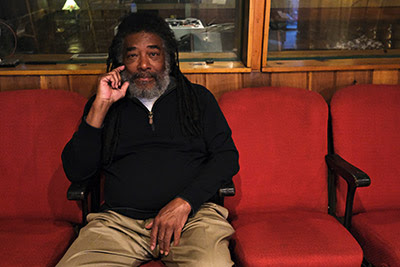
Wadada Leo Smith is quite the musical adventurer with a fertile mind and desire to continue to grow as a composer, arranger, and musician even as he moves through his ninth decade in this world.
 |
| Photo: Jimmy Katz |
Mr. Smith has found a willing partner with the Finnish record company TUM. The label has been in business since 2003; In 2011, the label has released the trumpeter/ composer's "
Dark Lady of The Sonnets", the first of 11 recordings on TUM (so far), four of which have been multiple disk sets. Every package has original art on the cover, contains a book of liner notes filled with information about the artists as well as an essay by the composer/ performer about his inspiration for the music. Many of the compositions bear dedications to artists, musicians, statesmen, or the individual work has a question or comment attached. Mr. Smith's makes one think, makes one contemplate issues and events outside the performance of the music. Like his other AACM brethren Henry Threadgill, Anthony Braxton, the late Muhal Richard Abrams, and Roscoe Mitchell (you can throw Oliver Lake and Julius Hemphill into the mix, both graduates of the Black Artists Group (BAG) out of St. Louis, Mo), he is a true original, a champion of Black Creative Music, and a tireless conceptualist.

TUM Records has now issued a seven-CD set titled "Wadada Leo Smith: String Quartets NOs. 1 - 12". The music is performed by the RedKoral Quartet (pictured below) as well as a sprinkling of guests on various movements. The musicians in the Quartet––Shalini Vijayan (first violin, Mona Tian (second violin), Andrew McIntosh (viola), and Ashley Walters (cello)––first met when Mr. Smith was on the faculty of CalArts (all but Ms. Walters) and has been featured on the composer's "Ten Freedom Summers" (Cuneiform Records) as well as TUM's "Rosa Parks: Pure Love, An Oratorio in Seven Songs". The 12 string quartets on the new boxed set includes four composed between 1965-2001, four between 2005-2011, and four between 1987-2019. In his introduction to the recordings, the composer talks of myriad influences ranging from the Delta Blues of his youth (Muddy Waters, John Lee Hooker, etc) to Claude Debussy, Anton Webern, Dmitri Shostakovich, and John Lewis to Scott Joplin, William G. Still, George Walker, Florence Price, Tania Leon, and Alvin Singleton. A number of the Quartets consist of one movement while "No. 11" has nine movements and is spread over two of the disks. The vast majority of the pieces and/or the movements carry dedications while "Quartet No. 2" and "4" have none.
 |
| Photo: Kot Nockels |
The music is spacious, making great use of close harmonies, silence, and long tones. The first 10 of the "Quartets" were recorded in late September and early October 2015 while the last two were recorded over three days in February 2020. Even when extra "voices" are added––for instance, the leader's trumpet and the baritone vocal of
Thomas Buckner on "
No. 8 ("Opuntia Humifusa")–the piece takes it time. Yes, there are more intense moments but never at the cost of clarity and melody. "
String Quartet No. 6 "Taif: Prayer in the Garden of Hijaz" has the most extra voices with the Quartet (
Lorenz Gamma replacing second violinist
Mona Thian) plus Mr. Smith's trumpet,
Anthony Davis (piano), and
Lynn Vartan (percussion including cymbals and marimba). The contrast between the three "extras" and the strings is fascinating as is the subtle call-and-response built into the music. Acoustic guitarist
Stuart Fox (Professor Emeritus at CalArts) joins the string ensemble for the beautiful "
String Quartet No. 7 "Ten Thousand Ceveus Peruvanus Amemvical (In Remembrance of Dorothy Ann Stone)"––the music is contemplative, impressionistic, and emotionally strong.
 |
| Photo: Kot Nockels |
Disk seven is somewhat of an anomaly in the collection.
The RedKoral Quartet now consists of four violists including Mr. McIntosh, Mr. Gamma,
Linea Powell, and
Adrianne Pope. The 20:33 album contains both movements of "
String Quartet No. 12" with the first movement dedicated to "
Billie Holiday (1915-1959)" and the second to "
Pacifica". There is a darker quality to the music (the viola is bigger and pitched a 5th down from the violin); when the Quartet plays in unison, there is a trance-like feel to the music. Yet, the high notes are well-articulated, both movements have quite a dramatic quality with the former seemingly touching on the mournful side of the great singer's life and the latter filled with long notes soon interrupted by several glissandi up and down. The piece closes with a high-pitched, sustained, unison note which is striking, solemn yet serves as a moment of unity.
To do these 12 quartets justice, you need the time to sit and listen deeply, to pick out the different voices, the different themes, how they move together and apart, and how the experience changes you. Therefore, you should listen more than once as you have to match your breathing to the movement of the music. Easier to do when there's a steady pulse yet most of this music flows in shorter statements and quick turnabouts. Never is it static. That's asking a lot of the contemporary listener, to devote that much of one's time––however, if you do, these "String Quartets 1 - 12" will open numerous doors of perception.
For more information, go to
https://wadadaleosmith.com/.
Hear "String Quartet No. 1, Movement 1":
Next to the work created by Wadada Leo Smith's Golden Quartet/ Quintet and his Great Lakers Quartet, my favorites among his many recordings are his trumpet and drum duets. Because his trumpet sound is so strong and expressive, the conversations with drummers are incredibly absorbing. Mr. Smith has done a slew of these recordings since his first one, "
The Blue Mountain's Sun Drummer" (Kabell) with
Ed Blackwell in 1986. Since then, he's recorded with
Soyo Toyozumi (1992 and 1994),
Adam Rudolph (2002),
Gunter Baby Sommer (2006),
Jack DeJohnette (2008),
Louis Moholo-Moholo (2011), and
Milford Graves (2016). The intimacy and excitement of these collaborations make for an engrossing listening experience. "
The Emerald Duets" (TUM) collects five more duet albums, two with Mr. DeJohnette plus one each with
Pheroan akLaff,
Han Bennink, and
Andrew Cyrille. The recording sessions began with Mr. Bennink in 2014, then Messrs Cyrille and akLaff in 2019, and Mr. DeJohnette in January of 2020. In the booklet that accompanies the set, Mr. Smith writes
"My own favorite duet music of all time is Louis Armstrong and Earl Hines performing "Weather Bird," and Parts 1 and 2 of "Mu" by Donald Cherry and Edward Blackwell." The spirit of those duets, the bursts of creativity that went into those recordings, how those individual voices merged to forge "new" music, all that and more is in the DNA of these five albums.

The first CD in the box, "
Litanies, Prayers and Meditations", features the trumpeter with
Pheroan akLaff. The youngest musician in the set (67), he first played with Mr. Smith in 1976; in fact, one of the drummer's first recordings was 1977's "
New Delta Akhri" (Kabell Records). Listening to their latest collaboration, one can hear how Mr. akLaff is an engaging musical conversationalist and his cymbal work throughout the 75 minute, 11-track, is impressive. He doesn't play a groove but is part of the thematic material and responds organically to where Mr. Smith goes during the improvisations. Hard to pick out a favorite track but "
A Sonic Litany on Peace" stands out on initial listens.
 |
| Photo: Enid Farber |
While
Andrew Cyrille (82) has not worked a lot with the trumpeter, Mr. Smith was featured along with guitarist Bill Frisell on the drummer's 2018 ECM recording "
Lebroba". This duet session, titled "
Havana, Cuba", consists of eight pieces including tracks inspired by and dedicated to people such as US. Representative Ilhan Omar (Dem. – Minnesota), vocalist Jeanne Lee, and trumpeters Donald Ayler, Tomasz Stanko, and Mongezi Feza (each one a distinctive voice on the instrument) plus a song dedicated to the drummer's homeland of Haiti. The mixture of the expressive trumpet and steady shuffle on "
Jeanne Lee in a Jupiter Mood" stands out for its simplicity, the power of the melody, and the gentle yet powerful drive forward while "
Haiti, An Independent Nation in 1804 but Not Recognized by Britain, France, Germany, the United States and Others: A Designed Tragedy!" is a powerful rebuke to the racist attitudes of the early 19th Century and today.
 |
| Photo: Ton Mijs |
As noted above, Mr. Smith's sessions with
Han Bennink (80) in 2014 set the stage for the boxed set. It's quite possible this album, subtitled "
Mysterious Sonic Fields", documents the first time the two ever recorded together. Nevertheless, the nine tracks cover much musical territory with moments when the trumpeter really gets into the swinging groove the drummer creates (most notably on "
Louis Armstrong in New York City and Accra, Ghana"). On "
The Call – A Duet between Joseph "King" Oliver and Jelly Roll Morton", the duo hit the ground running and, save for a short respite halfway through, the listener is pulled along in the musical mischief. Bennink's "tap dancing" beneath the muted trumpet on "
Johnny Dyani, the Artist Who Imagined a New South Africa. A Celebration" is yet another treat that makes one sit up and listen closely to how the two musicians inspire each other.
The last two CDs in the box feature
Wadada Leo Smith with
Jack DeJohnette (80). They met in Chicago in the 1960s at a time when the drummer had already made a name for himself playing with Charles Lloyd and was beginning a three-year tenure with Miles Davis. It wasn't until 2000 when the trumpeter invited Mr. DeJohnette to join his Golden Quartet that the two began working and playing together on a regular basis. In 2009, Tzadik Records released "
America", their initial recording of duets. Mr. Smith guested on Mr. DeJohnette's 2015 ECM recording "
Made in Chicago", a live album that also featured Henry Threadgill, Roscoe Mitchell, and bassist Larry Gray.
 |
| Photo: Enid Farber |
Disk four, "
Freedom Summer, The Legacy", sounds different than the others as it opens with the drummer playing piano on the impressionistic "
Sandalwood and Sage". Mr. Smith is most lyrical while Mr. DeJohnette blends sounds and long sustained notes. On the title track, the trumpeter moves to piano playing a deliberate melody as the drummer dances around his trap set. On the third (of five) tracks, "
Meditation: A Sonic Circle of Double Piano Resonances", Mr. Smith stays on piano while Mr. DeJohnette moves to Fender Rhodes, creating a meditative koan. The final cut, "
Silence, Quietness and Very Still" is also a keyboard duet–notice how this most gentle of pieces creates a feeling befitting its title. Notice how melodic the interaction is as well.
 |
| Photo: Enid Farber |
Disk Five is dedicated to the five-part "
Paradise: The Gardens and Fountains". Back to just trumpet and drums, the music has a clarity of both sound and vision; how assured and lyrical Mr. Smith sounds while Mr. DeJohnette's feel as if they are reaching out of the speakers and touching one's heart. The intimacy of this music, at times, is breathtaking as if you can hear the two musicians breathing and listening to each other. The final part, subtitled "
Pomegranates and Herbal Teas", is a short (2:02) trumpet solo that seemingly ends in the middle of a phrase as if Mr. Smith was assuring the listener his musical journey is not complete.
 |
| Photo: Jimmy Katz |
Three of the four drummers (all but Bennink) perform "
The Patriot Act, Unconstitutional and a Force That Destroys Democracy", a composition whose title sets the stage for the dramatic music. If music is indeed a "healing force", it also can expose the wounds of a people and a nation grappling with understand the meanings of equality and justice, of fairness, of standing together in the face of storms and tragedies. Each of the three versions is different as befits the drummer; two feature the trumpet and drums starting together while Mr. DeJohnette opens the third version with a long and powerful solo–when the trumpeter enters, the two musicians take off at a furious pace that slows on occasion for the trumpet or the drums to suggest a different direction or to play a solo or insert a new melodic phrase. At 20:03, the third version is the longest single track on the set but its fire and message is inescapable.
"The Emerald Duets" is "alive" music at its best, a five-CD collection that will reward the eager listener for years to come. Next to "String Quartets Nos. 1 - 12", these "conversations" are immediately more accessible but no less engrossing. Both projects contain exciting music, challenging one's expectations at nearly every turn. Both projects contain moments of pure beauty, making time stand still, making one wish for more time to enters these sonic worlds in the midst of the daily hustle. Through his music, Wadada Leo Smith offers visions of a master at work and at play––we are the beneficiaries of his creative benefactions.
Hear "The Patriot Act" with Jack DeJohnette:

 Posts
Posts


 Next to the work created by Wadada Leo Smith's Golden Quartet/ Quintet and his Great Lakers Quartet, my favorites among his many recordings are his trumpet and drum duets. Because his trumpet sound is so strong and expressive, the conversations with drummers are incredibly absorbing. Mr. Smith has done a slew of these recordings since his first one, "The Blue Mountain's Sun Drummer" (Kabell) with Ed Blackwell in 1986. Since then, he's recorded with Soyo Toyozumi (1992 and 1994), Adam Rudolph (2002), Gunter Baby Sommer (2006), Jack DeJohnette (2008), Louis Moholo-Moholo (2011), and Milford Graves (2016). The intimacy and excitement of these collaborations make for an engrossing listening experience. "The Emerald Duets" (TUM) collects five more duet albums, two with Mr. DeJohnette plus one each with Pheroan akLaff, Han Bennink, and Andrew Cyrille. The recording sessions began with Mr. Bennink in 2014, then Messrs Cyrille and akLaff in 2019, and Mr. DeJohnette in January of 2020. In the booklet that accompanies the set, Mr. Smith writes "My own favorite duet music of all time is Louis Armstrong and Earl Hines performing "Weather Bird," and Parts 1 and 2 of "Mu" by Donald Cherry and Edward Blackwell." The spirit of those duets, the bursts of creativity that went into those recordings, how those individual voices merged to forge "new" music, all that and more is in the DNA of these five albums.