Carn Davidson 9, the brainchild of trombonist/ composer William Carn and multi-reed player/ composer Tara Davidson (they are also husband and wife), has been in existence for a decade. Composed of nine of the busiest musicians and educators in the Toronto, Canada, area, the nonet (see personnel below) features three reeds, four brass, and bass and drums, but no chordal instruments. The intelligent compositions and arrangements spread the warm sounds of the brass and reeds across the sound spectrum with rich melodies and harmonies that pull in the listener. Kudos also go to the splendid rhythm section –– bassist Andrew Downing and drummer Ernesto Cervini –– for their great support, enthusiastic as well as musical playing, and sensitivity in propelling the "little big band".
The nonet's third album, "The History of Us" (Three Pines Records), consists of two three-song suites plus one composition by Carn dedicated to the late Murphy the Cat who is positioned in the middle of the album cover. The trombonist's "Finding Home Suite" (Pt. 1 – "A New Life") opens the recording in a ballad tempo led in by the flutes and clarinets with the brass and supportive reeds on either side of the sound spectrum. Kevin Turcotte creates a fine trumpet solo in the middle, reminiscent of the sound and style of the late Kenny Wheeler. The opening brass and reeds fanfare of "A Mother's Song" has the richness of a Bob Brookmeyer arrangement–– as the song progresses, the trumpets open the melody then share it with the reeds and trombones. The suite closes with "Home" with the baritone saxophone and low tines leading the way to the melody. The emotion of the melody pushes the piece forward to a bluesy and powerful baritone sax solo from Shirantha Beddage that fills the mid-section of the nearly nine-minute piece. The reeds follow with a repetition of the melody that builds in intensity until a solo trombone line slows the piece down, producing a lovely coda.
As the album title suggests, this is a very "family-centric" program with songs by both co-leaders dedicated to parents (and, yes, the late family cat). The music is impressionistic but nearly always with a calm center. On ""Swept Out to Sea (For Dad)", the sweep of the brass and reeds as well as how Kelly Jefferson's tenor sax solo steps out is reminiscent of Maria Schneider's "open sounds" –– the sharp but not harsh brass sounds and the warm reeds blend fill in the musical portrait.
"The History of Us" is a powerful yet mentally soothing program from Carn Davidson 9. Powerful because the songs and the performances are so heart-felt and soothing because in these uncertain often frightening times, we need "us" more than ever. To find out more, go to www.threepinesrecords.ca/home/carndavidson9. To hear, watch, and purchase the album, go to https://carndavidson9.bandcamp.com/album/the-history-of-us.
Listen to "A Mother's Song", the second Movement from the "Finding Home Suite":
Personnel:
Tara Davidson – alto & soprano saxophones, clarinet (track 4), flute, piccolo Kelly Jefferson – tenor & soprano saxophones, clarinet (track 1) Shirantha Beddage – baritone saxophone & bass clarinet Jason Logue – trumpet & flugelhorn Kevin Turcotte - trumpet & flugelhorn William Carn – trombone & bass trombone (track 4) Christian Overton – bass trombone Andrew Downing – acoustic bass Ernesto Cervini – drums & percussion
Multi-instrumentalist, composer, arranger, and bandleader Don Macdonald lives in Nelson, British Columbia, Canada (located 410 miles to the east of Vancouver, BC and 387 miles southwest of Calgary, Alberta, Canada) where he teaches in the Contemporary Music and Technology Program ofSelkirk College Contemporary Music and Technology Program. His musical life is delightfully eclectic having composed operas, choral works, movie soundtracks, played in jazz and rock bands plus has worked in World Music settings.
His latest album, "Shifting Sands" (self-released) is a collection of nine original instrumentals with a group of musicians from or based in Canada plus mandolinist Jason Anick from Boston, MA. Macdonald plays violin throughout (he's also a saxophonist); besides his fine musicianship and that of his colleagues, it's the musical settings he creates that catch the ear. Yes, this is "fusion" music but with a twist in that the melodies and rhythms get in your ears and stay there. Whether it's the jazzy drive of the title tune or the flamenco-inspired drive of "La Tormenta" (great solo from guitarist Mike Rud) or the flowing melody of "Atacama" or the joyous bounce of "Bayou" (a Crescent City hoedown at its best), the music wraps the listener in its creative embrace (leaving your feet free to dance!).
"Shifting Sands" is an apropos title in that every song stands out from the other yet the program never feels forced or slick. There are moments that remind this listener of the fusion music violinist Jean-Luc Ponty created through his career (also hear Ponty in Macdonald's tone). Need a musical pick-me-up? Play this new recording Don Macdonald and your mood is sure to turn brighter!
Put on those dancing shoes – here's a taste of "Bayou":
Personnel:
Don Macdonald - violin/composer/producer Dave Restivo - piano Mike Rud - guitar Steven Parish - drums Rob Fahie and Jill McKenna - upright bass Jason Anick and Dylan Ferris - mandolin
Israeli-born pianist, composer, and educator Noam Lemish has issued his second solo piano album, "Erlebnisse" (self-released) but his first with all-original music. Lemish, who is Assistant Professor of Jazz Instruction and Pedagogy in the Music Department of York University in Toronto, came to the United States, specifically to the San Francisco Bay area, to study music with and perform with W.A. Mathieu and percussionist George Marsh. He co-leads a quartet with Israeli oud player Amos Hoffman and they play original tunes as well as songs from their native land. Lemish is also the co-director of the Israeli-Iranian Musical Initiative, an ensemble based in Toronto that plays music from both countries with musicians that come from that area of the world.
"Erlebnisse" can mean "deeply felt experiences" (in conversation, the pianist hinted that translation does not totally the convey the power in the word) – in that spirit, the 16 improvisations that make up the program reflect the various life experiences that Lemish has encountered. Dedicated to Mathieu, the pieces range from dramatic to quiet to nearly without form to quiet rumination and more. There are myriad musical references but mostly, this is the pianist connecting his inner world to the piano keys. What one hears in this music is Lemish's sense of wonder, his love of exploration, and who he was at the time of and on the day of the recording. Shed your own expectations, step into the pianist's world, and listen. Be open. Be vulnerable. Noam Lemish can't hope for more than that.
As I write this post, yesterday (December 14) marked the beginning of the 12th year of "Step Tempest." This is post #1004 (that's a lot of albums although in the first five-six years, I write columns about live music in my home state of Connecticut)––I've slowed down over the past few years due to teaching and family responsibilities but I remain excited about Black Creative Music and its myriad creators as well as performers.
Each year, I have created a "Best of..." list which usually numbers in the 40s (hey, I hear a lot of good music) and 2020, despite its various challenges, has produced a plethora of outstanding. Instead of posting one giant list this year, I have broken it down to two editions. Mostly because 30% of my final list consists of large ensemble albums (minimum of eight members) and that's the most of any year since I began creating a list for CADENCE Magazine in the 1980s. Therefore, they get a column to themselves.
This pandemic has shaken up everyone's world. Illnesses are exaggerated, masks are a necessity (not for all but those non-wearers are chancing fate), and we all know someone or ones who has/ have passed. The past month has been quite an emotional time for our family and, while I have not been able to write, I have been listening to a lot of music. This post will include several that have stood out!
Looking at the cover of the new Dayna Stevens 2-CD set, "Right Now: Live at the Village Vanguard" (Contagious Music), just might bring a tear or two to one's eyes. People mingling outside the NYC nightclub, no masks, conversations aplenty, is a sight for sore eyes. Listening to the album might just do the same. You are posited at a front row table at the Vanguard, the quartet––Stephens (tenor and soprano saxes, EWI), Aaron Parks (piano), Ben Street (bass), and Gregory Hutchinson (drums)––goes through two sets of original material throughout his catalog plus several new pieces (and one Parks composition). It seems civilized. The band is fine shape, the leader enjoying their company, and the crowd excited and responsive. Listen to how the rhythm section pushes Stephens to dig deeply on pieces such as the bluesy "Lesson One" and how the Caribbean rhythms pulsate throughout "Tarifa" (listen below). Stephens playful soprano sax lines are a highlight of the program.
Stephens switches to his EWI (electronic wind instrument) once in each set. His instrument is connected to a Leslie Speaker (the kind often associated with the Hammond B-3 organ) and he exploits that sound on the album's final track "Blakonian Groove" (dedicated to drummer Johnathan Blake)––the piece starts slowly but once Hutchinson starts kicking hard, the moves moves forward with a purpose. In the first set, "Radio-Active Earworm" takes a more introspective approach especially after the leaders long introduction, pianist Parks steps into a handsome musical canvas that builds up to Stephens powerful solo. The EWI takes on more of a "synth-sound" yet never feels contrived or forced.
There's plenty of fine music on "Right Now!" from the running start of the opening track "Smoking Gun" to the Thelonious Monk-inspired "You Are Me Blues" to the rambunctious "JFK International" and more. Like the best Black American Music, the rhythm section deserves kudos for lighting the fires underneath Dayna Stephens and Aaron Parks while Stephens gets extra credit for doing such an excellent job mining her repertoire. Live music indeed––enjoy!
Drummer and percussionist Devin Gray was in awe of drummer and percussionist Gerald Cleaver long before they met in 2006––the awe melted into respect as they became friends and musical experimenters. "27 Licks" (Rataplan Records) is described by Gray as "....a small capture of our “just another day” vibe in the farming of our musical lives." Nine tracks, 42 minutes, all drums, many rhythms, a delightful conversation during which you can hear all influences disappear and the joy of playing reigns supreme. It's a waste of time to try and figure out who's playing which part, what's written and what's not––instead, go with their flow and listen with your feet and your body. Let the songs roll around in your brain, play it loud.
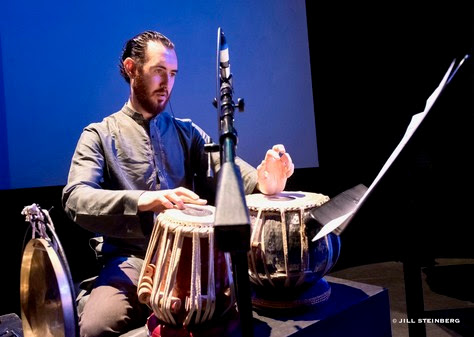
Brian Shankar Adler goes it alone in the studio for his latest album. "For a Gallery On the Moon" (Chant Records) features the artist on a plethora of instruments; the list reads bowed cymbals, buddha machine, ghatam, gong, kanjira, key chimes,
manjira, mridang, opera cymbal, paper, ride cymbals, river rocks, slit
drum, tabla, thunder sheet, and electronics. No traditional drum set to be found or heard. That said, the album is a delightful sound adventure; there are moments that are inventive in the way that books for young children (ages 2-6) can be; in other words, Adler is continually playing with sounds and combinations of instruments, asking the listener to use his/ her imagination to fill in the story. For example, is the use of the thunder sheet in "Flight" meant to symbolize the sounds a flock of geese hear on a late summer evening. Are the sounds of the gong and ride cymbals on "Cym" inviting or threatening? The tabla drums on "Relative(s)" create a trance-like rhythm that draws one closer.
Photo: Jill Steinberg
"For a Gallery On the Moon" lasts just 0ver 31 minutes yet is a travelogue like few you have encountered this year (or, perhaps, other years). There are moments that bring the music of Terry Riley to mind ("Ghost Box") while the backwards tones of "rahdarkahC" remind this listener of the experimental phase of The Beatle and Jimi Hendrix. Make up your stories for this music because that's part of what Brian Shankar Adler wants you to do. The percussionist also wants to take you out of your hectic world, make you relax and think about anything but politics and pandemics. Sounds like a good idea!
In the months that have passed since "Dialogues on Race, Vol. I" (self-released) was initially supposed to be issued (March 17, 2020), so much has happened that speaks to the topic. The two-disk set is an expansive treatise on race relations in the United States told using music, spoken word, and poetry composed and curated by bassist Gregg August. COVID-19 came to this country, with people of color being affected more than others, then the discovery of the killings of Ahmaud Arbery and Brionna Taylor plus the televised execution of George Floyd, and the continuation of a brutally bitter and divisive Presidential campaign. The United States has been violently shaken and those tremors continue.
Depending on which song you listen to, you might think this album is a celebration of Black Culture, of the music that inspires the 21 musicians to play from the heart. And, it is. Whether it be the somber opening of the first track "Sherbet (just to be certain that doubt stays on our side of the fence)" which breaks into a raucous dance to the swinging middle section of "I Rise" (based on the Maya Angelou poem of the same name) to the dancing rhythms of the final three tracks. "Sweet Words on Race" (based on a poem by Langston Hughes) is a Latin-flavored "shout" tune, the foppish "The Bird Leaps" (inspired by Ms. Angelou's "The Caged Bird Sings"), and the most-hands-on-deck jump tune "Blues Finale", this music would not sound like it does without the inspiration of Duke Ellington, Count Basie, Charles Mingus, Thad Jones/ Mel Lewis, Chico and Arturo O'Farrill, and other musical giants. The pieces mentioned and several others in the 12-song program speak to the power created by this music, how the music takes one out of the everyday and makes your body move.
Photo: Kaelen Burkett
The centerpiece of the album is the commemoration of the life and death of Emmett Till (the 65th anniversary of his death is 8/28/20) plus the celebration of the work his mother Mamie Till Mobley (1921-2003) did throughout her life to shed life on his torture and lynching. There are three "statements" of "Your Only Child": "First Statement" features Frank Lacy singing an excerpt from Marilyn Nelson's "A Wreath for Emmett Till" ("Sonnet V" - read here) while "Second Statement" is a bass solo from the leader, and the "Third Statement" features the seven string players, tenor saxophonist JD Allen, and the voice of Shelly Washington singing the Nelson excerpt. The track that precedes "Third Statement" features the voice of Ms. Mobley––the music is solemn, her voice electronically altered, but the words sear into your brain as it describes when the bereaved mother saw when she opened the coffin. Her words are graphic, stunning, and serves to remind one that the kind of treatment her 14-year old son received has been happening to Black people since their forced arrival in the United States.
There is plenty of music to be heard when listening to "Dialogues on Race, Vol. I" but you really have to read and listen to the words. Music should entertain us, we often listen to block out the b.s. When you look back at music, no matter what country, no matter what time, composers and performers strove to tell stories and educate their audience (especially music created by the lower and middle classes). The music of Gregg August reflects the sounds of a movement sparked 160 years ago by Frederick Douglass (and his love the possibilities of the Constitution of the United States), stoked by the likes of Zora Neale Houston, Langston Hughes, Amiri Baraka, Ishmael Reed, Marilyn Nelson, and today by Claudia Rankine, Colson Whitehead, Ta-Nehisi Coates, Ibram X. Kendi and many more. Timely music for unseemly times––listen and pay attention.
Here's the powerful "Letter to America"( based on a poem by Fransisco Alarcón):
Personnel:
John Ellis, soprano saxophone Bruce Williams, alto saxophone JD Allen, tenor saxophone Ken Thomson, bass clarinet John Bailey, trumpet / flugelhorn Rafi Malkiel, trombone / euphonium Marcus Rojas, tuba Luis Perdomo, piano Gregg August, bass / composer Donald Edwards, drums Mauricio Herrera, congas / shekeréb / castanets (tracks 1, 2, 3, 10) Frank Lacy, vocals (tracks 3 and 12) Shelley Washington, vocals (track 9) Forest VanDyke, vocals (track 7) Leah Asher, violin (track 9) Lena Vidulich, violin (track 9) Yuri Namkung, violin (track 9) Johnna Wu, violin (track 9) Wendy Richman, viola (track 9) Brian Zenone, viola (track 9) Madeline Lafayette, cello (track 9) Wayne Smith, narrator (track 2)
Photo: Eric Antoniou
Vocalist, composer, pianist, and reed player, Mehmet Ali Sanlikol, born and raised in Turkey, began his piano studies with his father when he was very young––in fact, he gave his initial piano recitals at the age of 5. Later on, after his studies with Turkish pianist and composer Aydin Esin, Sanlikol came to the United States to study at the Berklee College of Music where he came in contact with Herb Pomeroy plus went on to work with artists such as Bob Brookmeyer, Billy Cobham, Anat Cohen, Antonio Sanchez, and Dave Liebman. Plus, he created his own label, Dünya Productions, to document his music and other work. It was NEA Jazz Master Liebman who, in 2017, commissioned Sanlikol to create a piece for his soprano saxophone and large ensemble.
The commission has resulted in "The Rise Up; Stories of Strife, Struggle, and Inspiration" (Dünya), credited to Mehmet Ali Sanlikol & Whatsnext? Featuring Dave Liebman. The music, composed and arranged by Sanlikol, posits the soprano saxophonist in he midst of a 22-piece orchestra (see personnel below). The program features three three-part "Suites", each telling its own story. Suite #1,"Rumi", the "pen name" of 13th Century Sufi poet Mevlana Celaleddin, opens with a traditional song ("The Sun of Tabriz") that features the ney flute followed by Mr. Liebman's soprano that leads into "A Vicious Murder", the darbuka drum ushering the sections in (a hint of Gil Evans "Sketches of Spain" sounds in the brass and reeds plus a lovely reading of the time by the oboe of Mary Cicconnetti) that opens in a whirling dervish of a soprano sax solo. The final section, "Rumi's Solitude", takes a deliberate pace with the traditional flute and soprano playing in unison before various voices within the ensemble share the melody. After a handsome soprano solo, everyone drops out as the composer steps up to sing a plaintive melody based on a Rumi poem. This coda is deeply emotional and highly effective.
The second suite, "Sephardim", is named for the Jews expelled from Spain in during the Inquisition but taken in by the Ottomans where the two cultures began a long and fruitful collaboration. The combination of Middle-Eastern rhythms with a traditional Sephardic/ Ladino melody is introduced in the first movement, "Spain, 1492" celebrating the time Jews lived and flourished on the Iberian Peninsula while the next section, "Temmuz" ("July" in Turkish) has a martial beat over which the sections play a recurring pattern of phrases. The various "voices" rising up out of the ensemble speaks to the urgency of those fleeing Spain on their way to a new home. As the piece continues, the focus changes to illustrate the sounds the refugees heard as they entered the Turkish territories including the Muslim call to prayer. The final section, "A New Land, A New Music", combines the traditional Ladino music heard earlier with the oud and percussion showing how various elements can create new sounds.
The third and final suite is titled "Sinan", the story of an Orthodox Christian boy who was abducted by the Ottomans early in the 16th Century––he adopts the Muslim faith and becomes an architect for several of the world's finest mosques. One hears a male choir singing the "Kyrie Eleison" but as the voices chant, a marching band enters playing a somber traditional melody, the blare of the reeds and the dissonance of the horns giving the music a dark feel. The next section, titled "Rise Thru The Barracks", swings heartily not unlike a Duke Ellington piece with a rollicking solo from Mr. Liebman. The suite and the album ends with a sweet ballad, "The Owl Song", that builds like one of Maria Schneider compositions until the horns and brass are caressing the melody and the harmony, culminating in a call-and-response with the soprano saxophonist. The music is forceful but not frantic, more about the melody than the rhythm. "The Rise Up" is such a fascinating journey, a splendid mixture, with a such a panoply of sounds as well as melodies based on traditional music. Mehmet Ali Sanlikol played to his strengths as a musician, composer, and arranger, giving Dave Liebman an excellent showcase for his powerful, musical, soprano saxophone. The ensemble, Whatsnext?, features a large number of Boston-area musicians who play with power and elegance. The stories on this album are timeless and speak to the truths of human existence. Give this music a good listen!
Mehmet Ali Sanlikol - voice, ney, zurna, ud
Dave Liebman - soprano saxophone
Mary Cicconnetti - oboe, English horn
Rick Stone - alto + soprano saxophones, flute
Mark Zaleski - alto saxophone
Rick DiMuzio - tenor saxophone, clarinet
Aaron Henry - tenor saxophone, clarinet
Melanie Howell Brooks - baritone saxophone, bass clarinet
Rebekah Lorenz - French horn
Mike Peipman, Jeff Claassen, Sam Dechenne, and Jerry Sabatini - trumpet, flugelhorn
Bulut Gülen, Chris Gagne, and Bob Pilkington - trombones
Angel Subero - bass trombone
Bill Lowe - tuba
Utar Artun - piano
Fernando Huego - bass
Bertram Lehmann. drums, tam tam
George Lernis - percussion
Five voice choir led by Spyridon Antonpoulos
One would not be out of place writing that Jacob Garchik is a unique presence on the contemporary music scene. He plays trombone, tenor horn, tuba, and accordion, has played with the likes of Anthony Braxton, Henry Threadgill, John Hollenbeck, Darcy James Argue, Laurie Anderson, and Mary Halvorson plus many others. He has arranged for numerous vocalists including kd lang, Rhiannon Giddens, Sophie Von Otter, Natalie Merchant, and Angelique Kidjo. Over the past 14 years, Garchik has contributed a dozens of arrangements and transcriptions for Kronos Quartet. He's also a member of The Four Bags, the delightful ensemble that eschews genres for a mix of fascinating sounds.
In 2005, Garchik started his own label––Yestereve Records––and has issued five fascinating albums, including two trio dates, one for a trombone choir (2012's "The Heavens: The Atheist Gospel Trombone Album"), and 2015's "Ye Olde" for trombone, drums, and three electric guitarists. His latest recording, "Clear Line", features a large ensemble consisting four trumpets, four trombones, five saxophones (two alto, two tenor, and one baritone), and no rhythm section. Nary a chordal instrument in sight. The music, all Garchik originals, is fascinating from the opening note right through to the end. The title refers to the "Ligne Claire" style of drawing. Pioneered by French author and illustrator Hergé (1907-1983, the creator of "Tintin"), the drawings combine cartoon characters with "natural" backgrounds. Garchik, who does not play on the album but who is the conductor, has also developed an interest in architecture, not surprising as an arranger, among other things, needs to understand the framework of the music and what each composition will support.
Condé Nast Traveler
What will the curious listener hear on "Clear Line"? Nine pieces that feature crisp playing, intelligent and witty arrangements, and a distinctively fluid blend of styles. The album opens with the rippling phrases of "Visualizations of Interior Spaces" which the gives the music the feel of a fanfare. There are also moments that the listener can sense the growth of a new structure. "Ligne Claire" has a modern classical sound yet one could hear a touch of Bob Brookmeyer in the blend of the sections' phrasings. Long tones with just a touch of dissonance stand out on the ballad "Hergé: Vision and Blindness" while an infectious rhythm can be felt throughout the opening section of the delightful "Moebius and Mucha"––the latter track breaks down at several times for short solo statements. The composer celebrates the "Line Drawings of Paul Rudolph", the American architect (1918-1997) who was considered one of the leaders of the Modernist Era. It's a slow ballad that moves into a darker tone as the piece develops.
Photo montage: Jacob Garchik
The album closes with the title track. A lively piece, the melody is shared by the different instruments in a playful vein. The ensemble plays around with the rhythmic flow, bouncing beneath the solos, stopping to play an elegiac section, which is interrupted by the playful bouncy opening section then returns to the slower tempo. The two distinct "feels"––bouncy then slow––go back and forth changing somewhat each time.
"Clear Line" is such an enjoyable journey. The project should open your mind to the creative genius of Hergé and Paul Rudolph plus gives another glimpse into the creative world of Jacob Garchik. Take your time with this music as it's well worth the adventure.
Jacob Garchik: composer, conductor Nathan Eklund, Jonathan Finlayson, Adam O’Farrill, Davy Lazar: trumpets Natalie Cressman, Kalia Vandever, Kalun Leung: trombones Jennifer Wharton: bass trombone Roman Filiu, Charlotte Greve: alto saxophones Anna Webber, Kevin Sun: tenor saxophones Carl Maraghi: baritone saxophone
Alto saxophonist/ bass clarinetist Andrew D'Angelo is a musician who can light up a room with his incendiary musicianship, His solos can rise from a whisper to a shriek, raining down phrases, riffs, wails, on the listener. His fiery approach to creative music has been evident since emerging on the scene in the late 1980s and early 90s. With fellow saxophonist Chris Speed, drummer Jim Black, and guitarist Kurt Rosenwinkel, he toured clubs and concert halls as Human Feel. They recorded three albums in the 90s before going their own ways, regrouping to record in 2007 and, again to tour Europe in 2017 resulting in the album "Gold", released on Intakt Records in 2019. D'Angelo has also worked and recorded with Jamie Saft, Cuong Vu, Erik Friedlander, and was a long-time member of the Matt Wilson Quartet. In 2008, D'Angelo suffered a seizure and collapsed, was rushed to the hospital where it was discovered he had a brain tumor. That resulted in two surgeries and removal of his right temporal lobe. The saxophonist went the route of alternative healing. He returned to music as soon as possible, began writing pieces for a large ensemble, and the results can be heard on "DNA Orchestra" (Human Use Records). The 12-member ensemble (plus two guests) features the cream of the crop of fiery younger players, many based in New York City, all of whom are either leaders or co-leaders. The nine tracks are all D'Angelo compositions, filled with emotional passages, powerful solos, the occasional loud noises and screeching as well as poignant vocals, and a deep desire to communicate.
YouTube
The 64-minute program, recorded live, can best be described as "raucously joyful and joyously raucous." Yes, there are quiet moments there and there, especially on "I Love You". The piece has a sweet melody sung by the leader – the arrangement for the orchestra does a great job of framing the vocal as well as filling out the sound. The leader's alto sax lines at the opening of "FELICIA" are heart-felt as they lead in to the lovely viola tones supplied by Nicole Federici. The sections then enter playing the melody in a style that resembles Abdullah Ibrahim's South African sounds. The band joins in on the lyrics ("Love Felicia") before D'Angelo's strong solo. Strange sounds, courtesy of the human "beat box" Eric Biondo, are heard at the onset of "Big Butt". Drummer Dan Weiss joins the fun leading the band in with a modified James Brown rhythm attack which is echoed in the sections reading the melody. The forward motion of the rhythm section dares you to put on your dancing shoes. Weiss again kicks up a storm on "Marching Fvckers", its chaotic horn lines hearkening back to the arrangements of the late Fred Ho as well as Pierre Dorge's New Jungle Orchestra. Josh Sinton's baritone sax solo roars atop the thundering ensemble.
Photo: Dave Kaufman
The ensemble romps through "Meg Nam Sa", one of the pieces that came out of D'Angelo's healing process. Again the band roars, goosed forward by the rhythm section with a number of hard-edged solos, building in intensity like a Category 5 hurricane. Weiss's thunderous solo serves as a preamble to a blustery, stunning, finish. It's the final track and that's good as the listener will probably be as spent as the band members.
"DNA Orchestra" is quite an experience. Andrew D'Angelo, along with his very talented friends, create music that is joyous, noisy, exciting, filled with delicious section arrangements, all underpinned by Dan Weiss's drums and Trevor Dunn's great electric bass playing. Not for the faint of heart but definitely for the adventurous listener––play it loud!!
As a youth growing up in Lima, Peru, Jorge Roeder first studied guitar, moved on to cello, but became entranced by the bass in High School, and found his musical calling. He came to the United States in 2002 to study at the New England Conservatory of Music in Boston, MA, and soon came into contact with teachers such as Bob Moses, Dominique Eade, Danilo Perez, and bassists John Lockwood, Cecil McBee, and fellow Peruvian, Oscar Stagnaro. Roeder also began performing with his contemporaries such as drummer Richie Barshay, pianist Carmen Staaf, and pianist Dan Tepfer. Moving to Brooklyn, NY, in 2007, the bassist started a professional relationship with guitarist Julian Lage which is ongoing today as well as with pianist Shai Maestro, John Zorn, and has been a member of trombonist Ryan Keberle's Catharsis since 2012.
If you have listened to Roeder in any of those groups, you'll know he possesses a wonderful facility for playing melody, rhythm, and counterpoint, with rich tones emanating from both his acoustic and electric basses. For his debut album as a leader, "El Suelo Mio" (self-released), the bassist goes it alone, playing only his sonorous upright bass––the album title translates to "my ground" or "my soil". His classical training comes through on pieces such as Ornette Coleman's "Lonely Woman": Roeder plays the tune with his bow, sawing at his instrument to capture the beauty of the melody and the emotion the song contained within the composition. Other pieces that have great emotion are "El Piebeyo" by legendary Peruvian composer Felipe Pingol Alva (1899-1936) and the lovely original "Silencio De Um Minuto". The aptly-titled "Bounce" is a rollicking blues with a handsome melody while "Patrona" displays exquisite finger work not unlike a flamenco guitarist. "I'll Remember Paris", the oft-recorded Gene De Paul melody, shines as Roeder caresses the melody and then creates a powerful solo.
Photo: Isabel Roeder
"El Suelo Mio" closes with the slowly unfolding ballad "Les Lapins", the soulful melody highlighting Roeder's articulate playing, the harmonics he creates ring in your ears for just a second before he moves back into the melody.
Jorge Roeder has created an album that resonates in so many ways; with his love of melody, emotion, and communication shines throughout. Yes, the bassist has tremendous facility on his instrument yet that ability is harnessed in order to present songs that sing to your heart, mind, and soul.
Flutist, composer, and educator Nicole M. Mitchell is one of the most visible contemporary members of the AACM whose recordings cover many different subjects and styles of Black Music. Lisa E. Harris is a vocalist, composer, creator and manipulator of electronic sounds who is also a filmmaker. The two artists have come together, along with members of Ms. Mitchell's Black Earth Ensemble (including cellist Tomeka Reid), to create "EarthSeed" (FPE Records), the third chapter in Ms. Mitchell's projects inspired by the work and vision of author Octavia Butler (1947-2006).
When you listen to the music on "EarthSeed" (recorded live in concert in January of 2017 at the Art Institute of Chicago), be prepared to enter into a different sonic world. After the brief introduction titled "Evernascence/ Evanescence" for flute and voice (breathing and whistling), "Whispering Flame" begins the story in earnest. Instruments move in and around each other, cello and bass swirl, percussion rattles, while flute and trumpet rise above the combined voices of Ms. Harris and tenor Julian Otis singing a song of "creation". Both vocalists also stretch their instruments, creating alien languages, guttural noises, grunts and squeals as the cello creaks beneath. A quiet interlude for flute and cello as trumpeter Ben Lamar Gay roils above the singers. That's just one song.
Photo: Emily Berl (NYTimes)
There's the fun of "Yes and Know" with its bouncing rhythm courtesy of percussionist Avreeayl Ra, violinist Zara Zaharieva, and Ms. Reid and vocal play of Ms. Harris and Mr. Otis as the flute and trumpet dance above. The mewing, snorting, hissing, babbling, chattering, flirting voices cause the audience to laugh on "Phallus and Chalice"––when the instruments and percussion join, the interactions sound like a chase scene in a cartoon. The gentle interaction of flute, muted trumpet, cello, violin, and percussion frame Mr. Otis and Ms. Harris (who soars and wails behind the poetry) at the onset of "Fluids of Time" before the music erupts into a "Rite of Spring"-like section.
"EarthSeed" closes with "Purify Me with the Power to Self Transform", an impressionistic ballad that blends a gospel influenced lead vocal (Mr. Otis's falsetto) and Ms. Harris's wordless responses) with all the instruments plus synthesizer to create an otherworldly benediction. Even the 15 seconds of silence at the end holds great power while serving as a re-entrance into our everyday reality. This album that Nicole Mitchell and Lisa E. Harris have created with members of the Black Earth Ensemble is filled with sounds, voices, poetry, prose, and the joy of performance. Get lost in this "new" world.
Lisa E. Harris, vocals / theremin / electronics / composition Nicole M. Mitchell, flute / electronics / composition Julian Otis, vocals Zara Zaharieva, violin Ben LaMar Gay, trumpet / electronics Tomeka Reid, cello Avreeayl Ra, percussion
Photo: Joe Crocetta
Drummer Jeff Cosgrove lives in Maryland and, up until the pandemic, played a lot in the Washington, D.C. area. Over the last decade or so, he's been working with his group Motian Sickness as well as gigging with numerous local musicians. Plus, he's invited musicians such as pianists Matthew Shipp and Frank Kimbrough, bassists Ken Filiano and William Parker, saxophonists Scott Robinson, Noah Preminger, and Rob Brown plus guitarist Steve Cardenas to play in clubs in and around the Capitol area, releasing many of the collaborations on his own label and on Bandcamp.com. A majority of the recording sessions––in-studio and live––are improvisations and offer the attentive listener the opportunity to listen to musicians "conversing" and listening to each other for the sake of the music. Cosgrove never "overplays"or "overthinks" the music; that sensitivity is one of the major components of his music, making it all the more interesting.
His newest offering, "History Gets Ahead of the Story" (Grizzley Music/self-released)", finds the drummer in a new trio, alongside John Medeski (organ) and Jeff Lederer (tenor and soprano saxophones, flute). Seven of the program's 10 songs are from the pen of bassist William Parker with two from Lederer and one from Cosgrove. Parker is one of the more important people on the contemporary scene, not just for his music but also for the work that he and his wife, poet and choreographer Patricia Nicholson, have done for artists by creating organizations, most notably the Vision Festival. The blues-soaked sounds this trio produces serve to remind the listener of Mr. Parker's "roots", his connection to "soul" music and the blues as well as to fellow bassist and composer Charles Mingus.
Photo: Joe Crocetta
Opening with "O'Neal's Porch" (from the 2001 album of the same name), the trio sets the easy pace and one can feel the influence of Curtis Mayfield in the melody and groove. These musicians are not afraid to go "out" for a moment yet the song always returns to the walking organ bass lines and Cosgrove's steady cymbal and snare work. Lederer's solo ranges far afield, something he does with joy, playing with an exuberance that adds fire. Medeski gets rights into the groove with his soulful Hammond B-3 sound. Lederer moves to flute for the playful "Little Bird", opening with a cheerful duet with Medeski before dropping into a sweet groove. The clarinet comes out for "Wood Flute Song", an angular groove that the drummer drives with his innate sense of rhythm. The drummer contributed the other-worldly "Ghost"––again, the richly-hued tones of Lederer's clarinet reads the melody and dances off into a sweet solo while Medeski's gospel chords swell in the background.
Photo: Joe Crocetta
Lederer's two contributions, "Gospel Flowers" and "Purcell's Lament", both show the trio at its musical best. The former track has a steady groove with powerful solos from Medeski and the tenor saxophonist, all the while Cosgrove pushes them forward. The latter tune opens with a unaccompanied keening soprano sax before the organ enters. The piece moves into a lovely ballad, the cymbal and trap set coloring the lines as Medeski supports the voice in front. The swirling organ moves in and around the lovely soprano phrases while the drummer adds more color (the photo on the left gives you an idea of what Cosgrove is doing as he listens and plays).
"History Gets Ahead of the Story" closes with Mr. Parker's "Harlem" (off his Quartet's 2005 "Sound Unity" album). The power of the tenor sax, Lederer at his bluesiest, is balanced by the quiet organ and drum accompaniment. Pay attention to Medeski's solo and how Cosgrove gives him so much space but never abandons the groove. This is 2 a.m. music at its best.
The trio of Jeff Cosgrove, John Medeski, and Jeff Lederer celebrate the music of William Parker by taking his music and not copying it but by putting their own creative voices to the forefront. The clarity of the recording allows the listener to enter into the studio and really "feel" the conversations going on with the trio and this music. A delight from start to finish, take an hour to dive into these "Stories."

 Posts
Posts