Pianist Frank Woeste and trombonist Ryan Keberle first met in 2015 while playing with trumpeter Dave Douglas. The pianist, born in Germany now based in Paris, France, and the trombonist, born in Spokane, WA, now based in New York City, decided to create a project – which they named Reverso – that blended 20th Century music with jazz because they felt that certain elements of the two "genres" have influenced composers and performers right up to the present. They recruited French cellist Vincent Courtois and drummer percussionist Jeff Ballard to work with them. Composer Maurice Ravel (1875-1937) served as the influence for the group's 2018 debut album "Suite Ravel" using his six-part "Le Tombeau de Couperin" as a stepping-off point for both revising the piece for four voiced and creating compositions of their own influenced by the great master.
2020 brings Reverso's second album "The Melodic Line." Released on the leaders's Out Note Records (released through Outhere Music), the ensemble has been pared down to a trio with the subtraction of Ballard. Instead of focussing on one composer, this time the music bears the influence of Les Six, six French composers – Darius Milhaud, Francis Poulenc, Arthur Honegger, Georges Auric, Louis Durey, and Germaine Tailleferre – all of whom were active in the first decades of the 20th Century. Woeste studied the music of Milhaud, finding influences as varied as American jazz and Brazilian music. Meanwhile, Keberle spent his time exploring themusic of Ms. Tailleferre (1892-1983). Even though she lived a long life, her most successful period of writing was between the two World Wars.
The nine-song program kicks off with Woeste's "Blue Feather", a handsome melody pushed along by the composer's piano and the deep tones Courtois's cello. The piece tunes percussive with clapping supporting the piano solo until the cello br=egins counterpoint and the trombone plays a melodic accompaniment. Keberle's "Exemplar" is next; again, it's deep tones of the cello in the introduction that first catch your ear. Then, the trombone and cello share the melody over the spare piano accompaniment. Courtois's lovey solo with piano accompaniment and counterpoint stands out. The trombone solo rises over the melodic piano and pizzicato cello, feeling like the aural equivalent of clouds cutting across the blue daytime sky.
This music is often quite lovely, a fascinating blend of classical, jazz, and folk melodies. There's a funky feel to Woeste's "Absinthe" (especially in the piano's left hand in tandem with the plucked cello while Keberle's "Major Jack" has an anthemic intro that opens up to a long melody line before a sparkling piano solo. The album closes with the pianist's lovely "Clara", yet another example of how the various voices work together to not only support the rich melody but to create a sonic flow under the pizzicato cello solo.
Reverso creates music that pushes, albeit gently, at barriers, eschewing genre, creating memorable melodies in an atmosphere of creativity and trust. The album title – "The Melodic Line" – does give one a good idea of what you're in for. Ryan Keberle and Frank Woeste, along with the quite impressive Vincent Courtois, make music that will excite and soothe your soul. Give a long listen!
Pianist and composer Aaron Diehl still seems like he's the "new guy at the keyboard" but he's been playing professionally for, at least, 15 years. He's worked with a slew of artists, ranging from Wynton Marsalis to Wycliffe Gordon to the New York Philharmonic and the Cleveland Orchestra. His most high-profile gig is with vocalist Cecile McLorin Salvant. Listening to Diehl is such a treat; he loves melodies, is an excellent improviser, and has absorbed myriad influences into his own articulate statements. There are certain reviewers and critics who tend to lump him into the musical "Neo-cons" but, truly, he's his own man. In a trio setting, one hears traces of Bill Evans, Ahmad Jamal, Herbie Hancock, and even a touch of Memphis Slim in his blues playing; plus, his touch is impeccable.
"The Vagabond" is Diehl's third release for Mack Avenue Records and features his current trio of Paul Sikivie (bass) and Gregory Hutchinson (drums - the picture above features the Trio's former drummer, the late Lawrence Leathers). The program features 11 tracks with seven originals from the leader plus pieces by Sir Roland Hanna, John Lewis, Sergei Prokofiev, and Philip Glass (interesting that those four pieces are the final tracks on the album). One should notice how quiet many of these pieces are – Diehl and his rhythm section do not need to "shout" to get their musical points across and that allows the listener to really pay attention. Note the power and classical influences on "Park Slope" as well as the strong bass solo and excellent drum work. The subtle power of "Lamia" is its quiet yet insistent rhythm and Diehl's superb piano melody and solo. The whisper-touch of Hutchinson's cymbal work and Sikivie's simple yet powerful bass work allows the leader to range far afield without losing touch with the thematic material.
Photo: Jaime Kahn
This music really captures one's attention. The title track opens with a melody line that seems to keep rising along with impressive counterpoint from the bassist. Notice how Hutchinson plays beneath the piano solo, toying with the time and accents yet never tripping up his musical partners. There's also a strong classical feel to the lovely ballad "Treasures Past." Diehl opens his solo with such a soft touch and, while he does play a bit harder at times, the real power in the piece is how melodic the trio is.
"Prokofiev's March" is the first of the last four tracks. It's a dazzling display of powerful rhythms, martial-sounding piano chords, and intense forward motion. Sir Roland Hanna's "A Story Told, Seldom Heard" is a lovely ballad with a rich chordal melody and one more impressive bass solo. The unaccompanied piano opening of Lewis's "Milano" leads into a light-hearted, even a bit sentimental, ballad with more gentle cymbal colors and a touching piano solo. The album closes with Glass's "Piano Etude No. 16" in which the rhythm section gets to work with creating solos while Diehl moves the music forward. The power of his chordal work near the end of the piece plus its repetitive nature becomes hypnotic over the course of eight-plus minutes.
"The Vagabond" is an often stunning and soothing 65 minutes of music from Aaron Diehl, made all the more powerful and interesting by the work of bassist Paul Sikivie and drummer/ cymbalist Gregory Hutchinson. Even though each member of the Trio is a master of his instrument, this music is rarely about technique and always about the emotional richness of the compositions and the performances. Take the time to absorb these sounds – it's worth the adventure!
Saxophonist Dayna Stephens (he plays soprano, tenor, and baritone) has been on the creative music scene for the past decade recording eight albums as a leader plus appearing on dates with trumpeter Brian Lynch, guitarist Perry Smith, pianist Theo Hill, and bassist Linda May Han Oh (plus others). Over his career he's also played alongside Fred Hersch, Muhal Richard Abrams, Roy Hargrove, Ambrose Akinmusire, Wayne Shorter, Rufus Reid, John Scofield, Lionel Loueke, and Gretchen Parlato. He's been much more active since a kidney transplant in 2015 saved his life. After recording for Criss Cross Records and Sunnyside Records, Stephens started his own label in 2017 – Contagious Music – where he released "Gratitude", a quartet date with Brad Melhdau, Julian Late, Larry Grenadier, and Eric Harland. His saxophone influences are many and varied; he's also an accomplished bass player but has yet to record on the instrument.
His new album, "Liberty" (Contagious Music), is his first trio date. Featuring Harland and bassist Ben Street, the 11 song program (10 originals plus "Planting Flowers" from Aaron Parks) is filled with intelligent playing, intuitive interactions, fine solos, and Stephens playing with such confidence and joy. "Liberty" can have several meanings; in this setting, especially without a chordal instrument plus the saxophonist is also talking about creating art in a society that is "free" but those freedoms are under fire from may sides. Can Stephens's music help by reminding listeners that we music work together to produce positive results, that we each have a say in the world we want to live in but must be cognizant of the needs of others. No matter what you think the word means, the album "Liberty" is a delight from start to finish.
Photo: Paola Piga
The album, recorded at the Rudy Van Gelder Studios in Englewood Cliffs, New Jersey, has such an immediate sound as if the trio was in the room with you. There's an undercurrent of blues that runs through pieces such as the opener "Ran" and the closer "Wil's Way" (dedicated to organist Wil Blades). Street and Harland set the tone by swinging with a purpose, giving Stephens a delightful cushion of sound to bolster his attack. In his notes, the saxophonist writes that "Faith Leap" is inspired and influenced by John Coltrane's "Giant Steps" – even more inspiring for Stephens is Harland's funky attack and Street's melodic bass lines. The leader turns to baritone saxophone for "TheLost and Found", a handsome ballad that is emotionally strong and shows the leader's impressive range on the big horn. He recorded the song on the tenor sax for his 2007 debut "The Timeless Now", a sextet date that also featured this rhythm section.
Photo: Chris Drukker
Give a listen to "Loosy Goosy" down below and you'll hear the closest connection to the classic Sonny Rollins Trio recordings of the 1957-1958. Stephens is now imitating the great tenor innovator but displays a similar confidence and big sound as the elder did on the recordings. Don't miss the African-influenced "Tarifa" – the city for which the song is named sits at the southernmost end of the Iberian Peninsula, just eight miles from Morocco. Harland's splendid drumming along with Street's foundational bass lines and Stephen's overdubbed saxophones makes this track irresistible.
"Liberty" sounds great, with musical interactions that will not only keep your attention but also make you move your feet and nod your head. Dayna Stephens, along with Ben Street and Eric Harland, has made one of the most memorable albums of the past several years, brimming with ideas, melodies, and rhythms, exuding confidence and pleasure. Dig in – dig it!
For more information, go to daynastephens.net. The album will be released on 2/28/2020.
Here's the afore-mentioned "Loosy Goosy" in the studio:
Over the past several decades, guitarist and composer Rez Abbasi has been "fusing" sounds from India and his native Pakistan with the varied influences of Western Music, specifically jazz and blues. His 12th album as a leader, "Unfiltered Universe" (Whirlwind Recordings), features his long-time companions Vijay Iyer (piano), Rudresh Mahanthappa (alto saxophone), Johannes Weidenmueller (bass), and Dan Weiss (drums) and adds the cello of Elizabeth Mikael. Iyer, Weiss, Mahanthappa, and Weidenmueller appeared on 2011's "Suno Suno" and 2009's "Things to Come" and the leader sees this record as a third in a trilogy of recording that use South Asian music as touchstone for his compositions and the improvisations. The blend of alto sax, acoustic piano, and guitar with this highly active rhythm section makes for a winning combination.
John Rogers photo
"Propensity" opens the program and, right from the start, the listener should pay attention to the different components. The extended melody, the powerful combination of bass and drums, the vocal characteristic of Mahanthappa's alto sax, the way the arrangement includes the cello as counterpoint. and the excellent solos. The title track follows. This melody, played by the alto and guitar, has a lovely almost melancholy flavor especially when the cello enters shadowing the lines played by the piano. Notice the "freedom" yet structure in the rhythm section during the solos as well as Iyer's heavy chordal work. The rhythms slow down at the onset of the piano solo and one can really hear the articulated notes and how, slowly, surely, Iyer works in tandem with Weidenmueller and Weiss.
With exception of "Thoughts", a short (1:41) but rambunctious guitar solo, the songs stretch out but no piece is overdone. It's fun to hear how the tempos change within songs, how the different voices interact, how the power of the alto sax is matched by the guitar and piano but is not a "war" of virtuosi. The leader plays with great fire throughout yet there are moments of simple beauty as well. The longest track (11:54), "Turn of Events", take its time to get going but once the song hits a rhythmic stride, the musicians still don't hurry. The mysterious melody finally arrives, played by the guitar, sax, and cello and it's as if everything as fallen into the right places. Soon, Mahanthappa and Abbasi are soloing together as the pianist pulls the rhythm section forward. But, they drop for a piano solo framed by only the bass and drums yet you can hear how Iyer builds his powerful spot from the main melody and rhythm of the composition. Ms. Mikael steps out for a quick solo with Weidenmueller's bass as a counterpoint before the bass is by himself. Guitar and piano create a percussive dialogue before the sextet returns for the reprise of the opening theme.
"Unfiltered Universe" is structured yet has such a "free" feel at times it seems as if the musicians are spinning a magic story. While Rez Abbasi talks about the importance of carnatic music to this album, all the influences seems to have merged into an original sound. Give a listen and then another - this music all seduce you.
It was Peter Margasak in the Chicago Reader who hipped his readers to the "Flow", the new Delmark album from the Paul Gialorrenzo Trio. I went out and purchased the album on the power of his suggestion. Yes, it's a piano trio album, released at a time when one get lost easily in the plethora of piano trio recordings. But, I understand his enthusiasm. Pianist and composer Gialorrenzo, a native of Long Island, NY who now resides and works in Chicago, has crafted an album that may remind some of work of Herbie Nichols or Bud Powell or Thelonious Monk. He's not afraid of changing tempos in mid-phrase and is blessed to have the rhythm section of Joshua Abrams (bass) and Mikel Patrick Avery (drums) who not only follow his creative paths he creates but push, poke, prod, and "swing like mad" along the way.
Listen to how "Rolling" does just that, how it rolls along on the walking bass lines and ride cymbal and how the melody and solo dances atop it. Throughout the nine-song program, the emphasis is on melody, interplay, and the narrative Giallorenzo weaves into every track. Feet have to tap on "Flipd Scrip" and heads will lean in on the opening melody of "Interstice": with the entrance of bassist Abrams on the latter track, the piece moves in a "freer" direction but never goes all the way out. In fact, there's a section that is "deep" blues.
The two pieces that bookend the album, "A-Frolicking" and "A Way We Go", point to the playfulness of this music, the type of repertoire that make audiences sit up and smile. The Paul Giallorenzo Trio swings with glee, the music never feels forced, and you can see the musicians are paying close attention to each other. "Flow" is a delight from start to finish.
For more information about this fascinating musician, go to paulgiallorenzo.com.
Saxophonist Nick Hempton (alto and tenor) has issued four fine albums on Posi-Tone Records, mostly with his fine Quartet. With the release of "Trio Stonk: Live at Smalls" (SmallsLIVE), the Australian native has downsized but not to the detriment of his music. With his rhythm section - George DeLancey (bass) and long-time associate Dan Aran (drums) - Hempton moves his way through seven pieces, five of which are originals. Not hard to compare some of the pieces to the 1950s Trio work of Sonny Rollins - listen to the opening of "Dropping A Franklin" or the playful take of "When I Grow Too Old to Dream" and you can hear it in the way Hempton phrases and the gentle swing of the rhythm section. There are even a few Rollins quotes on the opening of "Not That Sort of Jazz That Stewart Likes", a delightful romp that has an easy groove.
The lovely take of the standard "Poor Butterfly" is a highlight, the alto sax dancing around the structural work of the bass and drums. The singing tone of the sax, the gentle brush work, and intelligent counterpoint from the bass, all combine for a sweet ballad. "A Whistling Blues" opens with just sax and bass playing a "down home" tune with the feel of David "Fathead" Newman supporting Ray Charles. The blues gets deeper when the drums enters to slowly push the tune forward.
Trio Stonk plays with verve, a sweet sense of humor, and the desire to entertain people who like jazz. Neither confrontational nor challenging, Nick Hempton and company make music that's filled with joy, soaked in the blues, not afraid to swing, and possessing a sense of humor. Relax and dig into these tasty sounds.
At its heart and soul, the new recording from tenor saxophonist Tim Armacost, "Time Being" (Whirlwind Recordings), is a saxophone trio album. Recorded at drummer Jeff "Tain" Watts' home studio in Pennsylvania, the session features the saxophonist in musical conversations with Watts and bassist Robert Hurst - pianist Dave Kikoski shows up on several tracks as well but it's the trio cuts that initially capture one's attention.
The program opens with "Alawain" (one of nine originals among the 11 tracks), an up-tempo piece that moves forward on the power of the bass, drums, and the saxophonist's powerful melody. One is immediately entranced by the interactions as well as the clean sound quality: it feels as if you are sitting alongside Watts as he dances around his kit. The title track is next, a ballad that slowly picks up tempo thanks to the powerful bass lines and the often funky as well as swinging drums.
It's a surprise when Kikoski's piano nudges its way in on "Sculpture #1: Phase Shift", moreso that he does not stick around but immediately steps back. He's much more part of the lovely ballad "The Next 20", although he leaves plenty of space for Armacost to present the melody and for Hurst to offer fine counterpoint and for Watts to show how versatile he is with his brushwork. The piano solo rises out of the sax spot, a pleasing melodic exploration with tines of the blues exposed in every phrase.
For this listener, it's the trio tracks that keep me coming back. The brilliant up-tempo take of Ornette Coleman's "Lonely Woman" and how the piece grows from the initial bass and sax interaction, prodded by Watts' double-time drumming. Armacost never rushes even as the rhythm section pushes alongside him. The three musicians swing delightfully through Thelonious Monk's "Teo", urged on throughout by Watts' joyous playing.
The album closes with the anarchic "Sculpture #3: All the Things You Become in the Large Hadron Collider" - along with Kikoski, the trio really do sound as if they are various particles moving in and around each other, occasionally bumping into one or the other, getting into sync as the music reaches its conclusion. It's a humorous idea that is also quite musical.
Tim Armacost, who may be best known for his work with the New York Standards Quartet, has soaked up numerous influences over his career and come out his own man. "Time Being" is filled with intense interactions yet rarely, if ever, feels frenzied or even rushed. It's easy to get "lost" in this music and so much fun to hear musicians really "play"; that playful quality is what stands out the most and is so satisfying.
Under One Sun is the collective name for an octet formed by drummer/ percussionist Jamey Haddad (Paul Simon, Dave Liebman): its self-titled debut album was recorded at the Oberlin (College) Conservatory of Music (where Haddad teaches) and features the music of saxophonist Billy Drewes (tenor and soprano saxes plus clarinet, bass clarinet, C flute and alto flute) who the percussionist met in the rehearsal studios of Berklee College in 1972. The ensemble features a fascinating array of musicians including Ali Paris (qanun - box zither, voice), Salar Nader (tabla), Luisito Quintero (congas, timbales, percussion), Leo Blanco (piano), Michael Ward-Bergeman (hyper accordion), and Roberto Occhipinti (acoustic bass). The music they create is as fascinating as the different instruments, music that is melodic and rhythmic as well as emotionally strong.
Drewes, whose credits include the Thad Jones/Mel Lewis Orchesta, the Vanguard Jazz Orchestra, Bill Frisell, the Alvin Ailey Dance Theater, Paul Motian, Fred Hersch, and many others, has created a program of music that shows not only his studies in Brazilian and Indian music but the influence of blues and big band sounds. While one is tempted to tout the virtues of every track, it's more fun to let the sounds soak through you, to make up your own mind, to enjoy how the disparate sounds of qanun and soprano sax intertwine and interact, how the voice of Paris evokes so many different memories, and how the percussion makes you want to turn up the volume and dance.
Drewes (pictured left) has composed several stunning ballads on the album. "Tinker" moves gently atop a cushion provided by tabla, bass and trap drums with the saxophonist, accordion, and voice sharing the melody. "For Those We've Known" opens with a sweet melodic tenor saxophone melody over piano, bass, and drums and stays with that formation, each musician with the exception of Haddad contributing a fine, heartfelt, solo. The influence of Maria Schneider is heard clearly on the final two tracks. "High Above" features the octet and is built off a gentle melody, each voice moving in and out of the spotlight. That melody and subsequent interactions are reminiscent of several of Ms, Schneider's pieces that are informed by her interest in the songs of birds. With the addition of a brass quartet (trombonist Lee Allen, tuba player Miguel Santos, trumpeters Olivia Pidl and Wyeth Aleksel), the final track "Ode to Brigadoon - A Path to All" is a lovely coda, wistful, poetic, and soothing. Drewes' gentle clarinet over Ward-Bergeman's accordion brings the melody to the forefront, a melody that is then amplified by the piano, voice and brass. Stunning, life-affirming, this music resonates long after you put the CD back into its case.
At nearly 72 minutes, "Under One Sun" offers so much music and shows listeners how sounds of different cultures plus intelligent melodies can come together to make a unified statement. If these voices can rise as one, can there not be hope for peace in a fractured world? I do not know about that but this album, this music, these performances, certainly made my day so much better.
If you are old enough to remember 1968, you know how terrible a year that was. The assassinations of Dr. Martin Luther King and Presidential candidate Robert Kennedy, the continuing escalation of the war in Vietnam, the horrific events in Chicago during the Democratic Convention, and more threw the United States into turmoil. Some pundits believe that 2017 is the equal but we need time to pass and time to reflect before making that statement.
For six months of that year, Jack DeJohnette sat in the drum chair for the Bill Evans Trio. He had spent several busy years touring with saxophonist Charles Lloyd as well as Betty Carter but jumped at the chance to play with the pianist. Up until several months ago, there was but one recorded document of that trio: "Bill Evans at The Montreux Jazz Festival" was issued in the fall of that year on Verve Records and even won a GRAMMY in 1969. Turns out that the Trio twice more in the next week. Earlier this month (September 2017), Resonance Records issued "Some Other Time: The Lost Session from the Black Forest" recorded in Germany five days after the Verve recording. Now, the label presents "Another Time: The Hilversum Concert" recorded in front of a live audience on June 22 1968 in the studios of Netherlands Radio Union.
photo by Giuseppe Pino
Of the 20 tracks on the "..Black Forest" CDs, only two are repeated here (same with the "...Montreux" album) which, to these eyes, shows how big a repertoire Evans had in those days. Bassist Eddie Gomez stands out on all three albums but especially on the "...Hilversum" set as his big tone, melodic lines, and unerring swing enliven the faster pieces and give just the right punch to the ballads as well. One can hear how much Stanley Clarke's acoustic bass work is informed by Gomez. He works well with DeJohnette (they would work together again in the 1980s); you can tell they trust each other as does Evans and these piece never are staid or rote. Evans is in good voice throughout as well and these tracks seems to have a liveliness that the album recorded two days before had in fits and starts (that written, "The Black Forest" sessions allow the pianist to be more expansive at times). Check out piece such as the CD opener 'You're Gonna Hear From Me", "Embraceable You", and the rapid-fire "Five" that closes the concert: all have such a playful quality, a buoyancy and lightness that is so appealing.
By the end of the summer, Jack DeJohnette was invited to play with Miles Davis and Marty Morell took his place, staying with the Trio through 1974. Eddie Gomez ended up spending 11 years (1966-77) alongside Bill Evans recording numerous Lps in trio, duo, quintet, and even orchestral settings. The pianist's addictions finally caught up to him in September 1980 and he died at the age of 51. He played and recorded up until a week before his passing; in fact, many critics and fans felt that his final recordings with the rhythm section of Marc Johnson (bass) and Joe LaBarbera (drums) rank up there with some of his early successes. No matter which side you fall on in there arguments about the best recordings by Bill Evans, "Another Time: The Hilversum Concert" is a delightful, musical journey. While the songs might not reflect the insanity of the times, the interaction and musicianship of Bill Evans, Eddie Gomez, and Jack DeJohnette shows us all how much good it is and how much fun it can be to work together.
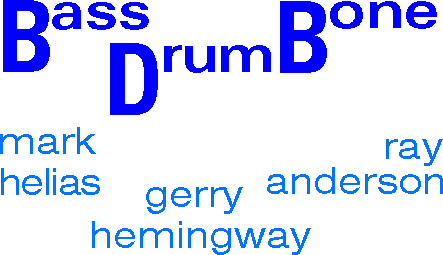
For the last four decades, these smiling gentlemen on the left - Mark Helias (bass), Gerry Hemingway (drums, percussion), and Ray Anderson (trombone) - have been touring this country, Europe, and beyond in an ensemble they smartly titled BassDrumBone. Over that time, they have released 10 Lps and/or CDs, each led his own group, took time off for illness, toured and/or recorded with other people/groups yet always came back to this trio configuration. Methinks that is because not only do they sound good playing together, they enjoy playing together.
Connecticut fans get a rare opportunity this week to see BDB twice in the midst of its 40th Anniversary Tour. Friday evening, Messrs. Helias, Hemingway, and Anderson return to Firehouse 12, 45 Crown Street in New Haven to play two sets. The trio last played the venue in May of 2008 - I was there and can assure you they "rocked the house." There's a strong steak of blues that runs through their music as well as ties to the avant-garde, to the "free" sounds of the late 1960s and '70s, to straight-ahead "blowing", to funk, and to the New Orleans roots of jazz. The band's most recent recording, 2016's "The Long Road" (Auricle Records), kicked off the group's Anniversary celebration: it's a 2-CD set with guest appearances from Joe Lovano (tenor sax) and Jason Moran (piano). It's a wonderful blend of original tunes by all three members of the group and closes with two live tracks from 2013
The New Haven show is the final one of the Firehouse 12 Spring 2017 Concert Series and is a perfect way to kick off the two-week long International Festival of Arts & Ideas (thought the series is not connected to IFA&I, BassDrumBone epitomizes the adventurous scope of the programs to over over the course of the Festival). The first set begins at 8:30 p.m. For more information about Friday's gig, call 203-785-0468 of go to firehouse12.com.
On Saturday, the trio ventures north on Route 91 to Hartford to play a concert at Real Art Ways, 56 Arbor Street. The event is free and open to the public. For more information, go to www.realartways.org or call 860-232-1006.
Mark Helias is also a member of Canadian-born saxophonist and composer Quinsin Nachoff's Ethereal Trio. Their self-titled debut album has just been issued on Whirlwind Recordings and is a joy to listen to. The bassist, who has led several trios over his long career, is the perfect fit for an ensemble of this size: he possesses a really powerful sound, is extremely melodic as well as percussive, is excellent at arco bass ("bowing"), and has a great sense of what his bandmates need from him. On this recording, he's paired in the rhythm section with drummer Dan Weiss who is also a fine accompanist with a strong sense of melody and forward motion. They provide Nachoff with such great support and counterpoint as well as a sense that he can play anything. And he gives them material to really dig into, not just rely on cliches but to truly explore the possibilities.
My personal touchstone for sax-bass-drums trios has always been Sonny Rollins's "Freedom Suite." One can hear a hint of the blueprint that 1958 recording created; still, this is definitely 2017 music. The funky beat Weiss produces on "Subliminal Circularity" has a hip hop feel but notice how the bass moves on his own around the beat while the tenor navigates in between the two "sonic" worlds. The opening track, "Clairvoyant Jest", might remind one of a groove that could be found on Dave Holland's "Conference of the Birds", the intelligent meshing of structure and freedom. That carries over to the second track, "Imagination Reconstruction" - here, the rhythm is more intense, the sound a bit more diffuse yet the piece does not boil over. Both the bassist and drummer take short solos that rise organically from the music.
The leader is no slouch. He, too, enjoys the freedom the open-ended music goes him, exploring so many different possibilities. Hear how he navigates the aptly-titled "Push-Pull Topology" with its odd-time meters, his melody actually hugging the beat while his solo dances along with Weiss's playful drums. The handsome ballad "Gravitas" is a lovely blend of tenor sax (played in a register not unlike Charles Lloyd and with a similar lightness), splendid brush work and cello-like tones from the bowed bass. This is dramatic music, the interactions displaying the trio's keen sense of listening to each other. That description is also apt for the final track, "Portrait in Sepia Tones" - Helias leads off the piece unaccompanied before Weiss tiptoes in (sounds like he's not holding sticks or brushes). After several minutes, the bass drops out for a moment for a statement from the drums before returning 25 seconds later to play counterpoint to the tenor melody (Nachoff sits out the first three minutes). Throughout the piece, Helias switches from bowed to plucked bass. At the six minute mark, the bassist fall into quite a walking bass line pursued by the drums and tenor - the frantic tempo and exciting interactions continue to close to the end of the 10 minute piece when they trio falls into a funky beat (like the afore-mentioned "Subliminal Circularity") to "dance" the piece to its close.
Quinsin Nachoff's Ethereal Trio has its exquisite moments but also many powerful moments as well. Messrs. Nachoff, Mark Helias, and Dan Weiss each contribute to the success of the music, each with an authoritative "voice" and an understanding how to make their interactions human and special.
Trumpeter David Weiss leads two of the most dynamic bands playing these days and nights. As a player, he takes a bit of a back seat in The Cookers(the septet with Billy Hart, George Cables, Billy Harper, Eddie Henderson, Cecil McBee, and Donald Harrison) - Weiss is much more prominent in Point of Departure, a quintet (plus guests) that takes its name from an Andrew Hill composition (and album). This group mines music from the late 1960s and early 70s from composers like Hill, Tony Williams, Wayne Shorter, and two men closely associated with the Detroit music scene of that time, pianist Kenny Cox and trumpeter Charlie Moore. Those two musicians, who recorded as the Cox and The Contemporary Jazz Quintet, had a big effect of Weiss and he has recorded a number of their pieces with Point of Departure.
"Wake Up Call" (Ropeadope) is the ensemble's fourth CD. The 9-song program is broken into three sections, "I. Prologue", "II. Unfinished Business", and "III. New Beginning". Judging by the power of the music, I believe that Weiss is telling his audience that these songs, many of them from the raucous years of the late 1960s, are indicative of the turmoil in this country at that time and how they reflect these troubled times. Besides Weiss on trumpet (and Fender Rhodes on 2 tracks), Point of Departure is composed of Matt Clohesy (bass), Ben Eunson (guitar), Myron Walden (tenor sax on 6 tracks), J.D. Allen (tenor sax on 3 tracks), Nir Felder (guitar on 3 tracks), Travis Reuter (guitar on 6 tracks) and, for my money, the most important element in the group, drummer Kush Abadey. The drummer, who first came to critical notice at the age of 16 when he joined Wallace Roney's group, has worked with Terence Blanchard, Chris Potter, Tomasz Stanko and many others.
The album opens with "Sanctuary", a John McLaughlin songs from the Mahavishnu Orchestra'a 1973 album "Birds Of Fire." The music starts slowly but soon Abadey plus guitarists Eunson and Reuter are creating a roiling rhythm for Walden's intense solo. "..Unfinished Business" begins with Wayne Shorter's "Two Faced", a song first recorded by the Miles Davis Quintet in 1968, appearing on 1976's "Water Babies". At 12:22, it's the longest track and takes its time to build up steam - there are strong solos from Weiss and Allen, both fairly long and both feeding off the energy of the rhythm section. Two songs from Charles Moore follow, the funky uptempo "Multidirection"(reminiscent, at times, of "Theme from Shaft") and the delightful ballad "Noh Word." On the latter track, Allen's soulful solo rolls into Felder's, a more impressionistic take over the powerful drums.
The third, and longest, section, "New Beginning" opens with Joe Henderson's "Gazelle" (recorded in 1970) - the piece rides the rampaging drums (listen to Abadey under Walden's fiery tenor solo) and percussive guitar. Cox's "Sojourn" has an understated power, pushed by the rhythm section and the counterpoint of the guitars. Perhaps the most fascinating cut in the program is "Sonhos Esquecodos" from Brazilian composer Lelo Nazario (recorded in 1982 as a member of Grupo Um). Sandwiched between two pieces by Tony Williams, the song has a long rubato beginning (yet listen to the power of Abadey) with trumpet and saxophone playing the melody (actually sounds like a tune Weather Report may have produced in its early years). Once the piece settles into a groove, Reuter's hard-edged solo ratchets up the intensity.
"Wake Up Call" is intense music, so much so that even the quieter moments have great power. Listen to this music for its messages, for the solos, for the amazing work of Kush Abadey and Matt Clohesy, for the smart two-guitar work, and for its power. David Weiss & Point of Departure wants you to get off your feet and let the music created here push you to action.
Tenor and soprano saxophonist Jason Rigby, from Cleveland, Ohio, is a busy musician and educator. He leads or co-leads four groups and is currently an Assistant Professor of Jazz/Commercial Saxophone at Towson University in Maryland. His third album as a leader, "One: Detroit - Cleveland Trio" (Fresh Sound New Talent), features the rhythm section of bassist Cameron Brown and drummer Gerald Cleaver, both of whomhail from the Motor City and recorded with Rigby on his 2009 FSNT album "The Sage." In fact, Brown was also on Rigby's 2006 debut for Fresh Sound, "Translucent Space."
Right from the opening moments, "One" is a treat for lovers of saxophone trio music. "Dive Bar" is a duet for tenor and drums - Cleaver opens the piece with a short introduction, a thunderous setting for Rigby to enter with a melody not unlike the initial theme of Sonny Rollins's "Freedom Suite." The power of the drums and the writhing saxophone lines sink their hooks into the ears of the listener and do not let go for seven minutes. Brown leads the trio in on ""Dorian Gray" with a three-note bass line then joins Rigby to play the theme. The tension created by the rhythm section gives the tenor plenty of room to play around. Rigby is a strong player but not a "shouter" or ""screamer", there's a subtlety to his lines that give a song like "Live By The Sword" its focus yet his phrases hint at the work of Albert Ayler - listen to Brown and Cleaver as they freely navigate underneath. Both musicians stoke the fires of this music without losing control or direction.
Yet, there are quieter moments with strong melodic flourishes. The Richard Rodgers - Lorenz Hart standard "You are Too Beautiful" (composed in 1931 for Al Jolson) starts off quietly with Rigby emphasizing the melody and building his solo from the theme. Pay attention to the great counterpoint of Brown and the sweet brush work of Cleaver. The saxophonist goes solo on the Gershwin's "Embraceable You", creating a mini-symphony and taking his time to reference the melody. He breaks out the soprano sax for Herbie Hancock's "Speak Like a Child", playing the melody against Brown's excellent counterpoint and Cleaver's splendid cymbal playing. Rigby's solo is mesmerizing, short phrases repeated, bouncing off the low notes of the bass, twisting around the poly-rhythms of the drums, and slowly picking up in intensity but never boiling over.
"One" is a good title. Yes, this is a trio recording but the musicians approached the session of one mind; to play hard, smart, and together. One can hear plenty of "freedom", with the sax, drums, and bass seemingly going in three directions at the same time but never at cross purposes. Listen to the music of Jason Rigby: The Detroit - Cleveland Trio with open ears and you will be rewarded many times over.
Since first hearing "Way Out West", Sonny Rollins's 1957 Lp with Ray Brown (bass) and Shelly Manne (drums), I have loved the sound of trios built on that instrumentation (more so than piano or guitar trios, but that's me.) When you have a melodic yet forceful drummer and a bassist whose playing is foundational as well as melodic, an adventurous saxophonist can do so much. The excitement and beauty are the interactions and conversations within the music.
Drummer and composer Rudy Royston (pictured above) recently released his second album as a leader. "Rise of Orion" (Greenleaf Music) features the powerful percussionist in a trio setting with saxophonist Jon Irabagon and bassist Yasushi Nakamura - it's a such a fine recording (my review is here) and now the three musicians are on a 9 gig/10 day tour that takes them around the country and, lucky for us CT residents, deposits them at The Side Door Cafe in Old Lyme on Friday December 16. Replacing Nakamura (who is in Tbilisi, Georgia, this weekend with pianist Aaron Goldberg and drummer Leon Parker) is bassist Thomson Kneeland.
The door opens at 7:30 p.m. and the music commences 60 minutes later. The room will rock but keep your ears open for the soulful ballads Mr. Royston composes. For more information and reservations, call 860-434-0886.
Here is one of those ballads (Mr. Irabagon on tenor sax):
Trumpeter Marquis Hill, a native of Chicago IL, brings his Quintet to The Side Door on Saturday (12/17). The young musician, who has worked with Marcus Miller, Joe Lovano, drummer Makaya McCraven, and bassist Matt Ulery, won the 2014 Thelonious Monk Trumpet Competition and recently released his first album on Concord Records, "The Way We Play." It's actually his 5th recording as a leader since 2011. For the past 2 years, he's been closely involved with FONT, the Festival of New Trumpet, created by the late Roy Campbell Jr. and Dave Douglas in 2003. This September, Hill created (thanks to the Roy Campbell Jr. commission) created new works for his ensemble Signatures in Brass, six trumpets (!) and rhythm section.
For his gig in Old Lyme, the music will be created by Hill (who also plays flugelhorn), Braxton Cook (alto saxophone), Joel Ross (piano), Chris Smith (bass), and Jonathan Pinson (drums). Hill's records feature many different styles, from straight-ahead to post-bop to "soul jazz" to hip hop and more. He's generous with giving his cohorts solo space and, when he steps out, Hill has a fluid style with hints of Booker Little and Clifford Brown.
The Side Door Jazz Club in Old Lyme presents vocalist and composer Tessa Souter in an intimate trio session this Friday (6/25) at 8:30 p.m.Ms. Souter, born in London, England now based in New York City, first came to critical notice in 2004. After several years working as a journalist, she started to study with vocalist Mark Murphy and has recorded 4 albums with her most recent being 2012's "Beyond the Blue", produced by the Japan-based Venus Records and released in the United States by Motéma. That album combines Ms. Souter's lyrics with classical works by the likes of Chopin, Schubert, Beethoven, Ravel, and others.
photo by Janis Wilkins
She's a marvelously articulate singer, caressing ballads without making them treacly. Her material comes from many different sources; besides her own material, her repertoire includes works by Cream, Paul McCartney, Burt Bacharach, Van Morisson, and Antonio Carlos Jobim. For this concert, she'll be accompanied by guitarist David Gilmore and bassist Boris Kozlov (best known for his work in the Mingus Big Band.) Much of the material in Old Lyme will come from Ms. Souter's upcoming album.
The doors open at 7:30 p.m. For more information, go to thesidedoorjazz.com or call 860-434-0868. To learn more about the vocalist, go to tessasouter.com.
Here's a piece from 2012, live at The Blue Note:
On Saturday night, Jan & Ken welcome the Vincent Herring Quartet to The Side Door. Herring, an alto saxophonist who's been on the "scene" for over three decades, first worked with cornettist Nat Adderley, brother of Cannonball (Herring is now a member of the Cannonball Adderley Legacy band). He went on to work with Dizzy Gillespie, Freddie Hubbard, Wynton Marsalis, the Mingus Big Band and many others. He's been on dozens of recordings while issuing 19 of his own.
Joining him in Old Lyme is his regular Quartet which includes Mike LeDonne (piano), David Williams (bass), and Carl Allen (drums and then some). They'll play some serious hard-bop plus a number of fine ballads. The Vincent Herring Quartet takes the stage at 8:30 p.m. For more information, call 860-434-0886.
Here's a piece from his 2013 Smoke Sessions Record release "The Uptown Shuffle:"
On Friday, The Buttonwood Tree, 605 Main Street in Middletown, presents Medusa, a quartet from Hartford that features tap dancer Corey Hutchins, drummer Jocelyn Pleasant, pianist Orice Jenkins, and bassist Matt Dwonszyk. The dancer and the drummer met at the Artists Collective in Hartford, formed a group to play mostly standards and great r'b' tunes. Once they added Jenkins and Dwonszyk, they really took off, playing gigs throughout Connecticut and also throwing in some original material. Tap and Black American music has a history that goes back to the mid-19th Century, really growing in popularity from the 1920s through World War II (and beyond - witness Savion Glover).
Medusa will play from 8 - 10 p.m. with a short break. For more information, go to www.buttonwood.org.
Here's a video of Mr. Hutchins and the band in action from 2014:
On Saturday, bassist Dwonszyk heads to Integrity 'n' Music, 506 Silas Deane Highway in Wethersfield, to play alongside tenor saxophonist Bennie Wallace and drummer Carmen Intorre. Wallace, a native of Chattanooga, TN, moved to New York City in the mid-1970s, formed a group with bassist Eddie Gomez (Bill Evans Trio) and drummer Eddie Moore, releasing his debut Lp in 1977, "The Fourteen Bar Blues." Over the decades, he's recorded with pianist Tommy Flanagan, Dr. John, Kenny Barron, Chick Corea, Dave Holland, and Oliver Lake plus he created or creating the orchestrations for movie soundtracks such "Bull Durham" and "White Men Can't Jump." He has always had a "big" sound, with a tone more akin to Coleman Hawkins and Ben Webster than John Coltrane (although Wallace has often shown a "wilder" side in his playing).
Wallace is now living in Greenwich, CT, where he is the artistic director ofBack Country Jazz, a program he created in 2007 to help stem the loss of music and arts programs in the public schools. He brings top-notch artists to work with the children and created several ensembles featuring the students.
Integrity 'n' Music is located in the rear of the building at 506 Silas Deane Highway. The concert, which starts at 2 p.m., is free and open to the public. For more information, call Ed K at 860-563-4005.
In the meantime, here's a "field recording" of Bennie Wallace from 2010:
sidedoorjazz.com
The young tenor saxophonist from the Hartford area, Mike Casey, is beginning to spread his musical wings. Casey, a graduate of the Jackie McLean Institute of Jazz at the University of Hartford, has been writing a slew of new songs and has developed quite a Trio with bassist Alex Tremblay and drummer Mike Scott. The ensemble has gelled nicely over the past 12 months and you can hear for yourself on Saturday evening when the Mike Casey Trio at the Passages Gallery, 509 Farmington Avenue in Hartford.

 Posts
Posts








:format(jpeg):mode_rgb():quality(40)/discogs-images/A-310249-1124455387.jpg.jpg)