Listen to the music of Henry Threadgill from 40 years ago, when the trio known as Air made its first recording. His saxophone and flute, the majestic bass of Fred Hopkins (1947-1999) and the brilliant percussion of Steve McCall (1933-1989) sounded like few other trios (compare their recordings to the work Sonny Rollins created in the 1950s) - the evidence of Threadgill's Chicago upbringing can be heard in the occasional hints of blues that enter the pieces but the freedom, the unexpected twists that don't sound dated or forced even today, their intuitive interactions (both live and on record) excited many people willing to travel down the trails they blazed.
Threadgill formed Zooid at the turn of the 21st Century building the sextet/quintet around the incredible tuba work of Jose Davila and the expressive guitar of Liberty Ellman. By the time of the group second Pi recording "This Brings Us To, Vol 1." (2009), drummer Elliot Humberto Kavee joined the ensemble with cellist Christopher Hoffman coming the 6th member (original cellist Dana Leong was on the band's initial release but left before #2.)
"In For a Penny, In For a Pound" is the new Pi release and, with the departure of bassist Stomu Takeishi, the group is once more a quintet. The 2-CD set features 6 tracks with each disc starting with a short track (the first disk is the title track, subtitled "opening" while the second disk starts with "Off The Prompt Box" subtitled "exordium", meaning "the beginning.") The other 4 tracks are much longer, episodic compositions dedicated to the different instruments (with the exception of the reeds) in which the quintet breaks into smaller formations at various times. Threadgill is fine voce throughout, his squiggly alto lines or colorful flute playing (he plays both concert and bass flutes) weaving in and out of the sound spectrum. "Ceroepic (for drums and percussion)" opens with the impressive melodic interaction, the alto sax in the lead, Davila playing counterpoint while both the guitar and cello plays the foundational bass lines. Kavee's drums people the work forward as the solos unwind, first Threadgill then Hoffman. After the fine cello solo, the piece and heads off into quiet territory, with just cello, guitar and percussion in the mix. After several several changes in direction, Threadgill's flute takes the lead for a turn before handing off to Davila, now on trombone. Despite the subtitle, there is never a drum solo in the spotlight although Kavee is crucial to the movement in several sections. Meanwhile the following cut, "Unoepic (for cello)" does start with the instrument the piece is named for but soon everyone joins in.
Meanwhile, this music features all the elements we have come to expect in Threadgill's music. Rhythms that push but do not represent any particular "style", solos that grow right out of the melodies and great interactions. On "...Prompt Box", listen to how each musician plays rhythm especially and notice how the leader steps out after the opening theme, not to return. The interaction of guitar and cello at the onset of the last cut, "Unoepic (for guitar)", sets the stage for several duo dialogues (alto sax and drums, cello and drums) yet, over the course on nearly 18 minutes, there are moments when the musicians solo over drums, tuba and guitar or guitar, cello and drums and so forth. Threadgill's alto erupts out of a drum solo, exchanging phrases with cello and guitar, then stepping out for a thoughtful and somewhat abstract solo.
At 80 minutes, "In For a Penny, In For a Pound" is much to digest and would not fit easily on one disk. That said, this suite is most certainly interconnected, with themes moving in and out of separate tracks. While there are solos throughout, the rhythm section does not just "comp" or simply keep "time" but are vitally important to the movement and direction of each piece. When you listen, pay attention to what Liberty Ellman, Christopher Hoffmann and Jose Davila are playing when the there are solos. Melodies and rhythms intermingle, all while the music continues to move forward. On the CD jacket, Henry Threadgill gives "my endearing thanks and respect" to both Sonny Rollins and Ornette Coleman, musicians, soloists, bandleaders and composers who paved the way for his vision and his music. Yet, we can be thankful that there is no one like Henry Threadgill. At 71, he's going strong (his work with Wadada Leo Smith and Jack DeJohnette on new recordings is wonderful), seeming to grow stronger with every recording and every ensemble. For more information, go to www.pirecordings.com/artist/henry_threadgill.
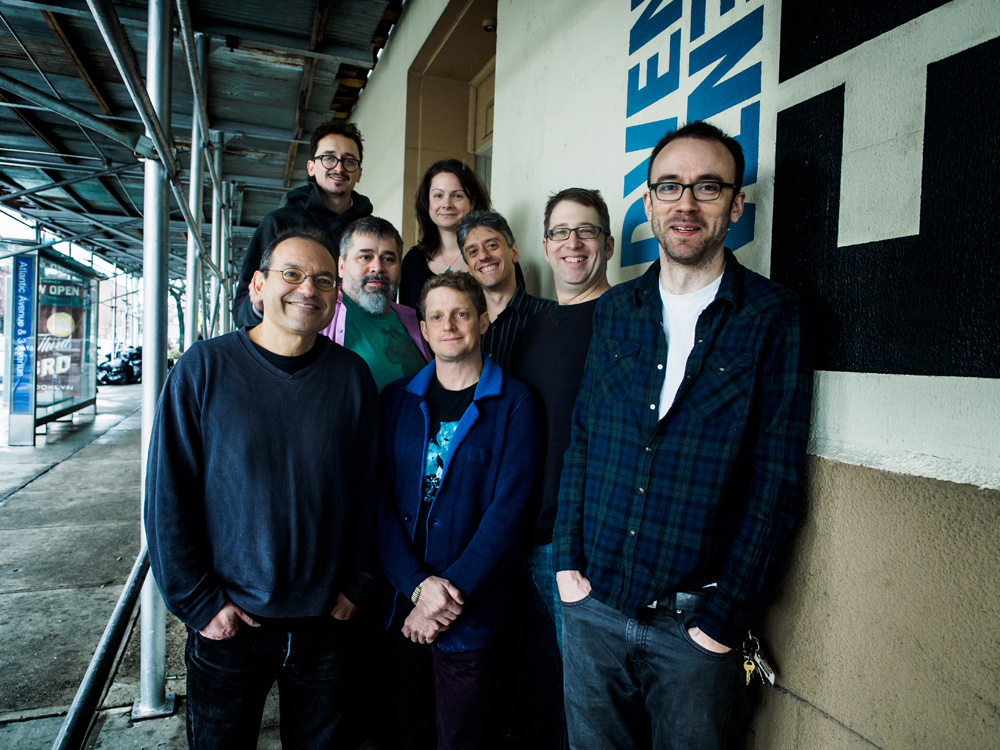
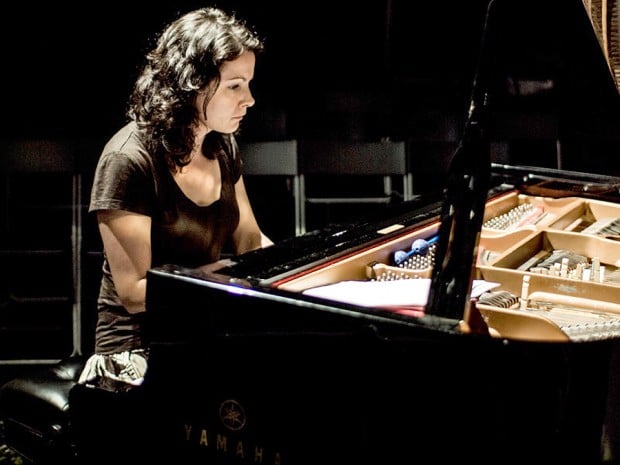
Composer and pianist Kris Davis, over the past 12 years since her debut CD appeared on Fresh Sound New Talent ("Life Span"), has grown in ways one might not have expected. Her solo piano recordings reveal an artist always searching for new ways to express herself, the Trio dates find her and rhythm section avoiding cliches, and her work with Ingrid Laubrock and Tyshawn Sorey in Paradoxical Frog is indescribably audacious. Her arrangements for Tony Malaby's 2011 recording "Novela" (where she worked with 4 reeds, 3 brass, drums and piano, set the stage for her new project "Infrasound" an octet that features 4 clarinetists (Ben Goldberg, Oscar Noriega, Joachim Badenhorst, and Andrew Bishop), guitarist Nate Radley, organist Gary Versace, drummer Jim Black, and her piano. There is a video on Ms. Davis' website that tells the story behind the group and recording (watch it here) - the octet had not worked together as a unit until the night before its first gig and went into the recording studio the day after the gig!
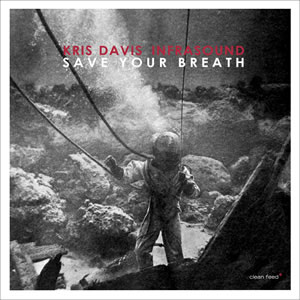
That written, her new recording - "Save Your Breath" (Clean Feed Records) - is a tribute to the talent of the musicians, to her arrangements, to her music that allows the ensemble to explore textures and rhythms, to the way silence and noise are a part of the mix and to how the lower reeds (bass clarinets and contrabass clarinets) are utilized. Opening with "Union Forever", which slowly moves towards a melody not unlike the chorus of "The Battle Cry Of Freedom" but not before introducing all the musicians. Black is often the spark plug, punching and jabbing, goosing the band forward. After the band drops out, a lonely clarinet plays above tolling piano chords. Davis' arrangement also has the organ moving in and out the mix, Versace's burbling lines adding a different flavor to the music. Is that accordion on the introduction of "Always Leave Them (Wanting More)", it's ethereal high notes drifting above the piano and increasingly powerful drums. Radley's guitar serves a similar purpose to the accordion, weaving in and out of the sounds from the reeds and the powerful piano chords. Slowly, the piece builds with the drums and piano in a fiery interchange while the clarinets keen quietly. Suddenly, the piece falls into a soulful rhythm for Noriega's powerful solo. "Whirly Swirly", which first appeared on Ms. Davis' 2014 Trio CD "Waiting For You To Grow", is a vehicle for Radley's hard-edged solo, over a bass line from Versace and rampaging drums. The piece stops on a dime and becomes extremely quiet, organ swirls and clarinet phrases nearly inaudible unless you sit still. When the band returns, Badenhorst's roaring clarinet is front-and-center over a chordal pattern not unlike a Black Sabbath tune.
The title song closes the program. The longest track (14:50), the sound rarely rises above a whisper, the instrumentalists stepping up and then fading out. Yet it's not an afterthought or an epilogue. Look at the cover photo - the music describes what to must be like to be underwater, to be standing on the ocean floor connected to the world above by ropes, breathing air from a tank, the only sounds being your breathing and whatever is going on in your mind. Each voice in the ensemble contributes to this adventure and it's makes for absorbing listening.
"Save Your Breath" has moments of great beauty and harsh noises ("The Ghost of Your Previous Fuckup" offers much of the latter without ignoring the former), often moving with great force and determination. Considering the time the octet had to rehearse, perform, and record, this is incredibly fine music. I can imagine how pieces could get stronger with more performances (alas, only 2 European dates on Ms. Davis' website) but this recording is mighty good. For more information, go to www.krisdavis.net.
Here's a taste of this fine recording:
Showing posts with label octet. Show all posts
Thursday, May 21, 2015
Thursday, August 14, 2014
August Winds and More
I recommend that, before you listen to "Corduroy" (Little Sky Records), the 3rd CD from guitarist/composer David Ullmann, you go to his website - davidullmann.com/video/ - and check out the video in which and members of his David Ullmann 8 speak about the making of the CD. You'll meet drummer Vinnie Sperrazza, vibraphonist Chris Dingman (both of whom played on his previous album "Falling") plus saxophonist Loren Stillman, clarinetist Mike McGinnis, and cornetist Kirk Knuffke (trombonist Brian Drye and bassist Gary Wang - who also played on "Falling" - round out the octet.) And, you will meet Mr. Ullmann who smiles a lot while talking about his band.
That genial attitude permeates the music on "Corduroy", songs which the composer says were influenced by TV show theme songs from the 1970s (such as "M.A.S.H." and "Taxi"). This music is filled with singable melodies; just try to listen to the title track without wanting to hum along. Sperrazza's fine cymbal work lights up the proceedings on "Ocelot", especially during the fine solos by Drye and McGinnis (both of whom play in The 4 Bags) - the "bang" of the snare drum also stands out when it leads the charge into Knuffke's solo. There's just a hint of Steely Dan in the opening section of "Something You Said" and wonderful West Coast bop turn on "Papaya." Both tracks feature exemplary guitar playing, the former for its quietly rippling single-note runs while Ullmann's rhythm playing shines on the latter (Dingman's vibes solo really impresses as does Stillman's strong alto work and, of course, Knuffke contributes another fine solo.) The soulful ballad "You Can't Go Back" is a well-constructed composition, with a sweet melody, fine harmonies and short solos from the leader, Knuffke and Wang. Still, it's the emotional quality of the song that will resonate long after you finish listening.
The closing track, the aptly titled "Moving On", is also a strong ballad. The piece seems influenced by Wayne Horvitz, especially the voicings of the reeds and brass. The melody moves around the front line before Drye and Stillman play solo lines that weave around each other. Following that, the guitar, bass clarinet and cornet follow the same format until their lines merge and the opening melody returns. It's one of the prettiest pieces you'll hear this year (and, perhaps, for a long time to come).
"Corduroy" is comfortable music, great to get lost in (the passionate playing of Vinnie Sperrazza immediately catches your ear with the melodies a close second). Every musician in the David Ullmann 8 is involved in the success of this music. The music seems to float effortlessly from the speakers, with the perfect balance of fire and calm, solos and ensemble playing. One can understand why David Ullmann smiles so much in the video - you will as well. For more information, go to davidullmann.com.
Pianist Joel Forrester and soprano saxophonist Phillip Johnston started The Microscopic Septet in 1980 as a vehicle for a saxophone quartet with rhythm section. For 13 years (through 1992), they toured and recorded, playing the often quirky tunes of its founders, songs that sound as if there was a juke joint in New York City where the proprietor locked Duke Ellington, Sun Ra, "Fats" Waller and Julius Hemphill into a room and they came with a splendid hybrid. The band's hiatus ended in 2006 and "Manhattan Moonrise" (Cuneiform Records) is the 3rd installment in their comeback. Amazingly, there have only been 2 changes in membership since the band started; Forrester and Johnston recruited the rhythm section of Dave Hofstra (bass) and Richard Dworkin (drums) as well as baritone saxophonist Dave Sewelson with alto saxophonist Don Davis replacing John Zorn (really) in 1981 and tenor saxophonist Mike Hashim joining when the band reformed 8 years ago.
As for the music, there's plenty of variety in the 12 song, 61 minute program. Johnston's sprightly "When You Get in Over Your Head" starts the program with the composer's shifting tempos and stop-on-a-dime changes. He also contributed the super funky "Obeying the Chemicals" that sounds like tune from The Band with an Allan Toussaint horn arrangement with an Albert Ammons-flavored piano solo. The subject is swing on Johnston's "Let's Coolerate One", a jumping jive with a hearty walking bass underneath a fine baritone sax solo followed by a boppish tenor spotlight and a sweet piano solo. His final contribution is "You Got That Right!", a "jump blues" powered by splashing cymbals and thick toned bass lines.
The other 8 compositions belong to Forrester; they range from the subtle "pop" sounds of "No Time" to the bouncing title track, with sections influenced by Thelonious Monk and Artie Shaw. Much more Monk in the slow blues of "A Snapshot Of the Soul" but the horn lines favor Coleman Hawkins. More blues, this time with an Ellingtonian feel, on "Star Turn" while there's a touch of gospel and r'n'b in the bouncy "Hang It On a Line" (the playful melody line and accompanying harmonies are mighty attractive as well.) Dworkin's fat-back drums and Hofstra's buoyant bass lines keep the piece jumping. Smart bow to "Hey Joe" during the baritone solo. The lovely unaccompanied piano solo at the onset of "Blue" does not prepare one for the musical chaos that follows, although the band does teeter on the brink of sanity every now and then. Is that a hint of Bach or Rachmaninoff in the melody line before the band breaks into a New Orleans groove on the final track, "Occupy Your Life"? Whatever it is, the tune has a snaky groove that dances beneath the solos. The composer delivers a heartfelt vocal near the close of the tune, reminding the listener to take control of their destiny.
Thee is something about the gentle anarchy of The Microscopic Septet that does good for one's soul. The band can swing, rock, glide, bounce and keep you guessing from one minute to the next. Their brand of musical joy never sounds stale - "Manhattan Moonrise" is good music that sounds better with each successive listen. For more information, go to www.microscopicseptet.com.
Here's a taste of the title track:
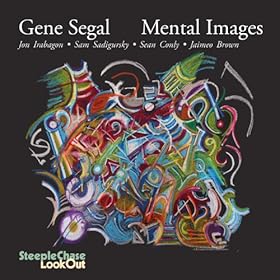
Russian-born and Brooklyn-raised, guitarist/composer Gene Segal studied music at William Paterson University in New Jersey, studying with guitarists Vic Juris, Gene Bertocini and Paul Murphy. He also studied composition with Richard DeRosa. In 2009, he issued his debut CD, "Hypnotic" (Innova) featuring the fine work of organist Sam Barsh and drummer Matt Kane (plus a 3-piece horn section). His 2nd disk, "Mental Images", finds the guitarist on the SteepleChase/LookOut label with another excellent band, this time featuring the front line of Jon Irabagon (alto saxophone) and Sam Sadigursky (tenor sax, clarinet) plus the fiery rhythm section of Sean Conly (bass) and Jaimeo Brown (drums).
Segal, Conly and Jaimeo Brown conjure up James Brown on the super-bad funky opening track,
"Healing Feeling." The deep groove (replete with "wah-wah" guitar comping) supports Irabagon's blazing solo. The leader steps out for his own "fuzzed-up" statement while Sadigursky (on tenor) draws down the intensity level at the start of his solo only to build it back up (with the drummer mightily pushing him on.) The proceedings take a turn for the Platonic on "Allegory of the Cave", a ballad with an Eastern European feel (and the occasional waltz tempo). Sadigursky's woody bass clarinet tones move the band into "Minds Eye", a ballad with great intensity. The clarinet solo twists and turns on the power of Brown's rapid-fire drumming and then joins with the bass and guitar to support a strong drum spotlight.
There's a playful and "free" feel to "Irrational Drives" as well as another intense alto solo while "The Bearded Lady" feels a flowing soprano sax solo from Sadigursky and more powerful drumming. Perhaps my favorite track is the mysterious "Trapeze Act", with its "film noir" feel and splendid clarinet work. In fact, Sadigursky dominates the first 2/3rds of the piece yet Segal's "rock-ish" solo stands out as well.
By the time you reach the "avant-blues" of the last track "Elephants", you realize that no 2 tracks sound the same and that Jaimeo Brown can be a game changer with his powerful drum work. Gene Segal is no slouch on his instrument not only when he is guiding the band through the pieces with his strong chordal support but also when he takes the spotlight. His background work often suggests the influences of both Bill Frisell and former teacher John Abercrombie but Segal is very much his own man. "Hypnotic" was quite good but "Mental Images" is a giant step forward. For more information, go to www.genesegal.com.
That genial attitude permeates the music on "Corduroy", songs which the composer says were influenced by TV show theme songs from the 1970s (such as "M.A.S.H." and "Taxi"). This music is filled with singable melodies; just try to listen to the title track without wanting to hum along. Sperrazza's fine cymbal work lights up the proceedings on "Ocelot", especially during the fine solos by Drye and McGinnis (both of whom play in The 4 Bags) - the "bang" of the snare drum also stands out when it leads the charge into Knuffke's solo. There's just a hint of Steely Dan in the opening section of "Something You Said" and wonderful West Coast bop turn on "Papaya." Both tracks feature exemplary guitar playing, the former for its quietly rippling single-note runs while Ullmann's rhythm playing shines on the latter (Dingman's vibes solo really impresses as does Stillman's strong alto work and, of course, Knuffke contributes another fine solo.) The soulful ballad "You Can't Go Back" is a well-constructed composition, with a sweet melody, fine harmonies and short solos from the leader, Knuffke and Wang. Still, it's the emotional quality of the song that will resonate long after you finish listening.
The closing track, the aptly titled "Moving On", is also a strong ballad. The piece seems influenced by Wayne Horvitz, especially the voicings of the reeds and brass. The melody moves around the front line before Drye and Stillman play solo lines that weave around each other. Following that, the guitar, bass clarinet and cornet follow the same format until their lines merge and the opening melody returns. It's one of the prettiest pieces you'll hear this year (and, perhaps, for a long time to come).
"Corduroy" is comfortable music, great to get lost in (the passionate playing of Vinnie Sperrazza immediately catches your ear with the melodies a close second). Every musician in the David Ullmann 8 is involved in the success of this music. The music seems to float effortlessly from the speakers, with the perfect balance of fire and calm, solos and ensemble playing. One can understand why David Ullmann smiles so much in the video - you will as well. For more information, go to davidullmann.com.
Pianist Joel Forrester and soprano saxophonist Phillip Johnston started The Microscopic Septet in 1980 as a vehicle for a saxophone quartet with rhythm section. For 13 years (through 1992), they toured and recorded, playing the often quirky tunes of its founders, songs that sound as if there was a juke joint in New York City where the proprietor locked Duke Ellington, Sun Ra, "Fats" Waller and Julius Hemphill into a room and they came with a splendid hybrid. The band's hiatus ended in 2006 and "Manhattan Moonrise" (Cuneiform Records) is the 3rd installment in their comeback. Amazingly, there have only been 2 changes in membership since the band started; Forrester and Johnston recruited the rhythm section of Dave Hofstra (bass) and Richard Dworkin (drums) as well as baritone saxophonist Dave Sewelson with alto saxophonist Don Davis replacing John Zorn (really) in 1981 and tenor saxophonist Mike Hashim joining when the band reformed 8 years ago.
As for the music, there's plenty of variety in the 12 song, 61 minute program. Johnston's sprightly "When You Get in Over Your Head" starts the program with the composer's shifting tempos and stop-on-a-dime changes. He also contributed the super funky "Obeying the Chemicals" that sounds like tune from The Band with an Allan Toussaint horn arrangement with an Albert Ammons-flavored piano solo. The subject is swing on Johnston's "Let's Coolerate One", a jumping jive with a hearty walking bass underneath a fine baritone sax solo followed by a boppish tenor spotlight and a sweet piano solo. His final contribution is "You Got That Right!", a "jump blues" powered by splashing cymbals and thick toned bass lines.
The other 8 compositions belong to Forrester; they range from the subtle "pop" sounds of "No Time" to the bouncing title track, with sections influenced by Thelonious Monk and Artie Shaw. Much more Monk in the slow blues of "A Snapshot Of the Soul" but the horn lines favor Coleman Hawkins. More blues, this time with an Ellingtonian feel, on "Star Turn" while there's a touch of gospel and r'n'b in the bouncy "Hang It On a Line" (the playful melody line and accompanying harmonies are mighty attractive as well.) Dworkin's fat-back drums and Hofstra's buoyant bass lines keep the piece jumping. Smart bow to "Hey Joe" during the baritone solo. The lovely unaccompanied piano solo at the onset of "Blue" does not prepare one for the musical chaos that follows, although the band does teeter on the brink of sanity every now and then. Is that a hint of Bach or Rachmaninoff in the melody line before the band breaks into a New Orleans groove on the final track, "Occupy Your Life"? Whatever it is, the tune has a snaky groove that dances beneath the solos. The composer delivers a heartfelt vocal near the close of the tune, reminding the listener to take control of their destiny.
Thee is something about the gentle anarchy of The Microscopic Septet that does good for one's soul. The band can swing, rock, glide, bounce and keep you guessing from one minute to the next. Their brand of musical joy never sounds stale - "Manhattan Moonrise" is good music that sounds better with each successive listen. For more information, go to www.microscopicseptet.com.
Here's a taste of the title track:
Russian-born and Brooklyn-raised, guitarist/composer Gene Segal studied music at William Paterson University in New Jersey, studying with guitarists Vic Juris, Gene Bertocini and Paul Murphy. He also studied composition with Richard DeRosa. In 2009, he issued his debut CD, "Hypnotic" (Innova) featuring the fine work of organist Sam Barsh and drummer Matt Kane (plus a 3-piece horn section). His 2nd disk, "Mental Images", finds the guitarist on the SteepleChase/LookOut label with another excellent band, this time featuring the front line of Jon Irabagon (alto saxophone) and Sam Sadigursky (tenor sax, clarinet) plus the fiery rhythm section of Sean Conly (bass) and Jaimeo Brown (drums).
Segal, Conly and Jaimeo Brown conjure up James Brown on the super-bad funky opening track,
"Healing Feeling." The deep groove (replete with "wah-wah" guitar comping) supports Irabagon's blazing solo. The leader steps out for his own "fuzzed-up" statement while Sadigursky (on tenor) draws down the intensity level at the start of his solo only to build it back up (with the drummer mightily pushing him on.) The proceedings take a turn for the Platonic on "Allegory of the Cave", a ballad with an Eastern European feel (and the occasional waltz tempo). Sadigursky's woody bass clarinet tones move the band into "Minds Eye", a ballad with great intensity. The clarinet solo twists and turns on the power of Brown's rapid-fire drumming and then joins with the bass and guitar to support a strong drum spotlight.
There's a playful and "free" feel to "Irrational Drives" as well as another intense alto solo while "The Bearded Lady" feels a flowing soprano sax solo from Sadigursky and more powerful drumming. Perhaps my favorite track is the mysterious "Trapeze Act", with its "film noir" feel and splendid clarinet work. In fact, Sadigursky dominates the first 2/3rds of the piece yet Segal's "rock-ish" solo stands out as well.
By the time you reach the "avant-blues" of the last track "Elephants", you realize that no 2 tracks sound the same and that Jaimeo Brown can be a game changer with his powerful drum work. Gene Segal is no slouch on his instrument not only when he is guiding the band through the pieces with his strong chordal support but also when he takes the spotlight. His background work often suggests the influences of both Bill Frisell and former teacher John Abercrombie but Segal is very much his own man. "Hypnotic" was quite good but "Mental Images" is a giant step forward. For more information, go to www.genesegal.com.
Subscribe to:
Posts (Atom)