Showing posts with label Soundcloud. Show all posts

Tuesday, October 31, 2017

One, Two, & Three

In this year of the Thelonious Monk Centennial, there is no more fascinating tribute than "Solo: Reflections and Meditations on Monk" (Tum Records) from trumpeter Wadada Leo Smith. Just trumpet.  Smith, who is a major force on the creative music scene (and has been since the early 1970s), interprets four Monk classics ("Ruby, My Dear", "Reflections", "Crepuscule With Nellie", and "'Round Midnight") plus creates four original "reflections" of his own inspired by his relationship to Monk's music.  Beautifully recorded over three sessions (in November of 2014 and August 2015), the package includes excellent notes by Smith and a fairly extensive bio.

Paul Ryan Photography
So much stands out on this very personal recording. Start with how in this setting, one can hear how the blues infiltrates Monk's music. Note how beautifully the trumpeter blends sounds and silence - there are many moments that the listener hangs on the notes, even after they fade.  One also hears how this music connects with the philosophies of the AACM and with Smith's creative philosophies as well as with the sounds of another creative musician celebrating his 100th birthday, John Birks "Dizzy" Gillespie.  The avid Monk fan knows that both Dizzy and Miles Davis recorded "'Round Midnight" yet the performance here apes none of the numerous recordings and live concert versions.  The plaintive melody pours over the listener; Smith takes his time, caressing each note who producing a sound that is so intimate on an instrument that can shake the rafters.

The original pieces range from the intense yet tender "Monk and His Five Point Ring at The Five Spot Café" to the gentle ballad "Adagio: Monkishness - A Cinematic Vision of Monk Playing Solo Piano." That latter track is quiet, with notes that ring out, gently fade, and create a heartfelt melody.  "Adagio: Monk, the Composer in Sepia - A Second Vision" is not only influenced by the blues of a Monk ballad but also by the "muted" tones of old photographs of the pianist. The muted trumpet sounds fragile but sympathetic, with strength in the higher notes.  Following that is a piece inspired by a dream: "Monk and Bud Powell at Shea Stadium - A Mystery" unites the two pianists, great friends, both who dealt with ailments, who were stalked by the police as well as demons, yet who created such vital music. The playful quality that Smith interjects into this piece reflects the creative adventure of the pianists. Still, as the piece comes to its close (it sounds as if the music ends in the middle of a phrase), one can hear both musicians lives were often interrupted.

"Solo" Reflections and Meditations on Monk" is music to savor, to sit and breathe in, to inhabit.   Once you surrender to the sounds, you grow to not only appreciate the immense contributions that Thelonious Monk made to contemporary music but also how Wadada Leo Smith made his explorations of this man and his music personal and universal at the same time.

For more information about this other TUM recordings, go to tumrecords.com/053-solo-reflections-and-meditations-on-monk.


In many big cities around the world, there are jazz clubs and other venues that stay open very late, well into darkness of the new day. Even if you have not spent time in one of these often intimate performance spaces, you probably have hear the music created in the last set of the evening can be extremely powerful, personal and, often, quite romantic.

Listening to the nine songs on "The Late Set", the new Anzic Records album from vocalist Hilary Gardner and pianist Ehud Asherie, one is transported to a late-night joint: the tables are close together, almost all of them near the bandstand, with candles burning down to their final moments, and several nearly-empty glasses that the listeners are caressing gently.  The songs were not chosen to spotlight the many talents of the duo but to tell stories that an audience can connect to.  Perhaps it's the loneliness of Lorenz Hart and Richard Rodgers's "A Ship Without a Sail" or the sweet reverie of "I Never Has Seen Snow" (from the musical "House of Flowers", music by Harold Arlen and words by Truman Capote) but Ms. Gardner and Mr. Asherie caress each tune, making sure the melody is given its due and you can hear every word.

After you've taken in these classic tunes (all composed between 1928 and 1950), then listen to how fine an accompanist and soloist Mr. Asherie in. There are touches of Thelonious Monk on the opening "Shadow Waltz" and Fats Waller on "After You've Gone"; also notice how he sets the mood on pieces such as the tender ballad  "Seems Like Old Times" or the jauntiness he infuses into Irving Berlin's "I Used to Be Color Blind." On the latter tune, he accompanies the vocal with a countermelody that is a perfect match for the joyful vocal.  The duo returns to Hart & Rodgers for the spunky "Everything I've Got", a delightful story of a love-struck but determined woman and her philandering boyfriend.  The joy in both the vocal and the piano are infectious!

If you are not moved by the sassy, sexy, seductive, and swinging version of "Sweet and Slow" (from the prolific team of Al Dubin and Harry Warren), you might want to go to the doctor.  Yes, it's about slow dancing late at night but not only on the dance floor.  Though one of the earliest versions of this song was recorded by Fats Waller, the piano accompaniment displays the influence of George Gershwin.

"The Late Set" is a delight from start to finish. Hilary Gardner has such a mature, honest, and, yes, playful voice while Ehud Asherie is such an intelligent accompanist, partner, and soloist.  If younger listeners want to understand the power of the Great American Songbook and how songs not only captured the hearts of many listeners but also their imaginations, this album is one of the best contemporary showcases of that power.

For more information, go to www.hilarygardner.com/the-late-set/

Here's a splendid tune from the album:


Violinist and composer Sam Bardfeld graduated from Wesleyan University in 1990. He had studied with a number of people while there including jazz saxophonist Bill Barron.  He played (and still plays) all sorts of music, from Latin and Afro-Cuban to the avant-garde works of Anthony Braxton and John Zorn to the Americana of Bruce Springsteen.  While he has recorded with the likes of Johnny Pacheco, Roy Nathanson & The Jazz Passengers, and Joel Harrison, the arrival of "The Great Enthusiasms" (BJU Records) is a delightful surprise.  It's his first CD as a leader since 2005 and features the dynamic pianist Kris Davis and intelligent yet playful percussionist Michael Sarin.

The opening track, "Fails While Daring Greatly", takes its name from President Richard Nixon's resignation speech and sets the tone for the entire program. The piece has a medium-tempo shuffle beat, a jaunty melody, and delightful interplay.  Ms. Davis lays out while the violinist and drummer dance about, returning to the shuffle rhythm at the close of the solo before stepping out with a Monk-like dancing solo.  Sarin is the glue of the music but also serves as a provocateur throughout.  His "second-line" bounce enlivens "Resignation Rag", a platform for the leader's swooping violin lines.  That beat makes the "resignation" more of a "celebration" (remember that the "second line" shows up on the way home from a New Orleans funeral).  Ms. Davis's unaccompanied solo is a treat; she messes with the tempos, moves from percussive sounds to melodic fragments, and, when the drummer returns, leads hi a chase through the middle of the performance.  The title track manages to combine traces of "country swing" fiddle music and the Teutonic beats of Kurt Weill, leading the listener through challenging yet enjoyable passageways.

BJU Records
Beside the five Bardfeld originals, the trio "covers" two pieces from the 1970s.  Bruce Springsteen's "Because the Night" was a Top 10 "smash" for Patti Smith - here, the melody is deconstructed, made darker and somewhat scarier by the unaccompanied piano solo plus listen to how the violinist leads the trio back into the melody in frenetic fashion. The funky take of Robbie Robertson's "King Harvest Has Surely Come" (the song that closes the classic second album by The Band) rides on the powerful drums and Ms. Davis's left hand.  Bardfeld soars over the rhythm section until he and Sarin drop for an impressionistic and solemn piano solo that takes the piece out (and takes the listener's breath away).

There's plenty of melody, rhythms, interactions, humor, and sadness spread throughout "The Great Enthusiasms"; much of that surprises the listener first time through but, once you return for several more journeys through this daring program, you begin to understand that this music displays the leader's myriad influences without being beholden to any of them.  Kris Davis and Michael Sarin are perfect partners for the"dancing on the edge" approach of this music.  The music of Sam Bardfeld dazzles, delights, and definitely deserves to be heard.

For more information, go to www.sambardfeld.com.

Check out the title track:

Tuesday, April 25, 2017

Strong Music, Subtle Message

Trumpeter David Weiss leads two of the most dynamic bands playing these days and nights. As a player, he takes a bit of a back seat in The Cookers (the septet with Billy Hart, George Cables, Billy Harper, Eddie Henderson, Cecil McBee, and Donald Harrison) - Weiss is much more prominent in Point of Departure, a quintet (plus guests) that takes its name from an Andrew Hill composition (and album).  This group mines music from the late 1960s and early 70s from composers like Hill, Tony Williams, Wayne Shorter, and two men closely associated with the Detroit music scene of that time, pianist Kenny Cox and trumpeter Charlie Moore.  Those two musicians, who recorded as the Cox and The Contemporary Jazz Quintet, had a big effect of Weiss and he has recorded a number of their pieces with Point of Departure.

"Wake Up Call" (Ropeadope) is the ensemble's fourth CD. The 9-song program is broken into three sections, "I. Prologue", "II. Unfinished Business", and "III. New Beginning".  Judging by the power of the music, I believe that Weiss is telling his audience that these songs, many of them from the raucous years of the late 1960s, are indicative of the turmoil in this country at that time and how they reflect these troubled times. Besides Weiss on trumpet (and Fender Rhodes on 2 tracks), Point of Departure is composed of Matt Clohesy (bass), Ben Eunson (guitar), Myron Walden (tenor sax on 6 tracks), J.D. Allen (tenor sax on 3 tracks), Nir Felder (guitar on 3 tracks), Travis Reuter (guitar on 6 tracks) and, for my money, the most important element in the group, drummer Kush Abadey. The drummer, who first came to critical notice at the age of 16 when he joined Wallace Roney's group, has worked with Terence Blanchard, Chris Potter, Tomasz Stanko and many others.

The album opens with "Sanctuary", a John McLaughlin songs from the Mahavishnu Orchestra'a 1973 album "Birds Of Fire."  The music starts slowly but soon Abadey plus guitarists Eunson and Reuter are creating a roiling rhythm for Walden's intense solo.   "..Unfinished Business" begins with Wayne Shorter's "Two Faced", a song first recorded by the Miles Davis Quintet in 1968, appearing on 1976's "Water Babies". At 12:22, it's the longest track and takes its time to build up steam - there are strong solos from Weiss and Allen, both fairly long and both feeding off the energy of the rhythm section.  Two songs from Charles Moore follow, the funky uptempo "Multidirection"(reminiscent, at times, of "Theme from Shaft") and the delightful ballad "Noh Word." On the latter track, Allen's soulful solo rolls into Felder's, a more impressionistic take over the powerful drums.

The third, and longest, section, "New Beginning" opens with Joe Henderson's "Gazelle" (recorded in 1970) - the piece rides the rampaging drums (listen to Abadey under Walden's fiery tenor solo) and percussive guitar. Cox's "Sojourn" has an understated power, pushed by the rhythm section and the counterpoint of the guitars. Perhaps the most fascinating cut in the program is "Sonhos Esquecodos" from Brazilian composer Lelo Nazario (recorded in 1982 as a member of Grupo Um).  Sandwiched between two pieces by Tony Williams, the song has a long rubato beginning (yet listen to the power of Abadey) with trumpet and saxophone playing the melody (actually sounds like a tune Weather Report may have produced in its early years). Once the piece settles into a groove, Reuter's hard-edged solo ratchets up the intensity.

"Wake Up Call" is intense music, so much so that even the quieter moments have great power. Listen to this music for its messages, for the solos, for the amazing work of Kush Abadey and Matt Clohesy, for the smart two-guitar work, and for its power.  David Weiss & Point of Departure wants you to get off your feet and let the music created here push you to action.

For more information, go to davidweissmusic.com/projects/david-weiss-point-of-departure/.

Take a listen:


Tenor and soprano saxophonist Jason Rigby, from Cleveland, Ohio, is a busy musician and educator. He leads or co-leads four groups and is currently an Assistant Professor of Jazz/Commercial Saxophone at Towson University in Maryland. His third album as a leader, "One: Detroit - Cleveland Trio" (Fresh Sound New Talent), features the rhythm section of bassist Cameron Brown and drummer Gerald Cleaver, both of whom hail from the Motor City and recorded with Rigby on his 2009 FSNT album "The Sage."  In fact, Brown was also on Rigby's 2006 debut for Fresh Sound, "Translucent Space."


Right from the opening moments, "One" is a treat for lovers of saxophone trio music. "Dive Bar" is a duet for tenor and drums - Cleaver opens the piece with a short introduction, a thunderous setting for Rigby to enter with a melody not unlike the initial theme of Sonny Rollins's "Freedom Suite."  The power of the drums and the writhing saxophone lines sink their hooks into the ears of the listener and do not let go for seven minutes. Brown leads the trio in on ""Dorian Gray" with a three-note bass line then joins Rigby to play the theme. The tension created by the rhythm section gives the tenor plenty of room to play around. Rigby is a strong player but not a "shouter" or ""screamer", there's a subtlety to his lines that give a song like "Live By The Sword" its focus yet his phrases hint at the work of Albert Ayler - listen to Brown and Cleaver as they freely navigate underneath. Both musicians stoke the fires of this music without losing control or direction.

Yet, there are quieter moments with strong melodic flourishes.  The Richard Rodgers - Lorenz Hart standard "You are Too Beautiful" (composed in 1931 for Al Jolson) starts off quietly with Rigby emphasizing the melody and building his solo from the theme. Pay attention to the great counterpoint of Brown and the sweet brush work of Cleaver.  The saxophonist goes solo on the Gershwin's "Embraceable You", creating a mini-symphony and taking his time to reference the melody. He breaks out the soprano sax for Herbie Hancock's "Speak Like a Child", playing the melody against Brown's excellent counterpoint and Cleaver's splendid cymbal playing.  Rigby's solo is mesmerizing, short phrases repeated, bouncing off the low notes of the bass, twisting around the poly-rhythms of the drums, and slowly picking up in intensity but never boiling over.

"One" is a good title. Yes, this is a trio recording but the musicians approached the session of one mind; to play hard, smart, and together.  One can hear plenty of "freedom", with the sax, drums, and bass seemingly going in three directions at the same time but never at cross purposes. Listen to the music of Jason Rigby: The Detroit - Cleveland Trio with open ears and you will be rewarded many times over.

For more information, go to www.jason-rigby.com.

Enjoy the opening track:

Sunday, February 12, 2017

Immigrants Songs

In this heightened time of insecurity about immigration in the United States, we often forget why people risk their lives to come here. Whether their reasons include escaping harsh treatment or to follow dreams, mothers, fathers, son and daughters still cross numerous borders to build new existences.

In the instance of Žan Tetičkovič, his is a story of following his dreams from his native Slovenia to study music in New York City. The drummer and composer who goes by the name Jean John has self-released his debut American album.  Titled "The Port of Life", he started creating the 15 track-75 minute program on his arrival in the New World in 2011 to study at The New School.  The handsome booklet includes "The New Colossus" by poet Emma Lazarus which features the lines emblazoned on our minds "Give me your tired, your poor, your huddled masses yearning to breathe free." Jean John returned home to  record the album with a septet that includes Alba Nacinovich (vocals), Lenart Crečič (tenor saxophone), Tomaž Gajšt (trumpet, flugelhorn), Jani Moder (guitar), Marko Črnčec (piano - he has an album for Whirlwind Recordings), and Myles Sloniker (acoustic bass) plus the Janus Atelier String Quartet (violinists Matija Crečič and Nejc Avbelj, violist Barbara Grahor, and cellist Zoran Bičanin).

The music tells of the composer's arrival in New York with the first two tracks including the instrumental "The Port of Life, Dusk" followed by "The Narrows Gateway" which is a sonic adventure of landing at Customs.  The first track features the entire ensemble on an uptempo piece that musically tells the story of the immigrant standing on the deck looking at his destination.  With the wordless vocal and uplifting melody, the music has the sound of the Pat Metheny Group as the rhythm section really pulls the band forward with the guitar and voice leading the way while the trumpet, saxophone, and string quartet color the melody.

The next 11 tracks comprise the "Acculturation Suite", a song cycle that blends sounds, voices, short tracks, longer cuts and powerful musicianship.  Opening with "Prelude", an introspective work played by the String Quartet, the Suite follows the drummer through his "Farewell" to the "Euphoria" of following his dream to "Collapse", the realization of how hard it is for someone to uproot himself and how alone he feels. The Strings return for "Intermezzo", a musical real to reflect on the journey and resettlement. The second half of the Suite includes "Alienation" (perhaps a pun) as the composer continues his search.  The music is not as dark as "Collapse", there seems to be light at the end of this tunnel.  Sloniker's powerful and melodic bass introduces "Adjustment"; joined by John's funky drums, the song moves forward on a slinky melody line with the saxophone and guitar leading the way. The leader introduces the last piece in the Suite, "A New Beginning", with a staggering drum solo that slows down and softens for the main melody.  The strings rise in on an circular line played by guitar and piano.  When the rest of the group enters, the music takes off on a celebration of the new "home", the composer nows has his feet on solid ground and his joy rises to the heavens. Once the festivities come to a close, the ensemble returns for the final track, "The Port of Life, Dawn". The voice and piano open as if praying and so does the String Quartet; the music is a reverie that, after five minutes, allows the rhythm section and guitarist to enter. As the music rises to its climax, all the instruments reenter in a triumphant "shout."

Jean John layers certain tracks with sounds and effects plus one particularly strong statement about immigration ("...our origin story") from President Obama, all the more powerful since his presidency ended.  On of the ironies of "The Port of Life" is the composer went back to Slovenia to record the album but the distance from his adopted home makes the music even more powerful.  The ensemble not only interprets the music but imbues much of it with their own desires and their appreciation for John's accomplishments.

Perhaps part of my enjoyment of this album comes from the numerous times I, a second generation American, have attended the Naturalization Ceremony in my home town, a day when immigrants become citizens. It's touching, life-affirming, and it's a bit humbling. "The Port of Life" is an impressive story of determination, of talent, of desire, and of fortitude.  Give it a listen.

For more information, go to www.jean-john.com.

Here's a taste of several tracks:


Vocalist, composer, and arranger Jihye Lee was born in Seoul, South Korea, and came to the United States to study at the Berklee College of Music in Boston, MA. And study she has done, learning from Ayn Inserto, private lessons from Maria Schneider and Terence Blanchard, and workshops with John Clayton and Robin Eubanks. Since graduation from Berklee, Ms. Lee is completing graduate work at the Manhattan School of Music under the tutelage of Jim McNeely.

With the help of Berklee Professor and trumpeter Greg Hopkins, she assembled a 19-piece orchestra (students and teachers) to record "April" (self-released), her first American album.  Much of the music Ms. Lee created for this project came in response to the sinking of the Korean ferry Sewol which took the lives of over 300 of the 476 passengers and crew; the majority of those who perished were teenage students.  Yet, the songs, while they have elegiac moments, are not filled with anger or long stretches of sadness. The album takes its title from the lovely opening track which is also the month of the tragic event that spurred the composer into action.  But the music, unlike the month T.S. Eliot described in "The Wasteland", as "the cruelest month" is filled with promise, with new life springing out of the earth, days are longer and beginning to be warmer; one hears joy in the dance created by Shannon LeClaire (alto sax) and Allan Chase (soprano sax) and no inkling of the tragedy to follow.

photo: Keith Davis
As this music tells its story, one person's reactions to events happening a world away in her native land, most of the tracks are not centered around solos, save for the longest  on the program.  "Sewol Ho" (12:52) moves away from its opening theme, building to a dissonant climax; then, five "voices" step up to tell their "stories" ranging from the duet of co-producer Hopkins (trumpet) and Jeff Galindo (trombone) to the conversation of Ben Whiting (bass clarinet) with Ms. LeClaire (clarinet) and, finally, Rick DiMuzio (soprano sax) takes the song out. Various instrumental voices move in and out of the melody on "Deep Blue Sea" and, in several instances, it's the sections that carry the melody. DiMuzio solos, this time on tenor sax, and he moves easily over the rhythm section and around the colors provided by the brass and reeds.  He returns to solo on tenor on the following track, "Whirlwind", a piece that is more uptempo and nervous, almost hyper. But he and pianist Alain Mallet are, at turns, calm in this storm as they convey how one can create an emotional oasis in times of heightened tension.

Sean Jones (pictured left) joins the ensemble for the final track, the lovely ballad "You Are Here (Every Time I Think of You)", how flugelhorn carrying both the melody and as the only solo voice.  The song opens with the reeds sans rhythm section playing the initial theme, the flutes frame Jones's melody, dropping away as he moves through the verse into his solo.  The reeds and brass take over for a chorus and Jones returns, this time taking flight as the sections move in and out behind him.  Stick around for the lovely coda - first, Jones goes it alone and then the ensemble, led by the reeds and brass return to take the piece out with Jones moving over the sound in a flurry of notes.

"April" is an impressive introduction to Jihye Lee, a composer and arranger (she studied vocal performance at Berklee and adds wordless vocals to several tracks here) who channeled her emotions to create this music that celebrates life, rarely pausing to mourn. How does one deal with loss of this proportion, a tragedy taking the lives of so many young people?  It's an unanswerable question yet the music serves as a balm.

For more information, go to jihyemusic.com.

Here's the last track from the album:

Wednesday, February 1, 2017

CD Release Party & Noted Tenor in Old Lyme

It was 49 weeks ago (give-or-take) that saxophonist Mike Casey (alto and tenor) brought his Trio to The Side Door Jazz Club in Old Lyme to record his debut album.  Joining him onstage was bassist Matt Dwonszyk and drummer Corey Garcia, his "regular unit' for the past three years. The two sets included originals from the saxophonist and drummer plus pieces by "classic" saxophonists Ornette Coleman, John Coltrane, and Jackie McLean (who founded the Institute at the Hartt School of the University of Hartford where Casey studied with Abraham Burton, Rene McLean and Steve Davis, among others).

The album, "The Sound of Surprise: Live at The Side Door" (self-released) comes out on February 7 and the Trio celebrates its release this Friday (2/03) at the very venue where they recorded.  The recording is quite "hot" with the bass and drums on equal sonic footing as the saxophone.  It's obvious this is a working band as one can tell these musicians are conversing, challenging, and supporting each other throughout the performance.  Dwonszyk stands out as quite a melodic player when he solos as well as laying down a solid bottom for his cohorts to build upon.  Garcia is impressive as well; the African rhythms he sets up on the opening track, "Hydraulics" (which the drummer composed), brings to mind Art Blakey's powerful work with his Jazz Messengers. The leader shines as well, with solos that not only push against the sounds produced by the bass and drums but also ride on their flow. Casey's alto solo on McLean's "Little Melonae" is a gem; at one point, his interaction with Dwonszyk features a smart bit of counterpoint amidst the "walking" bass lines. Another highlight is the original "Dagobah", with the tenor suggesting Coltrane as the rhythm section roils below.

Casey has been busy over the last year, not only working on producing the album (crowd-funded) but teaching, playing with the Trio and working with other ensembles.  I like the fact that his debut is a live album, the Trio did not try for perfection in the studio, opting instead to illustrate how a "live" show gives a truer representation of a working group.

The Mike Casey Trio hits the stage at 8:30 p.m. For tickets to the show and more, go to thesidedoorjazz.com.  To learn more about Mr. Casey and get links to purchase the album, go to www.mikecaseyjazz.com.

Give a listen to "Hydraulics":


photo by Erika Nj Allen
I would be tempted to stay overnight at The Old Lyme Inn (which houses The Side Door) because on Saturday, tenor saxophonist and composer J.D. Allen will perform with his Trio. Although neither the venue's website or Mr. Allen's site lists the personnel, he usually plays with bassist Gregg August and drummer Rudy Royston.  Their latest album together, "Americana: Musings on Jazz and Blues" (Savant Records), was issued in May of last year to great critical acclaim, the latest in a series of recordings that posit Allen as one of the finer contemporary composers and musicians.  His pieces, rooted in the blues, are quite melodic, have flowing rhythms, his sound hearkening back to the approaches of John Coltrane and Sonny Rollins without imitating either player (or anyone else, for that fact).

The J.D. Allen Trio will play two sets, the first commencing at 8:30 p.m.  For reservations to the show, go to the website above or call 860-434-2600.

Here's a taste of the Trio's latest recording to get you in the spirit:

Saturday, August 29, 2015

Potent Quartets

There was a thread going around Facebook earlier this summer asking about saxophonists who have been inspired by Charles Lloyd.  I could not think of one (although I'm sure they exist) until I heard the new recording by Ochion Jewell.  It's not that he sounds like the man from Memphis, TN, but the musical structures and the influences of both world music and folk/blues in the music of the Kentucky native (he grew up in Appalachia) has, in my ears, has many similarities.

"Volk" (self-released) is young Mr. Jewell's second CD with his Quartet - his debut, "First Suite for Quartet", was issued on David Binney's Mythology label and is quite hard to obtain. The opening track, "At The End of the World", is called by the composer "the overture to the album" setting the stage with its dramatic presentation (hear it below). One hears the influence of Spanish music is the conversation between the members of the Quartet. And, what a responsive band, the same musicians as on the debut including pianist Amino Belyamani (Dawn of Midi), bassist Sam Minaie (Tigran Hamasyan), and drummer Qasim Naqvi (Dawn of Midi, Burnt Sugar The Arkestra Chamber).  The 3 also play together as the Axis Trio. They are a integral part of telling the majority of the 10 stories on the album (Jewell goes it alone on the final track "Black Is The Color of My True Love's Hair").  This music can be extremely powerful, as displayed on in the opening minutes of  "Give Us A Drink of Water" yet the same piece has incredibly quiet passages. And the leader does not even come until after the 4 minute mark of the 11 minute track, then plays a delightfully schizoid solo ranging from bluesy sustained notes to short percussive notes. The tenor solo in the middle of "Radegast" displays an anger, veering into "free" territory yet is followed by one of the prettiest interludes on the album.

Guitarist Lionel Loueke shows up on 2 tracks, the forceful yet subtly exciting "Gnawa Blues" (Gnawa being in West Africa) and the highly rhythmical "The Master" (based on the drumming of the Ewe people of West Africa.)  Loueke's slinky, percussive, sounds meshes well with the Quartet on these tracks - his phrase on the latter track sound much like J.J. Cale in the short melodic mesmerizing phrases. The saxophonist slowly rises out of the piano-guitar interaction joining in the rhythmic lines and quietly adding a phrase here and there but not stepping out.  The song belongs to the rhythm section, Naqvi rampaging drums and Belyamani's throbbing piano.

Minaie's expressive bowed bass introduce the melody of "Shenandoah" then shares it with the tenor. The piano enters, its sweet and plaintive counterpoint supporting the saxophone before playing parts of the melody. Belyamani's sweet solo is variations of the melody line with the quiet cymbals beneath him. When Jewell re-enterts, he also plays abstracts of the melody, some with a touch of swaggers, others with gentle lyricism.  The pianist takes the song out on his own, tenderly reaching the final low chords.

There's beauty, rhythm, energy, melody, counterpoint and splendid interactions throughout "Volk". Ochion Jewell, the composer and arranger, challenges the listener to join in on this journey, to allow the music to seep into one's soul for what is "folk music" but "soul music" in another guise.  The Ochion Jewell Quartet plays this music with great passion, something else they share with Charles Lloyd and his Quartet.  Play this music next to one of Lloyd's post-2000 CDs - the ensembles, with mostly identical instrumentation, do not sound alike but they both play with great joy.

The release date is set for September 29, 2015.  For more information, go to www.ochion.com.


Bassist and composer Daniel Fortin, a native of Peterborough, Ontario, has a new CD - his debut as a leader.  Titled "Brinks" (Fresh Sound New Talent), the 10 original tracks feature the distinctive musical voices of Michael Davidson (vibraphone), David French (tenor saxophone) and Fabio Ragnelli (drums), all (including the leader) deeply involved in the Toronto jazz scene.  They create a program rich in melody, alive with interaction, and smart solos.  The blend of French's clear-toned tenor and Davidson's whirling, full-toned vibraphone creates a handsome atmosphere throughout the program.  Right from the opening moment of the first track, "Verona", one can sense this will be a pleasing journey. French plays the uncomplicated melody while Davidson dances around, Ragnelli creates a pulsating beat and Fortin adds counterpoint (and punch) as he pushes the piece forward.  The saxophonist takes the lead on the following track, "Ends",  while the vibes provide the counterpoint.  But, this music is not as easy to describe as that. The long and involved vibes solo skitters atop the bouncing bass and dancing drums. Fortin's solo is pleasingly melodic and the vibraphone flourishes just divine.

The multi-sectioned "So As To" pulls in the listener, taking one for a fascinating ride while "Smithereen" romps along on Ragnelli's playful yet rock-solid drumming. "Adldmbdld" (now that's a title that alludes spell-check!) moves in the manner of a Gary Burton piece, Fortin's electric bass and Ragnelli's uninhibited drumming propelling the piece forward.  There is a similar excitement in the rhythm on the final track, "But Still and Yet" - the tension between the slow melody line, the high energy of the lines that Davidson is playing, and the propulsive bass and drums is joyous as the sounds spill out of the speakers. Fortin the soloist stands out on the ballad "Flecks" and his interaction with Davidson near the close of the track as the piece speeds up is  infectious

Daniel Fortin, who is one of the three composer/musicians in the cooperative Myriad3, is a strong player who can play percussively along drummer Fabio Ragnelli and then create the most melodic solos. These pieces flow more than swing and several have quite an intensive drive.  A bit of judicious editing (8 songs instead of 10 but which 2 to cut?) might have made "Brinks" a stronger album but it still has much to recommend it.

For more information, go to www.danielfortinthewebsite.com.

Here's a taste to whet your whistle:


Saturday, August 8, 2015

Ensembles Small & Big (August '15)

The second album from the Michael McNeill Trio - "Flight" (self-produced) - opens with a piano solo. Titled "Placid, Ruffled", the piece sets the tone for a program that that is adventurous, intelligent, and highly musical.  The leader is an integral part of the creative music scene in Buffalo, NY, playing in numerous ensembles as well as teaching on various levels. The rhythm section  of Ken Filiano (bass) and Phil Haynes (drums, producer) are improvisers of the highest order, understanding that trio music is conversational and interactive.  You'll hear that in Haynes' sprightly brush work on "Za" and how the drummer gently but firmly propels the music forward on "Picture Window."   Filiano's thick tones and fluid lines provide excellent support and strong counterpoint throughout; his bowed bass work has classic overtones on pieces such as "Wild Geese I: Cloudburst" in which his stormy interactions with the piano create great tension.  His long introduction on "Skies" (nearly half of the 6 minute piece) is exploratory, quivering phrases interspersed with sweeping lines leads to a barely audible piano solo that, to me, is an auditory representation of sunset.

There's the bluesy "No Dice" that may remind some of Keith Jarrett's early trio work and the soulful "In That Number" which slyly shuffles forward on Haynes' exquisite drumming and Filiano's deep low notes and interactive phrases.  McNeill, to his credit, rides, even glides, atop his rhythm section. He's not a showy pianist, more of a sonic "painter" than a "technique freak".  He can certainly swing (he does so quite nicely on "Za" and quite forcefully on "Wild Geese III: Follow Our Sun") yet the manner in which his phrases flow on "Picture Window" illustrates how the pianist listens, reacts and creates within a song.

"Flight" is thoughtful music, interactive music that is seriously playful. Michael McNeill gives his collaborators plenty of creative license throughout; the listener will find much to ponder and enjoy each time the recording unfolds.

For more information, go to www.michaelgraymcneill.com.


"Like It Is" is the 5th album for John Fedchock (trombone, compositions, arrangements) and his New York Big Band, the first one to be released on the MAMA/Summit label. Fedchock first came to national attention in the early 1980s as a member of the Woody Herman Orchestra and went on to work with T.S. Monk, Gerry Mulligan, Louie Bellson, Bob Belden and many others.  The New York Big Band came together over 25 years ago, composed on musicians very active on the contemporary music scene then and now, and released its first CD in 1992.  Powered by the excellent drum work of Dave Ratajczak (a charter member of the band who passed several months after this session), the music hearkens back to Fedchock's days with Herman in its excellent section writing that not only moves the music forward but offers great support to the fine soloists.  The title track, one of 5 Fedchock originals, pairs the the drummer with percussionist Bobby Santabria and the dynamic duo drives the music with great abandon.  There's more of a subtle approach on the trombonist's "Havana", a piece with such a sensuous rhythm and wistful melody plus strong solos from the leader and flutist Mark Vinci. When the brass and reeds sweep in after the solos, it's like a warm breeze off the Caribbean.  One can just imagine dancers swirling across the floor on Cedar Walton's "Ojos De Rojos", the bounce and attack of the drummer and percussionist propelling the melody, the sections and the soloists with great joy.

There are highlights galore over the 70-minute program. "You and the Night and The Music" opens the recording on a series of high notes, starting with Fedchock's smart arrangement of the melody followed by excellent solos from the leader, Vinci (alto saxophone), Rich Perry (tenor sax) and Ratajczak. Scott Robinson and his eloquent baritone saxophone lead the way on a delightful take on Duke Ellington's "Just Squeeze Me" (with kudos to the delightful bass work of Dick Sarpola). The spirited call-and-response of the brass and reeds on "Just Sayin'" opens to a playful soprano solo courtesy of Charles Pillow while Barry Ries delivers a sweet, soulful, flugelhorn solo on "For Heaven's Sake." The album ends with "Ten Thirty 30", a blazing track whose title refers to the birthday of trumpeter Clifford Brown (1930-1956).  The splendid trumpet solo is courtesy of Scott Wendholt with additional statements from pianist Allan Farnham, Perry and the leader.  Make sure to pay attention to the super work of the rhythm section as they "drive" this piece with abandon.

In a year that has already seen a number of fine "big band" or "jazz orchestra" records, "Like It Is" will appeal to those fans of the Thad Jones-Mel Lewis Orchestra.  The John Fedchock New York Big Band swings is collective butts off and also displays a sweet and mellow side ("Never Let Me Go" is an original ballad whose melody is played by the brass and reeds before the leader delivers a emotionally rich solo.)  Many members of the band work with the large ensembles of Maria Schneider and Ryan Truesdell as well in Broadway "pits" and recording studios. This music goes down easy, like a cool glass of rosé on a warm summer night.

For more information go to www.johnfedchock.com.

Here's the opening track:

Wednesday, June 17, 2015

Large Ensembles 2015 (Part 3)

Composer, arranger, and conductor Ayn Inserto, born and raised in Singapore, moved to the San Francisco Bay Area at the age of 14. She got involved with music in both church and high school, discovering jazz along the way.  After several years in colleges on the West Coast, she transferred to the New England Conservatory of Music in Boston and, most notably, studied with Bob Brookmeyer and George Garzone.

"Home Away From Home" (Neuklang Records) is her 3rd recording, her first since 2009's "Muse" and also her first with an ensemble other than her own Orchestra.  This time around, she's working with the Colours Jazz Orchestra, the brainchild of trombonist Massimo Morganti (whom the composer met at NEC).  He invited her to Italy where she met his ensemble (in existence since 2002) and she knew she wanted ti work with them. Ms. Inserto composed 5 of the 7 tracks, including a smart rearrangement of Joe Henderson's "Recorda Me" and the splendid closer "Subo", a mambo from the pen of Boston-based trumpeter Dan Rosenthal (a member of Ms. Inserto's Jazz Orchestra).  One cannot help but hear the influence of Mr. Brookmeyer on the playful opening track, "You're Leaving? But I Just Got Here" with swirling interlocking solos and the long chords in the background, all taking place over a rousing beat. It's also evident in the lovely ballad "La Danza Infinita" in the way the various sections move in an out of the mix plus how Morganti's trombone solo does not occur until halfway through the piece, growing logically from what came before.  The slinky, soulful, "Down A Rabbit Hole" opens with a frantic brass and reeds scramble before dropping into a funky rhythm - the song also includes a blazing hot tenor solo from Fillippo Sebastianelli. Watch out for the really funky (think Average White Band funky) "Hang Around", driven by the "fatback" drumming of Massimo Manzi - he even gets a short high-energy solo near the close of the track.

"Home Away From Home" is a welcome addition to the discography of Ayn Inserto. Her compositions continues to mature and her arrangements have a sparkle that make them stand out from many of her contemporaries. Another impressive aspect of this music is how the emotional content comes through, even though the Colours Jazz Orchestra is not her main vehicle. The composer, who also serves as the conductor here, is able to get musicians who are not as familiar with her as the ones she has worked with for the past decade, to illuminate her intentions and emotions.

For more information, go to www.ayninserto.com.


Trombonist/composer John Yao, born and raised in Illinois, did his undergraduate work at Indiana University then earned a Master's Degree in Jazz Performance from the Aaron Copland School of Music at Queens College in New York City. He has worked with a slew of artists ranging from the Vanguard Jazz Orchestra, Arturo O'Farrill's Latin Jazz Orchestra, The Glenn Miller Orchestra and is a member of the salsa band, Chino Nunez and Friends.  


His debut CD as a leader was "In the Now", a Quintet date released by Innova Recordings in 2012. Now, he has issued "Flip-Flop", subtitled "John Yao and His 17-Piece Instrument" on his  See Tao Recordings. One will recognize many of the names in the ensemble, including Jon Irabagon (tenor saxophone, clarinet), Rich Perry (tenor sax), David Smith (trumpet, flugelhorn), Luis Bonilla (trombone), Jesse Stacken (piano) and Vince Cherico (drummer). Co-produced by Yao and JC Sanford (who has his own impressive large ensemble), the program kicks off (literally and figuratively) with the title track. It may remind some of the Mel Lewis Jazz Orchestra in its sweep and in how the the soloists moves easily in and out of the track.  Cherico is the perfect drummer for this music in that he can be explosive or tender when called but, more important, is always right on the beat and locked in with bassist Bob Sabin. Notice their support of the soloists throughout the album but especially on the medium-tempo "Reflection." "Ode to the Last Twinkie" may sound like the title of a Frank Zappa and there are some Zappa-esque flourishes plus a hyperactive closing section during which Irabagon, John O'Gallagher (alto sax), Andy Gravish (trumpet), and Matt McDonald (trombone) catch fire over the sections. The "call-and-response" right before the close is dazzling.

One needs to take his or her time with large ensemble. There is so much to listen, so many moving parts, and, often, so many impressive solos. Such is the case with "Flip-Flop".  One wants to go back and take time with all the tracks, even the 2 shorter "Soundscapes."  "No. 1" is a smattering of sounds, legato rhythm, swirling horns and cymbals yet never threatening. Rich Perry gets the lead on "No. 2", a piece with more forward motion but with moaning sounds from the reeds brass while Cherico moves around his kit with abandon. 

By the time you reach the final track, the straight-ahead swinging "Out of Socket", one realizes he's been on quite a journey. The composer may not be telling stories in the fashion of Maria Schneider or Bob Brookmeyer but that should come in time and experience; at this time, his intention is making music that involves the musicians, giving them a variety of avenues to display their talents  The album clocks in at 78 minutes with 6 of the tracks over 8 minutes. That's a lot to take in but it's worth the time.  John Yao uses this "Instrument" to deliver great pleasure.

For more information, go to www.johnyao.com.


Todd Marcus, who plays bass clarinet and hails from Baltimore, MD (where he still lives), has a new recording with his nonet, the Todd Marcus Jazz Orchestra. "Blues For Tahrir" (HiPNOTIC Records) is a multi-layered project, reflecting the composer's family roots (his father was born in Egypt) and his non-profit work in the poorer areas of his home.  Yes, this is music that has a message that can be construed as "dark"; after all, the title contains the word "blues" and we all know what has transpired since the 2011 "Arab Spring." It's also infused with hope and a desire to soothe, if not heal, the world with art.

The TMJO is a nonet that includes Greg Tardy (tenor saxophone), Russell Kirk (alto saxophone), Brent Birckhead (alto sax, flute), Alex Norris (trumpet), Alan Ferber (trombone), Xavier Davis (piano), Jeff Reed (bass), and Eric Kennedy (drums) plus guests Jon Seligman (percussion on 3 tracks) and Irene Jalenti (vocals on 3 tracks). The centerpiece is the   4-part, 24-minute title "Suite" yet the program opens with with "Many Moons (Intro)" and "Many Moons." These pieces posit Marcus's composing and arranging in the post 1960s, picking up hints of the work of McCoy Tyner and Herbie Hancock as well as younger composers such as Orrin Evans (Marcus has worked with the pianist's Captain Black Band). The quiet opening to "Alien" favors the reeds and brass with the leader's bass clarinet holding down the bottom.  The ballad picks up speed when Ms. Jalenti's husky alto, with a touch of Melody Gardot in the delivery, gives the lyrics (the piece was composed by Marcus's friend Gary Young) an air of mystery. There's a splendid solo from Ferber (not surprising) and, after vocal verse, Davis steps out over the active rhythms of Reed and Kennedy.  The vocalist returns for a fine Marcus arrangement of George Gershwin's oft-recorded "Summertime".  Again, the group takes its time moving through the opening section before Ms. Jalenti enters; she also is no hurry the first time through but, suddenly, the band moves in a funky direction. The Northern African influence is heard on "Wahsouli", pointing to Tyner's mid-70s recording with larger ensembles.  The sweep of the brass and the high tones of the flute also display a Randy Weston influence.

Add capGary Young imagetion
The "Blues for Tahrir Suite" open with "Adhan", a tune with a rippling, muezzin call for the melody line (also heard in the supporting phrases from the reed and brass). The excellent tenor sax solo rises over the forceful rhythm section.  The second section, "Reflections", starts out in a quiet mood again with a sinuous melody line, the alto sax doubling the muted trumpet while the bass clarinet and tenor saxophone respond.  The band quiets down for Marcus's emotional bass clarinet solo yet listen to Seligman's insistent hand percussion.  The handsome movement of the reeds and brass at the close of the piece gives way to "Tears on the Square", the third section, which opens with a long bass solo that echoes the prayer-like melody in the opening. Ms. Jalenti's wordless vocal lines, in tandem, at various times, with the flute or brass, have the feel of a person who has seen her dreams disappear but the piece ends n a more meditative state.  There's more hope in the final section, "Protest", but there's anger as well, heard in the fiery drum work of Kennedy and the roaring bass clarinet of the leader. Kirk flies out of the crowd with a blazing alto sax rallying cry before the drums solo sends fireworks through ending of the suite.

"Blues for Tahrir", the second large ensemble recording for Todd Marcus (2012's "Inheritance" featured 2 different quartet dates) is not only powerful work of social consciousness but also a strong musical step forward for the composer/arranger. The future for Marcus's father's homeland is muddy at best but that will not stop the citizen of baltimore and the world from trying to heal the rifts that surround him and us all.

For more information, go to www.toddmarcusjazz.com.


Out to the West Coast of the United States, Seattle WA to be exact, to uncover the music of the Zubatto Syndicate, a 14-member ensemble led by guitarist, composer, and arranger Andrew Boscardin.  The ensemble has a unique lineup; there are 8 reeds players including 2 bassoonists in Francine Peterson and Coltan Foster, oboist Janet Putnam, Beth Fleenor (clarinet), Chris Credit (bass clarinet), Steve Treseler (alto saxophone), Tobi Stone (tenor saxophone) and Jim DeJoie (baritone saxophone). Jim Sisko (trumpet) and David Marriot, Jr. (trombone) make up the brass section while Boscardin's guitar joins Tim Kennedy (acoustic and electric keyboards), Tim Carey (bass), and Eric Peters (drums) in the rhythm section.

There is a "pop" sensibility rife in the ensemble's program on its sophomore effort, simply titled "Zubatto Syndicate 2" (Boscology). One cannot miss it in the fiery take of Metallica's "Master of Puppets" and while the translation to large ensemble does not seem to be a parody, it's hard to match the energy of the original 1986 performance.  Not that the Syndicate does not try.  Boscardin's fuzzy guitar licks lurk in the background and there are "killer" solos from Ms. Fleener and and Marriot,Jr. The punk intro to "Thyonean Butt Rock" is even heavier (pun intended) and one has to chuckle in how the melody shifts from the clarinet to the bassoons and oboe. But, Boscardin is somewhat serious as well.   His blazing guitar solo is delightfully excessive and DeJoie's baritone sax solo matches his intensity. More of the same intensity on "Iggy (Ignaceous Carapace)" but this time it's Ms. Fleener who kicks serious butt on her wild solo.

The majority of this music is fun to listen to, especially to hear where Boscardin will take his band. The program opens with "BBots" - the swirling synth opening, a la Parliament Funkadelic, gives way to melody and arrangement that would not sound out of place on "Thriller". Can't help but chuckle at the keyboard "bagpipe" solo has the sound of Traffic's "Low Spark of High Heeled Boys."   "Gort's Big Day" displays a good dose of funk, much of which comes from the bass and drums.  The bass clarinet solo, with its somewhat excessive echo, does "get down" and the final 2 minutes has a pleasing call-and-response in the reeds while the brass bumps along. The guitarist combines 3 pieces by Beyoncé into "The Zeyoncé Suite".  Like the Metallica cover, one does not detect  parody as much as the opportunity to play with the possibilities in the originals.  When the oboe rises out of the mists of "Flawless" or the brass takes on the melody of "Pretty Hurts" or the trombone leads the way on "XO", there is an honesty that permeates the performances.

"Zubatto Syndicate 2" has its share of odd sounds (cheesy organ and synth riffs, flashy "shredded" guitar solos, and the delightful burbling bassoons) yet one can't help but smile and pump up the volume.  Andrew Boscardin is serious about the possibilities of linking "popular" music to an improvising ensemble yet does not discount the fun, the "play", in his and the band's endeavors.  Have fun with this recording!

For more information, go to www.boscology.com.

Enjoy "Gort's Big Day":

Thursday, May 21, 2015

Idiosyncratic Audio

Listen to the music of Henry Threadgill from 40 years ago, when the trio known as Air made its first recording.  His saxophone and flute, the majestic bass of Fred Hopkins (1947-1999) and the brilliant percussion of Steve McCall (1933-1989) sounded like few other trios (compare their recordings to the work Sonny Rollins created in the 1950s) - the evidence of Threadgill's Chicago upbringing can be heard in the occasional hints of blues that enter the pieces but the freedom, the unexpected twists that don't sound dated or forced even today, their intuitive interactions (both live and on record) excited many people willing to travel down the trails they blazed.

Threadgill formed Zooid at the turn of the 21st Century building the sextet/quintet around the incredible tuba work of Jose Davila and the expressive guitar of Liberty Ellman.  By the time of the group second Pi recording "This Brings Us To, Vol 1." (2009), drummer Elliot Humberto Kavee joined the ensemble with cellist Christopher Hoffman coming the 6th member (original cellist Dana Leong was on the band's initial release but left before #2.)

"In For a Penny, In For a Pound" is the new Pi release and, with the departure of bassist Stomu Takeishi, the group is once more a quintet. The 2-CD set features 6 tracks with each disc starting with a short track (the first disk is the title track, subtitled "opening" while the second disk starts with "Off The Prompt Box" subtitled "exordium", meaning "the beginning.") The other 4 tracks are much longer, episodic compositions dedicated to the different instruments (with the exception of the reeds) in which the quintet breaks into smaller formations at various times.  Threadgill is fine voce throughout, his squiggly alto lines or colorful flute playing (he plays both concert and bass flutes) weaving in and out of the sound spectrum.  "Ceroepic (for drums and percussion)" opens with the impressive melodic interaction, the alto sax in the lead, Davila playing counterpoint while both the guitar and cello plays the foundational bass lines.  Kavee's drums people the work forward as the solos unwind, first Threadgill then Hoffman.  After the fine cello solo, the piece and heads off into quiet territory, with just cello, guitar and percussion in the mix. After several several changes in direction, Threadgill's flute takes the lead for a turn before handing off to Davila, now on trombone.  Despite the subtitle, there is never a drum solo in the spotlight although Kavee is crucial to the movement in several sections. Meanwhile the following cut, "Unoepic (for cello)" does start with the instrument the piece is named for but soon everyone joins in.

Meanwhile, this music features all the elements we have come to expect in Threadgill's music.  Rhythms that push but do not represent any particular "style", solos that grow right out of the melodies and great interactions.  On "...Prompt Box", listen to how each musician plays rhythm especially and notice how the leader steps out after the opening theme, not to return. The interaction of guitar and cello at the onset of the last cut, "Unoepic (for guitar)", sets the stage for several duo dialogues (alto sax and drums, cello and drums) yet, over the course on nearly 18 minutes, there are moments when the musicians solo over drums, tuba and guitar or guitar, cello and drums and so forth. Threadgill's alto erupts out of a drum solo, exchanging phrases with cello and guitar, then stepping out for a thoughtful and somewhat abstract solo.

At 80 minutes, "In For a Penny, In For a Pound" is much to digest and would not fit easily on one disk.  That said, this suite is most certainly interconnected, with themes moving in and out of separate tracks. While there are solos throughout, the rhythm section does not just "comp" or simply keep "time" but are vitally important to the movement and direction of each piece.  When you listen, pay attention to what Liberty Ellman, Christopher Hoffmann and Jose Davila are playing when the there are solos. Melodies and rhythms intermingle, all while the music continues to move forward.  On the CD jacket, Henry Threadgill gives "my endearing thanks and respect" to both Sonny Rollins and Ornette Coleman, musicians, soloists, bandleaders and composers who paved the way for his vision and his music.  Yet, we can be thankful that there is no one like Henry Threadgill. At 71, he's going strong (his work with Wadada Leo Smith and Jack DeJohnette on new recordings is wonderful), seeming to grow stronger with every recording and every ensemble.  For more information, go to www.pirecordings.com/artist/henry_threadgill.

Composer and pianist Kris Davis, over the past 12 years since her debut CD appeared on Fresh Sound New Talent ("Life Span"), has grown in ways one might not have expected.  Her solo piano recordings reveal an artist always searching for new ways to express herself, the Trio dates find her and rhythm section avoiding cliches, and her work with Ingrid Laubrock and Tyshawn Sorey in Paradoxical Frog is indescribably audacious.  Her arrangements for Tony Malaby's 2011 recording "Novela" (where she worked with 4 reeds, 3 brass, drums and piano, set the stage for her new project "Infrasound" an octet that features 4 clarinetists (Ben Goldberg, Oscar Noriega, Joachim Badenhorst, and Andrew Bishop), guitarist Nate Radley, organist Gary Versace, drummer Jim Black, and her piano. There is a video on Ms. Davis' website that tells the story behind the group and recording (watch it here)  - the octet had not worked together as a unit until the night before its first gig and went into the recording studio the day after the gig!

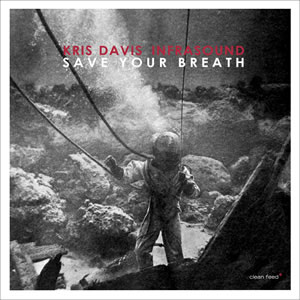
That written, her new recording - "Save Your Breath" (Clean Feed Records) -  is a tribute to the talent of the musicians, to her arrangements, to her music that allows the ensemble to explore textures and rhythms, to the way silence and noise are a part of the mix and to how the lower reeds (bass clarinets and contrabass clarinets) are utilized.  Opening with "Union Forever", which slowly moves towards a melody not unlike the chorus of "The Battle Cry Of Freedom" but not before introducing all the musicians.  Black is often the spark plug, punching and jabbing, goosing the band forward.  After the band drops out, a lonely clarinet plays above tolling piano chords. Davis' arrangement also has the organ moving in and out the mix, Versace's burbling lines adding a different flavor to the music.  Is that accordion on the introduction of "Always Leave Them (Wanting More)", it's ethereal high notes drifting above the piano and increasingly powerful drums. Radley's guitar serves a similar purpose to the accordion, weaving in and out of the sounds from the reeds and the powerful piano chords. Slowly, the piece builds with the drums and piano in a fiery interchange while the clarinets keen quietly.  Suddenly, the piece falls into a soulful rhythm for Noriega's powerful solo. "Whirly Swirly", which first appeared on Ms. Davis' 2014 Trio CD "Waiting For You To Grow", is a vehicle for Radley's hard-edged solo, over a bass line from Versace and rampaging drums.  The piece stops on a dime and becomes extremely quiet, organ swirls and clarinet phrases nearly inaudible unless you sit still.  When the band returns, Badenhorst's roaring clarinet is front-and-center over a chordal pattern not unlike a Black Sabbath tune.

The title song closes the program. The longest track (14:50), the sound rarely rises above a whisper, the instrumentalists stepping up and then fading out. Yet it's not an afterthought or an epilogue.  Look at the cover photo - the music describes what to must be like to be underwater, to be standing on the ocean floor connected to the world above by ropes, breathing air from a tank, the only sounds being your breathing and whatever is going on in your mind.  Each voice in the ensemble contributes to this adventure and it's makes for absorbing listening.

"Save Your Breath" has moments of great beauty and harsh noises ("The Ghost of Your Previous Fuckup" offers much of the latter without ignoring the former), often moving with great force and determination.  Considering the time the octet had to rehearse, perform, and record, this is incredibly fine music.  I can imagine how pieces could get stronger with more performances (alas, only 2 European dates on Ms. Davis' website) but this recording is mighty good.  For more information, go to www.krisdavis.net.

Here's a taste of this fine recording: