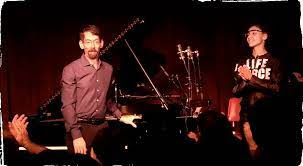
Two years ago, in the initial months of the COVID-19 pandemic, esperanza spalding and Fred Hersch issued a live recording with five songs they recorded in 2018 at the Village Vanguard. The digital-only album was posted on a special Bandcamp page with all proceeds from sales to the Jazz Foundation of America, an organization raising money to assist musicians affected by the international work stoppage. The album was posted for six weeks only (my review is here) and, unless you own it, disappeared from sight (and sound).
Until now, that is. "Fred Hersch & esperanza spalding: Alive at the Village Vanguard" (Palmetto Records) is available again and, great news, the program has been expanded to eight songs: the "original" five plus "My Little Suede Shoes" from Charlie Parker (first recorded in 1951), Thelonious Monk's "Evidence", and Mr. Hersch's lovely "A Wish" (that he first recorded with Norma Winstone in 2003). The new "additions" make the album even better (and the earlier version was quite delightful). Ms. spalding sticks to vocals and she's a great front-person. Her introduction to Bobby Troup's "Girl Talk" and patter throughout is hilarious but make sure to pay attention the delightful piano that plays along. "But Not for Me" opens the album and really sets the pace–listen below and just how playful both the lady and gent can be (one can just see lyricist Ira Gershwin laughing along with ms. spalding's joyous interpretation). Egberto Gismonti would be thrilled to hear the duo dance through "Loro" (the vocalist even stops her wordless jaunt to to say "bless you" to a patron who sneezed).
Photo: Facebook
O, how imaginative and expansive are the duo's performances of the two pieces from Monk. Actually "Dream of Monk" is Mr. Hersch's reimagining of "Monk's Dream" with original lyrics by the pianist––the vocal is so good especially when ms. spalding is scatting but dig the piano solo. "Evidence" captures the duo in full flight, playfully deconstructing Monk's original theme before the pianist creates a series of inventions around the theme and the rhythm.
How much one wishes to be in an audience when these fine people are playing. In fact, the duo is celebrating the release with 20 dates starting January 8th and running through February 5th (more information can be found by going to https://fredhersch.com/tour/.). For those of us who can't get to any of the gigs, "Fred Hersch & esperanza spalding: Alive at the Village Vanguard" is an absolute gem!
Listen to how the opening track, "But Not For Me" sets the pace for the entire set:
Photo: Leo Aversa
Brazilian-born saxophonist, composer, arranger, and conductor Gaia Wilmer was already a busy musician in her homeland before coming to the United States to study at Berklee Collee of Music and New England Conservatory (both located in Boston, MA). One of her teachers, Frank Carlberg, released Ms. Wilmer's US debut "Migrations" on his Red Piano Records label and serves as co-Producer on her new Sunnyside Records album "Folia: the Music of Egberto Gismonti".
The two-CD set (released on 1/13/23) features her 19-member Large Ensemble plus special guests Gabriel Grossi (harmonica on one cut) cellist Jaques Morelenbaum (on one track), and the honoree Mr. Gismonti (piano on two tracks). One of those tracks with the composer, "7 Aneis", features thunderous piano which during the unaccompanied solo section sounds like Art Tatum interpreting the song of birds but notice how the reed section is so melodic in contrast to the piano. There's a touch of birdsong in the opening of "Bianca", dedicated to the composer's daughter, but it opens up to a Near Eastern rhythm with a handsome melody atop it. Mr. Morelenbaum, who has recorded a duo album of the music of Caetano Veloso with Ms. Wilmer, joins the ensemble for the lovely "Infancia"––the cellist steps out unaccompanied for a moment in the middle of the song before the rhythm section enters pushing up the tempo. The rest of the piece features various members of the ensemble in a call-and-response with the piano, bass, and drums before they dive into the lively melody! The last several minutes features pianist Rafael Martini playing a classically-inspired coda that brings the Ensemble back for a short reprise of the original melody.
CD two opens with "Lôro", one of Mr. Gismonti's most recorded melodies. The arrangements opens with flutists Maiara Moraes and Aline Gonçalves wrapping their sweet lines around each other before the Ensemble plays an introduction to Mr. Grossi–his lively harmonica solo, reminiscent of the sound of the late Toots Thielemans, is accented by staccato blasts from the reeds and brass. Then, the ensemble breaks into the frolicking melody line. Later on, Mr. Grossi returns for an exciting romp of a solo. The composer returns to lead the musicians into "Karatê", yet another romp. Listen to how he and Mr. Martini (on accordion) dance their way through the melody line. The accordion solo jumps off the brass interjections before that section leads the group back into the melody. That song plus "Cego Aderaldo" both come from Mr. Gismonti's 1980 "Circense" album. The latter track opens somberly before the Ensemble breaks into the exciting rhythmic and melodic variations created by the arranger. Different voices step out throughout the performance (there is a splendid flute and clarinets interaction that is joined a minute on by the soprano sax). Guitarist Luciano Camara has a short, handsome, unaccompanied solo before the rest of the rhythm section enters (there's also a momentary vocal exchange between the women and men of the Ensemble right before a spirited exchange between the drums, muted trumpet, and clarinet).
"Folia" closes with "Baiâo Malandro", a piece that opens at a blistering tempo before introducing the amazing melody line that rises high before sliding back down. After a series of pinpoint twists-and-turns, there's a series of short solos including flute and flugelhorn (Diego Garbin) that grow into a rollicking call-and-response over the rampaging rhythm section. Drummer Lourenço Vasconcellos (son of pianist Renato Vasconcellos) steps out for just a moment before the Ensemble returns with an exciting close to a delight-filled album.
Gaia Wilmer has crafted quite a wonderful tribute to Egberto Gismonti. She's credited as having "arranged, recomposed, and conducted" the music and the Large Ensemble. While she does not play a note, her arrangements are colorful, imaginative, thoughtful, witty, and most impressive. Chances are very good you've never heard of many or all of the 19 members who comprise her group but a deep dive will show that each one is a busy musician and educator in Brazil and beyond. Start the New Year with "Folia: The Music of Egberto Gismonti"––the music and performances will make one feel like the sun shining even on the darkest days!
Special Guests: Gabriel Gross - harmonica Jaques Morelenbaum - cello Egberto Gismonti - piano
Orchestra: Maiara Moraes - reeds Aline Gonçalves - reeds Fernando Trocado - reeds Rui Alvim - reeds Gustavo D'Amico - reeds Joana Queiroz - reeds Henrique Band - reeds Bruno Soares - trumpet Diego Garbin - trumpet Gilson Santos - trumpet Pedro Paulo Junior - trumpet Rafael Rocha - trombone Everson Moraes - trombone Jonas Hocherman - trombone Leandro Dantas - bass trombone Luciano Camara - guitar Rafael Martini - piano & accordion Mayo Pamplona - bass Lourenço Vasconcellos - drums
Over the past decade+, pianist Fred Hersch has released solo piano records, several duo sessions as well as a number of trio albums plus a 2019 date with the WDR Big Band. He continues to explore different facets of his instrument as well as different ways to approach his original music. During the first lockdown of the pandemic, Hersch showed up online playing solo piano in his Pennsylvania home but was already writing charts for piano, bass, and drums joined by a string quartet. In August 2021, the pianist, composer, and arranger entered the studio with bassist Drew Gress, drummer Jochen Rueckert, the Crosby Street String Quartet – Joyce Hamman and Laura Seaton (violins), Lois Martin (viola), and Jody Redhage (cello) – plus, on one track, percussionist Rogerio Boccato. The results of their two days recording can be heard on "Breath by Breath" (Palmetto Records).
For this project, Hersch composed "The Sati Suite", an eight-part musical adventure based on the pianist's longtime practice of "insight meditation". The "Suite" opens with "Begin Again", its handsome melody moving atop a Latin-flavored rhythm reminiscent of the late Chick Corea's love of Spanish music. The string quartet is part of the piece not just background. The first one-third of the next track, "Awakened Heart", belongs to the strings; with its handsome melody and counterpoint, the music transitions into the composer's solo piano. The strings return to play a short coda. The quartet also gets the opening of the title track to themselves before the drums enter and bassist Gress begins his solo. The piano enters, the strings exit, but Gress continues for another 90 seconds. Hersch takes over the solo spotlight pushed forward by the bass and Rueckert's splendid brushes work.
Hersch, who has had a number of excellent trios over his career, continues that tradition here. Gress, who was a member in the 1990s and the first decade of the 2000s, is back – Rueckert is new to the ensemble and his gentle touch is perfect for this material. He creates such a fascinating atmosphere on pieces such as "Rising, Falling" as well as joining with Gress to really push "Worldly Winds" (listen below) forward.
The ninth and final track is "Pastorale (Hommage A Robert Schumann)", an original that the pianist featured on 2011's "Alone At the Vanguard" and on 2019's "Begin Again" with the WDR Big Band. And why not? It's one of Hersch prettiest pieces with counterpoint from the bass, a playful middle section with pizzicato strings, a powerful section for the piano, strings, and rhythm section leading back to the piano and bass, then solo piano to the finish (with the string quartet on the last note).
"Breath by Breath" is yet another triumph for Fred Hersch. With his Trio and the string quartet, one can fall into this music from the the opening notes to the very end. For the avid listener, the reward is that you can go back time and again because these songs are so melodic and the arrangements so intelligent. Enjoy!
Guitarist and composer Dave Stryker is nothing if not prolific. In the 1990s and early 2000s, he recorded two dozen albums for Steeplechase Records and, since 2014 for his own label. Stryker has performed in jazz groups, blues groups, big bands, and now, his latest album, "As We Are" (Strikezone Records), finds him fronting a jazz quartet and joined by a string quartet. It's a "dream" ensemble. The rhythm section features John Patitucci (bass), Brian Blade (drums), and Julian Shore (piano, all arrangements) with violinists Sara Caswell and Monica K Davis plus violist Benni von Gutzeit and cellist Marika Hughes.
After a short (70 seconds) "Overture" for the string quartet, the band kicks in to Stryker's "Lanes" (six of the nine tracks are composed by the leader, one he co-wrote with Shore, one piece by Shore plus Nick Drake's "River Man"). With the shimmering strings on top, the rhythm section sets a frisky pace and the guitarist plays a delightful solo. Blade steps out for a spotlight that leads into an excellent solo statement from the pianist. The funky "Hope" has a bouncy feel with the strings moving around the guitarist's melody lines. Shore, Stryker, and Patitucci each solo and the string quartet arrangement over the final two minutes is excellent. Shore is featured on the opening melody of Stryker's "Saudade", a lovely slow Brazilian-inspired piece with deep cello accompaniment from Ms. Hughes in the opening moments. The guitarist's solo kicks up the energy while the piano spotlight gently rides the waves from the rhythm section and strings. The final minute pays tribute to Tom Jobim with the quiet piano melody above the gentle guitar chords. "As We Were" may be the most mature ballad that Stryker has composed; the richness of the melody, the guitarist's evocation in the last chorus of his solo plus the excellent use of the strings, all make this track stand out on the album
Sara Caswell
The oft-recorded "River Man" is extremely soulful, especially the emotional work of the leader and the generous colors plus harmonies added by the string quartet. Ms. Caswell steps out in front for a powerful solo that captures many of the qualities composer Nick Drake imbued the song with, particularly the wonder and the solitude. Stryker builds off that solo: with his ability to infuse much of what he plays with the blues, the song stays at an emotional high throughout. The violinist is also a featured voice on the final track, the guitarist's "Soul Friend". This is more of a straight-ahead blues but make sure to listen to how Shore's arrangement utilizes all the strings. Stryker's long solo over the driving drums is a sheer delight but stick around for Patitucci's bluesy spotlight with the strings adding counterpoint.
Dave Stryker strikes gold again on "As We Are". He met Julian Shore two decades ago at the Litchfield Jazz Camp in CT when the pianist was a precocious and quickly maturing 14-year old. The guitarist's memories of those encounters plus listening to Shore's albums convinced Stryker that the now 35-year old musician was the right person to arrange these pieces. Adding Messrs. Patitucci and Blade to the mix as well as the smashing string quartet makes this recording stand out among new releases.
It's endlessly fascinating what music can do for the curious/ avid listener. On one hand, we have a great pianist spending time away from the city to play through the scourge of the pandemic. On the other, a stunning sextet of musicians joined on three tracks by one of the forefathers of British "art rock" exploring a variety of approaches to creative music with words that have many meanings.
Sixteen years ago, pianist Fred Hersch and his life partner Scott Morgan celebrated their union by building a house in the Pennsylvania woods. It is the place they go to escape the craziness of New York City and to rest in the midst of their very busy schedules. When the pandemic closed down all opportunities to play to a live audience, Hersch began releasing a "Song of the Day" on his Facebook page; after a month, he decided to do a short concert once a week but that only lasted for two weeks. In August of this year, the pianist left Morgan in the city, traveled to their second dwelling, and spent a week recording "Songs From Home" (Palmetto Records). With help from fellow pianists Benoit Delbecq (co-producer and mixing engineer) and Dan Tepfer plus two piano technicians (Greg Graham and Chris Solliday), the music will certainly warm your heart and soul.
Anyone who follows Fred Hersch knows his programs are always an eclectic mix of standards, "pop" tunes", Thelonious Monk, and originals. "Songs From Home" is different as there's no Monk and only one original. It's a mix of standards, jazz works, and delightful interpretations of Joni Mitchell (listen below), Jimmy Webb, and Lennon & McCartney. The album opens with an introspective take on "Wouldn't It Be Loverly" (from "My Fair Lady")––one could say that this performance is a comment on the lockdown and the desire to get back to some semblance of "normal". Webb's "Wichita Lineman", one of the finest songs he composed, is filled with love, longing, a prayer for people separated by their jobs. The one Hersch original "West Virginia Rose" is paired with the traditional "The Water is Wide"; the first melody has the feel of a Randy Newman ballad while the traditional is filled with hope. Kenny Wheeler's handsome "Consolation (a Folk Song)" follows and, like many of the late Canadian-born trumpeter's pieces, has a lovely and expansive melody. Duke Ellington's "Solitude" is an apt choice for this program. One can picture the pianist at the keyboard sifting through memories as he slowly plays the memorable melody..
Fred Hersch turned 65 on October 21; the program closes with a jaunty reading on "When I'm Sixty-Four" (he certainly was at the time). Playful and expansive, the performance reminds us all we have much to be thankful for. Yes, times are troublesome, the pandemic rages on, but music is wonderful medicine for the trouble soul. "Songs From Home" may be viewed by some as a response to the pandemic. So be it. To these ears and heart, it's a timeless, highly emotional, and deeply satisfying album that resonates long after the final note rings out.
Listen to Fred Hersch play Joni Mitchell's "All I Want":
Photo: Reuben Radding
One should always expect the unexpected when listening to the many different recordings, ensembles, and pairings that guitarist/ composer Mary Halvorson posits herself in. Code Girl started as a quintet to create settings for the poems she had been writing. With long-time associates Tomas Fujiwara (drums, percussion) and Michael Formanek (acoustic bass), the guitarist built a front line with vocalist Amirtha Kidambi and trumpeter Ambrose Akinmusire. The quintet's self-titled debut album was issued in early 2018 garnering critical acclaim for its mysterious blend of improvisational music, "progressive rock", the often-impressionistic lyrics, and the spellbinding vocals.
The group's second album, "Artlessly Falling" (Firehouse 12 Records), finds Akinmusire replaced by Adam O'Farrill plus the addition of Maria Grand (tenor saxophone, vocals) and, on three of the eight pieces, the voice of Robert Wyatt. Mr. Wyatt first came onto the British music scene in the mid-1960s as the drummer of Soft Machine, a quartet that created a beguiling mix of jazz, rock, minimalism, and more. When that group splintered, he helped form Matching Mole and embarked on a solo career, his soft vocals blending with his embrace of "free jazz." After an accident in 1973 left him paralyzed from the waist down, Wyatt regrouped creating a series of albums featuring his idiosyncratic compositions, often-political lyrics, and voice. He came out of retirement to record his vocals for Code Girl, fitting seamlessly into the beguiling, swirling, sounds.
Among the first sounds you hear on the album opener, "The Lemon Trees", are the sweet harmonies of Ms. Kidambi and Ms. Grand. Quiet brush work and simple, foundational, bass notes plus O'Farrill sharp trumpet lines serve to introduce Wyatt's first vocal. He sings one verse before the trumpeter creates a his own "sing-song" solo. Fujiwara steps out next with a pounding solo before the sextet falls back into the song, Wyatt now double-tracked. "Last Minute Smears" follows with lyrics taken directly from Judge Brett Kavanaugh's testimony during his Senate confirmation hearing. The dark ballad, replete with martial drumming and breathy tenor sax solo, is not farcical but does condemn the process with its own words.
Wyatt (pictured left) returns for "Walls and Roses"; he starts off the piece then Ms. Halvorson kicks the piece into a more "hard rock" direction dropping for Ms. Kibambi's verse. After one more "guitar shredding", Wyatt returns and then Ms. Grand sings a verse. The different voices, tempo and dynamic changes, keep the listener engaged. His third and final appearance comes on "Bigger Flames", an Impressionistic "word painting" with slightly askew strummed guitar chords and trumpet/ saxophone counterpoint. Despite being recorded in England, Wyatt sounds as if he sitting in front of the band.
Photo: James Wang
Tracks such as "Mexican War Streets (Pittsburgh)", "Muzzling Unwashed", and "A Nearing" show the influence of not only Wyatt but also the "freer" side of the late bassist Jack Bruce. The rhythm section is insistent throughout those songs, pulling the ensemble forward urgently. Note how the voices fit seamlessly into the mix of instruments. There are moments in "Mexican War..." that feel influenced by by both Kurt Weill and Black Sabbath! The lyrics speak to the history and the present in a city ever-changing. Formanek's percussive then melodic unaccompanied bass sets the tone for "A Nearing" which also stands out for Ms. Kidambi splendid vocal as well as O'Farrill's interactions with Ms. Halvorson, his inventive lines, and how he negotiates the dynamic rhythm section. Ms. Grand also creates a potent solo that is impressive for her in the maelstrom created by the guitar and drums.
Photo: James Wang
The album closes with the title track. Ms. Halvorson's modulated guitar accompanies Ms. Kidambi with the rhythm section swirling up a storm. Soon, one notices the trumpet and tenor saxophone creating their own swirling lines in their respective corners of the sound spectrum. Note the change near the end when the rhythm section kicks into a forward gear. The vocalist holds her own in the sonic storm singing right up to the abrupt ending. One should go right back and listen again as there is too much to take in in one sitting.
Mary Halvorson's Code Girl creates its own genre, taking from so many streams of contemporary music. Is it Jazz, is it Rock, Progressive, Art-Rock? Ms. Halvorson's lyrics are all in different poetic forms e.g the title song is a sestina and the opening track a double tanka. Call "Artlessly Falling" whatever you want but don't dare ignore it. The music and words are much too beguiling and thought-provoking to be typecast.
Fred Hersch, pianist and composer, has had a most successful career. His generation of musicians was among the last to grow up in a time when you work with an older musician serving as a mentor, travel the United States, get a recording contract, play constantly, testing your powers of improvisation and accompaniement. By the mid-2000s, Mr. Hersch had a large following, was traveling the world –– he had publicly acknowledged that he was gay and had been suffering from the long-term effects of HIV-AIDS. His condition was kept in check by a mixture of medications which allowed him to continue to perform, to teach, and to record. But, something went wrong in the Winter of 2007-08 and the pianist soon became quite sick –– originally, his doctors were able to fight the condition but it worsened to the point that Mr. Hersch stopped eating, became painfully ill and, to save him while they helped his system right itself, he was put into a medically-induced coma for two months.
The pianist recovered but it took may months of physical therapy, rest, and relearning the basics (eating, walking, etc) as well as finding his way back to the piano –– he was left so weak by the debacle that there was the fear he would never return to music, let alone t other daily activities. Happily for Mr. Hersch (and for his many fans), his abilities returned to the point where, within 18 months, he had returned to performance, composing, and teaching. Unlike many coma survivors, the pianist actually remembered a number of vivid dreams during the time he was, technically, "dead" to the outside world. Soon, he had sketched out melodies, harmonies, and his memories. With the help of librettist Herschel Garfein (who also directed the performances), Mr. Hersch began to make his dreams come to life. Soon, the pair had created an eight-song program for an 11-piece ensemble plus narrator (see personnel below).
Photo:Tom White/NY Times
"My Coma Dreams" never became a vehicle for touring but was performed several times with one presentation at the Miller Theatre on the campus of Columbia University in New York City recorded as a DVD in March 2013. If you do not own the video, released in 2014 by Palmetto Records, you can watch the entire performance free on YouTube beginning this Friday, July 17 2020 and will be free indefinitely (the link is listed below as well) –– in fact, you should it and not just because it's being presented free of charge but because it's an amazing piece of musical theater (kudos to actor Michael Winther on his powerful performance).
Personnel:
Fred Hersch, piano
John Hébert, bass
John Hollenbeck, drums and percussion
Ralph Alessi, trumpet, flute;horn
Mike Christiansen, trombone
Bruce Williamson, clarinet, bass clarinet, alto saxophone
Adam Kolker, flute, clarinet, tenor saxophone
Joyce Hammann, violin and viola
Laura Seaton, violin
Dave Eggar, cello
Gregg Kailor, conductor, music director
Over his career, pianist and composer Fred Hersch has performed and recorded in the duo setting many times with partners such as Jay Clayton, Norma Winstone, Bill Frisell, Anat Cohen, Jane Ira Bloom, and more. Up until this year, he's been holding an annual Duo Invitation Series in New York City (at The Jazz Standard with select dates at The Village Vanguard and Jazz at Lincoln Center). Since the pandemic struck the United States, Mr. Hersch and his fellow musicians have been "sheltering" at home but that has not stopped from beginning a video series of daily (for a while) and weekly "living room" shows (which started daily on Facebook and is now weekly on Patreon – to subscribe, go to www.patreon.com/fredhersch).
This week and through the end of June, you can hear and purchase "Esperanza Spalding & Fred Hersch: Live at The Village Vanguard". Recorded in October of 2018, this five-song program carries the subtitle "Rough Mix EP" and is being made available exclusively on Bandcamp (link below). On the site, the artists tell you that "all proceeds benefiting the Jazz Foundation of America and the organization’s efforts to assist members of the jazz community impacted by the COVID-19 pandemic." It's a delightful program –– the material includes one Fred Hersch original ("Dream of Monk"), "Loro" (Egberto Gismonti), "But Not For Me" (George & Ira Gershwin), "Some Other Time" (Sammy Cahn and Jules Styne), and the album's centerpiece, a hilarious take on "Girl Talk" (composed by Neal Hefti and Bobby Troup, made famous by Julie London –– watch Troup's video on YouTube for a comparison ). Ms. Spalding is in excellent voice and her sense of humor is evident throughout right through the dancing version of Gismonti's tune. As for Mr. Hersch, he proved years ago that he's a wonderful accompanist and he, too, is in "excellent voice." Music for a good cause? Absolutely! Good music?? No! No? Great music! Fun music! If you're not in a good mood after listening to "Esperanza Spalding & Fred Hersch: Live at The Village Vanguard", our prayers go out to you!
The trio of Adam Rudolph (percussion, voice, chordal instruments), Ralph M. Jones (reeds, wooden flutes, voice), and Hamid Drake (percussion, voice), have played together for many years in various ensembles. Rudolph and Drake first met in 1969 going on to work with jazz groups in the Mid-West while Jones and Rudolph met in 1974 and had a long relationship/ friendship with reed master/ educator Yusef Lateef. Jones has been a member of Rudolph's Go: Organic Orchestra since its inception two decades while Drake has played and recorded with the other two musicians as part of Rudolph's Moving Pictures ensemble. They've got history.
Several years ago, the three musicians formed the Karuna Trio. "Karuna" is a Sanskrit word for "compassionate action" and is related to the work of reiki (compassionate healing) –– in Buddhist traditions, the word simply translates to "compassion"). If one approaches the music the Trio makes on its second recording, "Imaginary Archipelago" ( as actions for healing, it may give you a better idea of what the ensemble attempts to do with its music. Yes, the music can be considered mystical but it's also timeless while, through the use of electronics and editing, quite contemporary. There are moments throughout the 67-minute program (11 separate tracks) that are cacophonous but the music never erupts into pure noise. It may remind some of Dr. Lateef's sonic experiments as well as Miles Davis's post "Bitches Brew" period (1970-74).
If you allow the music on "Imaginary Archipelago" to overtake your senses, the experience will serve to help you through these and any frightful times. The music that Karuna Trio creates is not about technique but has everything to do with interactions, to rhythms, to drones, to creating sounds as prayer, to allowing the imagination free range to express itself. You do need to know the names of songs or who plays what, you just need to surrender to the sound. My favorite time to listen to this album is in the early moments of daylight with the birds outside our windows singing for the sunshine. As the music plays, the bird's songs join in as the chorus to the drums and reeds. Give this form of peace a chance!
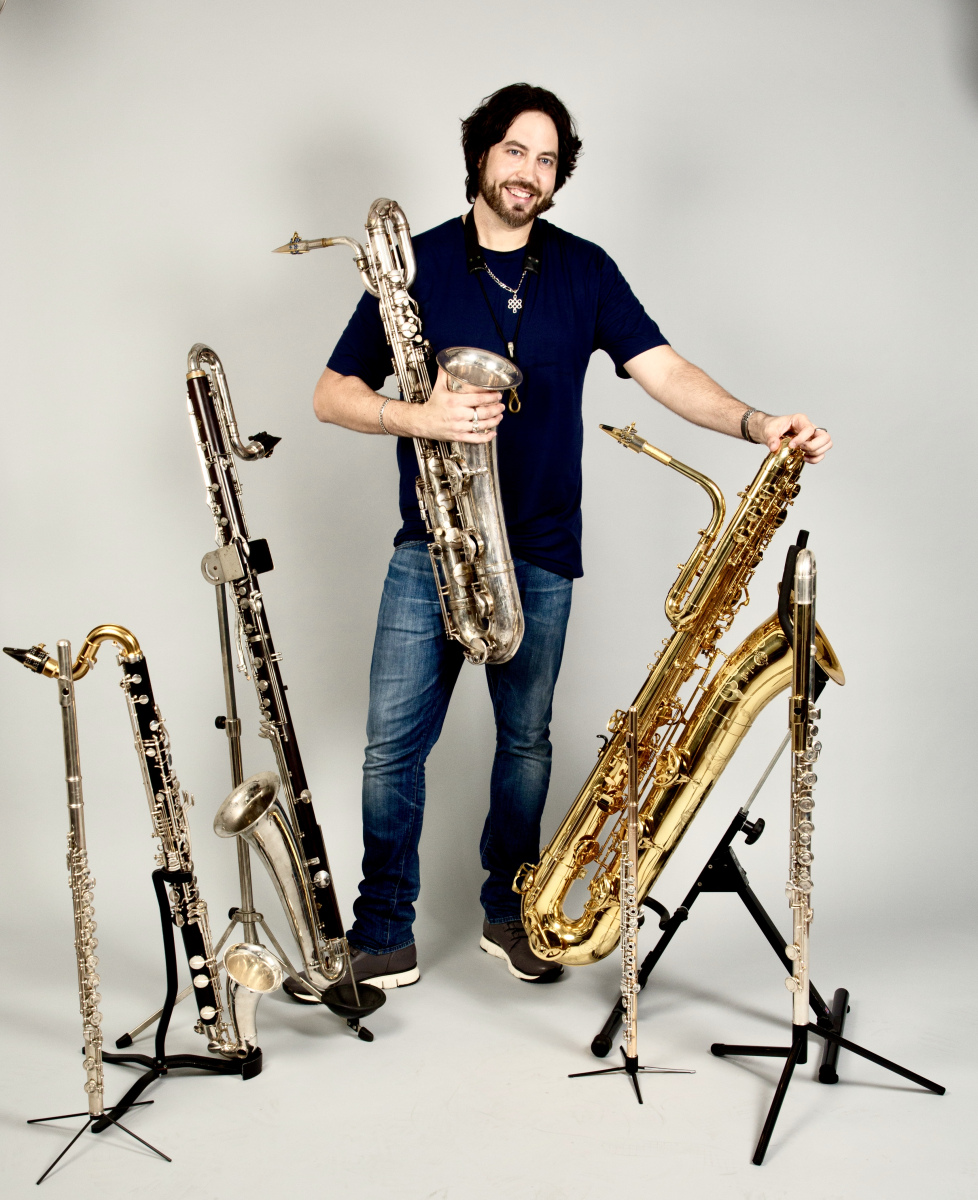
In 2017, saxophonist, flutist, and bass clarinetist Brian Landrus released "Generations" on his own BlueLand Records label –– he wrote all the music and arrangements for a 25-member large ensemble that included am eight-member string section. It was and is a major accomplishment in the now 42-year old musician's career, the ninth recording in his nearly two-decade career which started on 2007 with his debut album "Forward", a self-produced album issued on Cadence Jazz Records. Since 2010, Landrus has issued all his music on BlueLand and, pretty much, has gone his own way. How does one follow up that highly acclaimed album?
His new recording, "For Now", is the second straight Landrus album co-produced by Robert Livingston Aldridge (the classical composer and Professor at Rutgers University who also helped on arrangements); this time, he's joined by Herschel Garfein who worked with pianist Fred Hersch on "My Coma Dreams" and who is also a composer plus is on the faculty of the Steinhardt School of Music at New York University.
Landrus has organized quite the ensemble to play this 14-song program (11 originals, two from Thelonious Monk, and "Invitation" by Bronislaw Kaper)––the nine musicians include the afore-mentioned Mr. Hersch, Billy Hart (the fourth time the drummer has recorded with the reed player), Drew Gress (bass), Michael Rodriguez (trumpet) plus a four-piece string section composed of violinists Sara Caswell and Joyce Hammann, violist Lois Martin, and cellist Jody Redhage-Ferber. Instead of a "concept" album, Landrus has put together a program that shows his wide-angle approach to composing and arranging. The date kicks off with a swinger, "The Signs", which has a sharp theme that opens up to delightful solos from Rodriguez, Hersch, and Landrus (baritone sax). Make sure to pay attention to what the rhythm section brings to the song. Hart kicks and splashes cymbals, getting deep in the groove while Gress keeps the music together.
There are a number of delightful tracks on the album. "Clarity in Time" is a handsome ballad that features eight of the nine musicians (the trumpeter sits this one out). Landrus's baritone sax leads the way; his tone and attack may remind some of Harry Carney, or even tenor giant Ben Webster, plus the piano solo is rich and endearing. Hart leads the quintet into "J.J." and Landrus leaps out of the thematic section with a hearty solo followed by a dancing trumpet solo. The drummer really prods the soloists forward. "For Whom I Imagined" opens with the string quartet before the bass clarinet plus Hart's splendid cymbal and drumset play move the piece forward. Landrus overdubs a second bass clarinet as well a terrific flute solo. The standard "Invitation" belongs to the strings and baritone sax for the opening prologues before the rhythm section enters and the music jumps forward. Listen closely to the interaction of the strings and sax before the latter steps out for a lively solo. The string arrangement on "Her Smile" adds such a sparkling to the baritone solo; Ms. Caswell steps out for a delightful solo followed by a string quintet break (Gress joins them). To top it off, Billy Hart kicks the bottom out with glee! His work on the next track, "The Wait", really shines as well (no surprise the veteran drummer is a treat throughout the program).
The two Monk tunes also stand out. "'Round Midnight" is Landrus alone on bass clarinet. His breathy tone and circular lines in and around the classic melody as well as the performance is short (2:46) makes the piece sweeter. Hersch joins Landrus (baritone) for "Ruby My Dear" – the two take their time to work through the melody and then their two-way conversation is quite harmonious, closing the program in a introspective blue mood.
Brian Landrus shouldn't and doesn't feel the need to top his previous album. Because he did not fall victim to the "to this" syndrome, "For Now" strikes this listener as the equal of "Generations", looser, more open, with the airy string arrangements helping this production stand out. Filled with delightful music played by an excellent ensemble, this album will brighten your life!
You can tune in at 1 p.m. or find the link to his daily mini-concert.
Plus, you should follow the link to "The Ballad of Fred Hersch" – created by the team of Charlotte LaGarde and Carrie Lozano, the documentary was released in 2016 and, like his 2017 autobiography "Good Things Happen Slowly: A Life In and Out of Jazz" (Crown Archetype), paints a honest picture of the pianist's life , his coming-to-terms with AIDS, and the coma that nearly claimed his life in 2008. The movie contains a number of long musical performances plus shows the composers hard at work at recovering and creating "My Coma Dreams", his 2014 jazz/theater piece only available on DVD.
2) - Just discovered this morning that, for the next two weeks (through 4/7/20), you can view for free "Rambling Boy", the 2009 Charlie Haden documentary created by Reto Caduff. Haden was the essence of "Speak softly but carry a big stick" in that he had a a quite voice but his bass and music stood up against tyranny at home (the United States) and and the world world. Haden left many legacies including his musical family, his work with Ornette Coleman, Pat Metheny, Keith Jarrett, Old & New Dreams as well as the Liberation Music Orchestra.
3) – The number of music documentaries, concerts, and daily musical interludes on YouTube, Amazon Prime, Netflix, NPR.org, etc is amazing. Jazz at Lincoln Center announced they'll post free videos every week starting today with the JALC's shows about Miles Davis, South African Music, and a Family Concert: "Who is Chick Corea?" Go to https://www.jazz.org for more information.
4) - Podcasts: While you're hanging about or out for a walk/jog/run, there are a slew of podcasts (seemingly more everyday) for your distraction/entertainment. Check out my friend Jason Crane (you'll see links in the right-hand corner of this blog page) plus the often-brilliant "A Noise From the Deep" (trumpeter Dave Douglas's monthly conversations with modern musicians/creators––go to https://greenleafmusic.com/podcasts/). Make time for Leo Sidran's "The Third Story"podcast to be found at www.third-story.com as well as trombonist/label owner Nick Finzer's "Outside In Music Podcast" at www.outsideinmusic.com/podcast. Of course, there are a ton more––if you have a favorite, send me a link at richard_b_kamins@snet.net.
Alto saxophonist Will Vinson, born in London, England, has been a resident of New York City for over two decades. He's worked or still is working with groups led by pianist Gonzalo Rubalcaba, drummer Ari Hoenig, saxophonist Miguel Zenón, and many others. He's a founding member of the cooperative trio OWL (with bassist Orlando Le Fleming and guitarist Lage Lund) plus has issued five albums as a leader on various labels including Criss Cross Records and Smalls Live. For "441", his debut on Whirlwind Recordings, Vinson chose to record with four different pianists – Sullivan Fortner, Tiger Hamasyan, Gerald Clayton, Fred Hersch, and the afore-mentioned Rubalcaba – and five different rhythm sections – bassists Matt Brewer, Matt Penman, Rick Rosato, and Larry Grenadierpaired with (in order) drummers Obed Calvaire, Billy Hart, Jochen Rueckert, Clarence Penn, andEric Harland(Brewer also plays with Penn).
The results are a fascinating blend of styles, ideas, and interactions. 11 tracks, nearly 77 minutes of music, with originals mixed with one standard ("Love Letters" from Edward Heyman and Victor Young) plus songs from Keith Jarrett, Thelonious Monk, Bryn Roberts, and John Lewis. Each pairing opens with a saxophone and piano duet with the following track featuring bass and drums. Fortner is the only pianist with three tracks, the opening two and the delightful duet with Vinson on Lewis's "Milestones" the album closer. The saxophonist's "Boogaloo" opens the album; it's a sweet blues that rolls along on the full piano chords and Vinson's lithe alto lines. Brewer and Calvaire, now partners in the current edition of the SF Jazz Collective, have a delightful time pushing and pulling at the rhythms of "Love Letters" while the saxophonist and pianist chase variations of the melody lines throughout.
Photo: Jimmy Katz
There's nary a weak track in the program. Each pianist brings his style and strengths to the music. Hamasyan is featured on Vinson's "Banal Street" and Jarrett's "Oasis." The former rolls along pleasingly with both musicians enjoying presenting the melody and then Hoth taking sweet solos. The quartet captures the European Quartet characteristics of "Oasis" with Vinson even channeling Jan Garbarek's tart alto tone. Matt Penman and Billy Hart sparkle in support. Clayton and Vinson pair up on two originals, the blues-soaked ballad "I Am James Bond" (powerful solos from both) and another slower original, "Cherry Time." Also a blues, the ballad gets a strong push from Penn and Brewer who really lock in under the solos, paying close attention to shifts in intensity and lightness. No surprise that Hersch brings a Monk tune to the party; he and Vinson dance their way through "Work", the subtle blend of richness and minimalism in the pianist's approach meshes well with the alto's jaunty solo. Vinson turns to soprano sax on Robert's handsome ballad "KW." Composed with Kenny Wheeler in mind, there's plenty of space in the opening sax-piano duo that is enhanced by the addition of bassist Rosato and the splendid brush work of Reuckert. Rubalcaba caresses the melody of Vinson's "The Way To You" which the saxophonist literally sings through his horn. They then share the album's longest track (10:18) with Grenadier and Harland – "That Happened" is quite a happening with the pianist and drummer in sync on the rhythms, fine solos from all four, and a breezy quality that builds to an intensity that keeps you on the edge of your seat.
Lots and lots of music on "441", an album that invites one in and compels you to stay all the way through. Will Vinson must have had a ball mixing and matching the five pianists with the material as well as the rhythm sections. They all inspire his playing and, in turn, are inspired by his adventurousness and desire to have fun while telling these 11 stories. Take your time and let the music soak in – it's well worth the effort.
Here's the opening track featuring pianist Sullivan Fortner:
Slovenian-born and now New York City-based saxophonist (tenor and soprano plus bass clarinet) Jure Pukl is back with his third album for Whirlwind. "Broken Circles" finds Pukl in the company of a quartet of "young lions" including bassist Matt Brewer, guitarist Charles Altura, and especially vibraphonist Joel Ross (who is on a slew of recordings issued in the past four months), plus drummer Kweku Sumbry (The latter two can be heard on the powerful new Whirlwind release from bassist Harish Rhaghavan - read my review here).
Pukl created this program with this group in mind; the vast majority of the 11 tracks (plus the radio edit of "Separation") are originals with the one exception. "Gloomy Sunday" was composed in 1932 bu Hungarian composer Rezső Seress with the original lyrics plus the Englishtranslation linked to multiple suicides. The composer's story is fascinating yet this version is pushed forward by Sumbry's active drums. The melody is shared by the bass clarinet and vibes with guitar counterpoint. As an immigrant to the United States, Pukl composes songs that deal with broken families but also pieces that reflect life in a freer environment. An example of the former is "Separation", a somber ballad in which the tenor sax, guitar, and vibes each have a voice as does Brewer with a fine solo and the drummer taking the piece to its conclusion.
Photo: Aljosa Videtic
The center of the program is ballad-heavy. After the track above, "Compassion" opens with a kalimba melody before dropping into a slow, moody, ballad. Pukl's soprano plays the melody aided by quiet counterpoint from Ross and Brewer. "The afore-mentioned "Gloomy Sunday" is several tracks later followed by "Empty Words." There's a sparse quality to the tracking, at times, the rhythm stops. But, listen to how the musicians respond to the melody and to each other, not allowing excess emotion overtake the music. Near to the end of the program, "Kids" opens with Pukl's child offering a wordless vocal duo with Dad's tenor sax before the band enters with a sweet ballad. Altura's fine solo is a highlight but pay attention to what Brewer and Sumbry are creating beneath the guitar.
There's plenty of high-powered materials as well. The album kicks off with "Sustained Optimism", with the tenor sax and vibes playing the speedy melody while the drummer kicks everyone Ito gear. The title track follows; the song has quite a kick tumbling out of the rhythm section and the front line of tenor, vibes and guitar all take advantage to create strong solos. ""Triumph of Society" is also a very optimistic piece, tumbling forward with a delightful flow. The final track (before the extra radio edit) is the delightful "Sky Is The Limit" – Pukl's soprano sax shares the melody with guitar and then jumps into his solo, his melodic phrases high up in the soprano's range caught up in the powerful rhythmic flow below him.
Listening to "Broken Circles", one hears a quintet of musicians working and playing to create messages that resonate. Jure Pukl has been an impressive player since first coming to critical attention in the early years of the previous decade. His writing keeps on maturing as does his playing. He's recorded and/or worked with musicians such as pianist Vijay Iyer, drummer Damion Reid, the Vienna Sax Quartet, saxophonist Branford Marsalis, and his wife, saxophonist Melissa Aldana. This current quintet deserves to be heard in person as each person brings great musical knowledge to the project. Pay attention!
Been over two decades since saxophonist and NEA Jazz master Dave Liebman began his musical exploration and interpretation of the four Natural Elements. Starting in 1997 with "Water" (featuring Pat Metheny, Billy Hart, and Cecil McBee), then moving on to "Air" (a 2006 duo with computer whiz Walter Quintus), and then 2016's "Fire" (with Kenny Werner, Dave Holland, and Jack DeJohnette. Liebman brings the cycle to a close with "Earth" (Whaling City Sounds), a 14-piece suite that features his touring and recording group Expansions. The leader brings his signature soprano saxophone plus wooden recorder; the group consists of Matt Vashlishan (Wind synth, reeds), Bobby Avey (piano, keyboards), Alex Ritz (drums), and longtime associate Tony Marino (electric bass).
Liebman constructed this band to be an electro-acoustic outfit and no one exemplifies that more than Vashlishan. having seen the group in concert, it's impressive how he blends the wind synth in the more traditional sounds of piano, bass, and drums. One can hear that in all its glory on "Volcano/Avalanche" where his instrument creates the former and Liebman's darting soprano lines the other. Marino's bass and Ritz's drums keep the music from falling apart as well as add to the energy needed to tell the story. "The Sahara" is introduced by the percussion/ wooden flute "Interlude", complete with wind sounds from the synth and bass. The evocative soprano sax lead then blends with the wind synth to push the song into a different mood. Avey's electric piano solo over the powerful drum playing stands out.
Photo: N Hayashi
There are amazing moments throughout. The short "Interludes" not only serve as solo spotlights (in the instances above and below, an augmented duo) but also introduce the following track. Avey's piano spot may remind some of a waterfall or a gentle rain outside the window while Vashlishan's seems other-worldly but not unlike the synth work of the late Joe Zawinul. Ritz's spot is conversational while Marino plays a chordal riff with the drummer keeping time. Liebman's soprano solo "Interlude" is evocative of standing on a ridge and leads into "Grand Canyon/ Mt. Everest", a musical appreciation of these natural wonders with each voice stepping forward and then back into the ensemble in a slow procession that compels the listener to sit and let the music unfold, not to rush to move forward but take in the beauty of creation.
Photo: Attila Kleb
The music moves back from its close examination of the natural wonders of "Earth" to its place in the greater Cosmos. The album closes with "Galaxy", a raucous, funk-driven piece that has the feel of the music Miles Davis created for the "On The Corner". Marino and Ritz really drive this piece with Avey's chattering keys, Vashlishan's squealing wind synth, and Liebman's fiery soprano lines fluttering over the top of it. Midway through the piece, Avey steps out with just Ritz supplying the pulse before Marino reenters and pushes them harder. The ends then come in and help to take the piece into a short restatement of "Earth Theme", bringing the project back to a close but also serving as an invitation to reenter this music's rich atmosphere.
Photo: N. Hayashi
The pictures that Dave Liebman Expansions creates on "Earth" come into clearer focus each time you listen. This is music that connects you to the natural world in unexpected ways, asking one to pay closer attention to the majesty of what is all around you, impelling you to go outside away from the daily hustle if only for a short walk in the woods or by a river or near a pond or up to a mountain top.