Guitarist, composer, arranger, and occasional vocalist Joel Harrison is certainly s musical polymath, taking his guitar and songs into many genre-blurring areas. His guitar can squawk, squeal, dance, fly, and be gentle all in the cause of telling a story. His musical adventures in North and South Indian music, country music, film scoring, Americana, the music of George Harrison (no relation), classical music, etc, has opened his creative mind and opens the listener's mind to the endless possibilities in music
In 2013, Harrison released "Infinite Possibilities" (Sunnyside Records), his first foray in large ensemble writing (all tolled, 23 musicians including two vocalists) and, now, seven years later, his second effort for his large ensemble is here." America At War" (Sunnyside) posits Harrison in the midst of 18 musicians plus one guest (Ned Rothenberg on shakuhachi for one track). These compositions take their inspirations from the composer's father's experiences at the end of World War II ("My Father in Nagasaki"), a former President's assertions to his country that Saddam Hussein was preparing chemical weapons ("Yellowcake"), the composer's praise for people who not only fight our wars but also those who fight for peace ("Honor Song"), and the 1963 "March on Washington", the march for "Jobs and Freedom". Some of the music is angry with solos that tear across the sound spectrum (trombonist Curtis Hasselbring and tenor saxophonist Jon Irabagon on "Yellowcake"). "Gratitude" takes a quieter approach, a soulful tune that not only takes into accounts the composer's recovery from a traumatic brain injury but also the people who work with soldiers dealing with PTSD (Ingrid Jensen's trumpet solo rising out of the collective ensemble is quite handsome). The quiet vibraphone phrases of Wilson Torres takes the piece to its gentle conclusion.
Photo: Scott Friedlander
Harrison composed all nine tracks save for Tom Waits's "Day After Tomorrow" (from 2004's "Real Gone" album). The guitarist sings the plaintive melody whose lyrics tell the story of a young soldier from Illinois (Rockford, to be exact) writing home to his wife from the battle front. While there are no solos, the background is stunning in its support in how the sections frame the voice, capture the emotion, and advance the melody.
The program closes with the pointedly titled "Stupid, Pointless, Heartless Drug Wars"––the composer points his finger at how the casualties of this long and senseless battle, the prisoners, the poor, the various communities, the children who suffer from their parents addiction, have such a poor survival rate. Instead of education and support, those who command choose to incarcerate and, upon release, let the freed prisoners swing in the wind. There are those who will say "if you mess with this s**t, you deserve the consequences" but the U.S. is a country of second chances a beast, for those who can afford it), where rehabilitation can be a path to a positive life. As the music progresses, Harrison's arrangement becomes more claustrophobic, angrier, and the conclusion is unsatisfying. Note the powerful alto saxophone solo from Ken Thompson as well as the muscular work of bassist Gregg August and drummer Jared Schonig.
Photo: Scott Friedlander
"America at War" pokes the listener, pushes to make one more aware of the costs that wars have on society, and prods one to speak out in the face of jingoism and nationalism. Joel Harrison + 18 is a formidable ensemble, an assemblage that can roar, can purr, can get you of your chair (and stupor). Yes, this is emotional music, the song titles are provocative, the playing often acerbic––music that demands a response. In this time of societal isolation, think on these topics and see how you might change.
Joel Harrison - composer, arranger, guitar, voice Matt Holman - conductor Seneca Black - trumpet Dave Smith - trumpet, flugelhorn Ingrid Jensen - trumpet (five tracks) Chris Rogers - trumpet (four tracks) Marshal Sealy - French horn Alan Ferber - trombone Sara Jacovino - trombone Curtis Hasselbring - trombone Ben Staap - tuba Ben Kono - English horn, soprano, alto saxophone & flute Ken Thomson - alto saxophone, Bb clarinet & bass clarinet Stacy Dillard - tenor saxophone Jon Irabagon - tenor saxophone, flute Lisa Parrot - baritone saxophone & bass clarinet Daniel Kelly - piano Gregg August - electric & acoustic bass Jared Schonig - drums Wilson Torres - vibraphone, timpani, concert bass drum, bongos, bells & shaker Ned Rothenberg - shakuhachi (on "My Father In Nagasaki")
The Chicago Yestet, the brainchild of trombonist and composer Joel Adams, a veteran of the Woody Herman Orchestra as well as the Chicago music scene, is a unique large ensemble. The band, in existence for a dozen years, includes three saxophones, two trumpets, two trombones, guitar, bass, drums, a vocalist plus a spoken word artist. Their music combines elements of jazz, r'n'b, hip hop, and more with messages that speak about current issues and the age-old topic of love. The ensemble, listed below, is composed of musicians who are active throughout the Chicago area plus lead their own groups.
The band's third album, "Not There Yet" (self-released), take sits name from the opening track, a funky tune that may remind some of Curtis Mayfield (especially the muted trumpets in the opening section). Keith Harris's rap speaks on the relationship beween black people and the police––the title refers to the fact that, since the Civil Rights Acts, African American have been granted entry into American Society but only so many and only so far. Vocalist Maggie Burrell takes over from Harris yet her soulful vocal picks up the topic. The band is musical sympathetic but one is surprised on initial listening by Adam's highly amplified trombone solo ("megabone"). Yet, his harsh voice is in keeping with the lyrics. Bassist Clark Sommers and, especially, drummer Xavier Breaker stoke the fire throughout. The all-instrumental "Moment of Truth" opens with a passionate statement from Geoff Bradfield (tenor sax) before the rest of the musicians enter. The melody is developed by the section before Russ Johnson grabs the lead. Listen to how Breaker leads the band forward, taking a powerful as everyone vamps. Close to the end, Bradfield returns for a short but fiery solo.
Photo: Janet Takayama
Ms. Burrell's voice rides the waves of sound on "So It Goes", a multi-sectioned piece that, at times, resembles the music of the band Chicago as well as Isaac Hayes "Theme from Shaft." In the middle of the track, pianist Stu Mindeman (most recently with Kurt Elling as bassist Sommers is now) takes off on a fine solo. The ensemble hits hard on Adams's arrangement of John Coltrane's "Wise One" (from the 1964 Impulse "Crescent" album). Again, it's Breaker who provides the energy while the section writing goes from explosive to flowing melodically. Both Bradfield and guitarist Mike Allemana solo but not until after the sections get their say.
The album contains a song that could be a big hit on the "adult contemporary" charts. "I've Been Meaning to Tell You" (lyrics by Cherise Thomas plus a rhythmical rap from Harris), at times, sounds as if it would fit right in on an East, Wind, & Fire album, what with the funky backbeat, the chunky guitar chords, and the soaring reeds and brass. The long middle section allows the band to shows its versatility plus the fine tenor sax solo from Chris Madsen. Both Ms. Burrell and Harris are emotionally "real"; an off-note for some may be that the vocal tells a heartfelt love story while the rap deals with a couple's separation from the perspective of the husband. The final track, "Anthem for a New Generation of Sociopolitical Reactionaries", is a fascinating duo between the soundbites of President Donald Trump and the responses of Keith Harris. Depending on your politics, you'll either find the track irresponsible or humorous but it really is a poignant take on what many people on all political sides feels is a divisive politician. The writing for the band has great power, serving as a bluesy rallying call to the listeners. "Not There Yet" stands out for its impressive writing, the handsome ensemble playing, the excellent rhythm section, plus the intelligent lyrics. This music keeps your attention all the way through its 68 minutes; this music begs to heard and seen in person. Kudos to Joel Adams for his great work in bringing this music to light. For more information, go to www.chicagoyestet.com. Here's the "hit" song: Personnel: Maggie Burrell - vocals, lyrics Keith Harris - spoken word artist Geof Bradfield,Chris Madsen, and Nick Mazzarella - saxophones Chuck Parrish and Russ Johnson - trumpets Tom Garling and Joel Adams (leader) - trombones Clark Sommers - bass Mike Allemana - guitar Stu Mindemann - piano Xavier Breaker - drums
Some readers may remember that organist Chris Foreman and drummer Greg Rockingham were two-thirds of Deep Blue Trio – along with guitarist Bobby Broom, the Chicago-based ensemble recorded four albums, two on Delmark and two on Origin Records, from 2004 until 2011. Though the Trio in various iterations had been playing since 1992, they waited to record after a decade+ of gigs in the Midwest and beyond. After the trio split, Foreman and Rockingham formed Soul Message Band with guitarist Lee Rothenberg and alto saxophonist Greg Ward.
"Soulful Days" marks the organist and drummer's return to Delmark Records as leaders. SMB's debut recording takes its name from Cal Massey's "These Are Soulful Days" – recorded in 1961 on the trumpeter-composer's one and only album as a leader, "Blues to Coltrane" but not released by Candid Records until 1987 (15 years after Massey's passing), this updated version slows the piece down to a bluesy shuffle featuring guest tenor saxophonist Geoff Bradfield (he's on three tracks), Rothenberg, and Foreman stepping out over the groove. And, it's quite soulful. Ward contributes one of the two original pieces, the sprightly "Uncertainty". Not at all like it's title, the piece dances forward on Rockingham's active (but not intrusive) drums and Foreman's delightful bass lines. The guitarist composed "Sir Charles", the tune that opens the album; it's a tribute to both NBA star Charles Barkley and the great organist Charles Earland. The shuffle beat and easy interactions, delightful solos and the lack of ego, sets the tone for the album. The band is telling the listener these "Soulful Days" are made for swinging, relaxing, and getting into the groove.
Every song is worth spending time with but here are two particular high spots. Ward's singing alto and Foreman's gospel-infused organ lines open up the sweet Rodgers & Hart ballad "Little Girl Blue."
There are bluesy solos from Rothenberg, Foreman (it's the longest and most exciting one), and Ward (who plays such lilting phrases). The quartet absolutely soars on Louis Bellson's "Easy Time" –it's another shuffle but, thanks to the interactions and fine solos from the guitarist, alto saxophonist, and organist plus the drummer's power rising from below, you will want to dance.
"These Soulful Days" lives up to its name. This music will wash away your troubles and sounds so good as it cleaned the soul! Dance along with Soul Message Band as they put their spin on the organ-led band that has been a staple of soul-jazz for many, many decades.
Upon first listen, "Point Less" (Rugged Ram Records) struck me as an excellent debut by vocalist and composer Ola Onabulé. A little bit of research took me to his website whereupon I discovered the Nigerian-born, Great Britain resident, had released eight albums since his debut in 1995. Therefore, this 2019 album is his ninth for the singer with the wonderful range; naturally a tenor, he can really sing quite high and surprisingly low (he has a three-and-ahalf octave range!). But, as appealingly the rhythms are in the majority of the 14-song, 77-minute program, listen to what he's singing about. Themes of equality and inequality, promises made and broken, of violence perpetrated on people of all colors, and how the lower class is held physically and fiscally move through all songs. While the rhythms of "The Old Story" will remind many listeners of Santana's "Smooth", the theme of dominating the "other" reverberates in verses such as "I don't victim but why/Must I exist, just to tell a man/I must prepare him to die...."
"And Yet" opens with a splendid funky beat while Onabulé sings "Staring down a barrel again" then going on to "Don't blow Mister, Big Controller, do the rags bother/Maybe I could loose the hoodie for ya/...We all know you hold the rod of power." All this to a rhythm that would not feel out of place on a Steely Dan album, especially "Aja" and beyond. On "Exit Wound", the singer exclaims "Don't send me all your thoughts and prayers/If they make it, they'll be no use here." All this to a lively Latin-flavored beat provided by drummer Chris Nickolls, bassist Phil Mulford, percussionist Will Fry, pianist John Crawford, and guitarist Al Cherry. Nickolls plays on three on the tracks while Jack Pollitt pushes the band on the other 11.
The messages in the lyrics may seem relentless; it's best to put yourself into the composer's life. Even the lovely ballad "Tender Heart" (kudos to Cherry for his soulful accompaniment and the powerful piano work of John Crawford) is not a respite from the issues people face in a soul-less world. But Onabulé's vocals are soothing and give hope. The harmonica of Berthold Matschat is handed to the final two tracks. He dances along with the leader's wordless vocal on "Pas Famille", interacting behind as the song turns to tell the story about a person who has no issues selling out his brethren (the title translates to "not family"). The excellent harmonica solo, with its blend of long, flowing, phrases with short melodic passages, stands out. The final track, "You Can't Depend On Love", opens with the harmonica introducing the melody while the lyrics speak of moving carefully through your life. But, "Until you find a soul to some to/You'll find/You can't rely on hope" until the the singer changes the final chorus to "You can't depend on love." You can't help miss the lilt of Horace Silver in the melody and rhythm and the subtle honesty of Cole Porter in the lyrics.
Yes, "Point Less" is a long album yet it is worth taking your time to explore. Ola Onabulé writes all the music and lyrics, produced these sessions, and released it on his own label. He has stories to tell with a voice that does just honestly, melodically, soulfully, and without pity but filled with empathy. There's power in the rhythms and the beats as well. All his albums are on Bandcamp and there's much to discover.
Here's a video of Onabulé in studio (note the excellent guitar solo):
The language of hard bop was created in the 1950s nurtured by the likes of Clifford Brown, Theolonious Monk, Kenny Clarke, Sonny Rollins, Horace Silver, Art Blakey, Max Roach, and many others. In the 1960s, Ornette Coleman, Miles Davis, John Coltrane, and Albert Tyler (to name but four), began searching in multiple directions opening up the music while, often, scaring away older listeners. Even 60 years later, hard bop may sound obsolete to young listeners but, in the hands of musicians who understand the blues and "freedom" at the roots of the musical style, the music still can excite and electrify audiences.
Trumpeter Jimmy Smith and saxophonist James Hughes, both natives of the Detroit, MI, area, have been working together since 2012, recording three albums as a quintet. For "The Gates" (Shifting Paradigm Records), Smith and Hughes added trombonist John Yao (from Chicago IL) to the front line (making him a co-leader to boot) as well as putting a new rhythm section (pianist Corey Kendrick, bassist Jeff Pedraz, and drummer Nick Collins – all three live and work in Detroit). The front line first came together several years ago when they were all studying in New York City. The nine-song program, with four sings by Hughes, three by Yao, and two by Smith, features intelligent music, great interaction, and excellent solos. The rhythm section is delightful, with Kendrick's Horace Silver-inspired piano work, Pedraz's melodic and foundational bass, and Collins' delightful drumming.
While the first two tracks (Smith's "I-75 @ 5" and Yao's "Hell Gate" – the former moves faster than any highway I've been on at 5, p.m. that is) – swing with joyous abandon, Hughes's "Subterranean Miner" is a mysterious twisty blues line with fine bass work, a languid melody, and fine solos. Bassist Pedraz, who introduces the piece, also gets the first solo; his impressive melodic lines leads to a three-way conversation between Hughes (soprano), Smith (flugelhorn, perhaps), and Yao. The proceedings get a bit noisy before the band calms down to take the piece out. Hughes also composed the handsome ballad "Sophia's Song" – he plays the emotionally rich melody and takes the first solo (with Yao and Smith adding color in the background) the turns the spotlight over to Kendrick for a wide-ranging solo sans horns. His playing truly sings even as he hands the song back to the front line.
The title track (composed by Smith) adds a Brazilian feel while giving the feel of a Lee Morgan piece. Smith's crisp trumpet sound leads the way; the bounce in the rhythm section inspires his solo spot. Yao, too, is inspired, his solo dancing along with Collins sweet cymbal work. The drummer alters his attack a bit for Hughes's tenor spot, a playful romp from the co-leader. The album closer, Yao's "Dog Days", is one of several that bring to mind Mr. Blakey's Jazz Messengers. While the rhythm section is not as relentless as the master drummer's could be, the relaxed but powerful bop they create is highly appealing. Kendrick, the composer, and Smith get the solos and they have a great riding the waves from the bass and drums.
"The Gates" opens wide and the avid listener gets to enjoy the delightful interactions of the Yao/Smith/Hughes Sextet. The music brings to mind the hard-bop sounds that filled urban clubs in the 1950s and early 1960s, sounds that have never really gone out of style. Dg in to this feast – the music satisfies!
I have been wanting to talk to composer and educator Anthony Branker since 2013 and the release of "Uppity", an album that addressed racism, religion, and hope. Credited to "Word Play" and released on the Origin label, the music included "Ballad for Trayvon Martin", "Dance Like No One is Watching", "Across the Divide", "Let's Conversate" and the title track. At the time, I was teaching a course that dealt with music as social commentary and how music, theater, and poetry often reflects the time in which it is/was created.
But, I never had the opportunity to talk with Dr. Branker, at that time the director of the Program in Jazz Studies at Princeton University, leader of the improvising ensembles, and teacher of a number of different courses (he has since stepped down and Rudresh Mahanthappa will take over the program in the Fall of this year.) His debut album, "For the Children" (Sons of Sound Productions), was recorded in 1980 when he was a senior in the Music Department at Princeton (featuring a young Stanley Jordan on guitar) but not released until 2005. Just 4 months later, Sons of Sound released "Spirit Songs" featuring a sextet known as Ascent including Ralph Bowen (tenor and soprano saxophones) and Ralph Peterson (drums). Dr. Branker, who played trumpet for many years but had to stop due to health issues in 1999, contributed all the compositions and arrangements.
Anthony Branker's new album, "Beauty Within," has just been released by Origin Records (his 7th for the label, three each by Ascent and Word Play) and I could not resist the urge to speak with him. Not only because the music is so exciting, thoughtful, powerful, and hopeful but also because he's named this group Imagine and the music speaks to his dreams. The quintet that plays this music lives up to its name by taking the music off the printed page and giving it vitality as well as a commanding presence. (The interview - really a conversation - will air August 21 at 12 noon on WLIS and WMRD in Old Saybrook and Middletown CT respectively - online at www.wliswmrd.net and on the TuneIn Radio app).
timba.com/Tom Ehrlich
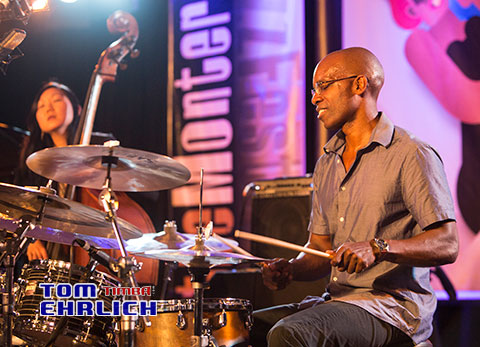
Ralph Bowen is here (as he has been on all of Dr. Branker's albums since 2006. Joining him is Pete McCann (guitar), Fabian Almazan (piano), and the amazing rhythm section of Linda Oh (bass) and Rudy Royston (drums), both of whom (pictured left) work with Dave Douglas Quintet and have appeared on each other's albums. It's hard to single out any one track as all nine contain music to recommend them. The opening cut, "Joy", starts with the guitar and the tenor saxophone playing what becomes the melody and then, one by one, Royston kicks in, Ms. Oh sets the foundation and Almazan supplies the chords. Bowen takes off on his solo flight and he really sets theme for the album, moving up through his horn's range while Royston pushes him forward amidst the impressionists sounds of guitar and piano and the underpinning of the bass. There are moments of tenderness and reflection in the mix as well.
allaboutjazz.com
Ms. Oh leads the quintet on the title track with a quiet yet poetic bass solo. Almazan (pictured left) and Bowen play the theme with McCann supplying the chords. Pay attention to how Royston works below the soloists, painting pictures with cymbal washes, fleet movements across his set, and stop-on-a-dime turnarounds. Some might say his work is distracting but it works to motivate his bandmates. The bassist's solid bottom sound gives the drummer the freedom to be creative and adventurous. And he takes advantage of that freedom throughout most of the album.
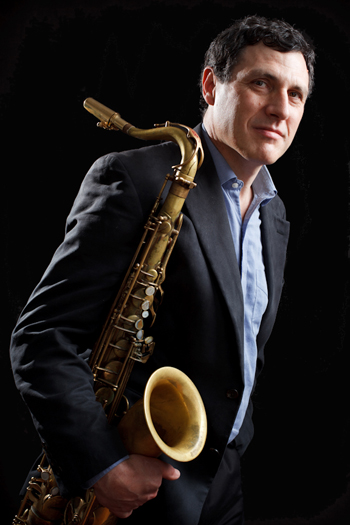
Also impressive is the powerful work of Ralph Bowen (pictured left). He has such a presence on his reeds. Listen to how he wraps his soprano sax around McCann's modified guitar on "People Everywhere", a high-energy song that also features a sparkling piano solo. His soulful tenor over the gospel piano chords on "(God's) Wisdom" is cliche-free and quite tuneful. Bowen maneuvers the tricky rhythmic landscape on "(We Are) What We Are Not Yet", switching from soprano to tenor after the piano solo and before McCann's excellent spot. The tenor solo on "Many Roads Beneath the Sky" starts in a reflective and soon catches fire, thanks to Royston's insistent jabbing.
One track led me to GOOGLE. "Loving Day (June 12)" is named for the day in 1967 when the Supreme Court of the United States struck down the anti-miscegenation laws in 16 states. The case before the court, "Loving vs Virginia" pitted an interracial couple (Mildred and Richard Loving) who had married and were arrested and forced to move out of Virginia. The couple brought the case to then-Attorney General Robert F. Kennedy and, several years later, the Supreme Court unanimously voted the law unconstitutional. Do you need to know that to enjoy the music? No, but the story informs the music and musicians, adding more power to an already powerful composition.
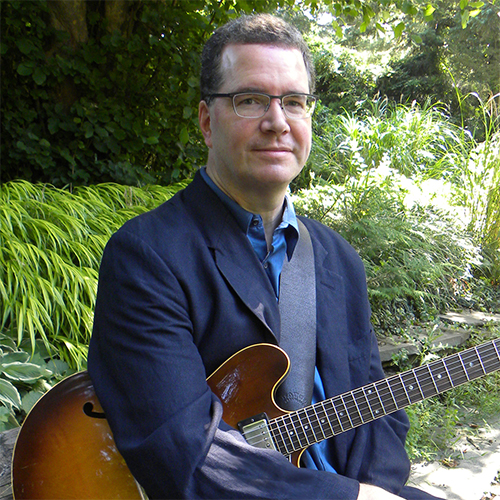
There's even more to discover on "Beauty Within" - you can sit each time you listen and concentrate on one or two musicians, hearing how each one works so well with the others. Listen for the impressive piano work of Fabian Almazan, forthe razor-sharp solos of Pete McCann (pictured left), the singing tones of Ralph Bowen, the fundamental as well as melodic work of Linda Oh, and the glorious drumming of Rudy Royston. Their life experiences, individual voices, and collective talent make the music of Anthony Branker glisten with confidence and soul.

 Posts
Posts