Posts
Posts


The 10-song program includes three compositions by Altschul, two apiece from Lake and Haynes, one by Fonda, and two collective improvisations. The drummer's title track is dedicated to Ornette Coleman while "Da Bang" is a tribute to the late violinist Billy Bang. The former piece opens the album in a swinging mode but check out the well-developed melody. Haynes takes the first solo and he dances along with the powerful bass lines and rambunctious drums. The latter track opens with a fine drum soliloquy that dips and swerves, talks and turns, before Fonda drops into a rapid-fire walking bass and the quartet dances forward. Lake's "Justice" includes a deliberate melody line over the rampaging rhythm section. The music feels akin to the "protest" music that Charles Mingus created in his powerful songs. Lake and Haynes solo together with the saxophonist squalling while the cornetist shouts back at him. The saxophonist composed "Bass Bottom", another tune with a deliberate melody line but this time it's Fonda funky bass lines and solo over the simple drum pattern that pushes the song forward.
 |
| Photo: Enid Farber |
Check out the two improvisations, especially "OGJB#3" with its playful electronics. Playful is a good word for "Ode To O"; the album is full of playing by four musicians who listen to and inspire each other as well as inspire the listener. Such goos music deserves to be heard both on album and in person.
For more information, go to https://tumrecords.com/058-ode-to-o/.
 On the first day of February 2021, three musicians entered Studios Ferber in Paris, France, all three associated at one time in their careers with pianist Cecil Taylor (1929-2018). Drummer Andrew Cyrille spent 11 years (1964-75) with the groundbreaking artist, recording on his two Blue Note albums, his work with and for the Jazz Composers Orchestra, and several other Taylor albums. Bassist William Parker also spent more than a decade as a member of the pianist's ensemble, recording 13 albums from the mid-1980s into the early 1990s. Flugelhornist and trumpeter Enrico Rava performed as a member of Taylor's Orchestra of Two Continents (1984) and his European Orchestra (1988), recording one album with each band.

Cyrille's "Top, Bottle, and What's in the Middle" opens with solo flugelhorn, then bass, and then drums, hence the title. Yet, that's how the tune moves forward, each member of the trio getting a short solo in that order. The drummer also contributes "Enrava Melody" –– Rava plays the melody in with Parker offering counterpoint until the composer enters to set the pace for the music to jump forward.
Here's the title track:
The 10-song program opens with "Improvisation No. 1", a burst of energy from the opening moments. For those listeners who only know the 82-year young Rava from his ECM recordings, his flugelhorn work is a joy to hear. He rides the rhythmic waves, playfully tossing out lines yet never overplaying. Meanwhile, Parker creates a throbbing bottom from Cyrille to play around with. "Ballerina" is the first of two Rava compositions; the title does not prepare one for the rapid-fire rhythms and blazing flugelhorn riffs. Even the unaccompanied cymbal and drums solo burst out with unbridled energy. Later in the program, Rava's "Overboard" opens with a short flugelhorn spot that resembles the melody of Ornette Coleman's "Lonely Woman". Parker's powerful bass lines atop Cyrille's rolling drums stands out as well.
 |
| Photo: Luciano Rossetti |
The album also includes two "Blues For Cecil". "No. 1" is a funky urban blues that Rava gleefully moves through while Parker shows his "gutbucket" side. The trio goes "free" for a moment before Cyrille's martial, drumbeat pushes the bassist out front for yet another powerful solo. Listen to Cyrille dancing, bobbing and weaving throughout the second half –– such joy! "No. 2" opens as a ballad with Rava displaying his blues "chops" while the bassist plays such deep low notes.
 |
| Photo: Luciano Rossetti |
"2 Blues for Cecil" closes with the program's only standard, Rodgers & Hart's "My Funny Valentine". Rava caresses the melody while Cyrille moves gracefully around his cymbals and Parker offers gentle support. The three musicians created this beguiling tribute to Cecil Taylor not by imitating but by playing who they are as musicians and as human being. Mr. Taylor always expected the very best from his ensemble and Andrew Cyrille, William Parker, and Enrico Rava responded during their time working with him. This delight-filled album is their gift to us!
For more information, go to https://tumrecords.com/059-2-blues-for-cecil/music.

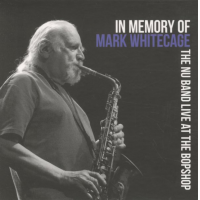 In January of 2018, The Nu Band performed at the Bop Shop in Rochester, NY. "In Memory of Mark Whitecage" (NotTwo Records) captures 63 minutes of that evening's performance. After Roy Campbell passed in 2014, the rest of the group asked trumpeter Thomas Heberer to join them and he's been a member ever since. The exciting seven-song program features songs by each member. The program opens with Whitecage's "Prayer for the Water Protectors"; the composer's Díne flute rolls on unaccompanied for the first two minutes before Grassi's tribal drums and Heberer's growling trumpet move behind him. Fonda's bowed bass lines quietly underpin the music. The saxophonist's "Five O'Clock Follies" opens with a short saxophone intro (opening lines sound a bit like "How are Things in Glocca Morra" from "Finian's Rainbow") and heads right into a rhythm that befits the name of the venue. Everybody takes a solo, the audience and the band have fun.
Give a listen:
Born in 1937, Mark Whitecage (alto saxophone, clarinet, Díne flute) lived a jazz life. He started playing while still a boy, his father exposing him to the music and sound of Lester Young, Charlie Parker, Ben Webster, and many other "boppers". By the time he arrived in New York City in the early 1970s, his approach to music had changed. Whitecage hooked up with multi-instrumentalist Gunter Hampel and they toured constantly spending a lot of time criss-crossing Europe. He led a number of his own bands through the 1980s and 90s recording a number of albums as a leader and sideman for CIMP Records. He joined The Nu Band in 1999, a quartet organized by drummer Lou Grassi and trumpeter Roy Campbell, Jr. (featuring bassist Joe Fonda) and was a member up until his passing in March of 2021 at the age of 83.


After a pair of Fonda's pieces, the free then rollicking "Christoff and Ornette" and the hard-driving "Minor Madness" (great solos all around), the album closes with Grassi's elegy "Dark Dawn in Aurora". Opening with a long and powerful solo from Fonda, the band enters on a martial beat and then into strong solos from Heberer and Whitecage (again, he duets with the drummer) before returning back to the theme with the added spice of the trumpeter dancing atop the saxophone melody until the close.
In the liner notes to "In Memory of Mark Whitecage", Joe Fonda writes about his 40-year relationship with the saxophonist first as a young musician soaking up all the stories then as an equal on the bandstand. Lou Grassi looks back at the 20 years of Whitecage's membership in The Nu Band while Thomas Heberer first met the man as a 24-year old new to America before joining him on the bandstand 25 years later. The energy, the creativity, the sheer joy of making music even as he entered his 80s, Mark Whitecage made and left his mark on creative music.
For more information, go to http://joefonda.com/the-nu-band.html.
Here's The Nu Band and "Five O'Clock Follies":