Showing posts with label Jeremy Pelt. Show all posts

Friday, April 5, 2024

Saxophones A'Plenty (Part Two) – Three Quartets

This post features three quartets led by tenor saxophonists who double on other reeds, two that  have the same type of lineup –– saxophone, piano, bass, and drums (same drummer on both albums) –– and one that substitutes guitar for piano.

Photo: Dave Stapleton
Chris Potter signed with Edition Records in 2019 and each one of his five releases show a different side.  Last year's "Got the Keys to the Kingdom" was recorded live at The Village Vanguard and featured Potter with Craig Taborn (piano), Scott Colley (bass), and Marcus Gilmore (drums).  His latest album, "Eagle's Point", is also a quartet date but with a totally different lineup –– Brad Mehldau (piano), John Patitucci (bass), and Brian Blade (drums). Just seeing those names should be enough to make one purchase the album or, at the very least, listen to it.  You should because it's good music and great fun.

"Dream of Home" gently opens the eight-song program but as soon as the leader begins to solo, the proceedings heat up. The bassist and drummer spent two+ decades with Wayne Shorter's last Quartet and they absolutely know how to support, how to push the soloists, and how much to add.  Patitucci's handsome bass opening (such a lovely tone!) leads the band into "Cloud Message". Potter's tenor playing so assured, his notes so articulate even as he flies through a solo. Throughout the album, Mehldau not only plays with authority (is that Bud Powell showing through on his solos) but also his comping is so delightfully post-bop.  Listen below to the title track –– the music is playful, slightly funky (check out the song's chorus), and the rhythm section is so "tight yet loose".  

Photo montage: Dave Stapleton
Among the the highlights is the African-influenced tune "Indigo IIdiko" which finds the leader on bass clarinet. There's such a melodious feel to Potter's tone as well as splendid solos by Patitucci and Mehldau with the latter reminding this listener of Keith Jarrett's work with the Charles Lloyd Quartet.  Potter switches to tenor sax for his solo which moves the piece more towards the mainstream.  "Aria for Anna" finds Potter on soprano sax where his lovely tone is perfect for the ballad where the only other instrument for 2/3rds of the song is the piano.  Mehldau, one of the best at painting pictures through melody, is the perfect match for the leader's soaring solo. It's easy to miss the bass and drums when they enter but they add just the right colors.

The album closes with "Horizon Dance", a piece with rhythms that incorporate South American influences.  The bassist is at his best here interacting with the saxophonist, playing off his riffs while the drummer gleefully dances. Mehldau keeps up the heat with his own spicy solo. Blade gets a moment to "strut his stuff" before the Quartet returns to the opening theme to close the program.

"Eagle's Point" is yet another feather in the expansive cap that is the career of Chris Potter. The majority of the music and musicianship exudes joy with nary a false note.  Listen up! Good music is infectious.

For more information, go to www.chrispottermusic.com/. To purchase the album, go to  https://chrispotterjazz.bandcamp.com/album/eagles-point

Here's the title track:


I am a long-time fan of the music of Charles Lloyd; he rarely disappoints with his music. While I receive many recordings to review from publicists, Blue Note releases rarely show up so I buy them. Once I heard tracks from Mr. Lloyd's new album, there was no way I could ignore the music.  The 15-song, 91-minute album, features a quartet with veteran Jason Moran (piano), Larry Grenadier (bass), and newcomer Brian Blade (drums) 

"The Sky Will Be There Tomorrow" is the 86-year old Lloyd's 51st album and first studio date since 2017.  He's always favored the quartet setting although he's been more adventurous with lineups since joining Blue Note nearly a decade ago. The energy that emanates from this recording is powerfully positive whether the music is meditative (as on the opening "Defiant, Tender Warrior" or the ballad "The Ghost of Lady Day"), fiery (as on the tenor-piano take of "Lift Every Voice and Sing" where the duo take the piece "out" is a flurry of Gospel chords) or rhythmically adventurous (as on the flute-driven "Booker's Garden" and the playful "Monk's Dance"). Listen below to the last track listed in the previous sentence. After a powerfully rollicking intro by Moran, the rest of the band enters and the piece takes off.  Blade certainly can swing while Grenadier is both melodic and pulsating.

One should listen to this album in its entirety each time. There are so many masterful moments.  The fire that Mr. Lloyd creates in his sparring with Blade and then Moran on the opening several minutes of the title track is one as is the piano solo on the same track. The beauty and open feeling of "Balm in Gilead" is lovely as is the long, exploratory, gentle "Cape to Cairo" near the close of Side 4 or disc 2.  

By the time you reach the final track, "Defiant Reprise; Homeward Dove", the music should have changed you. Here are four master musicians led by a person who moved from his hometown, Memphis TN, to Los Angeles in 1956, starting a career that has spanned nearly seven decades, a musician who has recorded numerous standout recordings with musicians from around the world.  Listen closely, listen deeply –– the rewards are endless!

For more information, go to https://charleslloyd.com/.  The link to his music is there as well as his 2024 tour schedule and more.

Here's "Monk's Dance":


Photo: William Brown
Saxophonist and composer Dayna Stephens has a new Quartet and a new album.  Since his 2015 kidney transplant, Stephens has issued five albums as a leader, a fusion album underneath the name of Pluto Juice, and appeared as a sideman on numerous albums including releases by Linda May Han Oh, Johannes Wallman, Massimo Biolcati, and Ethan Iverson & the Umbria Jazz Orchestra (among others).  It's easy to understand why he's so popular as his sound on tenor is full but never over-blown, his soprano playing is melodic and not shrill, and his ever-maturing work on EWI humanizes the electronic instrument.

For his new "working" ensemble, the atmospheric sounds of young guitarist Emmanuel Michael (born in South Dakota to Ugandan and South Sudanese parents) stand out alongside the rhythm section of Kanoa Mendenhall (bass), and Jongkuk Kim (drums). Stephens first met the guitarist in 2022 when Michael was a student at Manhattan School of Music and a member of his ensemble. This ensemble went into a New York City studio in May of 2023 and recorded "Closer Than You Think", Stephens' first album for Cory Weeds Cellar Live Records.  It's Michael's sweet guitar one hears first as it leads the band in on his composition  "Bubbly".  Listen below to how easily the rhythm section creates a flow for the leader's tenor sax and the guitar.  This is one of several times on the 11-song program that this music is reminiscent of the collaboration of Charles Lloyd with guitarist John Abercrombie.  

Photo: William Brown
Like Mr. Lloyd, this music often has an "open" feel.  The way that Ms. Mendenhall and Kim move under the music allows both the leader and guitarist to go on lengthy solo journeys.  "The Nomad" (the first of three pieces composed by Stephens) is a delightful sonic experience –– just sit back and get lost in the music. "Scrutiny" (another of Stephens' pieces) is more frenetic pushed hard by Kim's powerful drumming.  Wayne Shorter's "E.S.P." adds producer Jeremy Pelt's trumpet to the Quartet. The funky undertow allows the soloists to move freely around the melody with Michael's guitar work raising the temperature of the music.  The guitarist's other composition, "Placate", may remind some of songs by Bill Frisell, especially the work he created alongside Joe Lovano and the late Paul Motian –– Stephens' solo has a gentle quality as it moves effortlessly over the rhythm section and guitar counterpoint.

Near the close of the program, the band plays pianist Julian Shore's gentle bossa-nova "Back Home".  It's here that the leader switches to EWI; before his enchanting solo, bassist Mendenhall creates a melodic solo of his own with Michael's finger-picked acoustic guitar moving dancing beneath him.  The program ends with "Placate (reprise)", first a duet for guitar and bass, closing with Stephens' tenor leading the way to a gentle finish.

The more I listen to "Closer Than We Think", the more I enjoy the interactions of the quartet, the breadth of the material (including pieces by pianist David Berkman and Ms. Mendenhall's appealing "Te" with the leader on soprano sax), and how it's easy to fall under its spell.  Dayna Stephens continues his growth as a musician and interpreter as well as very good judge of talent.  Get lost in these grooves – you will better for the adventure!
 
For more information, go to www.daynastephens.net/. To hear more and to buy the album, go to  https://daynastephens.bandcamp.com/album/closer-than-we-think

Here's the opening track, "Bubbly":


Monday, February 27, 2023

These Sounds & Those Words


Argentinean-born pianist and composer Emilio Teubal creates music that shines with lyrical beauty, sparkling solos and interplay plus rhythms that make you dance and sway. His 2013 BJU release, "Musica Para un Dragon Dormido", is one of my all-time favorite albums. Teubal has been busy since moving to the United States over two decades. He writes constantly and has worked with artists such as bassist Pedro Giraudo, cellist Erik Friedlander, and various tango organizations and groups in the New York City area.  Currently, he leads a trio with bassist Pedro Lanouguere and drummer Chris Michael.

Those two musicians are the foundation of his new recording "Futuro" (Not Yet Records).  Recorded in several sessions in December 2021 and May 2022 (drummer Michael has been dealing with long COVID so Brian Shankar Adler appears on five of the 10 tracks, all recorded at the later sessions).  Joining the trio on three tracks is Sam Sadigursky (clarinet) and Fede Diaz (guitar) while vibraphonist Chris Dingman adds his sound to three other cuts.  From the opening measure of the opening cut (the title track), the listener is transported to sunnier climes.  The dancing clarinet and percussive guitar wrap around the warming piano figures. Bassist Lanouguere, who leads a quintet that Teubal is part of, is a rich melodic player with a full tone on both acoustic and electric; he also contributes fine bow work (he and the pianist play the opening melody of "Children of MMXX"––he then solos sans bow and is quite impressive there as well.

Photo: Sergio R. Reyes
Of the three tracks Dingman appears on, "Remolinos" stands out for its hypnotic piano figures and circular melody. There is a Steve Reich in the piano lines that is repeated by the vibes and the electric bass throughout. It certainly feels like all four musicians are percussionists and melody makers at the same time.  The vibraphonist also appears on the handsome take of Sir Paul McCartney's "Blackbird".  While the piece is the shortest track in the program (2:35), the arrangement allows everyone to shine and the melody to stand out.  


Photo: Sergio R. Reyes
The blend of the acoustic guitar and clarinet on "Los que Fluyen" hints at tango as well as Brazilian folk forms––Teubal's solo rises out of the main theme, dancing atop the guitar and electric bass then steps aside for Sadigursky to create a masterful, emotional, solo.  The quintet imbues "Tokyo Trenque" with such a gentle quality, caressing the melody while Adler's hand percussion clicks underneath.  The music picks up with intensity during Lanouguere's acoustic bass solo from which Teubal moves farther away without going "free" but much more impressionistic. The clarinet solo seems to move the rest of the band back to melody; after a quick climax, the music gently sighs to a close.

The album closes with "Los Ultimos Seran Los Primeros"  ("The last will be the first"), a wistful Trio piece dedicated to the pianist's father who passed in 2021.  The insistent quality in the piano solo allows the listener to hear touches of Keith Jarrett in the delightful two-hand work of Teubal.  As you listen to this track (and others), one can really tell that these musicians are in tune with each and with the material.  "Futuro" stands out as a work that celebrates life and melodic adventure without sacrificing the rhythms that have sparked the curiosity of Emilio Teubal since he was a boy.  Listen to "Rio" below––it's indicative of how the music incorporates its many influences to create sounds that please, hug, and brings joy!

For more information, go to www.emilioteubal.com.  To hear more and to purchase the album, go to  https://emilioteubal.bandcamp.com/album/futuro-2023

Join the group on its journey to "Rio"


Photo: Jimmy Katz
What do you get when mix drummer Matt Wilson, bassist Mimi Jones, and saxophonist Jeff Lederer, give them two nights at the end of February 2020 in the newly reopened Cafe Bohemia in New York City, and let them loose.  It's the Leap Day Trio and now you can hear the results on "Leap Day Trio: Live at The Cafe Bohemia" (Giant Steps Arts). The music on the recording is spirited, lively, at times thoughtful, and very human. Messrs. Wilson and Lederer have been friends and musical partners on and off for three decades; adding Ms. Jones to their special mix neither tempers nor hinders their musical fun. Instead, she's a solid foundational player and a melodic soloist (check her out on "The Dream Weaver" and "Leap of Faith").

The nine song, 68 minute program, opens with Wilson's "Dewey Spirit", (listen below) a tune the drummer dedicates to one of his earliest mentors and employers, tenor saxophonist Dewey Redman. Commencing with percussion and Lederer's spiky tenor sax sounds, the piece opens in rubato with Ms. Jones dancing underneath the melody line.  When the main theme kicks in, one hears a running bass line, swinging drums, and the saxophonist flying all around his horn.  Everyone solos, the energy is contagious, and the crowd enjoys it all.

Two of the next three tracks are ballads ("Leap of Faith" and "Ghost Town") but the track in between ("The Dream Weaver") rumbles along atop the pulsing bass and percussion.  "Ghost Town" is a fascinating journey through the musical terrains of blues, post-bop, and during the bass solo, the feel of Native American music. Lederer lets loose on the opening of "Strival For Survival"––that sets the tempo for the rhythm section and they rocket forward. When the tempo slows down for Ms. Jones fine solo, listen for Wilson's delightful work on the cymbals.

Photo: Jimmy Katz
The program closes with the spirited "For Friends"––again, Lederer leads off the piece with a solo introduction but one can hear from his exciting forward lean, the music is going to be fiery.  Even when the gentlemen step aside for Ms. Jones spirited solo, the music has great drive.  

One hopes that the Leap Day Trio doesn't only convene every four years. In the meantime, celebrate the group's music on "Live at The Cafe Bohemia".  

Hear Matt Wilson's musical tribute to Dewey Redman:


Trumpter, composer, mentor, and author Jeremy Pelt has just issued Volume III of "Griot: Celebrating the Lives of Jazz's Great Storytellers".  15 more interviews with artists whose ages range from 89 (Wayne Shorter) to 28 (Elena Pinderhughes) sharing insights into their musical and spiritual upbringing, how they each developed a singular voice, and the changes they have seen in this art form created by black musicians at the start of the 20th Century.  These are stories of resilience in the face of the racism that has never truly been eradicated in this country and in places around the world. Many of the artists speak of how the changes that other musical forms (styles) have brought to the music keeps it alive in the face of listeners and label owners apathy.  But you also read of how musicians have been mentored by their musical elders, about the rigors of the road, and the cost, mental and physical, of a musician's calling.  Still, there are joys galore in their retelling stories of their formative days and nights on and off the bandstand.  

Photo: Ra-Re Valverde
I have written before how "Griot" will remind older Black Music fans of "Notes and Tones: Musician-to-Musician Interviews", the 1977 classic interviews drummer Art Taylor compiled that featured 29 of the greats who helped push the music forward in the middle decades of the 20th Century.  Jeremy Pelt has given us the 21st equivalent of Mr. Taylor's book and, hopefully, he will continue to converse with his elders, contemporaries, and young people for years to come!

For more information and to order any one or all three volumes of "Griot", go to  http://jeremypelt.net/home.html.


Thursday, June 17, 2021

Summer Reading List

When I was first got interested into digging deeply into Black Music in the late 1970s, a friend recommended I read "Notes and Tones: Musician-to-Musician Interviews" (Da Capo Press), a collection written by drummer Arthur Taylor. Taylor (1929-1995) had a long and busy career working and/ or recording with artists such Coleman Hawkins, Thelonious Monk, Gene Ammons, Red Garland, Gigi Gryce, Jackie McLean, and John Coltrane.  Between 1968-1972, Taylor compiled the conversations that make up his book; musicians such as Ornette Coleman, Art Blakey, Carmen McRae, Sonny Rollins, Max Roach, Betty Carter, and others. Taylor's insightful questions pulled no punches and while many of the answers may have shocked White audiences, they gave great insights into the lives of these musicians.  In the decades since its publication, I have rarely encountered a book like "Notes and Tones".  

Photo: Gari Garalalde
Earlier this year, trumpeter, composer, and educator Jeremy Pelt released his latest album "GRIOT: THIS IS IMPORTANT!"  The recording not only featured music but also spoken word excerpts from interviews Pelt had conducted with Larry Willis, J.D.Allen, Harold Mabern, Bertha Hope, Ambrose Akinmusire, Paul West, Rene Marie, and Warren Smith.  The words the listener hears give real insights into the life of modern musicians, new and old veterans, trying to make a living doing what they love.

At just about the same time, Pelt self-published "GRIOT: Examining the Lives of Jazz's Great Storytellers, Vol. I".  The book is only available from the author's website and I can tell you from personal experience that the shipping is fairly quick, at least in the U.S.  The book contains interviews with the people from the album (except the late Mr. Mabern who will appear in "Vol. II") plus Robert Glasper, Terri Lyne Carrington, Lewis Nash, Greg Hutchinson, Dr. Eddie Henderson, Justin Robinson, and Wynton Marsalis.  The book is similar to "Notes and Tones" as are the responses. While Black Music has changed in the four-plus decades, issues with racism, musicians rights, how poorly people and record labels treat the artist, and much more.  If you only know these people through their music, you should be fascinated by who they are are human beings.   

For more information, go to http://jeremypelt.net/home.html.  


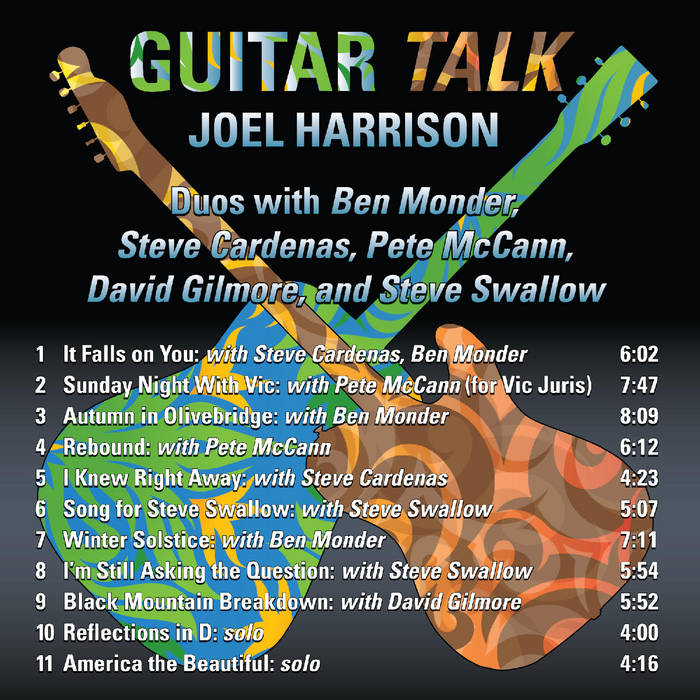
The day before my wife and I left for vacation, I received "Guitar Talk: Conversations with Visionary Players" (Terra Nova Press), a collection of interviews guitarist Joel Harrison (pictured left) conducted with his contemporaries. 26 different players, ranging from Ralph Towner to Pat Metheny to Michael Gregory Jackson to Ben Monder to Liberty Ellman to Mary Halvorson to Ava Mendoza and so many more. At the end, the author includes a "Catalogue of the Missing", a long list of guitarists who Harrison says the reader should give as much attention to as the ones who are in the book. 

The book is available at www.terranovapress.com/books/guitar-talk-conversations-with-visionary-players, from traditional book stores, and various online sources. Harrison has also released an album of the same name that features duos with Ben Monder, Steve Cardenas, Pete McCann, David Gilmore, and electric bass innovator Steve Swallow. That recording is the first for Harrison's new label Alternative Guitar Summit Recordings. Check it out  at 

Sunday, July 24, 2016

One Door Closes (for the weekend) & Another Opens (you'll see)

Jan and Ken are taking a well-deserved rest (actually, a busman's holiday) this weekend (7/29-30); therefore, The Side Door Jazz Club in Old Lyme is closed.  Jan Mullen, who searches for and books the talent, is going to the Newport Jazz Festival to scout the talent and hopefully, judging by the lineup (click on the name above), invite artists who have yet to play in the handsome performance space.

When she returns (chances are also good owner Ken Kitchings will be there as well), The Side Door has quite a group of artists scheduled for August through mid-September including trumpeter Dominick Farinacci (8/06), saxophonist Tia Fuller (8/13), vocalist and pianist Champian Fulton (8/26), and saxophonist Rudresh Mahanthappa's "Bird Calls" with trumpeter Adam O'Farrill and (perhaps) pianist Matt Mitchell (9/16). And, there's plenty more!  Go to thesidedoorjazz.com to check to all out.

On the weekend of August 19-20, Jan and Ken welcome back the Black Art Jazz Collective.  The sextet, organized in 2012 by Wayne Escoffery (saxophones), Jeremy Pelt (trumpet), Johnathan Blake (drums) and the late bassist Dwayne Burno, first played in Old Lyme in late November 2014, almost a year after the bassist passed.  Mr. Burno was replaced by Vicente Archer with the other members being James Burton III (trombone) and Xavier Davis (piano).  The band recorded live one night and then, the next day, used the space to record even more.

The results of those sessions can now be heard on the sextet's debut album.  Titled "Black Art Jazz Collective: Presented by The Side Door Jazz Club" (Sunnyside Records), the CD includes eight original compositions (two by Escoffery and Davis plus one each from the rest of the band, including Burno but not Archer). Most, if not all, of the group are bandleaders so this "collective" understands that one puts aside egos and focusses on the music.  The recording starts with two pieces by the saxophonist, the fiery "Double Consciousness" and the forceful "Awaiting Change" - pay attention to the work of Davis, Archer, and, especially Blake. as the music swells, pulsates and flows.  Both Escoffery and Pelt play with great fire on the latter track while Burton III's more mellow approach is an excellent contrast to the blasts of the sax and trumpet on the opener.  Yet, listen to how Blake fires up the band Iand he does so throughout the album.

This album is filled with exciting music with influences from Hank Mobley, Jackie McLean, Wayne Shorter and other creative musicians from the 1960s and 70s. "Salvador Da Bahia", from the pen of Davis, changes tempi with the two-handed piano chords leading the way.  Hints of McCoy Tyner's mid-1970s music enters this track, especially in the interaction of Escoffery with Davis, Blake, and Archer.  The pianist's "No Small Change" is a handsome ballad with the trombonist and bassist taking excellent solos.  Both this song and "Awaiting Change" were inspired by Barack Obama while the trombonist's rollicking "Going Somewhere" cites Sojourner Truth as its inspiration.  Pelt's solo has a bluesy edge but moves forward with great energy.  Both Escoffery and Burton match that energy while Davis dances through his solo with great joy.

The album closes with its longest track (12:16); "The Shadower" (inspired by saxophonist Joe Henderson) is the cut from the "live" show. The enthusiastic audience really enjoys the long solo from Pelt, especially the long moaning drone he plays for 90 seconds before launching into a series of phrases, melodic fragments that romp over the powerful rhythm section. By the end of the solo, (over five minutes) the audience is ecstatic.  Escoffery pours his soul out over the funky drums and bass (sounding like something Miles Davis played before going electric.  The saxophonist also stretches out but leaves room for a fantastic piano solo.  Davis starts out unaccompanied, somewhat introspective, but he soon takes a more rhythmic with Blake and Archer joining as he moves in-and-out of tempo. Everyone returns for the final minute, taking the set out on a rousing note.

Black Art Jazz Collective has the power and intelligence to stir an audience, making music that nods towards its influences yet sounds fresh and refreshing.  The Side Door Jazz Club in Old Lyme, CT, opened in May of 2013 with the mission of not only presenting first-class musicians from around the world but also shining its spotlights on younger musicians, especially those who have gone through the Jackie McLean Institute of Jazz at the Hartt School, the New England Conservatory, Berklee, Manhattan School of Music, and elsewhere.  Ken and Jan's first recording project opens a new door and one hopes that this portal stays off its latch a good long time.

For more information, go to sunnysidezone.com/album/presented-by-the-side-door-jazz-club.  For reservations to the CT show, call 860-434-0886 or go to thesidedoorjazz.com.