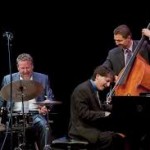
Argentinean-born pianist and composer Emilio Teubal creates music that shines with lyrical beauty, sparkling solos and interplay plus rhythms that make you dance and sway. His 2013 BJU release, "Musica Para un Dragon Dormido", is one of my all-time favorite albums. Teubal has been busy since moving to the United States over two decades. He writes constantly and has worked with artists such as bassist Pedro Giraudo, cellist Erik Friedlander, and various tango organizations and groups in the New York City area. Currently, he leads a trio with bassist Pedro Lanouguere and drummer Chris Michael.
Those two musicians are the foundation of his new recording "Futuro" (Not Yet Records). Recorded in several sessions in December 2021 and May 2022 (drummer Michael has been dealing with long COVID so Brian Shankar Adler appears on five of the 10 tracks, all recorded at the later sessions). Joining the trio on three tracks is Sam Sadigursky (clarinet) and Fede Diaz (guitar) while vibraphonist Chris Dingman adds his sound to three other cuts. From the opening measure of the opening cut (the title track), the listener is transported to sunnier climes. The dancing clarinet and percussive guitar wrap around the warming piano figures. Bassist Lanouguere, who leads a quintet that Teubal is part of, is a rich melodic player with a full tone on both acoustic and electric; he also contributes fine bow work (he and the pianist play the opening melody of "Children of MMXX"––he then solos sans bow and is quite impressive there as well.
Photo: Sergio R. Reyes
Of the three tracks Dingman appears on, "Remolinos" stands out for its hypnotic piano figures and circular melody. There is a Steve Reich in the piano lines that is repeated by the vibes and the electric bass throughout. It certainly feels like all four musicians are percussionists and melody makers at the same time. The vibraphonist also appears on the handsome take of Sir Paul McCartney's "Blackbird". While the piece is the shortest track in the program (2:35), the arrangement allows everyone to shine and the melody to stand out.
Photo: Sergio R. Reyes
The blend of the acoustic guitar and clarinet on "Los que Fluyen" hints at tango as well as Brazilian folk forms––Teubal's solo rises out of the main theme, dancing atop the guitar and electric bass then steps aside for Sadigursky to create a masterful, emotional, solo. The quintet imbues "Tokyo Trenque" with such a gentle quality, caressing the melody while Adler's hand percussion clicks underneath. The music picks up with intensity during Lanouguere's acoustic bass solo from which Teubal moves farther away without going "free" but much more impressionistic. The clarinet solo seems to move the rest of the band back to melody; after a quick climax, the music gently sighs to a close.
The album closes with "Los Ultimos Seran Los Primeros" ("The last will be the first"), a wistful Trio piece dedicated to the pianist's father who passed in 2021. The insistent quality in the piano solo allows the listener to hear touches of Keith Jarrett in the delightful two-hand work of Teubal. As you listen to this track (and others), one can really tell that these musicians are in tune with each and with the material. "Futuro" stands out as a work that celebrates life and melodic adventure without sacrificing the rhythms that have sparked the curiosity of Emilio Teubal since he was a boy. Listen to "Rio" below––it's indicative of how the music incorporates its many influences to create sounds that please, hug, and brings joy!
What do you get when mix drummer Matt Wilson, bassist Mimi Jones, and saxophonist Jeff Lederer, give them two nights at the end of February 2020 in the newly reopened Cafe Bohemia in New York City, and let them loose. It's the Leap Day Trio and now you can hear the results on "Leap Day Trio: Live at The Cafe Bohemia" (Giant Steps Arts). The music on the recording is spirited, lively, at times thoughtful, and very human. Messrs. Wilson and Lederer have been friends and musical partners on and off for three decades; adding Ms. Jones to their special mix neither tempers nor hinders their musical fun. Instead, she's a solid foundational player and a melodic soloist (check her out on "The Dream Weaver" and "Leap of Faith").
The nine song, 68 minute program, opens with Wilson's "Dewey Spirit", (listen below) a tune the drummer dedicates to one of his earliest mentors and employers, tenor saxophonist Dewey Redman. Commencing with percussion and Lederer's spiky tenor sax sounds, the piece opens in rubato with Ms. Jones dancing underneath the melody line. When the main theme kicks in, one hears a running bass line, swinging drums, and the saxophonist flying all around his horn. Everyone solos, the energy is contagious, and the crowd enjoys it all.
Two of the next three tracks are ballads ("Leap of Faith" and "Ghost Town") but the track in between ("The Dream Weaver") rumbles along atop the pulsing bass and percussion. "Ghost Town" is a fascinating journey through the musical terrains of blues, post-bop, and during the bass solo, the feel of Native American music. Lederer lets loose on the opening of "Strival For Survival"––that sets the tempo for the rhythm section and they rocket forward. When the tempo slows down for Ms. Jones fine solo, listen for Wilson's delightful work on the cymbals.
Photo: Jimmy Katz
The program closes with the spirited "For Friends"––again, Lederer leads off the piece with a solo introduction but one can hear from his exciting forward lean, the music is going to be fiery. Even when the gentlemen step aside for Ms. Jones spirited solo, the music has great drive.
One hopes that the Leap Day Trio doesn't only convene every four years. In the meantime, celebrate the group's music on "Live at The Cafe Bohemia".
Hear Matt Wilson's musical tribute to Dewey Redman:
Trumpter, composer, mentor, and author Jeremy Pelt has just issued Volume III of "Griot: Celebrating the Lives of Jazz's Great Storytellers". 15 more interviews with artists whose ages range from 89 (Wayne Shorter) to 28 (Elena Pinderhughes) sharing insights into their musical and spiritual upbringing, how they each developed a singular voice, and the changes they have seen in this art form created by black musicians at the start of the 20th Century. These are stories of resilience in the face of the racism that has never truly been eradicated in this country and in places around the world. Many of the artists speak of how the changes that other musical forms (styles) have brought to the music keeps it alive in the face of listeners and label owners apathy. But you also read of how musicians have been mentored by their musical elders, about the rigors of the road, and the cost, mental and physical, of a musician's calling. Still, there are joys galore in their retelling stories of their formative days and nights on and off the bandstand.
Photo: Ra-Re Valverde
I have written before how "Griot" will remind older Black Music fans of "Notes and Tones: Musician-to-Musician Interviews", the 1977 classic interviews drummer Art Taylor compiled that featured 29 of the greats who helped push the music forward in the middle decades of the 20th Century. Jeremy Pelt has given us the 21st equivalent of Mr. Taylor's book and, hopefully, he will continue to converse with his elders, contemporaries, and young people for years to come!
The music of Spanish-born (raised in Argentina) pianist and composer Emilio Teubal covers a wide swath of territory. One can hear classical influences, rhythms from his native lands mixed with modern sounds, and a love for lyricism that can be found in each of his recorded projects. His American debut album, 2013's "Musica Para un Dragon Dormido" (BJU Records), remains one of my favorite listening experiences (my review is here) while his 2018 recording "Memorias de Otro Tiempo" (Not Yet Records) is a splendid trio (piano, clarinet, acoustic guitar) that is lyrical and moving, forceful yet gentle, worth returning to time and again. He's also recorded with the Tango ensemble of bassist Pedro Giraudo as well as a member of bassist Pablo Lanouguere's Quintet.
Teubal's latest album, "Tides" (New Focus Recordings/ Naxos) is a perfect antidote to our current International unease and fear of disease. The nine original solo piano compositions and improvisations take a little over 33 minutes to listen to yet will reverberate through your mind and soul a long while. Yes, the lyricism and innate sense of rhythm is present but it's the emotional richness of the music that is so striking. Pieces such as the title track (listen below) and the Stephen Sondheim-like "Playing" pull the listener in; both songs conjure up visions of the ocean as well as strong winds blowing through thick, leafy, trees. There's also the playful melody and rhythms of "Tortuga" that dance out of the speakers, an artful tango with a mesmerizing rhythm. "Rio" has a similar feel––here, the rhythms and melody intertwine in a way that moves forward incessantly, powerfully. The yearning, searching, melody brings to mind the great 20th Century Brazilian composer Heitor Villa-Lobos. While its not very long (1:48), "Tectonic (plates)" is dramatic, theatrical, and sonically striking.
"Tides" is beautiful music with pieces and performances that have power, dignity, a sense of playfulness, an emotional pull, and a sense of exploration. Emilio Teubal has presented to the world a personal yet universal panacea, music that will excite your senses and calm your fears or, at least, serve as a respite from the troubling times.
Ahh, the trombone. In the right hands, the instrument can be melodic (Bob Brookmeyer), introspective (Julian Priester), raucous (Roswell Rudd, Albert Mangelsdorff), and playful (Trombone Shorty). The instrument's use in Latin Music is well documented as it can bring listeners to the dance floor and make them move. In the hands of Joe Fiedler and his brass quartet Big Sackbut, it's all the above and more. The collected work experiences of the leader and band's members––Ryan Keberle, Luis Bonilla, and Jon Sass who plays tuba)––would fill the rest of this page and more.
Joe Fiedler's Big Sackbut has just issued its third album, "Live In Graz" (Multiphonics Music/ self-released)––Keberle is the only constant member since the quartet's eponymous 2012debut album. Also a constant is the leader's joy in mixing genres, one minute you're feeling the implied "second line" rhythms on "Peekskill", digging into the funky blues on the ensemble's take on Charles Mingus's "Devil Blues" (check out the leader's "conversational" multi-phonic opening), and dancing through a playful take on Roswell Rudd's "Yankee No-How" (one of three Rudd tunes in the nine-song program). Pay attention to the deep "bottom" Sass creates on Rudd's onomatopoeic "Su Blah Blah Buh Sibi" (the chattering solos bearing a fairly close resemblance to a White House press conference).
Fiedler's "Chicken" is one of the album's slower pieces––the handsome tune features fine solos from the composer and Bonilla. Listen to Sass underneath the soloists as his counterpoint is so melodic. "Ways" brings to mind an Otis Redding-style "soul" tune while the program's closing tune, "Tonal Proportions", also has a ballad feel with a sparkling solo from Fiedler and sweet harmonies plus support from the other members.
"Live In Graz", recorded in Tube's Cafe in Graz, Austria, is quite the album. The "low-brass" quartet Big Sackbut sets a high bar for music that involves the listener on many levels; yes, the performances are fun but also quite rich in melodies, harmonies, counterpoint, and fine solos. The trombone has an impressive history, with works created by Mozart (one of the first to feature the horn as a lead instrument), Haydn, and others. One might say that the 'bone's reputation has only grown since the instrument came in contact with musicians in New Orleans, Memphis, Chicago, San Juan, Havana, and NewYork City (elsewhere, I know). Hat's off to Joe Fiedler, Ryan Keberle, Luis Bonilla, and Jon Sass for such a delight hour's worth of sounds!
I have had the opportunity to interview Dr. Denny Zeitlin several times over the past decade. He's had a long career - his first recording was issued in 1963 - not just in acoustic music but also as an experimenter in electronic pieces. The pianist, composer, clinical professor of psychiatry, turned 80 in April of this year and just this past week (5/02-5/05), he, bassist Buster Williams, and drummer Matt Wilson performed at Mezzrow in New York City. That trio has been together since the early 2000s, recording three albums and doing the occasional tour. Like the best trios, it's a group of equals: yes, the rhythm section takes its cues from the leader/pianist but their familiarity allows to give as good as they get. Because of that trust, musicality, and willingness to go were inspiration takes them, the music they create is such a joy to listen to.
The trio's latest sonic adventure, "Wishing On The Moon: Live at Dizzy's Club Coca Cola in New York City" (Sunnyside Records), was recorded in March of 2009 yet sounds fresh and is quite delicious. The 11-song program is a mix of standards and originals plus a fascinating take on "Put Your Little Foot Right Out", a child's nursery rhyme/traditional folk dance tune that inspired "The Hokey Pokey." This performance is neither hokey or pokey but a wonderful adventure in melody and improvisation. Even when the music is up-tempo, the trio makes sure to introduce melody, listening to each other, and pushing (sometimes gently, other times with forcefully) each other to move the music forward. On pieces such as the title track (a Zeitlin original), listening to Williams's fine counterpoint and Wilson's sparkling brush work under the articulate piano solo is a real treat.
The centerpiece of the recording is the four-part "Slickrock" (the title of this trio's first album on the MaxJazz label) - inspired by composer Zeitlin's mountain-biking trips to Moab, Utah, the music opens with "Dawn; Gathering", a rubato piece features noisy percussion, bowed bass, and "serious" piano chords before the pianist introduces a shimmering melody (even strumming the piano strings) before exploding into "On The Trial" (not the Ferde Grofe piece), an exciting romp powered by the flying bass lines and snappy drumming. "Recovery" sounds as if the bicyclist has slid off the path, with fiery drumming, throbbing bass, and skittish piano lines. Wilson's martial snare drum gives Zeitlin the opportunity to create a wide-ranging piano solo. The music calms down before before the final section, "On The Trail Again", when the trio moves back into high gear, powered by a thunderous drum solo that leads to a rousing climax.
If you are a fan of these musicians, you will devour this music. Classy, melodic, rhythmical, often stunning, and great fun, "Wishing On The Moon" will make you wish you were in the audience as well as go back ands listen to the other albums by Denny Zeitlin, Buster Williams, and Matt Wilson - I know I did!
Speaking of great fun, you should take a listen to "Live From San Pedro", the newest CD from the Jeff Hamilton Trio and their first live recording for Capri Records. The Trio - Hamilton (drums), Christoph Luty (bass), and Tamir Hendleman (piano) - has been together since the turn of the 21st Century, recording a slew of albums by themselves and backing artists such as saxophonists Cory Weeds and Scott Hamilton plus vocalist Wilford Brimley (!) For this album, recorded in January of 2017, the program includes two pieces by one of the drummer's long-time musical partners, bassist John Clayton, one original each from the drummer and the pianist, two from Broadway musicals, Thelonious Monk's "In Walked Bud", a splendid version of "Poinciana", and a piece each from Hamilton's friends, the late pianist George Robert (1960-2016) and drummer Joe LaBarbera
Again, familiarity breeds excellent results. Hamilton's "Sybille's Day" opens the album on quite the swinging note. It's a bluesy shuffle powered by the thick bass lines and dancing drums. That cushion allows the pianist to really dig in and produce quite the exciting solo. There are no surprises in the Trio's take of Ahmad Jamal's classic "Poinciana" - yet the loping beat, the circular bass line, and the recognizable piano melody is pleasantly comforting. Luty's elastic bass lines and Hamilton's drums do conjure up Jamal's classy rhythm section of Israel Crosby (b) and Vernel Fournier (d). It's so easy to get lost in the rhythm section that you miss the splendid playing of Hendelman. The temptation to press "repeat" is hard to resist.
Photo: Bill King
Several pieces emphasize Hamilton's fine work with brushes. Robert's "Hammer Tones" and Clayton's "Brush This", with the former being a jaunty showcase for how the ensemble can play a joyful blues and the latter a a sweet re-arrangement of a classy tune from the Clayton-Hamilton Jazz Orchestra repertoire. The other Clayton contribution is also an uptempo blues shuffle. Hendelman really digs in for a funky solo while his partners really provide the propulsion (dig the great cymbal work).
Hamilton's dancing brushes lead the trio into a samba-soaked performance of "Gary, Indiana" (from "The Music Man") while the brushes create a softer environment on the lovely "I Have Dreamed" (from "The King and I"), the one ballad on the program. Pay close attention on the slow song to the melodic counterpoint Luty creates as well as the soulful musings of the pianist.
"Live From San Pedro" is a flat-out treat from beginning to end. Three talented musicians who absolutely do not rest on their laurels create a program that is filled with swinging rhythms, splendid solos, and a joie de vivre that is impossible to resist. The Jeff Hamilton Trio shines brightly: like the Denny Zeitlin album above, one imagines it would have been great to have a front-row seat for this playful and play-filled set.
Acoustic guitarist and composer Adam Tully first studied tango music in 1995 Buenos Aires, Argentina, with tango guitarist master Anibal Arias. Since then, he performed as a soloist on stages throughout the United States. He has also worked alongside \numerous artists and groups in the U. S. and Latin America, playing with The Zvi Midgal (a group that takes its name from famous Polish prostitution ring that also sent women to Argentina) and Importango (a piano, guitar, and violin trio that was based in Brooklyn). Tully can play Baroque guitar, Latin American music, and flamenco but has found a home playing and composing tangos.
His debut album as a leader, "La Llegda" ("The Arrival") has just been issued by the Argentinean label Epsa Music: The 11-song program features Tully's guitar alongside the articulate bass work of Pedro Giraudo and the emotionally rich piano of Emilio Teubal. There are several moments when this music is reminiscent of the work of Astor Piazzolla as well as Ralph Towner. Tully's "Vals Mio" opens the album. The lovely melody is complemented by the subtle bass work (note Giraudo's counterpoint) and stately piano lines. The delicate piano and guitar interactions on Teubal's "Cumbio de Rumbo" are dramatic to be sure but also quite melodic. The grandeur of "Don Andrés" also has a playful side. Again, the brilliant bass counterpoint stands out alongside both the guitar and piano. When the guitarist leads the bass ands piano into the delightful "Andanzas", it's hard not to get up and dance. Yet, the piece can be as delicate as a spring breeze and powerful as a clap of thunder.
Tully goes it alone on "Doce", a lovely tune from contemporary Argentinean composer Fernando Otero. The blend of various melody and chords move like lines of poetry and Tully's use of silence gives such gravitas to the music. For the final track, "Lluvosia", Felipe Traine adds the voice of his guitarrón (an deep-bodied six-string acoustic bass) to Tully's guitar. They create quite a mysterious sound; it is fascinating to hear how they wrap their guitar lines around each other and how the lower guitar creates such a fine counterpoint to the higher sound. "La Llegada" is quite an attractive album with music that reaches into your mind and soul. At times joyous, other times melancholy, Adam Tully has created music that reflects and respects the past while illustrating how a trio can also be forward-looking. The interplay of Tully with Emilio Teubal and Pedro Giraudo (his bowed bass throughout is quite attractive) is so impressive. Sit down with this album and enjoy the journey. For more information, go to www.adamtully.com. Here's the delightful opening track:

 Posts
Posts


 The nine song, 68 minute program, opens with Wilson's "Dewey Spirit", (listen below) a tune the drummer dedicates to one of his earliest mentors and employers, tenor saxophonist Dewey Redman. Commencing with percussion and Lederer's spiky tenor sax sounds, the piece opens in rubato with Ms. Jones dancing underneath the melody line. When the main theme kicks in, one hears a running bass line, swinging drums, and the saxophonist flying all around his horn. Everyone solos, the energy is contagious, and the crowd enjoys it all.