Showing posts with label Boris Kozlov. Show all posts

Monday, September 30, 2024

Rush Hours, Part 1 - Nonet & Octet

 Lots of music yet so little time –– here begins a series of shorter reviews of the more exciting releases of the past several months. 

Commissioned by SF Jazz and the Hewlett Foundation, Miguel Zenón composed "Golden City" for sextet and a three-member trombone section (two of whom double on other brass - see below).  A musical history of San Francisco, the piece made it debut at SF Jazz in 2022 and was recorded a year later for the composer's Miel Music label.  Zenón makes sure each member of the ensemble has a feature, often at the beginning of the track. The album opens "Sacred Land" – the leader's sweet alto tone plays the intro alone before the brass enter for support and then the whole band arrives.  The story moves quickly to "Rush" (yes, the 1800s Gold Rush) to "Acts of Exclusion" (the 1862 law that curtailed the immigration of Chinese works) to "9066" (FDR's Executive Order that authorized the interment of Japanese Americans, the majority of who were already American Citizens).  One can sense the urgency and poignancy in the melodies and musicianship.

Photo: Herminio Rodriguez
Not only is the writing excellent but the performances stand out. Drummer Dan Weiss stands out as a master framer of the pieces and as a melodic presence. Pianist Matt Mitchell is the other "builder" of the foundation; along with bassist Chris Tordini, the two give the "front line" great support throughout. Percussionist Daniel Diaz creates rhythmical excitement but also adds colors that are necessary to the success of the music. Guitarist Miles Okazaki is solid in support and his ensemble work plus his solos stand out.  The three brass players – Diego Urcola, Alan Ferber, and Jacob Garchik – truly fill out the sound thanks to the splendid arrangements.  Perhaps the best part of this project is how Zenón gives so much room to the band that when his "voice" appears, his playing delights in flights of joy, power, sweetness, all while being highly melodic.

There's so much to like on "Golden City" from how Miguel Zenón tells the sprawling story to how the musicians give so much life and heart to the music to the wonderful playing over the course of 69 minutes.  Highly recommended! 

For more information, go to https://miguelzenon.com/. To hear more and to buy the music, go to  https://miguelzenon.bandcamp.com/album/golden-city

Listen to "Acts of Exclusion":


Personnel:

Miguel Zenón - alto saxophone
Matt Mitchell - piano
Chris Tordini - bass
Dan Weiss - drums
Miles Okazaki - guitar
Daniel Díaz - congas, tripandero and percussion
Diego Urcola - trumpet and valve trombone
Alan Ferber - trombone 
Jacob Garchik - tuba and trombone


Trombonist, composer, and band(s)leader Ryan Keberle is quite busy but he must have jumped at the opportunity to make this album for Marc Free and Posi-Tone Records. He's been doing a lot of smaller group work with Reverso (trio), Collectiv Do Brasil (quartet), and Catharsis (now a quintet) but it's been 14 years since his last Double Quartet album. "Bright Moments" is his first album as a leader on the label and, arguably, it's one of the 10 best Marc Free has ever released. Why?  Because Keberle had the opportunity to arrange the songs, all originals, to utilize the talents of a brilliant rhythm section – pianist Art Hirahara, bassist Boris Kozlov, and drummer Rudy Royston –  and have his melodies "sung" by the great "voices" of Pat Cornelius (reeds, flute), Diego Rivera (tenor sax, flute), Alex Norris (trumpet, flugelhorn), and Michael Dease (baritone sax).  All but one of the songs have appeared on previous albums – the new versions give both the composer and the audience a different perspective.

You can hear the influence of Keberle's immersion into Brazilian music on "Edu" – the music rolls forward on the power of the drums and the deep baritone sounds. The expansive melody is shared by the reeds and brass before Norris steps out for a handsome solo. "Despite the Dream", which the trombonist composed for Catharsis's 2020 "The Hope I Hold". This powerful ballad opens up in the middle as the tempo speeds up and short solos lines are created by Cornelius (alto sax) and Norris. Later, Cornelius and Dease (whose bari work is mighty impressive) take longer solos. "Sisters of Mine" was originally recorded by Reverso. Here, the tribute to the composer's two sibs serves as a vehicle for a lovely tenor solo from Rivera. To get there, the melody is presented by Cornelius (soprano sax), Norris, and Keberle (such a lovely tone).  Melody sharing abounds on this album.  The bass clarinet (Cornelius), trumpet, and flutes (Rivera and Cornelius) each introduce the melody on "All Ears", which is repeated twice without a solo. Yet, the piece is so satisfying because of how all the voices are utilized to make the piece so successful.

Photo" Anna Yatskevich
"Bright Moments" closes with the oldest piece in the collection. "When I'm Away" is from 2006 and was on the first of Keberle's two Double Quartet albums.  The arrangement is similar but the 2024 "voices" includes reeds whereas the older take has a four-piece brass section. Either way, it's a beautiful piece of music and features an excellent from the leader, brilliant backing from the great rhythm section.

If you're a Ryan Keberle fan, this is yet another gem in his growing discography (plus there's a new Catharsis album coming in October). Great music played by a great band – "Bright Moments" indeed!

For more information, go to https://ryankeberle.com/.  To hear more and purchase the album, go to https://ryankeberlejazz.bandcamp.com/album/bright-moments

Here's the opening track, "Quintessence":


Personnel:

Ryan Keberle - trombone
Alex Norris - trumpet; flugelhorn 
Michael Dease - baritone saxophone
Patrick Cornelius - alto saxophone, soprano saxophone, bass clarinet, and alto flute
Diego Rivera - tenor saxophone; flute 
Art Hirahara - piano
Boris Kozlov - bass
Rudy Royston - drums

Friday, July 12, 2024

The Power of Posi-Tone Thinking

Producer Marc Free and Chief Mixer-Master Nick O'Toole continue to issue high-quality music on the Posi-Tone Records, mixing newer artists with great rhythm section and giving established artists the opportunity to continue to stretch their creative wings. Here are three exciting new albums.

Photo: Anna Yatskevich
Vibraphonist and composer Behn Gillece has, over the past decade-and-a-half, taken part in dozens of sessions for Posi-Tone.  He first came to critical attention as part of duo with saxophonist Ken Fowser – they released four albums from 2009 to 2013.  Gillece released his debut album as a leader in 2015 and since then has recorded five more but also has been part of several ensembles created by Producer Free. Groups such as New Faces, Out to Dinner, and Idle Hands have released albums combining his vibes and some of his compositions with artists such as saxophonists Roxy Coss, Donny McCaslin, and Tim Green plus trombonist Ryan Keberle, drummer Donald Edwards, guitarist Will Bernard, and others.

Since the beginning of the Pandemic in 2020, Free has employed the "regular" rhythm section of pianist Art Hirahara, bassist Boris Kozlov, and either Rudy Royston or Donald Edwards on drums for his recording sessions in New York City.  They have done impressive work on numerous occasions adapting to different styles, harmonic ideas, and rhythms.  Gillece's seventh solo album, "Stick Together", features Messrs. Hirahara, Kozlov, and Royston in a 10-song, 56-minute, program that stands out for the excellent musicianship and intelligent compositions.  On top of all that, this music really swings.  "Almost There" opens the album on a slow pace; then the groove kicks in and the quartet dances forward. One of the joys of listening to these four musicians is that when they are playing, they are "playing".  Royston is disruptive, noisy, but always on the beat.

Listen below to "Four Of a Kind" and you'll see why that's the exact right title. After a quick run-through of the theme, they hit the floor running powered by Kozlov's mighty bass and Royston's wonderful attack.  The vibes solo is infectious which gives Hirahara the jolt for a flying fingers solo. This is the kind of performance that makes an audience rise from their seats and cheer.

The group slows down the pace several times including the lovely "Changing My Day" (the drummer sits out) and the medium-tempo "Dreamscape."  The latter track picks up the pace for a far-ranging vibes solo.  "Cascades Merging" has a similar feel with a slower opening and then a bump in the tempo for the solos.

One of the delightful surprises is the quartet's take on Sam Rivers' "Cyclic Episodes". The tune, which first appears on Rivers' 1962 Blue Note classic "Fuschia Swing Song", really does swing atop the excellent cymbal work and the melodic "walking" bass lines.

"Stick Together" closes with "Lazy September", a duet for vibraphone and piano.  Not only does the song have a handsome melody but also Hirahara's emotional, rhapsodic, piano support.  It's a gentle ending to a pleasing musical experience.  Behn Gillece has created an album that one can return to time and again, enjoying the music on many levels.  

For more information, go to www.behngillece.com.  To hear more and to purchase the album, go to https://behngillece.bandcamp.com/album/stick-together

Swing along with the quartet on "Four of a Kind":


Photo: Ola Baldych
For many of us, our introduction to trumpeter and composer Josh Lawrence was 2017's "Color Theory", his debut recording on Posi-Tone.  He certainly has done a lot in the last decade as member of the Fresh Cut Orchestra, working and recording with TARBABY, Posi-Tone's New Faces, Erykah Badu (among many others), and is now Director of Jazz Studies at Interlochen Center for the Arts and conductor of Interlochen Jazz Orchestra. His recorded output for Marc Free's label shows a musician who has created his own voice, who's not afraid of showing vulnerability in his musical and sonic choices and who has developed into an excellent composer.


His sixth Posi-Tone release, "Measured Response", is a thoughtful, intelligent, and, at times, quite playful collection of songs. Eight of the 10 pieces in the 57-minute program are Lawrence originals plus one song each by John Coltrane ("Wise One") and Charlie Haden ("Song For the Whales").  Unlike many of the label's releases which usually open with "barnburners", "Where Do We Go?" is a slower blues based on a Pandemic vacation trip.  There are excellent solos from the leader and tenor saxophonist Diego Rivera atop the gentle swing created by pianist Art Hirahara, bassist Luques Curtis, and drummer Rudy Royston.  "A Tragic Tango Comedy" follows – reminiscent of tangos composed the late Carla Bley, it's fun to hear Royston and Curtis play with the rhythms and Hirahara's ornamental yet rhythmical piano accompaniment.  The solos are concise and never overtly technical.  

Photo: Ola Baldych
Lawrence's choice of "cover" songs is inspired and inspiring. Charlie Haden's "Song For the Whales" (which the late bassist recorded with the Liberation Music Orchestra on 2016's "Time/Life") is an elegiac piece that utilizes Curtis's bowed bass as "whale song", Hirahara's rippling piano lines like waves over the prayer-like melody played by sax and trumpet, and pounding drums. That melody is actually lovely, moving slowly over the rhythm section.  John Coltrane's "Wise One" (from 1964's "Crescent" Lp) has a similar rubato feel in the opening 80 seconds before the bass and drums kick in for the powerful piano solo. Lawrence is next, caressing the melodic variations as the thundering rhythm section attempts to push him; instead, he leads them back to the opening, taking the piece out on a bluesier note.

Listen below to "Every Choices Comes With An Invoice" (Lawrence borrowed the title from Busta Rhymes) – it's an antithesis to the ballads as the piece explodes out of the gates on rapid-fire bass lines and frenetic drums. Lawrence digs into his solo displaying his own fire and versatility.  Riviera also rises to the challenge the rhythm section lays down. The pianist initially tamps down the fire before he too is inspired by Curtis's flying fingers.  

Photo: Ola Baldych
There are moments when the music feels like Miles Davis circa 1960-62 when one listens to songs such as "Flip On A Drip" (a "smoking" piece that really highlights what a good accompanist Hirahara can be) and other pieces ("Between the Lakes") that move towards the sound of the classic Davis Quintet in 1966 and '67. The muted trumpet and solemn melody on "Prelude To a Farewell (For Barry Harris)" pay tribute to one of Lawrence's most important teachers and mentors. The simple beauty of the lines played by trumpet and saxophone give way to a rhapsodic piano solo that also features excellent bass work and soft cymbals. Riviera's tenor spot has a gentle power that speaks to the heart as does Lawrence's short yet poignant turn in the spotlight.  

The album closes with "Texas Tenor", a bluesy ballad that gives Riviera a chance to take center stage. His solid solo hints at Coleman Hawkins and David "Fathead" Newman. Lawrence follows with a romp over the bouncing rhythms.  Because the leader is all about sharing, Hirahara creates a playful, "in your face", solo that brings the quintet back to the bridge and a quick close.  

With "Measured Response", Josh Lawrence and company have created a compelling artistic triumph that also is great fun to play loud.  Lawrence's material brims with creativity which his fellow musicians much to work with. He does not worry about playing "quiet" or giving other soloists more room to shine. This album is well worth diving into often!
 
For more information, go to www.joshlawrencejazz.com/. To hear more and purchase the album, go to https://joshlawrence.bandcamp.com/album/measured-response

Listen to Josh and the band tear it up on "Every Choice Comes With an Invoice":


Photo: Anna Yatskevich
Pianist, drummer, and composer Luther Allison made his recording debut at the age of 19 when he appeared (as the drummer) on trombonist Michael Dease's 2016 Posi-Tone recording "Father Figure".  Since then, he's appeared on several Dease albums plus releases by Diego Rivera (as pianist), Markus Howell (drummer) and on Samara Joy's GRAMMY-winning 2023 "Tight".  The Charlotte, NC, native now lives in New York City where he has performed with bassist Rodney Whittaker, vocalist Jazzmeia Horn, saxophonist Gregory Tardy, drummer Ulysses Horn, and so many others. Allison also teaches at Jazz Summer camps and as a clinican touring all the globe.

To his credit, Allison waited several years and had a plethora of musical and life experiences before recording his debut as a leader.  "I Owe It All To You" is a trio featuring bassist Boris Kozlov and drummer Zach Adelman.  The 10-song, 53-minute, program is a blend of four originals with four songs composed by piano greats James Williams, Mulgrew Miller, Harold Mabern, and Donald Brown plus a song each from Stevie Wonder and Richard Rodgers.  The album opens with the title track which, within the first few moments, one can hear the influences that underlay Allison's style – there's blues, gospel, hard-bop, a touch of Hip Hop, and a quest to create his own voice. The young man is an excellent soloist and the rhythm section makes sure he's a solid foundation to go off on his solo flights.  Just when you think the song is over, there's a slower, sly, gospel coda.

Photo: Roby Davidson Media
Click on the link below and listen to Allison's "Until I See You Again"; the tune has such a lovely melody but to how the tempo changes subtly throughout the solo as well as the fine bass work of Kozlov.  

It's fun to hear where the trio takes the material. The pianist's take on Rodgers's "I Didn't Know What Time It Was" starts out with a funky piano riff and goes through a couple of changes before settling into a swinging groove for the piano solo. Allison's two-handed approach may remind some of the late Harold Mabern, a musician whose blues roots ran deep through his music. It's interesting how the Mabern tune, "There But For the Grace of..." starts so regally before dropping into a delightful fast-paced groove. The trio caresses the melody of the late Mulgrew Miller's "From Day To Day", the longest track in the program at just over seven minutes. That's plenty of time for all three musicians to sparkle.

The album closes with "Lu's Blues", a high-powered blues introduced by a thundering two-handed piano attack before the rhythm section creates a break-neck pace. No problem for Allison who challenges the bassist and drummer to keep up with him. Yes, it'a technically impressive but also impressive how melodic the pianist can be at faster-than-light speed.  

No doubt about it, Luther Allison is a talent to be watched.  His choice of material, his own songs have weight and show his influences without being slavish to any one in particular. It's going to be a joy listening to him grow. Put on track one, sit back, and enjoy this 53-minute ride. I promise it'll make your day better!

For more information, go to www.luthersallison.com.


Listen to the lovely "Until I See You Again":

Monday, March 25, 2024

Saxophones A'Plenty (Part One)

Over the last several months, I have received a slew of excellent albums that feature the saxophonist as a leader or co-leader.  Here are the three of the best.  

In March of 2022, Argentinean-born saxophonist and composer Julieta Eugenio's debut Trio album. "Jump", was issued on Greenleaf Music.  Backed by Hartford, CT-born Jonathan Barber (drums) and Hartford-area resident Matt Dwonszyk (bass), the music displayed the leader's melodic tendencies and softer tones on the tenor. Even better, the rhythm section joined in the conversation, making the music come alive.  Ms. Eugenio composes music that leaves plenty of space for her compatriots to display their talents –– overall, a solid effort that made one wish for more.

Now we have "Stay", her second release on her own label, Christalyn Records.  With the exception of two duets with Leo Genovese playing Fender Rhodes, the new recording features Messrs. Barber and Dwonszyk.  The two years between recording dates shows a band that has gelled even more through numerous gigs. Listen below to the title track.  Dwonszyk's bass sets the pace pushed ahead by Barber's drums while the leader paints a handsome and somewhat mysterious canvas with her Middle-Eastern sounding melodies that dance out of the tenor.  "Trapped" follows with its modified samba beat and various tempo shifts. The vocal quality of the tenor sax meshes well with the bassist's counterpoint. One can hear a tinge of Charles Lloyd in Ms. Eugenio's sweet tone.  One hears it in "Sunday Stranger" as well plus even a touch of Lester Young in the saxophonist's melodic bent.

Photo: Alexx Duvall
There are four duets, each carrying the title "Breath" ("I-IV"), scattered through the 10-song program. The first two feature Genovese; "1" opens with solo tenor before the Rhodes enters and the music takes on the feels of a walk through a rain forest.  "II" starts in a more stately manner with a classical feel and maintaining that throughout the piece. "III" and "IV" feature Ms. Eugenio in musical dialogue with Barber. The former track finds the tenor dancing atop the African-inspired drum while the latter cut dances to a darker beat. It's more sensuous, a touch of Persian rhythms for the whisper-soft tenor to improvise over.

Before "Breath IV" closes the album, Ms. Eugenio and the rhythm section dig into Duke Ellington's "Sophisticated Lady".  After a lovely unaccompanied tenor saxophone opening, the piece becomes a sweet, slow, ballad. Here you hear a touch of Ben Webster in the saxophonist's sound. Barber's brushes, at times, sound like gentle sighs while the melodic bass accompaniment pushes the saxophonist to dig deeper during her long improvisation.  The bass solo features short snippets of several other Ellington melodies before Ms. Eugenio returns on the bridge and then to a sweet final verse and cadenza.

"Stay" is an excellent leap forward for Julieta Eugenio.  Her debut Trio release introduced the world to her sound and ideas while the new album allows her more freedom of movement. Kudos to both Jonathan Barber and Matt Dwonszyk for their splendid work.  If you like saxophone-led trios that simmer instead of burn, that favor well-developed melodies instead of long solo-filled tunes,  take an extended dive into "Stay". 

For more information, go to www.julieta-eugenio.com/. To purchase the album, go to  https://julietaeugenio.bandcamp.com/album/stay.

Here's the title track:


In November of 2022, tenor saxophonist and composer Willie Morris went into a Brooklyn, New York, studio and recorded his debut album as a leader. Aptly named "Conversation Starter", the album was released on Posi-Tone Records to positive reviews.  Less than three months later, he returned to the same studio (Acoustic Recording) to record "Attentive Listening" for Posi-Tone. Alto saxophonist and flutist Patrick Cornelius plus pianist Jon Davis return from the first session while bassist Boris Kozlov takes the place of Adi Meyerson and Rudy Royston takes over the drum chair from E.J. Strickland.  The first five tracks of the 10-song program are Morris originals while both Cornelius and Davis provide two pieces each and Kenny Dorham's "La Mesha" (composed by the trumpeter for Joe Henderson's 1963 album "Page One") is a lovely ballad.  Morris, a native of St. Louis, MO, now on the faculty of his alma mater The Juilliard School in New York City, is a perfect fit for producer Marc Free's label as he can swing like crazy plus is a strong writer.  

The program opens with the John Coltrane-inspired "Water Fountain of Youth".  The rhythm section sets a fiery pace (Davis channels McCoy Tyner in his powerful chordal work) and after a quick reading of the theme, Morris takes off on a powerful solo –– to his credit, his sound leans more to the afore-mentioned Joe Henderson than "Trane".  Cornelius (on alto) and Davis follow both riding the waves of energy produced by Kozlov and Royston.  Instead of continuing in the no-holds-barred mode, "Terminal Lucidity" follows; it's a contemplative ballad that takes its time to work through the main theme. The leader's solo is introspective and so melodic. Pianist Davis follows for a short yet rich solo before the reeds return to the main theme.  Listen below to "The Imitation Game" to hear how the quintet handles a hard-bop tune.  Love how the bass and drums leap out of the speakers setting a "wicked" pace. The soloists have such a great time matching their energy to the rhythm section. It all makes the music snap, crackle, and pop! 

Photo: Anna Yatskevich
Later on in the program, Davis's "Moving Right Along" balances between two tempos during the opening thematic section before Cornelius's lively alto leads way into the solos. Morris follows, at first tamping down the energy of his enthusiastic predecessor before he catches fire which leads to a sparkling piano solo over Royston's rollicking drum work.  Cornelius switches to alto flute for  his piece "Leaving Paradise".  It's a lovely bossa nova with opportunities for delightful solos from Davis and Morris (displaying more than a hint of Stan Getz in his fine solo).  "Et Tu, Caribou?", also from Cornelius, bounces like one of the mid-1940s Charlie Parker cuts that earned so much fame. The composer leads the solo parade with a swinging romp before Morris enters ––  he sounds as if he's having time of his life dancing over the changes.  Davis follows with his own romp. There's room for Royston to strut his own stuff before the theme returns.

The album closes with Davis's "Daly Minor Blues" for two. The solo piano opening is so fine and introduces Morris who plays the main melody with the pianist.  The tenor solo opens with the gravitas of Coleman Hawkins and Ben Webster before Morris takes flight.  The composer plays a modified "barrelhouse"-style solo that is quite witty. Then, the two musicians take the tune out bring this most delightful program to a gentle close.

"Attentive Listening" calls for just that. Pay attention to what Willie Morris and this fine band are playing for a most satisfying experience. 

For more information, go to https://williemorrismusic.com/. To hear more and to purchase this album, go to https://williemorrisjazz.bandcamp.com/album/attentive-listening.

Dive into "The Imitation Game":


Here's an intriguing grouping, a trio led by Dan Weiss (drums, compositions) and featuring Miguel Zenón (alto saxophone) and Matt Mitchell (piano). For Weiss's new album, "Even Odds" (Cygnus Recordings), the drummer composed six of the 20 pieces with the remainder being created from snippets of solo drum pieces that he recorded and his bandmates soloed over.  Because the leader has such "big ears", this music goes in multiple directions. The opening piece, "It Is What It Is", jumps out of the gate like a trimmed-down but sped-up version of Keith Jarrett's "The Windup" (from his 1974 recording "Belonging" with Jan Garbarek, Jon Christensen, and Palle Danielsson). The music has a reckless abandon feel yet never loses its way (which is amazing because there are moments when the three musicians are soloing at the same time).

Listen below to hear how the trio navigates through "The Children of Uvalde".  It's a mournful tune dedicated to the victims and survivors of the 2022 school shooting in their small Texas town.  Zenón plays one of the most powerful, emotionally moving, solos of his career followed by an impressive and evocative Mitchell solo. The program features pieces named for drummers such as "Bu" (a shortened version of Art Blakey's Buhaina nickname) and "Max Roach" (self-explanatory) plus "Nusrat" (for Pakistani singer Ustad Nusrat Fateh Ali Khan).  There's the occasional drum solo ("Recover the Mindset", "Too Many Outs", and "Bribes and Ultimatums") but really the focus is on the trio.  That the three musicians could create such impressive sounds from the sketches of rhythms Weiss created is also most impressive.  Tracks such as "Runner-Runner" and "Nineteen to the Dozen", though short (56 seconds and 1:13), sound through-composed. 

This is such an interesting sonic journey, one that never runs out of ideas or surprises. "Fathers and Daughters" is another lovely ballad, more like a lullaby, with such quiet percussion, an introspective alto sax solo, and and folk-like piano chords.  "Conversing With Stillness" starts off in a hurry but slows down into a very slow pace not unlike certain piano works by Erik Satie. The afore-mentioned "Nusrat" brings the program to a close. There is a real bounce in both the alto saxophonist's melodic lines and Weiss's dancing drums yet note the shimmering piano background, sounding like a summer downpour. Such a positive close to a fascinating collection of pieces.

"Even Odds" takes its time to grow on the listener. It's not really background music; if you pay attention, the richness of the ideas, melodies, and rhythms that Dan Weiss creates with more than a little help from his friends Matt Mitchell and Miguel Zenón, is worth exploring time and again.  

Fore more information, go to www.danweiss.net/. To hear more and purchase the album, go to https://even-odds.bandcamp.com/album/even-odds.

Listen closely to "The Children of Uvalde":


Friday, January 7, 2022

From the Bass Upwards & Onwards!

Photo: Antonio Porcar Cano
Bassist John Hébert, a native of New Orleans, LA, has made his home in New York City for the past quarter-century-plus.  He's been the foundation in groups led by Andrew Hill, Lee Konitz, Kenny Wheeler, Paul Motian, Tomasz Stanko, John Abercrombie, Fred Hersch, Mary Halvorson, and so many more.  As a leader, he's issued albums on Firehouse 12 Records, Clean Feed, and Sunnyside.  Hébert has co-led a number of ensembles as well as appearing on a slew of albums in the past decade.  He has a great tone, his bowing is superb, and his compositions intelligent.
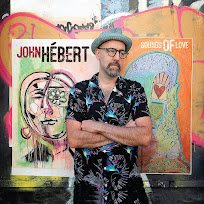
His third release for Sunnyside Records, "Sounds of Love", was recorded live in Lugano, Switzerland on March 27, 2013.  Hébert leads a most interesting lineup –– pianist Fred Hersch, alto saxophonist Tim Berne, cornetist Taylor Ho Bynum, and drummer/ percussionist Ches Smith –– in a six-song set that includes four  originals as well as two classics from the pen of the great bassist, Charles Mingus. The longest piece on the program (12:31) is Mingus's "Duke Ellington's Sound of Love" which opens with Hébert in a conversation with Smith. They dance around each other for 90 seconds before the percussionist drops out and the bassist goes on alone for another three minutes. The band, sans Berne, enter with Bynum playing the theme and Hersch harmonizing around him.  The alto saxophonist takes over the theme for several lines before he and Bynum play the theme in harmony.  Hersch steps out for a sparkling solo then Bynum creeps in for a delightful turn, softly twisting his lines around the bass and piano as his cornet moves into and out of the melody.  Berne returns to play the melody while Hersch dances like a sprite beneath him.  

Photo: Western Michigan Univ.
The other Mingus tune, "Remember Rockefeller at Attica",  opens with Bynum squeezing harsh notes out of the cornet with the alto sax in the background.  Smith enters, Bynum exits, there is now even more urgency in the piece as the drummer slowly but steadily builds his solo. Smith pushes the song into the "hard-bop" gear, the rest of the band enters and it's off to the races.  Berne jumps out in front and into a conversation with Hersch and Smith while Hébert keeps the song on track.  Bynum is next, with notes exploding out of the cornet then stepping aside for the piano solo.  If you are used to the more melodic side of Fred Hersch, he can really "get down" when the music calls for it.


This is not to take away from the leader's music. "Constrictor" opens the album with Bynum, his muted cornet shouting at the audience until the rest of the band quietly enters. He keeps rolling while Smith and Hébert scramble beneath him.  Berne enters and the music begins to take shape with a regular pulse. Smith's rollicking drums opens "The Blank-Faced Man" until the bassist's rapid-fire lines actually lowers the intensity. The rest of the band enters as if playing a second prologue untill the bottom falls out for a solemn interaction between alto and bowed bass.  When Hersch reenters, his dream-like reverie plus the overtones coming from the bass lay the foundation for a handsome Gamelan-like melody played by alto sax, cornet, and percussion.

"Sounds of Love" ends with "Frivolocity" – Hersch leads the band with another delightful solo turn before the rhythm takes on a quasi-Caribbean feel.  Playful solos by Smith and Bynum, together and separately, play off the lively stop-start rhythm with a quick turn to a ferocious "walking" tempo. The song goes back and forth rhythmically with a short return to the theme and then out.  

Not sure why this music nearly nine years to an album release but, be that as it may, this is an excellent album.  John Hébert is not only a fine musician but knows how to shape compositions so that they have a personality of their own. It hurts not one bit that his comrades-in-music are also great players and able to move through the music with creativity and wit. 

For more information, go to www.johnhebert.com.  To hear more and to purchase the album, go to https://johnhebertbass.bandcamp.com/album/sounds-of-love

Dig into "Frivolocity":


Photo: Anna Yatskevich
In the midst of Summer 2020, bassist and composer Boris Kozlov went into the studio for Posi-Tone Records producer Marc Free and mixing/mastering engineer Nick O'Toole with pianist/ organist Art Hirahara, drummer Rudy Royston, and vibraphonist Behn Gillece plus guest artist Donny McCaslin (tenor sax, alto flute).  The musicians spent four days recording a slew of songs resulting in albums released in 2021 from the pianist ("Open Sky") and vibraphonist ("Still Doing Our Thing").  Kozlov, who many jazz fans know as a top-notch accompanist on both acoustic and electric bass, now has issued the third album from those sessions –  "First Things First" (Posi-Tone Records) is actually the bassist's first for the label and second as a leader (which amazes this writer as Kozlov has appeared on so many albums). 
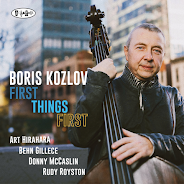
McCaslin's "Page One" opens the program. After a sombre piano, bowed bass, and vibraphone entrance, Royston and Kozlov kick the band into high gear with an energy level that rises from the rhythm section up. Gillece's solo, playing off the thick piano chords gleefully rolls forward until Hirahara takes over with his own joyous romp. The leader's finger-snapping solo follows goosed on by Royston's thunderous drums. McCaslin takes the piece out on the original melody. He trades his tenor sax for flute, Kozlov his acoustic for electric bass, for the bassist's "Flow", a lovely ballad sans piano and Royston on hand percussion.  Later in the program, McCaslin returns to the flute with the pianist moving to organ for the leader's "Once a Fog in Brooklyn", a medley of Russian folk tunes Kozlov remembers from his youth. McCaslin returns to tenor for his solo over the pattering drums and burbling organ. The exciting ending has such an uplifting and infectious feel. 
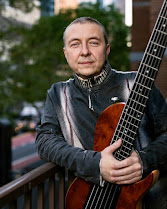
Photo: Anna Yatskevich
There is so much to like on this album. Kozlov's lovely ballad, "Aftermath", with its rippling piano and vibraphone phrases plus emotionally rich tenor sax.  McCaslin's "Second Line Sally" brings the band (minus Gillece) and the listener down to New Orleans.   The burbling organ, popping bass lines, and ever-so-funky drums hearkens back to the music of The Meters while the tenor sax dances out in front. Kozlov's overdubbed electric bass solo is so guitar-like, it's uncanny.  "Warm Sand", with its full piano chords and soft vibraphone, may remind some of Herbie Hancock and Bobby Hutcherson in those artists recordings for Blue Note. Gillece's "Mind Palace" opens quietly with the flute, vibes, and electric bass playing in unison as Royston roils beneath them –– the music goes into a series of fiery stops-and-starts before the tenor sax jumps atop atop the thrashing drums and deep, throbbing, bass lines.  The musical confection is topped by an exciting drum that leads the song to a quick exit.

After listening to "First Things First" several times, a number of thoughts became clear: 1)- what a great ensemble; 2) - how great the music sounds; and 3) - one hopes Boris Kozlov makes albums as good as this one on a regular basis. Dig in and dig this music!

For more information about the bassist, go to https://vpa.syr.edu/people/boris-kozlov/. "First Things First" will be released on 1/21/2022. 

Bassist, composer, and author Gui Divignau, born in France and raised in Brazil, has slowly but steadily making inroads into the US jazz scene.  He first came to North America to study at Berklee College and, upon graduating, headed to Paris and to Portugal before returning to Sāo Paulo to lead his own groups as well as play in others.  He came back to the US to study at New York University where he encountered Drew Gress, Billy Drummond, Billy Drewes, and others plus did private study with Ron Carter.    

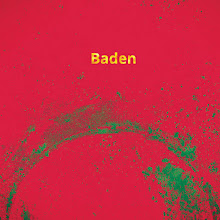
Duvignau's American debut album, "3,5,8", was issued last January by Sunnyside Records. The recording, all original pieces, featured saxophonist Drewes, drummer Jeff Hirschfield, pianist Santiago Liebson, and German guitarist Elias Meister.  For his second Sunnyside release, the bassist pays tribute to one of his Brazilian influences, the guitarist and composer Baden Powell (1937-2000).  "Baden" features Drewes, Hirschfield, and Lawrence Fields (piano, Wurlitzer) plus guests Bill Frisell (electric guitar on four tracks), and mentor Ron Carter (bass on one track).  The 12-song program features nine tunes (including one two-song medley) from Powell, four by Duvignau, and a two-song medley for the leader and Mr. Carter (one by the bassist, the other "Asa Branca" composed by Luiz Gonzaga & Humberto Teixeira).  
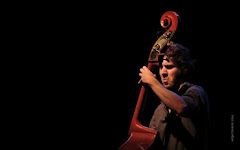
Photo: Edgar Tavares
The album opens with three songs from Powell and one of his most prolific co-writers, lyricist Vinicius de Moraes (1913-80).  Guitarist Frisell joins the ensemble for lively samba "Canto de Ossanha" and the more somber ballad "Tristeza e Solidāo" – the latter track, sans Drewes and Fields, may remind the work the guitarist has done with Paul Motian. The first original on the program, "Ao Baden", has a delightful melody and sweet interaction between the acoustic piano and bass before Drewes enters on alto sax. Notice also the fine connection between the bassist and the active brushes work of Hirschfield especially beneath the fine piano solo.  
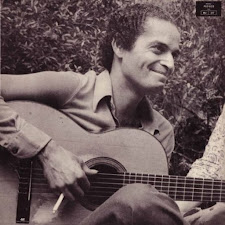
Photo: Baden Powell 1970s
There's a strong hint of the blues and bossa on "O Astronauta" – you can hear it in the bass lines as well as the Stan Getz-like lines of Drewes on tenor sax.  It's a more "down home blues" presence that is quite evident on the two-song medley ("Bluesa Preta/ Asa Branca"), the duet for Maestro Carter and Duvignau. Both musicians have a lovely tone and articulate their notes so well, it's a pleasure to hear them together. A sense of mystery fills the music of "Canto de lemanjá", an ode to the Afro-Brazilan goddess of the sea, also known as Janaína.  The saxophone plays the gentle melody while the bass and Wurlitzer piano offer counterpoint.  Drewes and Fields solo over Hirschfield's steady beat, pushing the piece forward before the musicians return to the gentle opening.  The bassist imitates the one-string berimbau (overdubbing hand percussion) on the first half of the two-song solo medley that pairs the song with the instrument's name with "Consolaçāo",a song named for the central district of Sāo Paulo. The performance is quite beautiful and moving.

The album closes with Duvinau's piece "For Bill & Baden" which opens with a melody influenced by Thelonious Monk and the blues.  Pay attention to Fields piano below Frisell's delightful solo as well as during Drewes exuberant soprano sax spotlight – the pianist rises above the rhythm section for a fine ramble. It's a sweet close to a very pleasurable listening experience.  

Hopefully, Gui Duvignau, with his explorations of the music of Baden Powell, will pique people's interest into checking out the Brazilian genius.  To his credit, Duvignau truly shares the spotlight with his ensemble through the 74-minute program while still showing off how melodic and supp ortive a musician he is.  "Baden" is quite good!!

For more information, go to www.guiduvignau.com.  To purchase this album, which will be issued on 1/21/2022, and others by the bassist, go to https://guiduvignau.bandcamp.com/

Here's the bassist's "Mata Adentro":

Wednesday, July 28, 2021

Open Skies & Illuminations

Photo: Sara Pettinella
Pianist and composer Art Hirahara is a deft pianist, technically and emotionally strong, an excellent composer, and can traverse genres with ease and wit.  Since moving to NewYork City in the early 2000s, the pianist has worked alongside vocalists Rosanna Vitro, Stacey Kent, and Freddie Cole, with the late saxophonist/conceptualist Fred Ho as well as drummer royal hartigan, and violinist Jenny Scheinman (among many).  Over the course of five albums for Posi-Tone Records, Hirahara has audibly demonstrated his growth as a composer, telling stories through his melodies and use of rhythmic movement.

His sixth album for Posi-Tone, "Open Sky", features the dynamic rhythm section of bassist Boris Kozlov and drummer Rudy Royston plus contributions saxophonist (tenor and soprano) Nicole Glover and vibraphonist Behn Gilecce.  The title track features Gilecce and sounds influenced by Charles Lloyd's "Forest Flower" and the percussive stylings of McCoy Tyner.  The four musicians move as one, spurred on by the leader's rhapsodic and bell-like piano sound.  Ms. Glover's tenor sax takes the lead on "Mia Bella", a lovely ballad, her tender phrases moving in and around the fine piano accompaniment.  She returns on soprano for the Latin-esque "Weathered the Storm" –– the track dances forward on the delightful drumming (listen to how Royston pushes the piano to really "groove"). 

The bassist contributes "Não Tão Azul"; based on the changes to A.C. Jobim's "Triste", the melody feels Brazilian even as the rhythm section move in and out of a Tropicalia feel.  Quite funky, thanks to Royston's sweet barrage.  The drummer's contribution, the ballad "Sunday Morning", has a touch of Gospel, a tinge of Philly Soul, and impressive communication between the musicians.  Kozlov blends melodic lines and deep notes underneath the melody until his handsome solo –– he has such a splendid tone!


Photo: Pablo Reyes
While the leader did pen nine of the 13 tracks on the disk, one should make note of the two "standards".  "I'm Getting Sentimental Over You" gets a jaunty uptempo reading that hints at Earl "Fatha" Hines and Art Tatum. "Empathy", from the pen of Duke Pearson, jumps from the opening chordal construction that Hirahara returns to throughout the piece.  The interaction of the trio is such a delight with the rhythm section responding to growing intensity of the piano solo. The other solo piece on the program, "Peony", is a Hirahara composition yet sounds might have been composed by Duke Ellington.   

The sky's the limit with "Open Sky", yet one more exemplary display of the talent of Art Hirahara.  His songs surround the listener, leading he/she in for an hour of delightful songs, fine musicianship, and, like the title, a sound that makes one to sit outdoors and let the breeze brush your shoulders as the music moves forward.  

For more information, go to http://arthirahara.com/.  To hear more and to purchase the music, go to https://arthirahara.bandcamp.com/album/open-sky

Here's the opening track, inspired by the protests in the wake of the killing of George Floyd, "Groundswell":


Photo: Dave Stapleton
I must admit to not hearing any of the albums of the group Slowly Rolling Camera before the trio's new recording "Where the Street Leads" (Edition Records) arrived.  The brainchild of Dave Stapleton (Fender Rhodes, piano, Moog), Deri Roberts (electronics), and Elliot Bennett (drums), the music obliterates genres on each song.  There are dance beats, swirling string sections, and excellent contributions from guests Mark Lockheart (soprano and tenor saxophones), Stuart McCallum (guitar), Jasper Høiby (double bass), Verneri Pojhola (trumpet), Chris Potter (tenor saxophone), and a stunning performance from vocalist Sachal Vasandani.  

"You Are the Truth" opens the eight-song program with the melody first played by Stapleton then shared by the strings. Bennett really pushes the song forward, with his insistent "trip-hop" drums.  When Stapleton steps out with a distorted Fender Rhodes reiteration of the melody, it might remind some of the Soft Machine's Mike Ratledge's Fender work.  As you listen to the following tune, the title track, you realize the the pianist composes the material with short melodic phrases repeated throughout each piece until the soloists step forward. On "Where the Street Leads", McCallum goes first and steps aside for Lockheart's soprano solo which hearkens back to the work that Wayne Shorter did with Weather Report.  The solos move easily over the swirling background.

Adding the voice of vocalist Vasandani is a stroke of genius.  The medium-tempo ballad "Illuminate" puts his voice in the midst of the keyboards and Bennett's active drums.  In the last 90 seconds, McCallum steps out with an emotional solo with the addition of the vocalists repeating "Who are you...who are you...can you do this?" over the middle of the guitar phrases.  

Chris Potter is featured on "Feels Like Fiction", joining the song two minutes with a strong tenor spotlight. McCallum also solos with the strings shimmering all around him (Stapleton's string arrangements for the eight-member ensemble are often dazzling and alway supportive). Lockheart steps out on soprano for a short statement before the Morse-code like keyboard notes bring the piece to a close.

"Where the Streets Lead" closes with "A Force for Good" with Verneri Pojhola's breathy trumpet lines supported by the circular keyboard phrases and the rising lines of the strings that then begin to soar as Lockheart's soprano swoops and dives around them.  The piece closes with gentle piano lines under the the trumpet which soon fades as the music slowly comes to its end.

Slowly Rolling Camera makes music that is too powerful to be called New Age, too funky to be Jazz, too jazzy to be Funk, and too acoustic to be called Electronica –– So, what is it?  Who cares what you call it.  Just sit and let the sounds flow over you, get lost in the repetitive keyboard phrases, move your feet to the often-dancing drums. And enjoy!

For more information, to hear more, and to purchase the recording, go to  https://slowlyrollingcamera.bandcamp.com/album/where-the-streets-lead.  

Here's the title track:

Wednesday, May 5, 2021

Inner & Outer Spaces

Two delightful new albums both influenced by the adventurous soundscapes of Wayne Shorter.

Photo: Geoff Countryman
Joe Lovano (tenor saxophone) and Dave Douglas (trumpet) created their co-led quintet Sound Prints in 2011 to celebrate the musical and artistic contributions of Wayne Shorter.  Both were members of the SFJazz Collective when that ensemble celebrated Mr. Shorter's music for its 2008 season.  Douglas's 1997 Arabesque album "Stargazer" was the trumpeter's first dedication to the saxophonist/ composer on record –– while the album only featured three songs by Mr. Shorter, the majority of Douglas's original pieces illustrate how he took the influences and adapted them without mimicking one of his musical mentor.

"Other Worlds" (Greenleaf Music) is the third album by Sound Prints and the first to feature all compositions by Lovano or Douglas.  The rhythm section supporting the two leaders remains the same: pianist Lawrence Fields, bassist Linda May Han Oh, and drummer Joey Baron. The band went into the studio a day after finishing a week-long run at The Village Vanguard in New York City; those gigs took place in January of 2020, six weeks before the club, the city, and the world closed down.  The familiarity with the material makes this 70-minute program move organically forward with exquisite playing from all involved. You can hear the influence of both Mr. Shorter and of Miles Davis's classic quintet of the the mid-1960s on Lovano's "Life on Earth", especially in the piano support and Baron's driving drums a la Tony Williams.   Lovano's "Sky Miles" is less a tribute to the trumpeter as it is a hard-driving, hard bop tune in which the band plays with the tempo, speeding up and slowing down which, at times, is dizzying.  Listen to the rhythm section during the solos as there are moments when the pianist, bassist, and drummer are each going in different directions and other times when all five musicians are in sync. 

Photo: Merrick Winter
Overall, this music should not surprise fans of the two leaders. Neither one is afraid of showing their influences or for pushing into areas in which both the musicians and the listeners are challenged.  And this band can swing. Fields's piano support on "Pythagoras" allows the soloists to soar and Baron to explore.  On that track, the pianist and drummer offer support in the style of Jimmy Garrison and McCoy Tyner in John Coltrane's Quartet. "Antiquity to Outer Space" (composed by Douglas) could be a title of a Sun Ra album but here is a multi-sectioned that opens up to allow each musician to express him- or her- self. Fields, who has worked with Lovano and Christian Scott aTunde Dejuah, sparkles throughout the album and, especially, on this track.  The two duets –– Douglas with Ms. May Han Oh and Lovano with Baron –– are quite inventive.  The trumpeter's handsome ballad, "The Transcendentalists", contains a handsome melody as well as strong solo statements from Lovano and Douglas (muted trumpet) as well as Fields (why doesn't he have an album out under his own name?) 

"Other Worlds" is an album well worth exploring! Joe Lovano & Dave Douglas Sound Prints is a group one needs to hear and (soon, one hopes) to see.  Yes, they play "in the tradition" but it's a very big, very wide, "tradition", a universe still ripe for traversing!

For more information, go to https://greenleafmusic.com/artists/soundprints/other-worlds/. To hear more and to purchase the album, go to https://soundprints.bandcamp.com/album/other-worlds


Photo: Anna Yatskevich
Trumpeter and composer Alex Sipiagin has been quite a busy musicians since moving to New York City from his native Russia in 1990. He's played in numerous ensembles, ranging from the Mingus Big Band & Orchestra to the Gil Evans Orchestra, to several groups led by bassist Dave Holland to Dave Sanborn to Michael Brecker to Elvis Costello and many others. Sipiagin has taught at New York University with residencies in both Amsterdam and Basel, Switzerland.  His discography includes 11 albums on Criss Cross Jazz plus recordings on SunnySide Records, TCB-The Sound of Montreux, 5Passion, and others. His new album, "Upstream" (his debut as a leader on Posi-Tone Records), serves as a farewell to the United States as, since the October 2020 recording, the trumpeter and his wife have spent time in Singapore and have plans to settle in Northern Italy

The new album is the latest in Posi-Tone Marc Free's "pandemic" recordings.  With the "house" rhythm section composed of Art Hirahara (piano, Fender Rhodes), Boris Kozlov (acoustic and electric basses), and Rudy Royston (drums) (the same trio recorded on Alexa Tarantino's "Firefly" and Behn Gillece's "Still Doing Our Thing", the two Posi-Tone releases before this one), Sipiagin's trumpet powers and sings its way through  the nine-song program.  The leader composed five of the tracks, two are from bassist (and fellow Russian) Kozlov, plus one each from pianist Hirahara and a lovely reading ofWayne Shorter's "Miyako".  That last piece listed, a gentle ballad first played by the composer on his 1969 Blue Note release "Schizophrenia", spotlights Sipiagin's fine flugelhorn work.  The leader composed "Rain", another flugelhorn ballad, as he was waiting for his wife to be released from the hospital. Perhaps that is why the music sounds so emotionally strong as well as wistful.  Pianist Hirahara contributed album's other splendid ballad; "Echo Canyon" moves forward on a rising melody lines with supple flugelhorn pushed forward by Royston's active but respectful drums. The composer's powerful solo energizes Sipiagin, whose soaring solo is punctuated by the drummer's press rolls and splashing cymbals.

Photo: Anna Yatskevich
Throughout the recording, Rudy Royston plays like he's been released from solitary confinement  The album's opening track, "Call", may initially remind you of one of Wayne Shorter's open-ended pieces but the fire rising up from the drummer sets this piece apart.  Listen how Kozlov and Royston set a torrid pace that really pushes both the trumpeter and pianist to respond emphatically.  Later in the program, "SipaTham" (the title combines the composer's name with that of his wife Melissa Tham) is a response to the pandemic and how the world outside the couple's home is changing rapidly.  The give-and-take of the trumpet and piano, powered by the rhythm section, stands out.  The bassist's funky "Magic Square", was first played by Sipiagin and Kozlov when both were in school in Moscow in the 1980s.  The electric bass and the powerful drumming has the feel of Chick Corea's electric Return to Forever and Lennie White's dynamic power.  How Royston's explosive drumming did not blow the mute out of the trumpet I'm not sure, but the drum solo just might shake the speakers off the wall!

The title track closes the album on a high.  After Hirahara'a Fender Rhodes intro, the song flies forward on the strength of the drums and Kozlov's thunderous electric bass.  The piece features solos by the leader, Hirahara, and Royston whose brash solo sounds as if he's trying to chase away the pandemic with his hands and feet!  "Upstream" has plenty of power and beauty in its 55 minutes. Alex Sipiagin has made numerous albums with great rhythm sections (Kozlov appears on several as do drummers Antonio Sanchez, Eric Harland, Jeff "Tain" Watts, and Johnathan Blake) –– this recording is among the best!  

To learn more about the trumpeter, go to www.alexsipiagin.com/ (needs to be updated).  

Click here to hear "Sight":