Showing posts with label Gui Duvignau. Show all posts

Friday, January 26, 2024

Confluence of the Basses

 Here we have three relatively new releases from three fine bassists and songwriters. This is powerful music that jumps out of the speakers and pulls the listener in.

"Ultraviolet" (Contagious Music) is the third album by the quartet of Billy Mohler (bass, compositions), Chris Speed (tenor sax, clarinet), Shane Endsley (trumpet), and Nate Wood (drums).  Like the previous two, the music is built upon the hardy interplay of bass and drums while the sax and trumpet often weave melodies around each other.  While this ensemble's shape is based on the classic Ornette Coleman lineup on the Atlantic Records he made with Don Cherry, Charlie Haden, and either Billy Higgins or Ed Blackwell, the short opening track "Matador" leads one to believe that the real influence in the music is Dave Holland's 1973 classic ECM recording "Conference of the Birds" (with Sam Rivers, Anthony Braxton, and Barry Altshul). You can hear it in the interactions on tracks such as "The Wait" and "Aberdeen" as well as in the short, free-form, "Disorder II" and "I".  Only one track exceeds five minutes and that's the closing "Reconstruction" (7:57) –– after an excellent bass intro, the well-designed melody opens to strong solos from Speed and Endsley. Even though Wood does not solo, his drums are upfront in the mix and you hear how he listens to and prods the soloists.

Photo: Jenny Rolapp
"Ultraviolet" stands out for numerous reasons (compositions, musicianship, great sound quality) but especially because the music sounds so alive.  Released in October 2023, it's one of the better releases of that year or any year!

For more information, go to www.billymohler.com. To hear more of the bassist's fine music and to purchase the albums, go to https://billymohler.bandcamp.com/album/ultraviolet.

Here's the title track:


Bassist Ethan Philion released his second album "Gnosis" (Sunnyside Records) in October of 2023, just 13 months after his powerful debut "Meditations on Mingus". The earlier album featured a wonderful 10-person ensemble playing the bassist's rearrangements of eight classic Charles Mingus compositions. The new album features three stalwarts of the Chicago Creative Music scene including Greg Ward (alto saxophone), Dana Hall (drums), and Russ Johnson (trumpet).  The six-song program features five Philion originals and one Charles Mingus but what a track!  The quartet swings, soars, roars, and explores its way through "What Love", the older bassist's musical contraction of "What Is This Thing Called Love" and "You Don't Know What Love Is". First recorded on "Charles Mingus Presents Mingus" in 1960 with trumpeter Ted Curson, multi-reed artist Eric Dolphy, and drummer Danny Richmond, the free-wheeling performance set the tone for a number of jazz artists of the early-to-mid 60s.

If the classic Mingus Quartet is the influence for the shape and sound of Philion's ensemble, his original compositions stand out for how he writes pieces to the strength of his group, how the music music builds on tradition without sounding stuffy or imitative, and how the power in the rhythm section (Hall and Philion are a muscular duo!) gives the front line music to work with.  There are "kick butt" pieces such as the rollicking opener "The Boot" plus "Sheep Shank" and the exploratory "Comment Section".  For a much different feel, listen below to "Nostalgia".  Philion's bass opening sounds like rain falling on the windows which leads to Johnson's somber melody line.  Ward warbles in the background while Hall adds percussion sounds.  When the trumpet and sax complete the opening theme in unison, the music takes on the feel of its title.  The pure tone of the alto sax blends with high, finely-etched trumpet before Ward takes off on an excellent wide-ranging solo. The rhythm section picks on his energy and really pushes the music higher.

The title track closes the program. Starting slowly, the music agains gains power as as it struts fowards with the rhythm section feediong off the interwoven lines created by the sax and trumpet.  This is the kind of music that sounds so alive and you want to be in the room as it is being created. "Gnosis" should warm the hearts of listeners who love adventurous music, excellent soloists, and musicians who really listen and create!  With his first two albums, Ethan Philion has shown he is a musical force to be reckoned with.

To learn more and to purchase the album, go to https://sunnysiderecords.bandcamp.com/album/gnosis

Here's "Nostalgia":


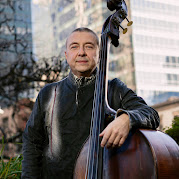
For his fourth album (and third for Sunnyside Records) as a leader, bassist and composer Gui Duvignau pared his group down to a trio and decided to record live.  "Live in Red Hook" finds him in the company of pianist Jacob Sacks and drummer Nathan Ellman-Bell performing a program and nine originals plus one tune each by Ron Carter ("Eighty-One") and Baden Powell ("Deixa").  The trio deconstructs the Carter piece before diving into the recognizable melody while the lovely ballad by Powell gets the gentle touch.  The album opener "Idee Fixe" illustrates how the three musicians listen closely and interact and how comfortable they are with "opening up" the music.  Ellman-Bell really pushes Sacks' playful solo forward while the leader holds the center. Listen below to "Right? Wow!" for another example of the trio's playfulness and cat-like ability to instantly change directions.

Photo: Tatiana Kahvegian
Duvignau's composition are not only witty but also well-constructed.  "Miniature for Drums" has a gentle melody line that bass and piano keep repeating Ellman-Bell plays his cymbals and floor toms.   "One at a Time" has a Herbie Nichols-feel in the rising melody line –– the bassist is also quite melodic through the thematic sections, moving to a strong "walking" bass line while Sacks dances on piano.  The pianist also stands out on "Still Untitled" stating the melody with classical precision (with a slight sense of anarchy in the two-handed dance at times). The bass and drums happily play around through the solo, stopping, starting, bouncing, whispering, anything but playing it safe.     

The album closes with "Scriabingus" which reads like a skin ailment or what it really is, a piece influenced by two very different composers.  It gives the listener the opportunity to hear the leader create an impressive solo.  But, note how Sacks and Ellman-Bell acquit themselves in the service of the far-ranging composition.  "Live in Red Hook" was recorded over two nights in the Coffey Street Studios in Brooklyn –– if you are a fan of adventurous but not "free" music, you should dig into this new release from Guy Duvignau. It will bring a smile to your face and mind!

For more information and to purchase the album, go to https://guiduvignau.bandcamp.com/album/live-in-red-hook

Give a listen to "Right? Wow!":

Friday, January 7, 2022

From the Bass Upwards & Onwards!

Photo: Antonio Porcar Cano
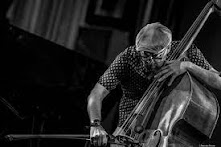
Bassist John Hébert, a native of New Orleans, LA, has made his home in New York City for the past quarter-century-plus.  He's been the foundation in groups led by Andrew Hill, Lee Konitz, Kenny Wheeler, Paul Motian, Tomasz Stanko, John Abercrombie, Fred Hersch, Mary Halvorson, and so many more.  As a leader, he's issued albums on Firehouse 12 Records, Clean Feed, and Sunnyside.  Hébert has co-led a number of ensembles as well as appearing on a slew of albums in the past decade.  He has a great tone, his bowing is superb, and his compositions intelligent.
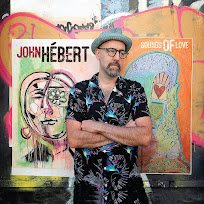
His third release for Sunnyside Records, "Sounds of Love", was recorded live in Lugano, Switzerland on March 27, 2013.  Hébert leads a most interesting lineup –– pianist Fred Hersch, alto saxophonist Tim Berne, cornetist Taylor Ho Bynum, and drummer/ percussionist Ches Smith –– in a six-song set that includes four  originals as well as two classics from the pen of the great bassist, Charles Mingus. The longest piece on the program (12:31) is Mingus's "Duke Ellington's Sound of Love" which opens with Hébert in a conversation with Smith. They dance around each other for 90 seconds before the percussionist drops out and the bassist goes on alone for another three minutes. The band, sans Berne, enter with Bynum playing the theme and Hersch harmonizing around him.  The alto saxophonist takes over the theme for several lines before he and Bynum play the theme in harmony.  Hersch steps out for a sparkling solo then Bynum creeps in for a delightful turn, softly twisting his lines around the bass and piano as his cornet moves into and out of the melody.  Berne returns to play the melody while Hersch dances like a sprite beneath him.  

Photo: Western Michigan Univ.
The other Mingus tune, "Remember Rockefeller at Attica",  opens with Bynum squeezing harsh notes out of the cornet with the alto sax in the background.  Smith enters, Bynum exits, there is now even more urgency in the piece as the drummer slowly but steadily builds his solo. Smith pushes the song into the "hard-bop" gear, the rest of the band enters and it's off to the races.  Berne jumps out in front and into a conversation with Hersch and Smith while Hébert keeps the song on track.  Bynum is next, with notes exploding out of the cornet then stepping aside for the piano solo.  If you are used to the more melodic side of Fred Hersch, he can really "get down" when the music calls for it.


This is not to take away from the leader's music. "Constrictor" opens the album with Bynum, his muted cornet shouting at the audience until the rest of the band quietly enters. He keeps rolling while Smith and Hébert scramble beneath him.  Berne enters and the music begins to take shape with a regular pulse. Smith's rollicking drums opens "The Blank-Faced Man" until the bassist's rapid-fire lines actually lowers the intensity. The rest of the band enters as if playing a second prologue untill the bottom falls out for a solemn interaction between alto and bowed bass.  When Hersch reenters, his dream-like reverie plus the overtones coming from the bass lay the foundation for a handsome Gamelan-like melody played by alto sax, cornet, and percussion.

"Sounds of Love" ends with "Frivolocity" – Hersch leads the band with another delightful solo turn before the rhythm takes on a quasi-Caribbean feel.  Playful solos by Smith and Bynum, together and separately, play off the lively stop-start rhythm with a quick turn to a ferocious "walking" tempo. The song goes back and forth rhythmically with a short return to the theme and then out.  

Not sure why this music nearly nine years to an album release but, be that as it may, this is an excellent album.  John Hébert is not only a fine musician but knows how to shape compositions so that they have a personality of their own. It hurts not one bit that his comrades-in-music are also great players and able to move through the music with creativity and wit. 

For more information, go to www.johnhebert.com.  To hear more and to purchase the album, go to https://johnhebertbass.bandcamp.com/album/sounds-of-love

Dig into "Frivolocity":


Photo: Anna Yatskevich
In the midst of Summer 2020, bassist and composer Boris Kozlov went into the studio for Posi-Tone Records producer Marc Free and mixing/mastering engineer Nick O'Toole with pianist/ organist Art Hirahara, drummer Rudy Royston, and vibraphonist Behn Gillece plus guest artist Donny McCaslin (tenor sax, alto flute).  The musicians spent four days recording a slew of songs resulting in albums released in 2021 from the pianist ("Open Sky") and vibraphonist ("Still Doing Our Thing").  Kozlov, who many jazz fans know as a top-notch accompanist on both acoustic and electric bass, now has issued the third album from those sessions –  "First Things First" (Posi-Tone Records) is actually the bassist's first for the label and second as a leader (which amazes this writer as Kozlov has appeared on so many albums). 

McCaslin's "Page One" opens the program. After a sombre piano, bowed bass, and vibraphone entrance, Royston and Kozlov kick the band into high gear with an energy level that rises from the rhythm section up. Gillece's solo, playing off the thick piano chords gleefully rolls forward until Hirahara takes over with his own joyous romp. The leader's finger-snapping solo follows goosed on by Royston's thunderous drums. McCaslin takes the piece out on the original melody. He trades his tenor sax for flute, Kozlov his acoustic for electric bass, for the bassist's "Flow", a lovely ballad sans piano and Royston on hand percussion.  Later in the program, McCaslin returns to the flute with the pianist moving to organ for the leader's "Once a Fog in Brooklyn", a medley of Russian folk tunes Kozlov remembers from his youth. McCaslin returns to tenor for his solo over the pattering drums and burbling organ. The exciting ending has such an uplifting and infectious feel. 

Photo: Anna Yatskevich
There is so much to like on this album. Kozlov's lovely ballad, "Aftermath", with its rippling piano and vibraphone phrases plus emotionally rich tenor sax.  McCaslin's "Second Line Sally" brings the band (minus Gillece) and the listener down to New Orleans.   The burbling organ, popping bass lines, and ever-so-funky drums hearkens back to the music of The Meters while the tenor sax dances out in front. Kozlov's overdubbed electric bass solo is so guitar-like, it's uncanny.  "Warm Sand", with its full piano chords and soft vibraphone, may remind some of Herbie Hancock and Bobby Hutcherson in those artists recordings for Blue Note. Gillece's "Mind Palace" opens quietly with the flute, vibes, and electric bass playing in unison as Royston roils beneath them –– the music goes into a series of fiery stops-and-starts before the tenor sax jumps atop atop the thrashing drums and deep, throbbing, bass lines.  The musical confection is topped by an exciting drum that leads the song to a quick exit.

After listening to "First Things First" several times, a number of thoughts became clear: 1)- what a great ensemble; 2) - how great the music sounds; and 3) - one hopes Boris Kozlov makes albums as good as this one on a regular basis. Dig in and dig this music!

For more information about the bassist, go to https://vpa.syr.edu/people/boris-kozlov/. "First Things First" will be released on 1/21/2022. 

Bassist, composer, and author Gui Divignau, born in France and raised in Brazil, has slowly but steadily making inroads into the US jazz scene.  He first came to North America to study at Berklee College and, upon graduating, headed to Paris and to Portugal before returning to Sāo Paulo to lead his own groups as well as play in others.  He came back to the US to study at New York University where he encountered Drew Gress, Billy Drummond, Billy Drewes, and others plus did private study with Ron Carter.    

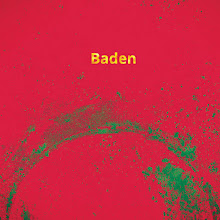
Duvignau's American debut album, "3,5,8", was issued last January by Sunnyside Records. The recording, all original pieces, featured saxophonist Drewes, drummer Jeff Hirschfield, pianist Santiago Liebson, and German guitarist Elias Meister.  For his second Sunnyside release, the bassist pays tribute to one of his Brazilian influences, the guitarist and composer Baden Powell (1937-2000).  "Baden" features Drewes, Hirschfield, and Lawrence Fields (piano, Wurlitzer) plus guests Bill Frisell (electric guitar on four tracks), and mentor Ron Carter (bass on one track).  The 12-song program features nine tunes (including one two-song medley) from Powell, four by Duvignau, and a two-song medley for the leader and Mr. Carter (one by the bassist, the other "Asa Branca" composed by Luiz Gonzaga & Humberto Teixeira).  
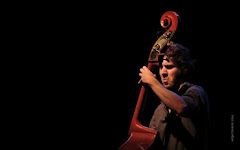
Photo: Edgar Tavares
The album opens with three songs from Powell and one of his most prolific co-writers, lyricist Vinicius de Moraes (1913-80).  Guitarist Frisell joins the ensemble for lively samba "Canto de Ossanha" and the more somber ballad "Tristeza e Solidāo" – the latter track, sans Drewes and Fields, may remind the work the guitarist has done with Paul Motian. The first original on the program, "Ao Baden", has a delightful melody and sweet interaction between the acoustic piano and bass before Drewes enters on alto sax. Notice also the fine connection between the bassist and the active brushes work of Hirschfield especially beneath the fine piano solo.  
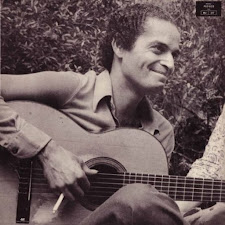
Photo: Baden Powell 1970s
There's a strong hint of the blues and bossa on "O Astronauta" – you can hear it in the bass lines as well as the Stan Getz-like lines of Drewes on tenor sax.  It's a more "down home blues" presence that is quite evident on the two-song medley ("Bluesa Preta/ Asa Branca"), the duet for Maestro Carter and Duvignau. Both musicians have a lovely tone and articulate their notes so well, it's a pleasure to hear them together. A sense of mystery fills the music of "Canto de lemanjá", an ode to the Afro-Brazilan goddess of the sea, also known as Janaína.  The saxophone plays the gentle melody while the bass and Wurlitzer piano offer counterpoint.  Drewes and Fields solo over Hirschfield's steady beat, pushing the piece forward before the musicians return to the gentle opening.  The bassist imitates the one-string berimbau (overdubbing hand percussion) on the first half of the two-song solo medley that pairs the song with the instrument's name with "Consolaçāo",a song named for the central district of Sāo Paulo. The performance is quite beautiful and moving.

The album closes with Duvinau's piece "For Bill & Baden" which opens with a melody influenced by Thelonious Monk and the blues.  Pay attention to Fields piano below Frisell's delightful solo as well as during Drewes exuberant soprano sax spotlight – the pianist rises above the rhythm section for a fine ramble. It's a sweet close to a very pleasurable listening experience.  

Hopefully, Gui Duvignau, with his explorations of the music of Baden Powell, will pique people's interest into checking out the Brazilian genius.  To his credit, Duvignau truly shares the spotlight with his ensemble through the 74-minute program while still showing off how melodic and supp ortive a musician he is.  "Baden" is quite good!!

For more information, go to www.guiduvignau.com.  To purchase this album, which will be issued on 1/21/2022, and others by the bassist, go to https://guiduvignau.bandcamp.com/

Here's the bassist's "Mata Adentro":

Wednesday, January 20, 2021

The Sunnyside of the Stream (Pt 1)

Upon graduating from Ohio State University in 1986, pianist and composer Russ Lossing moved to New York City. Over the decades, he has played and recorded with drummer Paul Motian, cornetist Kirk Knuffke, saxophonists Loren Stillman and John O'Gallagher plus many others.  As a leader, he has recorded for HATOLOGY, Clean Feed, Fresh Sound, and Sunnyside Records.  His music, while influenced by Thelonious Monk, Andrew Hill, and the afore-mentioned Motian, is wide open, leaving plenty of room for his collaborators to speak their own piece.

"Metamorphism" (Sunnyside Records), though recorded in 2017, sounds fresh and timeless.  Joined by Stillman (alto and soprano saxophones), John Hébert (bass), and Michael Sarin (drums) –– all long-time associates –– most of Lossing's eight original pieces flow with serenity from one to another. Yet, there is intensity in how the musicians move towards and away from each other, how the solos rise up and make the listener aware that the music is not about technique but has emotional depth.  The program opens with a percussive piano figure leading the rhythm section in with each musician playing elements of the melody.  When the alto sax and piano play the main theme, one hears a Middle Eastern-influenced melody. Notice how the rhythm section stops and starts, how they create a dialogue with the piano and sax, especially during the solos. 

Photo: Clara Pereira
The title track, the longest on the recording at 12:25, is dedicated to Paul Motian.  The sparse opening moments recall Lossing's long relationship to the late drummer-composer, the piano presenting the melody before the bass and drums enter. Stillman plays soprano sax here, his long tones rising above the spare accompaniment.  Slowly, steadily, the intensity ramps up with Lossing and Stillman weaving mini-rhapsodies around each other. Listen below to how the melody is moved back out front in the last moments of the performance.  There are moments that the music reminds this listener of the Keith Jarrett American Quartet on the 1970s - 80s (of which the late Mr. Motian was a member).

Photo: Chris Drukker
Another longer track (9:31), "Blue Horizon", is dedicated to Andrew Hill.  The music moves slowly, has a mysterious feel, yet one feels you can hear the band communicating with each other.  The shortest track (2:35), "Pileatus", serves as a spotlight for Sarin's powerful, melodic, drums.  The melody is percussive with the bass, piano, and soprano sax playing in unison. The funky "June Jig" dances forward on the drums and Hébert's rich bass work.  Lossing sits out during the alto solo so one can really hear how Stillman interacts with Sarin and how the bassist complements them. "Canto 24" closes the album; again all four musicians state the theme before the solo section is a series of encounters, responses, reactions, and counterpoint.  As the music moves forward, the quartet is responding to each other in such an organic fashion.

"Metamorphism" is an adventurous collection of pieces that never boils over nor lapses into cliches.  The listener can hear how comfortable the musicians are with each other, allowing themselves to be continually challenged by the compositions of Russ Lossing.  There's little clutter in the sound, the articulated piano notes stand out as do all the "voices" of the quartet.  This album deserves to be listened all the way through each time to appreciate the beauty and the humanity the music contains. 

For more information, go to www.russlossing.com.  To purchase the album, go to https://russlossing.bandcamp.com/album/metamorphism.

Here's the title track:


Born in France but raised in Brazil, bassist and composer Gui Duvignau has led a fascinating life. His first musical interest was "heavy metal" but he soon discovered the bass work of Ron Carter (with the "classic" Miles Davis Quintet), Jimmy Garrison (with the John Coltrane Quartet), Jaco Pastorious, and Charles Mingus.  He also explored the delights of Brazilian composers and performers.  The bassist moved to the United States to attend the Berklee College of Music and on to Portugal and Paris, France for several years.  While living there, the bassist co-led an ensemble with vocalist Sofia Ribeiro; they released an album, "Porto", is 2010. His debut as a leader, "Fissura", was also recorded in France (2014) and issued on a Brazilian label in 2016.  Duvignau then moved to New York City to study at NYU's Steinhardt School of Culture, Education, and Human Development.  There he met Argentinean-born pianist Santiago Leibson who introduced him to drummer Jeff Hirshfield and they created a trio.  
 
His American debut, "3, 5, 8" (Sunnyside Records),  features Leibson and Hirschfield plus, on several tracks, Billy Drewes (tenor saxophone) and German guitarist Elias Meister.  The nine-song program, all composed by the leader, opens with two trio tracks, "Volta" and "'2'".  The former is a ballad with a folk-like melody, moving forward in the style of the late Paul Motian.  Leibson's rippling piano lines rise above the counterpoint of the bass and the conversational drums.  Duvignau leads the way on the latter tune, also one with a folk-like melody, that turns towards swing especially during the delightful piano solo.  Later in the program, the lovely ballad "Une Pensée Pour Paris", is notable for the melodic bass solo, Leibson's emotional piano phrases, and Hirschfield's artistic brushwork.  The delightful "Vem Logo!" ("Coming Soon") is a sweet romp for the trio. Opening with a strong bass solo, the pianist follows with a solo built on a chordal progression that is continually and melodically mutating.  

Photo: Thibault Della Gaspera
Drewes and Meister first join the trio on the atmospheric ballad "Yerevan".  The piece, composed for the bassist's girlfriend, pushes forward on the insistent bass and piano with both the saxophone and guitar echoing the melody line.  Near the close of the tune, Drewes creates a fiery solo with Meister's distorted guitar and the pianist's flowing lines serving as counterpoint.  "Minas", inspired by Duvignau's first home in Brazil, opens with a handsome bass solo –– after a quiet start, Leibson leads the band into a samba rhythm over which the saxophonist creates a powerful, driving, solo. The bassist composed the dancing "Detuned for Drewes" to tap into the saxophonist's playful side and the quartet get into a sweet groove.  Meister stands out on the raucous, blues-drenched, ballad "Somewhat", showing the influences of Ben Monder and Bill Frisell. His guitar lines sting, roar, and moan opening the door for a hard-edged tenor sax solo.  

"3, 5, 8" serves as a delightful introduction to the musical worlds of bassist and composer Gui Duvignau.  While the music he created for his fellow musicians gives the leader plenty of opportunities to solo, he all also leaves room for everyone else to shine.  And they do!  With music this good, one is excited to see where the bassist goes from here.  

To learn more, go to www.guiduvignau.com.  Go to https://sunnysiderecords.bandcamp.com/album/3-5-8 to hear one track and to purchase this music.