Here are two more recordings that remind listeners music reflects the society we live in; the messages in these songs, whether overt or subtle, speak to all of us.
Bassist, composer, host of NPR's "Jazz Night in America" and "The Lowdown" on Sirius XM, and so much more, Christian McBride is a musician who makes his presence known. His list of sideman credits grows longer every month plus he leads a trio, a quartet (New Jahn), a quintet (Inside Straight), and an 18-member big band. A native of Philadelphia, PA, he is a master of both the acoustic and electric basses. In 1998, McBride was commissioned by the Portland Maine Historical Society as well as the National Endowment for the Arts to compose "The Movement, Revisited", an episodic work that speaks about the Civil Rights Movement through the words of Rosa Parks, Reverend Dr. Martin Luther King, Jr., Malcolm X, and Muhammad Ali. He toured the Northeasten United States with his quartet and a 30-member choir. In 2008, McBride revised the work, adding a section in honor of the election of President Barack Obama and scoring the piece for his Big Band.
McBride did not go into the studio until September of 2013 to record "The Movement, Revisited" and, thanks to Mack Avenue Records, the album is finally being released. Not sure why it's taken so long but now that the music is in wide release, make sure you listen. Chances are most people know the stories of these four heroes of the Movement yet, in this time of renewed racist activities, the growth of anti-Semitism, and fear of immigrants, the words one hears have renewed meaning. Among the highlights are the performances of all the "speakers", especially poet Sonia Sanchez and actor Wendell Pierce. The former brings great verve to her presentation of Ms. Park's words, tremendous rhythm and passion while the latter's sonorous tones may not match the "preacher's tones" of Dr. King, he brings a gravitas to the words that remind us of all the work that needs to be begun and carried.
Other voices stand out. Alicia Olatuja's impassioned vocal, supported by the Voices of The Flame choir, on "Brother Malcolm" elicits chills. Pay attention to the fine support from pianist Geoff Keezer, drummer Terreon Gully, and Ron Blake's equally passionate tenor sax solo. Warren Wolf's vibraphone and Steve Wilson's soprano saxophone solos on "Sister Rosa" ring out as do the voices of the choir. "Rumble In The Jungle" is a funky romp for the big band and choir – powered by Gully's thunderous drums, Carl Miraghi's foundational baritone sax locks in with McBride's bass to push the message across while the Choir celebrates the audacity that permeated the personality of Muhammad Ali.
Photo: John Watson
The album closes with "Apotheosis", a celebration of the election of Barack Obama in 2008. Instead of serving as the culmination of the Civil Rights Movement (which it did for many people), his rise to the most powerful office in the United States began a another campaign, one that attempted to discredit the unity that Barack Obama spoke about in his Election Night message. The four "narrators" (including Dion Graham and Vondie Curtis-Hall) take turns reading the powerful words – the accompanying music, especially the lovely soprano saxophone of Steve Wilson, is quite lovely and begins to intensify as the narrators intone "Yes We Can!" The music rises to a glorious climax with the choir repeating "Free at last" while the band grooves beneath them, culminating in an equally glorious "Amen."
The positivity that permeates "The Movement, Revisited" seems nostalgic in the light of the present administration's work to dismantle not only FDR's New Deal but the policies that President Barack Obama worked so hard to put place on the environment, voting rights, equal rights, and more. Yet, Christian McBride's music and presentations reminds us of the power that comes from unity, working from the ground up in our communities to make our communities thrive and prejudices again melt into the background.
Listen to "Soldiers" (music by Christian McBride, words by Dr. Martin Luther King Jr spoken by Wendell Pierce):
Personnel:
Christian McBride – bass, compositions
Terreon Gully – drums
Warren Wolf – vibraphone, percussion
Ron Blake – tenor and soprano saxophones
Geoffrey Keezer – piano
Steve Wilson – alto saxophone, flute
Todd Bashore – alto saxophone
Loren Schoenberg – tenor saxophone
Carl Maraghi – baritone saxophone
James Burton – trombone
Steve Davis – trombone
Michael Dease – trombone
Doug Purviance - bass trombone
Lew Solo – trumpet
Frank Greene – trumpet
Freddie Hendrix – trumpet
Daryll Shawl – trumpet
Ron Tooley – trumpet
Guests:
Sonia Sanchez – Rosa Parks
Wendell Pierce – Rev. Dr. Martin Luther King, Jr
Vondie Curtis-Hall – Malcolm X
Dion Graham – Muhammad Ali
Alicia Olatuja – vocal
J.D. Steele – vocal, choral arrangements
Voices of The Flame – vocals
Photo: Randy Cole
I cannot speak for other reviewers but I read a lot of my colleagues writings. Especially impressive are those writers who are also excellent musicians as they often can get to the heart of the music and how the musicians put the pieces together. Peter Hum, who is celebrating 20 years as a music and food reviewer for the Ottawa Citizen, is one of those fine writers who, when he puts his pen and sits down at the piano, makes intriguing music that is both inside and outside the "tradition".
For his third release (his first was issued in 2010, the second in 2015), Hum is in the company of most of the people on the other recordings – they include Kenji Omae (tenor saxophone), Mike Rud (guitar), Ted Warren (drums) plus Alec Walkington (bass on six tracks), and Dave Watts (bass on four tracks). Brooklyn, NY-based Dave Smith (trumpet) is the "new" member of the group replacing Nathan Cepelinski (alto and soprano saxophones). Hum, the composer, is on a mission and wants his music to reflect the changes in society over the past four years, i.e., the shift to nationalism, the closing of borders, disrespect for natural resources, and more. Yet, like some of the best of Charles Mingus's more pointed compositions, the music is neither strident or atonal. Notice when the band marches into "Rabble Rouser", led by Warren's martial drumming and Smith's trumpet parading on the top – the music has a powerful forward motion, fine supportive bass work (Walkington), and a positive feel. Just check out the groove the rhythm section falls into to usher in Omae's excellent tenor solo.
Photo: Randy Cole
Check out "Fake News Blues"; opening in a Jazz Messengers groove, the melody unfolds gradually thanks to the guitar, tenor sax, and trumpet. Rud's solo starts out understated but really digs in and raises the intensity. Omae follows – he displays a hard-edged tone without being shrill and this solo gets pushed forward by Warren's excellent drums. Bassist Walkinton and Warren share "fours" before the sextet returns to the theme. No half-truths here (the blues is always honest).
There are delights scattered throughout the program. "Tears For the Innocent" was composed after six Muslim worshippers were shot to death in Quebec City in early 2017. Strong solos from bassist Watts, Rud, and the composer highlight this powerful piece. "Safe Passage" is inspired by refugees fleeing oppression with the hope that they find asylum. The music, to these ears, has the feel of late 60s Herbie Hancock. Strong solos from Hum, Omae, and especially Smith play out over the active rhythm section. The ballad, "Embers", is a prayer that the"flames of progress" catch fire once again. The handsome melody is introduced by the guitar followed by a compelling statement from Smith. The "octaves" solo (in the stye of Wes Montgomery fthat Rud plays before the return too the theme truly catches the ears.
Photo: Randy Cole
"Ordinary Heroes" closes on the title track. Inspired by a quote from actor/ activist George Takei, the song reminds the listener that he, she, they, and all of us have the power within us to make the world a better place, to bring about positive change. The gospel and r'n'b feel in the rhythm section is echoed by the stunning guitar solo and heightened by the tenor solo.
Over the course of 73 minutes, Peter Hum and his fine ensemble create a world of possibilities, built on hope and the desire to make positive changes in this time of negativity. The composer and pianist knows there are people all over the world taking similar steps, tuning out the negativity from the majority of politicians and paying closer attention to their own neighborhoods, towns, cities, and countries. Music has more power than we think and can be used for good. "Ordinary Heroes" reminds us of the that all the way through.
Saxophonist, clarinetist, and composer Byron Asher moved to New Orleans a decade ago to attend college and earn his MMA (Masters of Musical Arts). The Maryland native became so engrossed in the sounds of the city that he has stayed. He currently co-leads several groups and is a member of several others. Like many transplants to the Crescent City, Asher has become absorbed in how the music, the city, and the citizens are all intertwined. Thanks to an Artist's Residency that the composer received from Tulane University, Asher not only had the time to write music but also create an Oral History project with the elders of New Orleans clarinet players. He created a 10-member ensemble including four reed players, three brass (including cornet, trombone, and sousaphone), piano, bass, and drums – see list below.
Asher and the ensemble went into the studio in winter of 2018 and the results can be heard on the album "Brian Asher's Skrontch Music" (Sinking City Records). The name "Skrontch" is not native to New Orleans but is the title of a 1938 piece by Duke Ellington that he used on his experiences working in Harlem's Cotton Club (check out Duke's version here). Asher's recording is composed of five original pieces, with most of them including pre-recorded voices, old recordings, excerpts from musician interviews, etc. The first track, "Blues Obligato", opens with the ensemble quietly in the background as recordings by Bessie Smith, King Oliver, Mamie Smith, and others weave together in a sound collage. Slowly the ensemble takes over with various instruments rising to the top of the mix. When that section is concluded, the three clarinet players play an unaccompanied somber melody for a moment before James Singleton's funky bass and Steve Glenn's sousaphone mesh with drummer James Thibodeaux to create a funky rhythm. The main melody, really one long line repeated over and over by different instruments with a touch of counterpoint, slowly opens up for a solo section that features a call-and-response featuring the clarinet of Aurora Nealand and the trombone of Emily Frederikson. The other front lines return and we hear a collective improvisation.
"Aural History" opens with a handsome ensemble melody before the music fades and is replaced by several different voices that belong to Crescent City clarinet stars of the early 20th Century. Listening to their stories, one gets a fascinating and compelling picture of life in the early 20th Century. Meanwhile, the music is respectful, bluesy, playing underneath as a celebration of these musicians. As the voices fade, the ensemble steps forward with the melody played by various sections. Near the end, there's lovely soprano saxophone playing from Reagan Mitchell.
Illustration: John Churchill, 1977
"Comité des Cityoens" is named for the New Orleans citizens activist group whose member Homer Plessy was arrested in 1892 for entering the "white-only" passenger car and refusing to move. His case was appealed to the US Supreme Court (Plessy v. Ferguson) which decided against Plessy therefore upholding the Jim Crow laws that kept African Americans "second-class citizens" until the 1960s. Plessy's actions set the stage for the protest tactics of the Civil Rights Movement. One might expect that the music Asher created for this section would be just as somber as previous cuts; instead, the music skips forward on short blasts of reeds over a raucous drum beat. The instrumental section of the track features a powerful statement from tenor saxophonist Ricardo Pascal followed a dazzling spin over the piano from Oscar Rossignoli. The song closes with more quotes from the Supreme Court's decision reminding modern listeners that there is still more work to do.
Image: YouTube
The album closes with "Elegy" and "After This, That", musical meditations on the present day with melodies and rhythms that have organically grown from the roots of the musical forefathers and mothers. The leader creates a long and passionate clarinet solo on the final track while the rhythm section kicks up a storm. Mitchell (soprano sax) and Ms. Nealand (alto sax) also make powerful statements while Singleton plays counterpoint (he also takes a wonderful arco bass solo) and Thibodeaux dances around his drum kit.
"Byron Asher's Skrontch Music" was issued in late October 2019; it's musical and emotional impact will last for years. Byron Asher did his homework and created this suite of music that encompasses the width and breadth of both the history and music of New Orleans (from the Jazz Age forward). Listen closely – there's much to be learned from all the voices that will move into your ears and your consciousness.
Byron Asher, clarinet and tenor saxophone, compositions Ricardo Pascal, clarinet and tenor saxophone Aurora Nealand, clarinet and alto saxophone Reagan Mitchell, soprano and alto saxophones Shaye Cohn, cornet Emily Frederickson, trombone Oscar Rossignoli, piano Steve Glenn, sousaphone James Singleton, upright bass Paul Thibodeaux, drumset
Nutria, the trio named for a Louisiana swamp rat that Asher formed with bassist Tim Boudreaux and drummer Shawn Myers in 2014, issues its third recording on Valentine's Day 2020. Titled "Meeting In Progress" (ears&eyes Records), the recording, made in the waning days of December 2018, presents a portrait of a group that is comfortable pushing each other forward, making music with an impressive dynamic range, a clean sound, and inviting the listener to enter into a sonic adventure that eschews labels and styles.
Each musician contributes, at least, two original compositions – still there is a unity in sound throughout the program. Asher contributed four pieces to the eight-song program including the title song that serves as the opening track. One can really hear the Air influence here especially in how the composer changes the melody and the rhythms throughout the piece. Asher's buzzing bass clarinet introduces "Once Annual Elegy" – his quiet solo is underscored by strong bass counterpoint and fine cymbal colors. The leader's other two contributions both bear names familiar to residents of Northern New England. The sublime ballad "Tremont ME" finds Asher on clarinet and Myers's brushes setting the pace while "Monadnock" (a mountain in New Hampshire bears that name) is a ballad for tenor saxophone yet notice how all three share the melody line. This is contemplative music that makes one listen closer.
Myers's drum work reminds this listener of New Orleans native Ed Blackwell as well as Chicago, IL, native Steve McCall (perhaps best known for his work with Trio Air). He also composed the exciting "Forth" which rumbles forward on impressive drum beats, throbbing bass, and the composer's . Myers is also responsible for the final track. "Lake Solitude" has a slow walking bass line, a melody line that contains echoes of Australian alto saxophonist Bernie McGann. Pay attention to the conversational drums and how Asher's tenor sax solo has such a "cool" feeling. Boudreaux's "The Mission" also alludes to Air, displaying a Henry Theadgill influence, especially in the quirky yet emotional melody. The bassist's solo is also fascinating, especially for its melodic lines and how Myers chooses to move beneath them.
"Meeting In Progress" is the work of three friends, musicians who listen and respond to each other without making a big deal about being technically impressive. No one voice is more important than any other – the trio's objective is to weave their life experiences into this music and see how it resonates with the listener. Nutria, the animal, lives on riverbanks, often congregates in large colonies, is mostly a herbivore, and can be dangerous to local landscapes. Nutria, the New Orleans-based trio, creates a musical environment hospitable to those willing to take the time to test the waters and then dive in!
As a novice jazz writer in the early 1970s I'd read Nat Hentoff, Whitney Ballet, Leonard Feather, Steve Lake (in England's Melody Maker), DownBeat, and others, in hope that some of those styles would rub off on me. It took time but I finally realized two important things; 1) - readers appreciate you more if you speak in your own voice and 2) - if you really engage in deep listening and do not rely on snap judgements, you will find the words to describe the indescribable. Still working on it!
I still seek out as many writers as I can (the Internet certainly helped that search) and discovered Mark Stryker (pictured left) a decade or so ago. His articles for the Detroit Free Press helped to open my eyes to the importance of the city's jazz scene on modern jazz and the many musicians who came from the area Like most larger U.S. industrial cities, Detroit's neighborhoods were filled with bars and nightclubs, places for workers to take it easy after a long day or long week in the factories. Many of those clubs had live entertainment where jazz and blues musicians older and younger cut their teeth playing all styles of contemporary.
Mr. Stryker has created a history of those people and their impact on the city and beyond, in an extremely well-researched and lovingly written book. "Jazz From Detroit" (University of Michigan Press) traces the development of the city's once burgeoning jazz scene to its lean years (really, since the 1990s) to today and a sense of rebirth for the music, musicians, and the cities. In six parts, the author profiles legendary folks, such as composer/bandleader Gerald Wilson, vibraphonist Milt Jackson, pianists Barry Harris, Tommy Flanagan, and Roland Hanna, guitarist Kenny Burrell, bassist Ron Carter, and saxophonist Joe Henderson. That's just the first section of the book. Mr. Stryker makes sure the readers understand how important the Jones Brothers – pianist Hank, trumpeter/composer/arranger Thad, and drummer Elvin – were and still are to the music of the 70s, 80s, and 90s and into the 21st Century. We meet the musicians of the Detroit Jazz Workshops and other Black music organizations of the 1970s that gave artists such as pianist Kenn Cox, trumpeter Charles Moore, trombonist Phil Ranelin, saxophonist Wendell Harrison, and, most of all, trumpeter Marcus Belgrave whose spirit and mentorship of young musicians inspires the final third of the book.
Mr. Belgrave (1936-2015) worked with the Ray Charles Orchestra in the early 1950s, moved to NewYork City where he played with Eric Dolphy and Charles Mingus, and moved to Detroit in the early 1960s to become a staff musician at Motown Records. Part five of "Jazz in Detroit" looks at a number of musicians that Mr. Belgrave mentored including pianist Geri Allen, saxophonists James Carter and Kenny Garrett, bassists Robert Hurst and Rodney Whittaker, and drummers Kareen Riggins and Gerald Cleaver. Most, if not all, of those listed serve (or served) as mentors or teachers to younger musicians in the Detroit area.
The final section looks at the present-day situation (as of 20
18) and offers hope for the proud city and the music it sired. Throughout the book, Mr. Strkyer gives examples of the music, offers insight into what life was like in the city during the youth and early careers of the musicians – an important factor in the development of these people is what the public schools and its dedicated teachers were able to provide in the way of instruction, band opportunities, and access to instruments.
"Jazz in Detroit" is a deep dive into the heart and soul of a city that created so much of the important music of the 20th Century. For this reader, the descriptions of the musicians as they were playing are often priceless: for example, the author writes about Elvin Jones's drumming – "On a technical level, Jones reinvented the fundamental bebop ride cymbal beat with his right hand. He reorganized the standard ding-dinga-ding pattern, breaking up the beat with fluidity and phrasing over bar lines. Jones scattered triplets across the drum kit with his left hand and integrated all four limbs into a churning undertow. He further unshackled the beat by abandoning the conventional practice of accenting beats 2 and 4 in every bar of 4/4 time on the hi-hat. Instead, he folded the hi-hat into his vortex." Then, there's Kenny Burrell's tone on guitar (pictured above)- "Instantly recognizable, it’s a singing sound, a seductive purr, with a faint halo of reverb and a refined attack that’s crisp upfront but finishes as warm and mellow as cognac." Mark Stryker makes musical history come alive in this book. If you're curious about that history, its roots and musicians, plus its implications for the future, look no further than "Jazz in Detroit" – the book is necessary reading!
It's been quite an amazing several years for pianist, composer, arranger, and educator Vijay Iyer. His Trio (with bassist Stephan Crump and drummer Marcus Gilmore) made a number of impressive albums including 2015's "Break Stuff"), he's released a soundtrack and a classical recording, joined the faculty of Harvard University, curated a month of concerts in March of 2015 for the Met Bruer Tony and Amie James gallery in New York City, and served as the music director for the 2017 Ojai Music Festival (held 6/8-11). Groups such as the Bang-on-a-Can Allstars, Brooklyn Rider, Imani Winds, and Silk Road Ensemble have recorded his pieces. His 2016 ECM recording with Wadada Leo Smith, "A Cosmic Rhythm With Each Stroke", made numerous Top 10 lists as "Record of the Year."
His latest project, the Vijay Iyer Sextet, combines his Trio mates of Crump and, here, Tyshawn Sorey with alto saxophonist Steve Lehman, tenor saxophonist Mark Shim, and cornetist/flugelhorn player Graham Haynes. The ensemble's new album, "Far From Over" (ECM Records) is a fascinating mixture of sounds, from the forceful title track to the funky "Nope" to the elegiac yet forceful "For Amiri Baraka" (just piano, bass, and drums) to the thunderous "Good On The Ground" (listen to the power of Sorey's drumming and the rhythmical work of the reeds and brass) to the stunning "Threnody" that closes the album. This is music that holds your attention, makes you move your feet as much as it makes you think. The musicianship is impressive throughout yet these songs are not mere exercises of technical prowess.
photo: Lynn Harty
Steve Lehman, who has played with the pianist and drummer in Fieldwork, plays with great fire throughout. His lines slash through the thunderous climax of "Threnody" and take flight over the drums on the album opener "Poles." Mark Shim, who has been a member of Lehman's ensemble, is a smart foil to the last saxophonist's tart tone. He can dig deep or fly high (doing both on the title track) and his powerful interactions with Haynes and Lehman on "Nope" really hit hard. Shim gets the spotlight on "Down to the Wire", connecting to the pianist and Sorey to produce a powerful statement. Cornetist Haynes is a treat as well; his brash electronic treatments on "End of the Tunnel" will remind many of early 1970s Miles Davis. His interaction with the Iyer's Fender Rhodes on "Wake" hearken back to "In A Silent Way" yet he is never imitative. His cornet rises up out of the horn section on "Into Action", creating a fine solo atop Sorey's "fatback" drums, Crump's powerful bass lines, and the excellent piano counterpoint/rhythm.
davidbazemore.com
How good is this rhythm section? Watch the video below to see how hard both Crump and Sorey play, how integral they are to the flow of the music as much as they are to the movement of the melodies and how well they interact with the soloists. Iyer is also a driving force beneath and in front of this music. His solos throughout display his great sense of rhythm - it's also great fun to see where his phrases go when he is deep into his solo. The employment of the Fender Rhodes on several tracks helps change the complexion of the music and the listener's ear.
"Far From Over", the title, can relate to many of the events taking place everyday, whether it's the seemingly endless political gyrations of the United States to the continuing racist, anti-Muslim, and anti-Semitic events taking place in the US and around the world. The music of the Vijay Iyer Sextet has great power, not only to entertain but also to educate, not to only to make us think but also to move. Dig in!
For more information, go to vijay-iyer.com. The album is set to be released on August 25 and be pre-ordered from iTunes, Amazon, and other outlets!
Here's the Sextet in concert from the 2017 Ojai Festival:
newseum.org
Nellie Bly, the pen name of pioneering journalist Elizabeth Jane Cochran (1864-1922), first got involved in the newspaper business when she sent a scathing response to an editorial in the Pittsburgh Dispatch titled "What Girls Are Good For?" (according to the editor, the answer was "staying home). That editor was so impressed by Ms. Cochran's reply that he asked her to write her own editorial in response and, then, gave her a position on the staff. He also gave her the byline of "Nellie Bly", the name of a children's song penned by Stephen Foster. The journalist went on to expose issues in "lunatic" asylums, crooked lobbyists, working conditions in factories, and so much more. Ms. Bly also took up the challenge to travel around the world in less than the "80 Days" that Author Jules Verne had written about. At a time when a woman rarely traveled abroad, especially by herself, Ms. Bly did just that and broke the fictional record by nearly eight days. To fond out more about this extraordinary person, go to www.nellieblyonline.com.
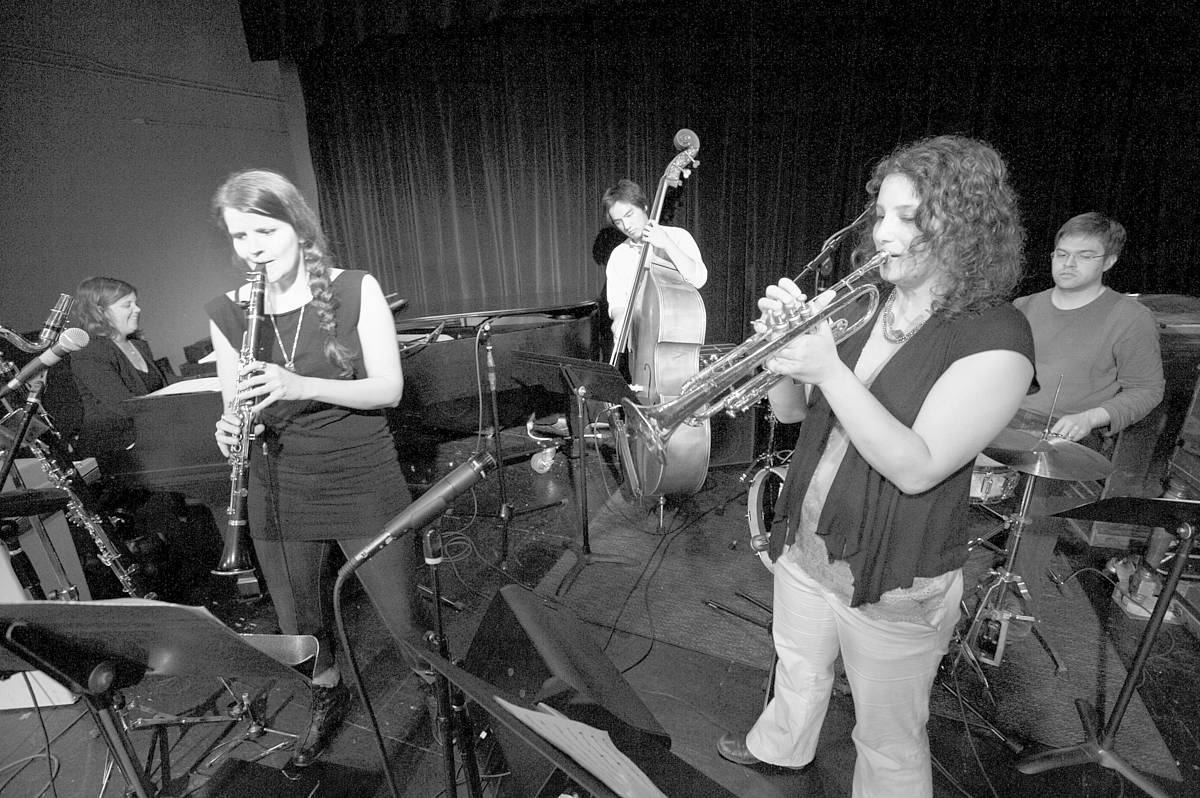
You can also listen to this new recording by the Sam Boshnack Quintet. The trumpeter, vocalist, and composer has created the "Nellie Bly Project" (Artist Recording Collective), a four-piece suite featuring Ms. Boshnack, Beth Fleenor (clarinet, bass clarinet), Alex Chadsey (piano, keys), Isaac Castillo (acoustic and electric bass), and Max Wood (drums). Joining the ensemble are vocalists Valerie Holt and Anne Matthews (both on tracks 1 and 3) and Anne Whitfield (spoken vocal on tracks 2 and 4). All the lyrics and words come from Ms. Bly's columns and essays. While no one would or should argue about the accomplishments of the journalist, Ms. Boshnack's music is also quite impressive. The integration of words and music is well thought-out and the compositions are quite strong.
Listen to the power of the opening track, "Expositions." The power of the rhythm section pushes the melody forward, the bass clarinet and trumpet two strong voices rising above the beat. Chadsey's electric piano softens the attack but he also deliver a fine solo. "After One Is In Trouble" opens with a sound and feel that reminds this listener of the week of the late baritone saxophonist and activist Fred Ho. After a handsome melody is played by trumpet and clarinet, Ms. Boshnack steps out for quite an impressive solo. The rhythm section applies heat and the trumpet flies about them. About a quick tempo shift, drummer Wood take over for a long and involved solo (with different musical voices stepping in along the way). "72 Days" has a wonderful acoustic piano solo before shifting gears with the voices coming in to show Ms. Bly's determination, chanting over and over"I would rather go in debt and successful/than alive and behind time." That mantra leads into an excellent. clarinet solo before Wood kicks in and the band celebrates the success of the trip as they take the song out.
Nellie Bly's story is one of courage, determination, the fight to find the truth and correct wrongs in what seems like an uncaring society. The power in her words and deeds is the fuel for Sam Boshnack; you can hear it in every note of her "Nellie Bly Project", hear it in the impressive melodies, the rhythms, the interactions, and solos of the Quintet. Music is be a powerful tool in education, helping students see more of the world around them and the people who have make great compositions to move this nation and the world forward out what seems to be the eternal "dark ages."
Here's an in-concert performance of the opening movement (Dawn Clements is on piano):
Saxophonist (tenor and soprano) Ralph Bowen has been an active member of the creative music scene since the mid-1980s both as a performer and educator (his teaching credits include serving on the faculties of Rutgers/State University of New Jersey and Princeton University). He has played and/or recorded with Horace Silver, the Art Blakey Big Band, Freddie Hubbard, pianist Michel Camilo, Orrin Evans, Dr. Anthony Branker, and many others. Bowen has recorded as a leader for CrissCross and Posi-Tone Records. His latest album for the latter label (his sixth) is a self-titled quartet date featuring Jim Ridl (piano, Fender Rhodes), Kenny Davis (acoustic and electric basses), and Cliff Almond (drums).
The program is set up like a concert. Opening with the high-octane original "Cache Cache", the piece serves as a "warmup" as the band dances its way through with solos by Ridl, Bowen, and Almond. The alliteration in the song title sets the listener up for "The Phylogeny Suite", a six-part, 42 minute, musical adventure with titles such as "A Rookery of Ravens", "A Leap of Leopards", and so forth. What stands out is not only the fine musicianship but also the intelligence of the material, the well-thought out melodies and the interactions. Almond and Davis are integral throughout, keeping the songs flowing forward and offering great support and, on occasion, powerful counterpoint. And there is such great variety. "A Pandemonium of Parrots" swing lustily while "A Venue of Vultures" (there's an image) has a delightful funky edge. "...Ravens" has a darker edge as well as a great solo from Ridl while there is a gentle edge to "A Flamboyance of Flamingos" (Ridl on Fender Rhodes). Listen also to Bowen's even tone, the clarity of his notes, and how well he builds his solo from the melody. The "...Suite" comes to a close with "A Cast of Crabs", a deeply funky piece with a touch of Steely Dan and a hint of New Orleans (dig Davis's deep notes on the electric bass). Ridl's overdubbed Rhodes solo has a jaunty edge
One could view the final three tracks as the "encores". Up first is "Aye", a sweet ballad from bassist Davis. Again, the "honest" tones that Bowen creates (no effects, light or no vibrato no "harsh" sounds) stand out as he builds his solo over the rich sounding piano chords and gentle rhythm section. Dave Liebman's "Picadilly Lily" is an inspired choice as the band romps through the song with such joy. Listen to the drive emanating from the rhythm section! The album closes with "Search For Peace" - composed by McCoy Tyner and first released on his 1967 Blue Note Records debut "The Real McCoy" (also his first album after leaving the John Coltrane Quartet), this lovely ballad is carried along gently on Ridl's Fender Rhodes work and the melodic work of Almond (Davis is the "foundation" on this piece). One can echoes of Joe Henderson (the tenor saxophonist on the Tyner album) in Bowen's tone yet one is reminded how much the leader of this date has had his own "sound" since his earliest recordings.
"Ralph Bowen" the album and Ralph Bowen the musician will bring the adventurous listener many hours of pleasure. This new recording is, arguably, his best and there's not a weak in the crowd. I'd love to see this group in action but this album is well worth your time.

 Posts
Posts