Any album and/or concert Kurt Elling presents/ creates is an adventure. The vocalist, songwriter, and poet came out of Chicago 25 years ago singing jazz, cognizant of the music's history in that city and this country, melding poetry with music, telling stories. Sometimes those stories were based in the blues, other times in the vocalese style of Jon Hendricks and Eddie Jefferson, and there were songs of a political nature. Most recently, he teamed up with Branford Marsalis for a pair of albums on Okeh Records, 2016's "Upward Spiral" with Marsalis's Quartet and the other under his own name "Questions"(2018).
Late last year, the vocalist signed with Great Britain's Edition Records – his debut album for the label, "Secrets Are The Best Stories", is credited to Kurt Elling, featuring Danilo Pérez. The fascinating program is a collection of melodies by the pianist Perez and others, including the opening two tracks composed by Jaco Pastorius plus pieces from Wayne Shorter, Vince Mendoza, and two tracks composed by vocalist Sidsel Endresen with music by Django Bates. The program is one of the most intimate and least orchestrated of Elling's oeuvre, with Pérez on 10 of the 11 tracks; bassist Clark Sommers appears on five and percussionist Rogério Boccato on four (Johnathan Blake, Jr. plays on two songs while alto saxophonists Miguel Zenón, guitarist Chico Pinheiro, and percussionist Romån Dîaz each appear on one.
Photo: Anna Webber
The intimacy can be right from the onset: "The Fanfold Hawk (for Franz Wright)" utilizes a Pastroius melody, multi-tracked voices, and Sommers's expressive bass to tell its story and leads directly into "A Certain Continuum" (based on the late bassist's "Continuum")––on this track, Pérez, Blake, Jr., and Dîaz join Sommers to create a chugging rhythm. The lengthy piano solo is quite handsome. Pérez wrote the music for "Gratitude (for Robert Bly)", the second song dedicated to an American poet. The piano and voice are so excellently paired and, when Sommers and Bocato enter, the music moves away into an airy Latin groove.
Photo: Anna Webber
But the three songs that truly stand out are "Beloved (for Toni Morrison)", "Song of the Rio Grange (for Oscar and Valerie Martinez-Ramirez)", and "Rabo de Nube". The first track is not only the longest on the program (9:32) but features the largest ensemble. Zenón's keening alto saxophone moves around Elling's voice then echoes the vocal in the fast-paced middle section. Blake, Jr., Boccato, and Sommers raise the intensity beneath the hard-edged piano. The final tune mentioned is composed by Cuban folk singer Silvio Rodríguez and translates to "Tail of the Tornado." Yet, Elling and Pérez handle this song about a great wind coming to clean away sadnesses and ugliness, leaving behind hope.
As for "Song of the Rio Grange", listen and watch below knowing that the song is dedicated to the father and his daughter who died crossing the river from Mexico to the United States. Just Elling's multi-tracked voice and the amazing sounds of the prepared piano––fascinating lyrics and emotionally powerful music.
"Secrets Are The Best Stories" is an amazing musical and lyrical journey. Built upon the words and dramatic vocals of Kurt Elling and the powerful, lyrical, musicianship of Danilo Pérez, this music will resonate inside you, asking you to listen and take action, even as the world hunkers down in isolation. The power of music and the power of the pen make yet turn the world towards empathy.
So much has been written in the last seven+ years about Jimmy Greene and his family's personal tragedy of losing his daughter Ana Grace in the December 2012 school shooting in Sandy Hook, CT. To their credit, he and his wife Nelba Marquez-Greene have done so much since the to raise awareness about the issues of mental illness, gun laws, and more (check out https://anagraceproject.org/ana-grace/). The saxophonist (soprano and tenor) has continued to perform, record, and teach––he is currently Associate Professor of Music and Co-coordinator of Jazz Studies at Western Connecticut State University. His two albums on Mack Avenue, 2014's "Beautiful Life" and 2017's "Flowers – Beautiful Life, Volume 2", have shown his development as a musician and composer, his tenor sound maturing into a brighter, fuller, tone while his soprano playing gets better, richer, cleaner, with every passing year.
His new Mack Avenue album, 'While Looking Up", is a reunion of sorts. Each musician – Lage Lund (guitar), Reuben Rogers (bass), Stefon Harris (vibraphone, marimba), Kendrick Scott (drums), and Aaron Goldberg (piano, Fender Rhodes) – have recorded with Greene in the past (Goldberg appeared on the saxophonist's 2000 Criss Cross debut "Introducing Jimmy Greene"). The 10 song program features seven Greene originals plus three tracks by associated with other artists. The album opens with Cole Porter's "So In Love" with Greene essaying the melody on soprano sax while the band (minus Harris) dance beneath him, especially during his lyrical solo. Lund and Goldberg follow within solos of their own. Greene and company refashion Whitney Houston's major hit "I Wanna Dance With Somebody (Who Loves Me)" into a lovely ballad. Instead of the powerful dance rhythms of the original, one can truly hear the longing in the tenor saxophonist's phrasing of the melody. Be sure to notice the excellent brushes work from Scott and Rogers's melodic bass work. The stunning peformance of "Good Morning Heartache" (perhaps best know for Billy Holiday's 1946 recording) is one of the highlights of the album. With Rogers and Scott creating a gentle cushion, Green's breathy tenor solo hearkens back to the sounds of Coleman Hawkins and Ben Webster without sounding like either musician.
Photo: Anna Webber
Harris only appears on two cuts but both are worth noting. Greene's flute introduction (with overdubbed clarinet and bass clarinet) to "April 4th" leads the listener in to a lovely light samba. His lovely soprano playing is framed by Goldberg's gentle piano, the excellent rhythm section especially Scott's dancing drums. Harris steps out on vibraphone, raising the temperature of the piece and locking into the drums. He plays marimba on "Always There", a higher energy Greene tune with an insistent feels to the guitar and piano plus great push forward from the bass and drums. The tenor, marimba, guitar, and piano swap 4-bar phrases right up to the final 75 seconds when Scott steps out (and does he ever!)
The album comes to a close with the title track plus "A Simple Prayer." The former jumps forward on a subtle funky rhythm and features fine solos from Lund, Greene (on tenor– listen to the rhythm section dance behind him), and Goldberg (a sweet lyrical turn). The final song lives up to its name, a slow blues with more than a touch of gospel. Goldberg's rich piano work, a fine bass solo, and Greene's powerful statement over Scott's muscular drumming pulls one into the music and you find yourself on the edge of your seat shaking your head.
"While Looking Up" is a much-needed boost for the soul. The friendship of the musicians, their willingness to push each other higher, and the fine program written and/or arranged by Jimmy Greene is filled with good songs and great playing. Such positive vibes with brighten your day and your life!
Trumpeter Kenny Warren grew up in Denver, CO, and moved to NewYork City in 2002 to study music at SUNY-Purchase. Since graduation, he has played and recorded with many ensembles and people including Slavic Soul Party, Andy Biskin's 16 Tons, the Angela Morris & Anna Webber Big Band, and others. Warren also leads the Americana group "Laila and Smitty" (musical sample below) who have released three recordings since 2014. His debut jazz album, a quartet date titled "Thank You For Coming to Life", was issued in 2017 on Whirlwind Recordings.
For his second Whirlwind release, "In The Heat", Warren composed seven pieces for his trumpet, bass (Matthias Pichler), and drums (Nathan Ellman-Bell). There are few trumpet trio albums although bassist Linda May Han Oh's debut disk featured her in a trio setting with trumpeter Ambrose Akinmusire and trumpeter/ cornetist Josh Baerman has recorded in several trio settings. In many ways, this music sounds influenced by Henry Threadgill's writing for Air, not just for the intimate sound but also for how integral the bassist and drummer are to the development of the musical conversations. There are also moments when the trumpeter's squeezed notes and sound remind this listener of Taylor Ho Bynum.
The music has an adventurous feel, often moving in surprising directions and pulling the listener along. In the course of any one of the songs, the trio takes off on an aural adventure. Listen to the track below ("Pen In Hand"), to how Warren leads the bass and drums then immediately begins to play with the tempos, and then how playful their conversation becomes. The longest track, "Brain Phone Wired" (14:34), starts very slowly with the trumpet and the bass counterpoint taking their time to get into the body of the song. 2/3rds of the way through, the tempo picks up yet on can still hear how the three musicians are connected to each other rhythmically and melodically. Even the shorter tracks, such as the three-minute closer "One Room In My Mind", says a lot in a short time. The rhythm has a West African feel, the bass and drums locked in like Charlie Haden and Ed Blackwell in Old and New Dreams with Warren dancing atop their joyful beat.
"In The Heat" is conversational, challenging, open, free (at times), quite rhythmic, an album to sit with and let the sounds fill the room. Kenny Warren meets the challenge of the trio date with aplomb and joy. Enjoy the ride!
And, as a special treat, here's the final track from "Laila and Smitty III" – the band features Warren (trumpet and vocals), Jeremiah Lockwood (guitars), Myk Lockwood (lap steel), Adam Hopkins (bass), and Carlo Costa (drums) :
Here are two more recordings that remind listeners music reflects the society we live in; the messages in these songs, whether overt or subtle, speak to all of us.
Bassist, composer, host of NPR's "Jazz Night in America" and "The Lowdown" on Sirius XM, and so much more, Christian McBride is a musician who makes his presence known. His list of sideman credits grows longer every month plus he leads a trio, a quartet (New Jahn), a quintet (Inside Straight), and an 18-member big band. A native of Philadelphia, PA, he is a master of both the acoustic and electric basses. In 1998, McBride was commissioned by the Portland Maine Historical Society as well as the National Endowment for the Arts to compose "The Movement, Revisited", an episodic work that speaks about the Civil Rights Movement through the words of Rosa Parks, Reverend Dr. Martin Luther King, Jr., Malcolm X, and Muhammad Ali. He toured the Northeasten United States with his quartet and a 30-member choir. In 2008, McBride revised the work, adding a section in honor of the election of President Barack Obama and scoring the piece for his Big Band.
McBride did not go into the studio until September of 2013 to record "The Movement, Revisited" and, thanks to Mack Avenue Records, the album is finally being released. Not sure why it's taken so long but now that the music is in wide release, make sure you listen. Chances are most people know the stories of these four heroes of the Movement yet, in this time of renewed racist activities, the growth of anti-Semitism, and fear of immigrants, the words one hears have renewed meaning. Among the highlights are the performances of all the "speakers", especially poet Sonia Sanchez and actor Wendell Pierce. The former brings great verve to her presentation of Ms. Park's words, tremendous rhythm and passion while the latter's sonorous tones may not match the "preacher's tones" of Dr. King, he brings a gravitas to the words that remind us of all the work that needs to be begun and carried.
Other voices stand out. Alicia Olatuja's impassioned vocal, supported by the Voices of The Flame choir, on "Brother Malcolm" elicits chills. Pay attention to the fine support from pianist Geoff Keezer, drummer Terreon Gully, and Ron Blake's equally passionate tenor sax solo. Warren Wolf's vibraphone and Steve Wilson's soprano saxophone solos on "Sister Rosa" ring out as do the voices of the choir. "Rumble In The Jungle" is a funky romp for the big band and choir – powered by Gully's thunderous drums, Carl Miraghi's foundational baritone sax locks in with McBride's bass to push the message across while the Choir celebrates the audacity that permeated the personality of Muhammad Ali.
Photo: John Watson
The album closes with "Apotheosis", a celebration of the election of Barack Obama in 2008. Instead of serving as the culmination of the Civil Rights Movement (which it did for many people), his rise to the most powerful office in the United States began a another campaign, one that attempted to discredit the unity that Barack Obama spoke about in his Election Night message. The four "narrators" (including Dion Graham and Vondie Curtis-Hall) take turns reading the powerful words – the accompanying music, especially the lovely soprano saxophone of Steve Wilson, is quite lovely and begins to intensify as the narrators intone "Yes We Can!" The music rises to a glorious climax with the choir repeating "Free at last" while the band grooves beneath them, culminating in an equally glorious "Amen."
The positivity that permeates "The Movement, Revisited" seems nostalgic in the light of the present administration's work to dismantle not only FDR's New Deal but the policies that President Barack Obama worked so hard to put place on the environment, voting rights, equal rights, and more. Yet, Christian McBride's music and presentations reminds us of the power that comes from unity, working from the ground up in our communities to make our communities thrive and prejudices again melt into the background.
Listen to "Soldiers" (music by Christian McBride, words by Dr. Martin Luther King Jr spoken by Wendell Pierce):
Personnel:
Christian McBride – bass, compositions
Terreon Gully – drums
Warren Wolf – vibraphone, percussion
Ron Blake – tenor and soprano saxophones
Geoffrey Keezer – piano
Steve Wilson – alto saxophone, flute
Todd Bashore – alto saxophone
Loren Schoenberg – tenor saxophone
Carl Maraghi – baritone saxophone
James Burton – trombone
Steve Davis – trombone
Michael Dease – trombone
Doug Purviance - bass trombone
Lew Solo – trumpet
Frank Greene – trumpet
Freddie Hendrix – trumpet
Daryll Shawl – trumpet
Ron Tooley – trumpet
Guests:
Sonia Sanchez – Rosa Parks
Wendell Pierce – Rev. Dr. Martin Luther King, Jr
Vondie Curtis-Hall – Malcolm X
Dion Graham – Muhammad Ali
Alicia Olatuja – vocal
J.D. Steele – vocal, choral arrangements
Voices of The Flame – vocals
Photo: Randy Cole
I cannot speak for other reviewers but I read a lot of my colleagues writings. Especially impressive are those writers who are also excellent musicians as they often can get to the heart of the music and how the musicians put the pieces together. Peter Hum, who is celebrating 20 years as a music and food reviewer for the Ottawa Citizen, is one of those fine writers who, when he puts his pen and sits down at the piano, makes intriguing music that is both inside and outside the "tradition".
For his third release (his first was issued in 2010, the second in 2015), Hum is in the company of most of the people on the other recordings – they include Kenji Omae (tenor saxophone), Mike Rud (guitar), Ted Warren (drums) plus Alec Walkington (bass on six tracks), and Dave Watts (bass on four tracks). Brooklyn, NY-based Dave Smith (trumpet) is the "new" member of the group replacing Nathan Cepelinski (alto and soprano saxophones). Hum, the composer, is on a mission and wants his music to reflect the changes in society over the past four years, i.e., the shift to nationalism, the closing of borders, disrespect for natural resources, and more. Yet, like some of the best of Charles Mingus's more pointed compositions, the music is neither strident or atonal. Notice when the band marches into "Rabble Rouser", led by Warren's martial drumming and Smith's trumpet parading on the top – the music has a powerful forward motion, fine supportive bass work (Walkington), and a positive feel. Just check out the groove the rhythm section falls into to usher in Omae's excellent tenor solo.
Photo: Randy Cole
Check out "Fake News Blues"; opening in a Jazz Messengers groove, the melody unfolds gradually thanks to the guitar, tenor sax, and trumpet. Rud's solo starts out understated but really digs in and raises the intensity. Omae follows – he displays a hard-edged tone without being shrill and this solo gets pushed forward by Warren's excellent drums. Bassist Walkinton and Warren share "fours" before the sextet returns to the theme. No half-truths here (the blues is always honest).
There are delights scattered throughout the program. "Tears For the Innocent" was composed after six Muslim worshippers were shot to death in Quebec City in early 2017. Strong solos from bassist Watts, Rud, and the composer highlight this powerful piece. "Safe Passage" is inspired by refugees fleeing oppression with the hope that they find asylum. The music, to these ears, has the feel of late 60s Herbie Hancock. Strong solos from Hum, Omae, and especially Smith play out over the active rhythm section. The ballad, "Embers", is a prayer that the"flames of progress" catch fire once again. The handsome melody is introduced by the guitar followed by a compelling statement from Smith. The "octaves" solo (in the stye of Wes Montgomery fthat Rud plays before the return too the theme truly catches the ears.
Photo: Randy Cole
"Ordinary Heroes" closes on the title track. Inspired by a quote from actor/ activist George Takei, the song reminds the listener that he, she, they, and all of us have the power within us to make the world a better place, to bring about positive change. The gospel and r'n'b feel in the rhythm section is echoed by the stunning guitar solo and heightened by the tenor solo.
Over the course of 73 minutes, Peter Hum and his fine ensemble create a world of possibilities, built on hope and the desire to make positive changes in this time of negativity. The composer and pianist knows there are people all over the world taking similar steps, tuning out the negativity from the majority of politicians and paying closer attention to their own neighborhoods, towns, cities, and countries. Music has more power than we think and can be used for good. "Ordinary Heroes" reminds us of the that all the way through.
Guitarist Julian Lage is a musician one might be tempted to call a "journeyman" if he was 58 instead of 28. Since first coming to critical notice at the age of 8 in the documentary film "Jules at Eight" (check a clip out here), he's had an amazing career including playing at the GRAMMYs at the age of 12, playing and touring with vibraphonist Gary Burton at the age of 16 and so much more. His discography features duets with Fred Hersch, Nels Cline, and Chris Eldridge, a solo acoustic guitar date, 2 with his Quintet, and, now there is "Arclight" (Mack Avenue). On this album, Lage plays only electric guitar in the company of Scott Colley (bass) and Kenny Wollesen (drums, percussion, vibraphone). It's a concise program, 11 songs in 37 minutes, and lacks for nothing.
GETTY Images/Jack Vartoogian
From the rumbling blues-rock of "Fortune Teller" to the avant-swing of "Activate" to the sweet ballad sounds of "Ryland", the album is filled with melodies, notable for its interactions, and although neither Colley nor Wollesen get a solo, they are an integral part of the brilliance of the music. 7 of the tracks (including the 3 listed above) are Lage originals plus there are 4 intelligent "covers. There's the Django Reinhardt inspired swing of Gus Kahn/Charles Daniels 1927 "Persian Rug" (splendid brush work from Wollesen), the lovely ballad"Nocturne" from the British composer, bandleader and journalist Spike Hughes (1908-1987), an interactive take of Irving Kahal/Sammy Fain's "I'll Be Seeing You" (Colley and Lage each take turns playing the melody while the drummer pushes them forward) and a ripping reading of W.C. Handy's "Harlem Blues", adapted from a 1920s arrangement by bandleader Willard Robison. The final track is one of several that remind this listener of the trio work of Bill Frisell, Kermit Driscoll, and Joey Baron from the 1990s.
This album has such fascinating sound choices. In the midst of the rocking "Prospero", Lage's ripping guitar lines share the melody with the vibraphone. Sounds like a marimba on the opening of the appropriately-named "Stop Go Start" which brings to mind the exotica of Martin Denny as interpreted by Kip Hanrahan. Colley's rich bass lines take the lead melody on "Presley" before Lage enters and the piece takes off on the power of the guitar solo over Wollesen's charging drum work.
If you enjoy the guitar work of Mr. Frisell, Brad Shepik, John Scofield, and Jeff Parker (among others), "Arclight" is for you. While Julian Lage does not sound like any of those guitarists, his rapport with Scott Colley and Kenny Wollesen will remind you of other guitar trios, ones in which all members have equal say in the presentation.And, it's great fun. For more information, go to www.julianlage.com.
Here's the rollicking "Harlem Blues":
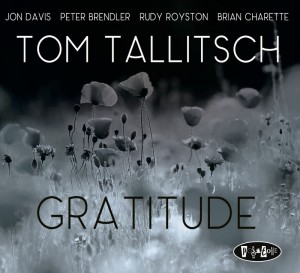
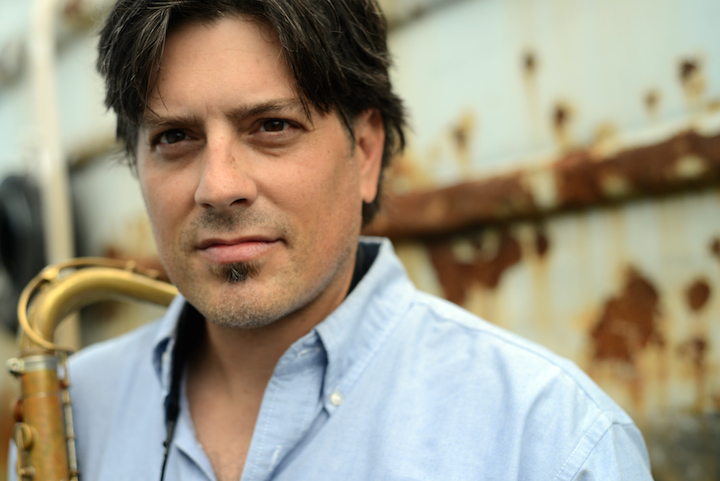
From the opening seconds of the first track "Terrain", it's easy to understand why the new Tom Tallitsch CD, titled "Gratitude" (his 4th for PosiTone Records), is so enjoyable. The music sounds like vintage John Coltrane, circa 1975, powerful yet accessible and played by a band that is on fire. The tenor saxophonist surrounds himself with such great players including pianist Jon Davis, bassist Peter Brendler, and drummer Rudy Royston (organist Brian Charette shows up on 2 of the 11 cuts). My affection for the amazing work of Mr. Royston is no secret and the bassist, one of the more melodic and focussed musicians, is very impressive. Davis, who worked with bassist and composer Jaco Pastorius, is a two-fisted delight, supportive and adventurous.
Tallitsch provides his band with a number of strong vehicles, not only for his rich, blues-drenched, sax but also making sure to give everyone a chance to shine. Listen to how Brendler and Royston drive "Refuge", their acceleration pulling the sax and pain with them. As is his won't, the leader does not overplay. He tends to caress melodies instead of roaring through. The group's take on John Lennon's "Because" starts slowly and sweetly, building during the saxophone solo and hitting its stride during Davis's strong solo. The bass counterpoint is also quite nice. Charrette shows up on the other 2 "covers", "Gold Dust Woman" (by Stevie Nicks) and "Thank You", one of the few slow tunes on "Led Zeppelin II" (composed by Robert Plant and Jimmy Page). The folky quality of the original version can be felt on the latter track; with the addition of the organ, one hears the influence of The Band. The tenor solo near the close of the tune hews closely to the melody and one can hear the gratitude from the lyrics.
sbarts.com
Several of the cuts are really barn-burners. Beside the CD opener, "Alternate Side" fires on all cylinders without overheating. Tallitsch really digs into his solo, romping atop the active cymbal work and the fast-paced "walking" bass lines. A big dollop of funk is the basis for "Rust Belt" - Brendler's thick foundation and Royston's snappy snare work set the tone with the leader and pianist playing with great delight. Turn it up and watch the speakers shake. More of that Coltrane/McCoy Tyner power enlivens "Oblivion", the tension created by the rhythm section is thick but enjoyable.
The soulful sounds of the title track serve as a good reminder that the best music is about melody, rhythm, intelligent interplay, and emotion. Jon Davis's splendid solo on "Gratitude" has so much soul as does the excellent bass work of Peter Brendler; when Tom Tallitsch enters, he plays with such ecstasy goosed on by the impeccable playing of Rudy Royston. This music sounds so good - engineer Nick O'Toole has such a knack for capturing rhythm sections while not ignoring the front line - and it feels quite good as well. With "Gratitude", Tom Tallitsch has, arguably, created the best recording of his career. Keep them coming!
Pianist/composer Carolina Calvache is a native of Cali, Colombia, who came to the United States to study in the prestigious music program at the University of North Texas and now lives in New York City. She has been mentored by the great Venezuelan pianist Luis Perdomo and has worked with saxophonist John Ellis, bassist Linda Oh and percussionist Samuel Torres. Her self-produced debut Cd, "Sotareno" (Sunnyside) is an often stunning display of melody and musicianship as well as a reminder of how jazz is a world music.
The opening cut, "El Sotareno", is based on a traditional hymn from the region of Colombia where her father's family lived. In the able hands of drummer Antonio Sanchez (the sole track on which he appears, bassist Hans Glawischnig and alto saxophonist Jaleel Shaw, the piece explodes out of the gate with an intensity that never flags. Ms. Calvache's solo soars over the active rhythm section as if sparked by McCoy Tyner. (A short solo piano reprise at the end of the CD gives the listener an idea of the original melody.) Cuban-born drummer Ludwig Afonso is featured on 7 of the tracks, powering the band on "Lluvia" which features the clear tones of trumpeter Michael Rodriguez. The trumpeter also appears on the lovely ballad "Too Soon", where his "singing" tones blend well with the rich piano chords. Shaw's soprano sax is the focal point of the lovely ballad "Melancholia", caressed by the full piano chords and buoyed by the excellent interactions of the bassist and drummer. Ms. Calvache's piano spotlight is filled with expressive single-note runs punctuated by chords that ring out. "Stella", the pianist's birthday song for her mother, has the feel of a Brazilian melody, one that has a long, flowing, line echoed in the fine bass solo that precedes Ms. Calvache's sweet solo. "Dream Maker" has an irresistible rhythmic feel in its melody line, in the forceful left hand of the pianist and in Afonso's first-rate work. Glawischnig insinuates his playing around the pianist; their interaction throughout the recording is delightful. The playful "Monday", inspired by a Perdomo concert Ms. Calvache attended has a quirky left hand rhythm, intense drumming, and a slippery alto saxophone melody for Shaw. The pianist's solo "swings", building in intensity over the exuberant rhythm section.
"El Sotareno" does not sound like a first album. Carolina Calvache seems neither tentative nor nervous; instead she's quite self-assured as a composer, arranger, producer and soloist. As debut recordings go, this is an impressive start to what one hopes is a long productive career. For more information, go to www.carolinacalvache.com.
You can listen to the CD here, courtesy of Sunnyside and Bandcamp:
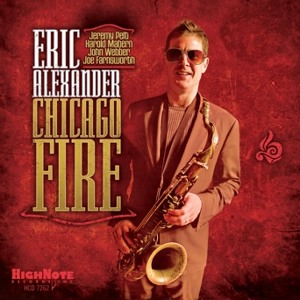
"Chicago Fire" (HighNote) is the 35th release by tenor saxophonist Eric Alexander under his own name (that includes 2 sessions co-led with Vincent Herring and 1 with Lin Halliday), not counting his work with One For All. It's been 23 years since he took part in the Thelonious Monk Saxophone Competition and went to record his debut with Delmark Records. While his sound has deepened and his blues "chops" strengthened, he still possess a great tone and great respect for his predecessors, players such as Don Byas, Johnny Griffin, Eddie Harris, Von Freeman and Sonny Stitt (the final 3 musicians are honored by original compositions on the CD.) Alexander records with his favorite rhythm section of bassist John Webber, drummer Joe Farnsworth and the irascible pianist Harold Mabern. Having seen and heard the great Memphis, Tennessee-native Mabern play live with Alexander, I know how hard the tenor saxophonist works to keep with the pianist (who can and does play everything). Trumpeter Jeremy Pelt, who has played on numerous occasions over the past 15+ years with Alexander, joins the band on 3 pieces including the fast-paced Mabern original "Bee Hive" that may remind some of the Clifford Brown-Max Roach Quintet of the mid-1950s. Pelt also digs into a fine solo on Buddy Johnson's "Save Your Love For Me" and gets "down and dirty" for "You Talk That Talk." Mabern and Alexander reminisce about the late tenor payer Freeman on "Blues for Vonski", a bluesy ditty that moves slowly and features a sultry saxophone solo and a rollicking piano spot. The group pays tribute to Johnny Griffin with an explosive reading of "Just One Of Those Things", Alexander flying over the rhythm section. The program closes with "Don't Take Your Love For Me", a Henry Nemo tune introduced by Mildred Bailey and recorded by Artie Shaw and Lena Horne (among others). Farnsworth gives the tune a bossa-nova rhythm, amplified by Mabern's bouncy chordal work, while Alexander plays a sweet and very melodic solo.
"Chicago Fire" is a first-rate tribute to saxophonists associated with the Second City as well as another highly enjoyable album from Eric Alexander. If you are a long-time fan, you will be pleased - if you're new to Alexander's music, this is a good place to begin exploring his fine work. For more information, go to www.ericalexanderjazz.com.
One of the myriad joys listening to the music of guitarist Nels Cline is that you now his music will run the gamut from lullaby-like melodies to moments of unfettered shredding. Besides touring and recording with Wilco, appearing on numerous side-projects, his main vehicle is the Nels Cline Singers. The Trio - Cline (guitars, etc), Scott Amendola (drums, percussion, electronics) and new member Trevor Dunn (bass, effects) who replaces Devon Hoff - has a new CD. "Macroscope" (Mack Avenue/Cyrptogramophone) features a number of guest contributors including Yuka Honda (electric piano), Cyro Baptista (percussion universe), Josh Jones (congas, other percussion) and Zeena Parkins (electric harp). Over the course of an hour, the music rocks, roars and roils, shimmers, sputters, clangs, burbles, charms, disarms and goes in many directions. Take a piece like the trance-like "Seven Zed Heaven"; the music starts as a high-energy, fast-paced jam to a long section that continues to builds in intensity until it explodes into shards of percussion. "Canales' Cabeza" is another burner with the guitarist letting loose over the rolling bass lines and furious drum work. Latin percussion blends with electronic effects at the onset of "The Wedding Band", a mix that feels like 1970s Santana before the lap steel and 12-string guitar provides a handsome melody. The solid throb from the electric bass and drums give Cline and Ms. Parkins a rocking rhythm to mess around on "Climb Over."
"Macroscope" is a very playful album and one was be willing to play along. The music can be quite noisy but almost always keeps a humorous edge. One imagine that the volume level in concert halls and other venues can be over-whelming ("Hairy Mother" just about melted my speakers in the house and the car.) That said, the Nels Cline Singers give listeners a mighty dose of serious fun. For more information, go to nelscline.com.

 Posts
Posts