The past month has included the usual "stuff of life", from convalescing partners to losing a favorite animal to sad deaths in the community to the long East Coast heat wave. While I still have been listening to the piles of CDs and mp3s that clutter my desk/desktop, writing time has diminished sharply. As for the listing part, there was a week where Miles Davis's "In a Silent Way" and music from the John Coltrane Quartet (concentrating on his Atlantic releases and the new Impulse "Lost Tapes.") That concentrated listening took place in mid-June but, since then, my ears have enjoyed a number of new albums including the two recordings below.
For his seventh album as a leader or co-leader, saxophonist and composer Geof Bradfield moves on to the Delmark Records label from successful stops at Cellar Live and Origin Records. "Yes, and...Music for Nine Improvisers" is a "concept" program with four pieces for nonet and four for four different trios. Utilizing his high-energy rhythm section of bassist Clark Sommers and drummer Dana Hall, Bradfield creates a number of different scenarios for the ensemble. "In Flux" shines the spotlight on guitarist Scott Hesse even as it builds color options for the brass work of trumpeters Marquis Hill and Russ Johnson plus trombonist Joel Adams as well as his fellow reed players, Anna Webber (flute, bass flute, tenor saxophone) and Greg Ward (alto saxophone. Note how the arranger weaves his bass clarinet into the ensemble lines as well as Ms. Webber's expressive flute.
What the composer/arranger accomplishes on the nonet pieces allows the music to breathe even as the ensemble move in and out of written material into improvisations. The long opening theme section to "Impossible Charms" gives Bradfield the opportunity to utilize all the voices, setting up a series of solos from himself, Adams, and Hill (especially on fire here) that are occasionally punctuated by the reeds and brass to play pieces of the opening theme. "Anamneses" (defined as recollections - the word is plural - from a supposed previous existence) opens with statements from Webber's bass flute, Adams's expressive trombone and the handsome section writing (led by Johnson's clear trumpet tones). Webber's flute solo over the expressive percussion and rippling guitar chords opens the piece even further. Johnson's solo is a fascinating tour-de-force, expressive, exploratory, thoughtful, and powerful. Listening to the final track without looking at the title of the piece, I immediately thought "Brazil." "Forro Hermeto" (inspired by and dedicated to Brazilian genius Hermeto Pascoal is imbued with a lightness of spirit - one hears it in the delightful rhythm section work, the fun give-and-take between guitar and trumpet that culminates with both soloing at the same time. Webber and Bradfield step out from the short full-band interjection to present their own call-and-response. The piece has a lightness yet still retains the adventurous spirit of the other nonet works.
The four shorter pieces for trio combinations include the opening "Prelude" that is a hard-driving sax-bass-drums romp that lights the fire for the proceedings. "Chorale" combines the two trumpets with the trombone for a darkly beautiful classically inspired piece. "Ostinato" is a work for guitar with bass and drums with all three overdubbed to great effect. "Chaconne" is the last of the trio pieces. Composed for soprano sax (Bradfield), Ward's alto, and tenor (Ms. Webber), it's also classically oriented and attractive.
"Yes, and..." is inspired by the improvisational techniques created by Chicago's Compass Players in the mid-1950s whose comedy skits inspired the work of Second City and other experimental troupes. Geof Bradfield also cites his studies of French composer Olivier Messiaen's variety of ideas about rhythm, melody, and harmony on his preparation of this material. Over the course of the saxophonist's career, he's paid tribute to Melba Liston, to Leadbelly, to bebop and mainstream jazz, and the inspiration of African rhythms. One can see that this new album is a continuation of all of his studies, his maturity as a composer and arranger, and his desire to continue searching. We who listen closely reap the rewards of his adventurous musical mind.
Here's a different edition of the nonet playing Herbie Hancock's "The Prisoner" (from late March 2017 - it will give you a good idea of the ensemble's sound and Bradfield's arranging talent):
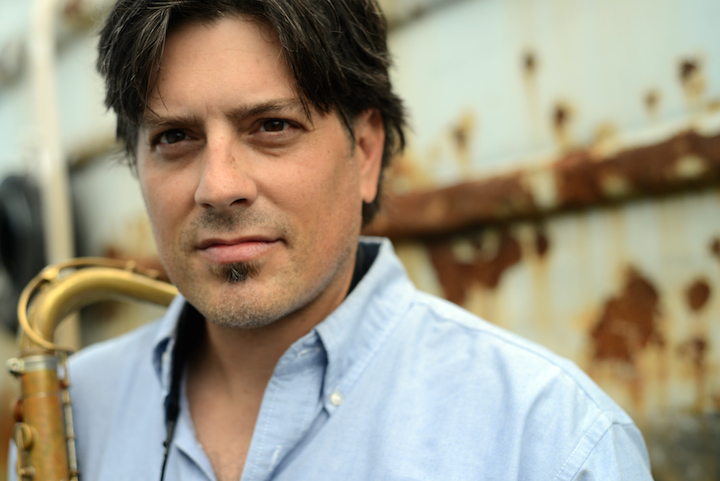
For his fifth release on Posi-Tone Records, "Wheelhouse", tenor saxophonist and composer Tom Tallitsch has gathered a strong assortment of musicians - Jon Davis (piano), Josh Lawrence (trumpet), Peter Brendler (bass), and Vinnie Sperrazza (drums), all leaders in their various groups - and let them loose on a nine-pack of originals that tempt the listener's ears and mind with fine melodies and excellent improvisation. It helps that the rhythm section is quite strong, from Davis's sparkling accompaniment and fine solos to Brendler's "foundational" bass work (not to forget what a melodic player he is), and Sperrazza's adventurous work at the drum set. The leader enjoys sparring with his rhythm section: those interactions on such songs as "Schlep City" and "Red Eye" makes the listener feel as if he or she are in the middle of the band watching as the musicians push, prod, and dance with each other.
Photo: Bryan Murray
One cannot miss the sound of the blues that permeates certain tracks. "Paulus Hook" (named for the waterfront area of Jersey City, New Jersey across the Hudson River from Manhattan) has a sweet, slowly swinging, feel with a handsome melody (note pianist Davis's lovely elaboration around the tenor and trumpet at the close of the tune). The one real ballad on the album, "One for Jonny", opens with a long, lovely, piano solo before Tallitsch enters with the sweet, wistful, melody. Lawrence shines on his part, so lyrical and clean, his articulated notes creating a fine musical portrait. The piece, written with Davis in mind, opens up for allow him to dance atop the gentle brush work and spare bass lines.
There are really no weak tracks on "Wheelhouse." The program closes with the aptly-titled "The Crusher" and "Gas Station Hot Dog" (the two tracks that surround "One for Jonny"). On the former, the quintet explodes from note one on a journey that roils and rollicks thanks to the propulsive drum work and the exciting bass figures. Davis absolutely rocks (he always plays as if he is having the "best time ever"), Lawrence's trumpet dances with glee (goosed on by the rhythm section), and Tallitsch flat-out swings! On the album's final tune, one hears a funky beat and melody reminiscent of Herbie Hancock's "Watermelon Man" - the listener may not be able to contain a laugh or two as the quintet hits the groove, as the soloists ride the "boogaloo", and the cares of the day wash away.
Need a sonic break from the endless waves of negativity that seem to batter one from all sides. Dig in to "Wheelhouse", enjoy what Tom Tallitsch and his creative companions have created, and have a good time.
Guitarist Julian Lage is a musician one might be tempted to call a "journeyman" if he was 58 instead of 28. Since first coming to critical notice at the age of 8 in the documentary film "Jules at Eight" (check a clip out here), he's had an amazing career including playing at the GRAMMYs at the age of 12, playing and touring with vibraphonist Gary Burton at the age of 16 and so much more. His discography features duets with Fred Hersch, Nels Cline, and Chris Eldridge, a solo acoustic guitar date, 2 with his Quintet, and, now there is "Arclight" (Mack Avenue). On this album, Lage plays only electric guitar in the company of Scott Colley (bass) and Kenny Wollesen (drums, percussion, vibraphone). It's a concise program, 11 songs in 37 minutes, and lacks for nothing.
GETTY Images/Jack Vartoogian
From the rumbling blues-rock of "Fortune Teller" to the avant-swing of "Activate" to the sweet ballad sounds of "Ryland", the album is filled with melodies, notable for its interactions, and although neither Colley nor Wollesen get a solo, they are an integral part of the brilliance of the music. 7 of the tracks (including the 3 listed above) are Lage originals plus there are 4 intelligent "covers. There's the Django Reinhardt inspired swing of Gus Kahn/Charles Daniels 1927 "Persian Rug" (splendid brush work from Wollesen), the lovely ballad"Nocturne" from the British composer, bandleader and journalist Spike Hughes (1908-1987), an interactive take of Irving Kahal/Sammy Fain's "I'll Be Seeing You" (Colley and Lage each take turns playing the melody while the drummer pushes them forward) and a ripping reading of W.C. Handy's "Harlem Blues", adapted from a 1920s arrangement by bandleader Willard Robison. The final track is one of several that remind this listener of the trio work of Bill Frisell, Kermit Driscoll, and Joey Baron from the 1990s.
This album has such fascinating sound choices. In the midst of the rocking "Prospero", Lage's ripping guitar lines share the melody with the vibraphone. Sounds like a marimba on the opening of the appropriately-named "Stop Go Start" which brings to mind the exotica of Martin Denny as interpreted by Kip Hanrahan. Colley's rich bass lines take the lead melody on "Presley" before Lage enters and the piece takes off on the power of the guitar solo over Wollesen's charging drum work.
If you enjoy the guitar work of Mr. Frisell, Brad Shepik, John Scofield, and Jeff Parker (among others), "Arclight" is for you. While Julian Lage does not sound like any of those guitarists, his rapport with Scott Colley and Kenny Wollesen will remind you of other guitar trios, ones in which all members have equal say in the presentation.And, it's great fun. For more information, go to www.julianlage.com.
Here's the rollicking "Harlem Blues":
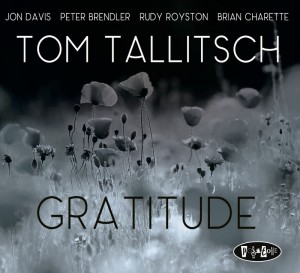
From the opening seconds of the first track "Terrain", it's easy to understand why the new Tom Tallitsch CD, titled "Gratitude" (his 4th for PosiTone Records), is so enjoyable. The music sounds like vintage John Coltrane, circa 1975, powerful yet accessible and played by a band that is on fire. The tenor saxophonist surrounds himself with such great players including pianist Jon Davis, bassist Peter Brendler, and drummer Rudy Royston (organist Brian Charette shows up on 2 of the 11 cuts). My affection for the amazing work of Mr. Royston is no secret and the bassist, one of the more melodic and focussed musicians, is very impressive. Davis, who worked with bassist and composer Jaco Pastorius, is a two-fisted delight, supportive and adventurous.
Tallitsch provides his band with a number of strong vehicles, not only for his rich, blues-drenched, sax but also making sure to give everyone a chance to shine. Listen to how Brendler and Royston drive "Refuge", their acceleration pulling the sax and pain with them. As is his won't, the leader does not overplay. He tends to caress melodies instead of roaring through. The group's take on John Lennon's "Because" starts slowly and sweetly, building during the saxophone solo and hitting its stride during Davis's strong solo. The bass counterpoint is also quite nice. Charrette shows up on the other 2 "covers", "Gold Dust Woman" (by Stevie Nicks) and "Thank You", one of the few slow tunes on "Led Zeppelin II" (composed by Robert Plant and Jimmy Page). The folky quality of the original version can be felt on the latter track; with the addition of the organ, one hears the influence of The Band. The tenor solo near the close of the tune hews closely to the melody and one can hear the gratitude from the lyrics.
sbarts.com
Several of the cuts are really barn-burners. Beside the CD opener, "Alternate Side" fires on all cylinders without overheating. Tallitsch really digs into his solo, romping atop the active cymbal work and the fast-paced "walking" bass lines. A big dollop of funk is the basis for "Rust Belt" - Brendler's thick foundation and Royston's snappy snare work set the tone with the leader and pianist playing with great delight. Turn it up and watch the speakers shake. More of that Coltrane/McCoy Tyner power enlivens "Oblivion", the tension created by the rhythm section is thick but enjoyable.
The soulful sounds of the title track serve as a good reminder that the best music is about melody, rhythm, intelligent interplay, and emotion. Jon Davis's splendid solo on "Gratitude" has so much soul as does the excellent bass work of Peter Brendler; when Tom Tallitsch enters, he plays with such ecstasy goosed on by the impeccable playing of Rudy Royston. This music sounds so good - engineer Nick O'Toole has such a knack for capturing rhythm sections while not ignoring the front line - and it feels quite good as well. With "Gratitude", Tom Tallitsch has, arguably, created the best recording of his career. Keep them coming!
Tenor saxophonist and composer Melissa Aldana has been involved with music from a young age. She started out by watching her father - a jazz saxophonist - teaching students in their home in Chile. Starting out on alto and switching to tenor after hearing Sonny Rollins (she was given her grandfather's Selmer Mark VI, the instrument she still uses today), Ms. Aldana came to the US to continue her education at the Berklee College of Music in Boston, MA, won the 2013 Thelonious Monk International Jazz Saxophone Competition, has been mentored by tenor great George Coleman, and now tours and records with her trio.
Her 4th CD as a leader, "Back Home" (Wommusic), is her second straight release in a trio setting. Bassist Pablo Menares (who played on her 2014 Concord release) is now paired with drummer Jochen Rueckert (he replaces Francisco Mela). The title refers to Ms. Aldana returning to the music of Sonny Rollins for inspiration. The lessons of "Live at The Vanguard" and "Freedom Suite" can be heard in how this is a "collective", not just a saxophone soloist with rhythm section. While the leader contributes 4 compositions, the bassist and drummer both contribute 2 (there's also a lovely tenor sax-bass duo on Kurt Weill's "My Ship").
More than anyone, Ms. Aldana's sound reminds me of Charles Lloyd, the lightness of her delivery, her phrases that sweep and flow over the rhythm section but never overwhelm the piece. Yes, one can hear passages that have heft (her solos on "Alegria" and on the title song) yet this music is more exploratory than exclamatory. Rueckert's "Obstacles" jabs and darts, the saxophone skating atop stop-start-run of the rhythm section. Menares' thick bass tines support the saxophone melody on the bassist's "Desde La Lluvia" as the drummer colors the proceedings with his splendid cymbal work.
NY Times
Like the most compelling contemporary music, "Back Home" looks backwards and forwards, never sounding dated or forced. The best tracks seem to move like dream passages. "Time" (composed by Ms. Aldana) opens with a bass solo before the saxophone melody enters, like a quiet tango. The bass counterpoint, the brushwork, the saxophone phrases that away from the melody and back again, all that and more make the song so attractive. The bassist also leads the way in on his ballad "En Otro Lugar", a piece that moves easily forward on Reuckert's gentle yet insistent forward motion.
The title track comes at the end of the album and certainly has the hallmarks of Sonny Rollins in its playful melody, stop-and-go rhythms, and the solid bass lines (reminiscent of the 1957 "Way Out West" classic). Ms. Aldana swings mightily, Menares does some serious "walking", and Reuckert propels the Trio forward with obvious delight.
"Back Home" is a treat from start to finish. Melissa Aldana plays with great confidence throughout, displaying both a thoughtful as well as playful side. Her influences continue to be incorporated into her own "voice" both as a player and composer. And, with such top-notch associates, this music is certainly stellar. For more information, go to www.melissaaldana.com.
Here's the Trio in action from 2015 and Vermont PBS playing "My Ship":

 Posts
Posts