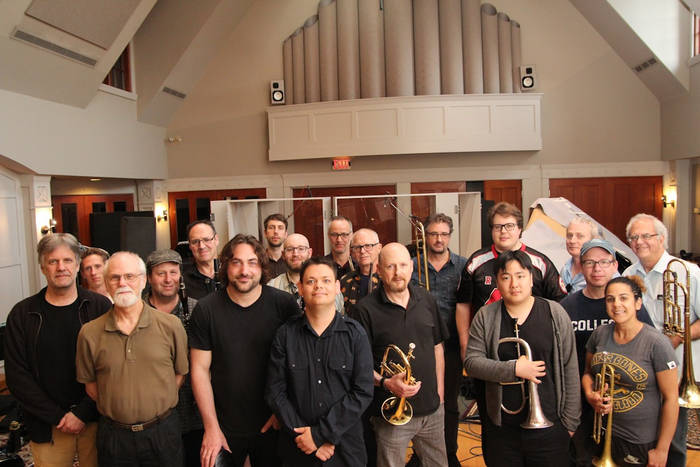
Composer, arranger, trumpeter, and educator Daniel Hersog seemingly burst onto the jazz scene with the release of his debut Large Ensemble album "Night Devoid of Stars" (Cellar Music). Of course, nobody just appears on the "scene"––Hersog, a native of Victoria, British Columbia, is a graduate of the New England Conservatory of Music in Boston, MA, and, as a trumpeter, has played throughout North America with artists such as drummer Terry Clarke, trumpeter Brad Turner, the Vancouver Legacy Jazz Orchestra, and the Jaelem Bhate Orchestra (with whom he recorded two albums). Hersog is currently on the faculty of Capilano University in Vancouver, BC, where he is an Academic Coordinator and Instructor in the Jazz Studies Program plus leads a trumpet ensemble.
Now, the second album from the Daniel Hersog Jazz Orchestra has dropped. "Open Spaces: Folk Songs Reimagined" (Cellar Music) states its mission in the title. The majority of the pieces come from traditional musics of Canada and the United States interspersed with pieces by Gordon Lightfoot and Bob Dylan plus several Hersog originals. The ensemble (listed below) is composed of musicians from both countries as well as classmates (Noah Preminger and Kim Cass) and instructors (Frank Carlberg and Brad Turner), many of whom appear on the first CD. The addition of reed master Scott Robinson and guitarist Kurt Rosenwinkel gives Hersog a bigger palette to work with and he does so liberally. The 10-song program opens with the late Mr. Lightfoot's "Wreck of the Edmund Fitzgerald"––Preminger's hard-edged tenor solo represents the blowing winds and Carlberg's piano the roiling waves while Dan Weiss's drums are the sound of the boat splitting apart. That's followed by a rousing coda leading into Hersog's imaginative take on Bob Dylan's "Blowin' In the Wind". Titled "How Many Roads", there's a flowing guitar solo over the responsive reeds and supportive brass. The reeds and brass play a "call-and-response" with the piano before Carlberg digs into his solo over the rough and tumble bass and drums.
After a stately introduction, "Shenandoah" becomes a beautiful ballad featuring an amazing baritone sax solo from Scott Robinson. Heartfelt, emotional, melodic, the listener is transported out of the crazy world by the stunning and brilliant arrangement that supports him (kudos to Carlberg as well) and the simple yet generous melody. Robinson returns to the spotlight on "Rentrer" but not until after Cass's lovely solo bass introduction and Carlberg plays the rambling theme which, in turn, leads into Rosenwinkel's short but sweet solo. Robinson's baritone solo goes deep and then swoops to the higher register of the big instrument. The final two minutes of the piece features the sections swirling around the guitar, rising like the murmuration of starlings before the the abstract finish.
Photo: Robert Iannone
Other highlights include the playful "I Hear", a piece that opens with the ensemble "barking" at other until Weiss falls into an up-tempo rhythm for a hard-edged tenor solo before the tempo changes abruptly into a Fellini soundtrack interspersed with a swing beat for Ben Kono's fine clarinet spot. The longest track on the album (11:10), the playful tune makes room for a sharp and humorous romp for trumpeter Turner. Later in the program, the Hersog original "Sarracenia Purpurea" (named for a Pitcher Plant that grows in marshes and bogs) starts off on fire but quiets down for Robinson's baritone solo which slowly and steadily picks up in intensity as the rhythm section pushes him to dig in. Soon, the brass and reeds begin to color behind him before everyone frolics around the drums as the music arrives at its rousing finish.
The album closes with a sweet reading of "Red River Valley" (for all its connections to Cowboy movies, the song actually was composed in Canada during the 1870s). After a pretty introduction, Rosenwinkel's guitar joins the brass and reeds to play the theme. After a second verse and a striking variation played by the Orchestra, the guitarist plays the melody once more and then plays his striking solo. Even sweeter, the entire ensemble sings two choruses before the ensemble plays the melody before the lovely crescendo that ends the piece and the album.
You will hear the influences of many large ensemble arrangers and composers in the music of the Daniel Hersog Jazz Orchestra but the leader's vision plus eloquent arrangements for this ensemble are clear and truly his own. "Open Spaces: Folk Songs Reimagined" grew out of the composer/arranger's need to move his music forward after a successful debut as well as to adapt to the changes in his life (teaching and marriage). There are interpretations of beauty and breaths of humor (and occasional chaos) throughout the album; the music flourishes on the collective work of this fine group of instrumentalists. Do sit and listen––the rewards are abounding!
Since vocalist Camila Meza joined Ryan Keberle & Catharsis in 2014, the quintet has gone from strength to strength Though Ms. Meza was not a full member in that year, she did sing on five of the eight tracks of "Into The Zone" (Greenleaf Music) plus the bonus track, Sufjan Stevens' "Sister." Two years later for "Azul Infinito", her voice had become an integral part of the quintet, an ensemble that features Keberle (trombone, keyboards), Michael Rodriguez (trumpet), Jorge Roeder (acoustic and electric basses), and Eric Doob (drums). That group also recorded 2017's "Find the Common, Shine a Light", a recording made in the wake of the 2016 U.S. election with music that was a strong indictment of the election process and results yet without pointing fingers. That album also featured several short improvised pieces plus longer pieces that showed the versatility of its members.
"The Hope I Hold" is a step forward for the group. Rodriguez is gone, replaced by tenor saxophonist Scott Robinson (who actually has guested on a number of Keberle's earlier albums). Also, the sound of the band has expanded with the addition of Ms. Meza's excellent guitar work plus vocal contributions from the leader and from Roeder. The program is split in two fascinating halves. The first five tracks are Keberle compositions with lyrics adapted from the great American poet Langston Hughes (1902-1967), specifically from his 1935 poem "Let America Be America Again." Hughes's powerful words (read them here) are been lightly edited to fit the equally powerful music. The four tracks that make up "The Hope I Hold Suite" are driven by the impressively forceful rhythm section, by the intelligent melodies the leader has created, by the mixture of reeds, brass, and guitar, plus the strong vocal work. Ms. Meza, an immigrant from Chile, understand the history of this country, has seen the remnants of "Jim Crow" that exist throughout the U.S. – yet, there is neither vitriol in her voice (as there is none in Hughes's words: sorrow yes but not burning hatred) nor sorrow in her delivery. One does hear hope, hope for a better country, a more compassionate leadership, and a better understanding of the myriad issues facing the world. Following the suite is another Keberle composition. "Campinas" not only features his trombone and keyboards but also he sings lead. The first part of the piece has a strong Brazilian feel, especially in the "floating" voices and the exciting drum patterns. The second part starts with understated percussion, synthesizer sweeps, and a lyrical trombone solo before the drums kick back into the rhythms of the opening under the trombone solo and the guitar spotlight that follows.
Photo: Takahiko Tokusa
The next four tracks introduces The Catharsis Trio. Composed of the leader, Ms. Meza, and bassist Roeder. The trio first worked together on a tour of Japan when the promoter really wanted the music but could not afford to bring the entire band. Needless to say, the participants viewed the tour as a both a challenge and an opportunity to see the material in a different light. The guitarist contributes the lovely "Para Volar" – the blend of voice, guitar, bass, and trombone is alluring. Roeder's first recorded composition, "Peering", has quite a fine melody with the various voices playing off each other, providing fine harmonies as well as smart counterpoint. The team of Manuel Jose Castillo (lyrics) and Gustavo "Cuchi" Leguizamon (music) composed "Zamba de Lozano", a song
made famous by Mercedes Sosa. Ms. Meza caresses the lovely melody while Keberle offers handsome support and even shadows her on several lines. The Trio closes its set with a rearranged version of "Become the Water" of the previous Catharsis album that took its title from the chorus of this song. Here, Keberle intertwines the sounds of his Korg Minilogue synthesizer into the mix but the words are loud and clear.
The album closes with with "Epilogue/Make America Again", a chorale for voices, trombones, and keyboard that ends with a long drawn-out chord (sounds like an organ). The music has the feel of a prayer, a wordless plea for hope that seems to have eluded many of us in the past two+ years. Bitterness and cruel satire is no help – it is imperative that we all talk to each other, at community meetings, in churches, mosques, and synagogues, in the classroom, in the halls of the government. Then, "The Hope I Hold" may become a reality. Ryan Keberle & Catharsis continue to make relevant music, the writing continues to mature, and the musicianship is of the highest caliber. Now that Ms. Meza's immense talent is being put to its full use, next time around, perhaps Scott Robinson will get to employ his full array of instruments. Imagine that!!
Saxophonist, violinist, vocalist, and composer Tori Freestone has been busy making a name for herself in her native England and on the Continent. As a leader or co-leader, she's issued four CDs and has appeared on recordings by Ivo Neame, Andre Canniere, and a group called Compassionate Cow. Ms. Freestone has also worked in a number of British big bands and smaller ensembles plus is currently a tutor for the National Youth Jazz Collective and for Trinity College of Music in London. Her main musical vehicle at the moment is the Tori Freestone Trio based on her saxophone playing and compositions with the delightful rhythm section of Dave Manington (bass) and Tim Giles (drums).
The Trio has just issued its third recording for Whirlwind Recordings. Titled "El Mar de Nubes" ("the Sea of Clouds"), much of the program was inspired by the saxophonist's retreat to the Canard Islands at the close of 2017. There she wandered the landscape catering her thoughts, inspired by the longs walks in the natural forests and mountains as well as viewing the Super Moon, a phenomenon that makes the night as bright as day when it rises. The music she created from her sojourns is not radically different than her previous two Trio discs yet one feels that the three musicians are locked in more than ever before. The title track opens the album with the leader's saxophone interacting and responding to the lyrical bass lines and dancing brushes work. Dig the funky opening of "Hiding Jekyll", how the rhythm section locks into the groove even as the saxophonist plays a double-time on top of them. Pieces such as "Hasta La Vista" and "Los Indianos" have such a playful quality, the former (composed by the bassist) built off a speedy riff that has hints of Trio Air in how the sax and bass work together over the dancing drums while the latter rises out of Giles's drums interacting with the cowbell. The riffs Ms. Freestone play may remind some of Sonny Rollins's playful interactions with Ray Brown and Shelly Manne on "Way Out West."
The album also includes two versions of the traditional American song "Shenandoah." Version 1 is all instrumental, replete with wonderful bass playing (note Manington's fine bow work and his deep sonorous phrases in response to Ms. Freestone's wide-ranging solo (she rarely strays far from the original melody but does create an impressive solo). In the middle section, Giles creates a hypnotic rhythm for the bass solo (note how the saxophonist plays long, breathy tones behind Manington)that leads into a more expansive tenor spotlight. Version 2 is quite different – Ms. Freestone accompanies her vocal with keening fiddle tones. The bassist creates a counter melody behind her, joined a verse later by Giles's skittish drums. The violin solo brings to mind the raspy tones of Charles Burnham and, when Ms. Freestone moves away from the melody, the music moves into more playful territory. The trio does return to the melody; this time, the vocalist sings with just the drums as her accompanist before it fades out on Giles.
"El Mar de Nubes" is music well worth exploring. Over the course of seven years and (now) three albums, Tori Freestone, Dave Manington, and Tim Giles have become tighter and looser, the former through the many gigs they have played and the latter from the trust they have built by playing all those gigs. Sadly, I don't see any live dates on this side of the Atlantic Ocean listed for the album release tour but this is a Trio one needs to hear live. That written, the new album is one for listening deeply and all the way through!
Most music aficionados are aware of multi-instrumentalist Scott Robinson from his long tenure with the Maria Schneider Orchestra. He's a whiz on just about every saxophone that exists including baritone, C-Melody, contrabass sax, and tenor. He also plays clarinet, trumpet, bass marimba, and is a master of the theremin and other electronic devices. His label, ScienSonic Recordings, features a number of albums including a tribute to Sun Ra (with Marshall Allen), duos with Roscoe Mitchell and Frank Kimbrough, and a trio date with reed masters J.D. Parran and Vinny Golia. Robinson has recorded with numerous artists and ensembles ranging from John Pizzarelli to the Bob Mintzer Big Band to Paquito D'Rivera to Bob Brookmeyer to Joe Lovano and David Bowie (plus many, many more).
His latest project for Arbors Jazz, "Tenormore", announces its theme in the album title. Robinson plays tenor saxophone and only tenor saxophone on all 10 tracks. Joining him is Helen Sung (piano, Hammond B-3 on two tracks), Dennis Mackrel (drums), and Martin Wind (string bass, acoustic bass guitar) plus the leader's wife Sharon plays flute on one song. The program, a mix of standards and originals, opens with an unaccompanied reading of The Beatles' "And I Love Her" - the saxophonist plays the four-note introduction way up in the tenor's higher range, sounding very music like a clarion call or even a wake-up call. He caresses the melody save for one dizzying run that goes "out."
Photo: Bud Glick
That tunes leads into "Tenor Eleven" which is, no surprise, an 11-bar blues. It's a "blowing" piece with Mackrel and Wind strutting right along and Ms. Sung providing a cushion for the tenor solo. Later in the program, the quartet dances its way through "Tenor Twelve", a piece that the leader first recorded in 1988. Also an uptempo blues, Ms. Sung plays a standout solo as does Robinson and Wind. Mackrel keeps the music percolating plus engages in a delightful give-and-take with the saxophonist near the close of the song. There's a lot of energy in the studio and it's a pleasure to eavesdrop on the proceedings.
There's a hint of the breathiness of Ben Webster and Coleman Hawkins on several of the ballads. "Put on a Happy Face", usually a sprightly tune, is slowed way down. That's just fine as both Robinson and Ms. Sung explore various emotions in their respective solos, the former sounding a more introspective while the latter seems to dance over the soft but steady rhythm section. While "The Good Life" opens with several minutes of "free" improvisation, Robinson draws the band into the melody with a long note. Note how Wind's sweet tone and Mackrel's fine brush work really create a lighter feel. Ms. Sung's gospel Hammond B-3 sound is the perfect opening for the bassist's piece "Rainy River." Based on a chapter from author Tim O'Brien's short collection "The Things They Carried" (stories from the Vietnam War), Robinson plays the melody then turns the piece over to the composer and the organist. Even if you don't know the stories, this is a powerful performance that speaks to what matters in our lives.
The leader's wife Sharon appears on "The Weaver", an original based a haiku composed by Robinson's father for his son's wedding. One hears Ms. Robinson's flute in the theme section and again at the close. In between, the piece has the feel of mid-70s McCoy Tyner composition only not as insistent. The blend of tenor and flute is quite lovely.
The program closes with a funky reading of Hoagy Carmichael's "The Nearness of You" and the title track. "Nearness" is propelled by Mackrel's "Pretty" Purdie drumming, Wind's dancing lines, and Ms. Sung's sweet Hammond organ playing. "Tenormore" is a fascinating puzzle, with its stop-and-start opening - here again Mackrel is the linchpin. He pushes the piece forward, plays several short interludes, engages in a rousing dialogue with Robinson, dances around his cymbals as Ms. Sung explores the many possibilities that the piece provides. Her solo is quite expansive as well as impressive. The angular closing section, with Robinson's eerie tenor sounds, is serious fun.
This is fun and serious and quite musical. Listen to this music with an open mind as the program is challenging, sweet, exciting, introspective, witty, and filled with great musicianship. Scott Robinson is a treasure!
Here's a generous taste:
Guitarist Bill Frisell and bassist Thomas Morgan played a series of shows at New York City's Village Vanguard in March of 2016. From those dates, ECM Records released "Small Town" in the Spring of 2017. It's Spring once more and now the label presents more music from that date. "Epistrophy" is a delight-filled collection of songs, a program of standards, pop tunes, folk songs, two Thelonious Monk pieces (the title tracks and "Pannonica"), and a James Bond movie theme (John Barry's "You Only Live Twice"). And, because both musicians love melody and love to improvise, the performances are never lackluster but enjoyable from beginning to end.
The two Monk tunes come back-to-back right after a lovely reading of Billy Strayhorn's "Lush Life." That tune features splendid counterpoint from Morgan, something he is quite adept at. The bassist also knows how to "swing" a piece as he demonstrates during Frisell's solo on the title track. "Pannonica" is quite a jaunty piece - as one gets older, it's amazing how Monk had one foot in the blues (so apparent on the "sweet" melody) and the other in jazz.
Frisell, who has embraced "Americana" since the 1990s, has also reached back to his formative years over the past decade. Here, he blends the country standard "Wildwood Flowers" (which also appeared on the earlier album) with "Save the Last Dance For Me" (composed by "Doc" Pomus and Mort Shuman for The Drifters). And, it works. The combination works because both songs have some memorable melodies. Later in the program, the duo creates a slow meditation on "Red River Valley" that opens up into the melody and begins to swing.
The album closes with "In the Wee Small Hours of the Morning", a lovely ballad that is the perfect ending to an enjoyable musical experience. By this point in his career, one seems to know what to expect from Bill Frisell. Yet, this meeting with Thomas Morgan, who has worked with the guitarist on several recordings and tours, has so many emotional and musical highs, it's well worth taking the time to bathe in these sounds.
Here's the title track recorded live at Paste Studios in NYC:
I can't claim the sobriquet "Thelonious The Onliest" for my own creation (there are numerous references to where it came from) but it is certainly a fitting description. Thelonious Sphere Monk (1917-1982) first came to critical notice in the mid-1940s during the birth of bebop and stayed popular through the 1960s. The native of Rocky Mount, North Carolina, created a unique style with references to the "rent party" piano of James P. Johnson, the rollicking stye of Thomas "Fats" Waller, and others but, really, nobody sounded like Monk. His splintered lines and fractured rhythms stand beside his fascinating melodies as a touchstone for pianists and other instrumentalists over the past seven decades and there is no reason to think that influence will ever dissipate. He played and recorded in many settings, from solo to trio to quartet to large ensembles yet his musical style never wavered. Songs such as "'Round Midnight", "Mistersioso", "Crepuscule With Nellie", "Well You Needn't" and so many more, show up on set lists every night in clubs and on stages from Chicago to Shanghai, New York City to New South Wales with musicians continually trying to decode his compositions.
2017 was Monk's "Centennial Year" and 2018 is shaping up to be the year where artists are making recordings of Monk's oeuvre.. Before the end of December, there will be three albums on the market. First out of the gate in mid-August was "Work: The Complete Compositions of Thelonious Monk", a solo gem from guitarist Miles Okazaki. The guitarist, who has worked and/or recorded with Jane Monheit, Steve Coleman, and Jonathan Finlayson plus many more, started the project in early 2017 and discovered he needed to learn a slew of the songs before he recorded. The album is only a digital form, available through Bandcamp, but Okazaki's liner notes (found on his website at www.milesokazaki.com/albums/work-2018/) tells the tale of how he came to record this project and why, what guitar he used, and about the importance of fellow guitarist Liberty Ellman in bringing this project to fruition.
If you are a long-time fan of the man and his music, it's a delight to hear what Okazaki does with the composition. It's important to note what he doesn't do, including any overdubbing, changing melodies or even key signatures, never utilizing different guitars, just his trusting Gibson Charlie Christian archtop guitar. What he does do is allow the listener to soak in each and every melody as well as expose the public to less often recorded Monk tunes ("North of the Sun", "Stuffy Turkey", and "A Merrier Christmas"). There is no shortage of rhythm on the album and the guitarist's approach truly brings out the influence of the blues on Monk. Plus, dig the bossa nova influence on "Bye-Ya", the flamenco-like lines of the title track, and the emotionally strong take of "'Round Midnight." There are moments you might think you're hearing Mary Halvorson or Howard Roberts but comparisons disappear after two or three listenings.
You can purchase "Work" as one large digital file or as six separate files of approximately 50 minutes. Whatever you choose to do, Miles Okazaki will, at turns, charm you, make you laugh, and become wistful. All that's there is the music of Thelonious Monk - just listen!
In the summer of 2017, pianist Frank Kimbrough was invited to perform in a Monk Centennial program to take place later that year at The Jazz Standard in New York City. He assembled a band that featured multi-reed master Scott Robinson, bassist Rufus Reid, and drummer Billy Drummond. After the concert, a long-time friend suggested that Kimbrough and company record the entire Thelonious Monk songbook. The pianist felt it was possible and, with the help of another good friend plus the head of Sunnyside Records François Zalacain, the project was put in motion. The band (minus Robinson) played 15 songs in April 2018 one night at Jazz at Kitano's in NYC and then 15 more the next night (with Robinson). The ensemble them headed to engineer Matt Balistaris's Maggie's Farm recording studio and, over the span of six days (May 22-24 and May 28-30), recorded 68 tunes (Kimbrough returned in June to record the two piano solos).
The result, to be released by Sunnyside on November 23, is titled "Monk's Dreams: The Complete Compositions of Thelonious Sphere Monk" - the album comes as an entire six-album set and each CD has a subtitle. The music is delightful throughout not just for the interactions of this fine group but also for the fact that Robinson is featured on tenor and bass saxophones, trumpet, echo cornet (a cornet with a fourth valve and a detachable second bell), bass clarinet, and contrabass sarrusophone! Once the listener gets over the sound of the lower reeds, you hear just how masterful Robinson is and how he can swing on absolutely every instrument he plays. He even plays trumpet and tenor sax on one track ("Thelonious"). It's no gimmick - it adds to the joyous sounds emanating from the speakers.
The quartet does not mess around with the songs, no radical departures but also no rote repetition of the originals. Besides the two solo pianist pieces, there is a splendid piano-tenor sax duo on "Something In Blue" where the stride piano influence on the composer comes shining through. also, dig the bass - bass saxophone duo on "Reflections" for just how sweet both instruments sound and work together to tell Monk's story. Kudos to all involved, from the four musicians to the excellent work of Balistaris to engineer, edit, and mix. The sound is so fine and clear, the low notes of the contrabass sarrusophone and bass saxophone rumble in your gut, Reid's class bass work stands out, Drummond's cymbals shimmer at the sides of the spectrum, and the piano tones ringing out.
I have had the opportunity to live with this music for the past month so, listening to four or five tracks each time I sit down (more on several occasions), and, if you buy "Monk's Dreams", you'll want to do the same (even though bingeing seems to be the "in thing"). I recommend you do purchase this album (as I do with the Miles Okazaki digital album) - you'll come away with an even greater appreciation of Thelonious Monk and be blown away by the brilliant musicianship!
Frank Kimbrough, Rufus Reid, Billy Drummond, and Scott Robinson (and his instrument menagerie) appears on November 27 and 28 at the Jazz Standard, 116 E. 27th Street, New York City, NY - call them at 212-576-2232 or go to jazzstandard.com.
I did mention that there three recordings that will be released before the close of 2018. The last one to reach the public is the work of pianist Jed Distler - go here to read more.

 Posts
Posts