(By way of apology, read on.) Christopher Zuar, composer and arranger, released his second album as a leader, "Exuberance" (Tonal Conversations) in May of this year. At the time, I had been listening to the music for a month while recuperating from the first of two fractures. With everything piling up (including student Final Papers), the album kept getting shunted aside. Yet, I kept returning to the music, especially in the quiet morning hours where the only other sounds one hears is the songs of various birds. Now is my chance to tell you this album is one of the best of this year!
First off, who is Christopher Zuar? A native of Long Island, NY, Zuar has been composing since his youth, winning numerous awards. He did his undergraduate work at the New England Conservatory and earned his Masters of Music degree at the Manhattan school of Music. Along the way, he has studied with Jim McNeely, Maria Schneider, and Mike Holober and had his works performed by the WDR Big Band, the Danish Radio Big Band, and the Brussels Jazz Orchestra. He has arranged for artists such as Miho Hazama (a great arranger in her own right), Joel Ross, Theo Bleckmann, and more. His debut recording, "Musings", was issued in 2016 by Sunnyside Records to great critical acclaim. In his music, one can hear traces of the influences of his mentors but also of the 20th Century classical composers he listened to as well as more "popular music" artists.
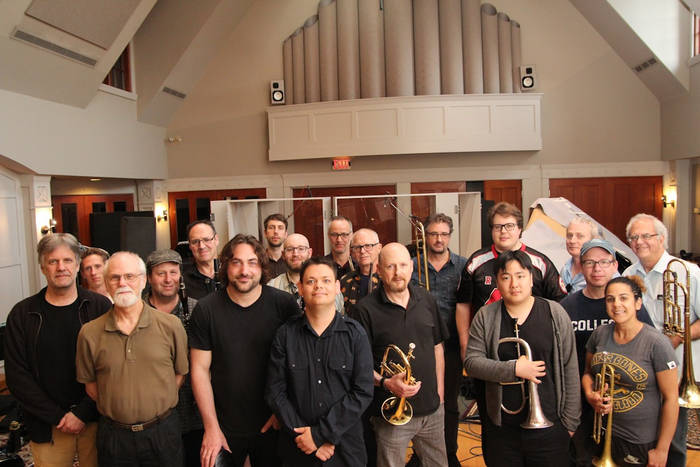
The initial sessions for "Exuberance" took place in August of 2018 but due to numerous complications and the pandemic, did re-commence until three years later (August '21). The project is a partnership with animation filmmaker Annie Beal (they were married in 2022) when both had fellowships to the MacDowell Colony in New Hampshire (go to https://vimeo.com/260899301 to see them at work). By then, they had created Tonal Conversations, an outlet for their creativity. The album is filled with brilliant musical conversations throughout played by an incredible 18-member band (see "personnel" below), many of them who have worked with each other on large ensemble projects. Guests include violinist Sara Caswell who has also shown up on numerous jazz and classical albums over the past few years. Conductor Mike Holober, who had produced Zuar's 2016 album, led the band for the recording sessions.
Photo: Maria Baranova
This music is quite melodic. The horn and brass sections often push the melodies forward –– they also often set the tone and mood of the music. The opening track, "In Winter Bloom", opens with with a static piano figure before the sections set the piece in motion. Their choruses set the the stage for solos from bassist Drew Gress and tenor saxophonist Jason Rigby. Listen below to "Communion", how the flutes and piccolos riuse aboe the horns to set the stage for Ms. Caswell's playing of the theme. Pianist Glenn Zaleski plays a second theme before the brass and flutes carry it forward, again opening the path for the piano solo. The violin solo that follows kicks the piece into the stratosphere as Gress and drummer Mark Ferber create a powerful thunderstorm.
Photo: Maria Baranova
One of the best aspects of this seven-song, 59-minute, program is that each song stands out on its own and as part of the overarching theme. "Simple Machines" blends the sound of Appalachian bluegrass with big band swing with Ben Kono creating a powerful tenor sax solo over a funky beat followed several minutes by a short fiddle hoedown (shades of Aaron Copland). That leads into a delightful mandolin spot from guest Joe Brent followed by a rollicking solo from Ms. Caswell. The episodic "Before Dawn" opens with a thunderstorm but, as the "day" breaks, the music becomes more tranquil. Guitarist Pete McCann creates a long, flowing, solo over the rhythm section until the horns and brass enter which then kicks his sound and attack into overdrive with drummer Ferber with him all the way through. One hears the storm fading as ther song closes.
Vocalist Emma Frank joins the Orchestra for the final track, the song that gives the album its title. The delightful love songs, lyrics by Ms. Beal, talks about how we all need to be nice, even as storms swirl around us as well as inside us. Ms. Frank flows along with the melody with the brass in unison behind her. The ensemble kicks into a higher gear for a hard-hitting alto sax solo courtesy of Dave Pietro followed by a fascinating trumpet spot from Scott Wendholt that actually starts on the powerful side, stays there for several minutes then slows down to reintroduce Ms. Frank to sing "Will you dance with me?/ Will you guide through the crowded floor?/ I will dance with you". The piece rides out on a wordless vocal over the whispering ensemble, a gentle finish to a splendid piece of music and entire album.
Exuberance is defined as "thequality of being full of energy, excitement, and cheerfulness". "Exuberance", the album from the Christopher Zuar Orchestra, is all that and much more, downright joyous. Christopher Zuar is becoming one of the finest composers and arrangers of this time and the future bodes ever-so-well!
Composer, arranger, trumpeter, and educator Daniel Hersog seemingly burst onto the jazz scene with the release of his debut Large Ensemble album "Night Devoid of Stars" (Cellar Music). Of course, nobody just appears on the "scene"––Hersog, a native of Victoria, British Columbia, is a graduate of the New England Conservatory of Music in Boston, MA, and, as a trumpeter, has played throughout North America with artists such as drummer Terry Clarke, trumpeter Brad Turner, the Vancouver Legacy Jazz Orchestra, and the Jaelem Bhate Orchestra (with whom he recorded two albums). Hersog is currently on the faculty of Capilano University in Vancouver, BC, where he is an Academic Coordinator and Instructor in the Jazz Studies Program plus leads a trumpet ensemble.
Now, the second album from the Daniel Hersog Jazz Orchestra has dropped. "Open Spaces: Folk Songs Reimagined" (Cellar Music) states its mission in the title. The majority of the pieces come from traditional musics of Canada and the United States interspersed with pieces by Gordon Lightfoot and Bob Dylan plus several Hersog originals. The ensemble (listed below) is composed of musicians from both countries as well as classmates (Noah Preminger and Kim Cass) and instructors (Frank Carlberg and Brad Turner), many of whom appear on the first CD. The addition of reed master Scott Robinson and guitarist Kurt Rosenwinkel gives Hersog a bigger palette to work with and he does so liberally. The 10-song program opens with the late Mr. Lightfoot's "Wreck of the Edmund Fitzgerald"––Preminger's hard-edged tenor solo represents the blowing winds and Carlberg's piano the roiling waves while Dan Weiss's drums are the sound of the boat splitting apart. That's followed by a rousing coda leading into Hersog's imaginative take on Bob Dylan's "Blowin' In the Wind". Titled "How Many Roads", there's a flowing guitar solo over the responsive reeds and supportive brass. The reeds and brass play a "call-and-response" with the piano before Carlberg digs into his solo over the rough and tumble bass and drums.
After a stately introduction, "Shenandoah" becomes a beautiful ballad featuring an amazing baritone sax solo from Scott Robinson. Heartfelt, emotional, melodic, the listener is transported out of the crazy world by the stunning and brilliant arrangement that supports him (kudos to Carlberg as well) and the simple yet generous melody. Robinson returns to the spotlight on "Rentrer" but not until after Cass's lovely solo bass introduction and Carlberg plays the rambling theme which, in turn, leads into Rosenwinkel's short but sweet solo. Robinson's baritone solo goes deep and then swoops to the higher register of the big instrument. The final two minutes of the piece features the sections swirling around the guitar, rising like the murmuration of starlings before the the abstract finish.
Photo: Robert Iannone
Other highlights include the playful "I Hear", a piece that opens with the ensemble "barking" at other until Weiss falls into an up-tempo rhythm for a hard-edged tenor solo before the tempo changes abruptly into a Fellini soundtrack interspersed with a swing beat for Ben Kono's fine clarinet spot. The longest track on the album (11:10), the playful tune makes room for a sharp and humorous romp for trumpeter Turner. Later in the program, the Hersog original "Sarracenia Purpurea" (named for a Pitcher Plant that grows in marshes and bogs) starts off on fire but quiets down for Robinson's baritone solo which slowly and steadily picks up in intensity as the rhythm section pushes him to dig in. Soon, the brass and reeds begin to color behind him before everyone frolics around the drums as the music arrives at its rousing finish.
The album closes with a sweet reading of "Red River Valley" (for all its connections to Cowboy movies, the song actually was composed in Canada during the 1870s). After a pretty introduction, Rosenwinkel's guitar joins the brass and reeds to play the theme. After a second verse and a striking variation played by the Orchestra, the guitarist plays the melody once more and then plays his striking solo. Even sweeter, the entire ensemble sings two choruses before the ensemble plays the melody before the lovely crescendo that ends the piece and the album.
You will hear the influences of many large ensemble arrangers and composers in the music of the Daniel Hersog Jazz Orchestra but the leader's vision plus eloquent arrangements for this ensemble are clear and truly his own. "Open Spaces: Folk Songs Reimagined" grew out of the composer/arranger's need to move his music forward after a successful debut as well as to adapt to the changes in his life (teaching and marriage). There are interpretations of beauty and breaths of humor (and occasional chaos) throughout the album; the music flourishes on the collective work of this fine group of instrumentalists. Do sit and listen––the rewards are abounding!