Violinist, composer, arranger, and educator Sam Bardfeld, a native of New York City, is comfortable in many different settings. He can play "free jazz", country music, folk, blues, swing jazz, Latin, and more. He's worked with The Jazz Passengers, with Anthony Braxton's Trillium Orchestra, Vince Giordano's Nighthawks, Steven Bernstein's Millennium Orchestra, and Bruce Springsteen (and so many more). His first album as a leader, "Taxidermy", came out in 1999 on CIMP Records; since then, his albums have appeared on Fresh Sounds New Talent (2004) and BJU Records (2017).
Now, BJU has issued "Refuge". The album finds the leader in a musical conversation with pianist Jacob Sacks and drummer Michael Sarin (who's now appeared on three of his four releases). The seven-song program features five originals plus one each from Andrew Hill (the title track) and Mr. Springsteen ("Atlantic City"). The music is, at turns, playful, swinging, jazzy, noisy, rhythmic, lyrical and, believe me, never overstays its welcome. Whether it's the funky dancing drums underneath the violin solo on "On the Seat of Which" or Sacks' Monk-like piano on the opening "It Might Not Work" or the bluesy cake-walk strut of "Kick Me", this trio keeps the listener tapping toes, snapping fingers, and being by surprised by what's next. The trio shines on "Atlantic City" (listen below) giving it the sonic of a Tom Waits ballad––yet one can not miss the heartbreak and emotion in the violin lines. The wistful piano lines and the soft brush work (although note the depth of the bass drum) beneath the soaring violin solo helps to soften the tension.
The album closes with a rousing version of the classic Andrew Hill tune (from his brilliant 1964 Blue Note Lp "Point of Departure"––the trio version here is slower and one hear the influence of Julius Hemphill's "The Hard Blues" on the arrangement. Sack's far-ranging solo stands out as does Sarin's hard-edged drum work. Near the end of the piece, Bardfeld quotes from a classic Paul Simon tune right after he imitates a police car siren. It's delightfully off-putting, funny, and poignant at the same time.
"Refuge" is an album to get lost in with songs that speak to the listener in many different ways. The musicianship of Sam Bardfeld, Jacob Sacks, and Michael Sarin is quite impressive plus the emotion they pour into these songs makes the program stand out. While the violinist is a very busy sideman, one hopes to see this Sam Bardfeld Trio bring this program into a concert space!
Drummer and composer Sanah Kadoura, born in the country of Lebanon and raised in Canada, has impressed many fellow musicians and listeners over the course of her young career. Since moving to New York City in the mid-2010s, she's played with pianist Kirk Lightsey, guitarist Ed Cherry, vibraphonist Joe Locke, trumpeter/pianist Nicholas Payton, the late Roy Hargrove, trumpeter Jeremy Pelt, and so many others. She's a member of the Canadian-based collective Ostara Project, whose 2022 debut album stood out for its creativity and musicianship, and self-released her first solo album "Hawk Eyes" in 2018 which featured, among others, guitarist Mark Whitfield and bassist James Genus. Ms. Kadoura writes her own music, produces her sessions, and is poised to become an important musical voice over the coming decades.
"Duality" (self-released) is Ms. Kadoura's new album and it's a winner from the opening note. Her running mates include Stacy Dillard (soprano saxophone), Virginia MacDonald (clarinet), Rachel Therrien (flugelhorn, trumpet), Michael King (acoustic piano, Rhodes, organ), Jonathan Michel (acoustic and electric basses), and vocalist Joanna Majoko plus Parham Haghighi (vocals on three tracks) and Flavio Silva (electric guitar on one cut). One of the more fascinating is how often Ms. Kadoura uses two or more "voices" to express the song's thematic material––take "The Seer, The Soarer" (listen below) and how the soprano sax, clarinet, and flugelhorn state the theme and how the solos build off Michel's funky electric bass. On the title track, notice how the different instruments move around each after Dillard states the theme. Haghighi's vocal adds a Middle-Eastern touch before the soprano sax and clarinet solo together in conversation. Then, Ms. Majoko joins Haghighi for a repetition of the theme. These textures are in contrast to each but not in conflict. The arranger is looking for textural diversity in her music.
Photo: Tieran Green
Later in the program, "Zaytoon" mines Ms. Kadoura's country of origin for a playful, dancing, intriguing, tune. The rhythm section dances below the different soloists with Dillard's soprano sax and Ms. Therrien's flugelhorn building their solos off the traditional-sounding melody. The piece closes with Haghighi chanting the melody as Ms. Majoko and the soprano "scat" behind him.
The album closes with "Rise", a contemporary r'n'b piece featuring Ms. Majoko's melismatic vocal (check out her vocal chorus overdubs) over a rock-solid drum and Michel's burbling bass lines plus the colors of the Rhodes. Again, Stacy Dillard's soprano saxophone serves as a delightful counterpoint to the vocal. at about 3/4s of the way through the tune, the band breaks into a section that sounds more like progressive rock; this features voices coming at the listener from all sides over the throbbing. It makes for a surprising ending to a consistently creative adventure.
"Duality" is filled with good, solid, well-played music, planned out enough to make each song stand on its own yet open enough to allow for impressive solo work by a top-notch ensemble. One has to believe that Sanah Kadoura knows what she wants, what she can do, and, sooner than later, that the sky may be her only limit! Give a listen, a close listen!
Ernesto Cervini is a multi-faceted person; not only does he play drums, piano, and clarinet but he also arranges, composes, is a publicist for numerous Canadian artists plus he teaches. And, apparently is an avid reader. His sister Amy (she of Duchess trio and solo albums) recommended he read the books of Louise Penny, the Canadian author best known for her series of mystery novels featuring the detective inspector Armand Gamache where much of the action is set in the fictional village of Three Pines, Quebec. Each one of the characters is finely drawn, their stories are often riveting, and the hero, while somewhat flawed, is wise and quite intelligent.
Cervini, the composer, was much taken by the series (up to 18 books now with the November 2022 publication of "A World of Curiosities") and decided to put his impressions into music. The result, "Joy" (TPR Music), is a fascinating melting pot of styles as the drummer creates portraits of the major characters utilizing 16 musician and vocalists (see the list below), some of who only appear on one tracks, others as many as seven. The programs ranges from the impressionistic opening track, "Three Pines", a work that features three vocalists and atmospheric guitar over acoustic bass and drums to the slow blues of "Myrna" that features the smoky tenor saxophone of Kelly Jefferson and the fine acoustic bass of Artie Roth. Pianist Adrian Farrugia, bassist Dan Fortin, and Cervini shine on "Sandalwood and Rosewater" (if one gets close to Gamache, that's what they smell). Then there's the quirky blues of "Ruth's Rosa" (Ruth is a poet, Rosa is her profane duck), a tune on which clarinetist Virginia Macdonald plays the former and trumpeter Jim Lewis the latter while Cervini creates clatter underneath their call-and-response. Even more fun is the "hot" swing of "Surprised by Joy" (listen below) with its thematic bow to Keith Jarrett's "The Windup" and smashing solos by Farrugia and Jefferson!
Photo: Justin Van Leeuwen
There are two solo performances in the program. First is "Clara", a villager who is an artist and she is aurally "painted" by alto saxophonist Tara Davidson and the second is Farrugia's solo piano portrait of the artist's husband "Peter Morrow". These characters have a troubled relationship and one can hear a touch of dissonance in their musical portraits. In another portrait, Cervini's lively brush work supports Ms. Davidson and her husband, trombonist William Carn, as they create a genial portrait of "Oliver & Gabri", the owners of the village's Bistro and Bed & Breakfast.
If you haven't read the books, you should still seek out "Joy"; the music is lively, heartwarming, tender, swinging, mysterious, and filled with fine melodies and great performances. Ernesto Cervini, who is a fine drummer, shows off his "composerly" side and it works like a charm. As a fan of Ms. Penny's book series, I'm delighted with this excellent collection of portraits of characters I've come to admire and look forward to reading about!
Felicity Williams , Emilie-Claire Barlow, Amy Cervini, Alex Samaras - Vocals,
Virginia MacDonald – Clarinet, Tara Davidson – Alto Saxophone, Luis Deniz – Alto Saxophone, Kelly Jefferson - Tenor, Soprano Saxophones,
Jim Lewis – Trumpet, William Carn – Trombone,
Adrean Farrugia – Piano,
Don Scott – Guitar,
Dan Fortin - Acoustic Bass, Artie Roth - Acoustic Bass, Rich Brown - Electric Bass,
EC – Drums, compositions, arrangements
Drummer-composer Mark Guiliana wears many hats as a musician including leader, sideman, composer, arranger, and collaborator. He's worked with David Bowie, Brad Mehldau, Dave Douglas, Donny McCaslin, Lionel Loueke, and Gretchen Parlato among others. Over the course of nine albums as a leader, he's integrated electronics with acoustic music, created dance music , and played straight-ahead jazz. His 10th album, and first for Edition Records, is "The Sound of Listening" and features his "jazz" quartet composed of Shai Maestro (piano, mellotron, ampli-celeste, Fender Rhodes), Jason Rigby (tenor saxophone, clarinet, bass clarinet, flute), and Chris Morrissey (acoustic bass) while the leader not only plays drums and composed all the pieces but also contributes synths, percussion, and drum programming.
Guiliana the composer asks the listener to look inside him-or-herself and to really think and feel how music can move you, can make you a better person, and even heal you. The program opens with "A Path To Bliss", a lovely ballad introduced by Maestro's acoustic piano and electronics; slowly but surely, the bass and tenor sax enter and the melody continues to rise until Rigby plays a short solo on bass clarinet. The layers of reeds and keys soon are underpinned by Guiliana dancing over the drums and cymbals. That powerful piece leads to "The Most Important Question" which opens on a tenor and a bass pedal point. The piano joins the melody before the bassist steps out for a short statement. The music speeds up but keeps fluctuating to different voices in the lead. The intensity draws the listener in as do the insistent rhythms.
Photo: John Watson
Interspersed amidst the 10 songs are four shorter compositions, two of which are fully "electronic" pieces, the longest (2:37) being the title track. One of the other short works, "A Way of Looking", blends acoustic and electronic sounds yet it's the handsome melody that catches your ears. One of the other "shorties", "Practicing Silence", has a loping bass line played on piano while Maestro and Morrissey play the gentle yet compelling melody.
The program closes with "Continuation", an African-inspired work that builds off of shaken percussion and prepared piano (that sounds like kalimba). All the members of the group get to play the melody, the sensuous phrases snaking over the galloping rhythms. All of a sudden, Maestro's piano steps out front (the solo sounds overdubbed)––Rigby comes back to state the melody before everyone drops out and the percussion takes the piece and the album to its conclusion. What remains in your mind is just how joyful a piece of music you just heard.
"The Sound of Listening" draws you in on its blend of rhythm, melody, and emotions. Mark Guiliana and company mix it up and keeps one's interest throughout. Dig in and really listen!
Trumpeter Diego Urcola (born in Buenos Aires, Argentina) and alto saxophonist/ clarinetist Paquito D'Rivera (born in Havana, Cuba) have been friends and musician partners forever three decades. Besides performing in Guillermo Klein y Los Guachos and with pianist Enrico Pieranunzi, Urcola has been in several of his friend's touring ensembles and has recorded with him several times. Urcola was invited to a South American festival several years ago to present a tribute to Gerry Mulligan's classic quartet with trumpeter Chet Baker: he immediately call D'Rivera and the seeds for the recording below were planted and have now come to fruition.
"El Duelo" (Paquito Records/ Sunnyside Records) is credited to the Diego Urcola Quartet featuring Paqutio D'Rivera. The rhythm section features the excellent drummer Eric Doob (Ryan Keberle's Catharsis) and young New Zealand-born bassist Hamish Smith (Terraza 7 Big Band). The 15-track, 77-minute, program features three original pieces by the trumpeter p,us works from the likes of Thelonious Monk, Guillermo Klein, Gerry Mulligan, Wayne Shorter, Dizzy Gillespie, and others. What you hear from the opening song, the title track (composed by Klein–listen below), is a band having the best of times over the course of two days at Bacque Recording Studios in New Jersey. Listen to how the rhythm section challenges the front line, how Urcola and D'Rivera mesh their sounds then try to outdo each other when soloing.
Photo: Jimmy Balkavicius
There is so much good stuff to hear here. The lively Ornette Coleman classic "Una May Bonita" opens with Smith strumming his bass before the band enters. Doob's delightful drumming more than nods to the playing of the late Ed Blackwell while D'Rivera's playful sets the pace for Urcola's powerful spot. The trumpeter (pictured left) switches to flugelhorn for the lovely "I Know, Don't Know How"–with D'Rivera on clarinet, the quartet sashays forth. Urcola's muted trumpet plays the melody on Astor Piazzolla's emotionally rich "Libertango". D'Rivera first enters playing percussive counterpoint before the trumpeter creates an impressive solo. Smith introduces Kenny Wheeler's "Foxy Trot" with a fine unaccompanied: when the rest of the band, the music jumps
The program ends on a high note with three jazz "standards, Dizzy's "Con Alma", Benny Golson's "Stablemates", and Mr. Monk's "Bye-Ya." The first track is taken a brisk pace with robust solos from the front line while Mr. Golson's piece dances in like a Latin ballad but a quick one. More flugelhorn and clarinet playing give the piece a robust feel. The final tune brings the album full circle with the quartet hitting on all cylinders. D'Rivera's alto solo is a treat––he plays with the energy of a person 50 years younger but the wisdom of an elder statesman.
"El Duelo" s a true delight. The energy level never flags, the rhythm section pushes both Diego Urcola and Paquito D'Rivera with fire knowing the good friends are more than up to the challenge. And the slower pieces, such as Willy Gonzalez's lovely "Pekin", have an airy feeling. I can picture producer Luis Bacque trying to choose the tracks for the album and giving up as each of the 15 cuts is with listening to time and again. Open the windows, turn up the music, and smile!
In a time when new artists are struggling even harder to be heard, one comes across an album that captures your attention and won't let go. Drummer Raphaël Pannier, born and raised in Paris, France, came to the United States as an 18-year old to study at the Berklee College of Music in Boston, MA, where he came into contact with Terri Lyne Carrington, Ralph Peterson, Jr., Dave Samuels and many others. Upon graduation, he met and toured with pianist Emil Afrasiyab who was leading a group that played a fusion of jazz and the traditional music of Azerbaijan. In 2015, Pannier continued his studies at the Manhattan School of Musisc studying with drummerJohn Riley as well as doing independent studies withsaxophonist Mark Turner and trumpeter Alex Sipiagin. The drummer has earned several awards while performing with saxophonist Steve Wilson, pianist Bob James, guitarist Lage Lund, bassist François Moutin, and pianistAaron Goldberg.
The last two musicians listed above appear on Pannier's debut as a leader "Faune" (French Paradox). Joining them is alto saxophonist/ music director Miguel Zenón and, on three tracks, classical pianist Giorgi Mikadze (who hails from Tilibisi, Republic of Georgia, and whose music bends classical, folk and jazz). The album opens with Ornette Coleman's classic "Lonely Woman", a song that has been recorded hundreds, if not thousands of times. It's a treat to hear Zenón's richly emotive reading of the theme but pay attention to where the four musicians take the music (listen below). This is what creative musicians do: they listen to each, suggest different directions, feeding each others imaginations so that a tune as often-recorded as this, sounds fresh and makes you want to bathe in its creativity time and again.
Photo: JB Milot
The three "classical" pieces include Messiaen's "Le Baiser de l'Enfant Jesus", Ravel's "Forlane", and Pannier's "Monkey Puzzle Tree". Each piece has its own pleasure. Messiaen's composition is simply gorgeous. The trio of Zenón, Mikadze, and Pannier caress the melody, the drummer skipping from cymbal to cymbal and onto the kit as the pianist supports the saxophonist's handsome phrasing. Zenón sits out the Ravel piece while Moutin is added to the mix as well as the presence of electronic effects (on the piano)––the bassist is wonderfully melodic, often playing the melody alongside the pianist. The drummer's original piece closes the album (with sax, bass, and piano). The impressionistic melody dances forward until Pannier introduces a dancing beat and Zenón solos over the quartet.
There's much more music on "Faune" including a rousing performance of Wayne Shorter's "ESP"––Goldberg's exciting intro sets the pace for the quartet but what initially stands out is how introspective the saxophonist and pianist sound in the thematic section while the rhythm section dances underneath them. Goldberg's subsequent solo is a gem while Zenón is so delightfully playful it should make you smile.
Raphaël Pannier does not use his debut album as a leader to show what a great soloist he is. Instead he creates an ensemble–the Raphaël Pannier Quartet–and, with the help of Miguel Zenón and the contributions of the talented musical partners, the music sings with originality, creativity, and joy.
Coming to jazz through John Coltrane, Miles Davis, and Dave Brubeck, I did not realize the import of organ trios until doing a deep dive into Jimmy Smith, Jimmy McGriff, Richard "Groove" Holmes, and others in the mid-1970s. One can understand the influence of gospel music on jazz when he hears a Hammond B-3 organ swelling its way through changes.
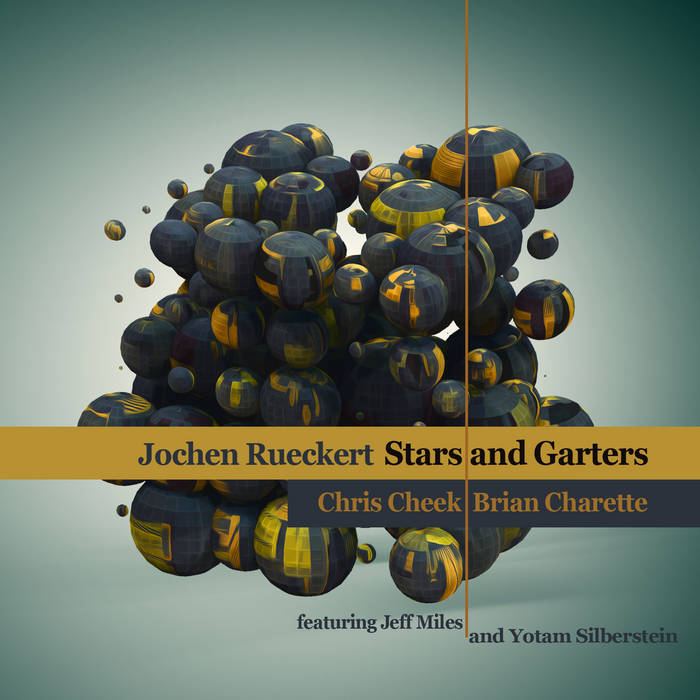
Drummer, composer, and devilish wit Jochen Rueckert has assembled a small group for his latest album "Stars and Garters" (self-released). The basic band is drums, tenor saxophone (Chris Cheek), and organ (Brian Charette) with guest guitarists Jeff Miles (on three tracks) and Yotam Silberstein (on two tracks)
The 11-song program has its share of swingers, rockers, and ballads. Opening with the easy-grooving "Corey and Trevor" and then moving right into "Finger Finger", one might expect the album to be a late-night set at a downtown bar. Cheek plays with controlled abandon in the style of Hank Mobley, especially on the latter track. Silberstein joins the trio and bounces along atop the dancing drums. Next the band (with Miles on guitar) rips into "Mind Parasite", a tune by Ryan Power –– it's a rip-roaring rocker that, at high volume, shakes the speakers to their core. Of course, the next track, "Radioland", is a quiet, Latin-esque, medium-tempo treat with soft burbling organ, delight drumming on the toms, and a pleasing tenor solo.
The title track brings one right back to the 1950s and 60s organ trio. Charette keeps a steady bass line –– when he solos, he and Rueckert have a swinging interaction. They don't rush, don't settle for cliches, they just play. In another unexpected move, the trio (plus Miles) interprets The Deftones' 1997 tune "My Own Summer", keeping the melody and chord structure but toning does the punk-rock mayhem save for the hard-edged guitar sounds.
"Stars and Garters" closes with one more cover. "Cannonball" was a hit in the mid-1990s for The Breeders; The trio (plus Silberstein) capture the nervous quality of the original yet also make the piece swing like mad. Even if you don't know the original, this version is a lot of f-u-n! And we all need a big dose of that these days...actually, just about any time. Hats to Jochen Rueckert and his gang who knocked the album out in a couple of hours just this past March 5, before the world went into lockdown.
Drummer Phil Haynes (pictured left) can be heard in a number of different groups, several of which he leads. His saxophone trio with Dave Liebman as well as a duo with the NEA Jazz Master, Free Country (his radical and fascinating interpretations of Country songs), organ trios, and more plus solo drum programs, all point to a person for whom borders are meant to be crossed if not ignored all together. Haynes also performs in a piano trio with bassist Drew Gress and pianist Steve Rudolph, an ensemble for whom melody and improvisation, swing and flow, are of the utmost important.
In 2009, the trio recorded its debut album under the three musicians names with the title "Day Dream". That's now their collective name and their second album, "Originals" (CornerStore Jazz), is just that; 10 new compositions, four by Rudolph and three each by Gress and Haynes. The music and performances are reminiscent of the work of Bill Evans, Fred Hersch, and Frank Kimbrough. What stands out is both the musicianship and the lyricism –– you can hum these melodies but the joy of the music is hearing how the trio interacts. Solos grow intelligently out of the melody, easily flowing from composition to improvisation and back. If you take your time to listen deeply, each song stands out.
There's the Evans-esque beauty of Rudolph's "Wedding Waltz" (listen to how Gress underlines the melody and Haynes color with his cymbals) as well as Gress's mysterious, hypnotic, "Afterwards" with its ascending then descending bass line over a steady 4/4 beat. One of Haynes's three contributions, "Spell", opens with a swinging brushes solo, dramatic piano chords as well as a bluesy bass line. Gress goes right through the melody into his solo and an impressive one it is. He dances atop the funky rhythm turning the spotlight over to Rudolph who gets in the groove and does not let it go! The drummer also composed "Beloved Refracted" (listen below), a melody built on a two-handed piano theme and powerful interaction between Rudolph and Gress.
"Originals" closes with the bassist's "Let Fly", a bopping tune with both a bluesy feel and a delightful swing. Day Dream will not put you to sleep –– instead, it's an album that you can listen to in one sitting and then listen again. Steve Rudolph, Drew Gress, and Phil Haynes are a trio of equals and the music they create together is powerful, music with a heart!
Here's a taste:
Photo: Peter Gasnnushkin
Drummer, composer, and bandleader Chad Taylor (on the left) may be best-known as the co-founder (with trumpeter Rob Mazurek) of the Chicago Underground Duo. The Arizona native grew up in Chicago where he worked with Fred Anderson, Nicole Mitchell, Matana Roberts, Ken Vandermark, and so many others. Currently, he's working in a duo setting with saxophonist James Brandon Lewis, in guitarist Marc Ribot's ensemble, with trumpeter Jaime Branch, saxophonist Avram Fefer, bass clarinetist Jason Stein, and others. He's issued three albums under his own name including 2018's solo percussion album "Myths and Morals" (my review here).
Photo: Paul de Lucena
The drummer has a new trio that bears his name, featuring tenor saxophonist Brian Settles (Tomas Fujiwara, Michael Formanek, Jonathan Finlayson) and pianist Neil Podgurski (Tim Warfied, Captain Black Big Band). The trio has just released its debut album, "The Daily Biological" (Cuneiform Records) –– Taylor has known his bandmates since the 1990s but they did not coalesce as an ensemble until several years ago. Taylor had moved to Philadelphia four or five years back after splitting time between Chicago and New York City. The pianist has lived in Philly for over two decades while Settles has moved back to his native Washington D.C. so the band is not too far apart.
The album, composed of all originals pieces by the trio members, is startling, music that verges on "free" yet there are times when the beat is so powerful it feels as if the drums could knock you off your feet. The opening track, "The Shepherd", roars out of the gate driven by Taylor's conversational drums, Settles' powerful tenor (he's the composer), and Podgurski's thunderous attack. Because the drums are so well-miked and up front in the mix and the pianist has such a strong left hand, one does not miss a bassist. Depending on your speakers, the bass drum thump is quite noticeable. The pianist's "Resistance" starts quietly, the piano chords and crisp cymbal sound leading to Settles and Podgurski reading the theme. Settles stays with the poignant theme while the pianist takes a powerful solo with Taylor ramping up the intensity. The trio calls down for just a second when the saxophonist begins his solo but soon he's being pushed by the drums and insistent piano.
Photo: Paul de Lucena
There is so much to enjoy in the hour+ recording. "Birds, Leaves, Wind, Trees" is a delightfully impressionistic piece from Podgurski with the trio taking parts throughout. Settles and Taylor argue like two birds fighting over a crust of bread, then Podguski joins with his notes dropping like rain on the leaves. "Swamp" kicks butt in the opening moments, stopping for an unaccompanied tenor solo that blends longer lines with fluttering notes and silence. The pianist takes over, engaging in a rapid-fire dialogue with Taylor that builds in intensity until the composer Settles returns to join the pianist in the bass line while the drummer solos through to the fade.
Photo: Paul de Lucena
The final two tracks, penned by Taylor, include the thunderous "Recife", which opens with a muscular drum solo over a repetitive figure by the sax and piano. Then the pianist takes over for a short statement and Settles gets the final minute through to the fade. The program ends with the longest track, the 12-minute "Between Sound and Silence" –– the drummer has the opening minute to himself before Settles jumps in followed shortly by Podgurski. The piano lines have a nervous feel prodded by the drums as the saxophonist struts and frets atop them. The music quiets down, Podgurski's searching piano lines move the piece forward, heading towards silence, supported only by a distant rumble of floor toms. When the saxophonist returns, he plays a gentle, gospel-influenced melody, over the tolling piano. Taylor returns, his drumming raising the intensity level but not pushing the emotions to the background. The tolling piano continues while Settles searching and Taylor's shimmering cymbal create a stunning final 30 seconds.
"The Daily Biological", if you listen deeply, will change your idea of "power trios." No over-amped guitars, fuzzy bass lines, no ponderous drums; instead, this is music teeming with ideas, interactions, inventive solos, intelligent writing, and more. Such an auspicious recorded debut for the Chad Taylor Trio that one can just imagine how great they must sound in a live setting. In the meantime, find this album and let the music play. Play it loud!!
Composer, arranger, and pianist Emilio Solla was born and raised in Argentina, has lived and worked in cities such as Buenos Aires, Barcelona, Spain, and, in 2006, relocated to New York City. He's has composed works for small ensembles, for symphony orchestras, and has worked with artists such as Paquito D'Rivera, Arturo O'Farrill, and Edmar Castañeda. Like many of his contemporaries, Solla's music has been influenced by Astor Piazzaolla but his travels have added many different layers to his music. His earlier albums came out on Fresh Sound New Talent; since 2014, he's been issuing his own recordings on his Avantango Records labels.
Solla's latest audio adventure is the first by his 17-piece Tango Jazz Orchestra. Titled "Puertos: Music From International Waters", the eight original compositions pay tribute to port cities around the world. They ranges from the dancing tribute to Havana, Cuba ("Sol La, al Sol" - to La Habana) to New York City ("Four For Miles") to the suave yet exciting "Chacafrik" (in honor of Benguela, Angola). Just about all the music is built from the drums up (kudos to Ferenc Nemeth for his creative contributions) and the section arrangements really favor long passages with fine harmonies and counterpoint. Pay attention to how Solla moves the different sections through melodies; an excellent example is "Andan Luces" (to Cádiz) where the melody lines are played by the piano, reeds, and accordion. The various solos jump off from the melodies – in the middle of the piece, the rhythm section gets to shine with solos from bassist Pablo Aslan and a long one from the leader.
The lovely ballad "La Novena" (to Buenos Aires) has a gentle, swaying, tango rhythm played by the piano and bass (Nemeth is quiet the first two minutes) while the melody is shared by soprano and baritone saxophones. The flute accompaniment rises above the soloist while the horns sit below; that leads into a fine solo from Labro (on bandoneon). That track is followed by "Buenos Aires Blues" but the rocking, hard-hitting, piece is actually dedicated to New Orleans, LA. Each one of the soloists gets a different feel beneath his solo; the rhythm section is somewhat below Noah Bless's trombone spot but picks up the intensity when trumpeter Alex Norris steps forward. After the sax section plays a boppish section, baritonist Terry Goss takes over and the music calms down. It's Aslan's bowed bass supporting Labro's delightful accordion solo. Piano and drums return while Labro dances on. Nemeth takes the piece back to the intro and on to the end.
Edmar Castaneda's harp leads the way on "Allegrón" (to Cartagena) sharing the lead lines with the soprano saxophone of Alejandro Aviles. The harpist's duet with Franco Pinna (bombo legüero) is highly rhythmical – note the interactions of the sections that lead the way to the splendid soprano solo.
"Puertos: Music From International Waters" shimmers with excitement, both melodic and rhythmical, as well as beauty. The songs that Emilio Solla created for the Tango Jazz Orchestra (several that have been recorded in smaller ensembles) have room for each musician to shine and for the arrangements that pique the listener's interest and make you return time and again. Do listen and listen closely – this album is definitely worth your time!
Alejandro Aviles: soprano and alto saxophones, flutes;
Todd Bashore: flutes and clarinet;
Tim Armacost: tenor saxophone, alto flute and clarinet;
John Ellis: tenor saxophone, soprano saxophone, clarinet and flute;
Terry Goss: baritone saxophone and bass clarinet;
Alex Norris: trumpet and flugelhorn;
Jim Seeley: trumpet and flugelhorn;
Jonathan Powell: trumpet and flugelhorn;
Noah Bless: trombone;
Mike Fahie: trombone;
Eric Miller: trombone;
James Rodgers: bass trombone;
Julien Labro: bandoneon and accordion;
Emilio Solla: piano and conducting;
Pablo Aslan: bass;
Ferenc Nemeth: drums.
Guests –
Samuel Torres: congas (“So La Al Sol”);
Arturo Prendez: percussion & Arturo O’Farrill: piano (“Llegara, Llegara, Llegara”);
Franco Pinna: bombo legüero & Edmar Castañeda: harp (“Allegron”).
Here's a track for your listening pleasure:
Two of the producers for Solla's album plus the one below are Kahbir Sehgal and Paul Averginos – they certainly have great ears!
Photo: Warren Le Fever
Joe McCarthy, drummer, educator, and band leader, organized the New York Afro Bop Alliance Big Band when he moved to the Big Apple in 2008. He has taught at schools around the United States plus played with the several ensembles associated with the United States Naval Academy Band. A graduate of the University of North Texas (famed for its large ensembles), McCarthy worked with numerous artists including Paquito D'Rivera, Slide Hampton, Arturo O'Farrill, and Linda May Han Oh. He's also published a book/DVD called "Joe McCarthy Afro Cuban Big Band Play-Along Series" that is used by several different University music programs.
The New York Alliance Afro Bop Big Band issued its debut album in 2008 on Heads Up Records with guest Dave Samuels (vibraphone, marimba) – at that time, the ensemble was known as the Afro Bop Alliance. They added "Big Band" to the name on the ensemble's 2016 release "Revelations" that came out on McCarthy's own label. ZOHO Records is the home of album #3 titled, simply "Upwards" and now they've added "New York" to the name. A glance below at the personnel and you'll see that the band is made up of first-call NYC musicians. The rhythm section is anchored by the leader, bassist Boris Kozlov (on electric much of the album), pianist Manuel Valera (who provided the two of the songs and several of the arrangements), and master percussionist Samuel Torres. It is noticeable from the start that those four musicians who set the band in motion.
Listen below to "Caravan." Torres and McCarthy create a dynamic opening in a call-and-response that sets the table for the delightful take on the Juan Tizol - Duke Ellington classic. If the rhythms don't move you, the excellent solos and intelligent arrangement will have you moving your feet. The band has great fun with Valera's arrangement of John Lewis's "Afternoon in Paris", the percussion pushing the band as they put a bop feel on the Latin rhythms.
As Torres and McCarthy dig into a heady groove, Valera's "Isabelita" has a lovely melody with excellent section writing. Strong solos from the composer, Kozlov, and trumpeter Dave Smith push the piece forward. "Five for Elvin", composed by vibraphonist Samuels for the large ensemble's first album, is a tour-de-force, effortlessly changing speeds and tempos, with more fine section work plus percussion that really moves along with Valera's dancing piano riffs.
The album closes with guitarist Vinny Valentino's emotional ballad "Positano." Note how the brass and horns provide a sweet cushion for the melody and the guitar solo that follows. Tenor saxophonist Ben Kono raises the intensity with a powerful yet still melodic solo followed by Kozlov's excellent acoustic bass solo. "Upwards" is proof that when you give excellent musicians strong material and fine arrangements, they can make music that sings, soars, caresses, and, yes, dances. Check out The New York Afro Bop Alliance Big Band – the name is quite a mouthful but the music is mighty tasty!
Saxophones: Matt Hong, Kristy Norter, Ben Kono, Dave Riekenberg, Eden Bareket
Trombones: Sara Jacovino, John Yao, Sam Blakeslee, Jen Hinkle
Trumpets: Nick Marchione, Raul Agraz, Bryan Davis, Dave Smith
Manuel Valera (piano) Vinny Valentino (guitar) Boris Kozlov (acoustic & electric bass)
Samuel Torres (percussion) Joe McCarthy (drums, leader) Here's "Caravan":
Pianist, composer, and arranger Satoko Fujii first convened the Orchestra New York in 1996. At that time, the ensemble contained 15 members including the pianist. For 2017's stunning "Fukushima", the group was pared down to 13 and Ms. Fujii replaced her piano with the guitar of Nels Cline. The 2020 edition welcomes back original member saxophonist Briggan Kraus and subtracts trombonist Joey Sellers (also an original member). What is always present on the Orchestra NY's recordings is the sense of adventure, the sounds that range from quiet contemplation to roaring madness but never collapsing into total anarchy.
The ONY's 11th release, "Entity" (Libra Records), features five originals from Ms. Fujii ranging in length from 10:08 to 16:17. The composer's style has always brought together disparate sounds composed for strengths of the individual members while achieving an often startling group sound. Ms. Fujii's pieces often feel like short stories, conversational, off-hand, more about the sound than the rhythm. That said, it's the chattering drums of Ches Smith that opens the album on the title song. Listen to how she paints around his solo, how the "skronky" sound of Nels Cline is the perfect accompaniment as Smith dances around the cymbals. The brass and reeds make quick appearances over the first four minutes, pushing and shouting at the guitar and drums until Smith kicks the piece into a funky beat picking up speed. That lasts less than a minute before the drummer and guitarist go off on another conversational jag – when their comrades come back in, the music picks up speed again and Cline goes dashing/squalling off over the roar. It all stops save for one trombone then both trombones moving around each other in slow motion. Yet, there's more; the trumpets, guitar, bass, and drums reenter then the reeds and the music explodes again, a roaring tenor saxophone attempting to be heard over the din.
"Flashback" opens with the entire ensemble at full volume (save for Cline who roars in and out), the brass and reeds sharing the theme for the first several minutes – then, the noise stops and is replaced by quiet sounds from muted trumpet and burbling bass. The group moves in and out of the picture, getting loud, then dropping back to two voices interacting. On first listen, one does not know what to expect. When you return to the music, you listen for how the different elements speak to the overall direction of the music. Yet, stop trying to make sense and just let the sounds enter you. For the first two pieces, that's not an easy experience – most listeners want order, logic, when they listen. Here, you have to create that order. The emotions are certainly here, you'll find them.
Photo: Peter Gannushkin
"Gounkaiku" is the album's longest track, a splendid sonic tour-de-force with a poetic opening section, fascinating interactions, strong solos, amazing work from bassist Stomu Takeishi and drummer Smith, with excellent section writing and execution. Like the other tracks, the song is episodic, moving from sections to full band to quiet sounds, to noise. Cline and Takeishi's guitar/ bass guitar noises and Smith's active percussion drive the final few minutes with separate voices stepping forward from the brass and reeds.
Photo: Bryan Murray
"Entity" invites the listener to dig in, to listen as Satoko Fujii moves the different pieces of her Orchestra New York through the mazes and open fields of the music. The various voices are often heard in duo, trio, quartet, settings, then full ensemble. Solos rise over and flit under the sections or stand alone. Written material and improvisation move effortlessly together, spin apart, come together again throughout the program. Iridescent melodies, such as the opening moments of the final track "Everlasting", collide with meanderings of different soloists, keeping the listener off-guard time and again. Like the world we all live, this music takes the beauty of a sunrise and mixes it with the chaos of human experiences, creating a musical experience that resonates long after the sounds have evaporated.

 Posts
Posts