30-plus years into a fascinating career, one is still impressed by the music Dave Douglas composes, records, and performs. When you think that trumpeter, educator, Greenleaf Music head, podcast host, festival coordinator, and so forth, is most comfortable in one of the various quintets he leads (or co-leads, in the case of Sound Prints), he'll record a solo trumpet album ("Hudson Solos") or work with an ensemble made up of students from Australia's Monash University ("The Dream: Monash Sessions") or record hard rock funk music for listening to during demonstrations with bassist Melvin Gibbs, guitarist Rhafiq Batia, and drummer Sim Cain ("Marching Music")––that's just in the last 24 months.
The trumpeter's new album, "Secular Psalms", is a 10-song program inspired by "The Adoration of the Mystic Lamb", painted between 1420-1432 and hung in Sgt. Bavo's Cathedral in Ghent, Belgium. Douglas initiated the project before the pandemic shut down the world, choosing a band (six members in all) from Europe and the United States; artists include Berlinde Deman (tuba, serpent, voice), Marta Warelis (piano, prepared piano, pump organ), Frederik Leroux (guitars, lute, electronics), Lander Gyselinck (drums, electronics), Tomeka Reid (cello), and the leader on trumpet and background vocals. The blend of tuba or serpent (a wooden brass instrument!) with amplified guitar, cello, trumpet, the various keyboards, and voice is fascinating. While the music is inspired by 14th Century composers, there is a 21st Century "avant-garde" as well as 1960s-70s "prog-rock" feel (if there was a flute, this music could easily be linked to Jethro Tull (check out "Agnus Dei" and see if you agree).
Photo: Gemma Vander Hayden
You understand you are in a different musical right from the opening seconds of "Arrival". The trumpet melody is supported by electronic sounds, cello, and the guitar with Ms. Deman's serpent playing a quiet counterpoint. The drone created by cello and serpent carries the piece as does the subtle drive of the drums. "Mercy" jumps forward with the trumpet and cello on the melody––the lyrics blend Marvin Gaye's "Mercy Mercy", "Kyrie Eleison", and a short phrase penned by Douglas. Leroux's funky, raunchy, guitar solo offsets the solemnity of the lyrics as does Ms. Reid far-ranging cello work. If you listen closely to the vocals, you can hear Douglas shadowing Ms. Deman's voice.
Photo: Johan Jacobs
If you listen closely, not only are Ms. Deman's vocals important to the sound but so are her tuba and serpent contributions (that's her on the left). Listen to how she and Ms. Reid join with Gyserlinck to create a rhythmic flow on "Instrumental Angels" and how her counterpoint enlivens "Hermits and Pilgrims". Her soulful vocal on "If I'm In Church More Often Now", based on lyrics composed by Christine de Pasan (1364-1430?), makes the poet's sentiment contemporary as we now see many people looking for answers from their spiritual leaders in these often-scary times. Douglas's original "Edge of Night" closes the album, the lyrics speaking to how music can heal, can serve to push us forward, all the while the drone created by the pump organ, the cello, and the lute takes on a chant-like feel. Leroux switches to electric, joining the trumpet, cello, percussion, and serpent in accentuating the closing lyrics "Making this music, will help us to heal/ Even as the world continues to reel/ We laugh/ We dance/ We love/ We pray/ Even as we mourn."
"Secular Psalms" is a stunning album, all the more so because all the parts were recorded remotely at different times, then edited and remixed by Tyler McDermid and Dave Douglas. The album stands out in the trumpeter's oeuvre not only because it's an amazing collection of music and performances but also because like 2012's "Be Still" and 2015's all-instrumental "Fabliaux", the songs, messages, and instrumental experimentation gives the listener deep insight into the trumpeter's inner life. Listen and be moved!
Saxophonist and composer Trish Clowes (pronounced "clues") hails from Shrewsbury, Shropshire, England. At the age of 19, she moved to London to study at the Royal Academy of Music. Seven years later (in 2010), Ms. Clowes issued her debut album "Tangent" on Basho Records––an ambitious project for sextet and, on two tracks, a full orchestra with vocalist. Two years later, not only did she release her second album as a leader ("And In the Night-Time, She Is There") which featured her touring quintet with a string quintet and guests, the saxophonist was named a BBC Radio 3 New Generation Artist. The BBC commissioned Ms. Clowes to compose for their Concert Orchestra which garnered her a British Composer Award in 2015. That piece of music can be heard on her third Basho release, 2014's "Pocket Compass", her first full album with her Quintet with three tracks featuring the BBC Concert Orchestra. Over the next few years, Ms. Clowes kept herself quite busy with many different commissions and projects including "Emulsion", a fascinating improvised music "happening" that continues to this day.
Photo: Brian Homer
In 2016, the saxophonist created MY IRIS, a quartet that features two members of her Quintet, guitarist Chris Montague and drummer James Maddren, plus pianist/ organist Ross Stanley. The bass-less ensemble's self-titled album was issued on Basho in early 2017 followed two years later by "90 Degrees Gravity" (also on Basho). The quartet was hoping to record in April of 2020 but the pandemic put that project on hold. Ms. Clowes did self-release "MY IRIS Live!", a digital-only album through Bandcamp in 2020, a "low-fi" six-track set from an October 2019 live date.
The group finally got into the studio at the end of August 2021 and the results of their efforts can be heard on "A View With a Room", Ms. Clowes debut for Greenleaf Music. Still working with MY IRIS, many of the saxophonist's eight original pieces were composed during the world's lockdown. One can hear a restlessness, an urgency, in several of the songs such as the funky title track and the driving "No Idea". The first track has such a "poppy" feel (note the bouncing piano line and dancing drums). The leader's solo is a joyful romp which leads right into pianist Stanley's spirited and playful spotlight. Montague steps out next and he makes a more intense statement and the band picks up on that fieriness. Ms. Clowes kicks off "No Idea" in musical conversation with drummer Maddren––notice how the piece then breaks into separate conversations (guitar with just drums before the piano reenters followed by sax, piano, drums, and quiet guitar).
"Amber" is dedicated to Amber Bauer, CEO of Donate4Refugees, a London-based charity that Ms. Clowes works as an ambassador––if the charity's head is an energetic as this music, she'll do well. The rhythm and main melody suggests Steely Dan (circa "Aja") and the band makes the most of the r'n'b swing of the piece. Guitarist Montague stands out on "Time", his Country-ish riffs reminiscent of Bill Frisell while there's a touch of Bruce Hornsby in Stanley's spot. The lovely ballad "Morning Song" is muted like the hour before daybreak, the handsome melody opening to a classically-inspired piano solo. The short yet hushed tenor solo makes way for a powerful guitar statement and the set of fascinating chord changes before the close.
The program closes with "Almost". The piece opens rubato, scurrying brushes on snare, scattered piano chords, atmospheric guitar phrases, and disjointed saxophones phrase that slowly take shape into a lilting ballad. Nobody rushes but the song seems to grow more soulful as Ms. Clowes rides the guitar chords and the piano glissandos forward. A shift in direction so that the guitarist can push the song forward and, as the intensity builds, the leader's soprano sax rises up above the rhythm section for a moment, like a colorful bird riding the thermals. Stunning, stirring, a momentary burst of pure joy.
Trish Clowes may be a new name to US audiences but do check out her music and, especially her work with MY IRIS. "A View With a Room" feels like a musical balm, creating a sense of joy in the midst of complicated and often dangerous world––do spend time soaking in these sounds!
I first became aware of Australian-born saxophonist Angela Davis back in 2013. At that time, she was studying for her Masters of Music at the University of the Arts in Philadelphia, PA. That was also the year Ms. Davis self-released her debut album, "The Art of the Melody". Two years later, her second album, "Lady Luck", featured the saxophonist alongside pianist Dan Tepfer, bassist Linda May Han Oh (who was also on the debut album, drummer Richie Barshay, and a string quartet. Ms. Davis moved back home, to Melbourne, where she serves as a lecturer at both University of Melbourne and Monash University. She's married to trumpeter Mat Jodrell and they have a son, Max. Since returning home, she's released one album, "Little Did They Know", for ABC Jazz, the label of the Australian Broadcasting Corporation.
Ms. Davis's fourth album is the result of a Commission from the ABC Fresh Start Fund. "Suite for Max" (ABC Jazz) is dedicated to her son born right before the pandemic. The five-movement, 36-minute, "Suite" features the saxophonist's "working" quartet including guitarist Stephen Magnusson, bassist Frank De Sario, and drummer Patrick Danao. The opening "Movement" bears the influence of the Joe Lovano/ Bill Frisell/ Paul Motian trio, especially in floating rhythmic feel and Magnusson's guitar tone. Max's father, Mat Jodrell, shows on the next track and his addition charges the album's atmosphere with Danao being more aggressive without overwhelming the music. The leader's takes the first and most lyrical of the solos. The guitarist also creates a fine solo with his rippling phrases swooping and diving about the interactive rhythm section.
"Movement 4" opens like a quiet lullaby, Ms. Davis's gentle tenor leading the way. The handsome and fully-realized gives way to short solos then to the guitar and saxophone dancing around each other and landing back at the melody. Bassist De Sario provides the counterpoint while the drummer moves from his cymbals back to a solid beat as the music draws to a close. A tender guitar melody serves as a prologue on "Movement 5" which takes its lively feel from the engaging. Ms. Davis's playing, at times, has a feathery feel as she was a leaf dancing on an Autumn breeze. Magnusson lets loose on his solo without jacking up his volume, making the most of the dancing rhythms of the bass and drums. The saxophonist leads the band through a melodic coda, reminiscent of the way Keith Jarrett led his American Quartet (there's Paul Motian again) on their mid-70s albums.
"Suite for Max" won't shake your world but that's not its purpose. The music that Angela Davis composed for this project is the result of her watching her son begin to move, begin to claim his own space in the world, all the while wide-eyed at wonders all around. Ms. Davis rarely plays on the fiery side; instead, she gravitates towards the melodic side of music. Listen to this music at the break of dawn or at the close of the day; it's such pleasant company!
Tenor saxophonist and composer Melissa Aldana, born and raised in Santiago, Chile, first played the saxophone when she was six years old with her musician father as her teacher. Her musical life was accelerated upon meeting pianist Danilo Pérez who invited her to play at The Panama Jazz Festival. From there, she auditioned for was admitted to the Berklee College of Music in Boston, MA. After graduation she recorded her first albums for Greg Osby's Inner Circle Music (2010 and 2012) -in 2013, Ms. Aldana became the first South American person to win the Thelonious Monk Jazz Saxophone Competition. Her third album, released on Concord Jazz in 2014, and fourth, released in 2016 on WOMMusic, both featured her Crash Trio comprised of bassist Pablo Menares with drummers Francisco Mela (2014) and Jochen Rueckert (2016).
Her fifth album as a leader, "Visions", finds her on the Motema Music label. Menares is still with her but now the ensemble is expanded to a quartet featuring Sam Harris (piano, Rhodes) and drummer Tommy Crane with special guest Joel Ross (vibraphone) on eight of the 11 tracks. The addition of Harris obviously fills the sound out and also opens up Ms. Aldana's compositions to new possibilities. The title song, composed with Frida Kahlo in mind, features powerful piano chords (a la McCoy Tyner and Fabian Almazan) which give the music depth and, really, unlimited range. On first impressions, this music may remind you of Miguel Zenon's Quartet in the way the musicians interact, how Crane and Menares give the music such space and breathing room yet are also an integral part of the melodic development. Hear the duo shine on the ballad "Abre Tus Ojos" and then how they drive the band on the next track "Elsewhere." On the latter track, the bass line suggests "A Love Supreme" but the propulsive drive from the drums and piano moves the music in other directions.
Photo: Anna Yatskevich
The music is also quite dramatic. On "Dos Casas Un Puente" and "The Search", the group takes its tie setting up the melody and them playing its way through the head before opening up to solos. It's fun to hear both Ross and Ms. Aladana ride the percussive drive on the latter track snd how the vibraphonist sets up the former tune's attractive melody line (playing in unison with the saxophonist). The bassist's "Perdon" is a handsome ballad with fine harmonic flourishes from Harris. The other piece not composed by the leader is "Never Let Me Go" - composed by Ray Evans and Jay Livingston for the long forgotten movie "The Scarlet Hour" (1956 - Nat "King" Cole" played the song in the movie). It's a sweet ballad with a lovely unaccompanied opening from Ms. Aldana as well as a handsome piano solo.
Photo: Harrison Weinstein
"Visions" is a mature statement from Melissa Aldana who has, over the past decade, grown steadily as a musician and composer. She has moved past the influences of her father, of teachers Joe Lovano, Bill Pierce, and George Coleman into her own voice. And, the fact that she works with this band on a regular basis is a big plus. Five of these songs appear on a live recording made in late August in Santiago, Chile (available on iTunes and Amazon.com) - it's a quartet date (Joel Ross is not on the album) and it's fascinating to compare the songs (there's really not much difference only that the songs are longer on the live date and Harris's contributions stand out even more). All told, "Visions" is an album to savor, to play all the way through because the stories that Ms. Aldana and her group tell are so involving! Also, dig the great cover art from Cecile McLorin Salvant.
Alexa Tarantino, who plays alto and soprano saxophones plus flutes, is a graduate of the prestigious jazz program at Hall High School in West Hartford CT, and graduated from both the Eastman School of Music (Rochester, NY) and the Juilliard School (NYC). She's worked and recorded with drummer Sherrie Maricle's DIVA Orchestra plus with Arturo O'Farrill's Afro-Latin Jazz Orchestra, and with Cecile McLorin Salvant's OGRESSE. She leads her own Quartet and is co-leader of LSAT (with baritone saxophonist Lauren Sevian).
2018 was a very busy year of recording for Ms. Taratino resulting in three releases in the first five months of 2019. "Winds of Change" is her debut as a leader for Posi-Tone Records. With the splendid rhythm section of Christian Sands (piano), Joe Martin (bass), and Rudy Royston (plus trombonist Nick Finzer on three tracks), she glides, soars, and dances her way through 10 tracks, eight of which are originals. Listen to the band swing on "Breeze" (complete with a sweet alto sax solo) and set the speakers on fire with the infectious "Face Value." She's generous with the solos, making sure that Sands, who is a delight throughout, gets the spotlight on numerous occasions (his far-ranging statement on "Undercurrent" is a real treat).
Photo: Anna Yatskevich
Ms. Tarantino plays with authority and assurance throughout - she is certainly ready to be a leader. The alto flute is featured on Antonio Carlos Jobim's "Zingaro" - note how softly the rhythm section plays yet still moves the song forward (excellent counterpoint from bassist Martin). The ensemble roars with delight on "Ready or Not", a hard bop original played at breakneck speed. She matches Sands's incredible solo with a very statement of her own - notice how she interacts with both the pianist and Royston plus leaves plenty of room for Finzer to raise his own ruckus. On the appropriately titled "Calm", she creates a handsome melody for her alto and for the echoing trombone. It's fun to hear her weave the melodic lines together. Check out what the rhythm section is playing under both the trombone and alto solo, how they push the music a bit "out"when Ms. Tarantino reenters and raising the ante for her solo, truly disrupting the "calm." The album closes with "Without"; the song opens as a duo for alto and piano before the rhythm section tiptoes in. There's just a hint of Johnny Hodges in the alto sound, not surprising as the tune also resembles Billy Strayhorn's "Blood Count." Yet, the final minute of the song leads the listener in a much different direction.
Photo: Steven Sussman
"Winds of Change" is a powerful debut for young Alexa Tarantino (26 as of the writing). No telling where her journey will take the composer and instrumentalist but it should be fun to hear. Great choice of sidemen on this date as each brings such great strength and creativity; they make each song "sing" in its own fashion. That written, Ms. Tarantino gives them some excellent material to work with! A pleasure to sit down and spend time with, "Winds of Change" is worth your attention.
Here are the two "collective" albums Alexa Tarantino was part of for Positive-Tone Records.
Posi-Tone co-owner and producer Marc Free put Ms. Tarantino together with trombonist Finzer and drummer Royston for the June 2018 recording session that resulted in "Maximum Enjoyment." Filling out the sextet - named Something Blue - are tenor saxophonist Sam Dillon (whose Posi-Tone debut was issued in early May of this year), pianist Art Hirahira, and bassist Boris Kozlov. The ensemble plays five originals from its members plus seven other tunes from the label's stable of artists. Opening with Behn Gillece's "Slick", the music hits hard with good solos all around. Other Posi-Tone artists represented here are guitarist Amanda Monaco ("Coppertone"), saxophonist Jacam Manricks (the appropriately titled "Cluster Funk"), bassist Peter Brendler ("Stunts and Twists", a bluesy ballad, no less), and saxophonist Travis Sullivan (the hard-hitting album closer "New Directions").
Photo: Sara Pettinella
Pianist Art Hirahara contributes two excellent songs to the album including the handsome "Aoi Blue." The blend of the saxophonists with trombone suggests Art Blakey's Jazz Messengers with Curtis Fuller but note the fie percussion work from Royston (pictured left). Ms. Tarantino's "Breeze" (which she also plays on her debut) has a bluesy feel, especially in the loping rhythms and opens to feature solos from the composer, Finzer, and the pianist. The fine mid-tempo ballad "Shift" serves as a spotlight for its composer, tenor saxophonist Dillon. The excellent rhythm section work is such a pleasure to hear as is Hirahara's expansive yet short solo. "Why Aren't You Excited", from the trombonist, is actually more introspective than one might expect from the title. Fine work all around from the band and the soloists.
"Maximum Enjoyment" reveals the fine talent that Posi-Tone Records and producer Marc Free has been able to cultivate over the past decade (Rudy Royston and Boris Kozlov appear on large number of the label's releases not to forget the composers whose work is recorded here). Something Blue certainly refers to the many times Blue Note Records made Lps featuring their sterling lineup of artists in the late 1950s and throughout the 60s. Smart concept and good exposure for both the artists and the label - give it a whirl.
Here's one of the two Behn Gillece pieces:
The day after Alexa Tarantino recorded her debut, she went into Brooklyn NY's Acoustic Recording studio with a sextet created by guitarist Amanda Monaco. Lioness came together during a monthly concert series in Flushing NY that the guitarist curates. Producer Marc Free suggested she put together a group of women musicians, baritone player Lauren Sevian suggested the name, and the sextet was formed. Featuring the three instrumentalists mentioned above, tenor saxophonist Jenny Hill, organist Akiko Tsuruga, and drummer Allison Miller fill out the group. Note the absence of a bassist - Ms. Tsuruga, who has previously recorded with drummer Jeff Hamilton and worked alongside Lou Donaldson plus saxophonist Ralph LaLama and trumpeter Joe Magnarelli, is a classic Hammond B-3 player, meaning that her feet supply the solid foundation.
Photo: Enid Hill
All six members contributed songs to their debut "Pride and Joy" released in March on Posi-Tone Records. The rhythm section - guitar, organ, and drums - gives the music a different and, to these ears , quite inviting, feel. On pieces such as Carla Bley's classic "Ida Lupino", their work allows the alto of Ms. Taratino to solo freely. Really, it's Allison Miller's funky, danceable, "Mad Time" that opens the album and sets the mood. Then there's the Caribbean feel that permeates Ms. Hill's "Sunny Day Pal" - note the delightful bounce under the guitar solo and the New Orleans drumming under the three saxes as they restate the theme.
Add caption
Ms. Monaco takes centerstage as the reed players sit out on the sweet reading of the late Emily Remler's "Mocha Spice." The gentle drumming of Ms. Miller and supportive organ work makes this piece a highlight. There's a short and highly funk reading of Aretha's "Think", hearken back to the days of Booker T. & The MGs and The Bar-Kays. Ms. Tsuruga's aptly titled "Funky Girl" provides a bluesy finish to the album plus a number of delightful low notes for Ms. Sevian. She also gets the first solo and sets the stage for Ms. Tarantino and Ms. Hill to dig in. The guitarist and the composer both get the spots and make the most of it.
"Pride and Joy" is suffused with excellent musicianship and is a whole lot of fun, especially if you play the album at higher volume. Not sure if Lioness will stay together in its present form as its members are so busy as leaders and side persons. Nevertheless, this is a delightful recording.
Here's the first cut - try not to dance, I dare you!
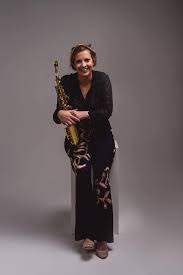
Photo: Michelle Grace Hunder
Alto saxophonist, educator, and composer Angela Davis came to the United States from her native Australia a decade ago to study. She stayed for six years, recording and self-releasing both her debut album "The Art of the Melody" and its followup, "Lady Luck." Both albums featured her quartet (with bassist and fellow Australian Linda May Han Oh); the second one also included a string section arranged by pianist Dan Tepfer.
She moved home a few years ago and is now a Lecturer of Jazz at the James Morrison Academy of Music at Univ. of SA. And, Ms. Davis now has a new album. "Little Did They Know" (ABC Music). FeaturingpianistTony Gould and bassist Sam Anning, the eight-song program features four originals and a song each from Charlie Haden, Bill Frisell, Sammy Fain, and George Frederic Handel. The song choices lean more to ballads - even Fain's "Love is a Many Splendored Thing" (fromthe 1955 movie of the sane name) starts with Gould playing a lovelyunaccompanied reading with variations of the theme. When Ms. Davis and Anning enter, the pace picks right up and the music takes on a light-hearted feeling highly by the sweet sounds of the alto sax (one can hear a bit of Paul Desmond in the leader's tones). Ms. Davis's "Circuit for Three" is more up-tempo - the excellent melodic line is followed by strong solos from Gould and Anning.
Photo: Hayley Miro
Haden's "Our Spanish Love Song", which the late bassist composed for his duo recording with Pat Metheny, has a handsome memory inferred by the composer's love of Iberian music. The sympathetic nature of the trio's interactions really make this song move forward while pulling you into the emotional power of the melody. Later in the program, Ms. Davis's "Hymn for Haden" celebrates the person and his love for traditional music. Anning's simple yet powerful counterpoint to Gould's sparkling solo is a highlight of this track and actually occurs throughout. Ms. Davis's "The Light Between Us" also feels like a hymn with its classic melody line, the soft chords, and the sweet singing alto sax sound.
Photo: Hayley Miro
"Little Did They Know" is a melodic gem, music to start the day (if the windows are open in Spring and Summer, the songs of the birds often fit in) and to close the evening. It's fitting that the program closes with Handel's aria "Lascio Ch'io Pianga"; the quiet melody, the short saxophone solo that takes its lead from the many singers who have performed the piece, and the gentle piano accompaniment, all combine to bring hope in a new day. Angela Davis lives, breathes, and cherishes melody; the listener is the beneficiary of her love.

 Posts
Posts