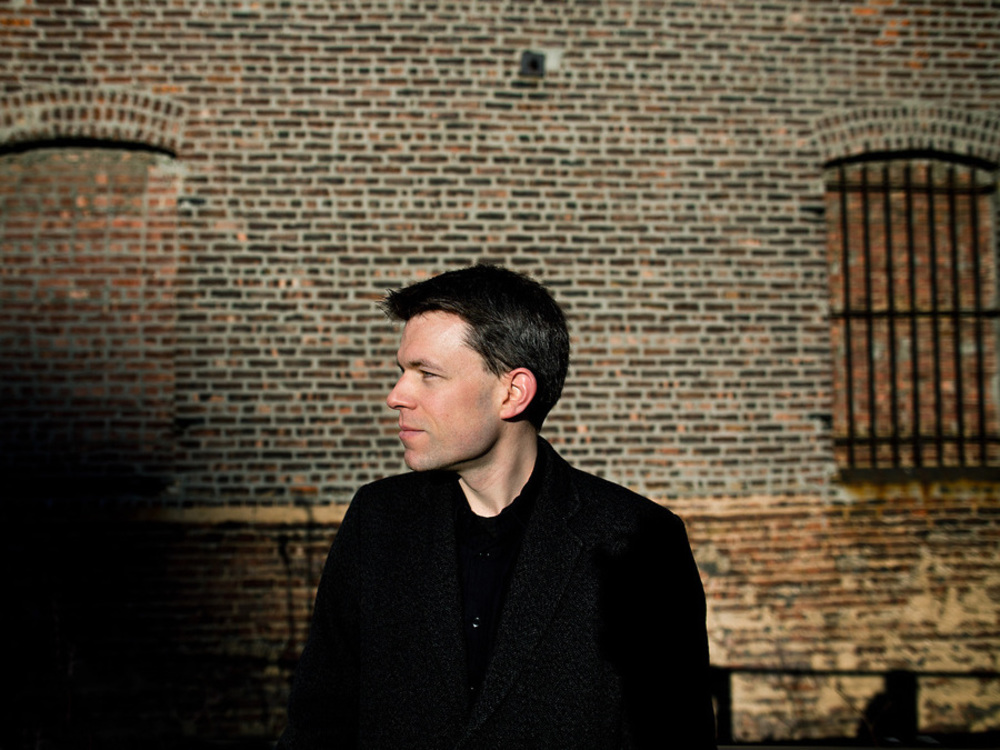
While visiting family in Chicago last month (6/21), I took the opportunity to meet (on separate occasions) with musicians Sam Pilnick (pictured left) and Shawn Maxwell. Both are saxophonists and composers with Pilnick just beginning his career and Maxwell twenty+ years into his (my next post will feature his two new releases). The younger musician teaches middle-school Band in a Chicago suburb and has been performing with various ensembles since moving to the city four years ago. One of those groups is the Sam Pilnick Nonet Project featuring himself on tenor saxophone and eight of his close musical friends. He composes pieces that play to each member's strength and his debut recording is a fine example of that
"The Adler Suite" (Outside In Music) started its life when the composer served as a chaperone on a school trip to the Adler Planetarium in Chicago. Not only was Pilnick impressed by the architecture (see photo below) but was fascinated by the many displays that spoke of man's quest to discover what's beyond the sky. Each time he returned to the Planetarium, Pilnick would take notes and begin composing themes about different aspects of exploration. The first three solo trumpet notes of the opening track, "Squawk Box", leads one to believe that the piece is a rewrite of Richard Strauss's "Also Sprach Zarathustra"; the piece soon moves into a harmonic adventure that invites in the nonet. The composer-arranger uses variations on those three notes throughout the first several minutes before a short bowed bass solo opens the music up to the reeds, brass, and piano creating musical universe. Pianist Meghan Stahl creates an introspective solo that is fllwed by an excellent bass clarinet solo from Ted Hogarth. In case you wondered, the title of the piece comes from the apparatus NASA would place in an astronaut's home so the family could hear the communications between those in outer space and Mission Control.
The Adler Planetarium
The Nonet then jumps into "Star Launch", a bebop-inspired romp that features a saxophone conversation between Max Bessesen (alto) and the leader's tenor. The interaction of two stars revolving around each other until they merge is the basis of "Revolving Twins" – you'll hear how the sections move around each other, how the rhythm section push them together and pull apart. "House of the Massives (Pismis-24)" rocks from the opening notes and is based on a photograph of a star system and the amazing colors one sees. The music also reflects the composer's love of rock music yet listen to how he moves the reeds and brass around each other. Powerful solos from Bessesen, guitarist Ben Cruz, and the leader give even more urgency to the music.
The album closes with "Expanding Universe" which feeds into "Falling Backwards". The first track has no set tempo but moves forward on the rich section work with Bessesen's alto leading the way. The intensity builds (thanks to drummer Matthew Smalligan) until it is broken by the eerie guitar scratches, bowed bass, and Pilnick's tenor playing the melody line until silence; then, the piano, bass, and drums set a driving rhythm for the latter piece which is based on the space capsule's reentry into Earth's atmosphere and gravity. The tenor solo over a changing rhythmic landscape highlights the various emotions one must feel coming home. Trombonist Euan Edmonds strong solo statement over the horns and thunderous rhythm section echoes the final, fiery, descent before the parachutes open and the capsule splashes into the ocean.
"The Adler Suite" is a delight-filled debut from Sam Pilnick. This labor of love is highly personal yet resonates with those who dream of seeing stars, traveling to other planets, and exploring the vast universe. The Nonet plays with verve and emotion, sharing the composer's Planetarium dreams. Listen with open ears and open mind; you'll find this journey quite exciting!
Nine years have passed since I last heard the music of pianist Ari Erev. Born, raised, and still living in Israel, he's been studying and playing jazz since the age of 17. He's worked alongside many Israeli musicians including bassist Tal Ronen, percussionist Gilad Dobrecky, and vocalist Ayelet Rose Gottlieb (now living in Canada). He's also recorded with saxophonists Joel Frahm and Yuval Cohen (brother of Anat and trumpeter Avishai). In addition to his Trio work, his Nocturno quartet explores the music of Central and South America as well as Cuba. Erev has recorded five albums as a leader, the latest being "Close to Home" (self-released).
Instead of celebrating exploring outer space or new worlds on this planet, composer' pianist writes about the places and people he loves, about his community, celebrating life in the midst of continuous strife. Joining Erev is bassist Assaf Hakimi and drummer Gasper Bertoncelj plus guests Yuval Cohen (soprano sax on five tracks), Hadar Noiberg (flute on two tracks), and Gilad Dobrecky (percussion on eight tracks). The 73+ minute program features nine originals plus one piece each by Keith Jarrett, Antonio Carlos Jobim, Israeli rock star Efraim Shamir, Brazilian composer/ conductor Debora Gurgel, and Paul Simon. The album opens with the leader's "Israeli Story", an uptempo samba featuring Ms. Noiberg's lyrical flute work. Dobrecky and Bertoncelj combine with the bassist to create a bouncy rhythm for the soloists to play upon. There is a similar feel to the following track "Playground" although this time it's Cohen's delightful soprano sax leading the way.
Photo: Gangi N all that jazz
Ms. Gurgel's "Para Sempre (Forever)" also utilizes a samba on which the composer places a fine melody. Erev leads the way with a heartfelt reading of the main melody. The pianist builds his solo off the melody lines moving back and forth like watching a leaf dancing in the wind. Shamir's "Shi'ur Moledet (Homeland Class)" opens with a classically-inspired melody played only by piano and bass (excellent counterpoint) until Dobrecky joins 1/3rd of the way into the piece. Listen closely to the interaction between bass and piano as it supplies the forward motion. Ms. Hoiberg and Cohen combine to present the melody on Erev's "Afar (for Tal)" but the first solo goes to bassist full-toned acoustic bass. Then the flute and soprano improvise together, wrapping the lines around each other and occasionally moving back to the melody until the leader steps out for a finely-constructed solo.
The last three tracks begin with A C Jobim's "Olha Maria", a lovely ballad on which the pianist caresses the circular melody with just bass and percussion in support. Following that is Simon's "Still Crazy After All These Years" – the drums and percussion percolate below the piano playing the melody as the bass dances in company with Erev's left hand. The pianist, as is his style, stays close to the melody throughout his solo. He captures the bluesy quality of the original. Hakimi switches to electric bass for the final track, Erev's "Po (Here)", while Cohen's soprano is featured on the melody. He's in the higher register throughout the tune; there's a delightful piano solo that leads back to Cohen whose solo stays close to the melody. The sax and piano tease each other as the rhythm section guide them to a gentle finish.
"Close To Home" is the most personal of the albums Ari Erev has released. The leader, the rhythm section, and the guests all have reverence for melody and Brazilian rhythms so the music rarely gets noisy. Many of the songs wrap around the listener like a comfortable blanket, a hug that serves as a balm in troubled times. Some make you want to dance. All of them sound really good!
TuneTown, the trio composed of Kelly Jefferson (saxophones), Artie Roth (acoustic bass), and Ernesto Cervini (drums), first came together in 2016. Each member of the trio is busy in their native Canada and in the lower 48 states. Readers of this blog know Cervini as a tireless drummer and composer, leading or co-leading several groups (including Turbopop and Myriad 3). Jefferson studied at McGill University in Montreal and earned his Masters Degree at the Manhattan School of Music. He has played with the Vanguard Jazz Orchestra, Maria Schneider, Kenny Werner, Brian Blade and a slew of others. Roth also studied in the U.S. thanks to grants from the Canada Council and has been a busy sideman and leader for over two decades. He's issued three albums since 2005 as the leader of the Artie Roth Quartet.
Not surprisingly, the band's debut album "Here To There" (Slammin' Media) features a wide spectrum of pieces, from originals to fascinating re-arrangements of Duke Ellington's "Sophisticated Lady" and Cole Porter's "All of You." Roth's melodic bass leads the Ellington into a rubato landscapes of long tones from the tenor sax and colors splashing from the brushes and cymbals. The conversation in the rhythm section continues as Jefferson plays the lovely melody. The airiness of the music makes the music more plaintive. Meanwhile, the Porter classic gets a straight-ahead, swinging, reading with more fine brushes work and handsome counterpoint from Roth. Cervini tap-dancing drumming beneath the fine tenor solo imbues the music with a joyous feel. When the drummer switches to sticks, the music picks up steam with all three charging ahead.
There's plenty to like on the original pieces. Pieces such as Cervini's "The Monks of Oka" can play within and without the "tradition" – the piece has a bop feel and a drive from the rhythm section that feels unstoppable. There's a funky backbeat to "Split Infinity" and the interaction between Roth's throbbing, droning, bass lines and Jefferson's echo-heavy tenor sax has a mysterious feel, staying clear of cliché. Listen the playful stick work that permeates "The Mayor", a short ditty with rampaging percussion, the boisterous tenor, and melodic underpinnings from the bass that hearkens back to Trio Air and its "ragtime" deconstructions.
"Here to There" closes with the bassist's "A Transient Space" – it's a quiet ballad with numerous silences, Jefferson's soprano sax keening at times and sounding oboe-like at others, while Roth fills the bottom with melodic murmurs and Cervini's changes the rhythmic feel from time-to-time, dropping in-and-out of a flow. A blues feel creeps in 2/3rds of the way through, the volume increases, and Jefferson begins wailing. Yet, the music turns back towards the quiet side and easily comes to a close.
TuneTown has created a delightful debut recording, a 44-minute journey into the collective minds of Kelly Jefferson, Artie Roth, and Ernesto Cervini. Certainly sounds like they are having fun and there's a great possibility the avid listener will as well.
Listen to the three musicians discuss their music:
Pianist and composer Florian Hoefner was born and raised in Germany where he first began his musical studies and career – not only did he study piano but also trumpet and accordion. Upon his graduation from the University of Arts in Berlin, he received a Fulbright Scholarship which took to New York City to earn a Master of Music from the Manhattan School of Music where was a student of Jason Moran, Dave Liebman, and Garry Dial. He recorded a number of albums in Europe for ENJA Records and other labels as a member of the German quintet Subtone plus he co-led a session for Fresh Sound New Talent with Kurt Rosenwinkel. He's issued four albums in the United States including three for Origin Records, two with a quartet and a lovely solo piano. That album, "Coldwater Stories", was the first Hoefner recorded after moving to St. Johns, Newfoundland, Canada.
He has pared his group to three musicians, a trio with bassist Andrew Downing and drummer Nick Fraser. The Florian Hoefner Trio's debut album, "First Spring" (ALMA Records) is quite a blend of traditional songs associated with Hoefner's new home, three originals, two pieces composed or arranged by contemporary folksinger Sam Amidon, Byron Issac's "Calvary" (a piece discovered by the pianist when his quartet's bassist Sam Anning brought Levon Helm's "Dirt Farmer" on the road), and composer Luciano Berio's reimagining of an Armenian folk song "Loosin Yelav." That final song listed is one of the lovelier works on the album – the melody unfolds slowly as the rhythm section proceeds (on tip-toes at times). Bassist Downing creates a fine, melodic, solo statement before the pianist with an introspective spot of his own.
Photo: Bo Huang
The album opens with "Hound's Tune"; composed by legendary Newfoundland fiddler Rufus Guinchard (1889-1970), the piece opens with Downing's bowed bass playing the original melody and then moves into more "modern" territory thanks to he pianist's inventive arrangement. "The Maid on The Shore", a Scottish ballad quite popular with the inhabitants of the Atlantic Canada region. The song has quite a handsome melody which, in the hands of the trio, is opened up in the manner that John Coltrane approached "Greensleeves." There is tremendous energy and joy in the trio's interactions.
Photo: Bo Huang
Listen to how Downing and Hoefner play the melody and countermelody on "Calvary" – it's certainly melodic but just as funky. the album is filled with examples of excellent ensemble interactions. The title track, dedicated to the pianist's son and influenced by the work of the bassist Edgar Meyer, blurs the line between Americana and contemporary jazz as it's fills with various tempo changes and feels plus contains a smashing bass solo. Amidon's "Short Life" has a plaintive expressed by Downing's bowed bass (he's also a fine cellist) and the powerful piano work of Hoefner.
Photo: Mike Meyer
The album closes with the trio's interpretation of Amidon's arrangement of the traditional "Rain and Snow." The quiet opening has the feel of a snowstorm on a cold winter's night, the flakes blowing in the air (here represented by the pianist's rippling fills); soon, the music turns bluesy, the rhythm is funeral-march slow, and Hoefner's lines are filled with articulate single-note runs. Nothing is rushed and the listener gets to soak in the sounds.
"First Spring" is a delight-filled album, a program that lets the light of a Newfoundland spring shine as opposed to the more scholarly "Coldwater Stories" from 2017. Both are excellent albums. Kudos to Nick Fraser and Andrew Downing, two Canadian musicians who deserve more recognition south of the Canadian border. Florian Hoefner has found a home in Newfoundland while its countryside and people have found a home in his creative soul.
Pianist and composer Jason Yeager released his first album "Ruminations" in 2011 on Greg Osby's Inner Circle Music. He's released three since them, one a duo with saxophonist Randall Despommier and another duo album with violinist Jason Anick. He's also recorded with Ran Blake and the Ayn Inserto Jazz Orchestra plus a number of others. Yeager has performed with drummer Matt Wilson, vocalist Luciana Souza, and saxophonist George Garzone as well as many others. He teaches on the faculty of the Berklee College of Music in Boston, even while living in New York City. Currently, Yeager holds the piano chair in both Ms. Inserto's Orchestra and in La Banda Ramirez.
Album #5, "New Songs of Resistance", finds the pianist on Nick Finzer's Outside In Music and in a feisty mood. Yeager has a created a program that meshes his original music with songs from the Chilean and Brazilian protests in the 1950s, 60s and 70s (known as the "New Song Movement" plus today, pieces by Violeta Parra (1917-67), Chico Buarque, Victor Jara (1932-1973), and the contemporary duo of Leôn Gieco and Luis Gurevich. The nucleus of the band posits the pianist with the rhythm section of Fernando Huergo (electric bass) and Mark Walker (drums, percussion) – selected tracks features Milena Casado (Spain – flugelhorn), Naseem Alatrash (Palestine – cello), Matthew Stubbs (California – bass clarinet, clarinet), Cosimo Boni (Italy – trumpet) with vocalists Erini (Crete), Farayi Malek (Idaho), and Mirella Costa (Brazil).
The album opens with Ms. Parra's "Gracias a la Vida" ("Thanks to Life"), a lovely piece celebrating long life and the ability to see all facets. After Erini sings the opening verse over a slow reading pf the melody by the ensemble (plus flugelhorn, cello, and bass clarinet), the piece opens up to a faster Brazilian rhythm, another verse, then solos from Yeager, Casado, and Alatrash's cello counterpoint. Erini also interprets Pablo Neruda lyrics (music by Jara and Patricio Castillo) on "Aqui Me Quedo" ("I'll Stay Here"), a piece dedicated to the Chilean workers who fought oppression in the 1970s with references to the colonialization of the country by Spain. Ms. Malek interprets the leader's lyrics on "In Search of Truth", a musical scree against those who do not believe in Civil Rights, human rights, climate change, a free press, or empathy. The music moves from a dark melody beneath the words and fast-paced instrumental passages. There's a powerful instrumental with wordless vocals moving alongside the piano while Huergo and Walker stoke the fire.
In addition to the various vocal tracks, there are three short solo piano "Interludes" – titled "Uncovering", "Resistance", and "Factitudes", Yeager's introspections range from contemplative to foreboding to quiet wonder. One other short piece, "Protest", actually features sounds from a street protest march with the piano, bass, and drums creating a powerful rage beneath the protesters. Ms. Malek's wordless vocals join Matt Stubb's clear clarinet tones to set the stage on Yeager's "Reckoning." Everyone gets the opportunity to make statements, especially Walker with his powerful drum solo near the close of the tune. The urgency of the bass and drums at the onset of "Mother Earth" along with Yeager's melodic piano brings Leonard Bernstein to mind. Adding the clarion-call trumpet of Boni to the mix gives thematic even more power. His solo, filled with fire and emotion, is a highlight.
"New Songs of Resistance" closes with a rousing reading of Buarque's 1970 anthem "Apesar e Você" ("In Spite of You"). The lyrics thumbs its nose at the authorities. Composed after the Brazilian writer returned from a short self-imposed exile to Italy (check out the video here), the song has an irrepressible bounce to it. Ms. Costa makes the most of her sole appearance on the recording, clearly enunciating the Portuguese lyrics over the exciting rhythms. Perhaps this joyous piece that closes the album is a sign that Jason Yeager feels hope even in the teeth of the political monsters spread around the world. Listeners will enjoy the music, the voices, and the young soloists (many of whom are students at the Berklee College of Music where the pianist is on the faculty as are Fernando Huergo and Mark Walker). Exciting music that speaks to the struggles of Latin America, the United States, and the world; listen closely and pay attention.

 Posts
Posts