Showing posts with label octet music. Show all posts

Tuesday, January 12, 2021

Let's Swing In This New Year!


Photo: A Yatskevich
Posi-Tone Records co-owner and A&R man Marc Free loves music that swings, songs based on good melodies with rhythm sections that can play any style, and front-line musicians with strong voices.  Over the past several, Free has been organizing ensembles made up of musicians who record for the label plus newer artists. The material is often a blend of new and old tunes, many of which appear on other Posi-Tone albums as well as the occasional jazz "standard." Three years ago this month, the label released the first album by New Faces, a sextet featuring Roxy Coss, Josh Lawrence, Behn Gillece, Theo Hill, Peter Brendler, and Vinny Sperrazza, all of whom have issued albums on Posi-Tone.   Now Free has chosen six more musicians –– Caili O'Doherty (pictured above, piano), Brandon Lee (trumpet, flugelhorn), Markus Howell (alto saxophone, flute), Nicole Glover (tenor sax), Adi Myerson (bass), and Cory Cox (drums) –– as the new faces of the group.

"New Sounds" is this group's debut and, like its predecessor, it's a soulful romp through the world of "straight-ahead jazz."  Also like its predecessor, the band is composed of top-notch soloists. Ms. O'Doherty, whose 2015 album "Padme" was quite impressive, is a stalwart throughout.  The Israeli-native Ms. Myerson is a powerful, foundational, bassist whose solos are melodic gems.  Ms. Glover has worked with Esperanza Spalding plus recorded with pianist George Colligan, has developed into a powerful soloist while Howell, a graduate of Michigan State University (where he studied with trombonist Michael Dease), has a sweet tone on alto sax.  Brandon Lee and Cory Cox were both raised in Houston, TX; the former has taught at his alma mater (the Juilliard School) and the University of North Carolina/ Greensboro while the drummer has toured with the Dave Brubeck Quartet where he teaches private lessons and leads workshops.

Photo: A. Yatskevich
Trumpeter Lee's (pictured left) "Shades of Brown" kicks off the 10-song program.  It's a medium-tempo blues, the composer leads the saxophones in and plays the melody as the reeds harmonize.  Cox's dancing cymbals are a highlight, especially during the trumpet solo. Note how the bass and piano lock in under the alto solo; the drums and bass lock in as Ms. O'Doherty steps out. Ms. Meyerson contributes two sweet ballads. "Afloat" possesses a gentle flow and a fine melody which the trumpet and alto sax states while the tenor sax plays counterpoint.  Ms. Glover steps right into her solo followed by a generous piano turn.  The bassist (pictured below) also composed "Hold My Heart", a song that may remind some of the writing of Robbie Robertson (listen to the chords changes and the descending bass line in the verse).  


Photo: Anna Yatskevich
Other than two tunes from vibraphonist Gillece and one from bassist Brendler, the rest of the tracks are originals from the newer Faces.  Howell's rollicking "Second Wind" features a thunderous drum solo while Ms. Glover's "Blues for Tangiers" is a lowdown blues ballad; the composer creates quite a strong statement while Howell and Lee have quite a call-and-response with the tenor in the following chorus.  Ms. O'Doherty's "Runaway" is also a blues ballad, this one with overtones of Charles Mingus. The piano solo is powerful as is the trumpet spot that follows.

"New Sounds" stands out for the quality of both the compositions and the musicianship.  The first edition of New Faces did a number of live dates (ahhh...the good old nights) and one hopes to see this group in action. In the meantime, start this year on a good foot and get lost in these "New Sounds."  

To hear more and to purchase the album, go to https://newfacesjazz.bandcamp.com/.

Here's the lovely ballad "Afloat":


A strong case can be made for clarinetist and composer Phil Nimmons as "the father of Canadian Jazz." The native of British Columbia, Nimmons was born in 1923 in British Colombia and started college as a pre-Med major.  He decided to follow his passion for music to the Juilliard School in New York City and then to the Royal Conservatory of Music in Toronto, Ontario, Canada.  He formed Nimmons 'N' Nine in 1953, a group that would eventually tour throughout his native country and beyond for the next 27 years. Perhaps his most famous work, "The Atlantic Suite" (credited to Nimmons 'N' Nine Plus Six), was issued by Sackville Records in 1974, winning numerous awards. Before that, the group had recorded for RCA-Victor and Verve.  After Nimmons ended the group, he toured and recorded with small ensembles plus dedicated himself to teaching at the University of Toronto. He retired from teaching at the age of 96 and remains in good health.

His grandson Sean Nimmons (piano, Fender Rhodes) has put together an eight-member ensemble comprised of former students, colleagues, and friends of his grandfather, dubbing the octet The Nimmons Tribute.  The group's self-released debut album, "Volume I –– To The Nth", recreates songs from throughout the elder Nimmons career plus adds one piece by Sean.  What a fine band –– Kevin Turcotte (trumpet, flugelhorn), Tara Davidson (alto + soprano saxophones, clarinet), William Carn (trombone), Mike Murley (tenor saxophone), Perry White (baritone saxophone, bass clarinet), Jon Maharaj (bass), and Ethan Ardelli (drums) –– each one active on the Canadian scene.  The album was recorded during the pandemic yet the music reflects the composer and musicians belief that music is the best way to fight through the pain, boredom, and fear of the current times.

The program kicks off with "Nufsicisum" which, read back to front, is composer Nimmons philosophy on his choice of his path through life.  The easy swing of the rhythm section points to the influences of West Coast (US) Jazz with a generous hint of Duke Ellington/ Billy Strayhorn in the melodies and arrangements. "The Atlantic Suite" is represented by "Harbours", another easy swinging tune graced by the fine alto work of Ms. Davidson and grandson Sean's gentle Rhodes work. When everybody jumps in for a stroll through the verse, the ensemble sounds twice its size. Ardelli gets a fairly "hot" solo before the Rhodes solo calms down the proceedings in time for Turcotte's trumpet to begin ramping up the temperature.

Sean (pictured left) dedicates "Rista's Vista" to his grandfather; Rista is the elder Nimmons middle name. The piece jumps along thanks to the solid work of Maharaj and the fine drumming and cymbal work of Ardelli.  The lovely ballad "Holly" (composed for Nimmons daughter) opens with the melody played by White on bass clarinet. The second verse goes to Ms. Davidson's soprano sax and she yields to all the brass and reeds expanding the melody as well as the harmonies.  Ardelli's smart stick work enlivens "Sands of Time", an episodic piece that features fine solos from the pianist and Mike Murley.   

"Volume I..." closes with "Liëse", another lovely ballad that adds Drew Jurecka (violin, viola) and Lydia Munchinsly (cello) while subtracting the reeds and brass.  The music has a cinematic quality plus features solos from the pianist and bassist, a handsome way to end an album that pays tribute to a master of melody.

This "Tribute to Nimmons" is a good introduction to the music of Phil Nimmons and should lead one to explore the music he recorded over his long career. What one gets on the album project spearheaded by his grandson Sean Nimmons-Paterson is more than a testimonial; it's a reminder that this American music crosses borders with ease, capturing musicians and composers, allowing them the freedom to use myriad influences and make something new.  

For more information, go to https://www.nimmonstribute.ca/.  

To hear the album plus purchase it, go to

Monday, May 14, 2018

Henry Threadgill Always Moving Inward & Outward

Not one but two new recordings and ensembles playing the music  of Henry Threadgill have been released this month on Pi Recordings.  Aficionados of the Chicago native, Pulitzer Prize winning, composer, saxophonist, and flutist, received an early New Year's gift when "Dirt...And More Dirt" was issued online 12/31/17. It's the first recording by 14 or 15 Kestra: Agg, a 15-member ensemble that features three alto saxophonists (including the composer), two drummers, two pianists, two trumpeters, two trombonists, tuba, bass, cello, and guitar. The program consists of two suites, the six-part "Dirt" and the four-part "And More Dirt", both inspired by artworks (Walter de Maria's "Earth Room" and the sculptures of Stephen De Staebler).

The music builds off of the work of Threadgill's Zooid ensemble (cellist Christopher Hoffman, guitarist Liberty Ellman, drummer Elliot Humberto Kavee, and the stunning tuba player Jose Davila) not only with the more expansive sonic palette but with even greater dynamic variations.  If you are familiar with Threadgill's music, the pieces often have choppy rhythm parts, usually move from melody to another melody, matching disparate sounds, going in unexpected directions, and rarely concerned with solos.  In those ways, the music on these albums may remind some of the work of Lawrence "Butch" Morris (1947-2013) as well as the large ensemble writing of Muhal Richard Abrams (1930-2017).

You need to hear this music without the prejudices of a reviewer or critic. Sit down and listen, then listen again. Play it loud. Pay attention. Look at the cover image taken by long-time colleague Jules Allen. How does the music relate to the image?  Listen again and take notice of the conversations between musicians. Be open.  The music Henry Threadgill composes, arranges, and plays is unlike any other. Like Morris and Abrams, like Wadada Leo Smith, George Lewis, Nicole Mitchell, Roscoe Mitchell, all members or former members of the AACM, Threadgill's music is unique.

Personnel:
Henry Threadgill - alto saxophone, flute, bass flute
Chris Hoffman - cello
Liberty Ellman - guitar
Jose Davila - tuba
Ben Gerstein – trombone
Jacob Garchik – trombone
Jonathan Finlayson - Bb trumpet, F trumpet
Stephanie Richards –Bb trumpet
Curtis Robert Macdonald – alto saxophone
Roman Filiú - alto saxophone, alto flute
David Bryant - piano
David Virelles – piano
Thomas Morgan - bass
Elliott Humberto Kavee – drums, percussion
Craig Weinrib - drums, percussion


Take a listen:


"Double Up, Plays Double Up Plus" is the second recording by Threadgill's Ensemble Double Up, that made its debut on the 2016 Pi Recording "Old Locks and Irregular Verbs." The "Plus" on the new album refers to the fact that the group is now an octet adding a third pianist to the lineup of saxophonists Curtis MacDonald and Roman Filiú, Jose Davila (tuba), Christopher Hoffman (cello), and Craig Weinrib (drums). Vijay Iyer and David Virelles were the pianists on the first album - Virelles returns but now is joined by Luis Perdomo and David Bryant.  In the past, Threadgill rarely included piano in his music but it is fascinating to hear his he uses the instrument in the ensembles reviewed here.  Listen to "Clear and Distinct From the Other A", notice how all the voices are utilized either in duos or trios, how the piano moves in and out, in one instance making room for Virelles's harmonium and also playing a short passage with just piano and harmonium.  When the rhythm section, notice the interaction between drums, cello, and tuba - that trio's forward motion is often dizzying and pushes the various soloists to dig deeper.

Photo: Dragan Tasic
The program also features "Clear and Distinct From the Other B" which may be the same composition but approached in a different manner. Both performances open with solo piano and then different combinations of musicians create fascinating interactions. There is more focus on the piano on "B" with several moments of powerful solo playing.

This two cuts are followed by "Clear and Distinct" - again, the piece opens with a solo voice and here it is Davila's stunning tuba playing (includes several moments of multiphonics). One by one, other instruments enter and the focus shifts to a long piano statement. In fact, all three pianists solo and support each other on this track. Again, the rhythm section shines. The interaction of tuba and cello (especially Hoffman plucks the strings) is a treat to listen to.

Pulitzer.org
What stands out for this listener is how playful this music is. Not that the music isn't "serious" but Threadgill has composed melodies and created arrangements that open up to allow the ensemble the freedom to move. Solos abound as do "groups-within-the-group" interactions (listen to "Game is Up" below) and, because these musicians have a great understanding of what the composer needs of and from them, the results are so pleasing.

"Double Up, Plays Double Up Plus" has elements of the music that Henry Threadgill has created for nearly five decades. And, the addition of piano has opened up the aural landscape even more for a composer who continues to create compelling music on so many levels.

For more information, go to www.henrythreadgill.com.

Wednesday, March 7, 2018

Masters At Play & Eight Makes Great (Music)

Perfect listening for a snowy March day in central Connecticut,
"Live at U of T" (UofT Jazz) is the second CD led by the saxophone duo of Dave Liebman (soprano, tenor, flute) and Mike Murley (tenor, soprano). The former has been on the faculty at the University of Toronto as a visiting artist/adjunct Professor since 2013 while the latter has been teaching there since 2011.  Joining them is bassist Jim Vivian (who has worked with both leaders in the past, especially with Murley for over three decades) and the veteran drummer Terry Clarke (John Handy, the Fifth Dimension, Rob McConnell Boss Brass).  The quartet sounds loose and limber, each musician playing with great fire and joy.
The program includes four compositions by Liebman, two by Murley, one by Vivian, Joe Lovano's "Blackwell's Message", and a smashing cover of Ziggy Elman's "And the Angels Sing" (which was first recorded by its composer as a Klezmer-style tune in the mid-1930s before he adapted it for the Benny Goodman Big Band and Johnny Mercer added lyrics).  The quartet swings the heck of the Elman, with the two tenors trading leads and and then "trading 4's".  The rhythm section really pushes the proceedings, something they do throughout the album.

Among the highlights is "Small One", a ballad/waltz composed by Liebman where both he and Murley play soprano sax.  Both create excellent solos over the easy-going rhythm section. Listen to how they intertwine the melody and harmony of the theme section.  The two sopranos play sans rhythm section on Liebman's "Missing Persons", a piece that has the feel of a modern classical composition (yet the timbre of the sopranos and direction of the music reminds this listener of the song "Fertility" from the "Buster Bee" album on Sackville by Julius Hemphill and Oliver Lake.)  There's a sense of the mysterious in Murley's "Open Spaces", starting with the flute sounds of Liebman.  When the tenor saxophones enter, one hears the influence of John Coltrane.

"Blackwell's Message", a piece that Joe Lovano wrote in tribute to drummer Ed Blackwell, opens with a delightful drum solo by Clarke. He then falls into a New Orleans "strut" over which the soprano and tenor saxes play the plaintive melody.  Dig how Vivian creates a drone then plays in and round the pedal point.  Both Liebman and Murley create powerful solos with the drummer pushing them forward with such glee.

"Live at U of T" is a treat for those listeners who like to listen "deeply" to music.  The Liebman/Murley Quartet plays with fire, grace, intelligence, a sense of the past and present of music, and with great joy.   You should listen.

For more information, go to mikemurley.com/2017/11/new-liebmanmurley-recording-now-available-on-itunes/.

Here's the Elman/Mercer tune:


Mike Murley and Terry Clarke show up again as members of the Dave Young/Terry Promane Octet, the ensemble that has just issued "Octet: Vol. 2" on Modica Music.  Bassist Young is a veteran of the Toronto music scene, having worked in the early 1960s with guitarist Lenny Breau plus a 35 year association with pianist Oscar Peterson.  Trombonist Promane has played and taught in the Toronto scene as well (not as long as his partner), playing in pit bands for touring Broadway shows as well as with artists such as the late Kenny Wheeler, Rob McConnell, Mike Murley's Septet, and so many others. He's been on the faculty of the University of Toronto where he leads the Jazz 12Tet.  For this album, he's joined in the brass section with Kevin Turcotte (trumpet and flugelhorn) while tenor saxophonist Murley is surrounded by Vern Dorge (alto sax) and Perry White (baritone sax). Young and Clarke are the foundation of the Octet along with pianist Dave Restive.

Like "Vol. 1" (which was issued in late 2012), the new album features music from Charles Mingus ("Duke Ellington's Sound of Love") and Dizzy Gillespie ("Bebop") but there is only one original and that's Murley's "Can't You See" (the earlier album contained three tunes from Promane). This time around, the band plays music from Rodgers & Hammerstein II (the opening "O What a Beautiful Morning"), Cedar Walton (the closer "Hindsight"), Duke Pearson ("Jeannine"), Alec Wilder & Morty Palitz ("Moon and Sand"),  Jimmy McHugh & Dorothy Fields ("I Can't Give You Anything But Love"), Michel Legrand ("You Must Believe In Spring"), and Jimmy Frigo, Herb Ellis, and Lou Carter ("Detour Ahead").

With the leaders contributing four arrangements apiece, the music shows vitality, wit, and intelligence throughout. Those listeners who like swing will enjoy the rollicking "Bebop" (with a super solo from Turcotte) and the driving "Can't You See" (with its melodic bass solo and mellow trombone spotlight). Turcotte also romps through "Jeannine" as does White.

For this listener, it's the ballads that shine.  Young's arrangement of fellow bassist Mingus's "Duke Ellington's Sounds..." celebrates the song's handsome melody while featuring a heartfelt alto sax solo from Dorge.  Murley's tenor leads the way into and throughout most of "Detour Ahead" with the only other solo courtesy of the bassist.  Restivo dances through "You Must Believe In Spring" (a more uptempo take than usual) and "Hindsight", two medium tempo delights.

"Octet: Vol. 2" is good listening music.  The Dave Young/ Terry Promane Octet moves easily through this music, never taking anything for granted. This could easily be background music but the fine arrangements and strong solos holds one's attention throughout.

For more information, go to thejazzbox.ca/dave-young-terry-promane-octet/.


Friday, September 29, 2017

May I Recommend (Part 1)

At its heart and soul, the new recording from tenor saxophonist Tim Armacost, "Time Being" (Whirlwind Recordings), is a saxophone trio album.  Recorded at drummer Jeff "Tain" Watts' home studio in Pennsylvania,  the session features the saxophonist in musical conversations with Watts and bassist Robert Hurst - pianist Dave Kikoski shows up on several tracks as well but it's the trio cuts that initially capture one's attention.

The program opens with "Alawain" (one of nine originals among the 11 tracks), an up-tempo piece that moves forward on the power of the bass, drums, and the saxophonist's powerful melody. One is immediately entranced by the interactions as well as the clean sound quality: it feels as if you are sitting alongside Watts as he dances around his kit.  The title track is next, a ballad that slowly picks up tempo thanks to the powerful bass lines and the often funky as well as swinging drums.

It's a surprise when Kikoski's piano nudges its way in on "Sculpture #1: Phase Shift", moreso that he does not stick around but immediately steps back. He's much more part of the lovely ballad "The Next 20", although he leaves plenty of space for Armacost to present the melody and for Hurst to offer fine counterpoint and for Watts to show how versatile he is with his brushwork.  The piano solo rises out of the sax spot, a pleasing melodic exploration with tines of the blues exposed in every phrase.

For this listener, it's the trio tracks that keep me coming back.  The brilliant up-tempo take of Ornette Coleman's "Lonely Woman" and how the piece grows from the initial bass and sax interaction, prodded by Watts' double-time drumming.  Armacost never rushes even as the rhythm section pushes alongside him.  The three musicians swing delightfully through Thelonious Monk's "Teo", urged on throughout by Watts' joyous playing.

The album closes with the anarchic "Sculpture #3: All the Things You Become in the Large Hadron Collider" - along with Kikoski, the trio really do sound as if they are various particles moving in and around each other, occasionally bumping into one or the other, getting into sync as the music reaches its conclusion.  It's a humorous idea that is also quite musical.

Tim Armacost, who may be best known for his work with the New York Standards Quartet, has  soaked up numerous influences over his career and come out his own man.  "Time Being" is filled with intense interactions yet rarely, if ever, feels frenzied or even rushed. It's easy to get "lost" in this music and so much fun to hear musicians really "play"; that playful quality is what stands out the most and is so satisfying.

For more information, go to music.whirlwindrecordings.com/album/time-being.

Here's the title track:


Under One Sun is the collective name for an octet formed by drummer/ percussionist Jamey Haddad (Paul Simon, Dave Liebman): its self-titled debut album was recorded at the Oberlin (College) Conservatory of Music (where Haddad teaches) and features the music of saxophonist Billy Drewes (tenor and soprano saxes plus clarinet, bass clarinet, C flute and alto flute) who the percussionist met in the rehearsal studios of Berklee College in 1972.  The ensemble features a fascinating array of musicians including Ali Paris (qanun - box zither, voice), Salar Nader (tabla), Luisito Quintero (congas, timbales, percussion), Leo Blanco (piano), Michael Ward-Bergeman (hyper accordion), and Roberto Occhipinti (acoustic bass).  The music they create is as fascinating as the different instruments, music that is melodic and rhythmic as well as emotionally strong.

Drewes, whose credits include the Thad Jones/Mel Lewis Orchesta, the Vanguard Jazz Orchestra, Bill Frisell, the Alvin Ailey Dance Theater, Paul Motian, Fred Hersch, and many others, has created a program of music that shows not only his studies in Brazilian and Indian music but the influence of blues and big band sounds.  While one is tempted to tout the virtues of every track, it's more fun to let the sounds soak through you, to make up your own mind, to enjoy how the disparate sounds of qanun and soprano sax intertwine and interact, how the voice of Paris evokes so many different memories, and how the percussion makes you want to turn up the volume and dance.

Drewes (pictured left) has composed several stunning ballads on the album. "Tinker" moves gently atop a cushion provided by tabla, bass and trap drums with the saxophonist, accordion, and voice sharing the melody.  "For Those We've Known" opens with a sweet melodic tenor saxophone melody over piano, bass, and drums and stays with that formation, each musician with the exception of Haddad contributing a fine, heartfelt, solo. The influence of Maria Schneider is heard clearly on the final two tracks.  "High Above" features the octet and is built off a gentle melody, each voice moving in and out of the spotlight. That melody and subsequent interactions are reminiscent of several of Ms, Schneider's pieces that are informed by her interest in the songs of birds.  With the addition of a brass quartet (trombonist Lee Allen, tuba player Miguel Santos, trumpeters Olivia Pidl and Wyeth Aleksel), the final track "Ode to Brigadoon - A Path to All" is a lovely coda, wistful, poetic, and soothing.  Drewes' gentle clarinet over Ward-Bergeman's accordion brings the melody to the forefront, a melody that is then amplified by the piano, voice and brass.  Stunning, life-affirming, this music resonates long after you put the CD back into its case.

At nearly 72 minutes, "Under One Sun" offers so much music and shows listeners how sounds of different cultures plus intelligent melodies can come together to make a unified statement. If these voices can rise as one, can there not be hope for peace in a fractured world?  I do not know about that but this album, this music, these performances, certainly made my day so much better.

For more information, go to jameyhaddad.com.

If you are old enough to remember 1968, you know how terrible a year that was.  The assassinations of Dr. Martin Luther King and Presidential candidate Robert Kennedy, the continuing escalation of the war in Vietnam, the horrific events in Chicago during the Democratic Convention, and more threw the United States into turmoil.  Some pundits believe that 2017 is the equal but we need time to pass and time to reflect before making that statement.

For six months of that year, Jack DeJohnette sat in the drum chair for the Bill Evans Trio.  He had spent several busy years touring with saxophonist Charles Lloyd as well as Betty Carter but jumped at the chance to play with the pianist.  Up until several months ago, there was but one recorded document of that trio: "Bill Evans at The Montreux Jazz Festival" was issued in the fall of that year on Verve Records and even won a GRAMMY in 1969.  Turns out that the Trio twice more in the next week.  Earlier this month (September 2017), Resonance Records issued "Some Other Time: The Lost Session from the Black Forest" recorded in Germany five days after the Verve recording.  Now, the label presents "Another Time: The Hilversum Concert" recorded in front of a live audience on June 22 1968 in the studios of Netherlands Radio Union.

photo by Giuseppe Pino
Of the 20 tracks on the "..Black Forest" CDs, only two are repeated here (same with the "...Montreux" album) which, to these eyes, shows how big a repertoire Evans had in those days.  Bassist Eddie Gomez stands out on all three albums but especially on the "...Hilversum" set as his big tone, melodic lines, and unerring swing enliven the faster pieces and give just the right punch to the ballads as well. One can hear how much Stanley Clarke's acoustic bass work is informed by Gomez.  He works well with DeJohnette (they would work together again in the 1980s); you can tell they trust each other as does Evans and these piece never are staid or rote.  Evans is in good voice throughout as well and these tracks seems to have a liveliness that the album recorded two days before had in fits and starts (that written, "The Black Forest" sessions allow the pianist to be more expansive at times).  Check out piece such as the CD opener 'You're Gonna Hear From Me", "Embraceable You", and the rapid-fire "Five" that closes the concert: all have such a playful quality, a buoyancy and lightness that is so appealing.

By the end of the summer, Jack DeJohnette was invited to play with Miles Davis and Marty Morell took his place, staying with the Trio through 1974.  Eddie Gomez ended up spending 11 years (1966-77) alongside Bill Evans recording numerous Lps in trio, duo, quintet, and even orchestral settings.  The pianist's addictions finally caught up to him in September 1980 and he died at the age of 51.  He played and recorded up until a week before his passing; in fact, many critics and fans felt that his final recordings with the rhythm section of Marc Johnson (bass) and Joe LaBarbera (drums) rank up there with some of his early successes.  No matter which side you fall on in there arguments about the best recordings by Bill Evans, "Another Time: The Hilversum Concert" is a delightful, musical journey. While the songs might not reflect the insanity of the times, the interaction and musicianship of Bill Evans, Eddie Gomez, and Jack DeJohnette shows us all how much good it is and how much fun it can be to work together.

For more information, go to www.resonancerecords.org/release.php?cat=HCD-2031.

Tuesday, March 15, 2016

Children, Bedtime, Poetry, & Music

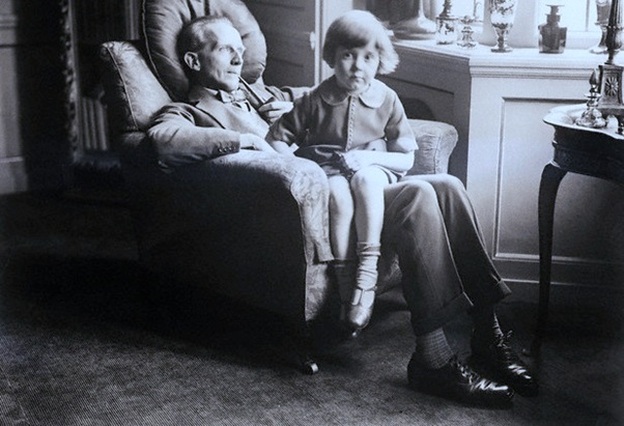
Musical inspiration can come from so many different places. For saxophonist, flutist, and composer Patrick Cornelius, the music on his 5th album as a leader, ""While We're Still Young" (Whirlwind Recordings) had as its "seeds" the poems of A.A. Milne that the Cornelius read to his young children before they went to sleep.

Before you start to think this is "kids" music, note the ensemble arranged for this production. Besides Cornelius (alto and soprano saxes, flute), there is John Ellis (tenor sax, bass clarinet), Jason Palmer (trumpet), Nick Vayenas (trombone), Miles Okazaki (guitars), Gerald Clayton (piano), Peter Slavov (bass), and Kendrick Scott (drums).   As I have written in reviews of earlier Cornelius CDs, he concentrates on melody and, like composers for larger ensembles such as Bob Brookmeyer, Gil Evans, and Maria Schneider, the solos grow naturally from the melodic material.  With the extra colors available in this album's musical palette, this material has more depth.

The program is divided into 6 "Movements", each taking its title from a Milne poem . The album starts with "Sand Between The Toes"; the opening section is a lovely prologue featuring the brass, alto sax and bass clarinet. Scott's propulsive leads the band in, pushing the handsome melody, played initially by alto and guitar, forward.  The different voices work around the theme until all drop out for a piano melody rises up and over the rhythm section (nice counterpoint from Slavov as Scott pushes forward.) That's followed by solos from Cornelius, Vayenas, and Okazaki before a return to the opening melody.

Milne and Christopher Robin
One of the more intriguing aspects of this music is that this is truly ensemble music. Yes, each track has solos; still each instrument has its voice in the story.  Okazaki, Palmer and Cornelius (soprano) each get to tell the story on "Water Lilies" (nice bow to Erik Satie right before the piano returns the song to the guitarist to conclude). "Jonathan Jo" jumps atop a modern start-and-stop "swing" beat before Ellis (on tenor) has a playful solo that leads into a snappy  and funky interchange for the ensemble before Clayton and Vayenas dig into their solos.

Vincent Soyez 
Lots to love on this album, from the Thad Jones' inspired "Lines and Squares" to the sweet sway of "The Invaders" (great section work) to the evening prayers that inspired the final track, "Vespers". If you really sit and listen, you can hear just how well these voices fit together.  There are many moments when it seems like more than 8 people are playing yet I do not detect obvious overdubbing.

"While We're Still Young" is a joy from beginning to end.  Patrick Cornelius, whose recorded music had always seemed mature, takes a giant step forward with this project.  Find the AA Milne poems, find the wonder and the exhilaration within, and then do the same with this music.  Those elements are there and so much more.

To find out more about this project and its participants, go to www.whilewerestillyoung.net.

Photo by J M Arthur
The producer, along with Patrick Cornelius, of this album is composer, arranger, and educator Kyle Saulnier.  He teaches, as I do, at Quinnipiac University. I asked him about his role on this project.
He responded "I met Patrick in graduate school at the Manhattan School of Music, where we were classmates and we've been friends since. I got involved pretty early on as a sounding board for some of Patrick's compositions for the record, I think he was looking for some general feedback from a composer (though he's a spectacular writer, he hardly needed my input). He asked me to co-produce the recording since I was already familiar with the project and the charts themselves, and he was looking for some directorial assistance in the studio since he was also playing, which can limit one's objectivity in the studio.

Patrick chimed in with "Kyle is selling himself way short here. Not only did he give me actual arranging lessons (to help me remember many principles that I had forgotten lo these many years since I last wrote for a medium-sized ensemble), but he also GREATLY assisted me in the sibelius copy work when my scores were completely lost a month before the premiere due to an unfortunate accident involving my laptop and a full mug of coffee. He also helped me rehearse the ensemble so that I could concentrate on being a "sideman" and provided invaluable feedback and coaching during the record date. I basically gave him carte blanche to make decisions regarding takes, punches, do-overs, etc on the day of the recording for this same reason."

Here's "Sand Between The Toes" performed live at Berklee, courtesy of "The Checkout" and WBGO-FM:


Tuesday, November 10, 2015

Music of All Shapes & Colors

Pianist and composer Mike Holober spends much of his time as an arranger with a number of large ensembles, from the Westchester Jazz Orchestra to the Gotham Wind Symphony to the HR Big Band of Frankfurt, Germany.  As a leader, he has issued 5 CDs over the 12 years, 2 at the head of the Gotham Jazz Orchestra and 2 with his Quintet. The 5th and latest, "Balancing Act" (Palmetto Records), features an octet of world-class musicians playing a program that includes 5 new songs by Holober, 1 by Jason Rigby (who plays tenor sax, clarinet and bass clarinet on the CD), Billy Joel's "Lullaby; Goodnight My Angel", and an inventive re-arrangement of Jerry Ragavoy/Bert Berns hit for Janis Joplin, "Piece of My Heart" (originally recorded by Erma Franklin, Aretha's sister.)

Chamber-music.org
And what a band!  The rhythm section includes Brian Blade (drums) and John Hébert (bass) plus a front line of Rigby, Dick Oatts (alto & soprano saxes, flute), Marvin Stamm (trumpet, flugelhorn), Mark Patterson (trombone), and Kate McGarry (voice).  Holober utilizes Ms; McGarry as both a singer and as another instrument blending her voice with the reed and brass.  Her reading of "Piece of my Heart" is heartfelt, bluesy, angry and defiant, matching the emotions of the arrangement.  Stamm's muted solo is a quiet counterpoint to the vocal.

There are moments of contemplation throughout the program including the opening moments of "Canyon." That piece picks up in intensity through the trumpet solo and explodes duty Oatts' fiery alto spot.  "Sighs Matter", one of 2 songs with "Sighs" in the title (the opening "Book of Sighs" is the other) is a lovely ballad with a Brazilian influence in the melody, a subtle tinge in the rhythm and in the beautiful soprano sax lines.  "Grace at Sea" may remind some of a Maria Schneider piece yet listen to the graceful funk of Blade and Hébert under Patterson's trombone solo plus the solo piano spotlight after the second vocal verse.  Speaking of funk, the rhythm section creates an incredible dance on "Idris", blending the influences of James Brown and Bob Brookmeyer in a glorious fashion. Listen for the strong tenor solo as well as Holober's hearty spotlight.  Blade gets a solo and honors the memory of the gentleman the song is named for, the late Idris Muhammad.

The album closes with the wistful "When There Were Trains", a remembrance of youth and quieter times. The Brazilian influence re-emerges here in the beat, the harmonies and Oatts' transcendent flute.   The composer's original lyrics stand out throughout the program and Ms. McGarry delivers with the game and emotion we have come to enjoy over the past decade.

 "Balancing Act" speaks to the challenges of modern life and is adult music of the highest quality.  Mike Holober does not speak down to his audience; instead, he respects the idea that the curious listener will enjoy the width and breadth of his project. The songs are intelligent, the arrangements impressive and the musicianship outstanding - find this music and take it into your heart.

For more information, go to www.mikeholober.com.

Here's the lovely last track:


It's the 50th anniversary of the creation of the Association for the Advancement of Creative Musicians, founded by Muhal Richard Abrams, Jodie Christian, Phil Corhan, and Steve McCall in Chicago. Over the 5 decades, the AACM's aim has been to help musicians and composers create "serious original music."

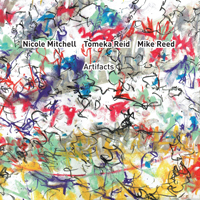
3 younger members, Nicole Mitchell (flute, electronics), Tomeka Reid (cello), and Mike Reed (drums), have recorded a tribute to the organization.  "Artifacts" (482 Music) is a fine collection of 10 pieces by 9 composers, most of whom (Abrams, McCall, Leroy Jenkins, Fred Anderson, Amina Claudine Myers, Anthony Braxton, and Roscoe Mitchell) were there at the beginning.  The Trio also plays a work by Edward Wilkerson, whose music emerged in the dates 1970s, and one by guitarist Jeff Parker.  The latter's composition, "Days Fly By with Ruby" is attached to Anderson's "Bernice", a smart move as the guitarist was mentored by the saxophonist in the 1990s.

The program serves as a reminder of the powerful music that these men and woman created.  The powerful drive of Mr. Braxton's "Composition 23B" swings hard, reminding that the composer was influenced by the music of John Coltrane and Miles Davis.  The playful dance rhythms of "Jo Jar", Mr. Mitchell's tune for his partner in the Art Ensemble of Chicago, makes one smile as does the energetic reading of Mr. Abrams' "Munkt Munk".  Ms. Myers' "Have Mercy On Us" is modern gospel and the trio, after a frenetic opening with electronically distorted flute, fall into a hypnotic rhythm - the distortion of the flute and the churning cello create an intensity matched by Reed's drumming.

The late Steve McCall (1933-1989) is the only composer on he CD with 2 tracks, both associated by his work alongside Henry Threadgill (saxes, flute) and the late Fred Hopkins (bass) in Air.  "B.K." has numerous rhythmic changes, a tumultuous cello part, and fiery drumming while "I'll Be Right Here Waiting" is a stunning ballad (certainly the prettiest piece that Air ever performed).  The round notes of the flute combined with the thick cello tones and the wonderful colors created by Reed (especially when the music drops out of tempo) is powerful and emotionally rich.

Mr. Wilkerson's delightful march "Light On The Path" closes the program on quite an upbeat note.  The way Ms. Mitchell's wraps her dancing flute phrases around the active pizzicato cello while the drummer dances along in abandon will set your feet tapping.  The funky drums that support Ms. Reid's cello solo reminds one that the AACM made and still makes music from all elements of the Black experience throughout the world.

The title "Artifacts" may make you think of a museum or an archaeological exploration yet this is far from what Nicole Mitchell, Tomeka Reid and Mike Reed want one to feel about this music.  No, these compositions and performances are alive with possibilities; the DNA of the originals is deep inside the musicians and they understand this music was made for the ages.  The album serves as both a tribute and a reminder what can be accomplished by a community.

For more information, go to www.482music.com.


"Vista Accumulation" (Pi Recordings), the new album from pianist and composer Matt Mitchell, may remind listeners of the work of Muhal Richard Abrams in its shifting rhythmic patterns and episodic nature.  Yet one can hear the influence of Andrew Hill and John Hollenbeck on the 8 tracks spread out over 2 CDs (over 96 minutes of music).  Joining Mitchell is his "working group" composed of Chris Speed (tenor saxophone, clarinet), Chris Tordini (bass) and Dan Weiss (drums).   Each one is essential to the success of this music as the pianist's pieces are filled with twists and turns, with long melody lines (shared by piano, bass and drums) and intelligent harmonies.  Mitchell's powerful left hand, on occasion, works in tandem with Tordini's bass and, at other times frees the bassist to play counterpoint.  Weiss, as he has exhibited over the past decade, has this wonderful ability to make music come alive and is often a melodic element as well as a timekeeper. Speed is a perfect partner with the piano, especially when playing clarinet  The reedy sound combined with the brightness coming from the keyboard soothes as it cajoles.

Hiroyuki Ito/NYTimes
Perhaps the most interesting aspects of this recording (in this author's mind) are the movement within the music, how melody drives each piece, and how solos come and grow so organically.  Tracks such as "'twouldn't've" and "Hyper Pathos" seem to breathe with the musicians, never sounding forced or contrived. The latter is a good example of how Tordini's bass is so important; not only does he solo (at the end) but his counterpoint to the clarinet is quietly intense and easy to pick up in the spaces left by the piano and drums.

What one should do with such (seemingly) complex music is to concentrate on a particular musician each time you listen.  Mitchell's piano is the driving force of this music yet he understands the need to stand back when the material calls for it.  His subtle backing of Speed's clarinet solo on "All The Elasticity" not only reacts to the phrases being played and providing counterpoint but also pays attention to the other members of the rhythm section, feeding them chords. Mitchell uses his power in a similar manner to Don Pullen on "Utensil Strength", splintering melodic lines and creating a musical firestorm in his left hands.  The propulsive melodic fragment that appears throughout the song serves to change the focus and intensity.  On that same track, notice how Weiss moves in and out of the picture; at one point, he is silent for 4 minutes while closer to the end, he's playing the melody and pushing the proceedings.  His hip-hop approach at the opening of "Numb Trudge" press at the tolling piano chords trying to coax Mitchell into a melody and, after 2 minutes, Speed enters and plays a theme.  When he's done, the song breaks down and the pianist plays a long, abstract, solo  that ultimately removes the tension.  Once he's done, the other musicians enter and slowly the piece builds up with Speed's clarinet leading the way.

I've played "Vista Accumulation" numerous times in the past 6 weeks and each time I hear something new.  What is more evident now is the emotional richness and sincerity of this music, the honesty with which Matt Mitchell and band breath life into the notes and in how they interact with each other.  The songs may be long (none under 7:48 and 4 above 12:28) but there is not a dull moment to be heard.

For more information, go to www.mattmitchell.us. To get a taste of this excellent recording, go to matt-mitchell.bandcamp.com/album/vista-accumulation.