Showing posts with label drums. Show all posts

Saturday, January 26, 2019

Her Story, His Music, Our History

Photo: Jon Grönsoos
Wadada Leo Smith (born 1941) first picked up the trumpet at the age of 12 and it seems as if he hasn't put it down since. His studies Took him from his local high school to the U.S Army to Chicago and to Wesleyan University in the mid-1970s.  But his adventures in modern creative music and the creation of his own musical language began in Chicago in 1967 when he met Anthony Braxton, violinist Leroy Jenkins,, and later drummer Steve McCall. Mr. Smith also became involved with the Association For the Advancement of Creative Musicians (AACM) which gave him a forum for his music and willing participants in making sure the music was played and heard. Over the decades that followed, his working and his teaching has taken him from Chicago to New Haven, CT, to CalArts in Santa Clarita, CA, and back to New Haven. He has traveled the world, played music with many different people and in many different styles but he always sought to educate his audience (whether the subject be the music of Miles Davis or the history of Black Music, nature, politics, Rastafarianism, and more. He has played solo, in many duos, trios, quartets, and up to large orchestras. His trumpet is always calling is to attention, making audiences pay attentions, his crisp, clear, tones rising out of his ensembles making us pay attention.

His latest album (to be released February 15), "Rosa Parks: Pure Love", is his eighth recording for TUM Records to be released since 2011 and continues Mr. Smith's work about Civil Rights that began with his brilliant 2012 Cunieform recording "10 Freedom Summers."  That album's material stretched from Dred Scott to Medgar Evers to JFK and LBJ to the Little Rock Nine to September 11, 2001, to Dr. Martin Luther King, Jr, and beyond.  There was also a piece titled "Rosa Parks and the Montgomery Bus Boycott, 381 Days."  That piece is here as well now with words,  performed by Min Xiao-Fen (voice and pipa) and the RedKoral (String) Quartet.  For this project, the music (which Mr. Smith calls an "oratorio") tells a specific story of how that victory over racism set the the stage for the growth of the Civil Rights Movement in the 1950s and the emergence of Dr. King.

Photo: R.I. Sutherland-Cohen
Besides Ms. Xiao-Fen and the RedKoral Quartet (violinists Shalini Vijayan and Mona Tian, violist Andrew McIntosh, and cellist Ashley Walters)  musicians on the album include the BlueTrumpet Quartet (pictured left and featuring Hugh Ragin, Ted Daniel, Graham Haynes, and Mr. Smith, the vocal trio Diamond Voices (Ms. Fen, Carmina Escobar, and Karen Parks) drummer Pheroan akLaff, and electronic musician Hardedge. Mr. Smith also injects into several pieces short excerpts of solo works created by Mr. Braxton, Mr. Jenkins, Mr. McCall, and himself taken from recordings made between 1969-1977.  Mr. Smith wrote all the lyrics save for one piece "No Fear" that is a direct quote from Rosa Parks (1913-2005).

If you lived through this time of American history, this music and these words contain great power.  If you were born after the the 1960s, this recording and these words will begin to educate you about what was happening in the Southern part of the United States.   It is also important that Mr. Smith acknowledges how this project - in fact, all of his work -  has its roots in the friendships, the improvisations, the concerts, that he, Mr. Braxton, Mr. Jenkins, and Mr. McCall played in 1967 (in the US) and in 1969 (in Paris, France).  Still, there is so much to take in, the various sounds, the voices, the blend of group sounds, the importance of what Ms. Parks accomplished with her act of defiance, and how this music invites us in to experience the fears, the anger, the hopes, the dreams, the victories, and the ongoing battles that still plague the United States over 63 years after Rosa Parks refused to move from where she was sitting on a Montgomery, Alabama, bus.

Photo: R.I. Sutherland-Cohen
"Rosa Parks: Pure Love" is an album to listen to all the way through, not to be excerpted, chopped up, or played piece by piece.  There is a flow from beginning to end, a storyline writ by music and words that comes to an end all too soon. This album cannot paint enough pictures to help you experience those days, how the African American community pitched in to defeat the racist policies of a city determined to keep them second-class citizens. Yet, this album opens (for some, reopens) doors that one must enter to understand how we got to now, how the politics of 2019 is built upon the responses and reactions to the events of the 1950s (and before) and the misguided beliefs of certain members of society that have been ingrained since before this country became United.  The enemy of this music is fear and ignorance - is it possible to create dialogue with music? This music, like most powerful music, needs to be experienced in a live setting. Wadada Leo Smith continues to create powerful music, continues to remind us of our history and to pay attention to the beauty as well as the contradictions that surround us. He reminds to also pay attention to those beliefs and insecurities that make us who we are and can lead us down the road to ruin or redemption.

For more information, go to wadadaleosmith.com.

Here's just a short taste of this amazing music:

Thursday, January 25, 2018

Let's Dance, say the Drummers

Drummer, composer, and arranger Rob Garcia is a very busy artist. Besides working with his own quartet, he is also the founder and artistic director of a non-profit organization called Connection Works, works and records with groups such as Svetlana and The Delancey Five and Brian Carpenter's Ghost Train Orchestra, and is an active member of the Brooklyn Jazz Underground.

His new project is a delightful aural treat. Aptly titled "Drum Solos for Dancers Only" (Connection Works Records), Garcia has created a program that will help people who love to dance realize that it's the drummer who gets them up and onto their feet and provides the impetus to keep going (not to slight the wailing horns, the athletic bass lines, the propulsive left hand of the pianist, and others).  The 13 pieces emphasize different dances ("Savoy Steps", "Honey Soft Shoe", "Elastic Boogie", etc) and it is impossible for the listener (or, the writer at the keyboard) to sit still.  It's fascinating to hear the different melody lines - yes, melody - that Garcia creates here. Listen to "Americana Thrill" -  do you hear the theme from Ferde GrofĂ©'s "Grand Canyon Suite"?


The album is not Rob Garcia showing off but illustrating how he can direct an orchestra and how to keep folks on the dance floor.  Technically, it's brilliant but this is neither a thesis project nor an exact history lesson.  Throughout the recording, you hear the influences of people like Chick Webb, Sonny Greer, Gene Krupa, and the countless drummers of the "swing era" and beyond.  In the long run, this is music for and about movement. The music brings people together, gives them a reason to have fun, to express themselves physically, to work out frustrations - it's why we sing in the car or the shower, why we go to concerts, why we sit up late at night listening to albums that turned our heads 40, 50 years ago.  Dancing can free us of certain inhibitions and I recommend you listen to this album really loud - Come on, "everybody dance now!"

For more information, go to www.robgarciamusic.com.

Frank Perowsky is a clarinetist and saxophonist from Des Moines, Iowa, who's been involved in the New York City music scene since graduating from the Juilliard School in the late 1950s. He's worked with bands led byWoody Herman, Jimmy Dorsey, in Broadway pit bands, backing singers such as Billy Eckstine, Peggy Lee, and Mel Torme, plus a three decade-plus working relationship with Liza Minnelli. One thing Frank Perowsky has yet to become is a prolific recording artist in his own right.

His new album, "An Afternoon in Gowanus" (JazzKey Music), features his 16-piece Jazz Orchestra (plus vocalist Ira Hawkins) and is his first album since he recorded "Bop on Pop" with  his son, drummer Ben Perowsky and organist Sam Yahel, in 2001.  The latest disc hearkens back to the days of the Count Basie Band, the Duke Ellington Orchestra, with hints of the Thad Jones-Mel Lewis Orchestra.

Look at the lineup and you'll see many familiar names. The saxophone section includes Jerry Dodgion, Loren Stillman, John Ellis, Bob Franceschini, and Roger Rosenberg while the trumpets include Seneca Black, Chris Rogers, Antoine Drye, and Waldren Ricks. The trombone section boasts the big sounds of Sam Burtis, Jacob Garchik, Brian Drye, and Joe Randazzo.  Besides Ben Perowksy at the drums, the rhythm section includes pianist David Berkman and bassist Aidan O'Donnell. The program, recorded in front of a live audience, features a bright selection of originals and intelligent arrangements of works by John Lewis, Tom McIntosh, Duke Ellington,  Bud Powell and Larry Young.  The Young piece, "Talkin' About J.C.", is a smart re-working of the organist's 1962 work recorded by Grant Green.  First of all, it swings like mad and opens up to a number of fine solos.  It's the blues that underpins this music, whether it's the happy-go-lucky original "Big Apple Circus" that opens the album or the quiet ballad "Paris Dreams", a vehicle for trombonist Burtis. Even on the latter track, there is a bounce in the rhythm section. I dare you to sit still on John Lewis's "Two Bass Hit" as it roars right out of the gates powered by the powerful drums.

When you listen all the way through "An Afternoon in Gowanus" a few times, you realize just how much fun this band is having.  Frank Perowksy's arrangements leave plenty of room for solos and the sectional work is exciting and active, quite complementary throughout.  This is "live" music, alive in many ways.  Perhaps no new ground is covered but never does it sound stale, re-hashed, or a pale copy of bands past.  This is the kind of music for a crowded nightclub or concert hall, sounds that fill the air and have the power to block out negativity.  Play it loud and enjoy!

For more information, go to www.jazzkey.com.

Here's a taste:

Saturday, March 15, 2014

The Next Roundup (Part 3 - Eric, Donald & Jon)

As an artist, bassist Eric Revis does not sit still.  He has been a member of the Branford Marsalis Quartet since 1997, has been touring and recording with guitarist Kurt Rosenwinkel for the past several years and is, with pianist Orrin Evans and drummer Nasheet Waits, an integral member of the cooperative Tarbaby.

Revis has also issued 3 CDs for Portugal's Clean Feed and each is different from the other. In 2012, he released "Parallax" with his 11:11 group featuring Ken Vandermark (reeds), Jason Moran (piano) and Mr. Waits.  2013 brought "City of Asylum", a trio date with pianist Kris Davis and drum master Andrew Cyrille, recorded the first time they got together.  For his new Clean Feed release, he recruited Bill McHenry (tenor saxophone), Darius Jones (alto saxophone) and Chad Taylor (drums, vibes) and created "In Memory of Things Yet Seen".  The results are attractive, blending fiery improvisations with introspective ballads, wailing saxophones with a thunderous rhythm section, and stately melodies with smart interplay.  Branford even shows up for a pair of tracks, the hard-driving "Unknown" and the rubato "FreeB."  The former features a solid beat from the rhythm section with the 3 saxophonists blowing strong while the latter is a short (2:37) but hot "free-for-all."

Revis's composition, "The Tulpa Chronicles", comes in 3 parts (cuts 1, 6 and 11) with the first, "Proem", opening the program on a meditative note, Taylor creating a trance-like feel with a 4-note figure on the vibes while striking a cymbal and the reeds delivering a quiet melody.  Part 2, "Ephemeral Canvas", builds off the simple cymbal rhythm for a handsome bass solo; halfway through the 2-minute piece, Taylor slams the tune into high gear and the reeds play an entrancing melody.  Part 3, "For Cordel "Boogie" Mosson", takes the forceful rhythm from Part 2 and expands upon it with great bowed bass and that fine melody line. (Cordel "Boogie" Mosson was the bassist in George Clinton's Parliament/Funkadelic, joining the band in 1971 - he passed in April of 2013 at the age of 60.)

The interplay of McHenry's tenor and Jones' alto works smartly atop the forceful bass presence and Taylor's hard-edged drumming. A piece such as "Son Seals" give the saxophonists plenty of room to blow but the arrangement leaves room for a bass solo and several tempo changes.  "Somethin's Cookin'" (composed by drummer Sunny Murray for his Untouchable Factor ensemble - the tune appears on 1976's "Wildflowers: The New York Jazz Loft Sessions") has the bass taking the lead and horns playing counterpoint while the drums dance and cymbals shimmer. McHenry composed the sweet ballad "3 Voices", notable for the conversational drum work and its quiet melody.  He also contributed the CD closer, "If You're Lonesome, Then You're Not Alone", another fine ballad with a melody one might hear coming from an Americana group.  Jones sole composition is "Hold My Snow Cone", an ironic title for such a melancholy tune. Taylor's funky "A Lesson Earned" has a soulful saxophone melody line, a throbbing bass line and a wicked beat.

The quartet fires on all cylinders as they attack Sun Ra's "The Shadow World." The piece opens with a forceful bass solo over Taylor's complimentary percussion. Just over 60 seconds into the song, the rhythm section sets a furious pace over which the saxophonists present the melody in a calm fashion before both men deliver incendiary solos.

"In Memory of Things Yet Seen" will certainly wake all your senses.  Eric Revis has proven over the course of his 5 releases as a leader that he can mesh strong melodic lines with rhythms that push the boundaries yet rarely dissolve into mere noise.  His new group and recording matches 2 saxophonists, each with his own individual "sound", with a rhythm section that works great together, whether "locked in" or working in counterpoint.  The quartet is currently on tour in Europe; when they return, the bassist hits the road with the Marsalis Quartet for 5 weeks.  Let's hope Eric Revis gets to take this fine group out to many cities in the US.  For more information, go to ericrevis.com.


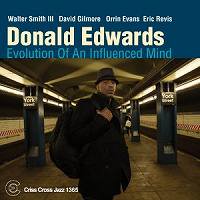
Drummer Donald Edwards, born in New Orleans, studied music at Southern University in Baton Rouge and went on to be one of the more sought-after musicians in Louisiana.  After moving to New York City, he began working with musicians such as Tom Harrell, Conrad Herwig, Dave Holland, Stefon Harris and many others.  In the past few years, Edwards has recorded with pianist Orrin Evans, The Mingus Big Band, the Criss Cross label supergroup Opus 5 (with Seamus Blake, Alex Sipiagin, Boris Kozlov and David Kikoski) and pianist Joey Calderazzo.

"Evolution of An Influenced Mind" is his debut as a leader for the Criss Cross label (his 3rd overall.)   The Quintet on the album includes pianist Evans, bassist Eric Revis, tenor saxophonist Walter Smith III and guitarist David Gilmore.   10 of the 11 tunes are composed by Edwards (the lone exception is "When", composed by the pianist) but don't expect this to be a loose conglomeration of jams linked by drum solos.  Edwards has a good ear for melody, making excellent use of his band.  One major exception is the opening track, "American Drum Call to Mama", which utilizes an overdubbed gospel choir with Edwards improvising below them.  "History of the Future" is next, an uptempo piece that utilizes electric piano to fill out the sound.  The rhythm section is quite active under the fine solos with Edwards getting his own spotlight 90 seconds before the close of the tune.

What's most impressive over multiple listenings is how each player is integral to the songs, whether it be the blend of electric guitar and tenor saxophone on the melody line of "Niecee" as well as Revis's strong support or the beautiful melody of "The Dream", with Evans' piano lines wrapping around the acoustic guitar.  The latter track is such a quiet piece yet the interplay is intense and shimmering.  The funky and sly "Dock's House" (Dock is the drummer's dad, a classical pianist) is a slippery dance piece with strong solos from Smith III, Evans and Gilmore.  "Not Really Gumbo" is a tribute to the Crescent City, more influenced by Astral Project than The Meters, displaying Edwards' mastery of poly rhythms.    During Evans' hearty piano solo, the drummer really drives the beat.  Gilmore's distorted guitar blends well with the electric piano and sax on "Nightmare of Fun" - there are several moments when Edwards joins in on the melody.  The rhythm section gets to romp on "The Essential Passion", Revis's hard-driving walking bass lines pushing the beat along with the leader's ride cymbal.   There's a strong r'n'b feel to "Culmination for Now", Smith III's smoky tones a good match for the sustained tones of Gilmore's electric guitar.

"Evolution of An Influenced Mind" may not take hold on your first listen but you'd be wise to let the music soak in.  The pieces that Donald Edwards composed and arranged for this session favors no one player and it's the sense that this is a unified group that clearly comes through.  On top of all that, Edwards is a mighty fine drummer and, when paired with bassist Eric Revis, truly commands your attention.  For more information, go to donaldedwards.com.  


Saxophonist Jon Irabagon is one busy musician.  Over the past 2 years, he has toured and recorded with Mostly Other People Do The Killing, done the same with trumpeter Dave Douglas, with Mike Pride's From Bacteria To Boys, guitarist Mary Halvorson's Septet, drummer Rudy Royston's 303, and drummer Barry Altschul's 3Dom Factor.  He has started his own label - Irabbagast Records - and released 2 different yet entertaining CDs.

In June of 2013, he traveled to Germany with Mr. Altschul and bassist Mark Helias to play at the Peitz Jazz Festival.  Armed with 8 of his compositions, the band played a strong set which is now being released on the saxophonist's label in conjunction with the German Jazzwerkstatt label. Irabagon is no stranger to the trio setting, having recorded "Foxy" with Mr. Altschul and bassist Peter Brendler, a multi-sectioned 79-minute CD with no breaks.  The new album,
"It Takes All Kinds", is not as "hard-core" as "Foxy" but just as fiery.  The rhythm section is electric, with Mr. Helias providing a solid foundation (and excellent melodic work) and Mr. Altschul at the top of his game.  The drummer can be subtle (his kit work on "Elusive" is stunning, especially when he enters in the middle of the long bass solo) and he can forceful (as he displays on the opening "Wherewithal".) The manner in which the drummer drives "Pause and Flip" is exhilarating. When the song breaks for the bass solo, Mr. Altschul "colors" beneath Mr. Helias and then allows him to go it alone.  When he and the saxophonist re-enter, the energy level immediately fires back up and then slowly dissipates - the 3-way conversation is a highlight of the concert.  The bassist is often cast here in the role of the timekeeper, allowing the drummer to accent, insinuate, and act as counterpoint to the leader's solo work.  Mark Helias is one of the more melodic players on the scene but he also has a percussive side - listen how he opens "Sunrise", going from an intense series of phrases to becoming so quiet. When Irabagon enters, the rhythm section is so restrained, just right for the lovely melody.

The cover image of Don Quixote with Sancho Panza might make one think that the music contained on "It Takes All Kinds" is fraught with peril, loaded with pitfalls.  But, Jon Irabagon, along with Barry Altschul and Mark Helias, has created music that is full of life, with close interactions, with humor and and fun.  This is living music that deserves to be heard live.  In the meantime, grab ahold and enjoy the ride.  For more information, go to www.jonirabagon.com.

Tuesday, December 4, 2012

Mallets For All + Drummers Shine (add-on)

Composer and marimba virtuoso Robert Paterson (born 1970 in Buffalo, New York) is one of the few musicians who has mastered the use of 6 mallets whilst playing his instrument.  One can imagine how impressive that must be to watch in person.  His new CD, "Six Mallet Marimba" (American Modern Recordings) features 9 Paterson originals composed for his style of playing and featuring members of the American Modern Ensemble.  The average listener won't necessarily be "wowed" by his technique but his music is quite a treat for the ears.

The program opens with 2 works for solo marimba, the lively and playful "Komodo" and the more slippery, impressionistic, "Piranha." The remainder of the pieces are duets including the feisty "Tongue and Groove" featuring alto saxophonist Jeremy Justeson, the sensuous and serious "Fantasia" (composed for marimba and tuba, here played by Dan Peck, a musician who also fronts a jazz trio) and the mysterious, jazzy, "Clarinatrix" (featuring the splendid bass clarinet playing of Meighan Stoops from the Da Capo Chamber Players.)

Other pieces include 2 works for marimba and violin, the dramatic "Braids" (featuring Paterson's wife Victoria) and the more up-tempo and fiery "Links & Chains" (featuring Robin Zeh of the Saratoga Chamber Players.)  Perhaps the loveliest piece on the CD, "Stillness" features the expressive oboe of Sarah Schram (who has played with the New Jersey Symphony and the New Haven Symphony as well as the Sonevole Wind Trio).  The longest piece on the program is the 3-part "Duo for Flute and Marimba", a lively, wide-ranging work that features the stunning flute and alto flute work of Sato Moughalian (a musician with numerous credits including serving as the Artistic Director of the Perspective Ensemble.)

"Six Mallet Marimba" deserves your full attention, not because of Robert Paterson's prodigious technique but because his compositions engage the listener on many levels (melodic, rhythmic and emotional.)  His interaction with the musicians on the duo works truly captures the ear and mind, so much so that one hears more each time he returns to the music.  For more information, go to either robpaterson.com or americanmodernensemble.org. 


Born in Japan and now a New York City resident (since 1997), Makoto Nakura is a master marimba and vibraphone player who has worked with orchestras, opera companies and poets.  He is, also, a champion of new music for his instrument; his new CD, "Wood and Forest" (American Modern Recordings) features 6 new works commissioned by the marimbist from composers Jacob Bancks (born 1982, now based in Chicago), Kenji Bunch (born in Oregon in 1973), Carlos Sanchez-Gutierrez (born 1964 in Mexico City, Michael Torke (born 1961 in Milwaukee) and Robert Paterson (see above).  The music ranges from Bunch's romantic, wistful and fanciful "Duo for Viola and Vibraphone: From the Verdant Kingdom" (featuring the composer on viola and the leader on the largest vibraphone in the world, an instrument which resides in Japan) to the fiery and rhythmical "Winik/Te for Solo Marimba" by Sanchez-Gutierez.  Torke's "After the Forest Fire" was composed for marimba, flute (played by David Fedele) and cello (Wilhelmina Smith) and has moments that range from Baroque to French Impressionism.  Bancks contributes 2 works, the 3-part "The Trees Where I Was Born" inspired by the poetic imagery in Walt Whitman's "O Magnet-South" (published in 1860) and "Arbor Una Nobilis" ("Noblest of Trees") for marimba and violin (played by Jesse Mills).  The latter work has moments that are whisper quiet and draw the listener in close - there are also stretches when the volume rises quickly.  Paterson's "Forest Shadows" is a solo marimba based on the composer's appreciation for the nature and landscape paintings of several 19th Century artists.

I love how the sound of the marimba fills the room, the warmth of its tones helping to ease the tensions from the day.  The vibraphone on Bunch's 3-part composition has a "sharper" sound, especially on the up-tempo third section; yet, this music neither grates nor alienates.  Jazz fans should seek both Paterson and Nakura's recordings out as both are satisfying, often adventurous and sonically rich.  For more information, go to makotonakura.com.

**********************************************

Colorado-native Jeff Davis is a composer and drummer who has worked and recorded with numerous creative musicians including the Jesse Stacken Trio, Michael Bates Outside Sources, Kirk Knuffke Quartet, the Amanda Monaco 4Ben Holmes Quartet,  Pedro Giruado Jazz Orchestra, Jon Irabagon’s Outright!, and Eivind Opsvik’s Overseas.  He first began percussion studies playing marimba, going on to study at the University of Colorado and earning a Master's Degree from the Manhattan School of Music. Having seen him play in several different ensembles, he is capable of not only "driving" a band but also creating masterful colors.

"Leaf House" (Fresh Sound New Talent) is the debut recording from his New Trio.  Featuring bassist Eivind Opsvik and pianist Russ Lossing, the music goes in multiple directions but rarely where one might expect a piano trio to go.  The title track opens the program with Lossing playing a percussive repeated figure before the rhythm section enters.  The powerful rhythmic surge beneath the pianist lurches forward as he plays a fragmented solo.  "Faded" is a bit subdued with the piano supplying a melody that blends blues and hard bop.  Opsvik "walks" or plays furious driving lines then moves around both the piano and drums, adding a solo that slows the proceedings, allowing the listener to breathe.

Davis leads the Trio through "Overath", moving around his kit and cymbals with stealth and somewhat manic determination. The shortest track at 2:23, "Saint Albert" has forceful Trio opening before the leader takes center stage for a solo that shows he can be powerful and melodic.  The majestic, deliberate, arco bass opening of "Catbird" sets the pace for a dramatic ballad.  At times, Lossing plays deep low notes while the bassist moves up into his higher registers.  The interaction of the Trio in the body of the piece is intelligent, free-wheeling and makes the piece feel like a "free improvisation" because of the way the music continually changes shapes.  The fiery "Lion Mouth" closes the CD, featuring a "wicked" bass and drum dialogue, a mouth-dropping bass solo and a piano solo taken at half-tempo (for a while) as the rhythm section pushes with abandon.

The intuitive interactions throughout "Leaf House" will thrill and fascinate the eager listener.  Jeff Davis challenges his fellow Trio mates and the audience with music that does not bow to any fashion; instead, the 8 pieces blaze trails that transcend mainstream jazz for their own particular world.  For more information, go to www.jeffdavisdrums.com.