Showing posts with label drummer-led bands. Show all posts

Tuesday, November 7, 2017

Give The Drummer Some (November '17 Edition)

Drummer, composer, and arranger Ernesto Cervini is quite a busy human. He leads or co-leads eight groups (!), is a publicist for a growing number of Canadian musicians, and is a member of several other ensembles.  His sextet, Ernesto Cervini's Turboprop, has just issued its second album - titled "Rev" (Anzic Records), the ensemble features the mighty rhythm section of Cervini, Adrian Farrugia (piano), and bassist Dan Loomis plus the front line of Joel Frahm (tenor saxophone), Tara Davidson (alto and soprano saxes), and William Carn (trombone). The majority of the program was recorded after the ensemble had finished a tour of Western Canada. The joy and camaraderie that the sextet exudes is obvious from the start and, honestly, the music they create is irresistible.

Farrugia contributes the opening track, "The Libertine": from the solo drums lead-in, the band builds off the sinewy bass and piano lines, playing a handsome melody.  The pianist dances over the active rhythm section. There's an appealing urgency as the music rushes forward. Frahm roars out of the piano solo, pushed by and pushing back against the tumultuous rhythms.

That spirited interplay continues on Cervini's original "Granada Bus."  Again, the bass and drums add the jet fuel to the music while the dance melody opens up for delight-filled solos from Ms. Davidson (soprano), Farrugia, and Frahm.  The title track (also a Cervini composition) is also a fiery exchange between the horns and drums with the alto, tenor, and 'bone "riffing" away while the drummer thunders beneath them.

There are three eclectic "covers" in the program.  "No Rain", a tune by Blind Melon that captivated the leader as a youth, maintains the sprightly melody while getting a powerful rhythmic undercoating.  Carn's dancing solo is a highlight (pay attention to splendid counterpoint created by Loomis) as is the lovely and powerful soprano sax statement.  "The Daily Mail", written, recorded, and released by Radiohead in 2011, is a handsome ballad that opens with a strong melodic bass solo over the simple piano chords before Frahm enters with the melody. When the tenor, soprano, and trombone take off for the combined solo, the songs takes on a gospel feel. The sextet does not overthink the piece but really the capture the power and mystery of the original.  The third standard is "Pennies From Heaven" and the band swings the heck out of the piece.  Frahm plays the theme then joins for the alto and trombone for a delightful romp.  Later on, Loomis steps out in front for a fine melodic solo before the song swings its way out.

The music and the performances invite you into "Rev", keeping your attention throughout and making you want to return again and again.  Sure would be great to see and hear this band live in the U.S. but the upcoming dates are all in Canada.  In the meantime, jump aboard Ernesto Cervini's Turboprop and enjoy the ride!

For more information, go to www.ernestocervini.com.

Here's the delightful "Granada Bus":


Dylan Jack is a drummer and composer from Massachusetts who has played in a number of rock and fusion bands.  Thanks to a gig that fellow student (bassist Anthony Leva) at Bard College's Longy School of Music in Boston had booked, Jack met and played alongside guitarist Eric Hofbauer and clarinetist Todd Brunel.  The drummer than asked the trio to play for his graduate recital: soon, the band had gelled playing his original material, played more clubs and concert halls, and Hofbauer invited Jack to join his Creative Nation Music label.  The results of a late February 2017 day in the studio is the drummer's debut as a leader.


"Diagrams" is credited to the Dylan Jack Quartet and the music is really a collective affair.  You can hear in the first seconds of the opening track "Are You Made of Coins" how the rhythm and melody are connected.  The high-spirited theme, played by bass clarinet and guitar, has its roots in bop and funk but it's such fun to hear how Jack and Leva change the feel during Brunel's solo (sounds like a touch of bossa nova).  When the guitarist steps out, the three plays a funky riff as Hofbauer digs in with a blend of single-note runs and chordal lines.  The exuberant drum solo during which Jack keeps circling back to the melody really stands out.

music-elements.com
The listener might not be able to tell listening to the gentle yet firm feel of the melody that the title of the next track, "Sentenced", was influenced by the trial of the Boston Marathon bomber. After the theme section, Hofbauer steps out over sweet brush work and a genial walking bass line.  The feel changes during Brunel's powerful soprano sax solo with much more energy from the rhythm section - note the interaction between the soloist, drums, and guitar. Leva solos over the impressionistic guitar. The piece has now slowed down and is more reflective before the the guitar, bass, and soprano reintroduce the melody. They drop out, Jack takes over for an intense solo with his brushes - it makes the listener lean in. He switches to sticks yet never overpowers the song, again referring to the melody which invites the band back in for the close.

"Ghost Pal", the longest track (13:58), opens in free time, with much dynamic variation and shifting focus, before the melody is introduced at 3:50. The piece teeters between being a ballad and short, spiky rapid-fire riffs, before Brunel steps out for a powerful clarinet solo. As he quiets down to an eerie moan, Hofbauer steps out. His electrified acoustic sound is quite melodic and percussive: in contrast, Leva plays a bowed bass solo.  Jack's skittering brush work takes center stage as with more clarinet moans, rapid-fire yet quiet guitar riffs, and the occasional bass interjection.  Soon, the band reenters, the "ghost" story continues, with a return to the melody line taking the piece out.

"Diagrams" asks a lot of the listener, as the music shifts and darts, changing direction with glee. Yet, one is rewarded time and again by hearing how this quartet works and plays together, really listening and responding to each other, not just "blowing" over the changes.  The Dylan Jack Quartet creates music worth exploring; let go of your expectations and enjoy this sonic journey.

For more information, go to dylanjackmusic.com.

Here's a track for you to dig into:

Monday, August 15, 2016

Catching Up for August (PT 1)

Sometimes it's amazing how quickly time flies by.  I received the US debut of drummer and composer Guilhem Flouzat last summer and put it on the pile of "stuff to review" - school started, the pile got higher, and the recording got overlooked.  My mistake.  "Portraits" (Sunnyside Communications) features nine original compositions performed by an ensemble that includes Ben Wendel (tenor saxophone), Desmond White (bass), Anna Webber (tenor sax, flute on 3 tracks), Jay Rattman (alto sax on 3 tracks), Laurent Coq (piano on 4 tracks), Can Olgun (piano on 5 tracks), and Becca Stevens (voice on 2 tracks).  The music is pleasantly beyond genrĂ© - yes, this is instrumentation for a jazz band and yes, there are solos but the melodies and rhythms come from so many different influences. Flouzat, a native of Paris, France, and graduate of the Manhattan School of Music, grew up surrounded by classical music which often shows itself in the richness of his melodies. But, also pay attention to how "melodic" his drumming can be. Listen to "Underachiever" (featuring just Olgun and White) and the conversation the three musicians are having. The playful "Truce" rides in on a simple piano line (Coq), echoed by Wendel, and then the solos are parsed around that melody; first, the piano, with White and Flouzat playing with the rhythm and then the tenor sax, with Wendel being pushed by the active rhythm section, responding with a forceful spot.

Ms. Stevens appears on "Where We Should Go", her plaintive voice gently through the piano counter-melody and the subdued rhythm section.  Wendel's tenor solo ups the heat but it's back to just piano and voice for several choruses before the band returns.  Pay attention to how the song moves, how the dream-like quality of the music envelops the vocals.  She also appears on the final track, "A Dream" - the African rhythm of the opening is set against the flowing melody. When White, Coq, and Wendel enter, they each add a distinctive voice, with the bassist shadowing the drums, the tenor sax and piano working with and moving away from the voice.   Listen to how the words move into, with, and away from the rhythm.

The program concludes three tracks with the three saxophonists. They range from the powerful drive of "At This Juncture in Time" to the slow motion of "Sleepwalk" (good blend of flute with alto and tenor saxes) to the circular melodies of "What's Up Yourself."  Each track deserves a close listen to enjoy the voices interact and how the arrangements play with time, colors, and, of course, melody.

Unlike "pop" music, most other styles and recordings have no expiration date. I may have come late to "Portraits" but, once rediscovered, this music has staying power.  It speaks to those who love melody, conversational interactions, adventurous rhythms, and more. Guilhem Flouzat, who has recorded and toured with vocalist Kevita Shah, saxophonist Adam Larson, and Jay Rattman, is a wonderfully sensitive drummer and proving that he's an excellent composer as well.

For more information, go to guilhemflouzat.com.

Here's a track:


Many people like to be blown away or bowled over by the music they listen to or attend.  Some of those people feel that quieter music is not exciting or involving. "Moments in Time" (SteepleChase/LookOut) is an excellent example of music that is both subtle and approachable, played by a sextet challenged by the compositions to create music that has emotional power not usually measured in decibels.

Bassist David Ambrosio (Grupo Los Santos, George Schuller) and drummer Russ Meissner (Sean Smith Quartet, Jim Campilongo & Honeyfingers) have worked together on numerous occasions, most recently on the bassist's 2014 "Gone" album.  Joining them on the musical journey are Nate Radley (guitar), Leonard Thompson (piano), Matt Renzi (tenor saxophone, English horn), and Loren Stillman (alto saxophone).  The music goes in different directions, from the Ornette Coleman and Thelonious Monk-inspired "Quartet Note" (the interaction of the leaders is quite impressive) to the sharper edges of "No V" (great interplay between Radley and Stillman on the opening) to the attractive forward motion of "Far West."  The listener can enjoy the work of the rhythm section throughout yet do not forget to pay attention how the guitar and piano are utilized join on most of the tracks plus the strong work of both saxophonists.

downtownmusic.net
Meissner (pictured left) and Ambrosio each contributed four songs to the session with one from pianist Thompson.  That tune, "First Time on the Moon", has a fine melody shared by both saxophonists while the composer adds smart chordal voices.  The rhythm section literally whispers throughout the piece.  The drummer's "Hourglass", has a hummable melody that, at times, sounds as bit like a tune by Burt Bacharach. Opening up into sparkling solos from both Stillman and Renzi, the song lopes along atop the active piano, bass, and drums (Radley sits this track out).There's an Eastern feel to the trance-like "Vibey Seven" - written by the drummer, Renzi's oboe-like English horn lines to the album's weave quite a spell behind the lovely alto saxophone while Radley's guitar work is reminiscent of John McLaughlin on "A Silent Way"

It's certainly possible to play "Moments in Time" in the background, enjoying the music for its melodic integrity. Yet, once you really sit and listen to the program, the fine details of the music come shining through. The ensemble does not overplay or overstay its welcome on any song (not always easy to say on a program that lasts over 66 minutes) and many of the solos are memorable. Also memorable is the work of the leaders, Russ Meissner and Dave Ambrosio (pictured left), not only for the support they supply as the rhythm section (Leonard Thompson also contributes there as well) but also for the variety in the compositions.  This album is well worth getting lost in.

For more information, go to www.russmeissner.com and/or to www.davidambrosio.com.


Wednesday, June 8, 2016

Drummers and Composers

Tyshawn Sorey wears many hats.  He's a top-notch drummer with ensembles led by Mario Pavone, Steve Lehman, Armen Donelian, John Zorn, Steve Coleman, Vijay Iyer, and has recorded duets with Roscoe Mitchell.  As a leader, he has recorded CDs that reflect his interest in so many styles of music, not the least of which is contemporary classical music.  His new double-CD, "The Inner Spectrum of Variables" is his third with Pi Recordings and fifth overall.  The program features his working trio - Cory Smythe (piano) and Chris Tordini (bass) - plus a strong trio composed of Chern Wei Fung (violin), Kyle Armbrust (viola), and Rubin Kodheli (cello).

One of the most impressive aspects of Sorey's music is that it's not all about him and his considerable prowess as a drummer. On this recording, he does not enter until the 18:42 mark of "Movement II" (nearly 22 minutes into the album) and then it's to color below the viola and Smythe's rippling piano lines.Upon initial listening, it seems as if the piano is the central element but, when you spend more time with the music, one hears that various voices - the string quartet (including Tordini's bass) on "Movement III" , the cymbals and percussion on "Reverie", the violin and viola on the highly rhythmic "Movement IV", and the ensemble (minus the drums) through the closing track ("Movements V + VI + Reprise") - are telling this extended story.  The scene is always shifting, moving from soft piano passages to percussive pizzicato from the strings to powerful interactions between the two trios to different combinations of the voices.

When you take the time to really listen to "The Inner Spectrum of Variables", the different themes and variations begin to make sense and one can hear an overarching theme.  Tyshawn Sorey has created music that defies categorization yet is filled with melody, dramatic solos, and long meditative passages.  Don't spend time trying to figure out his influences - just pay attention and you will be rewarded as well as moved.

For more information, go to pirecordings.com/artist/Tyshawn_Sorey.  To hear samples of the music, go to tyshawn-sorey.bandcamp.com/album/the-inner-spectrum-of-variables?.

Over the course of nearly 20 years and eight albums, The Claudia Quintet has expanded  upon the vision of its leader, drummer and composer John Hollenbeck. First and foremost, this is a working band whose personnel has stayed constant over the course of its existence with, really, only one change.  Red Wierenga (accordion, piano) replaced original member Ted Reichman in 2012 joining Hollenbeck, Drew Gress (bass), Matt Moran (vibraphone), and Chris Speed (clarinet, tenor saxophone).

Hollenbeck, who composes all the music for Claudia, usually sets a challenge for each recording, sometimes adding an additional musician or more (pianist Gary Versace joined the Quintet for "Royal Toast", vocalists Theo Bleckmann and Kurt Elling plus pianist Matt Mitchell on "What Is The Beautiful" and bassist Chris Tordini for the 7th CD, "September"). "Super-Petite" is the CQs eighth album (seventh for Cuneiform); Hollenbeck states in the liner notes,  "Contrary to the current popular trend of making works of literature or recordings longer and larger, I have focused most recently on writing shorter compositions."  Lest you think that he's created a jazz version of a Ramones album (14 songs in under 30 minutes), CQs album has 10 tracks that clock in at 47 minutes, the longest being 8:24 and the shortest a concise 1:53.  The "short" tune, "Pure Poem", sounds like a cross between a Irish dance and Native American pow-wow music.

One of the joys of listening to the Claudias is that they definitely have a distinct sound and style but you are always surprised by what you hear.  The album opens with "Nightbreak", a lovely reimagining of Charlie Parker's famous sax solo from "A Night in Tunisia."  Hollenbeck slows down the incredible solo and the resulting music soft and mesmerizing.  There are a number of tracks that make you slow down and concentrate, such as the playful "Newark Beagle"  and the delightful "Peterborough", the latter with its handsome, circular, phrases over a dancing rhythm (also listen for the unison work of Wierenga (accordion) and Speed (clarinet).  "Mangold" moves at a deliberate pace; after a mysterious clarinet/vibes opening, the piece falls into a slowly unfolding fragmented melody (low accordion notes paired with Gress's bass lines). Suddenly you realize that it's the drummer is pushing the music forward, ever so gently.

The Claudia Quintet keeps one on his toes. One hears traces of prog-rock, slabs of hard-bop, a touch of minimalism, a bit of humor and a dollop of funk.  "Super-Petite" will more than satisfy long-time listeners; those new to the ensemble should leave their expectations at the door and listen with fresh ears - the music is worth it!

For more information, go to johnhollenbeck.com/band/the-claudia-quintet/.

Here's a pleasing taste of the album:


One of the joys of actively listening to music is finding a new artist and discovering his or her music and then discovering that the artist has been around for over 2 decades.  Nick Fraser has been an integral part of the Toronto, Canada, music scene as a "first-call" drummer when visiting artists come to the city and he has led or co-led several ensembles that have been in the forefront of the creative music scene north of the border.  In the 2013, he built a quartet around saxophonist Tony Malaby (tenor and soprano saxes), bassist Rob Clutton, and cellist Andrew Downing. Originally, Fraser had envisioned the ensemble to have two bassists (similar to the lineup Ornate Coleman had in the latter part of his long career and one that Bill Dixon used in several occasions.)  It was Downing who suggested he play cello instead to serve as a melodic foil to the saxophonist and to interact with with Clutton's bass.  Critics and audiences approved and the Quartet has become Fraser's main vehicle (although he and Malaby linked up with pianist Kris Davis for a 2015 recording released by Clean Feed Records.

thequill.ca
Fraser's second album with the Quartet, "Starer" (self-released, cover above left), continues the sonic experiments of the group's debut CD.  Each musician contributes to the direction of the music.  On the powerful opening track, "minimalism/416-538-7149", the pulsating drone of the bass and cello serve as a foundation for the drums and saxophone to explore. Malaby, on soprano, flies over the ensemble while Fraser plays counterpoint.  "Sketch #26" is just that, a short musical vignette with a nervous rhythm set up by the drummer as Malaby roars on tenor.  The title track has an opening melody painted by the cello and drums. When the bass and tenor sax enter, the bass holds down the bottom while Malaby joins the cello in the melodic theme.  They then solo at the same time, wrapping their lines around each other as the rhythm section pushes them forward.  The sound reminds me of Julius Hemphill's Trio with cellist Abdul Wadud and Famadou Don Moye.

The blend of sounds throughout the program is impressive.  "Sketch #20/22" starts with the cello watching the range and notes of the soprano saxophone then allowing him to go out by himself.  As the piece progresses, they move away and into each other, sometimes the same note, sometimes harmony, other times counterpoint. After a short section of silence, both Clutton and Downing bow furiously while Fraser plays percussive fragments.  Then, the cellist plays fiery pizzicato in conversation with the drums. Malaby and Clutton enter the mix and the piece immediately picks up in intensity, a four-way conversation that explodes out of the speakers as the music reaches its powerful climax, finishing on squealing cello and sax.

Ryan Driver artist
"Starer" is a great introduction to the work of drummer and composer Nick Fraser. His music is filled with surprises, with wonderful group interactions and impressive solo work by each member of the Quartet. The music reflects the experiments of the late 1960s and 1970s, reminding this listener of the virility and honesty of the music created by people such as Oliver Lake, Anthony Braxton, Mr. Hemphill and others.  Listen closely, the rewards are numerous.

For more information, go to www.nickfraserthedrummer.com.

Here's the title track:

Saturday, February 21, 2015

February Goes Out Like a Lion

In the midst of the seemingly unceasing cold and storms that have battered the East Coast, The Side Door Jazz Club in Old Lyme has been a beacon of live music.  Musicians love its piano and intimate performance space while patrons enjoy being part of the "action."  Plus, it's connected to the Old Lyme Inn and there are "weekend packages" where one can stay over, enjoying the food, the ambiance of a small but arts-centric community of Old Lyme, and the allure of the beaches.  All this in less than 2 years.

This coming weekend (February 27 & 28), Ken and Jan (who manage/book the club) present 2 great shows.  Friday night at 8:30, drummer/composer E.J. Strickland (pictured left) celebrates the release of his new CD, "The Undying Spirit" (Strick Muzik). Despite appearing on over 30 recordings in his career (now into its second decade), this recording is only his second as a leader (his debut "In This Day" came out in 2009).  He's bringing the musicians who appear on the recording; they include Jaleel Shaw (alto saxophone), Luis Perdomo (piano), Linda Oh (bass) and twin brother Marcus (tenor and soprano saxophones).  While E. J. could have easily made this a recording about his brilliant technical prowess, instead this is most definitely a group recording.  Ms. Oh's active bass lines, Perdomo's probing piano work, the singing reed lines of Shaw, the uplifting sound of brother Marcus's hardy tenor and the lilt of his soprano work, all this and more makes this album a success.  When you see E. J. live in concert, watch and listen to how he directs the music from his chair. The essence of the uptempo pieces is how the music moves and flows; that gives the music its excitement.    

A review of the new CD will posted here soon but, in the meantime, to find out more, go to www.ejstrickland.com.

On Saturday, bassist/composer Ben Wolfe comes to The Side Door and, like E.J. Strickland, he's celebrating the release of a new CD.  "The Whisperer" (Posi-Tone Records - here's the review). He, too, is bringing the musicians on the album, pianist Orrin Evans, drummer Donald Edwards and saxophonist Stacy Dillard. Wolfe, who has worked with so many contemporary musicians (Wynton Marsalis and Diana Krall, to name but 2), creates music that concentrates on melody and, certainly, rhythm but, unlike many leaders who come from the rhythm section, he does not take many solos (so, I suppose, it's not "all about the bass").

This particular quartet is quite strong, the revelation being the excellent saxophone playing of Stacy Dillard (pictured left). The Michigan native has worked with numerous contemporary musicians (including   being a member of Orrin Evans' Captain Black Big Band) and has released several fine CDs as a leader including 2011's Criss Cross release "Good and Bad Memories."   His work with Wolfe, especially on the numerous ballads, is heartfelt, emotionally strong and oh-so-melodic.  He also let loose with a flurry of notes when called for. Dillard is really finding his voice on his reeds and it's refreshing to find a musician who does not overtly sound like John Coltrane or Wayne Shorter or Sonny Rollins.  Check him out at www.stacydillard.net.

To find out more about Ben Wolfe and his music, go to www.benwolfe.com.

To obtain tickets to these excellent shows, go to thesidedoorjazz.com.  You can also call at 860-434-0886.


Tuesday, September 2, 2014

All Hail The Drummer (Sept. 2014 Version)

The day that "Vipassana" arrived in the mail, I googled the word and discovered that it referred to an ancient form of Indian meditation and means "to see things as they really are." (If you keep digging, you'll also come across the Macklemore/Ryan Lewis video with the same name from 2010.)

Drummer/composer Eric Harland is a thrilling musician. His work with Charles Lloyd, Dave Holland, the cooperative quartet James Farm, Wayne Shorter, Esperanza Spalding and so many more is a tribute to his creativity as not only a timekeeper but as a time-expander. His group, not surprisingly, is dubbed Voyager and features Walter Smith III (saxophones), Taylor Eigsti (piano), Julian Lage (guitar) and Harish Raghavan (bass) - the music this band creates crosses many genres and does so forcefully yet with a certain amount of grace.  "Vipassana" (GSI Records) is the group's 2nd CD ("Live By Night" came out in 2011), expanding on the earlier effort by not only adding Chris Turner (vocals) and Nir Felder (guitar) but also going in new directions.  Turner, who has performed with Ms. Spalding, Bilal, and ERIMAJ, has a handsome, soulful, voice and, at times, his work here is reminiscent of Marvin Gaye from "What's Going On" (and beyond) with its layered sound. One hears that on the opening track, "Relax" with the lines "You don't need to worry/just relax your mind" coming at the listener from various points in the sound spectrum and serving as an invitation into the music. Turner does not appear on every cut but is a welcome addition.  His sweet tenor and falsetto float and moan behind the funky drums on "Passana" then becomes a lovely choir (and the only other musician) behind the electric guitar on "Greene" (perhaps a tribute to saxophonist Jimmy Greene). His voice soars above Felder's raucous and Lage's comforting acoustic guitars on the ballad, "Normal" and becomes a playful foil to the super-funky chunky rhythms on "Dhyana" that closes the program (a track that suggest Sly Stone, Robert Glasper, and Nile Rodgers). The long fade on the latter tune, with the piano solo rolling over the guitar, bass and drums, could have gone on for another 4-5 minutes, the groove is so infectious.

The group's arrangement of Herbie Hancock's "Maiden Voyage" is a wonderful reminder of the forward motion of creative music, changing the rhythm and creating a hypnotic background for the exciting work of Eigsti (the use of guitar and tenor sax as foundation is impressive as is restraint of the rhythm section. On "VI", the pianist creates an impressionistic solo over strings (synthesized?) and Turner's voice ping-ponging while Harland plays a simple beat. Smith III rises out of the mesmerizing background on "Eminence" with a soulful melody/improvisation built off the piano chords, paving the way for Lage's short but o-so-sweet solo. The energy of the saxophonist's duet with the drums draws the listener into"Singularis", setting the stage for excellent interaction and strong piano and saxophone solos.

If possible, one should listen to "Vipassana" all the way through (anybody do that anymore?) - at 50 minutes, the music moves by quickly yet there are times so much is happening and there is such pleasure in letting the music wash over and through you.  Eric Harland Voyager is very much a group, not a side project.  The soulfulness and energy of this music plus the excellent contributions of Chris Turner is a joyful addition to one's days and nights. For more information, go to www.ericharland.com.

If you have attended a Lincoln Center Jazz Orchestra concert over the past 8 years or bought a recent Wynton Marsalis recording or heard the Yes!Trio, you know Ali Jackson is one exuberant drummer - really, this is one musicians who always looks like he's having a great time.  "Amalgamations" is his 4th CD as a leader and first for Sunnyside Records.  Jackson, a native of New York City who was raised in Detroit, is the common denominator on the 11 tracks as each features a different lineup (none larger than a quintet) and, to the drummer's credit, the album hangs together.  7 of the tracks feature his LCJO rhythm section partner, bassist Carlos Henriquez, while 4 feature LCJO associate, trombonist Vincent Gardner (both are members of Jackson's touring quartet as has been pianist Jonathan Batiste, who appears on 2 tracks.) LCJO leader Marsalis shows up on 2 tracks, the Puerto Rican dance band piece "Cachita" and the "hot" trio reading of Ray Noble's "Cherokee" - the latter track opens with the trumpeter soloing over the energetic rhythm section and the famous melody is only played once (and then, only the first line.)

Among the highlights is the ultra-funky reading of "A Closer Walk With Thee" featuring Henriquez and Jackson in support of the sweet Hammond organ work of Shedrick Mitchell.  Trombonist Gardner join those 3 musicians for the heartfelt Jackson original "Praise", a tribute to the store front churches saw in the Detroit of his youth. The buoyant bass line and robust tambourine work of the leader puts the listener in the front pew.  The longest track (6:27), both the trombonist and organist get to stretch out.

Tenor saxophonist and fellow Detroiter, J.D. Allen, is featured on the quiet ballad "I Love You" along with the excellent piano work of Eldar Djangirov (who also appears on Allen's 2 recent HighNote CDs).  Jackson's cymbals create a subdued rhythmic backdrop for the soloists.  The saxophonist also appears on "Fee Fi Fo Fum", the Wayne Shorter tune recorded on Christmas Eve 1964 with a quintet and released on the Blue Note Lp "Speak No Evil."  Here, it is a blues influenced by Sonny Rollins' "Freedom Suite" trio with Jackson's mentor Max Roach.

Bassist Omer Avital appears on 2 tracks as well, the CD opener "Ali Got Rhythm" (featuring Yes! Trio mate Aaron Goldberg on piano) and the country-blues ballad "Kentucky Girl", played here as a duo. Avital's deep notes resonate over the sharp sounds of the drum kit and tambourine.

LCJO associate Ted Nash flashes his excellent alto sax on the CD closer, "Inner Urge."  Bassist Henriquez gets the first solo, a mighty impressive display of melodic and rhythmic elements.  When Nash steps in, the rhythm section really begins to propel the piece forward and the saxophonist flies high over them.  Jackson's solo anticipates the return of the melody -  he even plays the theme alongside Nash as the piece (and CD) comes to its sparkling close.

Ali Jackson is a player who loves his gig and never gets caught up in simply "showing off his stuff."  "Amalgamations" shows he is as adept at feeding the fire beneath small ensembles as he is at being the primary thrust rockets for the Lincoln Center Jazz Orchestra.  There is a warmth to the sound of this album; you can really hear what Jackson and the bassists (Phillip Keuhn also appears on 2 tracks) are playing.  Give a listen and you'll like what you hear!  For more information, go to www.alidrums.com.

Here's a mesmerizing taste of Mr. Shorter's tune:

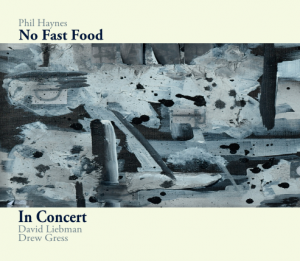
Drummer/composer Phil Haynes (Free Country, Paul Smoker, Gebhard Ullmann) organized his new trio - known as No Fast Food - around David Liebman (flutes, tenor sax, soprano sax) and his long-time collaborator Drew Gress (bass).  As someone who first was introduced to creative music in the late 1960s and early 1970s by seeing and hearing Wadada Leo Smith, Julius Hemphill, and Trio Air (Henry Threadgill, Fred Hopkins and Steve McCall) among others, the music one hears on "In Concert" (CornerStoreJazz) hearkens back to those nights in airless concert spaces or large churches, when the music would cut right through the listener, bounce off the walls, shock, soothe, and challenge everyone in the audience.

The 2-CD set was recorded over 2 nights (9/06 & 08/2012), one in the Bop Shop (Rochester, NY), the other in the Elk Creek Cafe (Millheim, PA).  Gress's full, thick, tones mesh well with Haynes' expansive use of his trap set.  As "free" as it seems at times, this music rarely feels noisy.  There are moments, especially on "Incantation", that the music feels more like praying. Isn't that what the blues, a prayer, calling out to the Lord for release?  One hears that in Leibman's heartfelt soprano solo on "Blues for Israel" and his tenor statements on "Last Dance."  The fine mallet work and the counterpoint from Gress on the latter track stand out.  The way this Trio manipulates rhythms is impressive throughout.  "West Virginia Blues" combines a hearty walking bass with pounding drums while the tenor solo seems to be in 1/2-time.  And, after the bass solo, the trio emulates Sonny Rollins' "Way Out West" for a brief moment before moving on.  There are numerous playful moments, most noticeably on "The Code", where the theme seems to built upon a game of hide-and-seek.  During the drum solo, the bass dips in and out, then Gress and Leibman conduct a feisty conversation (especially the tenor) - the drummer returns and the conversation gets a bit more agitated leading to Leibman's a cappella moment.  The Air connection really stands out, for me, on "Ballad du Jour" especially the interplay of the bass and drums as well as the "open" quality of the tenor solo.

"No Fast Food" is a fine credo to live by and, in the case of Phil Haynes, a splendid showcase for both his compositions and his relationship with Drew Gress and David Leibman. This is "live" music that deserves to be heard live.  Until that happens, take a deep breath and dive into this 100-minute ocean of sounds.  For more information, go to www.philhaynes.com.


Wednesday, January 29, 2014

Drummer-led Ensembles (Part 1)

Hard to believe that "Time's Tales" (Okeh Records) is drummer/ percussionist/composer Jeff Ballard's debut as a leader. Fans of creative modern music know the California-native from his work in pianist Brad Mehldau's Trio and his co-operative trio FLY (with Mark Turner and Larry Grenadier.  Over the past 2 decades, the drummer has worked and recorded with pianists Danilo Perez and Chick Corea as well as in Joshua Redman's Elastic Band.

For his debut CD, Ballard has created a trio (only seems natural) with  guitarist Lionel Loueke and alto saxophonist Miguel Zenon. Over the course of 10 tracks (57 minutes), the music moves around the globe, with stops in Africa (Loueke's "Virgin Forest" which opens the album),  New Orleans (the drummer's composition "Beat Street"), Cuba ("El Reperador de Suenos" from the pen of Silvio Rodriguez - it's one of the prettiest pieces on the disk), Tin Pan Alley (the Gershwin brothers' "The Man I Love", featuring an emotionally poignant solo from Zenon) and, perhaps the biggest surprise, the hard rock sounds of Queens of the Stone Age ("Hangin' Tree", with Lionel Loueke delivering scorching riff after riff.) Zenon holds his own on the last tune mentioned, playing with great fire as Ballard flails beneath the solos.

One can hear that this session is no "one-off", that the trio has worked together on numerous (in fact, since 2006) and, that while each one of them is a leader, this is a true group effort. The music goes in so many directions because these musicians have played so many different styles and bring such great ideas to the sessions.  "Dal (A Rhythm Song)" is based on a piece by Bela Bartok featuring a lovely saxophone solo over strong hand drumming and sparse yet effective guitar work.  The guitar and saxophone play the fascinating melody of "Western Wren (A Bird Call)", actually adapted from a recorded bird call, together (Loueke playing very high notes) and then spar over the active brush work of Ballard.  Two improvisations fill out the program, the short (:47 seconds) "Free 1" and the longer, much more involved "Free 3" that is the final track.  "Free" improvisation can be daunting yet the trio move the piece organically over the martial beat and staccato saxophone riffs.

Jeff Ballard may have waited until he was 50 before releasing his debut as a leader - for those of us who have enjoyed his efforts over the past 20 years, the wait was worth it and the results highly enjoyable.  "Time's Tale" is a joy to listen to and deserves your attention. For more information, go to www.jeffballard.com.  The Trio will be on a European tour in February and at selected venues in the United States starting in June of this year.  


Rudy Royston, born in Texas and raised in Colorado, is one of those drummers music listeners gravitate to.  He's an exciting, unpredictable, forceful yet gentle player.  He has worked to great effect with trumpeters Ron Miles and Dave Douglas, guitarist Bill Frisell, and saxophonist JD Allen.  Royston is an in-demand session player and now, with the release of "303" (Greenleaf Music), a leader.

The album, named for the zip code in the part of Colorado where Royston spent his formative years, features a septet with Jon Irabagon (saxophones), Nadja Noordhuis (trumpet), Nir Felder (electric guitar), Sam Harris (piano) and Mimi Jones plus Yasushi Nakumura (basses).  The music, all but 2 of the 11 tracks composed by the leader, is surprisingly soulful, especially the haunting rendition on Mozart's adaptation of a Eucharistic hymn "Ave Verum Corpus." Royston's quiet brush work and cymbal splashes color the strong saxophone work of Irabagon (he and Royston work together in Dave Douglas's Quintet). The other non-original is Radiohead's "High and Dry", with bass chords supporting the atmospheric guitar and the leader's hard-edged drums. It's quite a handsome melody and this version builds on it without losing the vision of the original.  There's a feel of "Philly soul" in the sounds of "Prayer (for the people)", a short piece featuring strong bass work from Ms. Jones (I believe), good piano from Harris and a horn arrangement that suggest s but not copies Abdullah Ibrahim.  Felder, whose debut was recently released on Okeh, is a sparkplug throughout the program.  His quiet and soul-stirring phrases lead the way into "Goodnight Kinyah" while his long tones and clicking rhythm underscore the horns and piano on "Mimi Sunrise."  His rippling lines soar over the driving drums and overdubbed percussion on "Play On Words", a piece with echoes of Miles Davis's mid-1960s Quintet, whereas "Miles to Go (Sunset Road)" has a funky Caribbean feel in the chunky guitar riffs and Royston's patterns.  The hypnotic interaction of Irabagon's tenor and Ms. Noordhuis's trumpet is soothing as the piece fades.  

To his credit, Rudy Royston has made a "group" recording, not a CD built around his drum solos.  He does step out on several occasions, especially on the fiery climax of "Gangs of New York" (Felder matches his intensity) and on the up-tempo romp "Bownze" (featuring a great sax solo and strong work from the bassists.)  There are moments when the music has the sound of Brian Blade's Fellowship or the afore-mentioned Miles Davis Quintet.  "303" is a solid debut for Royston, featuring an ensemble that can should mature as it plays in live settings (where the drummer usually does his finest work.) For more information, go to www.rudyroyston.com.

Tarun Balani is a drummer/composer born in India who first came to New York City to study with at the Collective School, then went up to study with Ralph Peterson, Jr. and Jamey Haddad at the Berklee School of Music before moving back to India to form the Global Music Institute in New Delhi.  His debut CD, "Sacred World" (self-released), was recorded in Mumbai and issued there in 2012.  It's now out in the United States and well worth your time.

His ensemble, the Tarun Balani Ensemble, features his brother Aditya on guitars, Sharik Hasan (piano), the veteran bassist (and Berklee instructor) Bruno Raberg plus Suhail Yusuf Khan (sarangi on 3 of the 8 tracks with vocal on another 1).  If you do not listen closely to the opening 2 cuts - "Belief" and "The Other Side" - one would think that the program was going to be influenced throughout by the work of The Pat Metheny Group, circa 1980. The Metheny sound is noticeable in the textures and certainly in the chordal patterns of "Belief."  Suhail Khan's first appearance is on cut #3, "Azaan", which opens with acoustic guitar tuned differently than a Western guitar;  then Hasan and Raberg play a unison melody joined after a moment by the guitar leading up to Khan's vocal.  The pace is different, the percussion (once Balani enters) taking on a more melodic part interacting with the piano and vocal.  Aditya Balani switches back to electric guitar on the next track, "Pictures", and that Metheny/Mays influence returns but is less reverential. The title track is a long ballad, built from a handsome unaccompanied nylon-string guitar introduction.  One by one, the other musicians (save for Khan) enter starting with Raberg's melodic bass, then Hasan's resonant piano work and finally the cymbals.

The final 3 tracks adds Khan's sarangi, an ancient Indian stringed instrument that sounds like a violin.  One can hear clearly on "Varsha" the fusion hinted at in the earlier tracks plus Balani' approach to the drum kit changes, the bass drum becoming more prominent and the the rhythms played on the snare and tom have more of an Eastern feels.  The CD closes with "Arjuna" and "Arjuna Reprise" which continues along the lines of fusion of East and West.  The tracks are actually on long performance, the first part featuring a powerful electric guitar solo followed by Hasan's more rhythmic piano spotlight (the pianist is an excellent musician, with a rich sound on his instrument).  After a reiteration of the theme, the pieces changes to a slower pace for an unaccompanied piano solo -  that leads to a long, crackling, drum solo over insistent piano chords and a descending bass line before the rest of the group returns to the formal theme.

The power inherent in the music on "Sacred World" grows with each listen.   One moves past the influences and begins to listen to the interactions of the musicians, how they connect with each other, and how melody and rhythm are front-and-center throughout.  Tarun Balani has created quite an impressive work of art; one is curious to hear how his music will grow, expand and mature.  For more information, go to tarunbalani.wordpress.com.