Showing posts with label Kurt Rosenwinkel. Show all posts

Saturday, August 3, 2024

See the Light


There was a long time in the recorded history of Black American Music, especially Improvised Music, that records labels big and small put together recording sessions that combined leaders of various ensembles in their own "Super Session."  Norman Granz did it in the 1950s with his "Jazz  at The Philharmonic" series, Milestone/Prestige producer Orrin Keepnews did something similar in the 1970s and 80s with Sonny Rollins, McCoy Tyner, Bobby Hutcherson. and others. Wayne Shorter's Quartet, founded in 2000, is, perhaps, the most successful of the "leaders-full" group – pianist Danilo Perez, bassist John Pattitucci, and drummer Brian Blade are all established artists who joined the late Mr. Shorter to create a two decades of explorations and sonic adventures.


Photo: Erika Kapin
The members of Lux Quartet have a similar lineage to Mr. Shorter's group. Pianist Myra Melford seemingly exploded onto the "jazz scene" out of Chicago to New York City in the early1990s with her HatArt trio recordings and has gone to lead or co-lead numerous ensembles. Drummer Allison Miller has been leading ensembles since the early 2000s, creating music that blends story and song, rhythm  and freedom; she also is a highly sought-after side person.  Saxophonist Dayna Stephens has also been in the spotlight since the mid-2000s creating albums and groups that celebrate tradition as well push at the borders of said tradition.  Bassist Scott Colley has a list of credits ranging from recordings and live gigs with guitarist Jim Hall, saxophonist Donny McCaslin, pianist Andrew Hill, vibraphonist Gary Burton, and so many others to eight albums as a leader. Put these four musicians together and the sky's the limit!

"Tomorrowland" (ENJA/Yellowbird) is the Lux Quartet's debut album. Ms. Melford and Ms. Miller, the co-leaders of the band, contribute three compositions apiece to the program with Mr. Stephens and Mr. Colley adding one of their own.  All that aside, when you put on the album, this is most assuredly a group effort.  The opening track, Ms. Melford's "Intricate Drift", comes in on a martial beat and a slinky melody line. First thing one hears is bassist Colley's counterpoint to that melody.  The alto sax solo skitters atop the now-dancing rhythm section. Ms. Melford's piano solo builds off the delightful alto spot, introducing a touch of Monk and a lot of angular melody lines and chords.  Ms. Miller's "Congratulations and Condolences" opens like a mid-1960s John Coltrane piece with the soprano sax melody bouncing off the high-powered rhythm section.  The energy jumps up considerably for the sax solo.  Ms. Melford follows with her knuckle-buster solo like a whirling dervish in the midst of a sand storm.

Image: Michael Jackson
The following track, "Deeply Us" (also a Miller composition), is a beautiful ballad on which Mr. Colley's bowed bass and the truly emotional piano solo stand out. Mr. Stephen's tenor does not really enter until half-way through but his melodic journey is gentle and heartfelt. Nothing is rushed or truncated, all the elements in their places. 


Listeners who remember the great San Francisco Bay-area drummer Eddie Marshall (1938-2011, pictured left) who played with the fusion quartet The Fourth Way as well as vibraphonist Bobby Hutcherson (among many others) will enjoy Ms. Miller's "Speak Eddie".  Starting out as a fast "bop" tune, the quartet immediately drops into a march beat to state the theme. Ms. Melford charges ahead into her solo firing up the rhythm section to alternate tempos, her dancing two-fisted attack raising the bar. What follows is a bass and sax conversation (sans piano and drums) with the musicians teasing, cajoling, and, all of a sudden, Ms. Miller takes Colley's place dueling with Stephens before the drummer takes over for a short, fiery, solo before everybody returns for a quick statement of the theme. 

The album closes with the title track, the bassist's contribution, and it too is a powerful ballad. After a two-minute solo piano introduction, the bassist shows his masterful melodic side which leads to the tenor taking the lead over the swirling cymbals and piano-bass conversation. The most impressionistic piece on the program, the second half of the performance rises and falls on the bowed bass, skittering cymbals, and the saxophone's gentle pleading, perhaps praying. The intensity ramps up until the inevitable fall back down to silence. 

The more I listen to "Tomorrowland", the more I hear a group effort. It's understandable for some to concentrate on the four excellent musicians in the Lux Quartet. One really has to listen as we were the fifth member of the group sitting alongside the rhythm section. Judging by the videos online (see one below), the band is excellent in person. Jump in – tomorrow is sounding quite good!

For more information, go to https://myramelford.com/projects/project/display/id/29/Lux-Quartet. To hear more and to purchase the album, go to https://lux-quartet.bandcamp.com/album/tomorrowland

Watch the band play "Intricate Drift":


O yes, one more review and a quick one: 

Guitarist Kurt Rosenwinkel really came into his own as a bandleader, composer, and guitarist in the late 1990s when he organized The Next Step Band, a quartet featuring Mark Turner (tenor saxophone), Ben Street (bass), and Jeff Ballard (drums). Sometimes, pianists Brad Mehldau or Scott Kinsey joined the core quartet.  Rosenwinkel signed with Verve Records in 2000, producing a trio of albums over the next three years featuring these musicians. "The Enemies of Energy" was issued first – the album had been recorded in 1996 and, upon its release, received great critical acclaim in the United States and around the world.  "Live at Smalls 1996" (Heartcore Records) shows the group at its best, navigating through six tunes, five of which exceed nine minutes, with an infectious energy that begs one to play the album loud...and often. It's a treat for the listener to get lost in the improvisations –– Turner and the leader are particularly impressive all the way through. Under headphones, one can hear the subtlety that Ballard and Street bring to the music, not just holding the pieces together but really pushing the front line.  

Listen below to "Use of Light" to hear a group that listens, responds, and is involved in telling its story!


Give a listen:

Monday, June 26, 2023

Large Ensemble: Roots Music

Composer, arranger, trumpeter, and educator Daniel Hersog seemingly burst onto the jazz scene with the release of his debut Large Ensemble album "Night Devoid of Stars" (Cellar Music). Of course, nobody just appears on the "scene"––Hersog, a native of Victoria, British Columbia, is a graduate of the New England Conservatory of Music in Boston, MA, and, as a trumpeter, has played throughout North America with artists such as drummer Terry Clarke, trumpeter Brad Turner, the Vancouver Legacy Jazz Orchestra, and the Jaelem Bhate Orchestra (with whom he recorded two albums).  Hersog is currently on the faculty of Capilano University in Vancouver, BC, where he is an Academic Coordinator and Instructor in the Jazz Studies Program plus leads a trumpet ensemble.


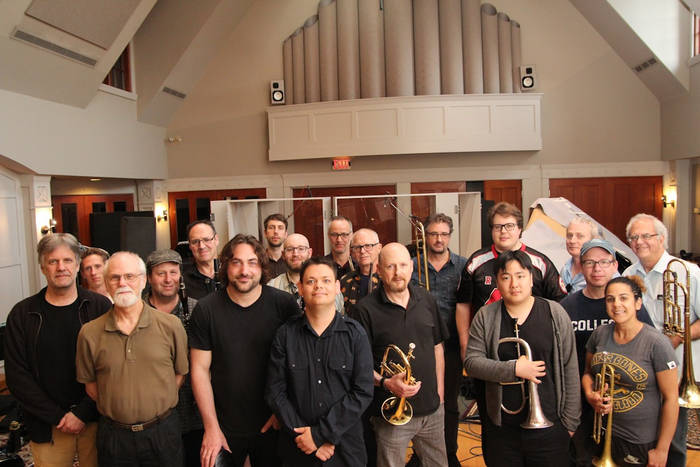
Now, the second album from the Daniel Hersog Jazz Orchestra has dropped.  "Open Spaces: Folk Songs Reimagined" (Cellar Music) states its mission in the title.  The majority of the pieces come from traditional musics of Canada and the United States interspersed with pieces by Gordon Lightfoot and Bob Dylan plus several Hersog originals. The ensemble (listed below) is composed of musicians from both countries as well as classmates (Noah Preminger and Kim Cass) and instructors (Frank Carlberg and Brad Turner), many of whom appear on the first CD.  The addition of reed master Scott Robinson and guitarist Kurt Rosenwinkel gives Hersog a bigger palette to work with and he does so liberally. The 10-song program opens with the late Mr. Lightfoot's "Wreck of the Edmund Fitzgerald"––Preminger's hard-edged tenor solo represents the blowing winds and Carlberg's piano the roiling waves while Dan Weiss's drums are the sound of the boat splitting apart. That's followed by a rousing coda leading into Hersog's imaginative take on Bob Dylan's "Blowin' In the Wind".  Titled "How Many Roads", there's a flowing guitar solo over the responsive reeds and supportive brass.  The reeds and brass play a "call-and-response" with the piano before Carlberg digs into his solo over the rough and tumble bass and drums.

After a stately introduction, "Shenandoah" becomes a beautiful ballad featuring an amazing baritone sax solo from Scott Robinson. Heartfelt, emotional, melodic, the listener is transported out of the crazy world by the stunning and brilliant arrangement that supports him (kudos to Carlberg as well) and the simple yet generous melody.  Robinson returns to the spotlight on "Rentrer" but not until after Cass's lovely solo bass introduction and Carlberg plays the rambling theme which, in turn, leads into Rosenwinkel's short but sweet solo.  Robinson's baritone solo goes deep and then swoops to the higher register of the big instrument. The final two minutes of the piece features the sections swirling around the guitar, rising like the murmuration of starlings before the the abstract finish.

Photo: Robert Iannone
Other highlights include the playful "I Hear", a piece that opens with the ensemble "barking" at other until Weiss falls into an up-tempo rhythm for a hard-edged tenor solo before the tempo changes abruptly into a Fellini soundtrack interspersed with a swing beat for Ben Kono's fine clarinet spot. The longest track on the album (11:10), the playful tune makes room for a sharp and humorous romp for trumpeter Turner. Later in the program, the Hersog original "Sarracenia Purpurea" (named for a Pitcher Plant that grows in marshes and bogs) starts off on fire but quiets down for Robinson's baritone solo which slowly and steadily picks up in intensity as the rhythm section pushes him to dig in. Soon, the brass and reeds begin to color behind him before everyone frolics around the drums as the music arrives at its rousing finish.  

The album closes with a sweet reading of "Red River Valley" (for all its connections to Cowboy movies, the song actually was composed in Canada during the 1870s). After a pretty introduction, Rosenwinkel's guitar joins the brass and reeds to play the theme. After a second verse and a striking variation played by the Orchestra, the guitarist plays the melody once more and then plays his striking solo.  Even sweeter, the entire ensemble sings two choruses before the ensemble plays the melody before the lovely crescendo that ends the piece and the album. 

You will hear the influences of many large ensemble arrangers and composers in the music of the Daniel Hersog Jazz Orchestra but the leader's vision plus eloquent arrangements for this ensemble are clear and truly his own.  "Open Spaces: Folk Songs Reimagined" grew out of the composer/arranger's need to move his music forward after a successful debut as well as to adapt to the changes in his life (teaching and marriage).  There are interpretations of beauty and breaths of humor (and occasional chaos) throughout the album; the music flourishes on the collective work of this fine group of instrumentalists.  Do sit and listen––the rewards are abounding!

For more information, go to www.danielhersog.com.  To hear more and to purchase the album, go to https://danielhersogjazzorchestra.bandcamp.com/album/open-spaces-folk-songs-reimagined.

Personnel:

Daniel Hersog- Conductor

Ben Kono- Oboe, Soprano Saxophone, Flute, Clarinet
Ben Henriques – Alto Saxophone, Soprano Saxophone, Clarinet
Noah Preminger- Tenor Saxophone
Tom Keenlyside- Flute, Alto Flute, Piccolo, Tenor Saxophone
Scott Robinson- Baritone Saxophone, Bass Clarinet, Flute

Michael Kim- Trumpet and Flugelhorn
Brad Turner- Trumpet and Flugelhorn
Derry Byrne- Trumpet and Flugelhorn
Jocelyn Waugh- Trumpet and Flugelhorn

Jeremy Berkman- Trombone
Jim Hopson- Trombone, Euphonium
Andrew Porrier- Trombone
Sharman King- Bass Trombone

Kurt Rosenwinkel- Guitar
Frank Carlberg- Piano
Kim Cass- Bass
Dan Weiss- Drums


Listen here to "Jib Set":


Here's the DHJO in the studio: