Showing posts with label Felipe Salles. Show all posts

Sunday, May 21, 2023

Large Ensembles and Real Life (Part 1)


Brazilian native (Sao Paulo), saxophonist, composer, and arranger Felipe Salles came to the United States in 1995. Since then, he has worked with and led several different-sized ensembles and has taught at the University of Massachusetts/ Amherst for 13 years.  As a composer, he's been quite interested in the Immigrant experience in the United States––in 2020, Tapestry Records issued "The New Immigrant Experience", his second album with his large band, the Interconnections Ensemble (their 2018 release, "The Lullabye Project", was based around tunes from the composer's Brazilian upbringing). The "...Immigrant Experience" is a multi-media project that combines Salles's powerful compositions with interviews featuring immigrants to the US as part of DACA (Deferred Action for Childhood Arrivals).  The stories within the music are heart-breaking, emotional, stunning, and question the attitudes of politicians around the country who hold the future of these people hostage.

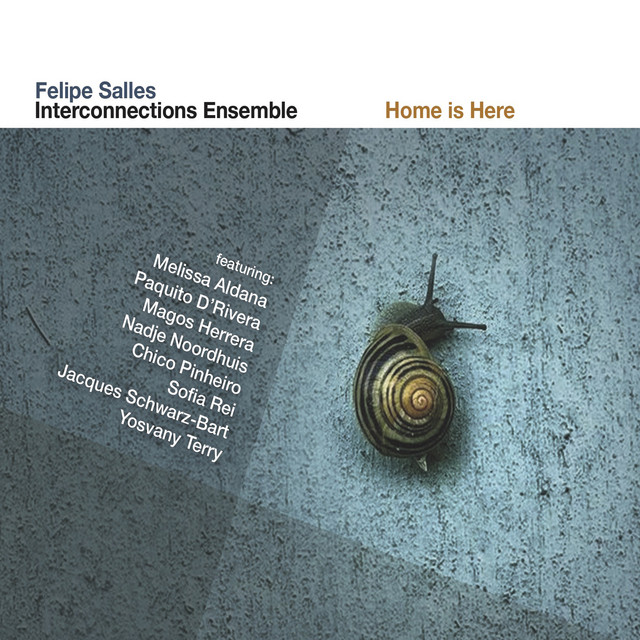
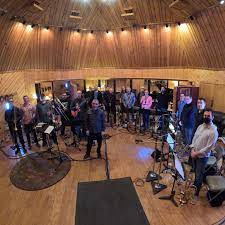
The 19-member Ensemble's latest project is "Home is Here" (Tapestry Records) and finds Salles writing intricate and vibrant pieces for eight guest artists, all of whom left their countries of origin to pursue their artistic dreams in the US.  The album opens with "Re-Invention", a vehicle for Paquito D'Rivera, the oldest guest in the project who, arguably, had the hardest journey to citizenship.  Listen below to how Salles blends Cuban rhythms into the body of the piece plus uses the ensemble to paint an evocative portrait. Rivera's joyous clarinet solo (like most if not all of his solos) dances with glee through the musical landscape. "World Citizen" finds Terry, the other Cuban ex-pat, in a less formal setting, one in which the drums and percussion push the proceedings forward.  The sensuous feel gives the soloists (bass trombonist Angel Subero and alto saxophonist Terry) just the right cushion (the setting for the sax solo has more fire but is positively effective).

The two tracks with vocals are quite different. Ms. Rei's moves easily through "Meridian 63", the mid-tempo "bouncing rhythm" supporting her voice as do the brass on the verse. Jonathan Ball's rollicking soprano sax gives the vocalist to scat along with the reeds and brass.  Quiet flutes lead the group in on "Two Worlds Together", a "dark" ballad featuring Ms. Herrera. Note how Salles uses the sections to provide a gentle response to the huskiness of the wordless vocal. However, the emotion displayed by Ms. Herrera gives Tyler Burchfield's bass clarinet solo its focal point while freeing up the vibraphone playing of Luke Glavanovits.  

"Home is Here" comes to a close with "Storytelling". After a quiet opening, the rhythm section propels the piece forward with tenor saxophonist Melissa Aldana leading the ensemble through the theme.  At the close of guitarist Kevin Grudeki's solo, the ensemble drops out and Ms. Aldana steps out for a short, lovely, solo.  She then leads the band back in to support her soaring and exuberant solo.  The full-throated music reminds the listener that many musicians from other parts of the world, including Felipe Salles, have made their mark in this "Promised Land" thankful for the artistic freedom that the United States provides, finding their voice in the Creative Music. We listeners are thankful for the many sounds these artists have brought to our lives.  

For more information, go to www.sallesjazz.com.

Here's the opening track:


Personnel: 
Felipe Salles conductor and composer, soprano saxophone on one track;
Saxophones and woodwinds; Jonathan Ball, John Mastroianni, Mike Caudill, Carl Clements, Tyler Burchfield; 
Trumpets and flugelhorns; Don Clough, Jeff Holmes, Seth Bailey, Bill Fanning, Jerry Sabatini; 
Trombones; Clayton DeWalt, Randy Pingrey, Bob Pilkington, Angel Subero; 
Nando Michelin, piano
Kevin Grudecki, guitar
Luke Glavanovits, vibraphone
Keala Kaumeheiwa, bass
Bertram Lehmann,  drums/percussion.

Guests:
Paquito D'Rivera (Cuba) – clarinet & alto saxophone
Sofia Rei (Argentina) – voice
Jacques Schwarz-Bart (Guadeloupe/France) – tenor saxophone
Nadje Noordhuis (Australia) – flugelhorn
Magos Herrera (Mexico) – voice
Yosvany Terry (Cuba) – alto saxophone & shekere
Chico Pinheiro (Brazil) – guitar
Melissa Aldana (Chile) – tenor saxophone


Saturday, March 21, 2020

Riches of the Large Ensemble (Part 2)

Photo: National Sawdust
As we sit in our homes in the early stages of the pandemic, music and arts seem even more important.  Other issues seem to be swept under the legislative carpets but not immigration––for all intents and purposes, no one is legally crossing the borders.  Still, we should all sit and watch the DVD that comes in the new 3-disk set from Felipe Salles Interconnections Ensemble "The New Immigrant Experience: Music Inspired by Conversations with Dreamers" (Tapestry).  No matter how you feel about the immigration situation in the United States and around the world, putting a human face and voice to the issue is so important.

The music stands up well without the video; in fact, this is a brilliant program that Salles has composed and arranged.  His 2018 Tapestry release, "The Lullaby Project (and Other Works for Large Ensemble",  was excellent (one of my Top Ten recordings of that year)––this music is even better. Salles, a Brazilian by birth, uses numerous rhythms from his homeland during this 11-song program.  Kudos to the rhythm section and, especially to the composer's use of Ryan Fedak's mallet percussion. Also worthy of mention is how brilliant (as in "illuminating") the sections sound, how they serve to advance the melody and open up spaces for solos. And this is not a program with many people soloing on every song (the average length of which is nine minutes).  When they do occur, the results are uniformly excellent. There's even a touch of modern electronic playfulness on several tracks e.g. guitarist Kevin Grudecki's heavily amplified solo on "IV: A Part And Not The Other" plus the "electronics"-enhanced trumpet solo (Eric Smith) and tenor sax solo (Mike Caudill) on "IX: These Things That Are Taken For Granted".

Truly, the best part of "The New Immigrant Experience" is the writing––this music, some of whose melodies are based on the cadence of certain words spoken by the people the composer interviewed during the process), stands out from the opening moment until the last notes have faded.  Even after listening to the stories of the nine "Dreamers", the feeling one gets from the music is hope, positive hope. Please listen to the stories, then listen to the music.  Then listen again and share with friends and your state and federal politicians. Felipe Salles has something to say and he does so brilliantly, especially with the aid of the Interconnections Ensemble.

For more information, go to www.sallesjazz.com.

Here's # "I":


Personnel:

Felipe Salles, composer and conductor
Jonathan Ball, alto and soprano saxes, flute, piccolo
Mike Caudill, tenor and soprano saxes, flute, clarinet, electronic effects
Rick DiMuzio, tenor sax, clarinet
Tyler Burchfield, bari sax, bass clarinet, clarinet

trumpets/ flugelhorns
Jeff Holmes; Don Clough; Yuta Yamaguchi; Eric Smith, electronic effects; Doug Olsen

trombones
Clayton DeWalt; Randy Pingrey, Bulut Gülen, Angel Subero, bass trombone

Nando Michelin, piano
Kevin Grudecki, guitar
Ryan Fedak, vibraphone
Keala Kaumeheiwa, bass
Bertram Lehmann, drums, percussion


Anna Webber (tenor saxophone, flute) and Angela Morris (tenor saxophone, flute) started their big band, in fact the Webber/Morris Big Band, in 2015, gathering an ensemble of New York City musicians to play music that refers to the past, is very much of the present moment, and often looks to the future.  The W/MBB has just issued its debut album, "Both Are True" (Greenleaf Music) and, like the aggregation's live show, this music is bound to turn grab one's attention.

Over the course of 58+ minutes, so much happens.  Voices step out of the songs, the different sections take on various roles, the music is both introspective and communal, emotional and cool, pulsating and ruminative, yet always alive.  "Climbing on Mirrors" (A.W. composition) opens the program with an urgent three-note staccato; immediately, other horns ands reeds pick up on playing slight variations a la Steve Reich. Only drummer Jeff Davis gets to move around freely. When the entire band enters, it's only for a short moment and one hears shades of the music of Darcy James Argue. As alto saxophonist Charlotte Greve moves into her solo, pay attention to what else is occurring. Soon, a "groove" emerges with Davis, bassist Adam Hopkins, and vibraphonist Patricia Brennan the spark plugs. Still, this is "slippery" music in that the shapes are continually shifting, creating a tension that is never quite dispelled.

For some listeners, the elusive quality of the music may be off-putting but, for this writer, it's engaging. Both Anna Webber and Angela Morris have roots in the avant-garde, creative classical music (Ms. Webber), and pop (Ms. Morris) with their individual works covering much territory. That's the spirit which pervades this music. Whether it's the two short duos performed by the leaders or the sombre "Coral" (A.M. composition), an elegy for orchestra out of whose floating chords and little "noises" the solo voice of Adam O'Farrill rises with short notes and long tones that begin to coalesce  into a series of phrases that pick up in intensity as the ensemble roils below him. Other voices give chase but soon the bottom disappears and the clarion call of the trumpet leads to a gentle finish.

Photo: Hiroyuki Masuro
There's much more, such as the rollicking "And It Rolled Right Down" (A.W.) with its triumvirate of Adam Schneit (clarinet), Jake Henry (trumpet), and Reginald Chapman (bass trombone) "conversing" over the stumbling rhythms plus Ms. Webber's "Reverses" that closes the album. With an opening  melody that suggests "The Peacocks" by Jimmy Rowles, the music picks up speed thanks to the insistent trumpets before dropping down to tolling piano chords.  The rhythm section revives the "groove" and the ensemble pushes forward even as the brass and reeds are playing the long, slow, phrases from the opening. Halfway through the 11:39 track, the trumpet of Kenny Warren steps out of the once again diminished ensemble, creating a solo that is filled with quick runs. The brilliance in the arrangement is how the arrangement frames the solo with occasional full-on blasts from the assembled multitude before all drop back. Yet, they all jump back in leading to the close where various voices recite Maya Angelou's poem that the track took for its name.

Give "Both Are True" the time to infiltrate your mind, take the time explore the melodies and how the sections move in and out, how the soloists use their time in front so intelligently, and the seeming infinite colors the Webber/Morris Big Band creates.  This music lives, breathes, and, in the long run, lifts one higher.

For more information, go to angelamorrismusic.com/bigband/

Here's the opening track:


Personnel:

Angela Morris: conductor, tenor saxophone, flute 
Anna Webber: conductor, tenor saxophone, flute 
Jay Rattman: alto saxophone, soprano saxophone, flute 
Charlotte Greve: alto saxophone, clarinet 
Adam Schneit: tenor saxophone, clarinet 
Lisa Parrott: baritone saxophone, bass clarinet 
John Lake: trumpet, flugelhorn 
Jake Henry: trumpet, flugelhorn 
Adam O’Farrill: trumpet, flugelhorn 
Kenny Warren: trumpet, flugelhorn 
Tim Vaughn: trombone 
Nick Grinder: trombone 
Jen Baker: trombone 
Reginald Chapman: bass trombone 
Patricia Brennan: vibraphone 
Dustin Carlson: guitar 
Marc Hannaford: piano 
Adam Hopkins: bass 
Jeff Davis: drums 


By this time, you should know the name and the voice of Luciana Souza.  Born and raised in São Paulo, Brazil, Ms. Souza actually began her career at the age of three (!) when she recorded a radio jingle. She was quite busy in the advertising world through her middle-teens and soon moved into the world of entertainment. She came to the United States, studied and rtaught at the Berklee School, then earned a Master's Degree at The New England Conservatory of Music, and also taught at the Manhattan School of Music. Ms. Souza's list of recordings is impressive, not only for the 12 releases under her own name (most on the Sunnyside label) but also for her collaborations with artists such as The Yellowjackets, Ryan Truesdell Gil Evans Centennial Orchestra, Bobby McFerrin, the vocal quartet MOSS, Herbie Hancock, the Maria Schneider Orchestra, and more. 


Among the "more" is composer-arranger Vince Mendoza––she appears on his 2011 album "Nights On Earth." In 2017, Ms. Souza and Maestro/ arranger Mendoza joined forces with the WDR Big Band Köln for "Storytellers" (Sunnyside), an album and concert celebrating great Brazilian songwriters. Over the course of the 10-song program, one hears music from Ivan Lines, Edu Lobo & Chico Buarque, Gilberto Gil, Djavan, Guinga, Chico Pinheiro & Tiago Costa pone piece each from Ms. Souza, Mr. Mendoza as well as two pieces from Antonio Carlos Jobim.  In the liner notes, the singer writes Matita Perê” is at the center of this recording. It is Jobim’s tribute to the vast and relentless presence of nature in Brazil". Composed in 1972 at a time when Brazil was going through martial law, censorship, and the Right Wing's consolidation of power, the piece celebrates the greatness of the country and its vast ecological power––while the lyrics are quite abstract, the music is extremely powerful (too bad there is no English translation in the liner notes).


The album moves between lovely ballads, such as Lobo/Buarque's stunning "Beatriz" (with a melody that invokes Stephen Sondheim) and delightful uptempo songs such Lins's "Se Acontecer" (whose tempo suggest Steely Dan circa "Royal Scam" and "Aja").  Mendoza's arrangements utilize the Big Band in intelligent fashion, with the brass and reeds often shadowing the voice, doubling her wordless vocals (as they do on his "Choro #3" which includes a delightful clarinet solo from Johan Hörlen as well as a dancing spot from trombonist Andy Hunter); the band gets to swing and float––check out Ms. Souza's "Baiäo" and how the rhythm sections buoys the flutes while the brass connect with the wordless vocal.  

Photo: Kim Fox
The other Jobim tune, "Choro Coração", is such a gentle piece. Besides the lovely vocal, Karolina Strassmeyer contributes an emotionally rich alto saxophone solo which is followed by a handsome muted trumpet solo courtesy of John Marshall.  Pay attention to how gentle the rhythm section is, especially pianist Rainier Böhm, bassist John Goldsby, and drummer Hans Dekker; smooth but ever-so-enchanting.  

"Storytellers" closes with the elegant "Sim ou Näo" (Djavan) where one hears Ms. Souza's voice joined by multiple flutes and supportive brass.  There's a fine flugelhorn from Ruud Bruels and such a gentle sway from the rhythm section that one finds it quite easy to fall under the spell of this special music.  Luciana Souza, Vince Mendoza, and the WDR Big Band Köln are a perfect match and this album is joyful listening in many different ways. Don't miss this recording!

For more information about the vocalist, go to www.lucianasouza.com.  For the WDRBB, go to www1.wdr.de/orchester-und-chor/bigband/ (it's all in German).  For Vince Mendoza, go to vincemendoza.net.  

Here's the delightful Ivan Lins tune:


Personnel:

Luciana Souza - vocals 
Vince Mendoza - producer, arranger & conductor 


WDR Big Band Köln: 
Johan Hörlen - saxophone 
Karolina Strassmayer - saxophone 
Olivier Peters - saxophone 
Paul Heller - saxophone 
Jens Neufang - saxophone 
Stefan Karl Schmid - saxophone 
Wim Both - trumpet 
Rob Bruynen - trumpet 
Andy Haderer - trumpet 
Ruud Breuls - trumpet 
John Marshall - trumpet 
Bastian Stein - trumpet 
Ludwig Nuss - trombone 
Shannon Barnett - trombone 
Andy Hunter - trombone 
Mattis Cederberg - tuba 
Paul Shigihara - guitar 
John Goldsby - bass 
Rainer Böhm - piano 
Hans Dekker - drums 
Marcio Doctor - percussion


Thursday, September 27, 2018

Boston Strong Music: Large Ensembles (Pt 1)

Seems like only yesterday that composer, arranger, and band leader Ayn Inserto released her debut album "Clairvoyance" - in fact, the album came out in 2006! That album featured trombonist and mentor Bob Brookmeyer as well as saxophonist George Garzone. A 2001 graduate of the New England Conservatory of Music in Boston (and currently on the faculty of the Berklee College of Music), she was born in Singapore and, with her family, moved to the Bay Area of California when she was 14.  After attending college in her adopted home state, she moved to the East Coast in the late 1990s to study with Mr. Brookmeyer.  It was not long before she organized her Jazz Orchestra, composed of some of the finest players in the Boston area, many of whom she now teaches with).

"Down a Rabbit Hole" (Summit Records) is Ms. Inserto's fourth recording and the third to feature her large ensemble with Garzone as a guest soloist - her 2014 album "Home Away From Home" was recorded in Italy with Massimo Morganti & The Colours Jazz Orchestra.  Besides Garzone, guest artists on the new album feature trombonist John Fedchock and trumpeter Sean Jones.  Over the course of her recordings, she has successfully incorporated  the ideas and teachings that Professor Brookmeyer provided and created her own large ensemble sound.


What you do hear on "...Rabbit Hole" is a delightful sense of playfulness, freedom, and intelligent interactions.  This is music that is not beholden to one sound.  Every piece stands out with splendid section writing, excellent solos, and a rhythm section that is supportive not intrusive, powerful without being overwhelming (special kudos go to pianist Jason Yeager, bassist Sean Farias, and drummer Austin McMahon).  Highlights include the sprightly opening track, Ms. Inserto's "Three and Me."  The "Three" in the title might allude to the guest soloists on the recording, all of whom get to play the melody plus take short yet fine solos.  The arrangement sets up each solo nicely with the sections providing a melodic conversation with counterpoint and harmonies while McMahon's drums strut happily below.

The title track rushes in like Alice in Wonderland's March Hare, in a hurry and not settling down. The song has an irresistible groove that along with a sly melody. Tenor saxophonist Garzone, with the urging of the rhythm section, digs into a delightful solo that often moves from "composed" to "frantic" in a heartbeat.  Fedchock stands out on the sweet ballad "Mister and Dudley", first when he introduces the delightful melody and then on his sweet solo which has a lovely singing quality.  Jones contributes "BJ's Tune" (one of two tracks in the eight-song program that were not composed by Ms. Inserto) - it's also on the slower side but opens up as the sections work through the arrangement of the melody. The composer steps out as the lone soloist with the sections "coloring" the backgrounds as he steps lively in and around the reeds and brass.

Photo: Steve Provizer
The other track not composed by the leader is the final one, a handsome take on The Jackson 5's 1970 smash "I'll Be There."  Pianist Yeager's impressionistic opening sets the stage for the ballad whose theme is lovingly performed by Jeff Claassen on flugelhorn.  Note the lovely unaccompanied reed quartet before trumpeter Dan Rosenthal moves into a fine solo excursion. The arrangement gives the soloist a cloak of reeds and brass to ease him forward.  It's a lovely finish to an excellent program.

"Down a Rabbit Hole" is a delight from start to finish.  You'll hear a trace of Bob Brookmeyer, a dollop of Thad Jones, and a very generous portion of Ayn Inserto.  This album made me smile as the music satisfied my soul!  Listen closely and enjoy!!

Enjoy "Part I: Ze Teach" (with its sly reference to Quincy Jones):


Personnel:

Ayn Inserto, conductor/composer/arranger
Guests: John Fedchock, trombone; George Garzone, tenor sax; Sean Jones, trumpet
Allan Chase, soprano/alto sax; Rick Stone, alto sax/flute/clarinet; Kelly Roberge, tenor sax/clarinet; Mark Zaleski, tenor sax/clarinet; Kathy Olson, bari sax/bass clarinet
Trumpets: Jeff Claassen, Bijon Watson, Dan Rosenthal, Matthew Small
Trombones: Randy Pingrey, Chris Gagne, Garo Saraydarian; Bass Trombone: Jennifer Wharton
Eric Hofbauer, guitar; Jason Yeager, piano; Sean Farias, bass; Austin McMahon, drums
Mike Tomasiak, tenor saxophone, Jerry Sabatini, trumpet, and Jamie Kember, bass trombone, on "Part I: Ze Teach" only.

Saxophonist, composer, and arranger Felipe Salles, a native of São Paulo, Brazil, has been performing and teaching in the United States since 1995. A 1998 graduate of the New England Conservatory of Music with a Doctorate from the Manhattan School of Music (2005), he is currently Associate Professor of Jazz and African-American Studies at the University of Massachusetts/Amherst. Salles has worked and/or recorded with artists such as trumpeter Randy Brecker, guitarist Lionel Loueke, vocalist Luciana Souza, and fellow saxophonist David Liebman.  He has been the recipient of numerous grants for composition including becoming a Guggenheim Foundation Composition Fellow in 2018. Sales has recorded seven albums as a leader (plus one as co-leader), two initially released in Brazil, two on Fresh Sound New Talent, and three on Tapestry Records.


His third for Tapestry is his first with the Felipe Salles Interconnections Ensemble, an 18-member group he assembled to play his original works that blend classical elements with modern Latin American rhythms.  The debut recording, "The Lullaby Project (and Other Works for Large Ensemble)", features two long pieces; the five-movement title track and "Three Tango-Inspired Pieces for Large Jazz Ensemble".  The "Lullabies" are inspired by traditional Brazilian lullabies and the composer's mission "is to create a musical commentary on the dark underlying qualities of lullabies, as well as to illustrate the socially transformative impact (they) have had on generations of children."

Not sure if that prepares the listener for the brilliance of these pieces, the excellent arrangements, the intelligent solos, and the power of the ensemble.  Through-composed, the individual movements take time to introduce the melody, the brass and reeds sharing phrases while the five-man rhythm section (piano, guitar, vibraphone, bass, and drums) create the tension and the urgency in many of the movements.  Throughout the work, the arrangements for the reeds and brass stand out on each "Lullaby".  The individual songs have solos: highlights include Angel Subero's bombastic (even elephantine) bass trombone spot on "Lullaby #2" (still listen to the beautiful writing for the reeds) as well as the powerful yet melodic baritone sax solo from Tyler Burchfield on "Lullaby #4." Salles's utilization of multiple flutes, clarinet, and vibraphone create such a stunning background on "..#4" right before Eric Smith's fine trumpet solo and during it as well.  Nando Michelin plays both piano and melodica on "Lullaby #5" - his piano spot spreads out over the handsome section work building in intensity spurred on by drummer Bertram Lehmann followed by an equally fine solo from alto saxophonist Jonathan Ball.

The "Three Tango-Inspired Pieces..." follow and each has its own charm and power.  The Brazilian Salles has long been charmed by Argentinean and he channels that charm in these compositions.  He writes in the liner notes  how inspired he was/is by composers like Astor Piazzolla yet one could argue that the arrangements also show, at times, the inspiration of Carla Bley and Guillermo Klein.  "Odd Tango" introduces the tension that the rhythm creates for the dancers yet smoothly moves forward on the strength of its melody and solos by Mike Claudill (tenor sax) and Dan Hendrix (trombone). "Astor Square" is dedicated to the modern master. The underlying rhythms, while inspired by the art form, are, at times, looser but note the instant shifts in emphasis and tension.  The album closes with "Carla's Tango".  The afore-mentioned Ms. Bley is not mentioned as an influence but the piece would not sound out-of-place performed by the Liberation Music Orchestra, the last Charlie Haden's big band that she writes and arranges for.  It's the only piece on the album where Salles plays, his soprano saxophone playing both the melody and a delightful solo.

Photo: Steve Schneider
My advice?  Get a copy of "The Lullaby Project", sit down and listen, and notice how the music flows in and around you. Notice how the section writing is so intelligent and filled with wit as well as, at times, tenderness. These melodies have depth and charm.  Nothing is rushed or sounds out of place and the musicianship of Felipe Salles Interconnections Ensemble is very impressive. Dig in and dig it!!

For more information, go to www.sallesjazz.com/InterconnectionsEnsemble.html.

Here's the opening track:


Personnel:

Felipe Salles - Conductor, Composer, Arranger, and soprano saxophone on "Carla's Tango"

Richard Garcia, alto sax, soprano sax, flute
Jonathan Ball, alto sax, soprano sax, flute
Mike Caudill, tenor sax, soprano sax, clarinet
Jacob Shulman, tenor sax, clarinet
Tyler Burchfield, bari sax, bass clarinet

Trumpets
Jeff Holmes
Yuta Yamaguchi
Eric Smith     
Doug Olsen

Trombones:
Joel Yennior
Clayton DeWalt
Randy Pingrey
Angel Subero (bass trombone)

Rhythm Section:
Piano, melodica: Nando Michelin
Guitar: Kevin Grudecki
Vibes: Ryan Fedak
Bass: Keala Kaumeheiwa
Drums: Bertram Lehmann