Thursday, June 30, 2011

"What Makes Sense, What's Absurd"

June 30, 2011

As I write this, the windows are all open in the house.  This is the first day in several weeks when the humidity level is tolerable. The breeze is shaking the leaves, birds are singing, swooping through our yard to get to the neighbor's feeders.  As usual, music fills the room but, today, it's neither jazz nor blues but the engrossing sounds of "Interstitials", the new recording by guitarist-vocalist-composer Joshua Stamper.

Self-recorded and self-released, the songs come from influences as wide-ranging as Aaron Copland and Nick Drake as well as Robert Wyatt and Morton Feldman (both mentioned in Stamper's notes.)  On the opening track, "Wake, Worried Sleeper, Wake", his vocals remind this listener of the more experimental (and British) side of XTC's Andy Partridge and Colin Moulding.  Another enjoyable aspect of this music is, instead of a rhythm section, underpinning the music is the trio of Paul Arbogast (low brass), Michael Cemprola (woodwinds), and Jon Rees (woodwinds, celeste).  Arbogast's trombone gives weight to the songs - however, it's hard not to smile at his bouncing, tuba-like, lines on "Incredible People" and the way Stamper's electric guitar and the saxophones dance atop the rhythm.  There's a hint of Paul McCartney on "Well", in the structure of the song (melody and rhythm) and the sweet jingle of the celeste. In the solo section, a flute takes a gentle journey atop the counterpoint of acoustic guitar, bass clarinet and trombone.  "Away My Sin" (the only instrumental of the 9 tracks) arrives with slide guitar, moaning brass and keening clarinet - as the piece progresses, a persistent and insistent guitar chord supplies the rhythm. The fine word-play of the poetry on "Press" closes the program.  Just voice and guitar until the alto flute, saxes and brass join an unidentified female voice in response to the lyrics -
"Pressed in (good measure)
Pressed out (shaken)
Pressed up (running over)
Pressed down (poured into you)"

and then, the wonder-filled final line -

"It was morning in heaven and we all knew where we were."

On this bright and beautiful morning, the birds still chatter while the chipmunks have begun their daily scamper across the yards and street.  The music of "Interstitials", having now completed its 3rd sojourn through the rooms and my mind, leaves me alert, refreshed and at peace.  Will it do the same for you; I have no idea but you may wish to try.

For more information, go to joshuastamper.com.  To find out even more, go to blissstreetstudios.wordpress.com/2010/03/01/featured-artist-joshua-stamper/.  To listen to and buy his music, click on the player embedded below.

Wednesday, June 29, 2011

Hitting the High Notes (Part 2)

Back to the stack of new CDs, all worth exploring.

Drummer-composer Jochen Rueckert is a versatile musicians, working in various genres from jazz to electronic to rock.  On the jazz side, he's powered the music of Marc Copland, Kurt Rosenwinkel, Sam Yahel and many others including the tenor player on this date, Mark Turner.  "Somewhere Meeting Nobody" (Pirouet) comes 13 years after the drummer's debut as a leader and, besides Turner, features guitarist Brad Shepik plus bassist Matt Penman.  The music doesn't so much attack the listener as it soothes one, pulls you in to the spare yet highly musical world of the 4 musicians. A good number of the 11 tracks drive hard, such as "Vodka Coke", "Delete Forever" (a duet with Penman) and "Dan Smith Will Teach You Guitar."  The soloists make strong statements (not sure if Turner is capable of a sloppy solo.)  Shepik's tone is on the softer side, not unlike that of Steve Cardenas in bassist Ben Allison's band. His contemplative yet exploratory solo on the title track blends blues and folk influences.  As opposed to Rueckert's debut that featured all covers, he composed 9 of the 11 tracks. The "covers" include "To Have and To Hold" composed by Martin Gore for his band, Depeche Mode, and Herbie Hancock's "The Sorcerer." 

The program, taken as a whole, feels like the second set of an extremely good live gig.  If you do not pay attention for the many subtleties in the music, you may think this is a fairly lackluster but, do not be fooled.  This music has fire and emotional depth - listen closely to the interactions of Penman and Rueckert, there's a lot going on there as well.  For more information, go to www.pirouet.com


The same lineup of instruments greets the listener on "Interface" , the 16th release as a leader for alto saxophonist Jim Snidero and his 3rd for Savant Records. It's also the 3rd straight time guitarist Paul Bollenbeck has been his partner on the front line.  The 2 players are quite attuned to each other, whether it's fiery poly-rhythmic drive of the title tracks or the sweet blend of musical voices on "Silhouette", one of several tracks where Bollenbeck switches to acoustic guitar.  Bassist Paul Gill and drummer McClenty Hunter fill out the group and its sound. 

One of the highlights of the disk is the beautiful "One by One" - opening with a handsome unaccompanied acoustic guitar reading of the theme, Snidero follows with his own short solo spotlight before Bollenbeck joins him, echoing the melody with soft guitar chords. Slowly, the bass and drums enter and the song slowly unfolds, not unlike a ballad from Charles Mingus.   Blues-soaked guitar lines give "After the Pain" its strength. Written for Snidero's mother soon after her passing, the song does not mourn as much as it celebrates her life.  On a more celebratory note, the driving rhythms and wailing melody line of "Vipor" captures the band in full voice.  Snidero "wails" above the active drums of Hunter and the insistence of Bollenbeck's acoustic guitar (and, what a fine solo he offers.)

This "sweet 16" for Jim Snidero gets better with each listen - it's quality music deserving of your full attention.  For more information, go to www.jimsnidero.com.


You may not recognize the names of Andrew McCormack (piano) and Jason Yarde (saxophones) but, once you hear "Duo" (Joy And Ears), you'll want to find out more.  Both musicians are based in Great Britain.  Yarde is a busy arranger and producer, having worked with (among others) Kronos Quartet, Hugh Masakela and a slew of Reggae artists. He produced the debut recording of British pianist Gwilym Simcock as well as the latest release by Empirical ("Out 'N' In", reviewed here.) McCormack studied both classical and jazz in college, played with Yarde in the Jazz Warriors and issued his own Trio's debut CD in 2006. 

"Duo" was issued in 2009 but only reached my desk this Spring.  With the exception of "Tune for Toru" by British composer Mark-Anthony Turnage and a lively reading of Leonard Bernstein's "Something's Coming", the CD is filled with original works.  Many of them are quiet and contemplative with Yarde's rich soprano sax in emotionally satisfying conversations with McCormack's engrossing piano lines (there are moments throughout the program where his phrases float like a feather - it's no coincidence one of the tracks is titled "Float Away.") They also have a playful side, on display during the opening moments of "I Miss the Sun" (featuring a feisty alto sax solo) and on their exuberant take of the Bernstein song. Yet, the lovely "No Time Can Tell" (with perhaps the most satisfying soprano work on the CD) and "Thank U4 2 Day" (which remind some listeners of the Jan Garbarek/Art Lande "Red Lanta" session on ECM) resound in one's mind and soul long after the notes fade.

Jason Yarde, who spent a year at William Paterson College in New Jersey, is a fine saxophonist, not afraid of displaying emotion or beauty in his music. Andrew McCormack is the perfect partner, listening, reacting, interacting, his lines articulate and finely played.  "Duo" is worth finding and diving right into - to find out more, go to joyandears.com.  

Tuesday, June 28, 2011

Hitting the High Notes (Part 1)

Here's a quick look at a batch of good CDs.

Alto saxophonist Phil Woods and pianist Bill Mays spent the day together on September 7, 2010, at Maggie's Farm, sound engineer Matt Balistaris's studio in the wilds of Bucks County Pennsylvania.  The result has been issued on the Palmetto label - it's a pleasure to hear the duo ramble through this program consisting of 7 standards and 2 Woods' originals. The saxophonist, 79 & 1/2 years old at the time of the recording, sounds in fine fettle while Mays, 13 years his junior, continues to be one of the most musical players on the scene.  Highlights includes Woods' "Blues for Lopes" (dedicated to his friend and clarinet teacher), the sweet (but not treacly) "Do I Love You?", the rousing take of Irving Berlin's "The Best Thing For You Is Me" (handsome coda to boot) and the other original, "Hank Jones", a touching tribute to the late pianist featuring Woods' most emotional solo. 
This music should go down as easy as summer lemonade - for more information, go to www.palmetto-records.com

Recorded over a number of sessions held in different years, "Colors From a Giant's Kit" (IPO Recordings) is a lovely reminder what a supremely talented pianist Sir Roland Hanna (1932-2002) was throughout his long career.  If you arrive at this recording expecting to hear purely jazz improvisations, you're in for a wonderful treat. The opening 3 tracks are Hanna originals and sound quite "modern classical."  He certainly does "swing" on John Coltrane's "Moment's Notice" and shows a subtle side on Illinois Jacquet's "Robbin's Nest." Many listeners will be attracted to his "bravura" take on "Lush Life" and the gentle meditation he creates on "Naima."  Intimate, heart-felt, and quite classy, this CD is a gem.  For more information, go to www.iporecordings.com and dig around.

"Signature Time" is the 5th release for pianist Laszlo Gardony on Sunnyside Records and his 4th with the rhythm section of bassist John Lockwood and drummer Yoron Israel.  The rapport the three have is palpable, making the music come alive.  Gardony writes that these tunes are "all shaped by in-the-moment inspiration and the spirit and sound of Africa." Rhythmic excitement abounds, from the gospel-soaked version of The Beatles' "Lady Madonna" to the slinky funk of George Shearing's "Lullaby of Birdland" to the Professor Longhair-inspired original, "Bourbon Street Boogie" that closes the program. Tenor saxophonist Stan Strickland shows up on several pieces, including the shuffle version of Billy Strayhorn's "Johnny Come Lately" and adds wordless vocals to "Spirit Dance."  It's hard to sit still while this music fills the room - everyone plays so well without "hogging the spotlight." The rhythm section is super and Gardony allows them to shine and, in turn, they give him plenty of support.  For more information, go to www.lgjazz.com/.

In the hands of Dave Valentin, the flute can be a thing of "jazz beauty."  Over the course of his 30+ years on the scene, Valentin has recorded many styles of music but his contributions to "Latin Jazz" remains what he is best known.  For his new CD, "Pure Imagination" (HighNote Records), he does not stray far from his strengths.  His regular rhythm section of Robbie Ameen (drums) and Ruben Rodriguez (electric bass) plus semi-regular Richie Flores (percussion) joins the flutist and long-time associate Bill O'Connell (piano, compositions, arrangements) on this classy rhythmical romp.  Besides the 6 new pieces by the pianist, the quintet performs a joyous version of Charlie Chaplin's "Smile" and the title track, a lovely take on the Leslie Bricusse/ Anthony Newley song from "Willie Wonka & The Chocolate Factory."  Arguably, the highlight of the program is the opening 3 minutes of "When Sunny Gets Blue" - Valentin triple-tracks flute, alto flute and bass flute to play the sweet melody and harmonies with no rhythm section.  It's almost a sin when the band comes in save for the fact O'Connell contributes a very impressive solo (with the overdubbed flutes as color.) Rodriguez's bass work is exemplary throughout while the tandem of Ameen and Flores create wonderful beds of rhythmic fun. Listen to "Hummingbird" and the ultra-funky "Cat Man" (replete with McCoy Tyner-like chords) - the rhythms are so infectious, it's hard to sit still. If you've got the blahs or the blues, "Pure Imagination" will cure you big time.  For more information, go to www.jazzdepot.com

If you enjoy "Mad Heaven", the new CD by vocalist-songwriter Peter Eldridge (pictured left), hie thee to "The Jazz Session" and listen to him chat about all things Eldridge (and more) with Jason Crane.  It's such an upbeat conversation, filled with snippets from the handsome CD (my review is here), that one cannot help but smile and then go listen to the recording.  Click on this link to listen - thejazzsession.com/2011/06/22/the-jazz-session-284-peter-eldridge/.

Monday, June 27, 2011

O, the Places the Mind Can Go

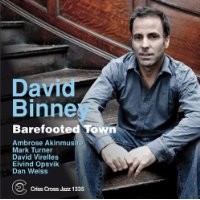
Alto saxophonist-composer David Binney is one of the busiest musicians on the contemporary music scene.  Since the turn of the century, he has issued 15 CDs (counting the one to be reviewed here) on a variety of labels, co-led sessions with Alan Ferber and Edward Simon and produced fine recordings for pianist John Escreet, saxophonist Donny McCaslin and saxophonist Samir Zarif.

Binney's music has tremendous drive and an affinity for handsome melodies, with arrangements that allow for individual moments  but always built off the original melody.  His choice of musicians is telling as well - his music demands that you execute the rhythmic turns flawlessly and solo with abandon.  "Barefooted Town" is Binney's 5th as a leader for the Dutch Criss Cross label; this is engrossing music from beginning to end.  Producer Gerry Teekens only allows one day to record and one might figure these CDs to be "blowing" sessions.   Some of them seem to be but a large majority are thoughtful and well-planned works.  That's Binney's style - he has a vision, a theme for each production.  The new release features the graceful tenor saxophonist Mark Turner, the engaging young trumpeter Ambrose Akinmusire, the Cuban/Canadian pianist David Virelles, bassist Eivind Opsvik and the elegant percussion of Dan Weiss.  Weiss's drums are the lead voice on the title track, accentuating the tolling piano chords, engaging in a musical dialogue with Binney's angular also sax phrases, and introducing then stepping aside for the leader's overdubbed voices. His martial yet funky drumming sets the pace for "Seven Sixty", supporting the circular melody lines and pushing or caressing the soloists.  After the leader's high-powered romp, the intensity subsides for Akinmusire's more subdued spot, one that hints at blues phrases and African melodies. Virelles brings the energy level back up with a solo that rumbles out of the left end of the piano then charges forward with a shower of percussive chords.

Every track is worth hearing time and again.  David Binney's melodies stay with one long after the pieces end and the work of these musicians challenges and satisfies the interested listener.  Give "Barefooted Town" time to seep into your soul - it's worth the effort.  For more information, go to www.davidbinney.com.  

"Destinations Unknown" is the 8th release on Criss Cross for trumpeter Alex Sipiagin and another display of his excellent playing plus continuing maturity as a composer.  The Russian-born and educated Sipiagin spent much of the last several years on the road with various ensembles (including the Mingus Big Band and the Dave Holland Octet) and these compositions have their basis in his travels.  With a front line of Chris Potter (tenor saxophone) and David Binney (alto saxophone) plus a stunning rhythm section featuring Craig Taborn (piano, Fender Rhodes), Boris Kozlov (bass - he emigrated to the US at the same time as Sipiagin) and drummer extraordinaire Eric Harland, this music is continuously involving and entertaining.  The pieces afford plenty of room for Harland and Kozlov to push the beat, to create a flow and pace that challenges the soloists to create truly memorable moments.  The drummer dances beneath the leader's flugelhorn on "Videlles", buoyed by Kozlov's highly melodic bass lines and Taborn's shimmering Fender Rhodes. After a rousing drum solo, Potter builds a soulful solo until Binney takes over with a fiery turn of quick phrases and stabbing notes.  The pace slows and the intensity softens for "Calming" - opening with a well-structured bass solo that opens to a smart melody line shared by the trumpet and saxophones, Binney takes yet another pleasing solo, rising above the tolling Rhodes chords and Harland's active yet never intrusive percussion.  Sipiagin's solo is filled with long tones alternating with rapid lines and when the saxophones return, the trumpeter continues by weaving phrases around the reeds.  Taborn (on acoustic piano) and Harland set a frantic for "Fast Forward" that moves into a theme with cascading melodic fragments showering down on the listener. Sipiagin's bell-like tone and articulate lines swerve in and around the piano chords, the cymbal splashes and pedal point bass work.  Binney and Potter engage in a fiery back-and-forth over Harland's driving drums.

I'd be happy to tell you more but you should really uncover the joys of this splendid session on your own.  Mature, melodic, poly-rhythmic and smartly-turned, Alex Sipiagin's "Destinations Unknown" is a journey well worth taking.  For more information, go to www.alexsipiagin.com.

Vibraphonist-composer Chris Dingman studied at Wesleyan University in Middletown, CT, where Professor Jay Hoggard introduced him to the instrument he now plays so well.  The California native also studied with percussionist Pheroan ak Laff, saxophonist-conceptualist Anthony Braxton and David Nelson, a master of the South Indian mridangam.  After graduation (2002), he went on to study at the Monk Institute (then in Los Angeles) and has played alongside fellow Wes grad Steve Lehman plus worked with Harris Eisenstadt's Canada Day and Adam Rudolph's Organic Orchestra.

"Waking Dreams" (self-released) is his 1st CD as a leader and is, arguably, one of the most impressive debuts of 2011 (and there have been a number of very good ones this year.)  With a quintet of his contemporaries that includes Ambrose Akinmusire (trumpet), Loren Stillman (saxophones), Fabian Almazan (piano), Joe Sanders (bass) and drummer Justin Brown plus guests Ryan Ferreira (guitar), Erica von Kleist (flutes) and Mark Small (bass clarinet), Dingman creates an illusionary landscape filled with shifting rhythms, richly tapered melodies and solos that rise easily from the mesmerizing sound textures.  Akinmusire, as a soloist, continues to create musical stories that are cliche-free, rarely resorting to pyrotechnics to make his point. His subtle bob-and-weave on "Jet Lag", spurred on Brown's energetic drumming and the "free" comping of Dingman is a highlight.  When the tune leaps to double-time, Stillman, Akinmusire and the leader fly around each other like dancers in ecstasy. The 27-year old Almazan, who has worked with Terence Blanchard and Gretchen Parlato, has a wonderful touch, simply melodic, at times, spare but never disappearing.  His lovely solo stroll on "Manhattan Bridge" is contemplative, soulful and emotional, setting the stage for Dingman's ruminative spot.  Ms. von Kleist's flute work appears on "Same Coin" and "Nocturnal" (the only non-original on the CD, composed by Joe Chambers) - on the former, she only plays on the theme (with Small's bass clarinet as an additional color) while, on the latter, her lovely tones ring out above the vibes and piano, then move in a graceful counterpoint to Akinmusire's clear trumpet lines.  On the title track, Stillman's feather-soft alto saxophone dances around atop Brown's active percussion, Sander's forceful bass lines and the leader's circular melodic phrases. His solo starts slowly yet immediately begins to build, with lines that go in many directions but always leading back to the melody.  After a break, Almazan takes up the vibes' circular line on his electric piano while Stillman playfully weaves his phrases around him.

"Waking Dreams" has so much to offer the listener.  Pay attention to the arrangements, how the soloists display their own voices without taking over the session, how well Dingman's vibes and Almazan's piano work together, how engaged the rhythm section is throughout the program.  Do this - put the music on, let it fill your listening space and find your own dreams in this highly evocative musical world.  For more information, go to www.chrisdingman.com.

Listen to "Waking Dreams" on the player provided below:

Monday, June 20, 2011

Trio Takes (Part 2)

First, the don'ts - Don't listen to "A Night at the Village Vanguard" (Pirouet), the new double CD from the Bill Carrothers Trio with the top down in your car.  Don't listen during a motorcycle rally, NASCAR race or when the high school band is practicing for the graduation ceremony.  Do listen when you have the time to savor the 2 sets recorded on July 18, 2009, taped during an extended stay at the historic New York City night spot. Do revel in the reinventions of material by Clifford Brown, Richie Powell, Henry Mancini and other fine composer created by pianist Carrothers, bassist Nicolas Thys and drummer DrĂ© Pallemaerts.  At the time of this appearance, the pianist (with bassist Drew Gress and drummer Bill Stewart) had already recorded "Joy Spring" (Pirouet), a CD dedicated to the music of the late trumpeter Brown, which was released to great critical acclaim in Spring of 2010.  Thys and Pallemaerts is Carrother's "European rhythm section" and they do an excellent job pushing the pianist as well as following his every whim.

Besides the excellent interpretations of the material from the Clifford Brown Quintet (including Duke Jordan's "Jordu"), there are several fine surprises.  Chief among them is the lovely take of Jimmy Dorsey's patriotic "This Is Worth Fighting For", a piece that an arrangement with echoes of Charles Ives.  The "First Set" closes with a sweet version of "Those Were the Days" (the melody stands out handsomely on this version as opposed to the one by Edith and Archie Bunker from "All in the Family.") During the "Second Set", Thys' long and melodic bass solo leads the listener into a New Orleans-soaked of the traditional gospel piece "Jordan Is a Hard Road To Travel." Carrothers goes it alone for a contemplative meditation on "Days of Wine and Roses" that ultimately picks up in pace as the pianist oes into his subconscious and allows himself to move far away from the original melody.

There are a number of Carrothers' original pieces scattered through the program, including "Peg" with its allusions to the music of Beethoven and the happy romp titled "Discombopulated."  The short yet wistful "Our House" closes the program with a sweet melody line, good counterpoint from Thys and  active percussion coloring from Pallemaerts.

In just under 140 minutes, the Bill Carrothers Trio creates a wonderful aural landscape for the listener willing to let go of the need to figure who he sounds like, who are the influences and the need for "speed."  There are several uptempo pieces but nothing resembling the need to just "show off one's chops."  Bill Carrothers lives in the wilds of northern Michigan, near the border of Wisconsin.  He has a fascinating website - www.carrothers.com - that is worth perusing plus his own record label, Bridge Boy Music, featuring music more of a personal nature.  Back to the "don'ts". Don't ignore this fine CD - get lost in its generosity of music, creativity and spirit.


The past year has been quite a musical ride for pianist/composer Orrin Evans, especially when it comes to his relationship to Posi-Tone Records.   Early in 2010, the Los Angeles-based label released the pianist's tribute to saxophonist Bobby Watson, "Faith in Action" followed in late October by "The End of Fear" from Tarbaby, the "trio collective" with Evans, bassist Eric Revis and drummer Nasheet Waits (plus some fine guests.)  2011 has already seen the release of the Captain Black Big Band, arguably one of the 5 best CDs of this year. 

Now, we have "Freedom", basically a trio date released under Evans' name, featuring bassist Dwayne Burno and drummer Byron Landham with Anwar Marshall taking over the drum chair on 3 cuts (1 of which features Landham on persussion) and tenor saxophonist Larry McKenna on 2 tracks.  While not as dramatic and forceful as the Big Band recording, this CD contains a multitude of pleasures.  The project is dedicated to the memories of Trudy Pitts, Sid Simmons and Charles Fambrough, all who passed near the end of 2010 (Fambrough on New Years' Day 2011.)  The first track on the CD is Fambrough's "One for Honor", a delightful romp that gives the musicians plenty of space to let loose - and they do play with fire.  Burno is one of the more melodic contemporary bassists as well as being a strong foundation.  He supplies "Gray's Ferry" ( a neighborhood in South Philadelphia), a medium tempo blues featuring a bluesy solo from McKenna, a veteran of the "Philly" jazz scene who has worked with Clark Terry, Tony Bennett and many others in his long career.

Other highlights include "Shades of Green" from the pen of the late Philadelphia-based pianist, Eddie Green (he passed in 2004) and the classy, poly-rhythmic, "Hodge Podge", composed by Chris Beck, a drummer from Philly and featuring Marshall in the drum chair.  Marshall and Landham lead the way into "Oasis", an atmospheric work from Shirley Scott. The only tune without an overt Philadelphia connection is Herbie Hancock's "Just Enough" that Evans plays sans accompaniment to close the CD. Filled with rich, resonant, chords, the pianist creates a fine musical tour-de-force as he works through the melody line into his excellent solo.

In the shadow of the Big Band recording, "Freedom" may seem a bit low-key but pay attention.  Like much of what Orrin Evans has been giving to the world lately, this CD pays tribute to his city, his influences and his contemporaries.  It's mature music yet never loses its spirit and the joy of playing. It's yet another "winner' in a streak that stretches back to Evans' fine sextet of recordings for Criss Cross.  For more information, go to www.posi-tone.com/orrinevans/freedom.html.

I feel compelled to remind you that Jason Crane is still conducting "100 by 300" campaign in hopes to continue the fine work he has done on "The Jazz Session."  With 15 shows to go (by the end of this week), he's got less than 50% of the people he needs to fund his on-going project to talk with and promote the creations of many of the best creative musicians in the world. And, Jason will stop if he does not reach his goal and that, dear reader, is a shame.  Go to thejazzsession.com/, give a listen and, if you don't think it's worth your while to know the "how & why" behind the music, that's fine.  But, if you enjoy how Crane gets to the heart of the creative process, you might want to become a sponsor.  Yes, I know there's lots of interviews shows you might be able to download for free but few as honest and human as "The Jazz Session." 

Finally, I spend a lot of time listening to new releases but always find it important to check older works when reviewing.  Last week, I wrote about "Shut Up and Dance", the CD of original compositions John Hollenbeck  composed for the Orchestre National de Jazz.  I found myself listening to works by Hollenbeck including his "Eternal Interlude" for his Large Ensemble, released in 2010 by Sunnyside. Thanks to the label, you can listen to the CD in its entirety by clicking below. And, you should listen - it's really fine music.

Thursday, June 16, 2011

Ensembles Large & Medium-sized + A Question

John Hollenbeck continues to move forward as a composer, arranger and drummer/percussionist. For the 10-member Orchestre National De Jazz, Daniel Yvinec artistic director, Hollenbeck has fashioned a suite of pieces (all but one dedicated to a member of the ONJ - the lone exception is "Up", the opening track that, at :29 seconds, serves as the overture.)  Titled "Shut Up and Dance" (BEE Jazz), the music on the 2-disc set will remind some listeners of the material Hollenbeck creates for the Claudia Quintet, with repetitive phrases, staccato rhythms, and dynamic variations that range from quite soft to overpowering.  Though drummer Yoann Serra is a powerful presence, electronic treatments are prevalent in the mix.  This version of the Paris, France-based ONJ, now in its 25th season, is composed of 4 reeds, 1 trumpet (saxophonist Matthieu Metzger also plays the trombophone, not really a brass instrument), 2 keyboards, guitar, bass and drums.

Much of this music has a hypnotic quality and it is easy to get lost in the "beats" and "floating" melodic phrases. There are exceptions, such as the highly percussive (and tuned percussion, at that) "Boom", one of several pieces that shows the influence of Steve Reich (especially "Drumming") and that leads into "Bob's Walk", a tribute to Bob Brookmeyer, Hollenbeck's teacher and mentor. Songs like "Praya Dance" and "Racing Heart, Heart Racing" are so intense that one wishes for some lighter pieces.  "Life Still", written for bassist Sylvain Daniel, gives some sonic relief as the bass is the lead thoughout the nearly 6-minute piece.  Following that song is "The Power of Water", the longest track (12:11) and the spotlight for Serra's driving yet melodic drum work. The melody sets a contemplative that never lets up even as the piece moves towards the climax. Here, one hears the influence of Mike Ratledge and the British "prog-rock" band, Soft Machine.

John Hollenbeck fans should find plenty to feast on with this recording from Orchestre National de Jazz.  Newcomers might be put off by the lack of "traditional" jazz forms but, stick with it and let the fine music enter your consciousness.  For more information, go to www.onj.org/en/.

Among the first sounds you hear on the self-titled and self-released debut recording of the Jordan Young Group is Mr. Young's crisp drum work.  Then, in comes the band - the smooth tenor saxophone of Joe Sucato, the burbling organ of Brian Charette and the clean guitar chords of Yotam Silberstein and you've got a classic sound.  The four-some rambles through "H and H", a tune by Pat Metheny, and doesn't seem to break a sweat.  That's pretty much the trend throughout the program which features tunes by all the participants (except Silberstein) and a slew of jazz standards ranging from Cole Porter's "Every Time We Say Goodbye" to "Jean de Fleur" (from Duke Pearson), Joe Henderson's "Afro-Centric" and "Angola" by Wayne Shorter. Add to that 4 short "PiNGS" from Charette, vignettes that sound like group improvs and feature tunes that move in unexpected directions.

There's nothing startling about the program nor is the music pedestrian.  Young pushes the band from the drum seat with an intensity  yet he never overplays. Even when he solos, there is an economy to his work that is refreshing.  Charette is classy throughout, Silberstein's sweet single-note runs are bluesy and playful, and Sucato is fairly mellow - the saxophonist also understands the art of the economical line, with solos that flow easily over the changes.

Young, a native of Detroit, Michigan, who now lives in Brooklyn, attended the University of Michigan and received his Master's Degree from the Manhattan School of Music. His music is anything but academic - in fact, it's a bit of throwback but not dated.  Pour a tall, cool, one or a glass of chilled pink wine and enjoy.  For more information, go to www.jordanyoung.net.

Pianist/composer Falkner Evans has issued 3 piano trio CDs, all of which featured the irrepressible Matt Wilson on drums.  Wilson is back on Evans' new CD as is bassist Belden Bullock (who appeared on the most recent trio release) for " Points of the Moon" (CAP Records) which also features Greg Tardy (tenor saxophone), Ron Horton (trumpet) and, on the last 2 of the 9 songs, Gary Versace (organ, accordion.)

This is a deceptive recording in that it feels so "cool": nothing is rushed, the pieces are, mostly, medium tempo and the playing fairly straight-forward. Horton is his usual classy self, nice crisp tone and a sense for just the right phrase. His solo on "Drawing In" does just that, draws the listener in for a sweet ride.  Tardy shows a fair amount of "heat" on "Cheer Up", egged on the by the ferocious drums of Wilson.  One of the more interesting aspects of the program is that solos are parsed out, not everyone solos on each cut and pieces are rarely expanded beyond  a comfortable length. On the opening track, "Altered Soul", Horton and Tardy play the theme through at the beginning and end but only Evans solos. Versace joins the band for the bluesy "Over the Top", adding his burbling sound to the hard-bop attack (and, staying true to the pattern of the CD, does not solo.)  He, then, adds accordion to the title track that closes the program.  Horton creates an articulate solo over the martial drums and swelling accordion chords.  The arrangement features a long reprise of the theme for the last 2+ minutes of the song.


"Deceptive"may seem a negative description for a recording as pleasing as this one.  Not a "blowing" session (save for maybe 1 or 2 tunes), "The Point of the Moon" is filled with strong melodies and solos that give the individuals their due without turning the program into one player following another into the spotlight ad infinitum.  Take your time to let this music work into your system - it may not excite you but it will be a balm for frayed sensibilities.  To find out more, go to www.falknerevans.com


**************************************************************************

Hard to argue with the Jazz Journalists Awards for 2011 (read the list by clicking here.)  I am not yet a member but I read the work of many of the people who voted in the poll and respect them all to a person.  One thing puzzles me - how did Blue Note Records win "Label of the Year"?  I don't receive most of that label's output but I purchase a fair amount (Jason Moran's Bandwagon, the new Ambrose Akinmusire, anything by Joe Lovano) - very good to excellent music all but you can't tell me that the music from independent labels such as Posi-Tone Records, BJU Records, Criss Cross and Sunnyside is not as good or as consistent (in some instances, just as forward-looking.) Just curious.

Wednesday, June 15, 2011

Fusion Not Confusion

One might think that the duo of Aaron Goldberg and Guillermo Klein was put together just for "Bienestan" (Sunnyside) but, in actuality, the former played piano on the latter's 1997 debut "El Minotauro" (Candid Records).

For this recording (composed of 2 sessions, the first in May 2009, the second in August 2010), Goldberg plays acoustic piano and Klein Fender Rhodes.  8 of the 14 tracks are Klein originals, 2 by Charlie Parker, 2 selections from Luis Bonfa and Antonio Maria's "Manha de Carnaval"  ("Black Orpheus" and "Orfeo Negro")  and "All the Things You Are" by Jerome Kern and Oscar Hammerstein II (which opens and closes the program.) The rhythm section is a classy one with drummer Eric Harland (who's appeared on all of Goldberg's solo efforts) and bassist Matt Penman.  Alto saxophonist Miguel Zenon is heard on 5 tracks including the lively reading of "Moose The Mooche" (with its variable lines and shifting rhythms).  Chris Cheek plays tenor saxophone on 2 tracks alongside Zenon and soprano saxophone on Klein's lovely "Yellow Roses" (which also features the alto saxophonist.)

Goldberg's work is exemplary throughout.  His finely articulated lines make the melodies come alive.  Listen how he winds his phrases around the Fender Rhodes on "Implacable" (a piece for the leaders without rhythm section and saxophones) - Klein creates a "drone" with his hypnotic riffing, supplying both the rhythm and bottom.  "Burrito" is a tasty ballad with the feel of a Radiohead melody while "Anita" has a melody line that suggests Milton Nascimento.  The pianists feed off each others lines while the saxophonists offer both melody and counterpoint.  "Impressions de Bienestar" moves easily atop Harland's quiet yet insistent percussion. The word "bienestar" means "well-being" and the tune exemplifies the word as well as giving off a feeling of peacefulness.  There's plenty of that feling throughout the program.

"Bienestan" is also noteworthy for Klein's arrangements and the way he is able to take the melodic intensity of his large-ensemble recordings to a softer yet no less effective level for a smaller band.  With the exception of the afore-mentioned "...Mooche" and the hard-hitting, funky, relentless "Human Feel", the pieces are often slow and contemplative.  Even the more rhythmic "Orfeo Negro" takes a more thoughtful approach. Harland and Penman are stalwarts when they appear and Zenon's playfulness and melodicism is quite sweet.  Hopefully it won't be another 14 years before Aaron Goldberg and Guillermo Klein record again. Listen for yourself and decide.


Jazz composers have turned to Far East on a number of notable occasions for inspiration. Included in the list are Duke Ellington & Billy Strayhorn ("The Far East Suite"), Dave Brubeck ("Jazz Impressions of Japan") and guitarist Pierre Dørge, whose New Jungle Orchestra have traversed the musical universe from Polynesia to Malaysia to to Southeast Asia to Africa.

Trombonist/composer Jeff Fairbanks' Project Hansori incorporates traditional Korean and Chinese folk melodies into contemporary jazz on its impressive debut recording.  "Mulberry Street" (BJU Records) blends the talents of a 17-piece big band with traditional Korean instruments, special guest Fred Ho's mighty baritone saxophone and, one 1 track, Heun Choi Fairbanks on cello.  The fusion works nicely right from the opening track "San Da Ma", with its Korean Church hymn melody played in unison on Fairbank's trombone and guest RaMi Seo on gayageum (Korean zither.)  "Hoping for Hope" has a full "big band" sound and is based on rhythm pattern from Korean Samulnori music.  Here, the splendid rhythm section of bassist Linda Oh and drummer Bryson Kern are joined by percussionist Yosun Yoo on several traditional percussion instruments. The multi-sectioned piece rises and falls atop the rhythm, the back-and-forth of the reeds and brass and the excellent solo work of Oh, pianist Francesca Han and guitarist Sebastian Noelle (a long-time member of Argue's Secret Society as are reed player Erica von Kleist and trombonist Jennifer Wharton.)

The title track is a 4-part, 26-minute, suite that is a tone poem dedicated to the intersection of New York City's "Little Italy: and the Chinatown district.   "Entrance and Funeral March" opens the "suite" with a dirge (though the use of flute and clarinet lightens the mood a bit) before a brass band moves in (here, as in other sections of the "suite", one hears the influence of both Charles Ives and Bob Brookmeyer).  Part 2, "Scaring Evil Spirits Away with Joyful Sounds", blends Ho's majestic baritone with a chorus of 4 soprano saxophones at the onset before the band comes roaring in.  The piece slows a bit for a soaring alto sax solo from von Kleist leading to a rousing climax with the saxophones and brass firing away (take that, evil spirits!) Ho leads the band in again on Part 3, "Releasing Grief", a piece that uses Buddhist and Christian hymns played simultaneously (again, the Ives influence).  Later in the song, Ho steps out for a fiery solo before the brass plays a funeral march beneath Noelle's aggressive guitar solo.  Part 4, "The Send-off", is a wonderful collage of clashing yet sympathetic melodies and rhythms that serves to lay the piece to rest and put a wide smile on the face of the listener. 

When I first encountered "Mulberry Street", I was knocked out by its bold combinations of traditional sounds and contemporary jazz but it is so much more than that.The section writing is clean, clear and inventive, harmonies abound, the soloists first-rate, and the vision of the composer is fully realized.  At a time when there are myriad large ensemble recordings, Jeff Fairbanks' Project Hansori is one of the most impressive and satisfying.  For more information, go to www.fairbanksmusic.com and follow the links. 

Here's a download of "Scaring Away Evil Spirits..." courtesy of BJU Records and IODA Promonet - enjoy!

Mulberry Street Part II: Scaring Away Evil Spirits with Joyful Sounds (mp3)