I would venture a guess that most people who read this blog know who Charlie Parker is and there is very little I can add to his legend. Here's the short bio. The alto saxophonist, who was born in Kansas City, Kansas, in 1920, is universally recognized as one of the originators of be-bop (along with Dizzy Gillespie, Max Roach, Kenny Clarke, and Bud Powell). Right after World War II came to a close, Parker made a series of recordings that many believe are the Holy Grail of jazz. But he had albatross around his neck - his addiction to heroin not only ruined the lives of many of the musicians who idolized him but also Parker's ability to perform, record, and tour. But his music lives on: nearly 65 years after his death at the age of 34, his endlessly inventive solos still inspire musicians around the world.
Yusuf Komunyakaa, born in Bogalusa, LA, in 1947, is one of the premier poets of the United States with a career that spans over 46 years. He did not start writing and punishing poetry until the early 1970s. Many of his poems, especially the early ones, were influenced by his experiences in Vietnam where he worked as a correspondent and editor during the height of the conflict. Among his collections, you will also find poems about jazz and blues. In addition, he co-edited (along with Sacha Feinstein) the two volumes of "The Jazz Poetry Anthology" published in the 1990s by Indiana University Press.
Wesleyan University Press/HFS
In 2013, Wesleyan University Press published Komunyakaa's "Testimony: A Tribute to Charlie Parker (with New and Selected Poems)", a book that also comes with an audio recording of a 2002 concert originally broadcast by the Australian Broadcasting Corporation (ABC). ABC had commissioned the work in the mid-1990s: the 14-part libretto first appeared in Komunyakaa's 1998 collection "Thieves of Paradise" (Wesleyan University Press). In September of 1997, the poet had recorded with saxophonist John Tchihai in a septet that also featured bassist Fred Hopkins (from trio Air) and guitarist Jeff Parker (his website is the only place to get the CD as there is no digital release) - a number of the poems Komunyakaa contributed to that project, titled "Love Notes From The Madhouse" (8th Harmonic Breakdown), appear in the book.
ABC also commissioned saxophonist, composer, and arranger Sandy Evans (pictured below) to create the music for the broadcast. Ms. Evans, who has worked with numerous Australian ensembles including being the co-leader of Clarion
Fracture Zone (see hear), the Australian Art Orchestra, and 10-Part Invention, assembled a program that not only included bebop but also blues, classical music, modern jazz, and much more. The two-minute "Overture" includes snippets of "Moose The Mooche", "Relaxin' At Camarillo", "Dewey Square", and "52nd Street Theme" (all Charle Parker tunes save for the last one listed which is by Thelonious Monk). The 96-minute concert also includes Parker's "Koko" and Irving Berlin's "If I Had You". Among the musicians are pianist Alistair Spence, bassist Lloyd Swanton (The Necks), trumpeter Warwick Alder, trombonist James Greening, and the great alto saxophonist Bernie McGann (1937-2013) plus spoken word artist Michael Edward-Stevens (an actor from New York City who makes his home in Australia) and a slew of vocalists including, on one track, Kurt Elling.
The only way one gets to hear this fascinating project is to buy "Testimony" as the two-cd set was here released on its own. It's truly worth the experience. The poems stand on their own and "Testimony" (the poem) can certainly read without the music. But to hear how Ms. Evans integrates the poetry into the music is really a treat. The package is available from all booksellers, from online retailers, and from HFS Books - the link is below.
Composer, arranger, conductor, guitarist, and leader of the Jazz Composers Alliance, Darrell Katz has been living in Boston, MA, since the mid-1970s. He created the JCA in 1985, an organization that commissioned new works from national, international, and local composers, put on concerts, sponsored composition competitions, and supported ensembles. Since 1992, the JCA has recorded 12 albums for companies such as CADENCE Jazz Records, CIMP, Innova Music, Leo Music, Accurate Records, and the defunct Northeastern and Brownstone labels. To my ears, Katz has carried on the compositional tradition of Julius Hemphill (1938-1995) in that his music is always a fusion of blues, avant-garde, poetry, improvisation, disparate elements thrown together that reveal their connections after multiple listenings (if ever). The first two JCA recordings featured Hemphill as well as Sam Rivers as guest soloists.
Album #12, Jailhouse Doc With Holes In her Socks, is the first for the JCA's own label (JCA Recordings) and is dedicated to Paula Tatarunis (1962-2015), Katz's wife, who was a physician (among other jobs, spent 10 years working in a medium security prison) as well as an accomplished and published poet. Six of the 12 tracks feature her poems while one, "Like a Wind", sets the words of Sherwood Anderson to music (the piece has appeared on two previous releases). 10 tracks feature the septet Oddsong. Composed of vocalist Rebecca Shrimpton (her 7th recording with Katz), Helen Sherrah-Davies (violin), Vessela Stoyanova (marimba, vibraphone), and the saxophone quartet of Jim Hobbs (alto), Rick Stone (alto), Phil Scarf (tenor, soprano, and sopranino), and Melanie Howell Brooks (baritone), the ensemble plays a fascinating combination of Katz's pieces as well as one,"LLAP Libertango", which is based on Astor Piazzolla's "Libertango 1974" and arranged by Ms. Sherrah-Davies plus the opening "Prayer", which is a group improvisation.
The title track has is a bluesy, rhythmic, jaunt with the Hemphill signature in the "walking" lines of the baritone but note how the violin and marimba are equal members of the ensemble (check out the interactions of Ms. Stoyanova with Ms. Howell-Brooks). Hobbs takes a blistering solo followed by a dialogues between Stone and Scarff (tenor). Ms. Shrimpton takes the lead on "Tell Time" sharing the melody with the violins and reeds while the marimba holds the rhythm. The afore-mentioned Piazzolla piece blends a South Indian rhythm with the modern tango the composer created and it's a fascinating mix (and an impressive arrangement). "Gone Now" is a remake of the opening track from the Katz-Tatarunis 2002 "The Death of Simone Weil" and is a wonderful episodic piece that combines elements of blues, tango, and more underpinned by the saxophone quartet. Late in the piece, Hobbs and Howell-Brooks have a short, fun, dialogue before the ensemble returns. The final track Oddsong appears on is a remake of "Red Blue", Katz's tribute to Julius Hemphill which has been recorded with several different ensemble on previous recordings (and appears again as part of thefts track on this disk). It's a rollicking piece in which each voice is important to the music (all this without a solo).
Accurate Records
The final two tracks, both recorded in concert, feature two different ensembles. "Ye Watchers And" feature Ms. Shrimpton, Ms. Sherrah-Davies, Ns. Howell-Brooks (bass clarinet), Scarf (sopranino), plus Bill Lowe (tuba), and Hiro Honshuku (flute); the music has a "free" feel as the text conflates Advent/Christmas with a basketball game in a venue with a Jumbotron. The JCA Orchestra shows up 20 strong on the "The Red Blues/Red Blue" which pairs Ms. Tatarunis's poem about Hemphill with Katz's tribute composition. Special guest Oliver Lake creates an alto sax solo that will tear your speakers to shreds. Later in the piece, he joins the reed section for a quick-building improvisation that leads into Honshuku's EWI (electric wind instrument/controller which makes his flute sound like a synthesizer) solo pushed by the impressive drive of drummer Pablo Bencid. The entire ensemble returns as Ms. Shrimpton sings the final two verses of the poem. The richness of her vocal tones matches the timbre of the saxophones adding a rich emotional quality to the words. Mr. Lake takes a quick coda before the vocalist rides out on the word "blues."
"Jailhouse Doc With Holes In her Socks" is quite a project. Though it can be viewed as a memorial to Paula Tatarunis, the vitality of her words and how Darrell Katz frames them, creates melodies out of them, uses the voices of Rebecca Shrimpton and the musicians to enhance the poetry. The poet lives in her words while the composer gives the listener a gift of her "presence" and the ensembles makes us hear with fresh ears. Don't search for style (is it jazz or classical?), just listen and soak in the sounds.
For more information, go to www.darrellkatz.com. The composer and loving husband has also kept Ms. Tatarunis's blog alive. Go to paulashouseoftoast.blogspot.com and look at her images of nature (that's her images on the album jacket), read her words, get a feeling for her passions.
Here's the title track:
Mark Dresser Seven - Sedimental You (Clean Feed Records) - Bassist, composer, and conceptualist Dresser first came to critical notice in the 1970s while playing on the West Coast in both free jazz and symphonic ensembles. He moved to the East Coast in the mid-1980s to play with Anthony Braxton and has since worked as an educator, bandleader, and sideman in numerous institutions and groups. Recently, he has been part of Trio M (with Myra Melford and Matt Wilson) as well as the trio known as Jones Jones (with saxophonist Larry Ochs and percussionist VladimirTarasov) while teaching at his alma mater, the University of California/San Diego. Plus, he is a pioneer in "telematics", described as the interface of computers, communication, and performance" - he has worked, performed,and recorded with musicians around the world in "real time." Dresser is a most expressive bassist with a rich tone, splendid technique, and an ear for melody and counterpoint that stands out among his contemporaries (on any instrument.
"Sedimental You" is a collection of seven compositions for seven musicians, an impressive ensemble that includes Nicole Mitchell (flutes), Marty Ehrlich (clarinets), David Morales Boroff (violin), Michael Dessen (trombone), Joshua White (piano), and Jim Black (drums, percussion). The album, issued in the fall of 2016, includes several pointedly "political" musical screes including the opening "Hobby Lobby Horse" and "TrumpinPutinStoopin"; the former is a rambling, loose-limbed, romp with impressive solos all around while the latter may remind some of the musical commentary Charles Mingus created in the 1950s and 60s, the instrumental voices - in this instance, the trombone - making the ridiculous sounds like the people in the song's title.
San Diego Reader
Even when the music is not overtly political, Dresser and company have a lot to say. The title track is a deconstruction of the standard "I'm Getting Sentimental Over You" (music composed, fittingly, by George Bassman) which, over the course of 12:44, runs the gamut from cocktail lounge music to disheveled blues (Dessen's expressive trombone solo) to noisy interactions (Black's solo over an extended reading of the theme). Three tracks are dedications to colleagues of the bassist. "Will Well" is for trombonist Roswell Rudd and is a lovely ballad with fine playing all around (the interweaved solos of Ms. Mitchell and Ehrlich is particularly striking). "I Can Smell You Listening" was composed in memory of vocalist Alexandra Montano (1961-2007) - she, Dresser, and vibraphonist Matt Moran had played a gig on the West Coast the day after 9/11/01. This song moves from quiet contemplation to fiery solos by Ehrlich and White to a lovely impressionistic melody for flute, violin, and trombone that culminates in a striking bass solo. The final track on the album, "Two Handfuls of Peace", was composed for Dresser's friend and mentor Daniel Jackson (1937-2014) and is a short, through-composed ballad that is lovely without being treacly.
The longest track on the disk (14:15) is "Newtown Char", a musical response to the mass shootings in Newtown CT and Charleston, SC. Opening with a powerful bass clarinet solo, the piece moves into a jumpy rhythmic feel (Black sets quite a pace) over which each member of the ensemble solos (save for Dresser, who is unaccompanied). There is great power in the angry reactions and equally frustrating resignation in this music but also a commitment to continue to fight for justice and equality. Yes, I am projecting my own feelings into this music but there is plenty of room for interpretation. Music can uplift as well as educate even as it entertains. "Sedimental You" does all that and more.
Any new album from saxophonist and composer Steve Lehman is a major event. His latest effort is titled "Steve Lehman & Sélébéyone" (Pi Recordings) and is credited to the saxophonist as well as to rappers Gaston Bandimic (Wolof), HPrizm (English) and soprano saxophonist Maciek Lasserre. The nine tracks feature rapping in English and Wolof, the official language of Senegal, The Gambia, and Mauritania, all part of sub-Saharan Africa. As sung/rapped by Bandimic, the words have a tremendous percussive feel. HPrizm, a founding member of the Anti-Pop Consortium, is also a strong rapper. Powered by the rhythm section of Drew Gress (acoustic bass) and the brilliant drummer Damión Reid plus the keyboard and piano work of Carlos Homs who has worked with drummers Bernard "Pretty" Purdie and Jim Black and saxophonist/clarinetist Michael Moore, the music fires on all cylinders.
Five of the tracks are composed, sequenced, and produced by Lehman while Lasserre does the same for four others. Because I like to know what the words are, I recommend you go to www.stevelehman.com/selebeyone and check them out (the Wolof verses are translated into English). But, do pay attention to the music, to the burbling keyboards, to the solid bass lines, to powerful streams of phrases from Lehman's alto sax (at times sounding like Henry Threadgill) and, especially to the fascinating work of drummer Reid. Pieces such as Lehman's "Are You In Peace" where he pushes the music forward at a torrid pace while Gress holds down the bottom and plays counterpoint as well are filled with stunning tension that reflects the lyrics. Then, there is "Cognition" where his bass drum and snare reflect the bubbling keyboard. Lehman soars over the rhythm section, his acid-seared sound going way to Bandimic - his rap is punctuated by impressive bass work and snapping drums. Lasserre's pieces have more of a "space" edge; on "Dualism", his soprano sax is set against Lehman's alto, the synth washes, and HPrizm and Bandimic's vocals. "Hybrid" plays with various sound samples while the rappers push the pace. The blend of soprano and alto saxophone shadowing the lyrics, giving the words about oppression and freedom a framework, buzzes, chatters and soars.
Sounds floating in and out of the sound spectrum, the trance-like repetition of melodic fragments, jittery rhythms, powerful raps, all make "Steve Lehman & Sélébéyone" attractive. Jazz purists just might turn up their nose but adventurous listeners, especially younger ones, will find the album will bring them closer to the intersection of jazz and rap. The music of Steve Lehman is a giant mixmaster, many influences thrown in the musical stewpot, boiling over at times but never less than fascinating.
From the opening bass figure of "NoD For Nelson", the music contained on "Stephan Crump's Rhombal" (Papillon Sounds) s steeped in the blues. There are moments when the music glides over to bebop (the handsome swing of "Skippaningam") or becomes wonderfully unclassifiable (the propulsive push of "Birdwhistle" - right near the end, the tune breaks into a rhythm similar to Lou Reed's "Walk on The Wild Side" while ) but you will listen to this album for the impressive interactions of Crump (bass and compositions), Tyshawn Sorey (drums), Ellery Eskelin (tenor saxophone), and Adam O'Farrill (trumpet). Pay attention to how the solos grow out of the melodies, how the quartet mix their distinctive styles to the composer's vision of the music, and the clarity of the sound. There's a soul music edge to "Grovi" in it's laid-back beat yet listen to the melodic bass lines under the solo phrases that move from foundational to counterpoint. Also notice how Eskelin steps in behind O'Farrill's solo several bars before his own solo yet does not seem to butting in, just adding to the sound.
Sometimes, it seems as if we're stepping into a private conversation, as if the band was reflecting on previous events. The deep blues of "Loose Bay" is a good example; moving at a very slow pace atop the splashing cymbals, tom-tom beats, and long bass tones, the youthful trumpeter takes a fascinating solo that often changes in volume, rising from a near-whisper to a heartfelt cry. The saxophonist follows, drifting over the beat, slowly but surely working around the bass lines but never in an agitated state.
You'll like the funky drive of "Esquima Dream" (Sorey in a "Pretty" Purdie state of mind) and the steady shuffle of "Tschi" (with its fun switch-arounds). Really, let the music of "Rhombal" wash over you. Play it loud, let the rhythm section fill your ears, notice the Ornette Coleman connection in the blues feel of several tracks (and the instrumentation) and also the folky melodies of pieces such as "Pulling Pillars" (the solo bass piece before the final track, "Outro for Patty"). Take it all in, then go back and let the sounds resonate inside your mind and body. Sometimes, the best music sounds old and new at the same time. "Stephan Crump's Rhombal", dedicated to the bassist's late brother Patrick, is contemporary blues, "blues with a feeling."
"Calma" is the opening track of "All The Dreams", the new album from Sara Serpa (vocals, piano, Fender Rhodes) and André Matos (guitars, electric bass, percussion) to be released on Sunnyside Records in mid-September. Meaning "calm", that's a good initial reaction to the 14 tracks on the recording. Ms. Serpa's gentle and emotionally true voice, either solo or multi-tracked (as it is on several tracks), blends so nicely with Matos's electric guitar, whether it is a folky track such as "Estado De Graça" or the mysterious "Night" (two guitars in the right speaker vying for attention).
Three cuts set poems to music, with the afore-mentioned "Night" based on a William Blake poem from "The Song Of Innocence" while the minimalist "Programa" features words from Portuguese poet Luis Amaro. "Nada" is from the pen of Ālvaro de Campos (a heteronym of poet Fernando Pessoa; the duo bathes this poem about a person who has settled for a world with nothing with shimmering guitars and a straightforward vocal. One other cut, "Os Outros", employs words from a 1964 essay by Brazilian writer Clarice Lispector (1920-1977).
photo by José Sarmento Matos
While most of the album is composed of duo performances, mix engineer Pete Rende adds synthesizer to three tracks while Billy Mintz can be heard on drums and percussion on four cuts. The latter musician's excellent hand drumming can be heard on haunting "Água", bubbling beneath the vocal and guitars, and quietly accenting the voice, piano, and guitars on "Lisboa". Both he and Rende add their talents to the opening track, Mintz with the simple yet effective brushes work.
Wordless vocals are used to great effect throughout the album, from the classically-influenced "A La Montagne" to the Beatles-esque "Postlude" (kind of like "Sun King" from "Abbey Road") with its waterfall-like descending vocal lines. Listen to Ms. Serpa's voice rise out of Rende's synth on the final track, "amlaC", not exactly a backwards version of the first cut - the track serves to bring the recording full circle and brings the dreams to a close.
Because André Matos does not take many solos but uses his guitar to paint the various backgrounds, one might overlook his contributions. He wrote or co-wrote 11 of the 14 tracks, his guitar is the foundation and other voice in the conversations of the songs, and his lines flow as effortlessly as the vocals. Sara Serpa understands the duo setting having recorded with pianist Ran Blake and the various vocal choirs on the recording may remind some of the work she does with the vocal quartet Mycale. The music on "All the Dreams" is in no hurry, at times as comforting as cool summer breeze or a warm blanket on a winter night. Warm, like calm, should be how one feels after spending time with this album - warm, calm, and, ultimately, hopeful.
Bassist, composer, arranger, and educator Alexis Cuadrado creates such fascinating music. On his previous 2 albums, he has explored the fusion of flamenco music with jazz (2011's "Noneto Ibérico") and the poetry of Federico Garcia Lorca, specifically the poetry he wrote during his visit to the United States in 1928-29 (2013's "A Lorca Soundscape"). Now the native of Barcelona turns his attention to the 21st Century writings of Melcion Mateu (also a native of Barcelona) and Rowan Ricardo Phillips (a NYC native fluent in Catalan); both are featured on "Poètica" (Sunnyside Records) alongside Cuadrado, Miles Okazaki (guitars), Andy Milne (piano, keyboards) and Tyshawn Sorey (drums) on a program that challenges, soothes, and provokes many emotions.
allaboutjazz.com
The album contains thirteen tracks with 3 dedicated to the 3-part "Balada de Matt Sweeney" (Mateu) and 4 cuts with multiple poems. Opening with with Phillips "Song of Fulton and Gold" and its evocation of 9/11, the power of the collaboration is immediately evident. The leader leads the band in with his insistent cajón, then the powerful rhythms created by the bass, guitar, and drums push the piece forward through the lyrics to a shattering finish. "Terra Incognita" (Phillips) also contains that powerful forward motion, with Sorey's forceful drums, Okazaki's roaring guitar lines, Milne's hypnotic piano chords and the leader's fundamental bass work.
photo by Jeremy Zilar
Throughout the album, the combination of the melodies and words are often filled with tension, the different stories being told capturing one's attention. "..Matt Sweeney" (Mateu) spreads over nearly 13 minutes with different rhythms, several solos, and the poet's voice, sometimes dripping with sarcasm, sometimes anger, even with genuine wonder, with "Pt III" sung in both Spanish and English. Mateu's gravely intro to "What Rose Is/Pamelia/ Cornelia St Café" sets the tone for the impressionistic images of a man fascinated with an older woman. In the middle of the piece, there's a long and powerful guitar solo.
The hypnotic melodies, the circular poems, the amazing interaction of voice and musicians, the multitude of sounds from the guitars of Miles Okazaki and keyboards of Andy Milne, the percussion barrage of Tyshawn Sorey, the two different narrators with their poems of the ever-shifting New York City, landscapes (physical and emotional), all that plus the arrangements by composer Alexis Cuadrado make this new project spring to life. The more you listen, the more you can hear how the different come together and complement each other. Part recital, part "poetry slam", often exciting, and always involving, "Poètica" shines.
Here's the ensemble in action from 2014, with both Rowan Ricardo Phillips and Melcion Mateu involved:
Since 2009, drummer, composer, and arranger Rob Garcia has led a most interesting quartet based around tenor saxophonist Noah Preminger, pianist Dan Tepfer, and a rotation of bass players (Joe Martin, John Hébert, and Chris Lightcap). For his 4th album for BJU Records, "Finding Love in an Oligarchy on a Dying Planet", Garcia turns his attention to issues that affect our daily lives, doing so with a stellar band including Preminger, bassist Masa Kamaguchi, and pianist Gary Versace plus tenor saxophonist Joe Lovano (3 tracks), vocalist Kate McGarry (2 tracks), and actor Brendan Burke (spoken word on 1 track).
robgarciamusic.com
Garcia's compositions take on such topics as gun control ("Guns Make Killing Easy"), global climate change ("Greenland Is Turning Green"), the current politic climate ("Terror, Fear, and Media"), and wars ("Johnny Has Gone for a Soldier"), doing so in the manner of Charles Mingus and Sonny Rollins; the titles make you think while the music pulls you in. "Greenland.." features both Lovano and Preminger on tenor sax playing the theme in harmony, each going on into strong solos. Ms. McGarry joins the band (minus Preminger but plus Lovano) for "The Journey is The Destination", a swinging reminder of the arc of one's life. She also teaches about the importance of equality on "People Are Everything", this time with Preminger winding his soft tenor lines around the lyrics.
The title track jumps atop the circular piano ones, throbbing bass and forceful drums plus the lyrical tenor sax of Preminger. Since he first came on the scene, the young saxophonist has been an impressive voice and now has a blues sensibility to his phrasing (not unlike Don Byas or Archie Sheep). After a long bass solo, the saxophonist plays the plaintive melody of "Guns..." shadowed by the more colorful piano counterpoint. There is a similar setup on "Johnny...." with a strong bass intro (melody and more) from Kamaguchi before Preminger play the folk-like melody.
Ottawa Jazz Fest
"Finding Love in an Oligarchy on a Dying Planet" (a message of hope on its own) charts the continuation of Rob Garcia as a composer, arranger, bandleader, and human being. Using music and his ensemble to help him make sense of the world as well as give his listeners the opportunity to find where they fit in this program makes this a fascinating program. The music stands out, is forceful yet never strident, and is contemporary with an understanding of its myriad roots. No matter your politics, this music soars, flows, and sings.
One look at the discography of drummer and composer Donald Edwards and you see that the Louisiana native is a busy and versatile musician. He's worked and recorded with guitarist Mark Whitfield, saxophonist Wayne Escoffery, the Mingus Big Band and Orchestra, bassist Ben Wolfe, trombonist Conrad Herwig, trumpeter Alex Sipiagin, pianist Orrin Evans, and others plus he's a charter member of Opus 5.
"Prelude To Real Life" is his 4th album as a leader and 2nd for the Criss Cross label. Three of the musicians who played on 2014's "Evolution of an Influenced Mind" return - Orrin Evans (piano), Walter Smith III (tenor sax), and David Gilmore (guitar) - and are joined by bassist Luques Curtis plus guests Nicholas Payton (keyboards on three tracks), Vivian Sessoms (vocalist on three tracks) and Antoine Drye (trumpet on one track).
allaboutjazz.com
The program includes three short "sound sculptures" including the album opener "Taking Shape." Each features Payton on either Fender Rhodes, organ and/or piano. "Hop Scotch" is a funky ditty with Ms. Sessoms singing the instructions for a children's game. "King" blends keys, drums, and saxophone into a quick, raucous, hit.
The majority of the material utilizes the quintet to excellent advantage. There are 2 standards in the program, the understated but swinging rendition of Benny Golson's "Stablemates", the melody played by Gilmore and Smith III with the rhythm section dancing beneath them. Curtis, a native of Hartford, CT, takes a sweetly melodic solo before Evans, Gilmore, and the tenor saxophonist play succinct spots, all the while the leader moves deftly around his kit. A short group of solos from piano, drums and tenor sax leads the ensemble into a playful take on Thelonious Monk's "Skippy" (which is a good description of Edwards' accompaniment.) Ms. Sessoms adds her whispery yet articulate voice to Alex Sipiagin's "Way To Her", shadowed by the saxophone with counterpoint from Gilmore's vocal-like guitar phrases. She returns for the drummer's "Thought For the Day" with lyrics that touch on the various ills in society, taking a positive approach. The ensemble kicks it up several notches with the rhythm section leading the way during the fine solos (Smith III really pushes with abandon).
The music in the longer cuts all feature start melodies and strong improvisations. Longer tracks, such as "Beautiful Intuition" (8:57) and "Apple Street" (8:09), take their time to establish the melody sections, leaving room for improvisations. What stars out on initial listening is how intelligently Edwards sets up the songs from his role in the rhythm section. His intuitive playing, knowing when to push or hold back, is one of the joys of the recording. Then, listen to the soloists and realize how each has his own style (or sound, if you will); this music is not about ego or technique as much as it is about story-telling and communication.
"Prelude to Real Life" is an album to play over and over, the program never gets tiring. Donald Edwards can be a "power drummer", like Rudy Royston and Eric Harland, but his control and how he plays in different situations really stands out. Highly recommended!
Pianist, composer, and educator Frank Carlberg, is also the founder of Red Piano Records. Based in Brooklyn, NY, the label has issued a number of impressive CDs over the past 5+ years, many of which feature Carlberg as leader, co-leader or ensemble member. His own projects are often built around poets, i.e. 2009's "The American Dream", the poems of Robert Creeley set to the pianist's original melodies. His most constant co-conspirators are his wife Christine Correa (vocals) and Michael Sarin (drums).
Both are featured on his latest project. "Word Circus" sets the words of 4 contemporary poets - Ken Mikolowski, Joe Elliot,Anselm Berrigan, and Ron Padgett - to an impressive group of melodies. Rounding out the group are bassist Pascal Niggenkemper and alto saxophonist John Gallagher. There is a minimalist feel to Mikolowki's "Things to Do in a Economic Crisis"; in fact, the title is longer than the body of the poem which reads "Buy low/Sell high." The music is much more expansive, the funky melody and rhythms supporting Ms. Correa as she plays with the title and the 4 words. O'Gallagher and Carlsberg share the solo space, pushed along by the forceful rhythms. Mikolowoski also wrote "Ecology", a ballad on which Ms. Correa caresses the short free-form verse that reads "Some day soon nothing will be made out of wood not even trees." The interaction of the music starts quietly but slowly picks up during the piano solo, a lengthy excursion during which Carlberg moves farther and farther away from the original melody. The blend of the wordless vocal and O"Gallagher's supporting alto sax lines creates great tension that Sarin picks up on and expands upon before the short, quiet, coda that returns to the poem. (The 10 tracks on Carlberg's 2013 CD "Big Enigmas" all use Mikolowski's poems for its lyrics).
The 2 shortest tracks, "On Some Level" and "Lullaby", both utilize poems by Ron Padgett. The former has a pleasing melody, an honest message and a wonderful counter melody played by O'Gallagher winding in and out of the vocal. "Lullaby" has a similar melody line with ethereal sounds from the saxophone, a musical forest one might encounter in a dream. The trance-like piano figures and skittering drum sounds (floor toms, snare and cymbals) set a mysterious path for the alto sax and wordless vocal to follow; soon, Ms. Correa returns to the text and the story comes together.
If we use the British meaning of circus (anopencircle,square,orplazawhere severalstreetsconverge), it helps to bring "Word Circus" into better focus. The different "avenues" of voice, words, melody, and musical interpretation do converge into an "aural" plaza that feels, at times, comfortable and a bit unsettling. The "poetry projects" of Frank Carlberg may remind some of the work Steve Kuhn and Sheila Jordan created for ECM (specifically 1979's "Playground") and that's fine - the music has much to offer, returning to your mind at all times of day like a slowly unraveling puzzle.
For his debut album as a solo artist, pianist, organist, and composer Dan Kaufman has created a most comfortable setting for his original music. With the splendid rhythm section of drummer Jonathan Blake and bassist Matt Clohesy (several tracks feature percussionist Keita Ogawa) plus the expressive work of Sam Sadigursky (tenor and soprano saxophones) and Gilad Hekselman (guitar), Kaufman creates 8 portraits of contemporary music that easily transport the listener beyond the mundane.
While living in Boston, MA, Kaufman studied with Danilo Perez and Fred Hersch (it's hard not to recognize the work these 2 men have done with a number of young pianists on the scene) at the New England Conservatory and recorded/worked with the Either/Orchestra, Miguel Zenon and drummer Bob Moses. Graduate work at the Julliard School brought him into the teaching sphere of Kenny Barron and then onto work and/or recordings with trumpeter Dominick Farinacci, trombonist Nick Vayenas, bassist Ben Wolfe, as well as saxophonists Wayne Escoffery and Donald Harrison. He has worked with vocalists such as Nneena Freelon, Kevin Mahogony and Gretchen Parlato.
All of that education and training doesn't amount to much (other than an impressive resumé) if one's music does not move the listener. Kaufman wisely titled debut CD "Familiar Places" because it does displays his talents as a composer and performer while illustrating how he has already begun the (life-long) process of moving away from his influences. On certain levels, the music is "familiar" in its song forms and melodies that allude to Messrs. Hersch, Barron and Keith Jarrett. What stands out is the work of the musicians, the rhythmic attack and the gentle colors created by Blake, the lively interplay of piano with saxophone and guitar, and Kaufman's expressive piano. Hear how he floats atop the rhythm section on "Dew Eye" and creates a chordal cushion for both the guitar and saxophone. "Kuumba" suggests an African excursion such as the ones created by Abdullah Ibrahim and Randy Weston yet the "lighter-than-air" quality of the piano chords, the lilting lines of soprano sax, gentle melody from the guitar as well as the excellent work from Blake, Ogawa and Clohesy in creating the "bounce" makes the music shine brightly. "Cross Check" suggests both the late Allen Toussaint and the long-running New Orleans-based group Astral Project in its funky attack; dig the overdubbed Hammond B-3 solo, the sweeping guitar sounds and the sweet soprano sax lines.
Cornelia Street Cafe
There is a grace and maturity in the handsome ballad "Falling Petals" plus fine bass work, a gentle piano solo, and an expansive, emotionally rich, tenor sax statement. When you return to listen again, pay close attention to how Blake maneuvers so freely beneath the rest of the band. His drive and delivery on the title track makes the music sound new, refreshing and challenges his musical companions to play with similar intent and creativity.
By the time the listener reaches the final track, "Farmington", one should feel comfortable following the musicians wherever they take the music. The sound is expanded to allow the organ to rise out of the rhythm section, for the "gospel" chords from the piano serve as counterpoint to the guitar sounds, and for the drummer to create his own storm that passes like a late summer shower.
Dan Kaufman, along with producer and fellow pianist Randy Ingram, have created a aural document of an artist spreading his creative wings, enjoying his opportunity and getting the best from his fellow participants. "Familiar Places" has been in rotation on my trips to and from school for the past 2 months, the music filling the car with its joyous noise and seemingly putting color back into the late autumn/early winter skies.
It would be simple to say that "Sounds and Cries of the World", the new recording by vocalist, composer and multi-instrumentalist Jen Shyu & Jade Tongue (Pi Recordings) was a collection of songs adapted from the composer's journeys through East Timor, Indonesia, Korea and Taiwan.
That would not be doing justice to this amazing recording. Ms. Shyu sings in various languages, often changing in the middle of verses, and the music created for her impressive quartet of musicians - Ambrose Akinmusire (trumpet), Mat Maneri (viola), Thomas Morgan (bass) and Dan Weiss (drums) - is not just steeped in contemporary jazz but also often sounds like a language of its own. The way the voice wraps around the instrumentalists on tracks such as "Mother of Time", incendiary "She Held Fire", and "Rai Nakakun Ba dada Ona" (with words from the poetry of East Timor poet Naldo Rei).
photo by Steven Schreiber
This music has great power and drama, no track more powerful than Ms. Shyu's "Song for Naldo" - with only the gat kim (2-stringed Taiwanese moon lute)for accompaniment; the lyrics tell the story of multiple attacks on the people of East Timor. The off-putting melody behind much of the vocal sounds strangely like "You Really Got Me" by The Kinks but the severity of the lyrics and the splendid vocal work (sounding, at different times, like Abbey Lincoln, Joni Mitchell, and Sheila Jordan) gives the song so much strength.
When you spend time with this program, you realize that the musicians are an integral part of each track on which they appear and not just there to play the melodies or long solos. The blaring trumpet and the soothing yet often moaning viola wind around the voice on "Moxa" while Weiss's drums skitter about and Morgan's bass throbs. There are moments on "Aku Yang Lahir Dari/Bâwâ Sidâ Asih" when the trumpet shadows and then illuminates the vocal lines (there's also a fascinating use of Ms. Shyu's field recording fromIndonesia on the "Bâwâ Sidâ Asih" section).
The album closes with "Thoughts of Light and Freedom", Ms. Shyu's musical adaptation of a poem by the late Taiwanese poet (and nuclear engineer) Edward Cheng (the composer and bassist Mark Dresser have perform the piece in concert - see a video here). The interaction of the musicians with the spoken word, then the vocal, features Akinmusire's growling trumpet (a la Lester Bowie), Maneri's keening viola, the occasional bass lines and percussion interjections with the forceful vocal creates great tension and ultimate release.
"Sounds and Cries of the World" is more education than entertainment, more theatrical, dramatic, filled with pathos and empathy, joy and fierce ardor. There is less "swing" than earlier releases (check them here) but a wider spectrum of sound. The message of persecution and unfair treatment of minorities, topics Jen Shyu has explored before, is loud and clear and the music she has composed is much more of a fusion of East and West with folk elements from the lands she has visited over the past decade. Take the time to explore this music, read the poetry, listen closely to the blend of instruments and to the marvelous instrument that is Jen Shyu's voice. Take the challenge offered by this artist and it will change you.
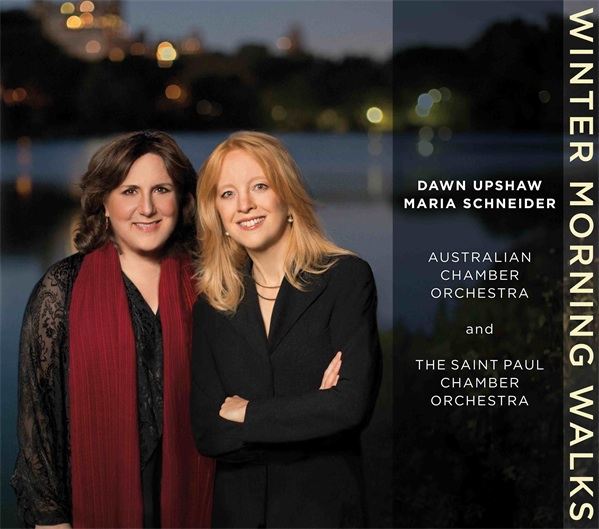
Several years ago, I read that soprano Dawn Upshaw has commissioned composer/band leader Maria Schneider to write new pieces for her. The 2 suites, "Winter Morning Walks" and "Carlos Drummond de Andrade Stories", are written for voice and chamber orchestra with the first work also featuring bassist Jay Anderson, pianist Frank Kimbrough and Scott Robinson (alto clarinet, bass clarinet.) The works were debuted in 2008 and, in 2011, Ms. Schneider launched an ArtistShare campaign to commit the pieces to record.
For those who participated in the campaign, the recording, also titled "Winter Morning Walks", arrived this week. If you are familiar with the music Ms Schneider creates for her orchestra, this is quite a different experience. Not just because this music for voice or that the majority of the musicians come from either the Australian Chamber Orchestra or the Saint Paul Chamber Orchestra; no, the 14 tracks are fairly compact (only 2 clock in at over 6 minutes and there are 2 under 2 minutes.) The title suite features 9 poems from Ted Kooser (born 1939 in Ames, Iowa, he now lives in Nebraska) written in 1998-99 as the poet was recovering from cancer surgery and the subsequent radiation treatments. The poems Ms.Schneider selected do not deal with illness or recovery but with living and love. The 4 poems that make up the second suite come from the Brazilian poet Carlos Drummond de Andrade (1902-87) - there is also a "Prologue" on which Ms. Upshaw supplies the wordless vocal. The vocalist, whose career has been put on hold twice in the last 7 years as she, too, recovered from cancer surgery, is in wonderful voice throughout.
This is a not a review but I felt the need to write about the recording in the aftermath of having to cancel classes today as our state was hit with 12 inches of snow. I found the time to sit and absorb the music and then, as I surfed the web later in the day, came across an October 2012 interview (audio and video) from Minnesota Public Radio. Taped as Ms. Schneider was in Minnesota recording the "...de Andrade Stories", the (nearly) 60 minutes she spends with interviewer Daniel Gilliam is filled with talk of birds, composing, her influences, the new music for the recording, ArtistShare and much more. It's quite delightful - see and hear the conversation by going to ht.ly/ix1RP. To find out more about Maria Schneider and her wonderful and wonder-filled music, go to www.mariaschneider.com.
Here are 2 poems, one each from Ted Kooser and Carlos Drummond de Andrade:
Spring, the Sky Rippled with Geese
Spring, the sky rippled with geese, but the green comes on slowly, timed to the ticking of downspouts.
The pond, still numb from months of ice, reflects just one enthusiast this morning, a budding maple whose every twig is strung with beads of carved cinnabar, bittersweet red.
(Ted Kooser, from "Winter Morning Walks: 100 Postcards to Jim Harrison", Carnegie Mellon University Press, 2001)
Quadrille
John loved Teresa who loved Raymond who loved Mary who loved Jack who loved Lily who didn’t love anybody. John went to the United States, Teresa to a convent, Raymond died in an accident, Mary became an old maid, Jack committed suicide and Lily married J. Pinto Fernandez who didn’t figure into the story. (Carlos Drummond de Andrade, translated by Mark Strand, from "Looking For Poetry: Poems by Carlos Drummond de Andrade and Rafael Alberti and Songs from the Quechua" Knopf Publishing, 2002
That's bassist Ben Allison on the left of the picture and poet Robert Pinsky on the right. They have been appearing together intermittently over the past 3 (or so) in a program that combines the spoken word and jazz. Nothing new about that practice other than it does not happen as much these as it did even 25 years ago. Jazz fans remember the work of Amiri Baraka with saxophonist David Murray in the 1980s as well as the hard-edged sound of poet Jayne Cortez and the Firespitters. You dig back further and you will find the jazz poetry of Kenneth Rexroth in the 1950s plus the writing of Langston Hughes and Hart Crane in the 1920s.
Ben Allison is no stranger to the folks of New Haven as he is a native son and has appeared a good number of times over the past 2 decades. Robert Pinsky, a native of New Jersey, studied at Rutgers then went on to get his PhD from Stanford. "Sadness and Happiness", his first book of poetry, was published in 1975 and he has since published 7 more collections, numerous essays, edited several books by other poets and served as the United States Poet Laureate from 1997-2000.
They'll be performing this coming Wednesday night (June 27) at 8 p.m. in Morse Recital Hall, 470 College Street in New Haven as part of the 2012 International Festival of Arts & Ideas. The Festival website (artidea.org) lists the Ben AllisonBand - the lineup will be percussionist Rogerio Boccato, guitarist Steve Cardenas and guitarist/banjo player Brandon Seabrook. In an email from Mr.Allison about the collaboration with the poet, "We'll be totally improvising our set with Robert. It's very conversational and interactive music. Lots of dynamics and creative forms." Sounds like this will be a great gig.
I have been lax writing about this year's Fest, which began on June 16 and runs through the 30th, closing with a free concert on the New Haven Green featuring Rosanne Cash. There has not been a lot of jazz in this year's schedule but there have been some excellent free concerts. Click on the link above to see what great shows are coming up this week. To find out more about Ben Allison (he's quite a busy person), go to www.benallison.com - for an overview of the life and work of Robert Pinsky, go to www.poetryfoundation.org/bio/robert-pinsky.
The first time I heard clarinet player/composer François Houle was his 1998 Songlines CD "Vernacular" - the recording featured trumpeter Dave Douglas, bassist Mark Dresser, cellist Peggy Lee and drummer Dylan van der Schyff. The interaction of that band was fantastic, the music brimmed with creative energy and it remains one of my favorite recordings. 14 years later, Houle has gathered another larger ensemble, dubbing the group François Houle 5 +1, and releasing "Genera" (Songlines). This is a band of leaders, including the "Connecticut Connection" Taylor Ho Bynum (Wesleyan graduate and New Haven resident on cornet and flugelhorn), Samuel Blaser (trombone), Michael Bates (bass) and Harris Eisenstadt (drums) - the +1 is Houle's long-time associate Benoit Delbecq (piano, electronics). The blend of the sounds is intriguing throughout, often pairing Bynum's tart cornet lines with Blaser's buttery trombone work. Bassist Bates and drummer Eisenstadt generate plenty of power pushing, coaxing and creating a strong foundation for the soloists to work off of. Delbecq's left hand complements Bates' thick bass lines, offering a "freer" counterpoint.
Houle (who, by way, completed his advanced degree at the Yale School of Music) wrote these pieces with this instrumentation in mind and it offers him quite abroad palette. The frenzied "swing" of "Albatros" suggests both Andrew Hill and New Orleans, the former in the construction of the melody and the solo sections while one can hear the latter in the group's work on the theme section. Bynum's solo builds off the energy of the rhythms section, adding even more fuel to the musical fire. Blaser's solo over Eisenstadt's active drumming blends blues with longer tones, cooling down the music but not the interaction. "Piano Loop (for BD)" opens with barely audible piano lines that coalesce into a classically inspired melody (played by Delbecq) and, one by one, the other musicians enter. Bynum, Blaser and Houle play variations of the pianist's theme until the cornet and clarinet come together to play the melody then separate into their own own phrases. There is an aura of peaceful interaction until one by one, the musicians depart to leave the pianist in his solemnity.
"Sulfur Dude" meshes (or mashes) several different styles (Latin rhythms and circus music, to name but 2) into a fanciful stew. Bynum reaches for the stratosphere in his solo while Houle tamps down that fire with a solo that starts quietly then build steadily over Eisenstadt's conversational drumming. When the group returns to the theme, the pianist plays rapid-fire lines that seen to encourage the other musicians to abandon the melody and interact with him as the piece fades. "Guanara", the longest track on the disk at 12 minutes, has a rhythmic approach reminiscent of Duke Ellington's "Blue Bird of Delhi" (from "The Far East Suite") - Bates and Eisenstadt not only set the tempo but also are entrusted with the shifting dynamics as they interact with the energy of the soloists (Houle takes a fiery solo that leads to a fine bass spotlight.) The sextet creates a similar musical volcano (in 2:13, no less) on "Old Paradigm", which brings to mind the musical experiments of Muhal Richard Abrams.
Perhaps the most impressive fact about "Genera" is that the 6 musicians had not played or even rehearsed this music together in a live setting before the March 23, 2012 recording date. Houle had recorded a "demo" with Bynum, Bates and Eisenstadt in 2011 but had worked on the music, changing arrangements and adding new songs in the months before the session. It speaks to the professionalism of the musicians, their respect and trust of the composer/arranger, as well as their considerable talents that this music is so good. On June 25, the 5+1 begin a 12 day-8 city tour in Toronto, Ontario, that takes them back and forth across Canada, as far west as Vancouver (July 1) and back east to St. John's/Newfoundland (July 6). By the time they finish, this music should be stunning (they should release a "live" version of "Genera" music.) One hopes that François Houle is able to keep writing for these musicians because his initial encounter with them is quite forceful and impressive. For more information, go to www.francoisehoule.ca/.
Here's a download of "Piano Loop (for BD)" courtesy of Songlines Recordings and IODA Promonet: Piano Loop (for BD) (mp3)
As I write this, the windows are all open in the house. This is the first day in several weeks when the humidity level is tolerable. The breeze is shaking the leaves, birds are singing, swooping through our yard to get to the neighbor's feeders. As usual, music fills the room but, today, it's neither jazz nor blues but the engrossing sounds of "Interstitials", the new recording by guitarist-vocalist-composer Joshua Stamper.
Self-recorded and self-released, the songs come from influences as wide-ranging as Aaron Copland and Nick Drake as well as Robert Wyatt and Morton Feldman (both mentioned in Stamper's notes.) On the opening track, "Wake, Worried Sleeper, Wake", his vocals remind this listener of the more experimental (and British) side of XTC's Andy Partridge and Colin Moulding. Another enjoyable aspect of this music is, instead of a rhythm section, underpinning the music is the trio of Paul Arbogast (low brass), Michael Cemprola (woodwinds), and Jon Rees (woodwinds, celeste). Arbogast's trombone gives weight to the songs - however, it's hard not to smile at his bouncing, tuba-like, lines on "Incredible People" and the way Stamper's electric guitar and the saxophones dance atop the rhythm. There's a hint of Paul McCartney on "Well", in the structure of the song (melody and rhythm) and the sweet jingle of the celeste. In the solo section, a flute takes a gentle journey atop the counterpoint of acoustic guitar, bass clarinet and trombone. "Away My Sin" (the only instrumental of the 9 tracks) arrives with slide guitar, moaning brass and keening clarinet - as the piece progresses, a persistent and insistent guitar chord supplies the rhythm. The fine word-play of the poetry on "Press" closes the program. Just voice and guitar until the alto flute, saxes and brass join an unidentified female voice in response to the lyrics -
"Pressed in (good measure) Pressed out (shaken)
Pressed up (running over)
Pressed down (poured into you)"
and then, the wonder-filled final line -
"It was morning in heaven and we all knew where we were."
On this bright and beautiful morning, the birds still chatter while the chipmunks have begun their daily scamper across the yards and street. The music of "Interstitials", having now completed its 3rd sojourn through the rooms and my mind, leaves me alert, refreshed and at peace. Will it do the same for you; I have no idea but you may wish to try.
Lots going on all around me and here are some of the highlights:
Firehouse 12 in New Haven springs back into action with its 13-week series of Friday evening shows this week (March 26.) The opening concerts features baritone saxophonist/composer/conceptualist Fred Ho with poet Magdalena Gomez with a program titled "Caliente! Circle Around the Sun." Ho has been active on the creative music scene since the early 1980s when he founded his Afro Asian Orchestra. He does not shy away from political issues and has always been in the forefront of cross-cultural experimentations. He's composed operas, musical theater/multi-media pieces, suites and concept albums. "Caliente" is one of his newer projects and it's described as drawing "upon the fire and heat of anti-imperialist struggle from around the planet, combining incendiary music and poetry infused with searing revolutionary politics." Ms. Gomez, performance poet and activist, has been presenting poetry and shows since 1971 and is the co-founder and artistic director of Teatro V!da, located in Springfield, Massachusetts.
The duo performs 2 sets, 8:30 and 10 p.m. - for more information (including tickets and links to the artists' website), go to www.firehouse.com. *********************************************
I wrote several weeks ago about the fine compilation CD published by the New England Conservatory of Music in conjunction with the 40th Anniversary of its Jazz Studies program (review here.) The 8 days of concerts started this past weekend (3/20/10) and continues through this weekend - here's a listing of the rest of the fine series.
Tuesday, March 23
HOT & COOL: NEC JAZZ 40th Presents Darcy James Argue's ('02 M.M.) Secret Society
7:30 and 9:30 p.m.
Tickets $25
Wednesday, March 24
HOT & COOL: NEC JAZZ 40th Presents NEC FACULTY JAZZ ALL STARS & MARTY EHRLICH's ('77 B.M.) QUARTET
7:30 pm NEC Faculty Jazz All Stars featuring George Garzone,John McNeil, Cecil McBee, Billy Hart and Frank Carlberg '92 M.M.
9:30 pm Marty Ehrlich's Quartet withRay Anderson, Matt Wilson and John Hébert.
Thursday, March 25
HOT & COOL: NEC JAZZ 40th Presents Curtis Hasselbring's "The New Mellow Edwards" & Post-show Jam Session with Frank Carlberg
7:00 pm The New Mellow Edwards featuring trombonist Curtis Hasselbring '88 B.M., tenor saxophonistChris Speed '90 B.M., bassist Trevor Dunn and drummer John Hollenbeck.
Post-Show Jam Session featuring pianist Frank Carlberg, drummer George Schuller '82 B.M., saxophonist Jeremy Udden '02 B.M. '03 M.M. and Joe Fitzgerald, '87 B.M.
Tickets $10
Douglass Street Music Collective, 295 Douglass St. near 3rd Ave., Gowanus, Brooklyn myspace.com/295douglass
Friday, March 26
HOT & COOL: NEC JAZZ 40th Presents A VOCAL SHOWCASE at JOE'S PUB
Featuring vocalists Dominique Eade '82 B.M. '89 A.D (pictured)., Sara Serpa '08 M.M,David Devoe '02 B.M. '04 M.M., Amy Cervini '00 B.M., Jo Lawry '10 D.M., Patrice Williamson '94 M.M., '97 A.D. and Sofia Koutsovitis '03 B.M., with percussionist Richie Barshay '05 B.M., pianist Carmen Staaf '05 B.M., M.M., and bassist Jorge Roeder '05 U.D.
HOT & COOL: NEC JAZZ 40th Presents the John McNeil-Bill McHenry ('91) Quartet featuring Billy Hart, Ethan Iverson & Matt Penman
9 p.m. & 10:30 p.m.
$10 cover; 1 drink minimum
Cornelia Street Café, 29 Cornelia Street, NYC
212-989-9319 www.corneliastreetcafe.com/
Saturday, March 27
HOT & COOL: NEC JAZZ 40th Presents NEC JAZZ SUMMIT
Featuring JOHN MEDESKI ('88) & BILLY MARTIN of Medeski, Martin & Wood with turntable maestro DJ LOGIC; RAN BLAKE, ANTON FIG '75 B.M. , BERNIE WORRELL '67, SARAH JAROSZ '13 B.M., DOMINIQUE EADE '82 B.M. '89 A.D., faculty member JOE MORRIS, LAKE STREET DIVE (Rachael Price '07 B.M., Michael Calabrese '07 B.M., Bridget Kearney '08 B.M., Mike Olson '05 B.M) JASON MORAN, MATTHEW SHIPP '84 B.M., and more; MC for the evening will be WBGO's JOSH JACKSON.
7:30 p.m.
Tickets $25 + $10 minimum
B.B. King's Blues Club and Grill, 237 W. 42nd Street, NYC. 212-997-4144www.bbkingblues.com
Proceeds from the B.B. King's event will support jazz scholarships at NEC.

 Posts
Posts


+copy.jpg?format=500w)