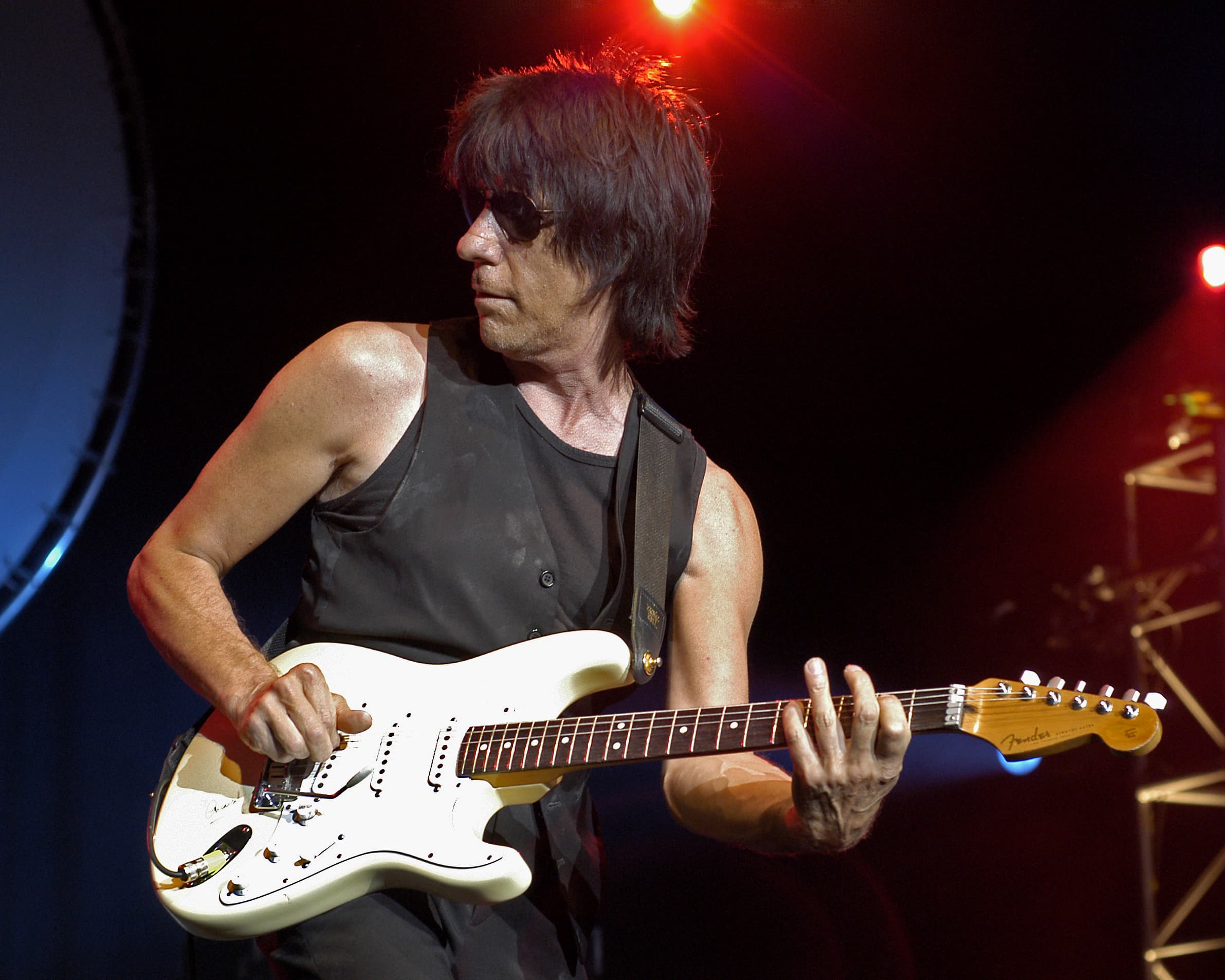
Growing in the 1960s, the "British Invasion" captured my mind and my ears. First, there was The Beatles, then The Rolling Stones, The Who, and on. Every week, it seemed there was another group from England playing music inspired by American musicians who has been bypassed or pigeon-holed by radio programmers into regional boxes that were hard to break out of. In June of 1965, The Yardbirds hit Top 40 with "For Your Love"–the British quintet were a blues-rock band known for its excellent support of American bluesman and featuring guitarist Eric Clapton. But, the group's turn towards "pop-rock" pushed Clapton to depart and join John Mayall & The Bluesbreakers; the group asked session musician Jimmy Page who, in turn, recommended Jeff Beck and, thus, a career was born.
While The Yardbirds pursued Top 40 audiences with their 45rpm "pop" tunes, their albums featured a lot of blues-inspired material some of which leaked onto the radio. The group's raucous rendition of Bo Diddley's "I'm a Man" gave listeners a hint of Beck's prowess but he lasted less than two years in the group, replaced by Page. After an uninspired pair of recordings, including "Hi Ho Silver Linings" (which included a rare Beck vocal), he formed his own group with Rod Stewart on vocals and Ron Wood on bass. The group released several albums of blues-soaked material but broke up after several years.
After Beck disbanded his "heavy metal" Beck/Bogert/Appice" (the bassist and drummer from the US band Cactus), he contacted producer George Martin to produce his new instrumental album. Released in 1975, "Blow by Blow" was a huge success thanks to excellent material, especially the two Stevie Wonder songs, the super funky "Thelonious" and the beautiful "'Cause We've Ended as Lovcrs". Beck's guitar playing on the latter track is emotionally rich and truly proved he was more than a technical whiz. A year later, Martin and Beck collaborated on "Wired" which included a number of cuts recorded with keyboardist Jan Hammer who helped to push the guitarist to play with even more abandon. The album includes a stunning take of Charles Mingus's "Goodbye Pork Pie Hat".
The guitarist recorded several albums with Hammer, toured with Hammer's band, and continued to record albums when the inspiration hit. When he wasn't guesting on recordings or doing the occasional tour, Beck would spend the time in his garage rebuilding cars. He had said on numerous occasions that he had no need to always be in the public eye. Still, his albums continued to sell and he would win GRAMMYs in 2011 for "Best Rock Instrumental Performance" (for "Hammerhead" from the album "Emotion & Commotion") and for his rendition of Puccini's "Nessun Dorma" ("Best Pop Instrumental Performance" from the same album).
One of the joys of listening to Jeff Beck is he could make the oddest sounds and make them fit into the context of any song. Like Buddy Guy, another guitarist who pushes the envelope, Mr. Beck could make one grimace, laugh out loud, and really smile. He will be missed but we were so lucky to have him here!!
Here's a live take of "Goodbye Pork Pie Hat":
Here he is shredding "What Mama Said" with guitarist Jennifer Batten:
Back to 1984 and Beck's reunion with Rod Stewart for Curtis Mayfield's "People Get Ready":
When you listen to Black American Music for over 50 years, over that time one discover musicians whose music you automatically gravitate to. Sometimes it's the sound of their instrument or how their music immediately draws you in or the company they keep or the messages in their music.
Photo: Thomas J. Krebs
For this writer, Ron Miles was one such person. Since first hearing him alongside guitarist Bill Frisell in the mid-1990s, I have been attracted by how his sound and melodic approach fits into the ensembles he plays with and how that translates into the music he creates with for his own recordings. Plus, he was a great mentor for his students––Miles has been on the Music Faculty of the Metropolitan State University of Denver since the late 1990s. He and his family had moved to Denver, CO, from Indianapolis when he was 11. Unlike many jazz musicians who go to New York City or Los Angeles, Miles, as his family grew, stayed close to home.
Still, his association with Bill Frisell lasted throughout the last quarter century-plus. Miles appeared on six of the guitarist's album while Frisell shows up on five of his. It's a delightful musical relationship; they push and pull against each other at times but most of the time they engage in a musical dialogue that belies influences and embraces melody. Miles also worked alongside Matt Wilson, Denver-based saxophonist Fred Hess, clarinetist Ben Goldberg, Joshua Redman, and drummer Ginger Baker among many others––he always managed to sound like himself in every situation.
Photo: Alan Nahigan?WSJ
His two most recent albums as a leader, "I Am a Man" (Yellowbird/Enja) and "Rainbow Sign" (Blue Note) feature the quintet of Miles, Frisell, Jason Moran, Brian Blade, and Thomas Morgan combine so many different elements such as folk music, spirituals, blues, social commentary, and more. The group created music one could get lost inside, feel challenged yet come out of the experience satisfied.
It was this quintet that reopened the Village Vanguard in October of 2021. Now, less than five months, Ron Miles has succumbed to a rare heart ailment (Polycythemia Vera). His music, his mentorship, his family, all live on. He set such a great example of how to be a human being, illustrating how a musician can be part of the local community and the global community without giving up his identity. Still, he died much too young.
Here is music to keep you company:
Here's a fascinating trio of Otis Taylor, Jason Moran, and Ron Miles:
Here's Ron Miles with Joshua Redman, Brian Blade, and Scott Colley paying tribute to Dewey Redman and the group Old & New Dreams:
What a weekend! First, we read that Chuck Berry has passed away. Granted, he lived to be 90, a life that featured many high points, some serious low ones, and, arguably, was the real "King of Rock 'n' Roll." He paved the way for so many "rockers", from The Beatles to The Beach Boys to Bruce Springsteen to The Rolling Stones to The Yardbirds to Randy Newman - I include the last person because Berry was the first great lyricist of Rock, a literate storyteller who make you laugh at his audacity and chortle at his rhymes. There was no better, or few bigger, artists between 1956 and 1964 with hit after hit on the charts at a time when the charts were awash in pablum. Black groups such as The Drifters and The Coasters, the early Motown successes, the "Philly" sound of the Cameo-Parkway label (Chubby Checker, The Orlons), and the emergence of Phil Spector, were just beginning to "cross over" to AM radio. Chuck Berry paved the way for all that plus the English Invasion of 1964-67.
His brushes with the law became quite famous; when he went "on the road", he insisted on being paid in cash before he would go onstage and always work with local bands. He had charisma as big as his ego, ignored the press, and rarely sat for autographs, yet his music spoke to so many. The music he created for Chess Records was a true "fusion" of country, rhythm 'n' blues, "jump" blues, and more.
There are lots of appreciations on line. Check them out. Some have links to songs such as "Maybelline", "Living In The USA", "Promised Land", "You Can't Catch Me", "Roll Over Beethoven", "Sweet Little Sixteen", and "Johnny B. Goode." You can find them on Youtube and elsewhere. That's American Music at its best!
Sunday brought the news of the passing of Jimmy Breslin, a newspaper writer, novelist, and raconteur. I first read Mr. Breslin when he wrote about my favorite baseball team, The New York Mets, in its first season of ineptitude. "Can Anybody Here Play This Game" was as uproarious as the team was atrocious. He went to write about the Mafia, the "Son of Sam", the AIDs epidemic, and the plight of poor people not only in New York City but around the country, He ran for office in the Big Apple on a ticket with Norman Mailer, has numerous personal tragedies in his life but it was his columns in the newspaper (most notably for The New York Herald Tribune, the New York Daily News, and Long Island's Newsday) that stood out. His stories about "real people" never made you feel as if Breslin was faking his sympathy while his diatribes against politicians, gangsters, and others were often filled with vitriol. This man could write, had an ego the size of the Empire State Building, and you always knew how he felt because he rarely, if ever, held back. Best of all, Jimmy Breslin was a newspaper man and understood the power of the printed word.
It's is tough to take when one of your "heroes" passes, tougher when you admired the person from afar and never reached out. My problem is that I read Nat Hentoff faithfully in the VILLAGE VOICE and in JazzTimes, continually impressed by his writing, his dedication to American music and to freedom and I never told him so. Yes, he infuriated me with some of his positions but his arguments were always well-researched, thoroughly fact-checked, and smartly written. His phone number - never an email address - was always listed at the bottom of the JazzTimes columns and I never called.
I never called to thank him for his attempts to teach his readers about music, about freedom, about the fragility of our democracy, about the greed rampant in most political entities, about standing up for those and to those we disagree with. Know all sides of an argument before you uncap your pen, sit at your keyboard, or open your mouth.
And those CANDID recordings from the 1960s! From Max Roach to Charles Mingus to Cal Massey to Jaki Byard to Cecil Taylor to Booker Little and others, they set a standard for quality that was as hard to replicate as it was to maintain. Hentoff was the A & R (artists snd repertoire) director and he made sure to chronicle the music he heard at the forefront of the contemporary jazz scene. Discovering those albums in the 1970s, just as I was exploring the work of the AACM, gave quite an education on how the music grew from its roots in blues, folk music, bebop, into an indescribable genre all its own. Think about how important it was to hear these stories at the beginning of the 1960s and throughout (and how this music begat the late 20th and early 21st Century works of the late Fred Ho, Public Enemy, Dave Douglas, Jason Moran, Matthew Shipp, Terence Blanchard, Kamasi Washington, Samora Pinderhughes, Kendrick Lamar, and so many more.
Nat Hentoff never backed down, never shied away from unpopular positions, believed fervently in the First Amendment (and the need to understand the entire Constitution of the United States), and fought complacency nearly every day of his life. Honesty, unflinching honesty, makes enemies but also friends, real friends not sycophants - I should have called Nat Hentoff but never felt I knew what to say other than "thank you!" Do yourself a favor, read one of his books, dig out interviews, check out the recordings he produced, the liner notes he wrote; pay close attention, even when you do not understand. Certain segments of our society rail about the "lame stream media" yet Mr. Hentoff, often tagged a liberal, was far from lame but an exemplar of what a journalist should be and do.

 Posts