In May of 2021, tenor saxophonist and composer James Brandon Lewis released "Jesup Wagon" on Tao Forms (AUM Fidelity). The music on the album told the inspirational story of George Washington Carver (1864-1943), agricultural scientist, inventor, and community organizer (the Southern farming communities). The recording introduced the world to the Red Lily Quintet. Composed of Lewis, Kirk Knuffke (cornet), Chris Hoffman (cello), William Parker (bass), and Chad Taylor (drums, percussion), the ensemble contains multitudes, playing with creativity, invention fire, and wit. The album made a slew of "Best of" lists later that year and deservedly so.
Lewis and the RLQ is back, this time album inspired by the saxophonist's grandmother. "For Mahalia, With Love" (Tao Forms) is a nine-song program of spirituals made famous by Ms. Jackson (1911-1972) during the four+ decades she toured the United States and the world. Many people point to the influence of Gospel music on the blues and "soul" music but certainly Black spirituals have influenced a multitude of artists from Louis Armstrong to Duke Ellington to John Coltrane to Archie Shepp to the wonderful albums of Hank Jones and Charlie Haden (there are plenty more). Lewis and company lean more to the Coltrane type of "testifying" but unlike the 1965 classic "A Love Supreme", there is only one original work on "For Mahalia"–the program opens with "Sparrow", which includes the melody "His Eye Is On The Sparrow" (composed in 1905 by Charles H. Gabriel and Civilla D. Martin) and the leader's "Even the Sparrow".
Smithsonian/Museum of African History
This music covers a wide swath of territory. From the fiery saxophone shouts on "Calvary" to the swinging final minutes of "Go Down Moses" to the hard-edged driving force of "Wade In The Water" to the joyous power of "Swing Low", this is music that celebrates Ms. Jackson's legacy and builds upon the lessons learned, the lives lost, and the freedoms gained (and now in jeopardy) over the last 400 years. The music also builds off the messages in the music adapted from the teachings Blacks learned in their churches, the prayers of hope and freedom that flowed into and out of the music. Check out the sly grooves of "Elijah Rock", the splendid bass solo that opens the piece, the long rubato tenor/trumpet call-and-response, and the mid-song drop into tempo; if that does not makes you want to shout "Hallelujah" for its sweet blend of African, Swing, and Caribbean rhythms, I do not know what will
The Red Lily Quintet is an excellent ensemble and the music James Brandon Lewis creates and/or arranges for them gives each person room to move, to influence the direction, to add to the harmonies, to engage in the call-and-response, and more. The saxophonist's interactions with Knuffke soar, shout praise, and dance on many of the pieces. Parker and Taylor are...well....they are a rhythm section par excellence in that one creates the foundation and the other the flow plus the fire. There are times when Hoffman's cello gets covered but he's there, sometimes playing counterpoint to the melody, other times counterpoint to the bass lines.
All told, "For Mahalia, With Love" is a great collection of songs for many and varied reasons, not the least of which is the the ensemble's powerful playing and the excellent settings created by James Brandon Lewis. Do dip your feet into this mighty stream!
For more information, go to https://jblewis.com/about. To purchase the recording, go to https://jamesbrandonlewis.bandcamp.com/album/for-mahalia-with-love. For a limited time, if you purchase the compact disk or vinyl versions of the album, you receive a second disk features Lewis leading the Lutoslawski Quartet in his chamber music piece "These Are Soulful Days", recorded live at its premiere performance in November 2021 at the Jazztopad Festival in Wroclaw, Poland.
Revive your spirits with "Swing Low":
Photo: Brian Harkin/NYT
Tenor saxophonist Mark Turner has been collecting critical acclaim since he moved to New York City in the early 1990s. One might say he has a "cool" tone" but you could also argue he's very much his own man. In late 2019, Turner recorded "Return From the Stars" for ECM with a quartet featuring Jason Palmer (trumpet), long-time collaborator Joe Martin (acoustic bass), and the young, dynamic, drummer Jonathan Pinson. That group was invited by photographer and label owner Jimmy Katz (Giant Step Arts) to take part in his label's new series. Titled "Modern Masters and New Horizons", the series is curated by Palmer and drummer Nasheet Waits and will include contributions from artists such as vibraphonist Chien Chien Lu, saxophonists Neta Ranaan and Ben Solomon, drummer Eric McPherson and others.
The first release in the series "Live at The Village Vanguard" and features the Mark Turner Quartet, the same ensemble on the ECM album. Recorded over two nights in June of 2022, the 11-song, 2+ hours, program features material from the earlier studio recording, new pieces written specifically for this ensemble as well as older Turner originals. What Katz the producer is get out of the artist's way and lets the band do what they do best–play. Listen to "Return from the Stars" below to hear how tight the band is, how much they listen to each other, and how this music flows. "Brother, Sister", first recorded in 2014 for ECM with a different quartet (save for Martin), opens with a long, poetic, powerful, solo tenor sax statement––the band comes in seemingly on tiptoes but pay attention to Pinson on the offbeat and Martin's swinging counterpoint. Palmer gets a shorter unaccompanied solo before the the band reenters. Now the trumpet and sax play long tones while Martin solos. Notice how the textures change as the music moves forward.
The newest piece on the album, "Wasteland", is a fascinating ballad that also opens with an unaccompanied tenor sax solo––this time, one hears a plaintive cry, a sense of deep sorrow or, even, loss of hope that leads to a full group elegy. There are long bass notes, Pinson on his toms, a melody line for the sax and trumpet that starts in unison, moves away, and back but in counterpoint now. When you listen to the song in total, you realize that not only is it an elegy but also serves as a vehicle for the drummer to create short solos in response to and seeming rejection of sorrow.
Photo: Jimmy & Dena Katz
"It's Not Alright With Me" is, at 18:36, the longest track on the album. The playfulness of the melody brings images of the Clifford Brown/Max Roach Quintet. While the rhythms prances and struts, the band takes its time to move through the melody section. Martin gets the first solo and it's a tour-de-force, quite melodic yet percussive, careering forward at breakneck speed. Turner's solo starts slowly but he rides the waves created by Pinson to create a masterful, hard-edged, dramatic solo.
The oldest Turner song on the program, "Lennie Groove", is from the leader's second album, 1998's "In This World". The piece has a nervous, almost jittery, melody line which does fall into a delightfully swinging "groove".
"Live at The Village Vanguard" is yet another high water mark in Mark Turner's three decade career. To me, the best to listen to this album is to sit back, put on headphones, pretend you're at one of the tables at the Vanguard, and let the music play. There's so much music to listen to so take your time and let them play!
On June 19 (from midnight (PT) June 19 to midnight (PT) June 20), we’ll hold our annual Juneteenth fundraiser, where we donate 100% of our share of sales* to the NAACP Legal Defense Fund to support their ongoing efforts to promote racial justice through litigation, advocacy, and public education.
This annual fundraiser is part of our larger, ongoing commitment to racial equity, and we’ll continue to promote diversity and opportunity through our mission to support artists, the products we develop, those we promote through the Bandcamp Daily and Bandcamp Radio, how we work together as a team, who and how we hire, and our relationships with organizations local to our Oakland space (some of which we’ve highlighted below).
We hope you’ll help us spread the word about the upcoming fundraiser, and thank you for being a part of the Bandcamp community!
Ethan Diamond CEO & Co-Founder of Bandcamp
Here's a few suggestions:
Trombonist/tubaist, composer, and educator Bill Lowe has created this work partially based on Jean Toomer's groundbreaking 1923 novel "Cane" as well as a musical biography. The program also includes compositions from Frank Foster whose Big Band the trombonist performed with months after moving to New York City and Bill Barron who was not only a fine composer but a Professor of Music at Wesleyan University when Lowe was a Visiting Artist-in-Residence (Author's note: Professor Lowe taught in the Graduate Liberal Studies Program and was my first teacher when I went there to get my Master's Degree). For this album, Lowe organized the Signifyin' Natives Ensemble featuring Taylor Ho Bynum (cornet, flugelhorn), Hafez Modirzadeh (alto saxophone, percussion), Luther Gray (drums), Ken Filiano (bass), Kevin Harris (piano), and the impressive young vocalist Naledi Masilo.
Here's "Karintha" one of the three tracks from the "Cane Suite":
Here are several more suggestions (both of which I purchased):
The Pan Afrikan Peoples Arkestra – "60 Years" (self-released) – This, hopefully, is the first of numerous retrospectives of the six decades of music created by the PAPA, founded in Los Angeles. CA, by pianist and composer Horace Tapscott. It's a great story of perseverance, creativity, promise, and self-determination.
Listen to "The Ballad of Deadwood Dick" recorded in 1995:
James Brandon Lewis/Red Lily Quintet – "Jesup Wagon" (TAO Forms) – This impressive album has been out for several years and should be in everyone's collection. Based on the life and work of American botanist George Washington Carver, tenor saxophonist Lewis created the music with an impressive ensemble including long-time associate Chad Taylor (drums, mbira), Kirk Knuffke (cornet), William Parker (bass, gimbri), and Chris Hoffman (cello). Powerful story, powerful music!
One of the great joys of listening to creative music is how many of the artists that came of age in the 1960s and 70s are still with us and are still pushing forward. OGJB –– Oliver Lake (alto saxophone), Graham Haynes (cornet, electronics), Joe Fonda (acoustic bass), and Barry Altschul (drums, percussion) –– first came together as a quartet in 2015 to do several tours. They recorded "Bamako" in 2016 and it was issued in 2019 on TUM Records. Right after that debut album was issued, the quartet went back into the studio and the results can be heard on "Ode To O", the group's second recording for the Finnish label.
The 10-song program includes three compositions by Altschul, two apiece from Lake and Haynes, one by Fonda, and two collective improvisations. The drummer's title track is dedicated to Ornette Coleman while "Da Bang" is a tribute to the late violinist Billy Bang. The former piece opens the album in a swinging mode but check out the well-developed melody. Haynes takes the first solo and he dances along with the powerful bass lines and rambunctious drums. The latter track opens with a fine drum soliloquy that dips and swerves, talks and turns, before Fonda drops into a rapid-fire walking bass and the quartet dances forward. Lake's "Justice" includes a deliberate melody line over the rampaging rhythm section. The music feels akin to the "protest" music that Charles Mingus created in his powerful songs. Lake and Haynes solo together with the saxophonist squalling while the cornetist shouts back at him. The saxophonist composed "Bass Bottom", another tune with a deliberate melody line but this time it's Fonda funky bass lines and solo over the simple drum pattern that pushes the song forward.
Photo: Enid Farber
The opening moment of Haynes' "The Other Side" feels inspired by Richard Strauss's "Thus Spake Zaruthustra"; it's slow development of the theme gives way to the composer's solo which also includes his use of electronics to distort the sound of cornet. Fonda's "Me Without Bela" owes its inspiration to the bassist's love of Mr. Bartok's string quartet but when the song moves out into its second half, Fonda drops into a hypnotic and funky rhythm which pushes Altschul and the front line into a fascinating push and pull. The coda of the song is quite engaging and surprising, an abridged version of the opening of the piece.
Check out the two improvisations, especially "OGJB#3" with its playful electronics. Playful is a good word for "Ode To O"; the album is full of playing by four musicians who listen to and inspire each other as well as inspire the listener. Such goos music deserves to be heard both on album and in person.
On the first day of February 2021, three musicians entered Studios Ferber in Paris, France, all three associated at one time in their careers with pianist Cecil Taylor (1929-2018). Drummer Andrew Cyrille spent 11 years (1964-75) with the groundbreaking artist, recording on his two Blue Note albums, his work with and for the Jazz Composers Orchestra, and several other Taylor albums. Bassist William Parker also spent more than a decade as a member of the pianist's ensemble, recording 13 albums from the mid-1980s into the early 1990s. Flugelhornist and trumpeter Enrico Rava performed as a member of Taylor's Orchestra of Two Continents (1984) and his European Orchestra (1988), recording one album with each band.
The 10-song program opens with "Improvisation No. 1", a burst of energy from the opening moments. For those listeners who only know the 82-year young Rava from his ECM recordings, his flugelhorn work is a joy to hear. He rides the rhythmic waves, playfully tossing out lines yet never overplaying. Meanwhile, Parker creates a throbbing bottom from Cyrille to play around with. "Ballerina" is the first of two Rava compositions; the title does not prepare one for the rapid-fire rhythms and blazing flugelhorn riffs. Even the unaccompanied cymbal and drums solo burst out with unbridled energy. Later in the program, Rava's "Overboard" opens with a short flugelhorn spot that resembles the melody of Ornette Coleman's "Lonely Woman". Parker's powerful bass lines atop Cyrille's rolling drums stands out as well.
Photo: Luciano Rossetti
Cyrille's "Top, Bottle, and What's in the Middle" opens with solo flugelhorn, then bass, and then drums, hence the title. Yet, that's how the tune moves forward, each member of the trio getting a short solo in that order. The drummer also contributes "Enrava Melody" –– Rava plays the melody in with Parker offering counterpoint until the composer enters to set the pace for the music to jump forward.
The album also includes two "Blues For Cecil". "No. 1" is a funky urban blues that Rava gleefully moves through while Parker shows his "gutbucket" side. The trio goes "free" for a moment before Cyrille's martial, drumbeat pushes the bassist out front for yet another powerful solo. Listen to Cyrille dancing, bobbing and weaving throughout the second half –– such joy! "No. 2" opens as a ballad with Rava displaying his blues "chops" while the bassist plays such deep low notes.
Photo: Luciano Rossetti
"2 Blues for Cecil" closes with the program's only standard, Rodgers & Hart's "My Funny Valentine". Rava caresses the melody while Cyrille moves gracefully around his cymbals and Parker offers gentle support. The three musicians created this beguiling tribute to Cecil Taylor not by imitating but by playing who they are as musicians and as human being. Mr. Taylor always expected the very best from his ensemble and Andrew Cyrille, William Parker, and Enrico Rava responded during their time working with him. This delight-filled album is their gift to us!
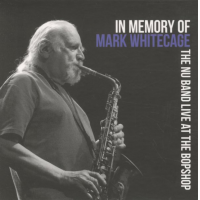
Born in 1937, Mark Whitecage (alto saxophone, clarinet, Díne flute) lived a jazz life. He started playing while still a boy, his father exposing him to the music and sound of Lester Young, Charlie Parker, Ben Webster, and many other "boppers". By the time he arrived in New York City in the early 1970s, his approach to music had changed. Whitecage hooked up with multi-instrumentalist Gunter Hampel and they toured constantly spending a lot of time criss-crossing Europe. He led a number of his own bands through the 1980s and 90s recording a number of albums as a leader and sideman for CIMP Records. He joined The Nu Band in 1999, a quartet organized by drummer Lou Grassi and trumpeter Roy Campbell, Jr. (featuring bassist Joe Fonda) and was a member up until his passing in March of 2021 at the age of 83.
In January of 2018, TheNu Band performed at the Bop Shop in Rochester, NY. "In Memory of Mark Whitecage" (NotTwo Records) captures 63 minutes of that evening's performance. After Roy Campbell passed in 2014, the rest of the group asked trumpeter Thomas Heberer to join them and he's been a member ever since. The exciting seven-song program features songs by each member. The program opens with Whitecage's "Prayer for the Water Protectors"; the composer's Díne flute rolls on unaccompanied for the first two minutes before Grassi's tribal drums and Heberer's growling trumpet move behind him. Fonda's bowed bass lines quietly underpin the music. The saxophonist's "Five O'Clock Follies" opens with a short saxophone intro (opening lines sound a bit like "How are Things in Glocca Morra" from "Finian's Rainbow") and heads right into a rhythm that befits the name of the venue. Everybody takes a solo, the audience and the band have fun.
The next two cuts are both composed by the trumpeter. "One For Roy" pays tribute to the late trumpeter and co-founder of The Nu Band. The music goes in and out of tempo plus features a great conversation between the alto sax and trumpet. "The Closer you Are the Further It Gets" is the album's longest piece and it, too, does not adhere to a strict rhythm. Yet, listen to how Fonda and Grassi converse underneath the soloists. They stay quite busy and finally push a rhythm onto the soloists which Whitecage obliterates with his wild duo with Grassi.
After a pair of Fonda's pieces, the free then rollicking "Christoff and Ornette" and the hard-driving "Minor Madness" (great solos all around), the album closes with Grassi's elegy "Dark Dawn in Aurora". Opening with a long and powerful solo from Fonda, the band enters on a martial beat and then into strong solos from Heberer and Whitecage (again, he duets with the drummer) before returning back to the theme with the added spice of the trumpeter dancing atop the saxophone melody until the close.
In the liner notes to "In Memory of Mark Whitecage", Joe Fonda writes about his 40-year relationship with the saxophonist first as a young musician soaking up all the stories then as an equal on the bandstand. Lou Grassi looks back at the 20 years of Whitecage's membership in The Nu Band while Thomas Heberer first met the man as a 24-year old new to America before joining him on the bandstand 25 years later. The energy, the creativity, the sheer joy of making music even as he entered his 80s, Mark Whitecage made and left his mark on creative music.
Since I began this blog in 2009, I realized that every Top Ten list has a number 11, 12, and so on. When hundreds of recordings are released every year, it's physically impossible to give every one of those albums the time it deserves to be heard but I believe that every reviewer/ critic has favorites that could quite easily replace several, if not more, of the recordings listed 1-10. Ergo, here's Part 2.
Fergus McCreadie – "Cairn" (Edition Records) – The young Scottish pianist and composer has proven himself to be a technical wizard but this album shows he has a delightful and potent lyrical side. Wit an equally impressive rhythm section, this music sings.
Joe Fiedler's "Open Sesame" – "Fuzzy and Blue" (Multiphonics Music) – Trombonist, orchestrator, and composer Fiedler has the music director of "Sesame Street" for over a decade embraces his playful side. Along with trumpeter Steven Bernstein, saxophonist Jeff Lederer, bassist Sean Conly, drummer Michael Sarin, and (occasional) vocalist Miles Griffith, he takes this "kids music" and brings out the funky, jazzy, side.
William Parker – "Migrations of Silence Into and Out of the Tone World" (AUM Fidelity) – 10 albums, 10 different ensembles, hours of fascinating music: released early in 2021, this collection continues to display/ uncover the bassist's endless springs of creativity each time you play one or more of the recordings. In those hours when the despair in the world has tried to overtake the days/ nights, Mr. Parker's music reminds one that music is a welcome oasis.
In 2021, the Finnish label TUM Records celebrated Wadada Leo Smith's 80th birth year by releasing four projects, three in multi-disk boxed sets that the trumpeter, composer, and conceptualist recorded in the past six year. All four deserve to to be listed in Part 1 of these posts and in any "Best of" list. The picture on the left is the cover of "A Love Sonnet for Billie Holiday" featuring Wadada with drummer/ percussionist Jack DeJohnette and pianist/ organist/ synth player Vijay Iyer.
"Trumpet" (pictured left) is three albums of solo trumpet music recorded in St Mary's Church in Pohja, Finland. Before you shake your head and walk away, know that this is an amazing journey filled with introspection, joy, feistiness, freedom, and more, never failing to satisfy the adventurous listener. One can hear the spirits of Louis Armstrong, Lester Bowie, Booker Little, and Clifford Brown shaking their collective heads and shouting "Amen"!
"Sacred Ceremonies" is also a three-CD set, one with Wadada and percussionist Milford Graves, one with the trumpeter and bassist Bill Laswell, the third with all three artists. The sound quality of these albums is stunning, one feels as he or she in the middle of a room watching the the musicians creating in the moment. Music without borders played by musicians who love and respect each other so they create without ego.
Go to https://tumrecords.com/tum-info to find out more and also to check the 38-minute video of Wadada's 80th Birthday tribute.
Gabriel Vicéns – "The Way We Are Created" (Inner Circle Music) – Puerto Rican-born guitarist and composer Vicéns strikes gold with his third album as a leader. His mature, intelligent, and playful compositions are performed by a splendid sextet including Roman Filiú (alto sax), Glenn Zaleski (piano), Rick Rosato (bass), E.J. Strickland (drums), and Victor Pablo (percussion). One can get lost, entranced, in the flow of this wonder-filled collection.
Roxana Amed - "Ontology" (Sony Music/Latin) – The Argentinean-born, Miami, FL, vocalist, composer, and educator has had a long and distinguished career in Latin America. Since moving to the US, Ms. Amed has created alongside Guillermo Klein, Frank Carlberg, Leo Genovese, and others – this album runs the gamut from introspective ballads to performances in a "freer" style and a voice that move one to the edge of his seat.
Jen Shyu – "Zero Grasses: Ritual for the Losses" (Pi Recordings) – There are albums and artists whose music enters my brain and soul yet I cannot really describe why. Ms. Shyu, an amazing composer, musician, and performer has the innate ability to make "foreign" sounds feel familiar; in the case of this album, much of which is inspired by the loss of her father, it's because she is telling a story mostly all of us live through, facing pain with the need to create music that "frees" feelings. Her ensemble – Ambrose Akinmusire (trumpet), Dan Weiss (drums, percussion), Thomas Morgan (bass), and Mat Manieri (viola) – aids in her quest with creativity and dignity for the subject matters.
Lorraine Feather – "My Own Particular Life" (Relarion Records) – Ms. Feather has proven herself time and time again to be one of the finest lyricists of the past 20 years. Over the past decade, her albums have become even more personal even as she displays quite a love for science as well as more arcane subjects. This may be her most personal album as there are songs that address her former husband's battle with dementia, how one lives a real life during the pandemic, and a few more. But there are also new examples of her delightful humor. The band, all recorded remotely (including the late percussionist Michael Shapiro who recorded his work in the Philippines!), is her usual band of suspects including the wondrous violin of Charlie Bisharat.
Art Hirahira – "Open Sky" (Posi-Tone Records) – Over the past decade, pianist and composer Art Hirahira has issued six albums as a leader for the Los Angeles-based Posi-Tone Records: he started out strong in 2011 with "Noble Path" and his music has only gotten stronger and more delightful since. Here, he is backed by Posi-Tone's "pandemic" rhythm section (bassist Boris Kozlov and drummer Rudy Royston with guests vibraphonist Behn Gillece and tenor saxophonist Nicole Glover performing on selected tracks) and the results are exciting, lyrical, exploratory, and so much more.
Chuck Owen & The Jazz Surge – "Within Us" (MAMA Records/ Summit Records) – Composer, arranger, and educator Owen (who retired this year) has produced one fine large ensemble album. The lyricism, the musicianship, the delightful violin of guest artist Sara Caswell, and a 19-piece band that is so responsive that the music flows seemingly without effort, Mr. Owen has kept this band together for 25 years (this album celebrates that longevity), continuing to produce music filled with ideas, possibilities, dreams, and realities.
Earlier this year, AUM Fidelity released "Migrations of Silence Into and Out of the Tone World", a massive yet splendid 10-album set of original music composed and arranged by bassist-composer William Parker. 10 separate groups, 91 tracks, 594 minutes of music, which takes down to ingest, ruminate upon, and understand. Like the recent works of Wadada Leo Smith and Anthony Braxton (also multiple disk sets), Mr. Parker's music is telling stories, narratives that blend tradition, history, and are very much a reflection of the present day. In the weeks leading to the Pandemic shutdown, the bassist recorded two albums that continue the exploration that his earlier albums began.
Both new releases are trio dates. "Painter's Winter" features the leader on bass, trombonium, and shakuhachi, Daniel Carter (trumpet, alto sax, tenor sax, clarinet, and flute) and Hamid Drake (drums). The program opens with the hard-driving "Groove 77" led by Mr. Parker's thick bass lines, Drake's funky yet creative drumming, and Carter's muted trumpet lines. The rhythm section, mixed up high, is in sharp contrast to the thoughtful trumpet throughout. The title tracks opens with Mr. Parker on trombonium (a smaller, curved, trombone), Carter's flowing flute, and Drake's spare yet conversational drums. The intensity of the flute and brass interaction picks up and the music begins to bounce as the drummer gets into conversation. The listener can sit back and revel in the deep sounds.
Carter's smooth-toned alto leads the way on "Happiness" with the bassist, at times, playing counterpoint and Drake right/ tight in the groove. The music slows down for a frantic arco bass solo but afterwards picks up in speed. The introspective is in stark contrast to Drake's dance around the drum set and Mr. Parker's occasional walking bass line. "Painted Scarf" pairs clarinet and shakahuchi with, at the onset, very quiet or little percussion. Over the 10:49, Drake pushes his bandmates by creating a Native American rhythm which ratchets up the intensity. "A Curley Russell" closes the program; Mr. Parker dedicates the piece to the late "Curley" Russell, the "be-bop era" bassist who played with Tadd Dameron, Charlie Parker, Art Blakey, and Bud Powell (among others). Carter's lively alto sax leads the way with the bassist's thick tones helping to fill the bottom. Drake creates a rollicking drum solo which lights a fire under the saxophonist who then creates his most impassioned solo on the disk. After the delightful bass solo, the trio takes the song out in a spirited fashion.
"Painter's Winter" is an album to savor, to sit back and let the sound wash over you time and again. William Parker, Daniel Carter, and Hamid Drake have history, as they say, know each other well, and sound as if they are having a great time –– you will as well!
"Mayan Space Station" posits Mr. Parker in the studio with guitarist Ava Mendoza and drummer Gerald Cleaver. With Ms. Mendoza's highly amplified sound, one could easily call this group a "power trio". Mr. Parker's locks in with the drummer and this music often has an irrepressible groove. It's hard to sit still listening to "Domingo"; notice how the guitarist creates a sound and attack not unlike that of Nels Cline but one also hears traces of Tom Verlaine (Television) and blues great Michael Bloomfield (when he played with the Paul Butterfield Blues Band on "East-West"). Mr. Parker's infectious groove jumpstarts "Rocas Rojas" with Cleaver diving right in, moving about his drum kit in glee, Ms. Mendoza wailing and shredding above. The title track opens in the spirited fashion of Arthur Blythe's "Down San Diego Way" with Cleaver's drums (he's using brushes, no less) and percussion paired with Mr. Parker's solid four-note bass runs. Ms. Mendoza jumps in, roaring in musical approval until the 4 minute mark, slows down for a moment, and picks up her sonic attack. The guitarist steps out of the spotlight halfway through the 14:42 track to make way for the raucous bowed bass solo over Cleaver's crashing cymbals and snappy snare.
"Canyons of Light" is a rubato piece with tremendous cymbal and cowbell work, shimmering/ furious arco bass, and long tones and moans from the guitar. As Ms. Mendoza goes into "attack mode", the rhythm section continue to thrash around beneath. There is a hint of a steady rhythm as the piece fades down at the 10-minute mark. It's a challenging piece of music that stands out for its aural expressions and passionate musicianship.
Photo: Peter Drukker
The album closes with "The Wall Tumbles Down", another hard-edged piece with a irresistible groove. Ms. Mendoza's chordal romp over a guitar drone gives way to a solo that builds up from a simple riff into a bluesy wailing spotlight. One can hear the influence of Vernon Reid and Sonny Sharrock especially later in the piece when she loops police sirens. The loops don't disappear until the last minute of the piece. Perhaps, these are the walls of racism, sexism,, and intolerance: nevertheless, it's a powerful finish to an album of powerful moods and sounds.
"Mayan Space Station" is music that demands to be played loud, windows open to the world. William Parker wants to touch the world, wants to help people get out of the doldrums and away from the fears that come blasting out of our televisions, radios, and "smart" phones. Kudos to Ava Mendoza and Gerald Cleaver for their contributions to this most appealing recording.
January 24th was the 83rd birthday anniversary of saxophonist, composer, arranger, conceptualist, and story-teller Julius Hemphill (1938-1995). Before forming the World Saxophone Quartet, the Fort Worth, Texas, native had co-founded the Black Artists Group (BAG) in St. Louis and, upon moving to New York City in the early 1970s had recorded with trumpeter Lester Bowie and fellow saxophonist Anthony Braxton. The WSQ began in 1977 and was an ensemble that originally included Oliver Lake, Hamiet Bluiett, and David Murray –– Hemphill stayed with the ensemble for 13 years, touring and making albums for Black Saint and Nonesuch Records. After leaving that group, he formed an "electric" band, a saxophone sextet, and composed for big band and string quartet plus works for solo piano performed by long-time companion, Ursula Oppens, an opera, and several works for dance companies. Hemphill created two truly fascinating solo albums "Roi Boyé and the Gotham Minstrels" (Sackville Records) and "Blue Boyé" (Mbari Records) both issued in 1977. Both "solo" recordings feature multiple tracks of alto and soprano saxophones plus flute, and, like the vast majority of Hemphill's original music, blurred (often obliterated) the lines between blues, folk, and jazz. "Roi Boyé", as well, is noted for Hemphill's use of overdubbed voices and poetry.
New World Records has just issued the seven-CD "THE BOYÉ MULTI-NATIONAL CRUSADE FOR HARMONY" with the subtitle "Archival Recordings 1977-2007". One hears the composer-saxophonist in numerous lineups as well as one solo track. Especially fascinating are the duos with cellist Abdul Wadud, bassist Jerome Harris, and with poet K.C. Lyle and Malinké Elliott. The seventh CD "Live at Joyous Lake" features a quartet including Hemphill, trumpeter Baikida Carroll, bassist Dave Holland, and drummer Jack DeJohnette. Each of the seven runs over 60 minutes with three running more than 73 minutes. One ensemble, The Janus Company ––a trio with Hemphill, Carroll, and drummer Alex Cline –– is featured on the third disk. Two of the three trio tracks come from a studio while the third piece comes from a live gig recorded by the trumpeter in Berkeley, CA. Two more live performances recorded by Carroll in Philadelphia, PA, feature cellist Wadud with the trio; one gets to hear a powerful performance of "Dogon A.D." that is filled with roaring and soaring solos.
Photo: George Rose/ Getty
Not only are there previously unheard compositions of Hemphill's but also the "Chamber Music" disk features "Mingus Gold", three pieces by bassist Charles Mingus that Hemphill arranged for the Daedalus String Quartet. Included in the set, recorded in the Isabella Stewart Gardner Museum in Boston, MA, is a rollicking rendition of "Better Get Hit In Yo' Soul."
One could write that "THE BOYÉ MULTI-NATIONAL CRUSADE FOR HARMONY" is a collection for Julius Hemphill completists. That is somewhat false in that these 52 tracks are not a collection of alternate takes but truly a deep dive into the many ensembles that Hemphill wrote for, organized, and played with. Many of these pieces are issued here for the first time. There are several pieces on which the leader stretches out, letting loose, showing his mastery of his reeds as well as how he is such a delightful "conversationalist" when he plays. Those who purchase this set (information below) should take the time to read producer Marty Ehrlich's incisive and expansive essay on the person and the music you're listening to.
To whet your appetite, here's Julius Hemphill and Abdul Wadud from the 1993 album "Oakland Duets":
Photo: Jason Andrew
Bassist, composer, conceptualist William Parker (born January 10, 1952) has been a mainstay of Black Creative Music since 1971. In those days and nights of the New York City "Loft Jazz" scene, Parker played alongside luminaries such as drummers Ed Blackwell and Sunny Murray, trumpeters Don Cherry and Bill Dixon, and in 1980, pianist Cecil Taylor. He was an original member of saxophonist David S. Ware's Quartet, playing with that ensemble from 1988 through Ware's untimely death in 2012. He's also played extensively with pianist Matthew Shipp in several of his ensembles, with saxophonist Peter Brötzmann, with guitarist/ bassist Joe Morris, with trumpeter Roy Campbell (in the group Other Dimensions in Music) and many others. Parker has been issuing albums as a leader and co/leader since the early 1990s on labels such as FMP, AUM Fidelity, Eremite, Thirsty Ear, Centering Records, and other independent outlets. As a bassist, Parker can be solid, foundational, holding down the bottom in the style of Wilbur Ware and Charles Mingus; like the latter musician, he's also a powerful, melodic, soloist.
2021 brings, perhaps, the most impressive set of recordings in Parker's career. "Migration of Silence Into and Out of the Tone World (Volumes 1–10)" (AUM Fidelity) is a 10-CD box, 10 very different settings of the bassist's music ranging from small groups to solo piano to a chamber ensemble and beyond; (notably missing is Parker's Little Huey Creative Music Orchestra which has been on hiatus since 2006). Seven of the CDs feature vocalists; included are sessions with Fay Victor (with Parker and percussionist Hamid Drake), Raina Sokolov-Gonzalez (with a chamber octet), Ellen Christie (in a trio setting with Parker and trumpeter Jalulu-Kalvert Nelson), Kyoko Kitamura (in a quintet session with Parker), Jean Carla Rodea (with Parker and 10 other musician), Lisa Sokolov (solo voice), and Andrea Wolper (with Parker in a septet session dedicated to Italian movie directors).
Photo: Peter Ganushkin
The remaining three recordings are instrumental. Pianist Eri Yamamoto, who has often performed and recorded with the bassist, plays 14 solo Parker piano pieces on "Child of Sound", an impressive display of melody, emotion, and rhythmic variation. "The Fastest Train" (CD #9) features Parker on a variety of flutes in a trio setting with Coen Aalberts (flutes, percussion, bird sounds, cricket sounds, drum set) and Klaas Hekman (flutes, piccolo, shakuhachi). Even though there are no vocals, every one of the 13 songs has a poem associated with the music. "Manzanar" is the 10th album and features Parker (various flutes, mouth organ) with the Universal Tonality String Quartet (violinists Jason Kao Hwang and Gwen Laster, violist Melanie Dyer, and cellist Dara Bloom). On the final track, "On Being Native", Parker is replaced by alto saxophonist Daniel Carter.
All but one of the albums that comprise "Migration of Silence Into and Out of the Tone World" was recorded between November 2018 and February 2020, the exception being "The Majesty of Jah" that was originally recorded in Autumn of 2010. In 2019, vocalist and conceptualist Ellen Christi took the original tapes, adding voices, sound snippets, and reassembled the album. 10 albums, 10+ hours of music, each ensemble has fascinating stories to tell, all coming from the fertile imagination of William Parker. He endows his musicians and vocalists with the power to use their imaginations, to listen and interact, to make each ensemble unique and each track worth exploring. Spend a good amount of time with each one of these albums, find the pieces that speak to you, explore the ones that make you uncomfortable, read the copious notes but not until after you listen at least once, and then listen again.
With the election so close, the division so fractious and potentially
explosive, we feel a special event is needed for the public on Election
Day. On November 3, Deep Tones for Change will transmit
4 performances each hour, spanning the 17 hours that US polls are open
nationwide, from the East Coast to Hawaii - 68 individual performances!
Deep Tones for Peace is a musical initiative that
originated in 2009 with a telematic performance between Jerusalem and
Manhattan, and has continued with annual iterations until the present
day. Deep Tones for Peace 2020 was launched by Mark Dresser and William
Parker. A regular streaming of live meditations for peace, healing and
transformation is delivered by musicians transmitting deep tones that
can strengthen the unseen bonds of our diversity as we oppose economic,
educational, and environmental inequities fueled by racism, sexism, and
greed.
Contributors play for 5-30 minutes with the intent of musically sending
healing vibrations to be felt worldwide. The call for participation is
open to all bassists who wish to join in an ongoing musical transmission
of vibrations for peace. Any style or form of music and any level bass
player is welcome to help promote peace in the world. We truly believe
this project will have a positive impact on the balance of life.
To date, the impact of the initiative has been far greater than
anticipated, despite being non-monetized and publicized solely via word
of mouth and social media. Since its first daily transmission on August
1, 2020, Deep Tones for Peace has broadcast more than 120 individual
performances, and membership in the public Facebook group has grown to
include nearly 2,100 members in more than 40 countries worldwide.
Voluntary contributors have included celebrated artists John Clayton,
Christian McBride, Rufus Reid, Robert Black, Pablo Aslan, Kristin Korb,
Bertram Turetzky, Thierry Barbé, Jorge Roeder, Scott Colley, and others.
Deep Tones for Peace is a public Facebook group – membership is open to everyone, and listening is possible for anyone via https://www.facebook.com/groups/DeepTonesForPeace2020, whether a Facebook member or not.
As a youth growing up in Lima, Peru, Jorge Roeder first studied guitar, moved on to cello, but became entranced by the bass in High School, and found his musical calling. He came to the United States in 2002 to study at the New England Conservatory of Music in Boston, MA, and soon came into contact with teachers such as Bob Moses, Dominique Eade, Danilo Perez, and bassists John Lockwood, Cecil McBee, and fellow Peruvian, Oscar Stagnaro. Roeder also began performing with his contemporaries such as drummer Richie Barshay, pianist Carmen Staaf, and pianist Dan Tepfer. Moving to Brooklyn, NY, in 2007, the bassist started a professional relationship with guitarist Julian Lage which is ongoing today as well as with pianist Shai Maestro, John Zorn, and has been a member of trombonist Ryan Keberle's Catharsis since 2012.
If you have listened to Roeder in any of those groups, you'll know he possesses a wonderful facility for playing melody, rhythm, and counterpoint, with rich tones emanating from both his acoustic and electric basses. For his debut album as a leader, "El Suelo Mio" (self-released), the bassist goes it alone, playing only his sonorous upright bass––the album title translates to "my ground" or "my soil". His classical training comes through on pieces such as Ornette Coleman's "Lonely Woman": Roeder plays the tune with his bow, sawing at his instrument to capture the beauty of the melody and the emotion the song contained within the composition. Other pieces that have great emotion are "El Piebeyo" by legendary Peruvian composer Felipe Pingol Alva (1899-1936) and the lovely original "Silencio De Um Minuto". The aptly-titled "Bounce" is a rollicking blues with a handsome melody while "Patrona" displays exquisite finger work not unlike a flamenco guitarist. "I'll Remember Paris", the oft-recorded Gene De Paul melody, shines as Roeder caresses the melody and then creates a powerful solo.
Photo: Isabel Roeder
"El Suelo Mio" closes with the slowly unfolding ballad "Les Lapins", the soulful melody highlighting Roeder's articulate playing, the harmonics he creates ring in your ears for just a second before he moves back into the melody.
Jorge Roeder has created an album that resonates in so many ways; with his love of melody, emotion, and communication shines throughout. Yes, the bassist has tremendous facility on his instrument yet that ability is harnessed in order to present songs that sing to your heart, mind, and soul.
Flutist, composer, and educator Nicole M. Mitchell is one of the most visible contemporary members of the AACM whose recordings cover many different subjects and styles of Black Music. Lisa E. Harris is a vocalist, composer, creator and manipulator of electronic sounds who is also a filmmaker. The two artists have come together, along with members of Ms. Mitchell's Black Earth Ensemble (including cellist Tomeka Reid), to create "EarthSeed" (FPE Records), the third chapter in Ms. Mitchell's projects inspired by the work and vision of author Octavia Butler (1947-2006).
When you listen to the music on "EarthSeed" (recorded live in concert in January of 2017 at the Art Institute of Chicago), be prepared to enter into a different sonic world. After the brief introduction titled "Evernascence/ Evanescence" for flute and voice (breathing and whistling), "Whispering Flame" begins the story in earnest. Instruments move in and around each other, cello and bass swirl, percussion rattles, while flute and trumpet rise above the combined voices of Ms. Harris and tenor Julian Otis singing a song of "creation". Both vocalists also stretch their instruments, creating alien languages, guttural noises, grunts and squeals as the cello creaks beneath. A quiet interlude for flute and cello as trumpeter Ben Lamar Gay roils above the singers. That's just one song.
Photo: Emily Berl (NYTimes)
There's the fun of "Yes and Know" with its bouncing rhythm courtesy of percussionist Avreeayl Ra, violinist Zara Zaharieva, and Ms. Reid and vocal play of Ms. Harris and Mr. Otis as the flute and trumpet dance above. The mewing, snorting, hissing, babbling, chattering, flirting voices cause the audience to laugh on "Phallus and Chalice"––when the instruments and percussion join, the interactions sound like a chase scene in a cartoon. The gentle interaction of flute, muted trumpet, cello, violin, and percussion frame Mr. Otis and Ms. Harris (who soars and wails behind the poetry) at the onset of "Fluids of Time" before the music erupts into a "Rite of Spring"-like section.
"EarthSeed" closes with "Purify Me with the Power to Self Transform", an impressionistic ballad that blends a gospel influenced lead vocal (Mr. Otis's falsetto) and Ms. Harris's wordless responses) with all the instruments plus synthesizer to create an otherworldly benediction. Even the 15 seconds of silence at the end holds great power while serving as a re-entrance into our everyday reality. This album that Nicole Mitchell and Lisa E. Harris have created with members of the Black Earth Ensemble is filled with sounds, voices, poetry, prose, and the joy of performance. Get lost in this "new" world.
Lisa E. Harris, vocals / theremin / electronics / composition Nicole M. Mitchell, flute / electronics / composition Julian Otis, vocals Zara Zaharieva, violin Ben LaMar Gay, trumpet / electronics Tomeka Reid, cello Avreeayl Ra, percussion
Photo: Joe Crocetta
Drummer Jeff Cosgrove lives in Maryland and, up until the pandemic, played a lot in the Washington, D.C. area. Over the last decade or so, he's been working with his group Motian Sickness as well as gigging with numerous local musicians. Plus, he's invited musicians such as pianists Matthew Shipp and Frank Kimbrough, bassists Ken Filiano and William Parker, saxophonists Scott Robinson, Noah Preminger, and Rob Brown plus guitarist Steve Cardenas to play in clubs in and around the Capitol area, releasing many of the collaborations on his own label and on Bandcamp.com. A majority of the recording sessions––in-studio and live––are improvisations and offer the attentive listener the opportunity to listen to musicians "conversing" and listening to each other for the sake of the music. Cosgrove never "overplays"or "overthinks" the music; that sensitivity is one of the major components of his music, making it all the more interesting.
His newest offering, "History Gets Ahead of the Story" (Grizzley Music/self-released)", finds the drummer in a new trio, alongside John Medeski (organ) and Jeff Lederer (tenor and soprano saxophones, flute). Seven of the program's 10 songs are from the pen of bassist William Parker with two from Lederer and one from Cosgrove. Parker is one of the more important people on the contemporary scene, not just for his music but also for the work that he and his wife, poet and choreographer Patricia Nicholson, have done for artists by creating organizations, most notably the Vision Festival. The blues-soaked sounds this trio produces serve to remind the listener of Mr. Parker's "roots", his connection to "soul" music and the blues as well as to fellow bassist and composer Charles Mingus.
Photo: Joe Crocetta
Opening with "O'Neal's Porch" (from the 2001 album of the same name), the trio sets the easy pace and one can feel the influence of Curtis Mayfield in the melody and groove. These musicians are not afraid to go "out" for a moment yet the song always returns to the walking organ bass lines and Cosgrove's steady cymbal and snare work. Lederer's solo ranges far afield, something he does with joy, playing with an exuberance that adds fire. Medeski gets rights into the groove with his soulful Hammond B-3 sound. Lederer moves to flute for the playful "Little Bird", opening with a cheerful duet with Medeski before dropping into a sweet groove. The clarinet comes out for "Wood Flute Song", an angular groove that the drummer drives with his innate sense of rhythm. The drummer contributed the other-worldly "Ghost"––again, the richly-hued tones of Lederer's clarinet reads the melody and dances off into a sweet solo while Medeski's gospel chords swell in the background.
Photo: Joe Crocetta
Lederer's two contributions, "Gospel Flowers" and "Purcell's Lament", both show the trio at its musical best. The former track has a steady groove with powerful solos from Medeski and the tenor saxophonist, all the while Cosgrove pushes them forward. The latter tune opens with a unaccompanied keening soprano sax before the organ enters. The piece moves into a lovely ballad, the cymbal and trap set coloring the lines as Medeski supports the voice in front. The swirling organ moves in and around the lovely soprano phrases while the drummer adds more color (the photo on the left gives you an idea of what Cosgrove is doing as he listens and plays).
"History Gets Ahead of the Story" closes with Mr. Parker's "Harlem" (off his Quartet's 2005 "Sound Unity" album). The power of the tenor sax, Lederer at his bluesiest, is balanced by the quiet organ and drum accompaniment. Pay attention to Medeski's solo and how Cosgrove gives him so much space but never abandons the groove. This is 2 a.m. music at its best.
The trio of Jeff Cosgrove, John Medeski, and Jeff Lederer celebrate the music of William Parker by taking his music and not copying it but by putting their own creative voices to the forefront. The clarity of the recording allows the listener to enter into the studio and really "feel" the conversations going on with the trio and this music. A delight from start to finish, take an hour to dive into these "Stories."

 Posts
Posts