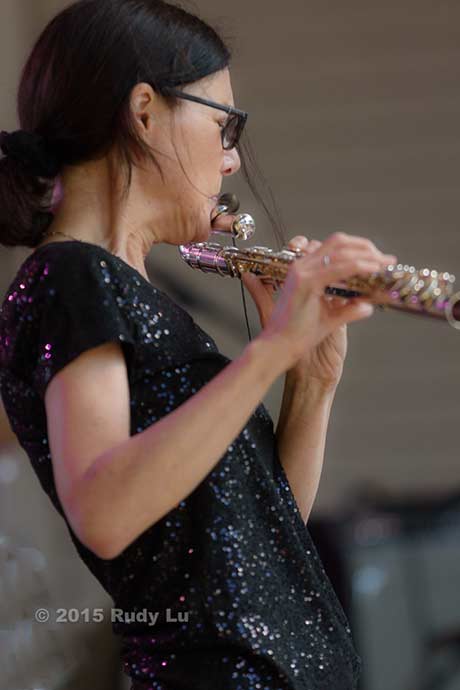
Over the past two decades, Jamie Baum has proven to be one of the most adventurous flutists, composers, and bandleaders in contemporary music. She has only released five albums as a leader or co-leader since 1997 (her debut, on the German Konnex label, was distributed in the US for a while but has seemed to disappear) but each stands out in ts own way. Her two Sunnyside albums, 2008's "Solace" and 2013's "In This Life", are among my favorites of the 2000s and, if you can find "Moving Forward, Standing Still" (OmniTone), you will understand why her Septet and Septet + are should be considered among the vanguard of modern jazz. Add to that 1997's GM recording "Sight Unheard", you'll hear that her influences are many and evolving continually. She also works in duo with one of her mentors, pianist Richie Bierach, in Far Out Flutes with Robert Dick, Jessica Lurie, and Elsa Nilsson as well as working with pianist Monika Herzog.
JChriss.com
While Ms. Baum is well-known for her impressive playing, the Septet groups do not give her lots of time to stand out - she likes to write material that gives the ensemble members the spotlight. In fact, the duo with pianist Bierach came about because he thought she needed to be heard as a soloist more often. She then decided to create Short Stories (the sextet pictured at the left) to compose and perform in the fashion of Thelonious Monk, Wayne Shorter, and Miles Davis. It's an impressive ensemble featuring long-time associate Jeff Hirshfield (drums), Andy Milne (piano), Gregoire Maret (harmonica), Joe Martin (bass) and either Nir Felder or Gilad Hekselman (guitar).
J Hunter photo
This Friday evening (July 7), Short Stories will perform at 8:30 pm at The Side Door Jazz Club in Old Lyme CT. Though the band, formed in 2015, does not have an album, Ms. Baum has creating material for the group since before she gathered the musicians for its first rehearsal. For the CT gig, there will be no guitar - Mr Hekselman rejoins the group on July 9 at The Falcon in Marlboro, NY and on July 11 at theJazz Standard in New York City. Judging by the group's two videos, the music will flow with grace and tension, melody and improvisation, splendid interaction, and fine solos from all involved.
For reservations and more information, go to thesidedoorjazz.com or call 860-434-2600. To learn more about the flutist and leader, go to jamiebaum.com.
Here's Short Stories in action from 2015 (with Gilad Hekselman):
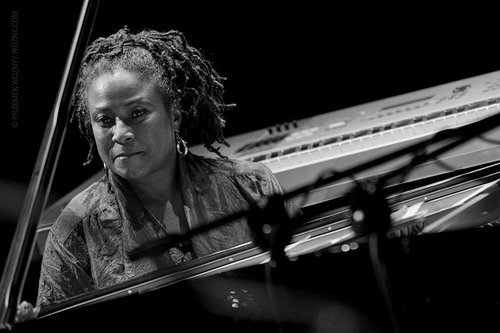
The passing of pianist, composer, and educator Geri Allen at the age of 60 shook the jazz world to its core. Since first moving to New York City in the 1980s, Ms. Allen created music that was challenging, soulful, enchanting, powerful, and rhythmically strong, possessing a style that rarely, if ever, sounded like someone else. Her early recordings (1983 1987) were with Joseph Jarman, Pheroan akLaff, Oliver Lake, Steve Coleman, James Newton, Wayne Shorter, and Woody Shaw (among others) displayed a pianist with great technique who never flaunted that technique but was always musical. She first performed with drummer Paul Motian in 1986 and, with bassist Charlie Haden, formed an influential trio that recorded four albums from 1988 to 1992. She also worked and recorded with Haden's Liberation Music Orchestra as well as with vocalist Betty Carter, drummer Ralph Peterson, Jr. (his brilliant "Triangular" on Blue Note is especially satisfying) vibraphonist Bobby Hutcherson, saxophonist/flutist Charles Lloyd, saxophonist Ornette Coleman, and was featured on the soundtrack of Robert Altman's "Kansas City."
Over the past seven years, Ms. Allen recorded several solo (or mostly solo) piano albums including 2010's "Flying Towards The Sound", 2011's "A Child Is Born" and 2013's "Grand River Crossings: Motown & Motor City Inspirations" (a recording that featured three tracks with her mentor, trumpeter Marcus Belgrave), all on Motema Records. That label also released latest recording, 2016's "Perfection", a cooperative with saxophonistDavid Murray and drummer Teri Lyne Carrington.
Geri Allen gave us so much music over the past three decades plus and had so much more to give. Whether in a solo context, piano trio, unconventional trio, with a tap dancer, or as an accompanist, she was always herself. There are plenty of tributes online (check out David Adler's fine tribute by going to bit.ly/2umyykv) but make sure to to go Ethan Iverson's "Birthday" post (bit.ly/2umyykv) posted on her birthday (June 12), 15 days before her passing. Dear Lord, she will be missed! Here's a collection of music from Ms. Allen, soundfiles and one delightful video:
Brian McCarthy, composer, arranger, and saxophonist, looks at the United States during a time when it was at its most divided, the Civil War. Six of the nine tracks on "The Better Angels of Our Nature" (Truth Revolution Records) were composed during the conflict, two are original, and one, "Oh Freedom", is an African American spiritual. Using a quote from President Abraham Lincoln's 1861 Inaugural Address as its title, the album could be weighed down by expectations as well as by comparisons to today's toxic (to many) political climate. But the project came into being thanks to a Vermont Arts Council Creation Grant in 2015 and really took flight when the Flynn Center for the Performing Arts in Burlington Vermont in November of that year.
Vermont Public Radio
Opening with "The Bonnie Blue Flag" (composed in 1861 by Harry McCarthy - no relation to the leader), the song was a favorite of the Confederate States. McCarthy, the arranger, creates an impressive arrangement around the melody, one that sounds quite contemporary. After the nonet explores the melody, baritone saxophonist Andrew Gutauskas begins a lengthy solo accompanied by the handsome piano of Justin Kauflin. The piece picks up with the entrance of the rhythm section, then the brass and reeds. Not surprisingly, "Battle Hymn of the Republic" follows, a piece that has as much for the North as the previous one did for the South. The leader opts for a less rousing readin, opening up the chords to give the piece its wings. Fine solos from pianist Kauflin and the leader on alto saxophone.
I admit that the first two tracks, while well played, did not capture the emotions one imagines anthemic music provides for people. "Shiloh", the first of McCarthy's original, has great power and gravitas while still telling its story. The title track is the other McCarthy original and is a three-part look at Abraham Lincoln, the lawyer, then the President, and closing with the Person. There's authority in Bill Mobley's fine solo that closes the first part. Kauflin's strong piano work draws a picture of President in command of his emotions after several early Confederate victories. Tenor saxophone Stantawn Kendrick also solos in that section and the second section comes to a crashing close. The last two minutes are contemplative, quiet, a portrait of a man reflecting on all the events occurring as he attempts to right the Ship of State.
There are numerous highlights during the remainder of the album. Daniel Ian Smith's impressive soprano sax solo on "Battle Cry of Freedom" as well as the lengthy exploration of the "I Wish I Was In Dixie" sparked by Zach Harmon's powerful drums and featuring strong saxophone work from Kendrick and McCarthy. However, it's the two ballads - "Weeping, Sad and Lonely" and "Oh Freedom" - that really stand out. The latter track, scored for reeds and brass, may remind some of the short introduction Blood, Sweat, and Tears created in 1968 for its reading of "God Bless The Child." Still, it's a powerful gospel work and the performance is captivating. That should be the last cut but Brian McCarthy decided to add a "bonus track", a swinging take of "All Quiet Along The Potomac To-Night" (composed by John Hill Hewitt in 1863). It's fine with good playing all around but it is anti-climatic (hence the "bonus" appellation).
Minor quibbles aside, "The Better Angels of Our Nature" is a powerful statement - particularly tracks three through eight - about the Civil War, a conflict whose issues were not confined to the four years of horrific battles and skirmishes but whose roots are in the country's fight for independence and its centuries of racial inequality. The music is a compelling fusion of our ethnic makeup, the messages in the songs are (mostly) uplifting, and the performances often riveting.
Personnel: Brian McCarthy, composer, alto & soprano saxophone Daniel Ian Smith, tenor & soprano saxophone Stantawn Kendrick, tenor saxophone Andy Gutauskas, baritone saxophone Bill Mobley, trumpet & flugelhorn Cameron MacManus, trombone Justin Kauflin, piano Matt Aronoff, bass Zach Harmon, drums
Here's the title track:
Trombonist, composer, and arranger Ed Neumeister (born in Topeka, Kansas, and raised in the San Fransisco Bay area) moved to New York City in 1980 and was soon a member of the Duke Ellington and the Mel Lewis Band (which became the Vanguard Jazz Orchestra after Lewis passed). He, also, performed and recorded with the likes of Jerry Garcia, Gerry Mulligan, Aretha Franklin, and the New York Philharmonic. After nearly two decades in Europe where he taught and worked with the Metropol Jazz Orchestra, Budapest Jazz Orchestra, and Jazz Big Band Graz, Neumeister is returning home to the United States, New York City, to be precise.
Like many modern composers-arrangers-educators (Jim McNeely Bill Kirchner, Maria Schneider), Neumeister displays the influences of Duke Ellington, Thad Jones, and Bob Brookmeyer, doing so without imitating any of them. His new self-released and fan-funded album, "Wake Up Call" (MeisteroMusic), is his first with the NeuHat Ensemble, a group he has written for over a decade. The musicians, listed below, should be familiar to most readers as many of them work and record with the Vanguard Jazz Orchestra, with Ms. Schneider, and with Ryan Truesdell's Gil Evans Project. And, like much of the material those groups play, the songs are more about melodic and harmonic development, a narrative, rather than an vehicle for multiple solos. Yes, it could be called "concert music" and that's fine. While there is plenty of rhythmic action, the leader wants you to listen and have emotional reactions.
Listen to the glorious tone-poem "Reflection" to hear how each member of the Ensemble contributes to the piece, how the tension is heightened by the repetitive lines in various sections while drummer John Riley colors the piece with his fine cymbal work. After the long introduction, the melody is moved forward by the brass until Dick Oatts (on tenor) and trombonist Larry Farrell begin a solo section (aided by the atmospheric guitar work of Steve Cardenas and David Berkman's impressionistic piano). There's more than a hint of Burt Bacharach in the arrangement and melody line of "Dog Play", enlivened by the sweet clarinet work of Billy Drewes. The focus is on the tenor sax of Rich Perry on "New Groove" but not until the melody is laid out by the reeds and brass.
There are impressive examples of ensemble writing throughout the album, especially on the opening and closing tracks. "Birds of Prey" moves in quietly on percussion before the main melody is introduced shared by the sections. There are no solos, just different voices moving in and out of the melody as well as the background. No solos either on the title track that closes the album. Yet, listen how the reeds and brass share melody and harmonies while the rhythm section creates a light samba feel. There's a playful nature to the interactions, the piece moves insistently forward and, again, listen to how all the pieces fit so well.
"Wake Up Call" is a delight from start to finish with melodies that linger long after the final fade. Though it's taken nearly three years from the recording dates to the release date, the music is timely and timeless. With Ed Neumeister moving back to the US, maybe the NeuHat Ensemble will bring this music to concert halls. That's so nice to contemplate!
Personnel: Reeds: Mark Gross Dick Oatts Billy Drewes Rich Perry Adam Kolker Trumpets: Tony Kadleck Ron Tooley Jon Owens Dave Ballou Trombones: Keith O’Quinn Marshall Gilkes Larry Farrell David Taylor
David Berkman - Piano Hans Glawischnig- Contra Bass Steve Cardenas - Guitar John Riley - Drums John Hollenbeck - percussion Take a listen:
Until "Big Alpaca", the self-released debut album from the Bill Simenson Orchestra, came in the mail, I knew nothing about the man and his ensemble. Do what I did - go to www.billsimenson.com and you'll discover the composer, trumpeter, and educator has led quite a busy life. Take a look past the names listed below under personnel. Chances are, unless you live in the Minneapolis/St. Paul area (where the ensemble is based), you've not heard of these musicians. Do not walk away from this album. Give it a good listen. You'll hear the influences of Thad Jones and Bob Brookmeyer in the compositions and arrangements as well as hints of Duke Ellington, Gil Evans, Quincy Jones, Thelonious Monk, and Kenny Wheeler.
Thanks to an Artist Fellowship, Simenson took time off to study composition for big band. In 2012, he formed the Orchestra, they began playing once-a-month in Minneapolis, learning the music and how to create a unified sound. In late January of 2016, they entered the Sateren Auditorium of Augsberg College (also in Minneapolis) and emerged with this album.
Jazz Central Studios
Allow the music to roll around your brain. Whether it's the bluesy opener "Bedlamoogie" (and its Count Basie-lie dance rhythms) or the noir-ish "Uptick" or the "Killer Joe" flow of "Pete's Waltz", this program has many pleasing qualities. There are pieces that swing in delightful fashion such as "New Shoes" with the brass and reeds playing off each other in contrapuntal fashion. Dig the second-line groove of "Steamboatin'", replete with playful trumpets and forthright reeds plus a straight-forward swig under the solos. The title track opens with a strong bass solo before the playful interaction of the sections roll through the melody. Trombonist Ryan Christianson and the leader share the solo spotlight, the former with just the rhythm section and the latter with the brass and reeds vying for your attention with quick riffs. "Might Have Been" has the makings of a classic big band ballad with the reeds and brass introducing the melody before excellent solos from Pete Whitman (soprano sax) and pianist Ted Godbout. Both short, both sweet. In the liner notes, Simenson credits the influence of Alison Krauss for the creation of "Titanium"; perhaps that influence shows in the ways the band moves together underneath the melody or how the sections make the melody and rhythm fit so seamlessly. Not sure how Ms. Krauss's music and lovely voice impacted the composer but it is quite a good tune.
In the 1930s and early 40s, the Bill Simenson Orchestra might be considered a "territory" band, with its home base in the Twin Cities. It's easy to imagine people gathering in a club or auditorium to listen and to dance. "Big Alpaca" is truly a collection of good tunes. The songs don't necessarily blow you out of your chair as the melodies and the crisp execution of the band insinuates its way into your head. Give the album a listen and you'll be glad you did. Go to www.billsimenson.com/billsimensonorchestra.html to find out more.
Personnel: Pete Whitman (soprano and alto saxophones), Doug Little (alto sax and flute), Clay Pufahl (tenor sax), Scott Johnson (tenor sax), and Gus Sandberg (baritone sax) Bill Simenson (leader, composer, arranger, trumpet, flugelhorn), Paul Stodolka (trumpet, flugelhorn), Elizabeth Stodolka (trumpet, flugelhorn), and Jake Baldwin (trumpet, flugelhorn) Pete Enblom, Ryan Christianson, and Matt Hanzelka (trombone) Derek Crosier (bass trombone) Ted Godbout (piano) David Martin (guitar) Chris Bates (bass) Dave Schmalenberger (drums)
To commemorate and celebrate the 50th Anniversary of the release of The Beatles "Sgt. Pepper's Lonely Hearts Club Band", the Frankfurt Radio Big Band (also known as the hr-Bigband) commissioned British multi-instrumentalist Django Bates (keyboards) to "reimagine" the classic album from 1967. Commission partners include the
Norrbotten Big Band (Sweden), the Danish Radio Big Band, and the UMO Jazz Orchestra. For the recording, Bates brought along Stuart Hall (acoustic and electric guitar, electric sitar, violin, lap steel) plus the Danish trio Eggs Laid By Tigers (vocalist Martin Ullits Dahl, bassist Jonas Westergaard, and drummer Peter Bruun) to augment the reeds and brass sections plus guitarist from the Frankfurt Radio Big Band (personnel listed below).
The assembled multitude move through "Saluting Sgt. Pepper" in the order of the original album. Bates doesn't change the music drastically but makes room in each song for his "alterations" - for instance, listen to the reeds and brass dance during the second chorus of "With a Little Help From My Friends" and the raucous tenor saxophone work of Tony Lakotos on "Lucy In the Sky.." Lakatos bops away on the extended close of "Getting Better" over a snappy arrangement. Impressive drum work from Bruun takes the place of tablas on "Within You Without You" (the one George Harrison song on the record) as well as strong violin work from Hall. Flutes replace the violin, the brass jump in, and Hall switches to electric sitar in the solo section. The brass sound like a traffic jam and car alarm at the onset of "Lovely Rita" - there is a Blood, Sweat, & Tears feel to the playful arrangement, especially in the middle of the song.
The desperation that seemed to envelop John Lennon's vocal on "A Day In The Life" is missing - Dahl, who does an impressive job throughout the album, seems a bit distant here. Yet, listen to the long rising line to the center section (the McCartney part of the song). After its climax, there is a feel of Rio De Janeiro and samba. It's cleverly done, a delightful shift in the mood. Back for the final verse and the long-awaited final piano chord. Bates gives the brass a quick shout and there's a long fade until....the goofy closing loop from the original pressing.
Kudos to the participants as they handle the classic material and the alterations Django Bates brought to the party with aplomb. Dahl and his compatriots from Eggs Laid By Tigers (the band took its monicker from as Dylan Thomas poem) capture the vocals without imitation (harmonies are nicely done). All in all, a fun and fine tribute that old fogies such as myself (18 years old at the time of the original album's release) and younger fans will enjoy.
Here's a live version of the Harrison song (check out YouTube for the group's versions of "Penny Lane" and "Strawberry Fields Forever":
Frankfurt Radio Big Band (hr-Bigband):
Heinz-Dieter Sauerborn: soprano sax, flute, clarinet.
Oliver Leicht: alto sax, flute, clarinet, alto clarinet.
Tony Lakatos: tenor sax, flute.
Steffen Weber: tenor sax, alto flute, bass clarinet.
Rainer Heute: baritone sax, bass sax, bass clarinet, contra alto clarinet. Frank Wellert: trumpet.
Thomas Vogel: trumpet.
Martin Auer: trumpet, flugelhorn. Axel Schlosser: trumpet, flugelhorn. Günter Bollmann: trombone.
Peter Feil: trombone.
Christian Jaksjø: trombone.
Jan Schreiner: bass trombone. Martin Scales: electric guitar.
Hard to believes it's been over 25 years since bassist, composer, and educator Ben Allison began making an impact on the contemporary music scene. The New Haven, CT, native was one of the co-founders of the Jazz Composers Collective, a nonprofit organization run by musicians that brought together a number of musicians and composers, put in concerts, began releasing records, and helped raise visibility for musicians such as saxophonist Ted Nash, trumpeter Ron Horton, saxophonist Michael Blake, pianist Frank Kimbrough, and Allison. Soon these musicians began to cross those invisible borders that seem to keep artists apart, whether it's "downtown" versus "uptown", "mainstream"versus "avant-garde." Groups such as The Herbie Nichols Project and Ted Nash's Double Quartet grew out of the cross-pollination.
"Layers of the City" is his thirteenth release as a leader (all CDs save for 2016's Newvelle vinyl-only release) and his second on his own Sonic CameraRecords label. Allison wrote music for a quintet he calls Think Free (he used a similar lineup for a 2009 Palmetto lineup with that name) that features long-time friends/associates Mr. Kimbrough and guitarist Steve Cardenas plus trumpeter Jeremy Pelt and drummer Allan Mednard. If you followed the bassist's career as a composer, you know that his songs have strong melody lines, that his wont is to work with textures, and not stretch pieces out too long (this recording has seven tracks and clocks in a just over 41 minutes). From the opening moments of "Magic Number" to the spacy sounds of the final track, "Get Me Offa This Thing"(which closes with quotes from the title track), one should notice the influence of Miles Davis circa 1958-73 on a good portion of this music. The opening track quietly rolls in the trumpeter's "In a Silent Way" (actually Joe Zawinul's piece) with the leader's electric bass rolling around the splashing cymbals and quiet piano chords. Pelt's tender trumpet shares the melody with piano and guitar on the ethereal "Ghost Ship" and he also gets the only solo. There are moments that hearken back to Miles work with Gil Evans.
benallison.com
Kimbrough's rolling piano leads in the noir-ish "The Detective's Wife" (note "The Canadian Sunset" riff in the bass on the opening melody) - the pianist really digs into his solo, pushing at the loping rhythms while Pelt, whose trumpet is muted throughout the track, has a nice atmospheric spot before the leader takes a strong solo. The piano solo on "Enter The Dragon" really stands out as Kimbrough starts out playing a angular "boogie-woogie" line before flying all around the keys. The trumpet and guitar keep the foundation, playing at half the tempo of the drums, piano, and bass.
benallison.com.
Cardenas is a stalwart, whether he is dancing around the fretboard as he does on the title track (check out the powerful bass line as well). The guitarist gets so much out of every note, never rushing a solo; he even seems a bit behind the beat on "Blowback" and that tension works well as Mednard and Allison roil below him. Pelt also offers an understated yet impressive solo on the track.
Ben Allison composes such fascinating music, knows the strength of his musical partners, and gives material to dig into and get lost in. "Layers of the City" is, at turns, powerful, soothing, rollicking, mysterious, noisy, and adventurous. While you hear the Miles influence on a number of tracks, you can't help but hear this as Ben Allison music and that, dear reader, is a very good thing.
Pianist, composer, and educator George Colligan is not joking around; his new album, his 28th!, is titled "More Powerful" ands is his debut for Whirlwind Recordings. Check out the rhythm section. Linda May Han Oh is the bassist and, her partner in the most recent vintage of the Dave Douglas Quintet, Rudy Royston is the drummer - need I write more. Saxophonist Nicole Glover (tenor and soprano), a former student of the pianist, plays on five of the nine tracks and is more than up to the task.
The opening track, "Whiffle Ball, comes out of the gate more like a Nolan Ryan fastball than its plastic namesake. Ms. Glover, on soprano, digs right in and rides the powerful waves from the rhythm section. Colligan plays with such joy as if he'd been set free after years of confinement yet he always plays with great passion. "More Powerful Than You Can Possibly Imagine", from whence the album derives its title, opens with Ms. Oh strumming by herself before the piano and drums enter leading to Ms. Glover, here on tenor, plays the melody. The leader gets the first solo, playing with abandon in the style of McCoy Tyner. Ms. Glover is no pussycat either as her solo is quite ferocious. There's a fascinating "free" section before the quartet returns to the powerful theme section.
Not every track hits like a sledgehammer. There are three songs in a row that take slower paths. "Retrograde Pluto" is a handsome ballad for trio. The melody shines but make sure to listen to the excellent melodic bass solo (Royston literally skips underneath) followed by a thoughtful piano spot. Every time, the piece threatens to pick up in energy, the pianist reigns in the trio, keeping the focus on the melody nature of the music. The following track, "Southwestern Silence", has a similar feel in its singable melody as well as a splendid solo from both Ms. Oh and Colligan. Ms. Glover joins in on tenor for "Empty", a piece with a bit more energy. In fact, by the end of the performance, the rhythms are roiling, the pianist is playing very powerful chords, and the saxophonist is squalling.
Timothy Forbes photography
"The Nash" brings the album to a splendid close. The piece has a circuitous melody line which Ms. Glover (on soprano) plays with delight while Colligan dances around her. Ms. Oh again gets the first solo before the pianist goes on a splendid romp, goosed right along by the heart-pumping drums. Ms. Glover enters with a series of short notes; then she and Royston create a storm of their own that will make you jump from your chair. After the piano and bassist re-enter, the saxophonist keeps going. She dives back into the playful main theme then rolls on to the close with fire and determination.
I suppose it's possible to get overwhelmed by the power of the music produced by George Colligan and his impressive band. Speaking for myself, every time I put this recording on, I get energized (dangerous to listen to in the car though as the music makes the car go faster - go figure). "More Powerful" may be one of the hardest-hitting contemporary jazz records you'll hear this year. Let it roar!
After a series of genre-breaking albums for Pi Recordings, trumpeter, vocalist ,and composer Amir ElSaffar moves to New Amsterdam Records for "Not Two", a fascinating double-CD, the first to feature his 17-member Rivers of Sound Orchestra. The eight song-program continues his search into adapting Iraqi song forms into Western music while his large ensemble differs from a traditional big band by adding more percussion and stringed instruments (such as the buzuq and oud. Yet, the band rises and falls on the powerful work of drummer Nasheet Waits and bassist Carlo DeRosa, musicians along with saxophonist Ole Mathisen and oud master Zaafir Tawil who have been members of his Two Rivers Ensemble since his 2007 debut as a leader ("Two Rivers").
photo by Alice Gebura
It would be unfair to describe each song but it is fascinating to hear how the different voices weave in and out of and around the enthralling rhythms. Also striking is the composer's use of several voices working in counterpoint (for example, how the tenor saxophone and oboe solo together as other voices rise and fall behind them on"Penny Explosion").
"Rivers of Sound" is a perfect name for this group - for many centuries, the river (and the seas and oceans) was one of the primary sources of cultural and economic movement. That interaction between people of different cultures, when benign, help to infuse different sounds and words (as well as customs) into the everyday life of cities and countrysides.
These collisions of cultures and ideas are evident throughout the music on "Not Two". The violin with oud and buzuq on the opening of "Layl (Night)" carry the melody; then the vibraphone is added, then the reeds, the santur (hammered dulcimer), more voices added as the percussion thunders and pounds. Soon, ElSaffar rises out of the storm, a plaintive vocal reaching towards the heavens. There is also such urgency to this music. Listen to how "Shards of Memory/B Half Flat Fantasy" unfolds, the powerful motion, the different voices (at one point, JD Parran's bass saxophone carries the bottom yet is also in sync with the trumpet and violin), the hypnotic melodic exchanges between oboe and guitar, on and on right up to the glorious "...Fantasy" at the very end.
In essence, to get the full effect of this music, one must listen all the way through. And, when you return, all those different voices stand out more and more. How ElSaffar employs the guitar, how the vibes add lightness, the percussive quality of the piano (akin to Latin dance music), the different sounds of the hand percussion, the reed voices, the violin, and so forth. At times, so soft, the music whispers in your ear; at other times, the ensemble pounds, plucks, and roars pulling the listener into this glorious din.
Above all, Amir ElSaffar makes "human" music: joy, sadness, anger, humor, intermingle with other emotions. Give yourself up to and immerse yourself into "Not Two" - the pleasures are endless.
Personnel: Amir ElSaffar (trumpet, santur, vocals), Carlo DeRosa (acoustic bass), Craig Taborn (piano), Dena ElSaffar (violin, jowza - 4-stringed bowed instrument), Fabrizio Cassol (alto saxophone), JD Parran (bass saxophone, clarinet), Ole Mathisen (tenor and soprano saxophones), Mohammed Saleh (oboe, English Horn), Naseem Alatrash (cello), Jason Adasiewicz (vibraphone), Miles Okazaki (guitar), George Ziadeh (oud, vocals), Tareq Abboushi (buzuq), Nasheet Waits (drums), Rajna Swaminathan (mridangam), Tim Moore (percussion, dumbek, frame drum), Zaafir Tawil (peecussion, oud).
**************************************
Steve Coleman, saxophonist, composer, and conceptualist, moves from strength to strength and has done so for nearly four decades. He's won several major awards including a Guggenheim Fellowship and a MacArthur "Genius Grant". Whether leading a large ensemble or a compact quintet, his music is filled with surprises, melodies that move with the deftness of a dancer, and rhythms that draw from all corners of the Black music continuum.
His new album, "Morphogenesis" (Pi Recordings), features a new ensemble, Natal Eclipse, an octet without a drummer (Neeraj Mehta adds a percussive voice on four of the nine tracks but she is not a trap set drummer). Besides the leader, there are two reed players (tenor saxophonist Maria Grand and clarinetist Rane Moore) plus the wondrous voice of Jen Shyu that gives this music a bit of a lighter feel than other Coleman recording. The composer has stated that this music was inspired by his study and appreciation for boxing, hence titles such as "Shoulder Roll", "Dancing and Jabbing", and "Inside Game." Both Ms. Moore and bassist Greg Chudzik are members of the "modern-classical group Talea Ensemble (and are members, along with violinist Kristin Lee, of the leader's Council of Balance ensemble) while Ms. Grand, Ms. Shyu, trumpeter Jonathan Finlayson, and pianist Matt Mitchell have been involved with others of Mr. Coleman's groups.
Two of the nine tracks, "NOH" and "SPAN", are in-studio improvisations and, as such, play into the true meaning of morphogenesis ("...biological process that causes an organism to develop its shape.") The first piece builds from the percussion slowly developing rhythm, the clarion call of the alto sax, deep bass notes, and Ms. Shyu's vocal into an arresting exploration. The second piece also starts slowly, this time from a melodic fragment played by the alto sax into a delightful sonic puzzle. Note how each member of the ensemble plays the rhythm of the piece at one time or another.
It has been noted time and again that Steve Coleman is a musical descendant from Charlie Parker but I can hear Henry Threadgill, at times, in his sound but especially in his adventurous compositions. The manner in the composer utilizes each voice, how the support of the bass and piano often are in rhythmic counterpoint to the soloists. The clarity of the recording stands out as well, the sonic "weight" of the bass is as important as that of the clarinet and violin, never overshadowing any instrument but equal. When listening to pieces such as "Morphing" or "Horda", you'll hear echoes of music from the Middle East, the Deep South of the United States, 19th and 20th Century European classical music, be bop, and more, all part of the evolving language of Mr. Coleman's music. As with the ElSaffar recording above, listen to "Morphogenesis" all the way through before going into deeper explorations. Approach the program as a live concert where it is impossible for a listener to hear everything. Then dig in. Enjoy the powerful melodies, listen to the excellent solos (the leader is generous in making sure every voice is heard throughout), follow the different trails the composer lays out for his ensemble members, take your time to enjoy this impressive recording. Natal Eclipse refers to astrology and certainly has great meaning for the composer. For the purposes of this music, the group is an engaging balancing act. Steve Coleman is continually exploring and we are the beneficiaries. For more information, go to m-base.com/biography/ and to pirecordings.com/album/pi69.
Here's a taste:
Natal Eclipse: Personnel: Steve Coleman (compositions, alto saxophone), Jonathan Finlayson (trumpet), Maria Grand (tenor saxophone), Rane Moore (clarinet), Kristin Lee (violin), Jen Shyu (vocals), Matt Mitchell (piano), Greg Chudzik (bass), Neeraj Mehta (percussion).
I do not believe anyone would argue the importance of John Coltrane (1926-1967) on 20th Century Black American Music (and beyond). His tenor saxophone playing, built off the advancements of Coleman Hawkins, Lester Young, Don Byas, and others, created sounds that still ripple through music. And his soprano work laid the path for people such as Wayne Shorter and Dave Liebman. His quartet music, especially the group with McCoy Tyner, Paul Chambers or Jimmy Garrison, and Elvin Jones remains a touchstone for artists such as Branford Marsalis and Joe Lovano. Coltrane's long-form compositions as well as his lengthy performances set the table for experimentalists in the AACM and in Europe. His embrace of spirituality opened doors for artists such as Pharaoh Sanders, Franklin Kirmeyer, Marion Brown, and Archie Shepp not to forget what his widow Alice Coltrane created in the 1970s and 80s.
As this article is about to post, we are four weeks away from the 50th anniversary of his passing (from liver disease). To honor his life and legacy, Resonance Records is releasing "Compassion: The Music of John Coltrane", a recording from the 40th Anniversary show that BBC3 commissioned from Dave Liebman in 2007. The producer, Robert Abel, asked the saxophonist if he could assemble the Saxophone Summit, a sextet that had been in existence (and still is) for the gig but several key members were not available including Ravi Coltrane, the Coltranes son. The quintet Liebman (tenor/soprano saxophone, wooden recorder, C flute) did assemble included Joe Lovano (tenor sax, aulochrome - a double soprano saxophone - alto clarinet, Scottish flute) plus the splendid rhythm section of Phil Markowitz (piano), Ron McClure (bass) and Billy Hart (drums).
The two saxophonists chose material from the last decade of John Coltrane's life. Opening with the hard-driving "Locomotion" (from the 1957 Blue Note recording "Blue Train", the band locks in and the music soars. All the soloists shine, thanks to their dedication to the project as well as the locomotive rhythm section. The one medley on the program, "Central Park West/Dear Lord", is a feature for the saxophonists. The first tune features Lovano dancing through his solo. A quick shift moves into a sparkling piano introduction leading into Liebman's expressive soprano sax in the spotlight. Neither saxophonist imitates the "Coltrane sound" which helps both pieces shine.
There's a splash of humor in the use of recorded and Scottish flute to introduce the delectable "Olé" but, when the rhythm section kicks in, the tenor (Lovano) and soprano (Liebman) lead the way. The piano solo is a delight, goosed forward by Hart's explosive drumming. Then the saxophonists have their say leading to Liebman's powerful soprano adventure. Also pay attention to McClure who is a strong "foundational" player.
Every song on the album stands out. From the heartfelt ballad "Dr. King" (clarinet and flute in the lead) to the expressive blues of "Equinox" (tenor/soprano) to the lengthy (17:27) "Compassion" (originally released in 1965 on "Meditations"). A long poly-rhythmical drum solo serves as an introduction for that final track then the two tenors state the theme and the music takes off. Lovano breaks out the aulochrome and creates quite a solo, switching in-and-out of the double reed sound nt unlike many of Rahsaan Roland Kirk's multi-reed adventures. The piano solo starts at a high level and keeps rising. A rapid-fire interaction with Liebman, now on soprano and Lovano on tenor, takes the piece to its conclusion.
"Compassion" is a wonderful tribute as well as a reminder of the vivid trails that John Coltrane blazed during his short but often amazing tenure in our world. This quintet, co-led by Dave Liebman and Joe Lovano, never settles for merely replaying the past but illustrates how the music has grown in time and was doing what jazz does best - moving forward on the strength on its innovators.
Dave Douglas, trumpeter, composer, podcaster, and label owner, has always been productive with, at least, two to three ensembles going at the same time. Several years ago, he partnered with electric bassist Steve Swallow and the Doxas brothers (tenor saxophonist and bass clarinetist Chet and drummer Jim) to create Riverside. The American-Canadian quartet's self-titled debut album was dedicated to the multi-reed master Jimmy Giuffre. The ensemble chose to create new music inspired by the clarinetist/saxophonist whose career moved from big bands to small groups to "free" music to electronic experimentation. Steve Swallow had worked with Giuffre in his Trio with pianist Paul Bley that played totally improvised music in the early 1960s. At that time, Swallow played acoustic bass - when Giuffre reconvened the Trio in the late 1980s, the bassist had switched to electric bass changing the overall sound of the group.
The music on and attitude of the second Riverside album, "The New National Anthem" (Greenleaf Music), was inspired by composer, pianist, and wife of Steve Swallow, Carla Bley. The title track, originally recorded by Gary Burton for his 1967 Lp, "A Genuine Tong Funeral", is just right for an anthem; you know, long enough for the flag to be raised but before the crowd gets restless. Ms. Bley, who is known for both the political nature of her music as well as the humor often found in her compositions, also composed "King Korn" which first appeared on a 1963 Paul Bley Lp (and which the late pianist recorded on several other occasions). Here, the piece has an Ornette Coleman/Don Cherry feel thanks to the sharp interactions of the trumpet and clarinet. Her other contribution is the Kurt Weill- inspired "Enormous Tots" (from her "Tropic Appetites" suite and the bouncy, martial, feel is perfect for both Chet Doxas (on tenor) and the trumpeter to play around with delight.
jongarelick.com
There's a cowboy music-cum-Nino Rota feel to "Il Sentiero", a tune with a boozy trumpet solo, pounding drums, sweetly melodic bass, and rippling clarinet, a touch of carnival in the Old West. Douglas's "King Conlon" is his musical response to learning "King Korn" (programmed as the following track) - it's a delightful jumble, perhaps more Charlie Parker than Conlon Noncarrow. There's a hint of be-bop in the trumpet-clarinet-drums that opens the piece. Drummer Doxas swings delightfully while Swallow dances along with the soloists.
The saxophonist's "View From A Bird" has a lovely solo bass introduction, a good reminder that Swallow is like no one else, putting musicality in front of technique, the third melodic member of the group. Sometimes, you have to listen closely to hear what he is playing but it's worth the concentration. Listen to how he and drummer Doxas lock the groove down on "Americano" and how he continues to do so even as his section mate kicks the tune to a higher level. Also, pay close attention to how good this music sounds, how you can everyone's part even when they play loud. Notice Swallow's stunning solo on "Demigods", how it perfectly fits the bluesy nature of the song and does not interrupt the flow. The bassist contributed a new song, "Never Mind", to the session, a blues-drenched ballad with strong solos from the saxophonist and trumpeter.
Long-time listeners to the music of Dave Douglas may hear a comparison to the trumpeter's "Magic Triangle"/ "Leap of Faith" quartet (with Chris Potter, James Genus, and Ben Perowsky), also a piano-less ensemble. Still, Riverside is blessed by the maturity of trumpeter/composer, the presence of master musician Steve Swallow, and the influences that the Doxas brothers bring to the music, not to forget lessons learned from listening to the music of Carla Bley. "The New National Anthem" is worth your attention (and you do not need to stand and salute, unless you want to).
One of the joys of reviewing is when a CD (or digital download) arrives in the mail and you are immediately bowled over by a musician unknown to you . The day "Gentle Giants" (self-released) showed up, so did the album below with vocalist Danielle Wertz. Both feature pianist and composer Tal Cohen, a young Israeli-born musician who finished school in Perth, Australia, before attending graduate school at the University of Florida in Miami. He's won numerous awards for his musicianship, has performed with Joe Lovano and George Garzone plus drummer Ari Hoenig and Australian saxophonist Jamie Oehlers, and is now living in the United States.
Listening to "Gentle Giant", I am reminded of my initial reaction to Wynton Marsalis's 1986 album, "Black Codes From the Underground." There is an audacious quality to the music, making one sit up and pay attention to what each musician is playing and how the ensemble interacts. We could argue all day long whether the music is "new" or not but that's not the point here. Cohen and company - Robert Hurst (bass), Nate Winn (drums), Greg Osby (alto and soprano saxophone on four tracks), and the afore-mentioned JamieOehlers (tenor saxophone on six tracks) - make this music breathe, alive with possibility, and going in unexpected directions. Case in point - the album opens with "Nardis", arguably the most famous Miles Davis composition that the trumpeter never recorded to his satisfaction but was pleased by pianist Bill Evans's many recordings of the tune. The music grows outward from the rhythm section, the slinky bass line that opens the piece and the atmospheric introduction. Oehlers (a mentor to the pianist in his school years in Australia and beyond) plays the melody while the piano, bass, and drums give the rhythms a Middle-Eastern feel. Listen to how Cohen builds his solo, the intensity he discovers, the interactions with Hurst and Winn. There is delight in this performance, power as well but a great feeling of playfulness.
The album is filled with fine melodies (all but the opening track are Cohen originals), many with the combination of Israeli folk songs blended with the influence of Chopin and Scriabin. "Lo Haya" is a two-part piece, the first a lovely duet with Oehlers, the second a lullaby built from a phrase from the original melody. "Part 2" opens with a lovely introspective piano solo then adds the rhythm section building to a powerful interchange between the two saxophonists as the intensity builds and builds. The saxophonists also combine on the delightful "Great PK (for Shuli)" which swings powerfully right from the get-go with strong solos all around. Osby gets the spotlight on "Gavetsch"; he follows a particularly high-spirited piano playing with pieces of the melody, interacting with the rhythm section, spurring both Hurst and Winn to respond - in an odd choice, the tune's reprise "Hazil Magil" is programmed three tracks previous and is a different take of the piano solo only. The album closes with "Chopin Meets Abach". Paraphrasing Cohen's notes, it's music that contrasts the peace the composer gets from classical music (Chopin) and the Israeli citizens need for a protective mask (Abach is the name of the mask's manufacturer) during the Gulf War. With eh rhythm section creating a powerful racket, Osby's soprano saxophone phrases rise like a flock of birds.
"Gentle Giants" is an excellent introduction to Tal Cohen, his music and his vision. This is music that is easy to get lost in, to let the sounds flow in and out of you. While, at times, the music sounds so spontaneous, one can hear that the music spent time living with the pieces, playing them and finding so much depth. This album is actually Cohen's second as a leader - his debut "Yellow Sticker" (also featuring Jamie Oehlers) was released in 2011 - and is a delight from start to finish.
"Intertwined" (self-released) features the combined talents of Tal Cohen and vocalist Danielle Wertz. Ms. Wertz, a native of Virginia, met the pianist when both were studying at the Frost School of Music at the University of Miami. Her voice will remind some of Kate McGarry, Gretchen Parlato, Sara Gazarek, and Sheila Jordan. There's a quality of lightness that shines through whether she is romping through the melody, as she does on the title track or wrapped in the gentle melody of "Autumn Leaves." On the latter track, Jamie Oehlers adds his breathy tenor saxophone, responding to the vocalist as well as creating a memorable solo. Listen to how Cohen weaves his lines throughout the piece, not only building the foundation but also responding to the emotion of his companions. The sparsity of the accompaniment allows Ms. Wertz to explore the words, their meanings, their relationship to the melody and the improvisations.
Actually, the first sounds one hears on the opening track is Oehlers's hypnotic melodic fragment leading in "Beautiful Love", a song first made famous in 1931 by the Wayne King Orchestra. The gentle vocal and the articulate piano work join the saxophone as the trio open the piece, each one listening to the other and responding. Cohen's "Chopin Meets Abach" blends wordless vocals with a rolling piano line, the power of the music coming from his the voice builds along with the piano, not always in contrast but in union with the message of the composition.
The story the duo tells on "Manhattan In the Rain" (composed by Duncan Lamont) is powerful description of chance encounter that goes from good to sad. It is performed without sentimentality or treacle but with honesty and beauty (the rainstorm conjured up by Cohen's piano is magical). Throughout the program, one can hear how time the musicians spent exploring the songs, moving away from cliched performances into interpretations that are more personal. That's what audiences usually want. If artists are going
perform standards, make the pieces sound brand-new. If the emotions are honest, the music has power.
"Intertwined" is powerful. Danielle Wertz and Tal Cohen have created an album that transports the listener beyond the ordinary. Be open and the music will seem like an adventure, a good and satisfying experience.

 Posts