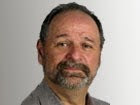
Those of us in central Connecticut who enjoy adventurous creative music rarely have to make choices like the one we have to make Friday April 5. In Middletown, bassist Joe Fonda has organized and curated the 8th Annual CT Jazz Composers & Improvisers Festival to take place starting at 7:30 p.m. in The Buttonwood Tree, 605 Main Street. Scheduled to appear are poet Steve Dalachinsky, violinist/ composer/artist Terry Jenoure (pictured), and the Michael Jefry Stevens/George Schuller Quartet.
Brooklyn, NY, native Steve Dalachinsky is well-known as a New York City "downtown poet" and is famed for his collaborations with creative musicians such as pianist Matthew Shipp, bassist William Parker, and saxophonist Rob Brown. Accompanying his poetry will be Mr. Fonda and saxophonist Gerhard Ullmann. Ms. Jenoure, who has recorded with the late clarinetist John Carter, is an accomplished musician and vocalist who lives in the Northampton, Massachusetts area. Closing the show will be the Quartet of pianist Stevens, drummer Schuller, bassist Fonda and multi-reed player Ullmann (you may know them better as Conference Call.) For more information, go to www.buttonwood.org where you can and should make reservations.
Meanwhile, the Firehouse 12 Spring Concert Series continues with the return of Tomas Fujiwara and the Hook Up. The quintet - drummer/composer Fujiwara, guitarist Mary Halvorson, saxophonist Brian Settles, trumpeter Jonathan Finlayson and bassist Adam Hopkins - last appeared in the performance space in April of 2010 (though Fujiwara is no stranger, having played 4 shows with cornetist and good friend Taylor Ho Bynum.) Fujiwara also works with saxophonist Greg Ward, Anthony Braxton's Tri-Centric Orchestra and Ideal Bread (among others). The music he creates for the band is a swirling blend of styles that transcends numerous barriers. The mix of Ms. Halvorson's adventurous guitar and Finlayson's clear trumpet tones makes for good listening - add in Settles' fiery tenor saxophone work plus the fine rhythm section and this music truly moves. Several of Fujiwara's melodies feature drums parts that work in tandem with the front line. The interaction of the 5 musicians is mighty impressive and lots of fun to see and hear.
The band plays 2 sets - 8:30 and 10 p.m. - to find out more, go to firehouse12.com. To check out the drummer and his numerous projects, go to www.tomasfujiwara.com.
Sunday, March 31, 2013
Thursday, March 28, 2013
The Wondrous Dance Music of Steve Coleman
Continuing his quest to meld improvisation and composition, melody and rhythm, alto saxophonist and composer Steve Coleman has released, what I believe, is one of the best recordings of his career. Paring his Five Elements ensemble to 4 musicians (Coleman, trumpeter Jonathan Findlayson, bassist Anthony Tidd and drummer Sean Rickman plus guitarist Miles Okazaki on 5 of the 14 tracks) has served to focus the composer's study "of the connection between the biology of the human body, the human soul, and music" which he discovered through his relationship with percussionist Milford Graves.
The 14 tracks that comprise Coleman's 3rd release for Pi Recordings "Functional Arrhythmias" bristle with creativity, with splendid musicianship and and impressive interplay. On top of that, much of this music has an irresistible rhythmic feel that induces smiles and the desire to move one's body, dance music for the entire person. Finlayson, who has also worked with guitarist Mary Halvorson, saxophonists Ravi Coltrane and Steve Lehman (among others) possesses a clear tone that meshes well with the leader's fluid lines and warm sound. The work of Rickman and Tidd, who both return to Coleman's band after a decade away, has to heard (and felt) - it is the "heartbeat" and the "flow" of this production. It's no surprise that the first sounds you hear on "Sinews", the track that opens the CD, comes from the rhythm section, the thick bass notes and funky drumming. All through this music (all original), the drums catch your ear. From the Ed Blackwell-influenced rhythms of "Cardiovascular" (the majority of the titles reference bodily functions and parts) to the fiery propulsion of "Snap-Sis", Rickman brings the beat. For his part, Tidd throbs, bounces, bobs and weaves, plays phrases that go "way low" and move "up high." His counterpoint of "Respiratory Flow" and his dub-like grooves on "Assim-Elim" serve to cushion the melodic interplay of Coleman and Finlayson. Yet, they, too, play with rhythmic drive in their phrases, whether it's the bounce of "Hormone Trig" or the James Brown-inspired grooves of "Cerebellum Lean" the front line gets into the groove. On the latter track, Coleman's solo is so slippery and feisty and he manages to incite the soul without wailing.
Finlayson is also an equal partner in the success of the music. His playing is forthright, he not only executes the melody lines with style but his solos are built with intelligence and wit, whether he's riffing off the percussion (as he does so gracefully on "Medulla-Vagus") or building off of a phrase or fragment he hears in Coleman's solos (so brilliantly displayed on "Limbic Cry").
Miles Okazaki makes his presence felt on the 5 tracks he appears on; there's his West African-inspired "clacking" rhythm guitar on "Cardiovascular", his funky interactions with Tidd's bass lines under Rickman's spright;y drumming on "Irregular Heartbeats" and his understated Nile Rodgers-like solo on "Adrenal, Got Ghost." His acoustic guitar sounds re-tuned, kora-like, on the mysterious yet funky "Lymph Swag (Dance of the Leukocytes)" - again, how he interacts with Tidd stands out as do his inventive, blues-soaked riffs beneath the solos.
Listening to "Functional Arrythmias", I am reminded of Ornette Coleman's 1959 Atlantic recording "The Shape of Jazz To Come." With the exception of the 5 tracks with guitarist Okazaki, the instrumentation is the same, the differences being Charlie Haden's acoustic bass instead of Tidd's electric and Don Cherry's cornet for Finlayson's trumpet. Billy Higgin's insistent drum and cymbal work may not be as multi-rythhmical as Sean Rickman's but it drives the music in the same manner (and the modern recording is much brighter.) Both recordings can be said to be "music of its time" yet both seem timeless. The 2 groups, separated by more than 5 decades, play with purpose, fire, and joy. I'm not sure either of the 2 Colemans get enough credit for how the rhythms in their music are so playful, elemental and essential (in the case of Ornette Coleman, especially in the music he and the group created for Atlantic Records).
Simply put, "Functional Arrhythmias" shines brightly - find it, play it loud and play it often. For more information, go to www.m-base.com or www.precordings.com.
Tuesday, March 26, 2013
More Firehouse News + Good Reading
The Uncertainty Music Series presents the 2nd of 2 concerts in conjunction with SOUND HALL on Saturday March 30 at 8:30 p.m. in Firehouse 12, 45 Crown Street in New Haven. Clarinetist/composer Jeremiah Cymerman presents "Book of Dead", a solo concert for clarinet and electronics; the work is part of a new project Cymerman is developing that moves his music into a more meditative state. Inspired by Chögyam Trungpa's "Tibetan Book of the Dead" (translated by Francesca Freemantle), the music focusses on the sound of the performer's clarinet and the silence between the notes.
Cymerman has issued several CDs on the Tzadik label as well for Porter Records; just last year, he started his own label, 5049. To find out more, go to www.jeremiahcymerman.com. The concert begins at 8:30 p.m. There is a free "Pre-concert Talk" at 7 p.m. - for ticket information, go to firehouse12.com or call 203-785-0468. To find out more about the Uncertainty Music Series, go to uncertaintymusic.com.
On the eve of the release of "Functional Arrhythmias", the brilliant new recording by Steve Coleman And Five Elements (Pi Recordings), bassist/composer/
blogger Ronan Guilfoyle has published part 1 of a long interview with the saxophonist/composer/ conceptualist on his blog, "Mostly Music." You can and should find their conversation titled "Steve Coleman on Rhythm" by going to ronanguil.blogspot.com. Coleman literally speaks volumes about his rhythmic concepts, especially (in Part 1) how he developed his ideas. You may be surprised by the people he cites. Nevertheless, it's engrossing reading. My review of the new CD should be posted next week. In the meantime, listen to the words!
Labels:
blogs,
Live Music,
Uncertainty Music Series
Sunday, March 24, 2013
Left Coast Meets Right at The Firehouse + Quick Hits
The Firehouse 12 Spring 2013 Concerts Series rolls this Friday March 29 with an appearance by the Lisa Mezzacappa Trio featuring Fay Victor. Ms.Mezzacappa, based in the San Francisco Bay area, is one of the busiest musician/curators around. Not only does the bassist/composer lead several different ensembles (Bait & Switch being the most recognizable) but she also programs several different music series in Los Angeles and San Francisco as well as a live Cinema series. Her Trio with the exciting Brooklyn, NY-based vocalist Fay Victor blends pop, jazz and blues influences into a sonic adventure unlike any you have heard. Ms. Victor, who leads her own ensembles, is a fearless improviser who treats words and sounds with equal weight. She enunciates, even when she is scat-singing. Rounding out the Trio is guitarist John Finkbeiner who has worked and recorded with bassist Adam Lane Full Throttle Orchestra, with drummer Vijay Anderson's various groups and alongside Ms. Mezzacappa (and Mr. Anderson) in the wonderfully eclectic and electric Bait & Switch. He's also got a great feel for the blues which stands him in good stead in this Trio.
Judging by the music the bassist has posted on her website (www.lisamezzacappa.com), the Trio makes one sit up and pay attention. They'll play 2 shows - 8:30 and 10 p.m. (each with its own admission charge) - and you can get more information by going to firehouse12.com or calling 203-785-0468.
Last week, the Matthew Shipp Trio rocked the Firehouse with its exciting brand of creative improvisations. 2/3rds of the Trio - pianist Shipp and bassist Michael Bisio - creates the music of "Floating Ice" (Relative Pitch Records), a CD that appeared late in 2012.
The 7 tracks will not surprise anyone who has listened to the Shipp Trio in that much of the music has a great forward motion and that the strong left hand of the pianist frees up the bassist to play counterpoint. There are some wonderful moments; "The Queen's Ballad" is a slow exploration built off a handsome melody that Shipp creates an impressive solo from. Meanwhile, Bisio moves beneath the melodic surface creating his own impressions (and rhythms) that catch the ear. The light-hearted swing of "Holographic Rag" suggests "Jelly Roll" Morton, Professor Longhair and Conlon Noncarrow in its bluesy feel and rhythmic drive. It's the longest track on the CD (10:29) yet moves with stealth and allows for a fiery bass solo that really moves.
The introspective opening of "Disc" shows a strain of Chicago blues before moving out and away from its melodic center (and doing so without resorting to high volume or displays of technical prowess.) Bisio's arco work sets the slower pace of the final cut, "Decay", a work that builds in intensity and then moves away from its climax on the rapid-paced bowing bass lines. Shipp's droning chords over the bowed bass close the piece on a strident note.
The music created by Michael Bisio and Matthew Shipp on "Floating Ice" demands your attention and deserves it. The 2 musicians know each other well and that friendship gives them the freedom to make music that goes in many directions (and never gets lost.) For more information, go to michaelbisio.com.
Like the more famous Neil Young, British artist Neil C. Young is a guitarist and composer. But, the younger Young does not rock out a super volume or create electronic landscapes or acoustic songs that go right to the heart of human relations. On his 4th CD as the leader of the Neil C. Young Trio, "El Camino" (ENCE), one hears music that blurs the lines between rock, blues, r'n'b and jazz without ever erasing those lines. Ably supported by bassist Alan Witham and drummer Richard Young, the guitarist creates a program that is enjoyable, undemanding and, for me, brings back some fond memories. When I was much younger, I used to scour the "cutout" bins for 45 r.p.m. vinyl records of an instrumental nature. 9 out of 10 times, I had no idea what the music was like or who the artists were but the price was often 4 for $.99 cents" - every once in a while, I'd come across a gem from the DOT label or SMASH or Chess Records.
"El Camino" reminds me of those long-gone treasures in that the music will not knock you out of your chair but, unlike many of those earlier recordings, the musicianship is top-notch. Neil C. Young is an excellent rhythm guitarist - a majority of the 8 tracks on the CD are built off of the solid rhythm section and the strong guitars that often comprise the melody. There are moments on the opening track, "Nutter Strut", that remind this listener of the rhythm guitar work of Jimi Hendrix, another musicians who often built his songs and solos off his chordal work. The "country meets jazz" feel of "The Wagon (it left without me)" works quite well, with a touch of Wes Montgomery and Lenny Breau, although the rhythm section is a bit "clunky." No such problem on "Slashville", where the drums and bass set the pace while the leader plays a hearty solo. Perhaps the best track is the lovely "Ballaed" (sic), with its stately melody and excellent counterpoint from the bass.
The music that the Neil C. Young Trio creates on "El Camino" probably won't blow you away but the results are certainly easy to listen to. Go to www.neilcyoungtrio.com and give the band your ears.
Wednesday, March 20, 2013
March Improvisations
The monthly "Improvisations" series at Real Art Ways, 56 Arbor Street in Hartford, continues this Saturday March 23 at 7 p.m. Series curators Stephen Haynes (cornet, trumpet) and Joe Morris (guitar) welcome Charles Downs (drums) and Pascal Niggenkemper (pictured left, acoustic bass) for an evening of musical adventures. Mr. Downs is a veteran of bands led by pianist Cecil Taylor and the late violinist Billy Bang - he is as known as Rashid Bakr. Mr. Niggenkemper has worked with drummer/composer Tyshawn Sorey (February's guest in the series), drummer/composer Gerald Cleaver and with guitarist Morris in his Abstract Truth group.
Messrs. Haynes and Morris are but 1 week removed from the cornetist Bill Dixon: Promegranate project, the quintet that opened the Spring Concerts series at Firehouse 12 and the recording session the following day. From all the reactions I have heard and read (plus what I saw at the live date), the weekend was quite successful. One should expect musical sparks to fly this Saturday as well. For more information, go to www.realartways.org or call 860-232-1006.
Labels:
Improvisations Series,
Live Music,
Real Art Ways
Tuesday, March 19, 2013
Truly Musical
Born in Madrid, Spain, to Argentinean parents in exile, Teubal has also covered much territory in his life. His family returned to their native land when he was 8 years and, one year later, he started studying and playing piano. He moved to New York City in 1999 to continue his studies and begin his professional career, one that has seen him perform with John Benitez and the Marta Gomez Group, among others.
All of which leads us to his new CD. The influence of his Argentinean roots is evident throughout but not overwhelming. Much of this music is carried by the tremendous rhythmical playing of the pianist, the percussionists and Fukushima thick-toned electric bass. On top of that are the often captivating melodies, many of which feature Sadigurksy on clarinet. The program opens with "Un Simple Objeto" with its perky melody played over chords that would not be out of place in Vince Guaraldi's music for "Charlie Brown." While the clarinetist and cellist share the melody line, the music percolates forward. Hadfield (hand drums) and Takeishi (cajon and hand percussion) strut back and forth while the bass and piano support them. The impressionistic solo piano opening of "The Constant Reinventor" has the sound of a work by Ralph Towner, even more so when the clarinet enters to share the main theme. The arrangement adds the other players as it moves forward with the cello having its part in the melodic development and the bass serving as counterpoint. All of sudden, the tempo shifts into a tango yet the melody continues to be shared by the 3 musical voices. Teubal's solo is a series of cascading notes and rhythmic patterns over the percolating rhythms.Near the close of the song, he adds a short section with a rapidly descending line for the piano, clarinet and cello that is so thrilling (especially as Friedlander goes in the opposite direction of the piano and clarinet.
This recording is filled with breath-taking moments. Sadigursky gets to play most of his reeds on "La Perla", overdubbing clarinet, bass clarinet and flute even soloing on all 3 as the piece moves forward. Then, close to the end, there's a section that features 2 clarinets, bass clarinet and flute pushing the melody and rhythm forward. In an email exchange with the reed player, he wrote "Emilio plays with such a great time feel and percussiveness, and really writes for the entire piano. He has a vision, but also trusts the players around him to make decisions and push things in different directions."
"Musica Para Un Dragon Dormido" is quite an impressive achievement. Like a great movie director, Emilio Teubal went into the studio having an overall blueprint for this music and, once he put it in the hands and minds of this fine ensemble, the project took flight. Like fellow Argentinean Guillermo Klein accomplishes in his original music, Teubal has woven threads of numerous musical styles into his compositions without losing touch with his "roots." This CD creates such an amazing sonic world, one does not want the music to end. Brilliant and accessible, highly rhythmic and strongly melodic, one will find much to enjoy in Emilio Teubal's new recording. For more information, go to www.emilioteubal.com.
Trumpeter/composer Matt Holman has a list of credits the length of one's arm, ranging from his regular gigs with Darcy James Argue's Secret Society, John Hollenbeck's Large Ensemble and Asuka Kakitani's Big Band to appearances with Kurt Elling and Kate McGarry. He's won a slew of awards, grants and commissions and is currently of the New York Symphony Jazz Band, a 17-piece ensemble dedicated to not only preserving the Big Band tradition but also support young composers.
For his debut CD as a leader, Holman has convened a quintet featuring Mike McGinnis (clarinet, bass clarinet), Christopher Hoffman (cello), Nate Radley (electric guitar) and Ziv Ravitz (drums, percussion) and supplied them with a program that challenges their skills as creators. Hoffman, who has worked and recorded with Henry Threadgill, is called on to be both a soloist and to play the bass lines; he does so with poise and style. Ravitz, born in Israel and now in the United States for over a decade, displays great sensitivity and drive. His wonderful martial drumming on the title track really pushes the band but never overwhelms them. Guitarist Radley, who is a member of Loren Stillman's Bad Touch and has worked with a score of New York-based musicians, is a fine rhythm guitarist. His rippling lines, funky rhythm lines and smart counterpoint on "Chain Of Command" captures one's attention. McGinnis, a member of the four bags and co-founder of OK|OK, is a wonderful foil on the front line, his warm tones working nicely with and alongside the clear, crisp, tones of the leader's trumpet.
There is a modern classical feel to the opening strains of "Kindred Spirits" with the theme carried the clarinet.Once the rhythm section settles into the beat, Holman's trumpet enters, playing the second theme. When he and McGinnis play in unison, the music soars. And, listen to how the cello and drums negotiate the rhythms. The clarinet once again leads the way on the subsequent track, the handsome ballad title "Tutti." When Holman starts, the piece begins to swell and recede, like waves lapping on a dock. The stately feel of the previous can be felt in the early moments of the title track, with the trumpet leading the way and the clarinet lines moving in and around. Then, the piece picks up for a while before dropping back to a quiet groove for Radley's halting solo (he seems to be just behind the beat at the beginning before riding the groove.) The guitar solo builds in intensity as the front line plays flowing lines behind him.
Ravitz's Middle-Eastern rhythms open "Where the Tracks End", a piece with a melancholy melody. McGinnis's bass clarinet melds with the trumpet at times then splits away moving back in. After Hoffman's short, blues-influenced solo (over the percussion and Radley's gentle backing phrases, the guitarist takes off on his own.
One hears the influence of Dave Douglas (especially the Tiny Bell Trio), at times, in the melody lines and rhythms. Yet, Holman is also very interested in group dynamics and how each musician contributes to the overall sound. So, in the rocking mid-section of "Chain of Command", there is equality in the hard-edged guitar lines, the rollicking clarinet, the keening cello, the clarion call of the trumpet and, all the while, Ravitz is bashing away with glee, not out of control but with purpose.
"When Flooded" continues the flood of impressive new recordings for 2013. These are Matt Holman's compositions and his vision but the music is an entire group effort. The sound quality is excellent, there is very little clutter (the clarity of the cymbals and cello is super) and, most certainly, no ego-trips. This CD, like the Emilio Teubal reviewed above, deserves your attention. For more information, go to mattholman.com.
Labels:
BJU Records,
CD reviews,
pianist-led group
Sunday, March 17, 2013
Mr. Shipp Comes to New Haven + CD Picks
One of the most creative as well as one of the more outspoken people in Black American Music is pianist/composer Matthew Shipp. On Friday March 22, Mr Shipp returns to Firehouse 12, 45 Crown Street for his 3rd appearance at the performance space/recording studio. And he seems to like to match the number of musicians with the number of times he has played; his initial appearance in 2005 was a solo piano concert, the next (in 2006) was a duo show with bassist William Parker and, this time he's bringing his Trio. Joining him is bassist Michael Bisio and long-time drummer Whit Dickey (all pictured above).
Mr. Shipp is touring in support of his latest Thirsty Ear release, "Greatest Hits", which is a compilation of tracks from the past decade. The pieces range from solo observations to Trio cuts and larger ensembles. The music reflects the pianist's continuing creative probing of melody and rhythm. Bisio and Dickey are perfect foils in that they are both excellent musicians, capable of playing anything that the composer puts on the music stand or follow whatever improvisatory path the pianist decides to take.
The Matthew Shipp Trio will play 2 sets - 8:30 and 10 p.m. (a separate admission for each) - and I strongly recommend reservations. It was quite a treat to see and hear Stephen Haynes: Pomegranate last week (the music was and the musicians were mighty impressive) and also quite wonderful to see the first set sold out. For ticket information, go online to firehouse12.com or call 203-785-0468.
In the past 3 years, trombonist/composer Samuel Blaser has released several impressive CDs including a classical music-inspired date with the late drummer Paul Motian, bassist Thomas Morgan and pianist Russ Lossing plus a live date with guitarist Marc Ducret, bassist Banz Oester and drummer Gerald Cleaver. 13 months after that latter Quartet recorded its initial CD, they got together at the Hnita Jazz Club in Belguim; the results can be heard on "As The Sea", released on the Hatology label. The 4-part title suite ranges from the introspective opening section to the full-out blast on both "Part 2" and "Part 4" Ducret, who sounds like the legitimate child of Bill Frisell and Derek Bailey (with more than a passing nod to Uncle Jimi Hendrix), gets an amazing array of sounds out of his guitar and pedals. On "Part 1", the Frisell influence can be heard on the somewhat twisted solo in the middle of the cut while "Part 2" is hard edged and angular picking, Ducret climbing aboard the supersonic rhythm section (Cleaver is downright forceful.) Blaser follows the guitarist with a fiery solo that blends rapid single-note lines with the multi-phonic blasts (a la Albert Mangelsdorff.) He and Ducret weave their lines in and around each other (and the furious rhythm section) on "Part 3", blending blues and free-blowing to great effect. "Part 4" takes the suite out on a raucous note with all 4 musicians in a high-energy mode. Pay attention to the excellent work of Oester - he's not just the "anchor" of the band but his counterpoint is quite creative.
"As The Sea" begins to build halfway through "Part 1" and becomes a mesmerizing roller-coaster ride. Samuel Blaser and company have built this music from numerous nights of free improvisation, they know, respect and like each other and this music hits the listener with quite a pleasing punch. For more information, go to www.samuelblaser.com.
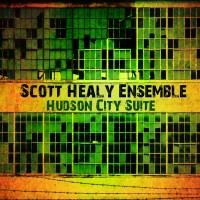
The first time I listened to "Hudson City Suite", the latest recording from pianist/composer Scott Healy, the music blew me away. Haven't changed my opinion in the 4+ months the CD has been in rotation but am not sure why this review has taken so long (the word "laziness" comes to mind.) Healy, who worked in Conan O'Brien's "show" band when he started at NBC and his subsequent move to TBS, admits to being greatly influenced by Duke Ellington. There are moments on the 9 tracks that make up the "..Suite" where one can notice that influence but what is even more noticeable is how good this music and this 11-member ensemble are. Employing mostly Los Angeles-based musicians (with the exception of trumpeter Tim Hagans who plays on 3 tracks), the composer's "little Big Band" (formally known as the Scott Healy Ensemble) is comprised of 3 trumpets, 2 trombones, 3 saxophones, piano, bass and drums. While the songs have well-constructed melodies and intelligent arrangements, the solos are uniformly fine. Each time Hagans takes the spotlight, he produces a winning solo. On the opening "Transfer", he rises majestically over the ensemble while on "Summit Avenue Conversation", he just lets loose over the solid rhythm section of pianist Healy, bassist Carlitos Del Puerto and drummer Bill Wysaske. The cut also features impressive solos from tenor saxophonist Alex Budman and trombonist Andrew Lippman - but the best part might just be the coda that features the saxophone section blowing over the comping" brass.
All of these pieces, even the short "Interlude" (1:47) in the middle of the program, are fully realized and never cluttered. The mysterious "Princess Tongora", with its lullaby-like opening, features artful drumming from Kendall Kay (he's worked with Rickie Lee Jones, Kenny Burrell, Alan Broadbent and many others). His cymbal and snare work under Jeff Driskill's soprano sax solo is both delicate and musical and he really drives the piece as Healy's piano solo reaches its climax. Wysaske displays his excellent brushwork on the bluesy "Gaslight", the muted trombone solo of Lippman over the clarinet of Tom Luer and bass clarinet of Doug Webb an added treat as is Hagan's smooth and swinging flugelhorn spot. Webb moves to baritone saxophone for the sly and slinky "Koko On The Boulevard"; the song's descending melody line carrying all the way through the first half, whether the rhythm section is moving in 3/4's time or blowing in 4/4. Webb gets to drive his solo over the sparkling brass and shifting rhythms from the bass and drums (there's a hint of Charles Mingus in the arrangement near the end of the baritone solo.)
Though it is tempting to talk about (and praise) every track on "Hudson City Suite" (issued on the pianist's Hudson City label), let me suggest you go find this gem wherever you can (iTunes. Amazon.com, emusic.com). Yes, one can hear the influence of Duke Ellington on the melodies and arrangements of Scott Healy but there is so much more to be heard in the voicings, the counterpoint and the inventive manner in which the composer writes for the sections of his talented ensemble. Positively smashing music - for more information as well as a handsome video devoted to the recording, go to www.hudsoncityrecords.com.
Subscribe to:
Posts (Atom)