Growing up in the 1960s, guitar "heroes" were all the rage (for some of us). There was Eric Clapton, Jimi Hendrix, Steve Miller, Carlos Santana, Ritchie Blackmore (Deep Purple), Peter Green, Buddy Guy, Jeff Beck, Jimmy Page, and so on. Every one of these musicians has his own "style", critics and reviewers would argue who's the best or the flashiest or the most overrated/ underrated, and fans would chip in with their own opinions. While that sort of hype has mostly dissipated, there are still a number of really fine artists from around the world adding their unique voices to the mix.
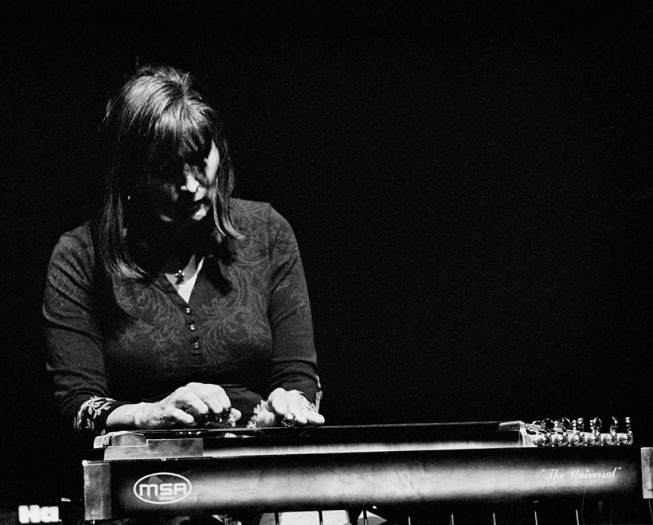
Pedal steel guitarist Susan Alcorn has been playing her instrument for over four decades. She was at a club in Chicago when she first heard the instrument and the sound fascinated her. The next day, she purchased one and soon was playing in country bands around the Windy City. Moving to Houston, Texas, helped her to learn and to play Western Swing. Ms. Alcorn began to study jazz improvisation and a meeting with composer/ conceptualist/ performer Pauline Oliveros led to a collaboration that opened the eyes of the younger artists to a multitude of sounds and possibilities. Subsequent meetings with Eugene Chadbourne and German bassist Peter Kowald led to more expansion of creativity; her first album date as a leader or co-leader was with guitarist Chadbourne in 1996––since then, she has issued eleven albums plus appeared on several more. It was on guitarist Mary Halvorson's 2016 octet album "Away With You" that this writer first heard Ms. Alcorn and her work within that ensemble was ear and mind-opening.
The majority of her albums are solo but her new recording, "Pedernal" (Relative Pitch Records) features the pedal steel player with her friend Ms. Halvorson, bassist (and duo partner) Michael Formanek, violinist Mark Feldman, and drummer Ryan Sawyer. The music, all composed by Ms. Alcorn, is often soft and slow; yet the quintet also gives the interactions power while creating intelligent, far-ranging, solos. The title track opens the program. It's a delightful blend of folk, country, classical, and blues influences with a touch of anarchy at times. The blend of electric and pedal steel guitars and players not afraid to stretch notes and ideas makes one pay closer attention. Feldman's sweet violin tone is a handsome –placed on the right side of the mix with Ms. Halvorson on the left (Ms. Alcorn is in the center), the violinist can both stand out and blend in.
Photo: Nicole Fara Silver
That opening song sets the tone for the entire album. "Circular Ruins" has a somber first several minutes before opening up to Ms. Halvorson's sparring with the bass and drums. A moment later, Feldman takes over the match. The leader joins in as well. "R.U.R." has a boppish feel in its quick tempo; its first set of solos features angular swift lines. The pace slows down in the second of the piece for a rubato, spacey, group of interactions, that break down to duos (pedal steel and drums, drums and guitar) and occasional interjections from the leader and violinist before returning to the main theme.
Photo: David Lobato
The centerpiece of the album is the 13+ "Night in Gdansk", a episodic piece that runs the gamut in dynamics, in melodic interplay, its interactions and counterpoint giving way to short unaccompanied transitions. There's mystery within this music, the plaintive violin melodies, the guitar duo with lines that connect then spin away from each other, how the drummer and bassist are both foundation and colorists to the sounds above them in the mix. There's a lot to take in on the initial listenings––hit "repeat" when you hit the final note, start over, and you will slowly but surely begin to see the overall shape of the piece.
The program closes with the delightful, playful, folk/bluegrass influenced "Northeast Rising Sun" where everyone gets to let loose. Ms. Alcorn sits back, letting Ms. Halvorson and Mr. Feldman gleefully solo over the scampering rhythm section before she reenters her most playful solo. A short, melodic, bass solo leads us back to the original melody and the sweet close.
Susan Alcorn and her excellent musical companions have produced a splendid album, emotionally rich yet adventurous, and ultimately satisfying. If you have never heard the pedal steel guitarist, start with "Pedernal" but make sure to check out her fascinating solo albums (2015's "Soledad", also on Relative Pitch Records, is especially rich music). Pay attention and the rewards are copious.
Guitarist, composer, and educator Alex Wintz is one busy person. Between gigs with Etienne Charles, Roxy Coss, and Nick Finzer, his own trio, and private lessons, the California native (raised in New Jersey) stays quite busy. The current pandemic has certainly slowed down the gigs but not the teaching. While he appeared on numerous albums, Wintz has only one recording as a leader––2017's "Life Cycle" (Culture Shock Records)––to his name. That album featured his Trio, bassist Dave Baron and drummer Jimmy MacBride, plus guests Lucas Pino (tenor saxophone), Victor Gould (piano), and Ben Williams (acoustic bass) on selected tracks.
In January of 2019, a recording engineer friend of Wintz made the offer of six hours in the studio. The guitarist brought the trio in to Red Bull Studios; they had been playing as often as they could and had built up a good-sized repertoire. They set up, did a quick sound check, and started recording. As the title tells you, these sessions are "Live to Tape" and Finzer's label, Outside In Music has issued the results on vinyl, CD, and digital downloads. No overdubs, only a few takes (at most), the seven-song program consists of four Wintz originals and one piece each from Herbie Hancock ("Textures"), Annie Clark/ St. Vincent ("What Me Worry"), and Herbert Martin/ Michael Leonard ("I'm All Smiles"). The recording and mix (Evan Sutton) posits the listener in the middle of the Trio and, while there's no crowd noise or words from the leader, one feels as if he is in concert space.
Clicking, percussive, guitar leads the Trio and the listener into "Idris", a tribute to the late drummer Idris Muhammad (1939-2014) who imbued every fast song he played with an irrepressible dancing beat. MacBride is right on top of the beat throughout and his bandmates dance with glee. "Textures", composed by Herbie Hancock for his 1980 "Mr. Hands" Lp, dances gently in a Caribbean mode (the composer's version mixed synths with acoustic piano)––the melody is quite lovely and the rhythm section gives it an Ahmad Jamal-feel. The St. Vincent composition follows; the trio treats the ballad respectfully giving the song a bluesy shade a la Jimi Hendrix's "Little Wing".
The straight-ahead jump of "Ely, MN" (a Wintz original) allows the band to gallop ahead although there are numerous momentary slowdowns on the way. MacBride and Baron do a great job of push the music forward with the guitarist complying with a hard-driving solo. The drummer also gets to step out which he does with great force and style.
"Live to Tape" closes with "I'm All Smiles", a perfect tune in that the music on this album will make you do just that––smile. This album is the perfect Friday or Saturday evening experience. At the end of a long week, turn down the lights, pour a libation, sit back and let the delightful sounds produced by the Alex Wintz Trio wash away the week's detritus. No deep messages on the album; in fact, just one and that could be "take it easy and enjoy!"
When the pandemic hit in earnest back in March, many countries closed down, limiting access to restaurants, theaters, clubs, stadiums, schools, airports, shops, and just about every place where people congregate. Many of us wondered then how artists would respond to this major threat to their livelihood. Musicians are adapting to online concerts, a number of venues have opened to present concerts but the audience is only allowed in via the Internet. Musicians are figuring out ways to record at home. In April, we read reports of musicians streaming short "concerts" every day or week plus others who lived in cities stepping out on their balconies or onto the streets in front of their domiciles. In warmer climes, groups have performed in large public spaces but few, if any, will play to a crowd indoors for a while longer.
Danish guitarist and composer Mikkel Ploug, who has worked on both sides of the Atlantic Ocean with artists such as Kenny Wheeler, Pete Robbins, Mark Turner (their 2018 duo album "Faroe" is a quiet gem) and a host of others, was ensconced in his apartment at a loss for ideas. Two weeks into the shutdown, Ploug opened his balcony doors in the early evening, put his amplifier and a chair out there and proceeded to play a lullaby for the neighborhood children. The response was immediate and overwhelmingly positive so he continued every night for the next month. Soon, the videos he recorded of each performance went viral so Ploug started a Kickstarter program to raise money to record these Danish lullabies and "pop" standards in a studio setting. The result is the truly lovely "Balcony Lullabies" (Stunt Records).
The 13 songs include nine traditional songs plus "Julia" (The Beatles), "Somewhere Over The Rainbow" (Harold Arlen), "The Nearness of You" (Hoagy Carmichael), and "You are My Sunshine" (Jimmie Davis/ Charles Mitchell). There are not "bravura" performances, recorded to show off the guitarist's versatility but they do show he can adapt material to his solo guitar and make it meaningful to any audience. Whoever listens will find their own favorites but keep in mind that there are "lullabies", pieces of music that allow your mind to wander. The sound of Ploug's acoustic and electric guitars is lovely throughout and one wishes he lived nearby so that the music could waft through the windows of the house. He had previously recorded a solo album (the all-acoustic "Alleviation" in 2017) that is also worth exploring.
The pandemic has scared many of us, forced us to retreat and think only of ourselves. "Balcony Lullabies" reminds us that we should not abandon our neighbors and have empathy for those separated from their families, for those younger ones who cannot connect with their friends or continue their education in a proper setting. Will this worldwide problem help us appreciate patience? Who knows? In various places, pandemic "fatigue" has created an upsurge in cases but art can remind us of the best in people. Mikkel Ploug, has created a delight-filled interlude, escape if you will, from the madness.
For more information, go to www.mikkelploug.com. Go to sites such as amazon.com and iTunes to for purchase options.
Here's the "live" version of the album's final track (recorded 4/15/20):
Like many critics/reviewers (I'm in the latter camp), I make a year-end list of my favorite recordings of the past 12 months. Since I rarely, if ever, review an album I truly dislike (or even are lukewarm about), it's hard to keep that list at 10 or 20. In June of this year, I remarked to a good friend that I could probably create a 2018 "Best of" list with all Big Band or large ensemble albums alone. Nonetheless, this year, I present you the entire list with spare comments. This list, unlike the one I created for the NPS Jazz Critics Poll (which was truly a Top 10 and will be published soon) is in no particular order.
Top Albums 2018
Felipe Salles Interconnections Ensemble – “The Lullaby Project (and Other Works for Large Ensemble)” (Tapestry Records) - Such brilliant section writing as well as memorable melodies
Jim McNeely & The Frankfurt Radio (HR) Big Band – “Barefoot Dances and Other Visions” (Planet Arts) - Same as above but with the Ellingtonian legacy of "knowing" who you re writing for
Kate McGarry, Keith Ganz, & Gary Versace – “The Subject Tonight is Love” (Binxtown Records) - The joy of intimate collaboration and emotionally strong material makes this collection something to listen over and over
Dafnis Prieto Big Band – “Back To The Sunset” (Dafnison Music) - Power and precision, melodies fired by rhythms led by an amazing drummer
Ambrose Akinmusire – “Origami Harvest” (Blue Note Records) - Mr. Akinmusire is really in a class by himself, moving in multiple directions without diluting his vision
Rudy Royston – “Flatbed Buggy” (Greenleaf Music) - Mr. Royston, known for his fiery and exuberant drumming, is maturing into a fine composer blending a variety of influences with a splendid ensemble of musical colleagues
Kind Folk – “Why Not” – (Fresh Sound New Talent) - The spirit of the late Kenny Wheeler is celebrated here by four young musicians who gelled long before entering the studio
Andrew Rathbun Large Ensemble – “Atwood Suites” (Origin Records) - Mr. Rathbun takes a number of chances never missing his mark to bring Margaret Atwood's writing to a listing audience
Miguel Zenon & The Spektral Quartet – “Yo Soy La Tradicion” (Miel Music) - Mr. Zenon with a string quartet playing traditional religious music and ore from his native land of Puerto Rico is chock-full of brilliant writing and playing
Edward Simon (w/ Afinidad and Imani Winds) – “Sorrows and Triumphs” (Sunnyside Records) - A subtly beautiful recording which sounds better with each listen
Thumbscrew - “Ours” + “Theirs” – (Cuneiform Records) - Amazing musicality and interplay between three masterful musicians who often think as one Mary Halvorson - "Code Girl" (Firehouse 12 Records) - A new quintet that utilizes her Thumbscrew mates plus the expressive trumpet of Ambrose Akinmusire and amazing voice of Amirtha Kidambi. Prog-rock roots (I hear the influence of Robert Fripp in the opening guitar sounds) plus much more
Miles Okazaki – “Work: The Complete Works of Thelonious Monk” (self-released/Bandcamp) - Wow! So much thought and vision in this project, giving the listener an even better understanding how Thelonious Monk continues inspire generations of musicians and music
Frank Kimbrough - "Monk's Dreams: The Complete Compositions of Thelonious Sphere Monk” (Sunnyside Records - See above - Mr. Kimbrough shares the spotlight with three colleagues including the amazing multi-instrumentalist Scott Robinson
Noah Preminger – “Genuinity” – (CrissCross Records) - Moving back to Boston has energized young Mr. Preminger as both a composer and saxophonist. The addition of Dan Weiss has lit a fire under his quartet (which already boasts the great bassist Kim Cass and trumpeter supreme Jason Palmer)
Cecile McLorin Salvant – “The Window” (Mack Avenue) - What a voice! What an actress, a composer, an interpreter, and judos as well to the versatile Sullivan Fortner
Benjamin Boone/Philip Levine – “The Poetry of Jazz” (Origin Records) - The late Philip Levine is one of my favorite poets yet it took me nine months to dig into this amazing blend of the poet's voice and the intelligent compositions and arrangements of Mr. Boone
Jeff Baker – “Phrases” (Oa2 Records) - Another album that took its way to burrow under my skin and in my ears. Baker's emotional delivery and a great band featuring pianist Darrell Grant and drummer Brian Blade Lorraine Feather – “Math Camp” (Relarion Records) - Ms. Feather is such a delightfully intelligent and humorous lyricist, not to forget she sings nicely as well. With science at its core, this album sparkles Tessa Souter – “Pictures In Black and White” – (self-released) - Heartfelt, honest, adventurous, smartly arranged set of songs that allows the listener into Ms. Souter's complicated life story and her triumphs
Darrell Katz and the JCA Orchestra – “Rats Live On No Evil Star” (JCA Records) - Mr. Katz utilizes his orchestra to tell stories that range from political satire to treatises on friendship. A good number of these musicians have appeared on previous Katz/JCA recordings and he writes knowing their voices. Also, the voice of Katz's late wife, poet Paula Tatarunis, is heard in the impressive vocal work of Rebecca Shrimpton
Henry Conerway III. "With Pride For Dignity" (self-released) – Best Debut Recording! Such joy, gospel, blues, and jazz with life experience makes for a splendid album.
Carn Davidson 9 – “Murphy” (self-released) - I love how this ensemble blends all its voices int such a delightful stew - special shout-out to drummer Ernesto Cervini for his powerhouse yet subtle drumming
Ingrid Jensen & Steve Treseler - “Invisible Sounds: For Kenny Wheeler” (Whirlwind Recordings) - A fine quintet of musicians including the four members of saxophonist Steve Treseler's quartet plus trumpeter Ingrid Jensen pay tribute to the late Kenny Wheeler with an excellent selection of his songs
NYSQ – "Seven Steps to Heaven” (Whirlwind Recordings) - Nothing standard about this "standards" and the New York Standard Quintet - they make this material fresh and new.
Owen Broder – “Heritage: The American Roots Project” (ArtistShare) - Intelligent arrangements! Great musicianship! Music that speaks of today by going back and examining material that mines the American spirit
Benje Danneman’s SearchParty – “Light In The Darkness” (Self-released) - Heartfelt & thoughtful project played an amazing quintet of musicians
Anne Mette Iversen & the Norrbotten Big Band – “Everything In Between” (Prophone) -Brilliant section writing and arranging - this band loves to play!
Marshall Gilkes & the WDR Big Band – “Always Forward” (Alternate Sides Records/WDR - see comment just above
Judy Niemack & the Danish Radio Big Band – “New York Stories” (Sunnyside Records) - More great work from Jim McNeely plus great lyrics to T Monk tunes from Ms. Niemack
John Hollenbeck Large Ensemble – “All Can Work” (New Amsterdam) - Certainly one of the most intriguing group of arrangements
Joe Lovano & Dave Douglas: Sound Prints – “Scandal” (Greenleaf Music) - Two masters and great young band plus such passionate material
Jon Irabagon Quartet (with Tim Hagans) – “Dr. Quixotic’s Traveling Exotics” (Irabbagast Records) - Perhaps the most powerful performances on record this year
Henry Threadgill Ensemble Double Up – “Double Up, Plays Double Up Plus” (Pi Recordings)
Henry Threadgill 14 or 15 Kestra: Egg – "Dirt….And More Dirt" (Pi Recordings) - Mr. Threadgill continues to grow, expanding his interests as well as his sonic palette.
Steve Coleman & Five Elements – “ Live at The Village Vanguard (The Embedded Sets)" (Pi Recordings) - Intense music from start to finish, a great front line paired with an equally great rhythm section
Jonathan Finlayson – “3 Times Round” (Pi Recordings) - Mr. Finlayson continues to grow as a composer and performer
Walter Smith III – “Twio” (Whirlwind Recordings) - Music that is so filled with the joy of playing together Michael Musilami Trio + 2 - "Life Anthem" (Playscape Recordings) - Guitarist and composer Musillami bounces back after a life-threatening brain tumor - the album features his long-time trio plus cornetist Kirk Knuffke and multi-reed player Jason Robinson. Like the composer/musician, the music is so filled with life!
Jamie Baum Septet + - “Bridges” (Sunnyside Records) - Ms. Baum's music continues to expand as she challenges her musicians and the audiences
Andy Biskin - "16 Tons: Songs from the Alan Lomax Collection" (AnDorfin Music) - Modern American music has so many influences and Mr. Biskin on reeds with a four-trumpet choir manages to mash a whole bunch together!
Geoff Bradfield – “Yes, and...Music for Nine Improvisers” (Delmark Records) - Mr. Bradfield is a true student of jazz eras, writers and soloists. His latest mines the various strains that have developed in Chicago
Art Hirahara – “Sunward Bound” (Posi-Tone Records) - Great band, great pianist, great material!
Tom Tallitsch – "Self-titled" (Posi-Tone) - Another artist who continues to mature with every album
Adam O'Farrill - "El Maquech" (Biophilia Records) - Great young band led by a trumpeter who already has an identifiable sound
Reissues and Historical
John Coltrane – “Both Directions At Once – The Lost Album” (Impulse) - Coltrane was always in transition and this is a fascinating example of a band in its prime
Wes Montgomery - "Wes Montgomery In Paris: The Definitive ORTF Recording” (Resonance Records) - What a treat to hear Wes let loose!
Fred Hersch Trio - “Heartsongs” (Sunnyside Records) - His first trio record, a unspoken tribute to several of his major influences as well as a reminder that Mr. Hersch's trios have been collaborative from the beginning
Sonny Rollins – “Way Out West (Deluxe Edition)” (Craft Recordings) - A favorite since forever, a one-shot trio that made history.
Beyond Category
Yo-Yo Ma – “Six Evolutions – Bach: Cello Suites” (Sony Music) - Third time is a charm for Yo-Yo Ma in his life-long quest to plumb the depths of these amazing dance pieces - one could argue that one and second times through the music are also pretty great. Tyshawn Sorey - "Pillars" (Firehouse 12 Records) - 21st Century Creative music with subtle influences from around the world doesn't do justice to the sounds that Mr. Sorey (drums, trombone, dungchen - low Tibetan horn, percussion, conductor) and his seven collaborators create on this trio of 75-minute + pieces
Label of the Year
Hard to choose - let's congratulate Pi Recordings, Sunnyside Records (a perennial favorite), Greenleaf Music, Whirlwind Recordings, and Resonance Records for their continuing excellence!
Best News of the Year!
Jason Crane and The Jazz Session has returned - it's still a joy to listen to. I am so jealous of his interviewing skills and his continuing good taste (and not just because he chose to interview me.....no, really, I've written that before).
I can't claim the sobriquet "Thelonious The Onliest" for my own creation (there are numerous references to where it came from) but it is certainly a fitting description. Thelonious Sphere Monk (1917-1982) first came to critical notice in the mid-1940s during the birth of bebop and stayed popular through the 1960s. The native of Rocky Mount, North Carolina, created a unique style with references to the "rent party" piano of James P. Johnson, the rollicking stye of Thomas "Fats" Waller, and others but, really, nobody sounded like Monk. His splintered lines and fractured rhythms stand beside his fascinating melodies as a touchstone for pianists and other instrumentalists over the past seven decades and there is no reason to think that influence will ever dissipate. He played and recorded in many settings, from solo to trio to quartet to large ensembles yet his musical style never wavered. Songs such as "'Round Midnight", "Mistersioso", "Crepuscule With Nellie", "Well You Needn't" and so many more, show up on set lists every night in clubs and on stages from Chicago to Shanghai, New York City to New South Wales with musicians continually trying to decode his compositions.
2017 was Monk's "Centennial Year" and 2018 is shaping up to be the year where artists are making recordings of Monk's oeuvre.. Before the end of December, there will be three albums on the market. First out of the gate in mid-August was "Work: The Complete Compositions of Thelonious Monk", a solo gem from guitarist Miles Okazaki. The guitarist, who has worked and/or recorded with Jane Monheit, Steve Coleman, and Jonathan Finlayson plus many more, started the project in early 2017 and discovered he needed to learn a slew of the songs before he recorded. The album is only a digital form, available through Bandcamp, but Okazaki's liner notes (found on his website at www.milesokazaki.com/albums/work-2018/) tells the tale of how he came to record this project and why, what guitar he used, and about the importance of fellow guitarist Liberty Ellman in bringing this project to fruition.
If you are a long-time fan of the man and his music, it's a delight to hear what Okazaki does with the composition. It's important to note what he doesn't do, including any overdubbing, changing melodies or even key signatures, never utilizing different guitars, just his trusting Gibson Charlie Christian archtop guitar. What he does do is allow the listener to soak in each and every melody as well as expose the public to less often recorded Monk tunes ("North of the Sun", "Stuffy Turkey", and "A Merrier Christmas"). There is no shortage of rhythm on the album and the guitarist's approach truly brings out the influence of the blues on Monk. Plus, dig the bossa nova influence on "Bye-Ya", the flamenco-like lines of the title track, and the emotionally strong take of "'Round Midnight." There are moments you might think you're hearing Mary Halvorson or Howard Roberts but comparisons disappear after two or three listenings.
You can purchase "Work" as one large digital file or as six separate files of approximately 50 minutes. Whatever you choose to do, Miles Okazaki will, at turns, charm you, make you laugh, and become wistful. All that's there is the music of Thelonious Monk - just listen!
In the summer of 2017, pianist Frank Kimbrough was invited to perform in a Monk Centennial program to take place later that year at The Jazz Standard in New York City. He assembled a band that featured multi-reed master Scott Robinson, bassist Rufus Reid, and drummer Billy Drummond. After the concert, a long-time friend suggested that Kimbrough and company record the entire Thelonious Monk songbook. The pianist felt it was possible and, with the help of another good friend plus the head of Sunnyside Records François Zalacain, the project was put in motion. The band (minus Robinson) played 15 songs in April 2018 one night at Jazz at Kitano's in NYC and then 15 more the next night (with Robinson). The ensemble them headed to engineer Matt Balistaris's Maggie's Farm recording studio and, over the span of six days (May 22-24 and May 28-30), recorded 68 tunes (Kimbrough returned in June to record the two piano solos).
The result, to be released by Sunnyside on November 23, is titled "Monk's Dreams: The Complete Compositions of Thelonious Sphere Monk" - the album comes as an entire six-album set and each CD has a subtitle. The music is delightful throughout not just for the interactions of this fine group but also for the fact that Robinson is featured on tenor and bass saxophones, trumpet, echo cornet (a cornet with a fourth valve and a detachable second bell), bass clarinet, and contrabass sarrusophone! Once the listener gets over the sound of the lower reeds, you hear just how masterful Robinson is and how he can swing on absolutely every instrument he plays. He even plays trumpet and tenor sax on one track ("Thelonious"). It's no gimmick - it adds to the joyous sounds emanating from the speakers.
The quartet does not mess around with the songs, no radical departures but also no rote repetition of the originals. Besides the two solo pianist pieces, there is a splendid piano-tenor sax duo on "Something In Blue" where the stride piano influence on the composer comes shining through. also, dig the bass - bass saxophone duo on "Reflections" for just how sweet both instruments sound and work together to tell Monk's story. Kudos to all involved, from the four musicians to the excellent work of Balistaris to engineer, edit, and mix. The sound is so fine and clear, the low notes of the contrabass sarrusophone and bass saxophone rumble in your gut, Reid's class bass work stands out, Drummond's cymbals shimmer at the sides of the spectrum, and the piano tones ringing out.
I have had the opportunity to live with this music for the past month so, listening to four or five tracks each time I sit down (more on several occasions), and, if you buy "Monk's Dreams", you'll want to do the same (even though bingeing seems to be the "in thing"). I recommend you do purchase this album (as I do with the Miles Okazaki digital album) - you'll come away with an even greater appreciation of Thelonious Monk and be blown away by the brilliant musicianship!
Frank Kimbrough, Rufus Reid, Billy Drummond, and Scott Robinson (and his instrument menagerie) appears on November 27 and 28 at the Jazz Standard, 116 E. 27th Street, New York City, NY - call them at 212-576-2232 or go to jazzstandard.com.
I did mention that there three recordings that will be released before the close of 2018. The last one to reach the public is the work of pianist Jed Distler - go here to read more.
When times are busy, uncertain, even a bit scary, music serves as both an antidote to depression and and a kick in the butt. Here are three new recordings that make me smile and give me hope.
Miguel Zenón, in my opinion (humble or not), is one of the finest alto saxophonists in the world. He is a technically dazzling musician who has been able to synthesize the music of his native Puerto Rico with African American creative music in a seamless fashion. Over the past decade, each recording he has released (either for Marsalis Music or his own MIEL Music label), Zenón has displayed this delightful ability to make art out of dance music and vice versa. Yes, his music swings but what it truly does is flow, sometimes rapidly, sometime gently, but the performances make one want to move his or her feet.
For the past 15 years, he has toured and recorded with pianist Luis Perdomo, bassist Hans Glawischnig, and drummer Henry Cole. This group's latest album, "TÃpico" (MIEL Music), is its first in a decade that just features the quartet. The music is great to get lost in. The fiery "Academia" opens the album and illustrates just how the band has gelled, the rhythm section beneath the leader pushing, listening, prodding, responding to each other, propelling the song on the joy they bring to the performance. The title track bounces on the two-handed piano figure that not only introduces the piece but shows up throughout - listen to the seamless tempo changes, how Cole's cymbal work echoes Zenón's flights of fancy, and Glawischnig not only keeps the pulse but builds the foundation for the band to build off of.
For those who think Zenon's music does not have enough "soul", listen to the lovely ballad "Cantor." Dedicated to composer, vocalist, and pianist Guillermo Klein, Zenon's handsome melody has hints of tango while Perdomo's piano lines beneath seem classically inspired. The quartet does not rush the piece, the melody stretches out until the pianist rises up and takes a solo that is melodically rich. "Sangre De Mi Sangre" (translates to "Blood of my Blood") is dedicated to Zenon's daughter and has a story quality in both its melody lines and the leader's passionate solo. There are moments when the music picks up pace, becomes a dazzling dance before slowing down as a reminder not to be carried away.
The keening alto saxophone leads the way on "Corteza", a delightful adventure in how melody can influence rhythm. Again, the musicians do not rush into the solos but give the listener a fine melody before stepping into the spotlight. The rapid-fire rhythms of "Entre Las RaÃces" ("Among Roots") give Zenón the impetus to create an amazing solo, especially when he rides the percussive storm of Cole's drums. The melody line may remind listeners of Rudresh Mahanthappa's melody for his "Bird Calls" ensemble and he updates the speedy riffs Charlie Parker with the influences of his Indian heritage. Zenón and company makes sure one hears the Afro Caribbean roots in their music, molding the melodies from the impassioned rhythms.
"TÃpico" is a splendid recording and reminds us of how great music can be created when ensembles are familiar with each other and love to challenge themselves to keep growing, keep moving forward. Kudos to Miguel Zenón and his Quartet for creating such delightful music.
Tenor saxophonist and composer Kirk MacDonald is a prolific musician living in Toronto, Canada. He leads a quartet, has guested in numerous bands, and now has issued his third recording with the 19-member Kirk MacDonald Jazz Orchestra. "Common Ground" (Addo Records) features all original works arranged by trumpeter Joe Sullivan (who also has a big band which in based in Montreal). The KMJO has been in existence since 2004, has a fairly large book of Macdonald originals, and boasts two arrangers (trombonist Terry Promane is the other).
The new album, two CDs and 90 minutes long, has a "swing" feel from the get-go, with allusions to the big band recordings of John Coltrane and Thad Jones, at times even Duke Ellington and Count Basie. The title track at 8:33 is the shortest cut on the album, meaning each musician gets time to develop his or her solo. But even on the shorter tracks, the arrangements still give the players enough time to really dig in.
That gives the listener a lot to dig. The rhythm section - Nancy Walker (piano), Lorne Lofsky (guitar), Neil Swainson (bass), and Barry Romberg (drums) - do a great job setting the table throughout the program. When the band is flying, as they do on "You See But You Don't Hear", "Kirk's Blues", and "The Power of Four", you won't be able to stop tapping your feet. Romberg and Swainson, both veterans, know how to drive an ensemble, never getting in the way but continually stoking the fires.
There are also pieces that take their time to get going, plenty of time for the melody to be played fully and the various sections to harmonize. The leader's daughter, Virginia Frigault-MacDonald (20 years old at the time of this June 2015 recording), creates a lovely clarinet spotlight on "Vanda Justina" (listen to the flurry of sounds from the brass as her solo hits its stride); she yields the floor to her father who paints a lovely tenor saxophone portrait over the second half of the 12-minute track. One hear the Thad Jones influence in the melody and arrangement of "You See But..." as well as how the brass and reed sections frame the solos of Luis Deniz (alto sax) and Pat LaBarbera (soprano sax). Listen for the light sound of the flutes (supported by the low notes of Peter Hysen's tuba) carrying the melody of "Shadows" right before Ms. Walker's delightful solo. Her rhythmic inventions are matched by Romberg's playful drumming.
What I like most about "Common Ground" is how each song takes on its own personality after you listen three or four times. There is nothing generic about this music. It's born out of the joy of playing, out of the love of creating as a team, of an ensemble utilizing the musical visions of a fine composer and an intelligent arranger. The music of the Kirk MacDonald Jazz Orchestra should resonate with fans of big band jazz or, for that matter, anyone who likes music.
Complete personnel: Kirk MacDonald, P.J. Perry, Luis Deniz, Pat LaBarbera, Perry White - saxophones, flutes, clarinets Virginia Frigault-MacDonald - clarinet on three tracks Jason Logue, Brian O'Kane, Rob Smith, Kevin Turcotte, Joe Sullivan - trumpet, flugelhorn Alastair Kay, Terry Promane, Kelsley Grant - trombone Peter Hysen - bass trombone, tuba Lorne Lofsky - guitar Nancy Walker - piano Neil Swainson - bass Barry Romberg - drums
Here's a good taste of KMJO:
I've been listening to guitarist Ross Hammond's music, both electric and acoustic, since 2014's "Humanity Suite." His electric excursions are often loud, filled with sonic explosions but also brilliant interactions and challenging directions for both musicians and listeners.
Yet, it's his fascinating acoustic work that really captures my imagination. 2015's solo "Flight" remains one of my favorite albums of the last five years; the different textures and locations make the program sound alive. His 2016 releases, duo albums with tabla masterSameer Gupta and multi-reed genius Vinny Golia, featured improvisations shaped out of common musical ideas and shared languages.
"Follow Your Heart" (Big Weezus Music) is a return to the acoustic solo format. Recorded live in St Paul's Church in Sacramento, CA, Hammond used his 12-string and resonator guitars to create a 9-song program that blends folk and blues elements. Instead of looking for influences, just listen. Close your eyes. There's a timeless quality to pieces such as "Blues for Bob Feathers", one that hearkens back to Woody Guthrie, to Lead Belly; perhaps it's in the simplicity of a single guitar or the trance-like sound of the bass string as it resonates. Notice how the guitarist uses dynamics on "Lake Tahoe Waltz", how the ringing slide notes decay as if being carried away by a gentle breeze, and how the melody has a bittersweet, Country & Western feel. The 12-string sounds as much like an ocean as an orchestra on "Whirlpool", the sounds swirling, swelling, holding our attention, drawing us in, hypnotizing us as much as it heals.
sacbee.com
The album's final track is "I Ain't Scared of Your Jail" which, despite its defiant title as well as its powerful single-note lines, aches more with resignation. Listen to the notes quiver, the shivering sound of the slide on the strings, the darkness of the lower notes - then, go back, listen again, maybe you will hear the mood shift from darkness to, at least, an appreciation of the light, wherever it may come from.
Perhaps it's the frazzled emotional damage caused by the changes one feels in daily life these days as much as the heartfelt music Ross Hammond has created that makes "Follow Your Heart" so powerful. A single voice (in the form of a guitar) echoing through a church is a powerful salve, a form of salvation in hard times. This music, like the blues and folk sounds that inspired it, is human music. Even without words to guide us, these guitar sounds often feel like the "gospel truth."
Two years ago, guitarist, composer, and arranger Eric Hofbauer released two fascinating CDs with his Quintet under the monickers of "Prehistoric Jazz Volumes 1 and 2 (released on his Creative Nation Music label). The first was a reimagining of Igor Stravinsky's "The Rite of Spring" and the second a journey into Olivier Messiaen's "Quartet for the End of Time." The splendid ensemble - Jerry Sabatini (trumpet), Todd Brunel (Bb clarinet, bass clarinet), Junko Fujiwara (cello), and Curt Newton (drums and percussion) - took hold of the material and, thanks to the inventive arrangements and despite the title of the project, made listeners hear the material with new ears. Also important to the overall project were David Adler's impressive liner notes.
The team is back, including Adler, for "Volume 3." This time, the Quintet tackles the quintessential American composer Charles Ives (pictured left)and his "Three Places in New England." Ives, well-known for his insertion of hymns, marching band tunes, and dissonant melodies in the midst of his symphonies, does not have a huge catalog like Aaron Copland or Leonard Bernstein and he continually worked on pieces - Ives started sketching out "Three Places..." in 1903, did the main work between 1911-14 and finished revisions in 1929.
What Hofbauer has done here is create an atmosphere that takes Ives's piece through various stages of jazz. One hears a touch of early New Orleans, Duke Ellington's "jungle music", swing, bop and more, doubling the piece from its 20-minute structure with the additions of solos and group-within-the-Quintet interaction. The real joy is how well this approach works. All the musicians are stalwarts. The crisp electro-acoustic sound of Hofbauer, the classically inspired tones of Sabatini's trumpet, the round sounds and "hot" swing of Brunel's clarinet, and the drive plus the colors that Newton produces. Extra credit should go to Ms. Fujiwara as both her arco and pizzicato work are par excellence (she "walks" a bass line with the fluidity of Ron Carter and Christian McBride). Just listen how the Quintet creates an amazing amount of musical heat (while maintaining a fine sense of humor) on "Putnam's Camp, Redding Connecticut" yet also allows for Ives's melodies and "quotes" to be heard. Guitarist Bill Frisell recorded "The "St. Gauden's" in Boston Common", the composer's tribute to the sculpture dedicated to the first African American regiment to fight in the Civil War. While Frisell's 1993 version was fairly short, Hofbauer stretches this performance to 17 minutes, going in so many different directions.
By the time the listener reaches the third and final track, "The Housatonic at Stockbridge", one is ready for this crazy blend of hymn and "free" playing that reaches a thunderous climax followed by a quiet guitar melody that takes the piece to its close. The music does not seem finished, as if both Ives and Hofbauer could see a continuation of these studies. No matter how you perceive the closing movement, this music is a striking piece of Americana. Charles Ives pushed the boundaries of classical music with his approach to orchestral and solo works (his songs also cover a great amount of territory and one can hear how they influenced composers like Aaron Copland and Randy Newman). Eric Hofbauer and Quintet also push boundaries, make you hear American music in different ways, illustrating the fusion of styles that compelled Ives and the multitude of curious jazz and classical performers and composers throughout the 20th Century to the present day. "Three Places in New England" is quite an aural treat - enjoy the journey.
Here's the final track on the album:
Earlier this Autumn, guitarist Hofbauer digitally released "Ghost Frets" (Creative Nation Music), an 11-track solo guitar album dedicated to his late musical partner, guitarist Garrison Fewell (1953-2015). Over the years, the two musicians had a built a bond based on exploring music from all genres and styles. Though they only released one album together - 2007's "The Lady of Khartoum" - the duo spent a lot of time playing together. That sense of openness and play is quite audible on the new recording, an eclectic blend of improvisations, two pieces by Fewell, and one track each from Thelonious Monk ("Let's Cool One"), Eric Dolphy ("Out To Lunch"), Joe "King" Oliver ("Buddy Bolden's Blues"), George Harrison ("All Things Must Pass"), and Richard L. Butler and Timothy Butler of The Psychedelic Furs ("The Ghost In You").
The eclectic choice of material plus the improvisations gives the listener plenty of choices to find their way. Two of the first three tracks are come from Fewell, the pleasing swing of "Blues Update" and the fascinating "Ayleristic" with its blend of John Fahey, Robert Johnson, and Sandy Bull. There's a sense of mystery to the latter track, a sense that Hofbauer is listening to his former partner's voice telling him to dig deeper, into the emotional heart of the music. This whole project has a sense of purpose; one gets a feeling these musical stories need to be told. The depth of the audio is intense, the guitar sound flowing from the speakers or into earphones clean and clear.
Whether it's the slide guitar reading of the Harrison song (an impressionistic opening leads to a bluesy and intoxicated reading of the melody) or the traditional yet contemporary take on "Buddy Bolden's Blues", this music is engrossing. Monk's tune has a pleasing swing and like that master's music, is filled with rhythmic surprises. "The Ghost In You" has a fine melody and a lightness that lasts the entire piece. Not surprisingly, "Out to Lunch" displays the angularity and playfulness of the original. The improvised pieces runs from the percussive "Masafir" (the guitarist creating the rhythm plucking the strings behind the bridge) to the playful rhythmic swing of "Scratchadelic" (listen and you'll understand the song's title) and on to the Monk-inspired "Meet @ Office, Midnight" (a bluesy ballad) to the album closer "A Sognare di Bergamo" (another ballad, this one with a Romantic classical feel).
"Ghost Frets" also includes liner notes from David Adler that are well worth checking out, especially for the explanation of the relationship Eric Hofbauer had with Garrison Fewell. The album is a tribute but not in the traditional sense. Yes, it celebrates the relationship of the two musicians but also celebrates the artist's connection to music. Music this good has stories embedded in the notes and the performances, in the slide of the guitarist's fingers on the fret board, on the strength of the plucked notes and chords. Each listener will find different ways into this music but, with patience and a sense of curiosity, each person will be rewarded.
In the 6+ years since coming out of a medically induced 2-month coma caused by the onset of sepsis after a severe bout of pneumonia, pianist-composer Fred Hersch has been extremely busy. He has created an a jazz/theater piece titled "My Coma Dreams", issued a live solo recording (from his week-long residency at The Village Vanguard in 2010, released 3 CDs with his Trio, a duo recording with guitarist Julian Lage, and has created a new theater piece titled "Room of Light." He's also produced a number of CDs including the first 2 efforts by pianist Nick Sanders.
In October 2015, Fred Hersch turns 60 years old and is celebrating by releasing "Solo" (Palmetto Records). Recorded live in August 2014 in Windham, NY (140 miles due north of New York City), the 7-song program runs the musical gamut from originals (2), a medley of 2 pieces from Antonio Carlos "Tom" Jobim, a wondrous re-imagining of Juan Tizol's "Caravan", a heart-stopping, heart-breaking, reading of Jerome Kern's "The Song Is You", the obligatory but not desultory Thelonious Monk song ("In Walked Bud"), closing with an emotionally rich reading of Joni Mitchell's "Both Sides Now."
One imagines that Ms. Mitchell's lyrics really resonate with the pianist, verses such as "But now old friends are acting strange/They shake their heads, they say I've changed/Well something's lost, but something's gained/In living every day." Yet, Mr. Hersch does not create a vapid performance or try to pull out new meanings; instead, he caresses the melody in the first few verses and then stretches out, coming back to the melody for a gentle finish. Of the 2 originals, "Pastorale" was on his previous solo recording. Dedicated to composer Robert Schumann (1810-1856), the music manages to sound jazz and classical music at the same time, moving aways from and back to the original melody and chords with a delicate intensity. "Whirl" was the title track of the pianist's 2010 Trio CD, the first recording after his recovery. Composed as a tribute to ballerina Suzanne Farrell, the work has great drive, a tour-de-force with out sounding forced.
As I sit on our back porch, with the playful sounds of "Caravan" punctuated by bird songs, it's easy to feel safe wrapped in the warm sounds of "Solo." The world beyond the street on which our house is located is often dark, occasionally dangerous and can be fraught with anxiety. The music of Fred Hersch gives this listener hope, the possibility that art - in this instance, music - can lift one above the fray, if only for an hour or 2. For more information, go to www.fredhersch.com. Here's "Whirl:"
Guitarist/composer Mary Halvorson continues to surprise and amaze listeners. She leads or co-leads a number of ensembles while playing with a number of creative artists ranging from Anthony Braxton to Ingrid Laubrock to Jacob Garchik to Stephan Crump and beyond.
There are several transcendent works on the album including the prayer-like reading of Mr. Ellington's "Solitude", a John Fahey finger-picked approach to Mr. Coleman's "Sadness", and an Andulusian-inspired reading of Annette Peacock's "Blood." Mr. Mitchell's "Leola" sounds as if the song was written for the late Lou Reed while Mr. Tyner's "Aisha" gets a gentle approach until the piece explodes, then immediately returns to its quieter self. Yet the solo section has a skewed feel, the bent notes and rapid-fire phrases disassembling the melody and stripping away any of the excess emotional content, reminiscent of the work of the late Kurt Cobain. There is also a progressive rock feel to the opening half of Mr. Fujiwara's "When" (whose group The Hook Up the guitarist has been a member of since its inception); when the piece slows down, Ms. Halvorson breaks the melody down into fragments. "Ida Lupino" (one of Carla Bley's earlier compositions) gets a Bob Dylan treatment without sacrificing the melody (listen below).
"Meltframe" is music for adventurous minds, those listeners who enjoy a challenge. Yet, this music is not difficult as much as it is expansive and informative. Mary Halvorson has proven time and again her music follows it own paths, her influences long ago absorbed, her eyes and mind always looking for new landscapes.