Growing up in the 1960s, guitar "heroes" were all the rage (for some of us). There was Eric Clapton, Jimi Hendrix, Steve Miller, Carlos Santana, Ritchie Blackmore (Deep Purple), Peter Green, Buddy Guy, Jeff Beck, Jimmy Page, and so on. Every one of these musicians has his own "style", critics and reviewers would argue who's the best or the flashiest or the most overrated/ underrated, and fans would chip in with their own opinions. While that sort of hype has mostly dissipated, there are still a number of really fine artists from around the world adding their unique voices to the mix.
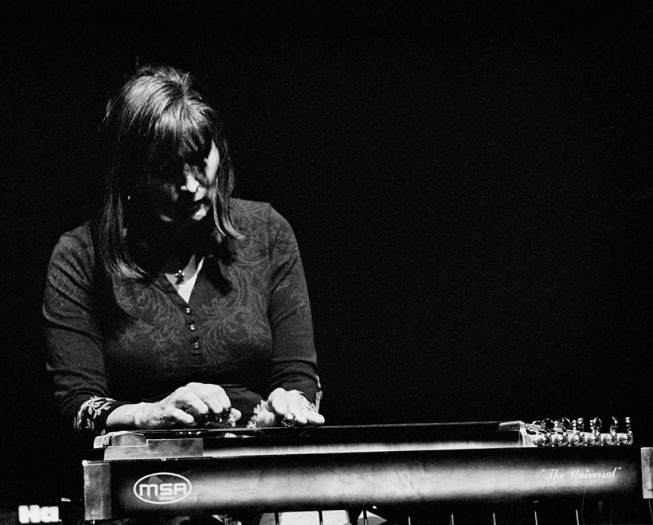
Pedal steel guitarist Susan Alcorn has been playing her instrument for over four decades. She was at a club in Chicago when she first heard the instrument and the sound fascinated her. The next day, she purchased one and soon was playing in country bands around the Windy City. Moving to Houston, Texas, helped her to learn and to play Western Swing. Ms. Alcorn began to study jazz improvisation and a meeting with composer/ conceptualist/ performer Pauline Oliveros led to a collaboration that opened the eyes of the younger artists to a multitude of sounds and possibilities. Subsequent meetings with Eugene Chadbourne and German bassist Peter Kowald led to more expansion of creativity; her first album date as a leader or co-leader was with guitarist Chadbourne in 1996––since then, she has issued eleven albums plus appeared on several more. It was on guitarist Mary Halvorson's 2016 octet album "Away With You" that this writer first heard Ms. Alcorn and her work within that ensemble was ear and mind-opening.
The majority of her albums are solo but her new recording, "Pedernal" (Relative Pitch Records) features the pedal steel player with her friend Ms. Halvorson, bassist (and duo partner) Michael Formanek, violinist Mark Feldman, and drummer Ryan Sawyer. The music, all composed by Ms. Alcorn, is often soft and slow; yet the quintet also gives the interactions power while creating intelligent, far-ranging, solos. The title track opens the program. It's a delightful blend of folk, country, classical, and blues influences with a touch of anarchy at times. The blend of electric and pedal steel guitars and players not afraid to stretch notes and ideas makes one pay closer attention. Feldman's sweet violin tone is a handsome –placed on the right side of the mix with Ms. Halvorson on the left (Ms. Alcorn is in the center), the violinist can both stand out and blend in.
Photo: Nicole Fara Silver
That opening song sets the tone for the entire album. "Circular Ruins" has a somber first several minutes before opening up to Ms. Halvorson's sparring with the bass and drums. A moment later, Feldman takes over the match. The leader joins in as well. "R.U.R." has a boppish feel in its quick tempo; its first set of solos features angular swift lines. The pace slows down in the second of the piece for a rubato, spacey, group of interactions, that break down to duos (pedal steel and drums, drums and guitar) and occasional interjections from the leader and violinist before returning to the main theme.
Photo: David Lobato
The centerpiece of the album is the 13+ "Night in Gdansk", a episodic piece that runs the gamut in dynamics, in melodic interplay, its interactions and counterpoint giving way to short unaccompanied transitions. There's mystery within this music, the plaintive violin melodies, the guitar duo with lines that connect then spin away from each other, how the drummer and bassist are both foundation and colorists to the sounds above them in the mix. There's a lot to take in on the initial listenings––hit "repeat" when you hit the final note, start over, and you will slowly but surely begin to see the overall shape of the piece.
The program closes with the delightful, playful, folk/bluegrass influenced "Northeast Rising Sun" where everyone gets to let loose. Ms. Alcorn sits back, letting Ms. Halvorson and Mr. Feldman gleefully solo over the scampering rhythm section before she reenters her most playful solo. A short, melodic, bass solo leads us back to the original melody and the sweet close.
Susan Alcorn and her excellent musical companions have produced a splendid album, emotionally rich yet adventurous, and ultimately satisfying. If you have never heard the pedal steel guitarist, start with "Pedernal" but make sure to check out her fascinating solo albums (2015's "Soledad", also on Relative Pitch Records, is especially rich music). Pay attention and the rewards are copious.
Guitarist, composer, and educator Alex Wintz is one busy person. Between gigs with Etienne Charles, Roxy Coss, and Nick Finzer, his own trio, and private lessons, the California native (raised in New Jersey) stays quite busy. The current pandemic has certainly slowed down the gigs but not the teaching. While he appeared on numerous albums, Wintz has only one recording as a leader––2017's "Life Cycle" (Culture Shock Records)––to his name. That album featured his Trio, bassist Dave Baron and drummer Jimmy MacBride, plus guests Lucas Pino (tenor saxophone), Victor Gould (piano), and Ben Williams (acoustic bass) on selected tracks.
In January of 2019, a recording engineer friend of Wintz made the offer of six hours in the studio. The guitarist brought the trio in to Red Bull Studios; they had been playing as often as they could and had built up a good-sized repertoire. They set up, did a quick sound check, and started recording. As the title tells you, these sessions are "Live to Tape" and Finzer's label, Outside In Music has issued the results on vinyl, CD, and digital downloads. No overdubs, only a few takes (at most), the seven-song program consists of four Wintz originals and one piece each from Herbie Hancock ("Textures"), Annie Clark/ St. Vincent ("What Me Worry"), and Herbert Martin/ Michael Leonard ("I'm All Smiles"). The recording and mix (Evan Sutton) posits the listener in the middle of the Trio and, while there's no crowd noise or words from the leader, one feels as if he is in concert space.
Clicking, percussive, guitar leads the Trio and the listener into "Idris", a tribute to the late drummer Idris Muhammad (1939-2014) who imbued every fast song he played with an irrepressible dancing beat. MacBride is right on top of the beat throughout and his bandmates dance with glee. "Textures", composed by Herbie Hancock for his 1980 "Mr. Hands" Lp, dances gently in a Caribbean mode (the composer's version mixed synths with acoustic piano)––the melody is quite lovely and the rhythm section gives it an Ahmad Jamal-feel. The St. Vincent composition follows; the trio treats the ballad respectfully giving the song a bluesy shade a la Jimi Hendrix's "Little Wing".
The straight-ahead jump of "Ely, MN" (a Wintz original) allows the band to gallop ahead although there are numerous momentary slowdowns on the way. MacBride and Baron do a great job of push the music forward with the guitarist complying with a hard-driving solo. The drummer also gets to step out which he does with great force and style.
"Live to Tape" closes with "I'm All Smiles", a perfect tune in that the music on this album will make you do just that––smile. This album is the perfect Friday or Saturday evening experience. At the end of a long week, turn down the lights, pour a libation, sit back and let the delightful sounds produced by the Alex Wintz Trio wash away the week's detritus. No deep messages on the album; in fact, just one and that could be "take it easy and enjoy!"
When the pandemic hit in earnest back in March, many countries closed down, limiting access to restaurants, theaters, clubs, stadiums, schools, airports, shops, and just about every place where people congregate. Many of us wondered then how artists would respond to this major threat to their livelihood. Musicians are adapting to online concerts, a number of venues have opened to present concerts but the audience is only allowed in via the Internet. Musicians are figuring out ways to record at home. In April, we read reports of musicians streaming short "concerts" every day or week plus others who lived in cities stepping out on their balconies or onto the streets in front of their domiciles. In warmer climes, groups have performed in large public spaces but few, if any, will play to a crowd indoors for a while longer.
Danish guitarist and composer Mikkel Ploug, who has worked on both sides of the Atlantic Ocean with artists such as Kenny Wheeler, Pete Robbins, Mark Turner (their 2018 duo album "Faroe" is a quiet gem) and a host of others, was ensconced in his apartment at a loss for ideas. Two weeks into the shutdown, Ploug opened his balcony doors in the early evening, put his amplifier and a chair out there and proceeded to play a lullaby for the neighborhood children. The response was immediate and overwhelmingly positive so he continued every night for the next month. Soon, the videos he recorded of each performance went viral so Ploug started a Kickstarter program to raise money to record these Danish lullabies and "pop" standards in a studio setting. The result is the truly lovely "Balcony Lullabies" (Stunt Records).
The 13 songs include nine traditional songs plus "Julia" (The Beatles), "Somewhere Over The Rainbow" (Harold Arlen), "The Nearness of You" (Hoagy Carmichael), and "You are My Sunshine" (Jimmie Davis/ Charles Mitchell). There are not "bravura" performances, recorded to show off the guitarist's versatility but they do show he can adapt material to his solo guitar and make it meaningful to any audience. Whoever listens will find their own favorites but keep in mind that there are "lullabies", pieces of music that allow your mind to wander. The sound of Ploug's acoustic and electric guitars is lovely throughout and one wishes he lived nearby so that the music could waft through the windows of the house. He had previously recorded a solo album (the all-acoustic "Alleviation" in 2017) that is also worth exploring.
The pandemic has scared many of us, forced us to retreat and think only of ourselves. "Balcony Lullabies" reminds us that we should not abandon our neighbors and have empathy for those separated from their families, for those younger ones who cannot connect with their friends or continue their education in a proper setting. Will this worldwide problem help us appreciate patience? Who knows? In various places, pandemic "fatigue" has created an upsurge in cases but art can remind us of the best in people. Mikkel Ploug, has created a delight-filled interlude, escape if you will, from the madness.
For more information, go to www.mikkelploug.com. Go to sites such as amazon.com and iTunes to for purchase options.
Here's the "live" version of the album's final track (recorded 4/15/20):
At a time when the entire world is on tenterhooks, tragedy strikes quickly and sharply. My sister died in the hospital on Wednesday the 8th, not from the virus scrubbing away at our communities but from complications with her heart. The worst part was not being able to visit her in her final hours as the facility was, and remains, on lockdown.
Mildred Rae (Mickey) Kamins, born January 28, 1943 – died April 8, 2020.
In the past, when a family member or close friend died, it's been the solo piano music of Keith Jarrett, the compositions of Erik Satie, or the "Cello Suites" of J.S. Bach (Yo-Yo Ma or Pablo Casals plus Johnny Gandelsman's brilliantadaptation of the pieces for violin) that I would turn to. Last week, it was the new album from the trio Gilfema, an album I was preparing to review, that helped me get through.
Photo: Seiichi Niitsuma
The trio – Lionel Gilles Loueke (guitar, vocals), Ferenc Nemeth (drums, vocals) and Massimo Biolcati (acoustic and electric basses) – first met at The Berklee College of Music two decades ago. Several years later, all three went on to the (then) Thelonious Monk Institute of Jazz in Los Angeles, CA. Returning East to New York City, the trio wrote and performed music, signed to ObliqSound Records, releasing their eponymously-titled debut album in 2005. "+ 2" followed in 2008 but when Loueke signed with Blue Note, the trio took his name, recording a series of albums while the guitarist toured with Herbie Hancock plus appeared on albums by Jack DeJohnette, Terence Blanchard, Esperanza Spalding, and many others.
"Three" (Sounderscore Records) is the trio's first "official group" album in 12 years and the musicians seemed as locked in and "free" as ever. The 13-song program builds off their ability to all be rhythm player as well as melodicists. Check out the open track "Têkê", how the melody builds off the dancing high-hat and the burbling bass, the West African melody plucked out by the guitar, and then, the music takes off on the strength of the multi-tracked guitar. Yes, it's Loueke's song, he's got the lead role, but this music needs the rhythm section to make it whole. Hear what the trio does to Jimi Hendrix's "Little Wing" (see and hear below) –– the melody is first played by Biolcati (acoustic) before Loueke takes over. Yet, the guitarist is quite active in the opening minute. The splendid percussion, the fundamental bass lines, all combine to keep one alert to how the trio makes this song its own.
Photo: Seiichi Niitsuma
Try sitting still during Nemeth's driving "Happiness" and while the drummer leads in "Algorythm and Blues" (co-written by Loueke and Biolcati). The latter track's groove evokes The Meters and The Neville Brothers Band, so much so you expect to hear snatches of New Orleans patois sung in the background. The guitarist and bassist also collaborated on the eminently danceable "Brio", the joyous West African groove sparked by Loueke's rippling guitar, Biolcati's bouncing bass lines, and the Caribbean-drum approach of Nemeth.
Photo: Seiichi Niitsuma
Loueke's "Dear J.L." is a spare ballad, with a long, flowing melody section, quiet percussion, and melodic bass accompaniment. The guitar solo builds smartly off the melody and the electronic effects plus Loueke's soft vocal paint a gentle portrait. The album closes with Biolcati's "Until", his overdubbed bowed bass chordal drone under Loueke's processed guitar melody creating a impressionistic setting. The bassist solos first (over his bass choir) before he and the guitarist play counterpart over the drone and soft hand-held percussion.
Why is "Three" so therapeutic for this writer in his time of mourning and remembrance? Maybe because my favorite music comes from the idea of dance, rhythms, pushing you, dragging you out of yourself –– Maybe it's the fact that Gilfema is a group made up of friends, musicians who have stayed in touch with each other, played regularly, and enjoy pushing their own boundaries. The joy I feel with Bach's "Cello Suites", the searching that created John Coltrane's " A Love Supreme", the gentle moments of Maria Schneider's "Sky Blue", all elements that also appear on "Three". The right music at the right time and, if you are already in a good mood, this music will heighten that mood as well. Just sit and listen.
Anyone with even a casual link to creative music has heard the work of Liberty Ellman but may never have heard of him. Born in London, England, his family moved to the United States when the guitarist was still in the early grades of school. Settling on the West Coast, he got involved with artists such as Vijay Iyer, Rudresh Mahanthappa, Steve Coleman as well as hip-hop groups and the San Francisco Mime Troupe. Ellman made his recording debut with pianist Iyer in 1995 and his first album as a leader, "Orthodoxy", was issued by Noir Records in late 1997. After moving back to New York City, Ellman worked with many artists across the musical spectrum, from pianist Jason Moran to Wadada Leo Smith to Rwandan composer/ vocalist Somi to pianist Myra Melford's Snowy Egret and more; not only did he perform and record with these artists but also mixed and mastered the recordings. His work with alto saxophonist and composer Henry Threadgill began when he became a member of Zooid in the latter part of 2008; he's now recorded six albums with the Pulitzer Prize-winning artist, all on Pi Recordings.
"Last Desert" is Ellman's fifth album as a leader, his first in five years, and fourth for Pi. He's composed seven pieces for a sextet that appeared on 2015's "Radiate": his guitar, Steve Lehman (alto saxophone), Jonathan Finlayson (trumpet), Jose Davila (tuba), Stephan Crump (bass), and Damion Reid (drums). The album's title refers to the international ultramarathon "4 Deserts", in which competitors race across several of the harshest environments in the world. The album is no competition but a smartly-shaped set of songs that range from the introspective opening track, "The Sip" to the Threadgill-inspired speedy "Rubber Flowers" (splendid drumming from Reid while Lehmann and Ellman spar) to the funky "Doppler" (listen to how the tuba, drums, bass, and guitar bounce off each other while trumpet and alto sax play a percussive melody). Finlayson, Lehman, and Ellman converse in short solos built off the main melody which as a bit of Thelonious Monk lurking in there. The blend of Lehman's tart sound, the crisp, soaring, phrases of Finlayson, and the percussive melodicism of the leader
Photo: Alan Nahigian
The title track is, actually, two pieces that stretch out to over 15 minutes. "I", an episodic composition, opens with a through-composed melody for trumpet lead, tuba bottom, and saxophone counterpoint. The guitar and drums enter filling out the melody line and providing color. Crump joins to fill out the sound. The next section moves forwardly rapidly thanks to the active rhythm section while Ellman and Finlayson create powerful solos. Near the close of the piece, Lehman and Rojas play a strong counterpoint to the trumpet before a quick restatement of the initial theme. "II" starts similarly with trumpet lead, saxophone counterpoint but also tuba and guitar counterpoint. When Reid and Crump enter, the music falls into a skewed blues pattern while the alto sax and guitar take the lead––the drums beneath the sax solo are explosive, on a rampage, as the guitar and bass play sparse riffs. Davila steps out alone leading the way to a powerful trumpet solo . There's much to listen to here between the rhythms, the background voices, the tuba and bass support while Finlayson leads the way to the close.
The program comes to a close on the funky "Liquid" with an opening that brings to mind James Brown, Steve Coleman, West African pop, hip hop, and more without being like any of those names and styles. Again, Reid is the spark that moves the music forward; yet, like the other tracks, the mood and pace change on a dime before the hardy tuba solo.
"Last Desert" is truly modern music. Grown on the fertile ground that Ornette Coleman, Jamaldeen Tacuma, Ronald Shannon Jackson, Henry Threadgill, and others churned up in the 1980s and 90s, Liberty Ellman moves into a newer territory, one where you hear the individual voices in the ensemble weave in and around each others, sometimes joining together, other times spinning away, yet always keeping your attention. You might not truly appreciate this music on the first or second listen but giving it time and attention will open the amazing worlds Ellman and his cohort are creating.
Guitarist Wolfgang Muthspiel (born 1965 in Judenburg, Austria) has been active on the international music scene since his student days in Graz, Austria. He first studied classical music but was exposed to jazz and, over the next three+ decades, he has kept his hands in both genres while expanding into singer-songwriter territory. While at the Berklee School on Boston, MA in the mid-to-late 1980s, he studied with Mick Goodrick and his first major gig was with the Gary Burton Group. Muthspiel stayed in the United States until 2001, moving to Vienna that year where he still lives. Many of his earlier recordings as a leader appeared on his own Material Records label (where you can find the singer-songwriter albums); the guitarist signed with ECM in 2013 as member of a trio with fellow guitarists Ralph Towner and Slava Grigoryan. In 2014, the label issued "Driftwood", Muthspiel's trio with bassist Larry Grenadier and drummer Brian Blade. The guitarist has since gone on to release two other ECM albums, both featuring trumpeter Ambrose Akinmusire and pianist Brad Mehldau.
Muthspiel's latest for the label is "Angular Blues"; the ensemble is back to a trio still with Brian Blade and now Scott Colley playing bass. The nine-song program features seven originals by the guitarist plus, for the first time in his ECM career, two "standards", Cole Porter's "Everything I Love" and Gene Paul's "I'll Remember April." The former, inspired by the Keith Jarrett Trio's version, swings on the power of Blade's delightful brushes and Colley's counterpoint. Muthspiel caresses the melody and then plays a wide-ranging solo. Colley also contributes a fine solo––he's one of the more melodic players of the bass––all the while, Blade dances underneath. The latter tune, actually, the final track, has a lively Caribbean rhythm under the guitarist's playful reading of the melody; Colley solos first over a steady beat and quiet chords. Both he and Muthspiel stay close to the melody for their solos plus there's a lengthy rubato section that may remind some of Marc Johnson's "Bass Desires" group (John Scofield, Bill Frisell, and Peter Erskine) for ECM
The opening three tracks feature the guitarist on nylon-string acoustic. "Wondering" starts the album, an up-tempo tune that shows just how well the rhythm section interact with the softer guitar. The title track follows, a rambunctious piece with impressive interaction, excellent use of the bass as counterpoint, and a stop-and-go approach in the early minutes before opening to an expansive guitar solo and another excellent solo from Colley. Listen to how Blade interacts with the guitarist during his solo and how both he and Muthspiel frame the bass solo. The final acoustic guitar piece is the lovely "Hüttengriffe"' its folk-like melody and gently county-western strolling rhythm pulling in the listener and asking nothing more than total attention.
The remainder of the program features electric guitar and each track offers new delights. Look out especially for the rapid-fire "Ride" for the loping melody and Blade's super brush work. Also, check out "Kanon in 6/8", a trio romp that features sparkling guitar work (involving subtle looping) and "Kanon in 5/4" which is a solo piece for electric guitar. One can certainly hear Muthspiel's classical training throughout the piece; he's playful and even ebullient at times but always quite melodic.
"Angular Blues" is a delight-filled album from the trio of Wolfgang Muthspiel (leader), Scott Colley, and the always masterly Brian Blade. The usually pristine ECM sound allows the listener to hear each musician and their glorious interactions are an integral part of what makes the recording so enjoyable. Check it out!
Guitarist and composer Jeff Swanson, a native of Indiana and graduate of Northern Illinois University (located in DeKalb, IL), has been based in Chicago for the better part of the past 10 years. He's performed and recorded with saxophonist Caroline Davis and drummer Charles Rumback (in the trio called Whirlpool) plus formed the quartet Living Bridge (you can find albums by both groups on bandcamp.com). Swanson has also toured with many of the area's more progressive jazz bands. In 2018, he released his debut album as a leader on his own Bace label––titled "Case-fitter", the recording featured an octet including saxophonists Greg Ward and Dustin Laurenzi, trumpeter Quentin Coaxum, drummer Greg Artry plus Fender Rhodes player Paul Bedal.
Bedal and Artry are part of Swanson's new album, "Fathoms" (Bace), now featuring electric bassist Matt Ulery and taking the group name from the title of the guitarist's debut album. Ward and Laurenzi show up on four of the 10 tracks. Swanson's music takes elements of jazz, blues, prog-rock, rock, and more, to create textures that catch the ear even as they make you want to dance. What one should notice immediately is these songs, all composed by the guitarist, have strong melody lines, even, as in the instances of "Replicant" and "Let The Children Play", the group is thrashing away; that latter tune has an excellent intro featuring Ward's alto in the lead. There is a flow to Swanson's phrases when he is soloing while his arrangements for the expanded group on the four songs give the saxophonists the opportunity to stretch out. The opener, "Gaussian" (named for a friend), introduces the "prog-rock" from the get-go with the OP-1 synth (played by the guitarist) supplying strings. Artry and Ulery really lock in on the track, really pushing the song forward as they create a cushion for the guitar solo.
There are less intense moments scattered throughout the program such as the insistent "Roads", "Elisha" (with a guitar solo that starts quietly and picks up slowly), and the medium-tempo blues "The Accutron" (which also has several ballad sections that Ulery and Swanson use to begin their solo)s. Bedal takes the lead on "Fyra", first with an unaccompanied section that opens him interacting with Ulery and Artry while the leader creates eerie noises in the background. "Tre" is a handsome ballad with a long opening section in which Swanson sticks close to the melody before Ulery's melodic bass solo (the only person to get a solo on the track).
There's more than a touch of West Coast funky swing on "Färvel" with the drummer's clicking sticks and the bassist's thumping bottom notes. Swanson's intense solo stands out as does Ward's romping spot. As the climax, the band drops the volume quickly and reprises the opening. On the afore-mentioned "Let The Children Play" (the track that closes the album), Swanson's guitar work and subsequent solo evokes sonic images of both Jimi Hendrix and Vernon Reid.
"Fathoms" is one of those albums that dances across so many musical genres that the smartest move is to just let it rip through your speakers at a high volume and enjoy the ride. What fun!
Trumpeter, educator, and artist Jamie Breiwick has made a name for himself over the past two decades in each of his chosen fields. His artwork adorns many albums by Mid-Western artists including those on Shifting Paradigm Records (as well as the cover of the Lesser Lakes Trio of which he is a member). He has worked with numerous artists in the Milwaukee area including Matt Wilson, saxophonist Ralph Bowen, and pianist David Hazeltine. Breiwick has taught and directed ensembles in several different schools and is currently on the faculty of the Prairie School in Racine, WI.
His new release for Shifting Paradigm is "Awake/The Music of Don Cherry" and features the trumpeter in the company of bassist Tim Ipsen and drummer/engineer Devin Drobka (also a member of Lesser Lakes). The tribute to the great pocket trumpeter, member of the Ornate Coleman Quartet that recorded for Atlantic Records, and a world traveler, features six songs (plus two "alternate" takes) from Cherry's repertoire. Breiwick doesn't attempt to "mimic" the elder trumpeter's style; instead, he and his rhythm section move inside the music with passion and excitement, making it their own. Check out the trio's journey through "Awake Nu" (composed for Cherry's 1966 Blue Note Lp "Where Is Brooklyn?"). The trumpeter romps throughout as the bass and drums roil and rumble.
Before joining Colin Wolcott and Nana Vasconcelos in 1978 to record and tour as CODONA, Cherry recorded "Hear & Now" for Atlantic Records. Breiwick and company take one tune from that album, "Mahakali", remove the South Indian sounds and replace them with a funky backbeat, making it feel like a dance tune. There are two versions of "Art Deco" from the 1989 album of the same name for A&M – that album paired with the rhythm section from several of Ornette's Atlantic Lps, bassist Charlie Haden and drummer Billy Higgins.
"Awake/The Music of Don Cherry" hopefully will push younger listeners to discover the work of Don Cherry (1936-1995) as well as discover the impressive recordings of Jamie Breiwick. This album s short – with the two alternate takes, it's just under 33 minutes – and it certainly leaves the involved listener wanting more. That said, listening to this music will be time well spent!
Bassist, educator, and composer Jeff Denson first came to critical notice in the early 2000s as a member of a trio with Berklee classmates Florian Weber (piano) and Ziv Ravitz (drums). The threesome toured and recorded with alto sax legend Lee Konitz. Denson went to earn his graduate degrees at Florida State University and the University of California/San Diego where he studied with and befriended fellow bassist Mark Dresser. The bassist is currently on the faculty of the California Jazz Conservatory. He has recorded a slew of albums as a leader, co-leader, and sideman plus started his own Ridgeway Records in 2015 – the label's initial release featured Denson's trio backing Lee Konitz.
The label's latest release is "Between Two Worlds" credited to the trio of Denson (acoustic bass), Romain Pilon (guitar), and Brian Blade (drums). Pilon, a native of France, and Denson have been friends for over two decades, working together on ideas that led to bringing Blade, who is one busy musician and first met the bassist in 2017 when they were the rhythm section for guitarist Joel Harrison's "Spirit House", into the mix to record the 10 songs – five each composed by Denson and Pilon – that make up the album. At first glance, one might wish to compare this trio with the one that recorded with Pat Metheny on 1976's "Bright Size Life" but the newer recording is quieter, more contemplative, but no less interesting.
While each track is unique, it's best to first listen to the program without trying to pull it apart. Listen to how melodic both Pilon and Denson are as composers and soloists as well as how Blade easily, often quietly, moves the music forward. You'll notice how these songs are three-way conversations, how supportive each person is underneath the solos, and how no one person hogs the spotlight. When you go back on further listens, moments begin to stand out. one has Blade's unaccompanied opening to Denson's "Listen Up" sets the pace for what follows and never loses its forward motion when the bass and guitar enter. Dig the playing of the drums and guitar beneath Denson's solo. Pilon's "Generation" opens in ballad setting yet picks up in intensity during the guitar solo.
The title track, composed by Denson, is a spotlight for the bassist's impressive arco playing, his solo rising above the guitars (Pilon overdubbed) and Blade's melodic drumming. The musicians don't rush through the ballad, allowing the contemplative mood to spread gently through the sound spectrum. Listen to the song posted below to hear how the trio interact, how they change direction naturally, and always pay attention to the overall sound and mood.
"Between Two Worlds" will grow on you. The music does not explode one's ears as much as it expands in the mind. Give the music the attention it deserves and you will be rewarded! Kudos to Jeff Denson, Romain Pilon, and Brian Blade!
Ben Monder has been a part of the Creative Music scene for over three decades performing and recording with the likes of Paul Motian, Lee Konitz, David Bowie, Marshall Crenshaw, and the Maria Schneider Orchestra (among a whole slew of artists). He's issued, at least, 13 CDs as a leader or co-leader and appeared on dozens more. There was a time that the writer thought his sound was close to that of Bill Frisell but, in actuality, Monder's style is very much his own, his attack is different, his use of electronics, solo style, all different. However, both he and Frisell are consummate believers in the power of melody.
Which brings us to his latest solo effort. "Day After Day" (Sunnyside Records). It's a double album set, the first CD recorded in April 2018 on which Monder plays solo while the second disk was recorded over two days in early October 2018 with bassist Matt Brewer and drummer Ted Poor. All songs on both albums are "standards" (of a sort), many from the 1950s and1960s, as well as a solo reading of Olivier Messiaen's "O Sacrum Convivium" , a choral piece composed in 1937. And, it fits right in. The melody, as faithfully played by Monder, sits comfortably next to songs such as Johnny Mercer/Johnny Mandel's "Emily" and Guy Wood and Robert Mellin's "My One and Only Love."
Photo: John Rogers
While the acoustic side is quite gentle throughout, the trio album opens what sounds like a straight-forward reading of Jimmy Webb's "Galveston." Well, it opens fairly conservatively but three-quarters of the way through, Monder steps on the high-volume pedal and lays down a fiery solo, one that ignites Poor's drums right down to the finish. "Dust", from the pen of Danny Kirwan during the final months of his work with Fleetwood Mac, is a lovely medium-tempo ballad that the trio plays acoustically (Poor uses his brushes). There's a beautiful guitar and drums (note the impressive cymbal work by Poor) reading of George Harrison's "Long, Long, Long" (from the 1968 "The Beatles" or, as most people know it, "The White Album") and a "swinging", brought sunshine, take of Richard Carpenter's "Only Yesterday." John Barry's "Goldfinger" sounds like Black Sabbath and features a deft shredding of the melody, especially during the delightful solo. Nice take of David Gates's "Guitar Man" (Gates wrote all the music for Bread, a group he led from 1968-73) with delicious plucking throughout.
The second disk closes with the title track, the song that Pete Ham wrote for Badfinger. The original version features the slide guitar work of George Harrison. Monder's version, recorded for multiple electric guitars and effects (and sans rhythm section), deconstructs the piece, resulting in a fascinating and slow, mostly rubato, performance of the melody. Such a psychedelic close to the entire program, one that does not truly resolve but fades slowly. It took this listener several times through to find the melody: yet, the piece draws the listener in on the power of the long, drawn-out chords and roaring notes.
"Day By Day" is a handsome portrait of the many sides of guitarist Ben Monder. At times playful, other times contemplative, always thoughtful, the songs, many of which many listeners should recognize, pull their power from our memories as well as the guitarist's creative arrangements and impressive musicianship. Listen closely!
"The Travelers" (Shifting Paradigm Records) is the debut album from the Lapis Trio, an acoustic group composed of Casey Nielsen (guitar, compositions), Dan Thatcher (bass), and Tim Mulvenna (percussion). Based in the Chicago area, the group has been together since 2014 and are dedicated to playing Nielsen's compositions. Both Thatcher and Mulveena are busy musicians with the former currently holding down the bass chair in Lucas Gillan's Many Blessings while the latter has worked with Ken Vandermark, the late Fred Anderson, and John Abercrombie. Nielsen also leads a "standards" trio plus is quite busy teaching both jazz and classical guitar. He's also worked and recorded with vocalist Christy Bennett.
The music on the Trio's debut album, lovingly recorded and mixed by the guitarist's brother Dana (best known for his work on albums by Smashing Pumpkins, the Avett Brothers, and Neil Young), covers much territory. The program can best be described as a pleasurable of classical, folk, pop, Brazilian, and jazz influences. Thatcher is quite the supportive as well as adventurous bassist and a fine soloist (check out his work on "Scatalogical Humor" for his smart solo and delightful counterpoint). Mulvenna's main work is on cajon (as pictured above) but he also adds other hand percussion and cymbals.
The sound of the group is somewhat reminiscent of the trio recordings guitarist Tim Sparks made for Tzadik but the compositions are quite different. Nielsen creates a lovely melody for "Culver City" - listen to the depth of his sound, the clarity of the melody and the notes he plays. There's plenty of improvisation but first pay attention to the "stories" the band creates. If you pay attention, you'll soon sway with the rhythms of "Clavé" and it's hard not to dance to the "popping" percussion on "The Fischer" yet don't miss the excellent bass counterpoint, the well-developed melody line. and Mulvenna's witty work.
"The Travelers" has such a light feel one cannot help to his or her spirits raised as you "travel" through the seven-song program. Lapis Trio is a refreshing change as those of us in the northern half of the United States move into Springtime. The charity of the sound and the richness of the compositions plus the delightful musicianship makes the Trio's debut album an aural treat!
Here's the title track recorded in a live setting:
"Hungry Ghosts" is the second recording from Typical Sisters and the first to be issued on Outside In Music. The trio - Gregory Uhlmann (guitars), Matt Carroll (drums), and Clark Sommers (bass) - first played together in Chicago in 2009 and has stayed as a working unit although the guitarist moved to Los Angeles in 2010. He returned to Chicago to record the band's 2016 self-titled debut album (issued of ears&eyes Records). Although the three musicians have busy careers as sidemen, this project and music is quite important to them. One of the more attractive elements of the group is how the songs have all sorts of influences yet stand on their own.
Pieces such as "Goner" and "Excavate" have great power. In the case of the former, it's the hard-edged guitar and, in the latter, it's the powerful rhythm section. When Uhlmann jumps into his solo on "Excavate", Sommers and Carroll push him forward with thunderous playing. The title track hearkens back to the sound of Peter Green's Fleetwood Mac around the time of "Oh Well" and the album "Then Play On." The influences of the blues can be heard and felt on "Portrait Of a Fast Moving Object" - Uhlmann pushes against the steady drone of the rhythm section with his hard-hitting solo
(and overdubbed rhythm guitars).
I grew up listening to the great guitarists of the 1960s and 70s but also paid attention to groups such as Pell Mell (from Portland, Oregon) and the guitar music of Tom Verlaine. While Typical Sisters often "rock out" on this album, there are pieces where the melody is just important. There's a folky feel to "Benjamin" and a gentleness to the album closer, "Young and Foolish" (an original tune, not the "pop" song from the mid-1950s). Stand-out work from Clark Sommers (a lovely "thick" yet "buttery" tone) and Matt Carroll (his ballad playing is so subtle) plus the excellent guitar work of Gregory Uhlmann make "Hungry Ghost" a pleasure to listen to over and over.
Pianist and composer Matt Choboter, originally from Vancouver, British Columbia, Canada, is currently, living, playing, and studying in three European cities (Copenhagen, Berlin, and Paris). he's now signed to Greg Osby's Inner Circle Music label. His second album as a leader, "Spillimacheen" (named for a river in British Columbia), features trumpeter Simon Millerd and guitarist Maxime Rheault-Trembley in the front line plus bassist Cole Birney-Stewart and drummer Andrew Thomson providing the propulsion. Choboter is the driving force, the director, yet one gets the feeling throughout the album that he gives the band plenty of space to help re-shape (but not overthrow) his original vision for his compositions.
Choboter graduated from Capilano University in Vancouver and has gone on to study with pianist Jean-Michel Pilc and drummer Dan Weiss. He also spent a significant amount time in 2015 studying Carnatic rhythm and melody in India. All the influences play into his original music but not overtly. His pieces are often episodic with plenty of ensemble plating as well as lengthy solos, never sounding forced or over-thought.
In the instance of the two pieces in the middle of the program, the title track and "Meaninglessness", the two long tracks (8:42 and 13 minutes respectively) move into each other as if this was a concert presentation. Millerd's breathy solo at the end of "Spillimacheen" pours over into the following track. The trumpeter continues to solo after the theme section (which he shares with the piano). Notice how the song dissolves a third of the way with Thomson taking a short solo that has the feel of a First Nations (Canadian Native Americans) drum chant before Choboter changes the direction of the music once again. Sit back, listen to how all of the musicians can be heard, how what they play, even if is quiet riffs or gentle cymbal splashes, in integral to the music.
Photo: Justin Choboter
In case one thinks all of Choboter's music has an "inward" feel or is introspective, just listen to the power of the band on "Outsider." Thomson really pushes this music forward as does the leader, especially in his exciting solo (notice how the snare is in sync with the piano notes). "Soweto" follows and, while the music tiptoes in on bowed bass and squealing trumpet, once the chiming piano chords enters, the music becomes like a whirling dervish, stopping to allow in the trumpet yet continuing to dance forward.
At 80 minutes, "Spillimacheen", like the river that gives the album its name, twists and turns, bubbles and then becomes calm, changing with every melodic or rhythmic idea. Matt Choboter makes modern music that is every bit as intriguing as his grandfather's painting that graces the cover of the album. Take your time and dive in to this music with an open mind and heart.
I have listened to and talked with guitarist Mike Baggetta since the mid-2000s when I discovered his duo music with trumpeter Kris Tiner in their duo known as TinBag). Over the last 15 years, the guitarist has crafted quite a career with a quartet that recorded for Fresh Sound New Talent (and featured saxophonist Jason Rigby) to solo work to a reunion with Tiner and a trio with drummer Billy Mintz and bassist guitarist Jerome Harris. His latest album, "Wall of Flowers" (Big Ego Records), is a trio disk, this one with bassist Mike Watt (Minutemen) and drummer Jim Keltner (whose credits date back to the 1960s and include legends like Joe Cocker, Leon Russell, George Harrison, Charlie Watts, Ry Cooder, The Traveling Wilburys and many, many more).
What you have here is a delightful potpourri of sounds ranging from quiet ballads to wailing guitar workouts. The album opens with "Hospital Song (intro)", a solo piece featuring several overdubbed guitars that leads into the trio version of "Hospital Song." The rhythm section lays down quiet a beat and Baggetta's overdubbed guitars play a handsome melody that to these ears display a California twang (he's a native of Agawam, Massachusetts - go figure). There are also two versions of "Blue Velvet", one for solo acoustic guitar, and the other a duo for Baggetta's electric guitar and Keltner's quiet shuffle rhythm. Both expose the handsome melody (composed in 1950 by Bernie Wayne and Lee Morris) and leave room for solos built off that recognizable tune. There's a sinister feeling to "I Am Not A Data Point", starting with the circular bass line which leads into Baggetta's howling, argumentative, guitar sounds (quite like Jimi Hendrix's noisy experiments with his tremolo bar/Whammy Bar). Watt holds it all together while Keltner skitters and jiggles across his snare and floor tom. There's a similar feel to "Dirty Smell of Dying" with Baggetta's overdubbed guitars screaming, strumming, and howling in the distance over the rhythm section. The bass and drums take centerstage in the last third of the tune - the mix has Keltner's kit spread across the audio spectrum with Watt's bass right in the middle.
The album closes with the title song, a tune that starts slowly with melodic guitar chords over the solid rhythm section. The piece take sit time to move through the melody but when Baggetta steps into his solo, the music picks up in intensity. No overdubs, just the guitarist working with and interacting with the bassist and drummer from beginning to end.
"Wall of Flowers" is a powerful recording. Yes, it shows off the compositional and guitar skills of Mike Baggetta as well as his mastery of the studio but, first and foremost, it's a trio gig. The guitarist has a strong connection with bassist Mike Watt and drummer Jim Keltner and everyone sounds invested in the project. Since the beginning of 2019, there have been a number of guitar trio albums released (Joe Policastro Trio, David Torn's "Sun of Goldfinger" with Tim Berne and Ches Smith, Typical Sisters, and Lapis Trio, all but the last "electrified") - "Wall of Flowers" is no wallflower in the bunch and is worth your time to explore.