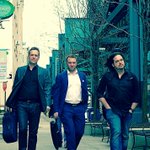
Clarinetist-soprano saxophonist Mike McGinnis walked into Systems Two Studio in Brooklyn, NY, on March 28, 2016, in the company of pianist Art Lande and bassist Steve Swallow. When they exited the building later that very same day, they had recorded a bushel of songs. Eight were released in April of 2017 on "Recurring Dreams" (Sunnyside Records). 13 months later, McGinnis and his musical partners have issued 12 more tracks under the title of "Singular Awakening." The majority of these tracks come from the first hour of the session when the three musicians just started playing - in fact, eight of the pieces are improvisations. What stands out here, as it did on the trio's initial offering (my review here), is how much fun they have playing music.
The program opens and closes with a song each from Swallow and Lande. "Here Comes Everybody" is a joyous romp that bounces atop Swallow's melodic and thick electric bass. Lande's Monk-like accompaniment is a treat over the fiery clarinet solo. The bassist's rollicking "Bite Your Grandmother" has the feel of a Charlie Parker tune with jumping solos from Lande and McGinnis (on soprano). The pianist's contributions, "Shining Lights" and "For Elise", have strong melody lines: in fact, all three musicians share the statement of the melody on the former track while the latter is a lovely ballad (reminiscent of Randy Newman). This song reminds the listener how much influence reed master Jimmy Giuffre has on the trio. The classical quality of the musicians' interactions and the clarity of their notes stands out.
In between, the improvisations range from the free-wheeling "Shockinawe" (and its furious interplay) to the lovely ballad "A First Memory" to the siren-like clarinet that introduces "O'Flaherty Decides to Play Jazz", a tune that also has McGinnis playing "rhythm" clarinet while Swallow walks and Lande dances across the keys. "Slow Dance In a Whisper" is also quite a beautiful ballad with Swallow creating the melody over sparse piano chords (McGinnis sits out this track) - the bassist's instrument sounds so acoustic. The dream-like piece is airy, with sustained piano notes and intelligent use of space and silence.
If you did not hear this trio's first album, that's okay: but I'd suggest buy them both. This is music that speaks to the creative listener, those people who enjoy when musicians take chances and leaps-of-faith the way Mike McGinnis, Art Lande, and Steve Swallow usually do and definitely do here. "Singular Awakening" shines brightly!
Here's a taste of one of the improvised tracks:
Pianist and composer Roberta Piket is a musician who can play in any type of ensemble as well as solo. Still, it's fun to hear her in a trio. "West Coast Trio" (13th Note Records) gives the listener a big clue in its title. The pianist ventured west from her NYC digs to Los Angeles for a West Coast tour. She lined up drummer Joe La Barbera who recommended bassist Darek Oleszkiewicz: they went into the studio, then hit the road. Ms. Piket came back to the East Coast with a good memories of her tour and a delightful recording.
The nine tracks include two Piket originals, the attractively flowing tribute to her teacher Richie Bierach titled "Mentor" and the handsome ballad "A Bridge to Nowhere" (one of the two tracks to feature guitarist Larry Koonse). Note La Barbera's splendid cymbal work on the latter track as well as the wonderful chordal work from the leader beneath the guitar solo. The other seven tracks feature a number of recognizable standards ( i.e. "Windmills of Your Mind" and "My Buddy") and some surprises (Chick Corea's hard-driving "Humpty Dumpty" and John Hicks's sweetly melodic "Yemenja") plus a swinging reading of George Shearing's "Conception" (the other track to feature guitarist Koonse) as well as a lovely reading of "Flor de Lis" by Brazilian composer ands vocalist Djavan (Billy Mintz joins the trio on percussion to add percussive spice to the mix).
Photo: Jason Kahn
For some reason, the track that really impresses me is the swinging reading of Richard Rodgers's "Falling In Love With Love" - the trio plays so inspired, they interacting as if they were breathing as one, and their joy jumps out of the speakers. Oleszkiewicz's solo is splendid, quite melodic (as he is throughout the album) while the standard 8 bars trio - 8 bars drum solo is anything but standard. It's the give-and-take that audiences enjoy so much and that this trio generously supplies. "Windmills.." also gets an uptempo reading: again, the three musicians sound so in sync that you want to immediately replay the song to hear what each individual is playing.
The best "piano trios" are the ones in which the listener gets lost in the group's sound before he starts to listen to the solos. "West Coast Trio" is one of those recordings. You expect that, based on previous recordings and live gigs one may have seen and/or heard, these musicians will play well. Roberta Piket chose her companions and the material wisely and we are the beneficiaries.
Here's Roberta talking about the trio, the music, and the conception:
NPO Trio is Meg Okura (violin), Sam Newsome (soprano saxophone) and Jean-Michel Pilc (piano and its debut is an often dazzling, free-wheeling, improvisational collection titled "Live at The Stone" (Chant Records). Ms Okura, born in Japan, is married to Mr. Newsome and both have known and played with the pianist for the past two decades. After her move to the United States, the violinist converted to Judaism. Besides leading various ensembles (including her Pan-Asian Chamber Jazz Ensemble and the J-Orchestra), she has worked with a wide variety of musicians, from the late Michael Brecker to the Jewish/Middle Eastern band Pharaoh's Daughter.
The album features three fascinating musical adventures including the untitled six-part, 49-minute suite that opens the program. Based on the Yiddish tune "Oyfn Pripetchik" (a song about a parent teaching her children the alphabet), the music is often spell-binding aa the piano rolls beneath the high notes of the violin and the soprano sax alternately wails and sighs. The opening section, "A Four Forty", is the prelude: about five minutes in, the original melody makes its first of numerous appearances. The plaintive tune rises out of the din of the aptly-titled "Bells, Whistles, and Sirens", after the riveting piano, the hard-edged soprano, and the high-notes of the violin have taken the listener on a journey through a chaotic world. Along the way, the musicians portray a world where so many people are dealing with relocation with the hope of a new life ("Travels" and "Exodus and Emancipation") - the journey the trio "plays" is not an easy one but fragments of the original melody help to soothe the troubled heart. By the time you reach the last section, "Pleading" (which is mostly a duet for soprano sax and piano), you begin to understand that this is not the climax of the journey but that your plea is a prayer fore the strength to go on. Newsome's tremendous range of notes and emotions are amazing to follow, to be absorbed in, to be able to tell such a powerful story that one hangs on every note.
The track following the suite, "Unkind Gestures", is the shortest improvisation (6:54) but its power comes from its anger and the musicians attempt to reconcile that emotion the power of creativity to transform the players and the listeners. If you listen closely, on occasion you hear snippets from John Coltrane's "Giant Steps", the melody line often fragmented but recognizable. "Yiddish Mama No Tsuki", the final track, combines Ms. Okura native and adopted heritages taking two songs dedicated to mothers which the trio play and then create variations. It opens with solo violin followed by solo piano; then, Ms. Okura and Pilc play a tango which Newsome's "clicking" soprano joins after a moment. It is fascinating to hear the soprano saxophonist go from the keys clicking to a soaring melody to an abrasive set of sounds and back to melody. The trio changes directions and moods several times during the last half of the piece, closing on a rippling piano line, more clicking saxophone, and chords plus the violinist hitting the strings with her bow .
One hopes that is just the beginning for NPO, that Meg Okura, Sam Newsome, and Jean-Michel Pilc continue to play together, to make challenging and such rewarding music. "Live at The Stone" is an aural magic show that reaches for your heart and your mind.
In her own way, Marian McPartland (1918-2013) was truly instrumental (pun somewhat intended) in educating the world about the great pianists and other musicians who live in our world. Through her weekly radio show, "Piano Jazz" (still alive and well on NPR), she talked and played with musicians (and others) from all across the spectrum, from Dizzy Gillespie to Studs Terkel to Steely Dan to Roberta Piket.
Over Ms. McPartland's lengthy career, she recorded a slew of albums, continuing to compose and perform into her early 90s. She's been gone nearly 3 years but her show still air regularly every week (plus new broadcasts hosted by her hand-picked successor, Jon Weber).
allaboutjazz.com
Since her passing, there have been plenty of written tributes but no recordings of her music. Until now. Roberta Piket (pictured left with Ms. McPartland) had organized a band in 2014 to pay tribute to the late composer and, a year later, she brought that ensemble into the studio to record "One For Marian: Celebrating Marian McPartland" (Thirteenth Note Records). Produced by Todd Barkan, Ms. Piket chose six of the pianist's pieces plus two of her own to arrange for a sextet that features Virginia Mayhew (tenor saxophone, clarinet), Steve Wilson (alto saxophone, flute), Bill Mobley (trumpet, flugelhorn), Harvie S (bass), and Billy Mintz (drums, percussion). What stands out besides the superb musicianship of all involved are the wonderful melodies that the ensemble performs. The two "new" songs include the lovely "Saying Goodbye" that opens with piano plus flute, clarinet, and trumpet before sliding into a waltz-like tempo led by the full-toned (and melodic) bass and the splendid brush work. The other Piket composition is the feisty title track featuring a strong melody line and excellent solos from Ms. Mayhew (tenor sax), Wilson (alto sax), and the leader. Mobley is in fine form throughout, especially on "In the Days of Our Love" and on "Time and Time Again" where he picks up the melodic thread from Ms. Mayhew's tenor sax and expands it with his tasty muted trumpet (over the bongos and conga work of Mintz). Wilson's flute work stands out on "Threnody", his dancing and playful phrases in sync with the "swing" of the rhythm section. Originally a ballad that Ms. McPartland composed to commemorate the life of Mary Lou Williams, this new arrangement chooses to celebrate the memory of that pianist/composer in a breezy, sweet, fashion.
Vocalist Karrin Allyson joins Ms Piket for an intimate reading of "Twilight World", a handsome melody with lyrics by Johnny Mercer that was most famously recorded in 1972 by Tony Bennett. Elsewhere on the album, Ms. Piket's playing is quite expansive; here, she is delicate, supporting the excellent vocal with lush chords and melodic counterpoint.
The album closes with "Kaleidoscope", which attentive listeners and fans should recognize as the theme to "Piano Jazz" - after an impressionistic opening piano solo, the band his the ground running with exciting solos from Wilson (alto), Mobley (trumpet), Ms. Piket, and her husband short but powerful drum statement right before the close.
"One for Marian" does an excellent job not only in celebrating the work and life of Marian McPartland but also in reminding listeners how fine a composer she was. Roberta Piket plays with grace and fire as does her excellent ensemble. Let's hope there's a Volume 2.
There are few things more fun than listening to the Daniel Bennett Group. Over the course of six albums, Mr. Bennett (who plays alto saxophone, flute, clarinet, piano and other reeds) has created music that is wonderfully un-categorizable. Sometimes it sounds like rock, sometimes jazz, sometimes "pop", usually more involved with melody and atmosphere than with long solos. Album # six is "Sinking Houseboat Confusion" (Manhattan Daylight Media Group) and the 10 tracks feature his "working" group of Nat Janoff (guitars) and Matthew Feick (drums) plus bassist Eddy Khaimovich with guests Michele Herman (spoken work on one track) and guitarist Mark Cocheo on the "Acoustic Reprise" of the title track).
As for that title track, it shows up four cuts into the program and rocks out something serious, with chunky guitar chords, thumping drums - the song also has a handsome melody played by alto sax and shadowed by the flute and electric guitar. Janoff's jangly guitar riffs leads in "Paint The Fence"; the melody, played on flute (Bennett has such a lovely tone), is pushed forward by the dynamic drum work of Feick. The bassist gets a short yet quite melodic solo as does the lead as the piece flows to a close.
Bennett's song titles often include animals; this album has "Doctor Duck Builds a Patio", "John Lizard Comes Home", and the generic "Animals Discussing Life Changes" (only the title is generic as the song is a sweet vehicle for Bennett's clarinet). "John Lizard..." opens the program on a thumping beat, perfect for dancing around - the band describes its music as "Surf Rock" and, while it isn't just that, that designation fits this track to a T. "Doctor Duck..." is a bit funkier in the rhythm section but also has a splendid melody that s quite well constructed.
Ms. Herman shows up on "Little Disappointments of Modern Life" - the track opens with an unaccompanied alto saxophone that is the closest to jazz the album gets. When the poet recites her work, the saxophone lines now are looped and processed) and there's a hard-edged solo to close out the track.
The "Acoustic Reprise" closes the album with Bennett playing a handsome melody (not the melody from "Sinking Houseboat Confusion") over several guitars, one of which (an acoustic) bounces between the speakers. After 5+ minutes, the band breaks into the acoustic version of the song. The piece still retains its bounce, just in a gentler fashion.
Listen - if "this whole world is getting you down", you should go "up on the roof" with the Daniel Bennett Group's music in tow. Pour a cool drink, set up a lawn chair, and crank up "Sinking Houseboat Confusion." The world outside your doors will still be crazy but your mood will be much lighter after this music.

 Posts
Posts