Showing posts with label NDR Big Band. Show all posts

Monday, June 7, 2021

Large Ensemble: Joy, Tears, Concepts & Changes

 Ahhhh....the sounds of the modern Big Band.  The stories on these two albums will touch your heart and the rhythms just might shake the foundations of your house.

Actress Glenn Close and saxophonist/ composer Ted Nash first met when the actress hosted the Lincoln Center Jazz Orchestra after the ensemble had played a show near her home in Maine.  Ms. Close appeared on Nash's 2016 "Presidential Suite" (Motema Music) reading the words of Aung San Suu Kyi, the former Minister of Foreign Affairs for the country of Myanmar. They now have a fascinating new collaboration recorded with the Lincoln Center Jazz Orchestra and special guests Amy Irving, Wayne Brady, Matthew Stevenson, and the saxophonist's son Eli.  "Transformation" (Tiger Turn) tells stories of change, most times personal but also communal. As Nash writes in the liner notes, "Transformation is the highest expression of change" while Ms. Close says "I wanted to create an experience from which people are comforted, but also inspired, to discover their true humanity".  

Recorded live in concert at Lincoln Center's Rose Hall just weeks before the COVID pandemic shut down venues around the globe, the pieces include texts by Ted Hughes (excerpt from "Tales from Ovid"), Conrad Aiken ("Preludes from Memnon"), Judith Clarke ("One Among Many"), Matthew Stevenson ("Rising Out of Hatred"), Wayne Brady ("A Piece by the Angriest Black Man in America; or, How I Learned to Forgive Myself for Being a Black Man in America"), E.O. Wilson ("Wisdom of the Humanities"), Tony Kushner ("Reaching the Tropopause" from "Angels in America"), and Eli Nash ("Dear Dad/ Letter").   Of the 11 tracks in the program, three have a musical response as a separate track while the rest have the responses built into the performances.
The opening piece, "Creation, Part I", utilizes the words written by Hughes, to reframe the opening section of Genesis in the Old Testament.  Ms. Brady and Brady tell the story while the band responses with alto saxophonist Sherman Irby and trumpeter Wynton Marsalis translate the words into music. Note the splendid backgrounds created by drummer Obed Calvaire and pianist Dan Nimmer. "Part II" comes in on an irresistible with the sections playing before trombonist Chris Crenshaw and baritone saxophonist Paul Nedzela solo over the rhythm section. 

Next up is "Dear Dad/ Letter". Eli Nash tells his story of feeling awkward in his body and desires. After making the decision to "transgender", the younger Nash struggled with how to tell his family.  The letter, read without anger or fear but with love and honesty, is surrounded by the long chords from the different sections with the elder Nash's soprano sax soaring above the music and words.  The composer's musical response follows: the piece has an expansive melody, the orchestra creates a full background while the soprano sax plays a solo that exudes emotion, confidence, and love.

Among the other "transformations" is the story of Judith Clarke who gets paroled after 38 years in prison. Amy Irving's fine reading of Ms. Clarke's words is full of wonder, regret, and gratitude. Matthew Stevenson tells his story of meeting fellow college student Derek Black who, at the time, was a Neo-Nazi. Inviting Black to Friday night dinner (after Shabbat services) much to the dismay of his friends, Stevenson and Black find common ground by meeting many different people, people from different faiths and beliefs. Eventually, Black stepped away from his family's embrace of racist and anti-Semitic views.  

Wayne Brady (pictured left) takes center stage for his "Angriest Black in America" –– the words may be rated R but the story, so well-written, comes on like a rap piece, at times, with humor mixed into the incident in which Brady is told he's too Black (in much less flattering terms).  He has such a negative reaction to being surrounded by people who tell Black jokes that he begins to hate himself.  Listen to how the Orchestra support the narrator (bassist Carlos Henriquez plays a modified version of Jimmy Garrison's foundational bass line from the "Acknowledgement" movement of John Coltrane's "A Love Supreme").

There's more – the concert runs 78 minutes – and that is for you to uncover and discover.  First listen to "Transformations" for the words, for the stories, for the excellent narrations; then return for the music. Listen to how the music supports the words, strengthening them, echo them, and respond to the emotions, be it anger, joy, fear, or acceptance.  The Lincoln Center Jazz Orchestra shines playing this music by one its long-time members, Ted Nash. The soloists are uniformly excellent (always great to hear Wynton rise to his powers) while the rhythm section plays at its usual high standard throughout.  Kudos to Glenn Close for helping to bringing this project to life and to Wayne Brady for his excellent work!  As the world slowly reopens, embrace these stories and see if you can be brave as these people.

For more information, go to https://tednash.com/discography/

Hear the opening "Creation, Part I":


Personnel:

TED NASH - CONDUCTOR, SOPRANO SAX

Woodwinds: Sherman Irby (lead), Marc Phaneuf, Victor Goines, Mark Lopeman, Paul Nedzela

Trumpets: Ryan Kisor (lead), Tatum Greenblatt, Marcus Printup, Wynton Marsalis

Trombones: Vincent Gardner (lead), Christopher Crenshaw, Elliot Mason

Rhythm Section:
Dan Nimmer, piano; 
Carlos Henriquez, bass; Obed Calvaire, drums 


Trumpeter Tim Hagans (born 1954, Dayton, Ohio) has taken his horn and his music around the world. He first came to critical notice in the 1970s in the big bands of Stan Kenton and Woody Herman before heading over to Sweden where he played with Dexter Gordon, Thad Jones, and others. It was Jones who encouraged the young Hagans to compose for large ensembles.  Even after moving back to the United States in the 1980s, he served as music director and composer-in-residence for the Sweden-based Norbotten Big Band (1996-2010) and has been involved with the NDR BigBand (Hamburg Radio Jazz Orchestra) since 2000.  As a soloist, Hagans absorbed the musical and stylistic influences of Miles Davis, Freddie Hubbard, and the afore-mentioned Thad Jones plus John Coltrane. He recorded a number of small group recordings for Blue Note Records and SteepleChase as well as appearing on recordings by Bob Belden, Maria Schneider, Joe Lovano, arranger Mark Masters, the Yellowjackets, and others. 

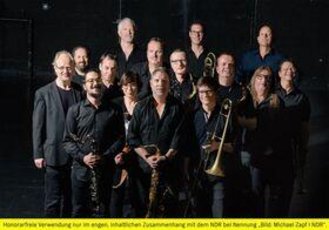
Hagans latest adventure with the NDR BigBand, "A Conversation" (Waiting Moon Records), is a five-part Suite ("Movements I-V") –– for the program, the Band members are not grouped by sections but into four separate "ensembles" (the composer/ arranger calls them "divisions" and it's based on "sonics" and "emotions"; see "Personnel" below).  On first listen, one can not pick out the separation but there are moments throughout where you can hear Hagans concept at work.  Because of his long association with NDR, he composes to the musicians' strength; their familiarity with his ideas, how he arranges, his expectations, all that and more means they will and can go anywhere he wants to.  

"Movement I" opens with various voices communicating across the sound spectrum. When the rhythm section enters, the music picks up speed; yet there is still the various instruments talking to and over each other. Six minutes in, pianist Vladyslav Sendecki steps out above the ensemble and begins a long, absorbing, solo with the collective ensemble playing counterpoint, pushing him, or creating a wash of sound.  As "I" fades on long notes, that sound introduces "Movement II" which then breaks into different voices crossing the spectrum a la the opening of Gershwin's "An American in Paris" albeit more disjointed.  The main melody is slow, stately, sans rhythm section, that slowly gives way to a lovely bass clarinet solo by Daniel Buch.  He stays close to the melody as the percussion, guitar, and piano fill in the background. As Buch catches fire, the music picks up in intensity until the full Band reenters playing a swaggering melody that soon steps aside for what sounds like a coda of long tones but instead leads to a bass solo from Ingmar Heller that goes right to the close of the movement. 

Photo: Michele Brangwengen
You get the idea. This music is hardly static, often changing directions yet making sure individual voices stand out.  After a solo trumpet introduction (one of the three pieces Hagans plays on) "Movement IV" turns into a dark blues that, at times, shimmies and struts its way for four minutes until percussionist Marcio Doctor helps "lighten" the mood and change the "groove" for a delightful alto saxophone solo from Fiete Felsch. The gentle habanera rhythm that opens "Movement V" moves sinuously beneath the Aaron Copland-like melody.  The muted trumpet solo (by Hagans) brings to mind the sound of Miles Davis on "Sketches of Spain" – that mood continues the middle of the piece when the music changes direction and mood, becoming a bouncy rhythm to support the fine solo from trombonist Klaus Heidenreich. As that solo comes to a close, the rhythm slows down, all the different "voices" enter, split apart then coalesce into a powerful climax and a soft coda.

"A Conversation" is splendid music, covering a wide swath of musical territory, never sounding cliched, the pieces played with feeling, emotion, and, at times, great fire.  Kudos to Tim Hagans and to his compatriots at the NDR BigBand – this music sings, swings, rocks, and soothes, human interaction at its best.

For more information, go to www.timhagans.com.  To purchase this recording and more, go to https://timhagans.bandcamp.com/album/a-conversation-2.  

Hear the opening "Movement":


Personnel:

TIM HAGANS, composer, arranger, conductor, trumpet (solos on Movements III, IV, & V)

Ensemble I:
 
FIETE FELSCH, lead alto saxophone, flute (solo Movement IV) 
FRANK DELLE, tenor saxophone, clarinet 
INGOLF BURKHARDT, trumpet, flugelhorn 
STEVE WISEMAN, trumpet, flugelhorn 
CLAUS STÖTTER, trumpet, flugelhorn (solo Movement III) 
KLAUS HEIDENREICH, trombone (solo Movement V) 

Ensemble II: 
PETER BOLTE, alto & soprano saxophone (solo Movement III) 
STEPHAN MEINBERG, trumpet, flugelhorn (solo Movement III) 
DAN GOTTSHALL, lead trombone (solo Movement III) 
DANIEL BUCH, baritone saxophone, bass clarinet (solo Movement II & III) 

Ensemble III: 
CHRISTOF LAUER, tenor saxophone 
THORSTEN BENKENSTEIN, lead trumpet, flugelhorn 
STEFAN LOTTERMAN, trombone (solo Movement III) 
INGO LAHME, bass trombone 

Ensemble IV 
JUKKIS UOTILA, drums 
ED HARRIS, guitar 
INGMAR HELLER, acoustic bass (solo Movement II) 
VLADYSLAV SENDECKI, piano (solo Movement I) 
MARCIO DOCTOR, percussion (solo Movement IV) 

Monday, September 21, 2020

Michael Moore, Clarinets & Alto Saxophone, Big Band & Quartet

Photo: Francesca Patella
Michael Moore, a native of Eureka, California, has lived in the Netherlands for nearly four decades.  The clarinetist and saxophonist is celebrating his residency and the art he is creating by issuing three new recordings, all quite different, two of which are reviewed below.  It's also the 30th anniversary of his first release on his own Ramboy Records––that initial album, "Trio Clusone", featured the amazing percussion of Han Bennink and the equally exciting work of cellist Ernst Reijseger, two musicians Moore would spend a decade with redefining the sound of a trio.  Over the years, the label has issued 36 recordings that posit Moore in many different sound ensembles.  He's also spent a number of years performing, touring, and recording with the ICP Orchestra but has never fronted a large ensemble....until now.

In January 2019, at the invitation of percussionist Marcio Doctor (longtime member of the NDR Big Band),  Moore flew to Hamburg, Germany to spend a week rehearsing and recording with the 18-member large ensemble. The resulting album, "Sanctuary", is a smashing success.  The 10 pieces are all Moore originals pulled from his various Ramboy recordings; the clarinetist also contributed six of the arrangements with two by Henk Meugeert (Dutch composer and arranger) plus one each from Christian Elsässer (German composer and arranger) and Frank Carlberg (American-based Finnish pianist and composer).  Each piece stands outs, not just for Moore's splendid playing but also for the arrangements that frame the melodies and soloists plus excellent support from the NDR players. Drummer Tom Rainey rejoins the band (he has played with the ensemble a number of times before) for the album with trumpeter Tim Hagans picking up the conductor's baton.

The music is so fascinating. The lovely opening of "Brunheiras" opens to a sweet melody yet after the band fills the background, the clarinetist steps aside for a raucous solo from guitarist Sandra Hempel with Rainey driving the band.  "Anomalous Soul", first recorded with pianist Fred Hersch and bassist Mark Helias in 1993, is a handsome ballad with more lovely clarinet and intricate interactions within the rhythm section.  "Fogo von Slack" is a short (2:18) work for the three clarinets of Moore, Fiete Felsh, and Luigi Grasso––there's a classical feel that also has a touch of the work of Jimmy Giuffre.  Felsh (on alto sax) also shines on "Odin" as does the impressive section writing.  Listen all to the simple yet solid rhythm section.  The bluesy "Shotgun Wedding" with its delightful trumpet melody and Moore's smoky alto sax work glides along like a smooth ride on a midnight ride.

Photo: Francesca Patella
Because the music is so good, there is the desire to write about each track. Whether it be the Americana-flavored "Trouble House" or the conversation-laden "Igor" (a tribute to Igor Stravinsky) or powerful yet sweet episodic tribute to the composer's mother (the album's title song) that closes the album, this music has melodic and harmonic power, excellent solos, intelligent arranging, and delightful solos.  "Sanctuary" serves as a refuge to the daily madness, a refreshing bath of sounds to excite your soul.

For more information, go to www.ramboyrecordings.com.

Here's the opening song:


Personnel:
Michael Moore - clarinets, alto saxophone

NDR Big Band:
Felix Meyer, Ingolf Burkhardt, Claus Stötter, Sebastian Stein - trumpet, flugelhorn
Dan Gottshall, Klaus Heidenreich, Stefan Lotterman - trombone
Sebastian Hoffmann - bass trombone
Fiete Felsh - clarinet, alto sax, Peter Bolte - flute, alto sax
Gabriel Coburger, Konstantin Herleinsberger - clarinet tenor sax
Luigi Grasso - baritone sax
Florian Weber - piano

Sandra Hempel - guitars
Ingmar Heller - bass
Tom Rainey - drums

Marcio Doctor - percussion
Tim Hagans - conductor

Michael Moore - clarinets, alto saxophone


Photo: Scheba F M
Michael Moore convened his Fragile Quartet for the first time in 2007. Composed of pianist Harmen Fraanje, bassist Clemens van der Feen, and drummer/percussionist Michael Vatcher (who also has worked with Moore in their Jewels & Binoculars Bob Dylan Tribute trio), the ensemble allows the alto saxophonist and clarinetist to create music that can and does go wherever the music wants to go, many times in unexpected and exciting directions.

For the Quartet's fifth album––Gerry Hemingway has replaced Vatcher––Moore created 13 songs that serve as a travelogue, an appreciation of natural beauty, and meditations on the Greek god Zeus, photographer Saul Leiter (1923-2013) and the painter Paul Klee (1879-1940). "Cretan Dialogues" opens with "...Dialogue #1" a three-song medley ("Lollapalooza", "Fenix Blue", and "The Meliae" (nurses of the infant Zeus)) that goes through a number of changes and melodic ideas.  The interplay is powerful, especially the work of the rhythm section as they chart new courses for the leader's reeds over the course nearly 16 minutes.  "...Dialogues #2" follows ("Europa", "Doldrums", and "Leaving Paleochora"); the first part really swings with a hint of Kenny Wheeler in the melody before van der Feen introduces the second piece with a slow spare yet effective bass solo. that leads to the clarinet melody over Frannje's supportive chordal work.  After a splendid percussion interlude, Hemingway's cymbals and brush work give way to a lovely piano ballad. "Paleochora" is on the southwestern coast of Crete and the music sees to look back at the town while looking forward to another ocean voyage.

Photo: YouTube
The album continues on with a Brazilian-flavored piece "Eugenia Uniflora" (named for the Brazilian Cherry bush) and the handsome ballad "Pussy Willow."  On the latter track, Moore's breathy alto and Hemingway's conversational drumming lead the way.  One of the album's shorter tracks, "A Little Box of Jazz", is also one of its "freer" pieces with all four musicians engaged in the "chat room".  The shortest track "Slowly, Slowly" closes the program–the bowed bass solo over the solemn piano chords and simple percussion serves as a coda to an album that covered a wide stylistic territory without settling in one.

"Cretan Dialogues" is quite the journey, one that moves the soul and heart of the engaged listener.  Michael Moore remains one of the more creative artists you will hear these days. He uses his Ramboy Records as an outlet for his various projects and you'd be wise to take a listen to his often-absorbing, probing, and exciting works.

Here's the tune to the Brazilian Cherry:

The albums reviewed here will be released on October 2 in the United States.. To listen to and purchase Moore's recordings on Ramboy, go to https://michaelmooreramboy.bandcamp.com.