Saturday April 23 2022 marks the 14th Annual Record Store Day, a day to celebrate the "brick-and-mortar" stores where one can go and browse albums from all styles of music. With vinyl making a comeback over the past decade, many labels use the day to introduce new recordings, holding off on digital or CD releases so that the platters get to be celebrated. As one who grew up listening to 45 rpm "singles" and to full-length albums (and whose younger daughter learned to read by reading album jackets and lyric sheets while the music was playing), this day is more than a trip down Nostalgia Lane. There is something indescribable about the smell of an unwrapped album and the joy of liner notes.
For the past decade,
Resonance Records has issued some great albums on Record Store Day and 2022 is no exception. To celebrate the 100th Birth anniversary of bassist, composer, author, and activist Charles Mingus (4/22/1922-1/05/1979), label co-President and album co-Producer
Zev Feldman (trumpeter
David Weiss is the other co-Producer) is issuing the three-Lp "
Mingus: The Lost Album From Ronnie Scott's", a document of the mercurial artist and his sextet at the close of a very successful 1972 European tour. Mingus was enjoying a career renaissance thanks to receiving a Guggenheim Fellowship in 1971; the same year, choreographer Alvin Ailey had adapted several of the bassist's compositions for his ground-breaking dance troupe. In early 1972, Mingus's auto-biography "
Beneath the Underdog" was published and Columbia Records issued his large jazz orchestra album "
Let My Children Hear Music" (before dumping him and many of their jazz artists the following year).
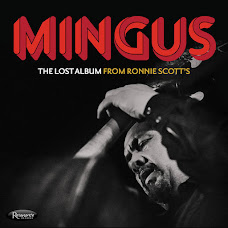
In usual Resonance style, there is a great booklet with numerous photos and interviews but you're going want to hear this music. The ensemble includes Charles McPherson (alto sax), Bobby Jones (tenor sax, clarinet), 19-year old Jon Faddis (trumpet), Roy Brooks (drums, musical saw), and the relatively unknown John Foster (piano, vocals––he would stay in Europe as did Jones but the pianist died relatively young in 1976). Of the nine tracks, two are over 30 minutes and one, "Mind Readers Convention in Milano", just three seconds shy of that mark. Two more pieces are over 18 minutes so you get the idea––each song is a concert in its own right with long solos, numerous tempo changes, and fascinating interaction. "Fables of Faubus" stretches out to 35 minutes (!) yet is so fascinating that it's tough to tear one's self away. Definitely pay attention to the bass solo as Mingus inserts a number of lines from such American songs like "The Star-Spangled Banner", "Dixie", "Short'nin' Bread", and others.
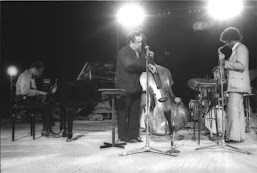
Foster, who joined the band at the beginning of the tour, is quite a treat to listen to. His piano style is very much like the person he replaced, Jaki Byard, and on "
Pops" (a.k.a "When The Saints Go Marchin' In"), he does a credible imitation of Louis Armstrong's inimitable vocalizations. Foster drops the imitation for a soulful vocal on "
Noddin' Ya Head Blues" that is notable for the powerful bass work and several fine sax solos. Faddis, who turned 19 a few weeks before the tour, is in great form––he may have been nervous working for the combative Mingus but there is no evidence of shyness in his playing. Brooks fits right in; if anything, he's more "exciting"a player than Mingus's long-time companion Danny Richmond. Bobby Jones, who also stayed in Europe and enjoyed a long career, wasn't as bluesy a tenor as, say, Booker Ervin, or fiery as George Adams (who played with Mingus before and after this ensemble, but he was an intelligent, intuitive, player on tenor and pretty good on clarinet. Charles McPherson, 23 at the time of this recordings, play with abandon, at times, on these tracks but, to his credit, does not try to be Eric Dolphy or Jackie McLean
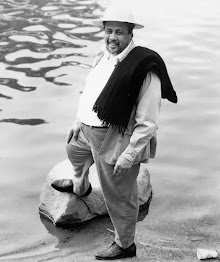
The enclosed booklet includes two interviews with McPherson (one alongside Mingus, another just last year), as well as conversations with Eddie Gomez, Christian McBride, the writer Fran Lebowitz (a close friend of Susan Graham Mingus), British critic and historian Brian Priestley, and more. There are great pictures but the best part of the package (besides the music), is how good the music sounds. Mingus's bass work is impressive throughout and he truly seems to be enjoying himself and his band. Most of this music sounds contemporary as if it coul have been recorded in the last several years. Pieces such as "Pops" and Charlie Christian's "Air Mail Special" sound somewhat dated but serve to fill out the portrait of an artist who was restless and creative until his untimely passing. "Mingus: The Lost Album From Ronnie Scott's" is the perfect gift for Charles Mingus's 100th Birth Anniversary year and well worth checking out.
Give a listen to "The Man Who Never Sleeps":

Over the past 10 years, no one has done more to fill in the gaps of pianist Bill Evans live recordings than Resonance Records. The first release, "
Live at Art D'Lugoff's Top of the Gate", came in 2012 followed by 2016's "
Some Other Time: The Lost Sessions From The Black Forest", the first of two albums recorded in the Summer of 1968 when drummer J
ack DeJohnette was a member before he went off to join Miles Davis. 2019 brought "
Evans in England" recorded live at Ronnie Scott's London club inDecember of 1969 while 2020's "
Live at Ronnie Scott's" was recorded 17 months earlier with bassist
Eddie Gomez and DeJohnette.
For Record Store Day 2022, Resonance is releasing two 2-CD sets recorded in Buenos Aires, Argentina, one in 1973 (with Eddie Gomez and drummer Marty Morell who is on two of the earlier releases listed above) and another in 1979 (see below). The earlier recording came at a particularly good, stable, time in Evans' life. Having been addicted to heroin for almost two decades, he was on Methadone, gigs were plentiful, the Trio had been together for five years, and his recordings were selling well. From start to finish, the music on "Morning Glory": The 1973 Concert at The Teatro Gran Rex, Buenos Aires" flows easily. The album takes its name from the fact the performance took place at 10 a.m. (!!) on a very cold Sunday morning in June. Yet, the Trio sounds great buoyed by an audience excited for this artistic respite from the political tensions that rocked the country.
The material will be familiar to aficionados of the Evans ensemble. Pieces such as "
Who Can I Turn To, "Re: Person I Knew", "T.T.T. (Twelve Tone Blues)", "Emily", songs this Trio had played hundreds of time sound fresh and the interplay, especially, of Evans and Gomez, is outstanding. The pianist also liked to incorporate the occasional "pop" tune into his repertoire; the title track (originally spelled without the "g" at the end of the first word) was composed by Bobby Gentry for her 1968 "
The Delta Sweete" Lp. Listen below to "
Waltz for Debby" and you'll hear music that exemplifies why Bill Evans, despite all his baggage, became the model for many piano trios that followed. The lyricism and the intimacy, the articulated phrases plus the occasional bluesy swing, all this and more make "Morning Glory" a splendid document.
Hear's the afore-mentioned "Waltz For Debby":
The political tensions that swirled around the 1973 Buenos Aires concert had only gotten worse six years later when Bill Evans returned. Evans had changed as well. He divorced his wife, married and had a son, finally kicked heroin but when his brother Harry committed suicide earlier in 1979, he started getting deeper into cocaine. Eddie Gomez left in 1977 and the pianist went through two bassists (Chuck Israels and Michael Moore) before 25-year old Marc Johnson joined him and drummer Joe LaBarbera (who replaced Marty Morell in 1975). By the time the band got to Argentina, they were firing on all cylinders and the fact that they continue the Trio's commitments kept Evans alive (he would eventually die 50 weeks after this concert).
In the midst of a vicious military dictatorship came the three musicians and the audiences were more than ready.
"Inner Spirit: the 1979 Concert at The Teatro General San Martin Buenos Aires" documents two sets played on September 27. The pianist often sequestered himself before concerts and often needed help getting to the piano; once there, his superb musicianship took over (most nights). The first set opens with "
Stella by Starlight", a surprise to the rhythm section but after the long solo piano introduction, the bass and drums fall right into place. Johnson's bass tone is quick thick but his regular forays into the higher register and his delightful counterpoint inspire Evans to continue his adventurous playing. Melody still remains the most important of the Trio's mission; still, on the uptempo tracks, this trio really smokes.
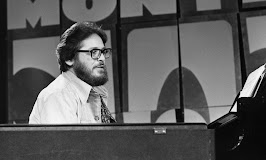 |
| Photo: David Redfern |
I find it quite ironic that Evans chooses to play the "
Theme From M*A*S*H" considering its subtitle is "
Suicide is Painless" (considering his brother's recent death but the music becomes very exciting as the trio builds the intensity of the tune–listen below. Paul Simon's "
I Do It For Your Love" starts with a short solo piano reading of the theme before the eloquent bass lines and soft brushes work lay down a gentle cushion for the long piano improvisation. "
Letter To Evan" closes the first disc, a lovely song dedicated to his son (who was 4 at the time), a lovely solo piano lament for time spent away from each other.
Disk #2 opens with one more piano solo, a fascinating journey through George Gershwin's "
I Loves You, Porgy" that shows how percussive the pianist's playing was becoming. The concert picks up steam with two powerful tracks in a row, "
Someday My Prince Will Come" and "
If You Could See Me Now". The former begins to cook after the opening featuring solos from all three. The Tadd Dameron piece that is a ballad yet listen to how the trio interacts, respecting the melody even as the de-construct the piece. The album closes with a 17+ minute take on Miles Davis "
Nardis" and what a version this is. The piano solo opens the piece lasts nearly eight minutes and it's a true joy to hear Evans deconstruct the melody and set the framework for Johnson and LaBarbera to join him. The bass solo calms the piece down for several minutes as Johnson for four minutes so he can explore numerous melodic avenues. After a quick abstract on the main melody, the drummer picks up his mallets and dances around his kit. After an explosive climax, the pianist and bassist join the drummer to bring the track to its close.
"Inner Spirit" is an appropriate title for an album recorded in a tough political environment by an artist pursued by his vices and sorrows. Yet Bill Evans had always been able to marshal his resources once he sat down to play. He was in the midst of killing himself but the beauty of his music is undeniable. He does not sound theatrical playing with artifice; instead, he seems to get stronger from the first notes forward. Mark Johnson and Joe LaBarbera are excellent partners––this is music that should be heard!

 Posts
Posts