I have been impressed by a number of new albums released this Summer that are soft in volume but musically and emotionally strong.
The trio of Steve Cardenas (guitar), Ted Nash (tenor + soprano saxophones, clarinet), and Ben Allison (bass) have played on each other's albums and in live concerts for more than two decades. Nash and Allison were connected as founding members of the New York City-based Jazz Composers Collective (very active in the 1990s) while Cardenas began recording as a member of the bassist's group around the turn of the century. As an ensemble, they've recorded three albums, 2018's "Quiet Revolution" (Sonic Camera, Allison's label), 2019s "Somewhere Else – West Side Story Songs" (Plastic Sax, Nash's label), and the recently released (July 2022) "Healing Power – The Music of Carla Bley" (Sunnyside Records, the label Cardenas records for). Their 2018 debut was dedicated to the music of reed master Jimmy Guiffre and his work with guitarist Jim Hall–the shape and sound of the lineup was perfect for an exploration of that composer's music and also worked really well for the Bernstein/Sondheim songs on the second recording..
For the trio's third release, they turn to Carla Bley whose unique musical stylings has kept listeners and critics entranced and guessing for over five decades. She has led numerous ensembles including both a small and large big band as well as, most recently, a trio with bassist Steve Swallow and saxophonist Andy Sheppard. Her music reveals all sorts of influence but Ms. Bley has always a penchant for smartly-crafted melodies. The songs on "Healing Power" come from throughout the composer's career; not only do Messrs. Cardenas, Nash, & Allison do the music justice, they make the songs their own. The nine-song program opens with one of her most famous pieces "Ida Lupino". Composed in 1964 and first recorded by her-then husband Paul Bley, the music is quite introspective and has a lovely melody. Allison's quiet bass lines creates a perfect foundation for the solos.
Photo: Ludovico Granvassu
The second track, "Donkey", is even older (1962) and swings nicely with a be-bop line worthy of Charlie Parker. With the exception of "Lawns" and the title track (both from 1987), all the tracks are from the mid-1960s. The music shows both the composer's versatility and her willingness to carve out her own compositional space in the fertile Creative Music scene. The listener should be thrilled by the mysterious and emotional "Olhos de Gato" (listen below) as well as the playful "King Korn" (both pieces that feature Nash on clarinet). The former has a Spanish "tinge"(a hint of flamenco) plus splendid short solos from all three musicians. Meanwhile, the latter track has a sweet bluesy feel–the main "body" of the piece is a three-way conversation that is bright, musical, with a touch of humor.
The program closes with the blues-drenched title track; note the interaction of the bass and guitar on Cardenas's sweet solo plus how Nash "gets down" over the sympathetic background. Yes, "Healing Power" just might cure what ails the world (ah, we can dream) but this soft yet dynamic session will make you smile as it reminds you just how impressive a composer Carla Bley has been through her long and continuing career. Kudos to Steve Cardenas, Ben Allison, and Ted Nash!!
Hard to believes it's been over 25 years since bassist, composer, and educator Ben Allison began making an impact on the contemporary music scene. The New Haven, CT, native was one of the co-founders of the Jazz Composers Collective, a nonprofit organization run by musicians that brought together a number of musicians and composers, put in concerts, began releasing records, and helped raise visibility for musicians such as saxophonist Ted Nash, trumpeter Ron Horton, saxophonist Michael Blake, pianist Frank Kimbrough, and Allison. Soon these musicians began to cross those invisible borders that seem to keep artists apart, whether it's "downtown" versus "uptown", "mainstream"versus "avant-garde." Groups such as The Herbie Nichols Project and Ted Nash's Double Quartet grew out of the cross-pollination.
"Layers of the City" is his thirteenth release as a leader (all CDs save for 2016's Newvelle vinyl-only release) and his second on his own Sonic CameraRecords label. Allison wrote music for a quintet he calls Think Free (he used a similar lineup for a 2009 Palmetto lineup with that name) that features long-time friends/associates Mr. Kimbrough and guitarist Steve Cardenas plus trumpeter Jeremy Pelt and drummer Allan Mednard. If you followed the bassist's career as a composer, you know that his songs have strong melody lines, that his wont is to work with textures, and not stretch pieces out too long (this recording has seven tracks and clocks in a just over 41 minutes). From the opening moments of "Magic Number" to the spacy sounds of the final track, "Get Me Offa This Thing"(which closes with quotes from the title track), one should notice the influence of Miles Davis circa 1958-73 on a good portion of this music. The opening track quietly rolls in the trumpeter's "In a Silent Way" (actually Joe Zawinul's piece) with the leader's electric bass rolling around the splashing cymbals and quiet piano chords. Pelt's tender trumpet shares the melody with piano and guitar on the ethereal "Ghost Ship" and he also gets the only solo. There are moments that hearken back to Miles work with Gil Evans.
benallison.com
Kimbrough's rolling piano leads in the noir-ish "The Detective's Wife" (note "The Canadian Sunset" riff in the bass on the opening melody) - the pianist really digs into his solo, pushing at the loping rhythms while Pelt, whose trumpet is muted throughout the track, has a nice atmospheric spot before the leader takes a strong solo. The piano solo on "Enter The Dragon" really stands out as Kimbrough starts out playing a angular "boogie-woogie" line before flying all around the keys. The trumpet and guitar keep the foundation, playing at half the tempo of the drums, piano, and bass.
benallison.com.
Cardenas is a stalwart, whether he is dancing around the fretboard as he does on the title track (check out the powerful bass line as well). The guitarist gets so much out of every note, never rushing a solo; he even seems a bit behind the beat on "Blowback" and that tension works well as Mednard and Allison roil below him. Pelt also offers an understated yet impressive solo on the track.
Ben Allison composes such fascinating music, knows the strength of his musical partners, and gives material to dig into and get lost in. "Layers of the City" is, at turns, powerful, soothing, rollicking, mysterious, noisy, and adventurous. While you hear the Miles influence on a number of tracks, you can't help but hear this as Ben Allison music and that, dear reader, is a very good thing.
Pianist, composer, and educator George Colligan is not joking around; his new album, his 28th!, is titled "More Powerful" ands is his debut for Whirlwind Recordings. Check out the rhythm section. Linda May Han Oh is the bassist and, her partner in the most recent vintage of the Dave Douglas Quintet, Rudy Royston is the drummer - need I write more. Saxophonist Nicole Glover (tenor and soprano), a former student of the pianist, plays on five of the nine tracks and is more than up to the task.
The opening track, "Whiffle Ball, comes out of the gate more like a Nolan Ryan fastball than its plastic namesake. Ms. Glover, on soprano, digs right in and rides the powerful waves from the rhythm section. Colligan plays with such joy as if he'd been set free after years of confinement yet he always plays with great passion. "More Powerful Than You Can Possibly Imagine", from whence the album derives its title, opens with Ms. Oh strumming by herself before the piano and drums enter leading to Ms. Glover, here on tenor, plays the melody. The leader gets the first solo, playing with abandon in the style of McCoy Tyner. Ms. Glover is no pussycat either as her solo is quite ferocious. There's a fascinating "free" section before the quartet returns to the powerful theme section.
Not every track hits like a sledgehammer. There are three songs in a row that take slower paths. "Retrograde Pluto" is a handsome ballad for trio. The melody shines but make sure to listen to the excellent melodic bass solo (Royston literally skips underneath) followed by a thoughtful piano spot. Every time, the piece threatens to pick up in energy, the pianist reigns in the trio, keeping the focus on the melody nature of the music. The following track, "Southwestern Silence", has a similar feel in its singable melody as well as a splendid solo from both Ms. Oh and Colligan. Ms. Glover joins in on tenor for "Empty", a piece with a bit more energy. In fact, by the end of the performance, the rhythms are roiling, the pianist is playing very powerful chords, and the saxophonist is squalling.
Timothy Forbes photography
"The Nash" brings the album to a splendid close. The piece has a circuitous melody line which Ms. Glover (on soprano) plays with delight while Colligan dances around her. Ms. Oh again gets the first solo before the pianist goes on a splendid romp, goosed right along by the heart-pumping drums. Ms. Glover enters with a series of short notes; then she and Royston create a storm of their own that will make you jump from your chair. After the piano and bassist re-enter, the saxophonist keeps going. She dives back into the playful main theme then rolls on to the close with fire and determination.
I suppose it's possible to get overwhelmed by the power of the music produced by George Colligan and his impressive band. Speaking for myself, every time I put this recording on, I get energized (dangerous to listen to in the car though as the music makes the car go faster - go figure). "More Powerful" may be one of the hardest-hitting contemporary jazz records you'll hear this year. Let it roar!
Firehouse 12, 45 Crown Street in New Haven is back in business, the concert business that is. The Spring 2014 season commences this Friday (March 21st, the first full day of Spring) with the Ben Allison Trio. Bassist/composer Allison, a proud son of New Haven, issued his first self-released CD, "The Stars Look Very Different Today" (Sonic Camera) in late 2013 with a quartet featuring guitarist Steve Cardenas, drummer Allison Miller, and guitarist/banjo picker Brandon Seabrook. Sonically, the recording contains some of the most dense music the bassist has ever recorded with Seabrook being the wild card. That writ, there are several strong ballads including the banjo-led "The Ballad of Joe Buck" and the harder-edged "No Other Side" (the blend of Cardenas's more mellow sound with Seabrook's electronically altered 6-string is quite attractive). There's a raucous re-arangement of Allison's "Swiss Cheese D" (first recorded on 2001's "Riding The Nuclear Tiger") that slashes and dashes, churns and burns (the title of the song comes from the repertoire of New York Knicks' commentator Walt Frazier.) Overall, it's one of Ben Allison's strongest recordings.
(photo by Ben Allison)
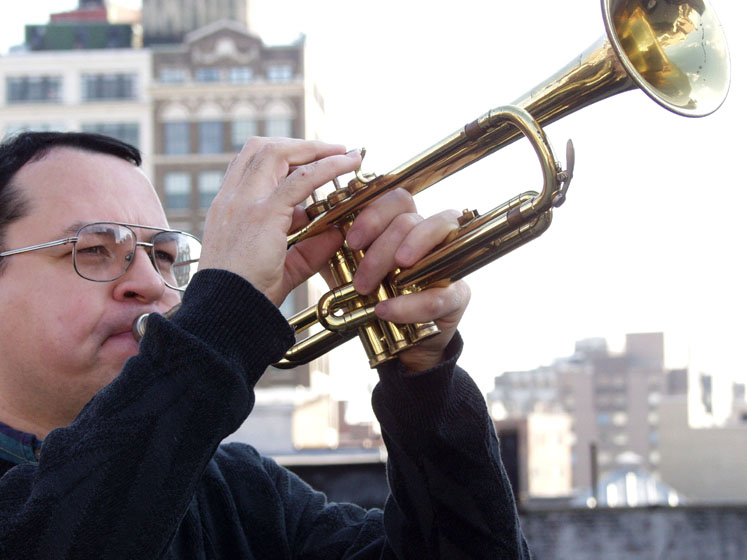
For the New Haven gig, the bassist is bringing a different lineup, one that I'm not sure he has ever performed with in a live setting. Cardenas, who has now appeared on Allison latest 5 recordings, will be on the gig and the third member of the Trio is trumpeter Ron Horton (pictured left). Horton was a charter member of the New York City-based Jazz Composers Collective and appeared on the bassist's first 4 CDs as well as being part of the JCC's Herbie Nichols Project.
The opening set is at 8:30 p.m. and the second begins at 10 (separate admission charges for each). For ticket information, call 203-785-0468 or go to firehouse12.com. To learn more about Ben Allison and his music, go to benallison.com.
Guitarist/composer Steve Cardenas has a brand new CD, his 4th as a leader and 2nd to appear on Sunnyside Records. Although there is no dedication on the album jacket, "Melody in a Dream" sounds like a tribute to Paul Motian (1931-2011). The guitarist recorded 4 CDs with the late drummer/composer/bandleader, 3 as a member of the Electric Bebop Band. Cardenas has also worked with bassist Charlie Haden, vocalist Elaine Elias, drummer Joey Baron. an is prominently featured on fellow guitarist Anthony Wilson's delightful "Seasons" project.
On this new project, Cardenas works with a splendid rhythm section of drummer Baron, bassist Thomas Morgan (who also worked with Paul Motian), and, on 3 tracks, trumpeter Shane Endsley. Upon first listen, what stands out is the crisp percussion, the excellent guitar accompaniments and Morgan's impressive bass work (he is so melodic). Baron does not imitate Motian but his work on the CD's ballads remind one of the spare style that his elder was well not for (it's shown to great example on tracks on the opening 2 tracks, "Just One More Time" and "New Moon", both Cardenas originals. The blend of guitar and bass (who is often playing counterpoint) is impressive throughout. The bluesy strut of "Ode To Joey" adds the trumpet to the mix - the piece shifts tempo several times but Baron's drumming guides all through the changes with no problem.
The program features a pair of Motian compositions, the sweet ballad "Once Around The Park" and the loping medium tempo of "In The Year of The Dragon." The late drummer's compositions have such fascinating melodies (quite singable - I'm surprised there are so few with lyrics); On "..Park", Morgan builds his solo off the theme and it really sparkles. There is a hint of Bobby Troup's "Route 66" in the melody of "...Dragon" - still, it's a subtle gesture on a program filled with subtleties.
There is a quartet of "standards" programmed one after another starting with the Victor Young/Sam Lewis 1932 classic "Street of Dreams" (the Trio performs the piece ever so slowly) moving to an up-tempo take of Lee Konitz's "Subconscious-Lee" (Endsley takes the lead and his bright tone works nicely with the muted sounds of the guitar.) Horace Silver's classic "Peace" is transformed into a gentle samba (the mix makes Baron's excellent percussion stand out as do Morgan's fine counterpoint phrases) which leads into a guitar/drums reading of Thelonious Monk's "Teo." Cardenas's crisp lines and harder sounds are a fine foil to Baron's crisp snare, splashing cymbals and thumping bass drum.
Don't approach "Melody in a Dream" expecting to be blown away by musical pyrotechnics or long, convoluted, solos. Take your time with this music, enjoy the fine drawn interactions, the sounds of the instruments, the various melodies and how the musicians explore these songs. The albums Steve Cardenas has created over the past decade show a musician who digs into songs to mine them them for their myriad possibilities and we, the listeners, are the benefactors of his musical research. To get a taste of this fine recording, go to sunnysidezone.com/album/melody-in-a-dream.

 Posts
Posts