Showing posts with label composers. Show all posts

Saturday, October 27, 2018

Songwriters, Singers, Science, & Personal Journeys

When I try to explain to my friends about why I love the music of Lorraine Feather so much, I'm often at a loss for words.  In a recent post of another blog, I compared the ballads she writes and sings to those of Randy Newman. But, the jazzy inflections of other tunes might suggest comparisions to Joni Mitchell or Oscar Brown Jr.  Her lyrics to songs by Fats Waller and Duke Ellington have links to the work of Jon Hendricks, Annie Ross, and Bob Dorough. Yet, she sounds like none of the artist I mentioned above. What's a hapless writer to do?  Mea Culpa - Lorraine Feather is her own person, a fascinating lyricist who does not avoid humor, exposes her myriad interests in her songs, understands that "this is what I do, who I am (or, at least, as much I will let you into my life)", and is curious about so much.

"Math Camp", her latest musical adventure, is the 12th release since she first began her solo career in the mid-1990s. This is her "science" album (although one could argue, most of the music she has released since 2008 shows her fascination with the science of relationships) as well as the first since she headed back East from rural Washington state.  Seven of the 10 tracks were composed by long-time associate Eddie Arkin with the remainder by another long-time contributor Shelly Berg.  Four songs are just piano and voice, three feature the quartet of Fred Hersch (piano), James Genus (bass), Gilad Hekselman (guitar), and Terri Lyne Carrington (drums), and the remaining three feature the West Coast ensemble of Grant Geissman (guitar), Michael Valerio (bass), and Michael Shapiro (drums) joined on several tracks by co-producer/co-arranger Arkin on guitar or pianist Russell Ferrante, and  on two cuts, by reed master Dan Higgins (alto flute, clarinet).

Songs such as the title track, "Hadron, Meson, Baryon", "In a Hot Minute", "It All Adds Up", and "Some Kind of Einstein" all are related to the overall Science theme.  "Hadron..." is a jazzy, breezy, journey inspired by a magazine about physicists at a conference studying a "theory of everything" with the song's title not a law firm but a trio of sub-atomic particles.  It's a treat to listen to the NYC musicians grooving underneath the voice.  "...Hot Minute" and "...Adds Up" are inspired by quotes from scientists, the first from astro-physicist Neil de Grasse Tyson and the second from physicist Richard Feynman.  The former has a Latin groove delightfully transmitted by the NYC quartet while the latter is a "jump tune" taken a breakneck speed. Enjoy how Ferrante and Higgins (clarinet) play Berg's be-bop inspired riff alongside Ms. Feather's vocal.  Ferrante returns to accompany the voice on the emotionally rich ballad "The Rules Don't Apply", the title song from a 2016 Warren Beatty movie "Rules Don't Apply" - the piece was nominated for the Critics Choice Award.

"I'll See You Yesterday" (another one of the Berg melodies) takes its inspiration from Kurt Vonnegut's "Slaughterhouse 5" as well as William Shakespeare. Berg's third contribution, "...Einstein", closes the album and is built off a splendid Mozart-inspired melody while one of the verses was inspired by a New York Times article from 1919 about an experiment conducted during a solar eclipse by British astronomer/ physicist Sir Arthur Eddington.  Note the lovely use of vocal overdubs.

Is "Math Camp" the first album that could be called "Geek Jazz"?  That's up to you. Ditch the label and just listen, laugh and sigh, tap your toes, enjoy the wonderful contributions from the musicians, and revel in the way Lorraine Feather sings, speaks, and writes.  In my youth, I was a horrible science student but, over the years, my fascination with what human beings and the physical world is composed of, has increased umpteenth fold (is there such a thing?).  As for outer space, like many of my contemporaries, I was equally fascinated by the "Space Race" and by the likes of Isaac Asimov, Arthur C. Clarke, and other speculative fiction writers.  Who knew Ms. Feather was a kindred spirit?  It would not surprise that the singer/songwriter's fans around the world might croon to her "Teach Me Tonight." Seriously, "Math Camp" is a delight from start-to-finish and will send ripples through your personal universe for many a day and night.

For more information, go to lorrainefeather.com.


Go to vimeo.com/271560555 to watch the promotional video!

Imagine if you can that you are raised in London, England, by a single mother.  Then, you move to the United States to begin career as a journalist. Now in your mid-20s, you discover that your birth father is a Black man from Trinidad and that your DNA contains numerous connections to Africa. Some years later, you decide to study jazz singing in New York City with the likes of Mark Murphy and Sheila Jordan.  Seven years later, in 2004, you record your first album.

That is a very short description of the life of Tessa Souter, the singer-songwriter whose fifth album, "Picture in Black And White" (self-released), is, in some ways, a musical autobiography as much as a fascinating collection of songs.  Ms. Souter, who also produced the album, works with a band throughout the program, an ensemble that includes her husband Billy Drummond (drums), Yotam Silberstein (guitars, oud), Adam Platt (piano), Dana Leong (cello), Keita Ogawa (percussion), and Yasushi Nakamura (bass).   The material blends originals with songs by Jon Lucien (a mentor to  the singer), Wayne Shorter, Ornette Coleman, McCoy Tyner, Terry Callier, U2, Milton Nascimento as well as folks songs and the standard "A Taste of Honey."

Photo: Richard Conde
There is a plethora of memorable moments on this album.  The intelligent blending of Callier's "Dancing Girl" with U2's "Where the Streets Have No Name" is emotionally rich while Lucien's "Child of Love" dances forward on the strength of the percussion work by Ogawa and Drummond and the handsome acoustic guitar playing.  Vicki Burns created a powerful and lyrical story for Tyner's "Contemplation" while also adding the title "Ancestors".  Led by Platt's powerful piano work and  Drummond's equally robust drumming, her voice rises above the musical storm to tell a story about a person's roots.  Coleman's "Lonely Woman" with its recognizable melody features voice, bass, cymbals, and drums. There's so much going on, the participants are fully invested, and the song becomes a haunting elegy.

There are three originals pieces (words and music) in the 12 song program and they appear in order 2/3rds of the way through the CD.  The title track features with just the bass and guitar (overdubbed, at least, twice); it is a bittersweet story of the memories that the singer has of her father, mostly through old photographs.  The pace picks up with "You Don't Have to Believe" with Silberstein playing both guitar and oud while Ogawa creates a steady beat on the frame drum. "Reynardine" is actually a traditional British folk ballad adapted for string bass, guitar, and oud.  Ms. Souter, who arranged the song, tells the tale-in-song in a powerful voice, the words clearly articulated. The piece would not sound out of place on a Sandy Denny album.

Earlier albums from Tessa Souter have appeared on Motema Records and the Japanese Venus label.
"Picture in Black and White" is her first self-released project and the freedom one gets from a "Do It Yourself" project is evident throughout as this program is so varied, the band (in its various forms) is with the leader from the beginning, and the results are rewarding for the listener.

For more information, go to www.tessasouter.com.

Here's the T Callier/U2 medley:

Friday, June 12, 2015

Two Michaels and One Sam, Bassists & Composers

Michael Bates is one might call a "Renaissance" musician.  He's recorded music by Shostakovich, created mainstream recordings, and is co-host, with trumpeter Dave Douglas, of the Greenleaf Music podcast, "A Noise From the Deep."

Judging by the cover of his new recording, "Northern Spy" (Stereoscopic), one realizes the title relates more to his Canadian heritage (with a nod to James Bond) than to the apple of the same name. It's his third trio recording, the first being his 2004 debut "Outside Sources" and the second a 2014 date co-led with saxophonist Peter Van Huffel, "Boom Crane."  Here, he leads a group with fellow Canadian Michael Blake (tenor saxophone) and Jeremy "Bean" Clemons (drums). Right from the opening notes of "Theme for a Blind Man", it's evident this will be yet another change of direction for the bassist. This music has its roots planted in the blues  Instead of a slide guitar, there is the thick toned bass notes behind the moaning voice and the heavy breathing of the saxophone.  "Essex House" is a slow blues with Blake's swaggering tenor pushed forward by the throbbing bass and steady drums. In the quieter moments, one can hear the basic blues patterns. "An Otis Theme on Curtis Changes" gives its influences in the title and features serious "testifying" from Blake.  The very slow take of Henry Mancini's "The Days of Wine and Roses" is quite powerful as well, sad but defiant as befits the storyline of the movie.

And the trio can swing.  "Roxy" has a great groove laid down by the walking bass and the driving drums.  Blake digs in, giving his all, jumping up into the higher register of the sax every now and then. The drummer takes the spotlight on the aptly-titled "Bean", moving around the kit with abandon. His partners join on a quick set of riffs but, for the most part, Clemons is the main voice. His funky intro to the title track provides the bed for the hip-shaking bass lines and the expressive conversational sax phrases. The final track, "Neptune", picks up on the energy of that track and intensifies it even more.  Blake really lets loose yet never loses control, even as the rhythm section pushes really hard beneath him.

"Northern Spy" is an aural treat, with strong playing, heady compositions and and "in-your-face" presentation. Michael Bates has such a "deep" tone, his notes seem to grab your chest to say "pay attention" - his cohorts also give their best, making this album a tasty addition to your library. For more information, go to outsidesources.org.

Michael Oien grew up in Wisconsin in a house filled with all sorts of music. At the age of 12, he met bassist Richard David and he found his true instrument.  After graduating from the Berklee School in Boston, Oien moved to New York City in 2004, finding work with drummer Yotan Rosenbaum, saxophonists Darius Jones and Uri Gurvich plus guitarists Nir Felder and Mick Goodrich.

Now, he has a debut CD.  "And Now" (Fresh Sound New Talent) features a quintet with the "rising star" guitarist Matthew Stevens, Canadian-born pianist and composer Jamie Reynolds (husband of vocalist Melissa Stylianou),  drummer Eric Doob, and alto saxophonist Nick Videen (tenor saxophonist Travis LaPlante appears on one track). The program concentrates more on the bassist's compositions (6 originals plus the traditional "All My Trials") than on his prowess as a soloist.  To his credit, the album starts with the lovely ballad "In The Early Autumn" - he does not play his first note until after the piano introduction and the acoustic guitar reading of the theme (over 90 seconds into the song).  He's careful to make sure that one fully hears the melody before Stevens' striking solo.  Oien opens the next track, "Skol", with a forceful Mingus-like solo before Doob enters with a skipping beat.  Videen's slow alto sax lines are a smart counterpoint to the rousing rhythm section (no piano or guitar on this track). The alto solo eventually picks up steam which pushes Doob to react in kind.

The centerpiece of the album is the 3-part "Dreamer".  "Part 1" opens with bass, cymbals and alto saxophone in legato before Stevens enters with his atmospheric electric guitar chords.  The bouncing bass lines lead in "Part 2" with Reynold's piano joining in. There is a touch of Pat Metheny in the melody and chords but the pace slows for the saxophone, piano, and guitar to move around each other.  "Part 3" opens with Videen's solo over Doob's striking drum work and Reynolds' powerful chords and short phrases. After the alto sax drops away the pianist moves the song into a different mood, more contemplative, before the rhythm section picks up in intensity and Reynolds responds in kind.  Soon, Stevens joins the mix in a support mode, his phrases in sync with the alto sax pushing the piece to its climax and a soft coda.

One of the more impressive aspects of the music is how the musicians moved around inside the pieces.  "Smile This Mile" has a lovely melody played by Videen, pushed along by the rich piano chords until Reynolds steps out. He does not rush, his phrases flowing like a leaf in the wind while Doob and Oien serve as both musical and emotional counterpoint.  The alto sax solo starts in the same "mood" before going in a more playful direction, dancing around the chords and the active drums.

"And Now" close with a solo bass reading of "All My Trials" - as he does throughout the album in his supportive role, Michael Oien shows a melodic side.  One hears traces of Charlie Haden, Charles Mingus, and Dave Holland in his assertive yet tasteful journey through the piece. His debut as a leader is impactful, especially in his desire to make this a "group" effort, to showcase the work of saxophonist Nick Videen and to give both Jamie Reynolds and Matt Stevens major roles in telling his stories.  Kudos to Eric Doob in his capacity as sparkplug for the music and battery mate to the leader's rhythmic conception. Overall, a splendid introduction to the music and vision of Michael Oien.

For more information, go to michaeloien.com.

art by Jeffrey Bishop
It's been nearly 4 &1/2 years since bassist/composer Sam Trapchak (born 1984, Livonia, MI) released his debut CD "Lollipopocalypse" with his quartet Put Together Funny. That group found the bassist in the company of Greg Ward (alto saxophone), Tom Chang (electric guitar), and Arthur Vint (drums).  Trapchak is set to release his 2nd CD "Land Grab" (Raw Toast Records), another quartet date with both Ward and Chang but now with Christian Coleman in the drummer's seat (and minus the group name).

What else has remained from the first effort is the impressive drive in the songs, the intelligent interactions of the musicians and the playful melodies the bassist creates for the quartet. Greg Ward impresses with his facility and bright tone, Tom Chang is both fiery and introspective, and Christian Coleman displays power and subtlety throughout.  "Lumpy's Blues" is just that, a hard-rocking blues with an odd meter and a smoking guitar solo. The leader gets to step out, displaying a big tone akin to that of Dave Holland. "Bell Curve" is a sweet ballad with classical overtones - Ward's expressive alto phrases reach into the higher registers of the alto saxophone. He has a tone not unlike Arthur Blythe in that one can hear the influence of the blues in the way he shapes his notes and how he "tells a story" in his solos. Hear how he moans in the background during the early moments of "Beautiful/Furious" eventually taking over the melody from the bass.  His solo takes its energy from Coleman's intense drumming.  Chang's fine guitar playing walks a line between jazz, rock and blues. When he lets loose over the active rhythm section on "Breathing Room" and "Pterofractal", all genres blur into his "attack mode" attitude.  Yet, his soft opening lines and continuing counterpoint on "Bell Curve" is spare yet vital to the movement of the piece. The mesmerizing back-and-forth riffing in the early part of the title track gets one's attention by creating the tension in tandem with the insistent bass note underneath the melody line played by Ward. The structure of the piece changes after the first part of the saxophone solo, picking up in intensity as the guitarist's rapid-fire phrases bob and weave in the mix. His solo near the end is refreshingly intense fueled by the drummer's insistent forward motion.

Through it all, Trapchak's bass sets the tone.  He can be percussive, his throbbing pulse freeing up Coleman to push and interact with the soloists.  His solid lines never waver, he does not step out of his foundational role  just to "show off", and is the heart of the music.  The parts he plays allow the others the freedom to move around in the structure.  When he and Coleman lock in under the saxophone solo on "Breathing Room", Trapchak's ever-changing yet steady bass lines are riveting.

The music and performances on "Land Grab" will grab you, make you sit up and pay attention, make you want to come back again and again to hear its kaleidoscope of sounds.  Sam Trapchak stands at the center of this music, his compositions and musicianship creating a joyful and adventurous listening experience.

For more information, go to samtrapchak.com.

Monday, September 2, 2013

Four Bass Hits

After releasing the excellent "Noneto Iberico" (Brooklyn Jazz Underground Records) in 2011, bassist/composer Alexis Cuadrado went to work on a project on which he wrote to selected poems that the Spanish writer/poet Federico Garcia Lorca created during the 9 months he was in the United States during the time before and after the Stock Market Crash in 1929.  "Poeta en Nueva York" was not published during Lorca's lifetime but 4 years after he was assassinated in a graveyard by soldiers of Spanish dictator Francisco Franco.  Reading through the volume, one can see that the poet was shocked by what he saw and heard, a city in the thrall of racism, bootleg liquor and technology.

Cuadrado chose 8 pieces to record, resulting in the 7 tracks that comprise "A Lorca Soundscape" (Sunnyside Records).  He entrusted the words to Claudia Acuna and she is magnificent as she walks through Lorca's harsh city. The dramatic nature of the pieces blended with (often) surrealistic lyrics makes for music ripe with tension. Alto saxophonist Miguel Zenon plays with great passion throughout, as if he were channeling the poet's emotional state - when he wraps his keening saxophone around the vocalist's cries on "Asesinato (Dos Voces de Madrugada en Riverside Drive)", it's a chilling and exciting moment.  The Afro-Cuban rhythms, supplied by drummer Mark Ferber and guest percussionist Gilmar Gomes of "Danzas de la Muerte" ("Dance of Death") support rippling piano lines from Dan Tepfer as well as the rapid-fire delivery of both Ms. Acuna and Zenon.  Ferber is also quite a presence in this music; his understanding and executions of the various rhythms is vital to the success.  He drives and pushes his fellow musicians on like the intimate then fiery ballad "La Aurora" (Dawn)"; he allows the composer to play the melody and also counterpoint. Tepfer's rumbling piano supports the voice on "New York", a piece that rallies against the conspicuous consumption of the city's inhabitants.  Creative overdubbing creates a musical "Tower of Babel" in the impassioned center of the song with numerous alto saxophones arguing with multiple pianos.  Tepfer's gentle lines lead the listener into "Vals en las Ramas"(Waltz of the Branches"), perhaps the sweetest melody in the program and also some of the most surrealistic lyrics in the program (many of which explode.  When Ms. Acuna sings the following verse "Llegará un torso de sombra coronado de laurel. Será el cielo para el viento duro como una paredy las ramas desgajadas se irán bailando con él" (which translates to "A shadow’s torso will arrive, wearing a laurel crown. For the wind, the sky will be as hard as a wall and all the drowned branches will leave as they dance"), she does so with the rhythm section gently beneath but as she reaches the lines that follow, Zenon enters and the music soars.  But, Ms. Acuna calms the saxophone's swirling lines but (vocally) bringing the swirling winds of music (Tepfer's lines, at times, resemble a dust devil) down to the earth ever-so-gently.

Federico Garcia Lorca saw the United States at its worst; it scared and sickened him.  8 decades later, Alexis Cuadrado, a native of Barcelona, Spain now an American citizen, watched the US economy suffer due to the excesses of greed, squandering of natural resources and vanity.  The music he creates on "A Lorca Soundscape" reflects Lorca's shock, imbuing the words with a panoply of emotions.  With the assistance and input of Claudia Acuna, Miguel Zenon, Dan Tepfer and Mark Ferber (plus Gilmar Gomes), the words and music come alive, a cautionary tale that also dances and sways to the rhythms of the composer's (and the poet's) Spanish heritage.  For more information, go to www.alexiscuadrado.com.  


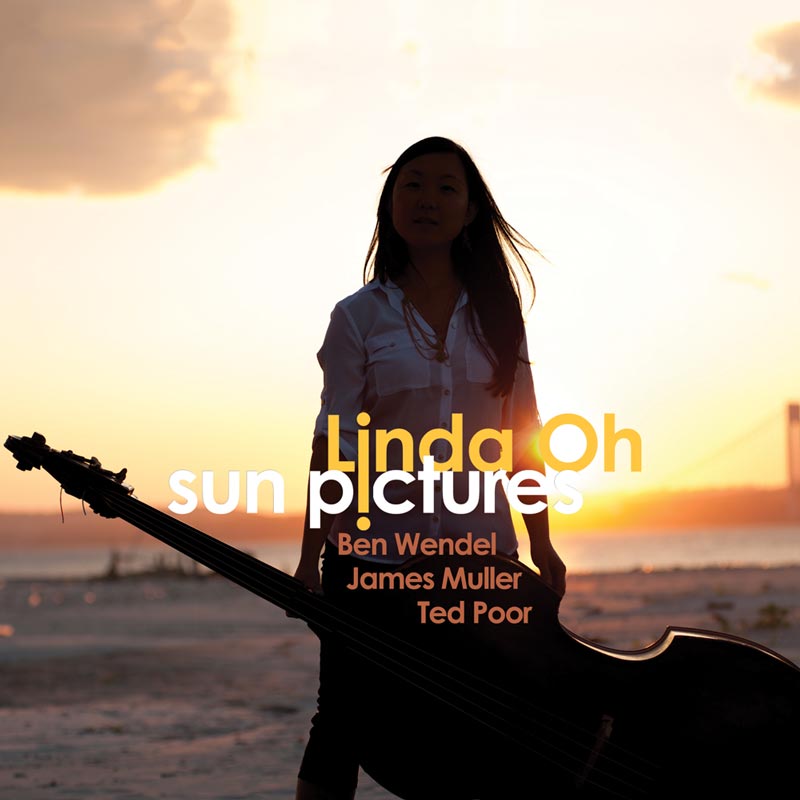
Bassist/composer Linda Oh, born in Malayasia, raised in Perth, Australia and now living in New York City, is a most intense musician.  She plays the acoustic bass with great skill yet never flaunts her technique.  Now a member of David Douglas's Quintet, she has worked with with pianists Pascal Le Beouf and Fabian Almazan.  As a composer, she writes pieces that have solid structures yet room for movement.

"Sun Pictures" is her 3rd CD as a leader and 2nd for the Greenleaf Music label.  Joining her on this session smartly recorded live in the studios of WKCR-FM New York (Columbia University) is Ben Wendel (alto saxophone), Ted Poor (drums) and fellow Australian James Muller (electric guitar).  The music ranges from the electronic collage of the opening track ("Shutterspeed Dreams") to the blues-inflected "Footfall", a tune on which the rhythm section locks into the groove and lets the music flow freely on top.  Muller, who has a successful career in his native land and has toured the world with drummer Chad Wackerman and worked with Maria Schneider, has a wonderful fluid style that matches well with Wendel's breathy abstractions.  The quartet can also fire on all cylinders, as is evident on the fiery funk of "Yoda" that builds off of the leader's percussive bass intro to a driving solo section.  The 'live" sound of Poor's drums shouts out of the speakers as the Muller and Wendel spar near the close of the song. "Terminal 3" is a sweet ballad; Poor's brush work and Muller's inventive chordal comping behind Ms. Oh's excellent solo while providing a good foundation for Wendel's melodic explorations.

Linda Oh builds most of these pieces off of strong melodies, allowing for the creative interaction throughout the program. This is music that not only displays the leader's continuing growth as a musician but her innate abilities in the rhythm section. "Sun Pictures" is indeed a collection of bright moments.  For more information, go to www.lindaohmusic.com.


Dave Holland came to the United States at the end in 1968 to join Miles Davis as the trumpeter/visionary began to move away from acoustic music (the native of Wolverhampton, England, replaced Ron Carter). After leaving Davis, he hooked with Chick Corea, Barry Altschul and Anthony Braxton to form the "free jazz" quartet Circle.  In 1972, Sam Rivers joined Holland, Altschul and Braxton to record "Conference of the Birds", considered by many as one of the best albums released by Manfred Eicher on ECM.  The bassist appeared on a number of Anthony Braxton's Lps in the mid-1970s. Anyone who has followed the bassist's career knows he has been prolific as a sideman and has lead a number of excellent ensembles.

His latest project is a quartet he calls Prism featuring Craig Taborn (piano, electric piano), Eric Harland (drums) and is a reunion with guitarist Kevin Eubanks (brother Robin played trombone with Holland's quintet, sextet and big band throughout the 1st decade of the 2000s.)   On the quartet's self-titled debut (released on Holland's Dare2 Records), the guitarist howls, wails, cries, shreds and basically obliterates his sidekick image.  He composed 3 of the 9 tunes, including the rip-snorting opener "The Watcher" (is Harland playing the intro to "Shaft" as Taborn's electric piano brings the piece in?)  Anyone who has seen and heard Eric Harland in Charles Lloyd's New Quartet or the SFJazz Collective knows how imaginative and forceful he can be on his kit. He can handle tricky rhythm changes or time signatures without blinking, caress his cymbals and kick the daylights out of his bass drum.  He's also a fine composer, with 2 of his pieces here, including the incendiary "Choir" that opens with the drums and electric guitar (sounding like a organ) pushing like mad.  When Taborn and Holland, the quartet "swing" mightily beneath Taborn's piano solo. The drummer's other contribution, "Breathe", is a stunning ballad, cymbals washing behind the rich piano lines, Eubank's long notes and the leader's handsome counterpoint.

Holland contributes 2 new pieces as well including the dynamic "A New Day" with its finely-constructed melody and chord structure plus a pulsating rhythm track that Harland shines on.  "The Empty Chair (For Clare)" is dedicated to the bassist's wife (who passed in 2011) - it is a blues built upon a simple bass line also played by Taborn on electric piano.  Holland takes a long solo, filled with blues figures but neither sorrowful or raging but emotionally strong.  Eubanks is the one who "burns", showing a touch of Jimi Hendrix and Larry Carlton in his fierce solo.  Holland's thick tones open "The True Meaning of Determination" (one of Taborn's 2 pieces) that soon moves into a jack-hammer rhythm that may remind some of pieces that Chick Corea wrote for Return To Forever.  The interaction of the acoustic piano and electric guitar over the forceful rhythm section is joyous, raucous, and, when Taborn switches to electric piano during the guitar solo, the piece gets even more intense.

Intense is a good word to describe this music.  There are quieter moments as well as a strong feel of "funk" on others. Within the space of 10 seconds on Eubanks' "Evolution", the song moves from flat-out flying over the guitar solo to a funky drive as a backdrop for the electric piano solo.  Then, there's the drum solo - let's just say it took the house a while to settle back on its foundation only to be rattling again for another guitar solo.  Prism has given fusion music an updated sound for the 2000-teens - After 4+ decades playing creative music, Dave Holland continues to enthrall listeners by taking chances and making honest music.  This music truly rocks! For more information, go to www.daveholland.com.


Mario Pavone latest venture, dubbed Arc Trio, featuring pianist Craig Taborn and drummer Gerald Cleaver, have a new album on Playscape Recordings and it is the exemplar of what creative music should.  The 3-way conversation never flags, the interactions are exciting and the music challenging.  Right from the opening notes of "Andrew", bassist Pavone (who composed all the tunes) sets the tone with his furious strumming. Taborn plays the short melody and moves right into his solo while Cleaver, who has worked on-and-off with the bassist for over a decade, kicks and pushes the rhythm.  "Not Five Kimono" is slower but no less intense, impressive in how the bass and drums fit together to not only support Taborn but continually move the piece forward. Pavone's chunky chords and Cleaver's splashing cymbals and active high-hat generate great tension that pianist pushes against and rises over. "Hotep", dedicated to the late South African pianist/composer Hotep Idris Galeta (1941-2010) who spent 6 years as a lecturer at the Hartt School of Music/University of Hartford in the 1980s, opens with a purposeful swing in the bass line then moves into a melody that displays the influence of Thelonious Monk but also has quite a percussive feel. "Alban Berg" swings lustily yet shifts tempo at ease, the bassist keeping the tempo while Cleaver alternately "swings" and "plays around" the tempo interacting with Taborn.

Mario Pavone, The bassist, who produced this live session (recorded February 1, 2013 at the Cornelia Street Cafe in New York City, chooses to fade out several of the tracks, leading one to believe that the Trio played these pieces as part of a suite.  Other pieces end without applause.  

Mario Pavone explains in the liner notes that these pieces and his approach to their performances has its roots in the music of Andrew Hill (specifically the 2-bass approach on "Smokestack"), Steve Kuhn, Dick Twardzik, Keith Jarrett (early Trio music) and Muhal Richard Abrams with Malachi Favors ("Sight Song").  Yet, "Arc Trio" is neither imitative nor dated - instead, the music stands right alongside its influences as consummate creative music.  For more information, go to www.mariopavone.com.  (Official release date is 9/17/13.)