As many of us sit down to a table of plenty, whether with family and friends or with a congregation, it's easy to put out of our minds those living through this holiday who don't have family, who do not have enough or who do not have good health. Imagine the families of Michael Brown in Ferguson, MO. or Officer Darren Wilson and how their lives at this moment in time are so turbulent and tragic. Say a prayer for those soldiers who are in Afghanistan or elsewhere in the world protecting our right to enjoy the fruits of the harvest. Take the time to wonder what it must be like to be a police officer in the United States or an immigrant picking fruits and vegetables in the Central Valley of California or stuck in detention centers in the Southwest.
All around this country (and the civilized world), people celebrate the "good old days", as if that's what they really were. History has a way of evening out the lows and boosting the highs; our memories do the rest. Sure seemed to be simpler times when I was a boy in the 1950s but what did I know of the issues in the Deep South? President Kennedy was assassinated when I was in high school, Malcolm X less than 16 months later, and Dr. King and the President's younger brother Robert in 1968. Detroit, Los Angeles, and other cities burned from the inside out and "white flight" became a serious reality. The Vietnam war raged on for over a decade, turning brother against brother. Drug use and abuse started to go "mainstream" in the 60s and shows no inclination to disappear. The rich got richer, the poor poorer and those in the "middle" started a long, slow, slide downward. Politics became sport, sports became religion and religion became passé or devoutly evangelical.
For me, I hid behind the "sounds" for the longest time, preferring to retreat to the vinyl grooves or the CDs for solace and a reminder of what I believed real brotherhood could be. Took a long time to realize that hiding is just another excuse for doing nothing but I have gone on to be involved in my communities. Haven't changed anyone's world other than my immediate family's but that is where true change begins.
Enjoy this Holiday season but do try and give back in any way that you are able.
*************************************
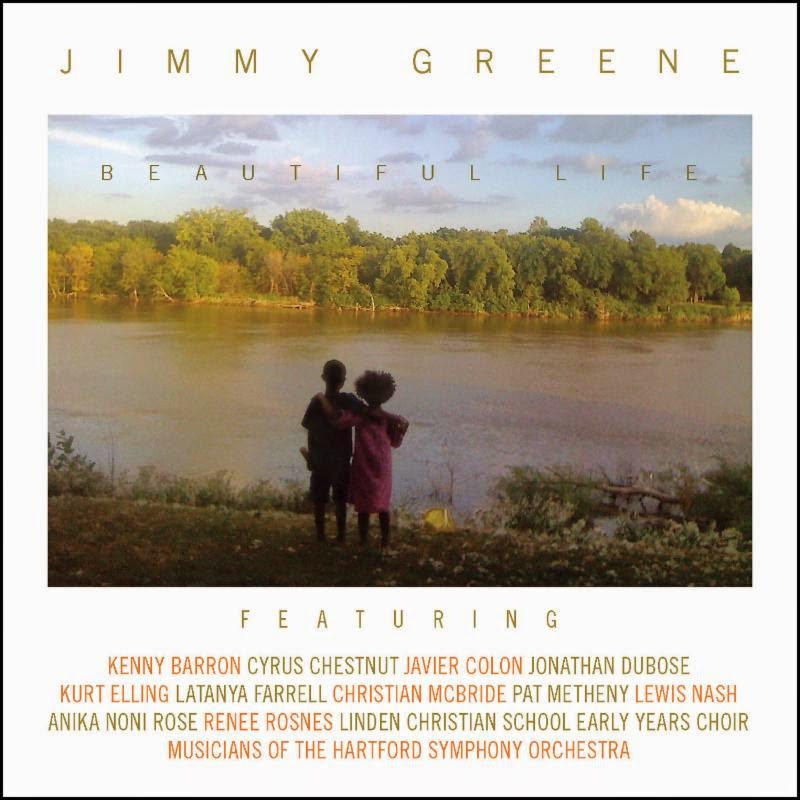
Most readers and listeners know the events and the long road that lead to "
Beautiful Life" (Greene Music Works/Mack Avenue Records), the new recording by saxophonist, composer, and educator
Jimmy Greene. Both of his children were in attendance at the Sandy Hook Elementary School the day that a mentally disturbed young man forcibly entered the building and killed 26 people, 20 children and 6 teachers/administrator.
Jimmy Greene and his wife
Nelba Marquez-Greene lost their daughter
Ana, aged 6 years old. Those of us who live in Connecticut were glued to the news outlets that mid-December 2012 weekend, shocked, saddened and angered. Greene, a native of Bloomfield, CT., had attended the Jackie McLean Artists Collective during high school and gone on to the Hartt School of Music at the University of Hartford and performed throughout the area, ultimately taking a teaching position in Winnipeg, Manitoba, Canada. Just months before Ana's untimely death, Greene had moved his family back to Connecticut upon taking a position at Western Connecticut State University.
The recording is a celebration of life, using the example of Ana Marquez-Greene's enthusiasm for living and music as its starting point. The majority of the 12 tracks feature the rhythm section of
Renee Rosnes (piano),
Christian McBride (bass) and
Lewis Nash (drums). Guests include guitarists
Pat Metheny and
Jonathan DuBose, Jr, pianists
Kenny Barron and
Cyrus Chestnut plus the string section of the
Hartford Symphony Orchestra and the
Early Years Choir of the Linden Christian School from Winnipeg. Vocalists include
Javier Colon, Latanya Farrell, Anika Noni Rose and
Kurt Elling. Ana's voice is heard on the opening track, singing "
Saludos" and "
Come Thou Almighty King", recorded at a family Christmas party, accompanied by percussionists and by her father on quiet tenor sax on the former and older brother
Isaiah on piano for the latter (in-between, Jimmy Greene and Pat Metheny play a solemn, reverential, version of the prayer.)
The music pays tribute and looks forward without ever becoming maudlin or mawkish. Pieces such as "
Last Summer" and "
Seventh Candle" are filled with buoyancy and joy, the former featuring a sparkling solo from Ms. Rosnes and the latter featuring strong work from Greene on soprano sax and bassist McBride. Both cuts show Lewis Nash at his best, propelling the music forward on waves of cymbals. Kenny Barron plays 2 duets with the leader, the sublime "
Where Is Love" (from Lionel Bart's score for the play "Oliver") and the achingly tender "
Maybe" (from "Annie"). The latter track finds Greene on soprano, hewing close to the melody his daughter loved to sing.
Javier Colon sings Greene's stunning "
When I Come Home", his handsome tenor blending with with the leader's feathery yet substantial tenor saxophone phrases. Elling's voice shines on "
Ana's Way", which describes the child's zest for living and love of family - when the Children's Choir enters, the song shimmers. Hartford-area resident and family friend Latanya Farrell delivers a powerful vocal on "
Prayer", a setting of "
The Lord's Prayer" for quartet and strings. Anika Noni Rose, also a native of Bloomfield, speaks Greene's powerful message of hope, forgiving and love on the final track "
Little Voices" with Greene overdubbing flute, soprano and tenor saxophones over the Children's voices repeating "
Remember me" as the song fades.
"
Beautiful Life" is a powerful album, a beautiful reminder of a spirit removed far too soon from her earthly existence. Instead of grief,
Jimmy Greene focusses on joyous memories, on healing, on beauty and on hope. As a parent myself, I am brought to tears by the loving care that Greene put into this program, making very sure that there was no anger expressed, no vitriol towards the troubled young man who changed the family forever. One is humbled by the Greene family's deep faith and insistence that, despite all the pain, horrific images, and tragic loss, love wins.
A portion of the proceeds from "
Beautiful Life" will go to
The Ana Grace Project of Klingberg Family Centers (
anagraceproject.org) and
The Artists Collective (
artistscollective.org). For more on Jimmy Greene and his music, go to
www.jimmygreene.com.
In the summer of 2008, pianist/composer
Fred Hersch contracted a particularly vicious case of septic pneumonia. Earlier that year Hersch, who has been HIV-positive since the mid-1980s, had been in the midst of a particularly busy touring schedule and had lost a lot of weight. He stopped eating and his doctors decided to take him off the antiviral medication to give his body a rest. He did start to eat again but the HIV flared up, causing an infection in his brain and creating AIDS-related dementia. By June, he went into septic shock, his organs shut down one-by-one and Hersch fell into a coma that lasted more than 2 months. When his doctors brought him out of the coma, be could not talk, eat, swallow, had no power over his limbs and he, in his own words, "had to completely rebuild himself."
Fred Hersch returned to performing in late 2009 and released his first new Trio recording in 2010, "
Whirl." The musicality we had come to expect from his performances seemed to be intact, his solos strong and inventive and his interactions sharp. He also began work on a long-form piece taken from the dreams he had during his coma. Working with lyricist Herschel Garfein, the composer created a work he calls "
My Coma Dreams", a work of theater for Trio (bassist
John Hebert and drummer
John Hollenbeck), a 4-piece brass and reed section (trumpeter/flugelhorn
Ralph Alessi, trombonist
Mike Christianson, clarinetist and alto saxophonist
Bruce Williamson, plus the flute, clarinet and tenor sax of
Adam Kolker and a string quartet (
Joyce Hammann on violin and viola,
Laura Seaton on violin,
Ron Lawrence on viola and
Dave Eggar on cello). Playing the roles of narrator, Hersch, his partner Scott Morgan and more is the incredible
Michael Winther - he is the connecting tissue of the work, the face and voice of the dreams, and the focus of our attention.
 |
| New York Daily News photo |
Palmetto Records has issued the DVD of "
My Coma Dreams" taken from the live performance at Miller Theatre on the campus of Columbia University in March of 2013. The 87-minute production includes animation and graphic design by
Sarah Wickliffe plus the brilliant video system design of
Eamonn Farrell and sound design of
Jody Elff. Not only do the words tell the story but Hersch's music takes us through the experience as well. What stands out to the viewer is that, for Hersch, the experience is not grim - scary certainly, but these dreams have humor, are filled with music and images that are cinematic. Scott Morgan is the one doing the suffering. But, also the person doing the caring, the sitting, the holding, the praying and he emerges from the narrative as the "hero" - he never gives up hope even as his partner is just lying there being kept alive by machines and the doctors refuse to give prognoses.
The music that Hersch provides for this work of "Jazz Theater" is, not surprisingly, quite impressive, ranging from blues to classical interludes to duets to Monk's "
I Mean You" (there's even a dream starring Monk and one wonders if Hersch's unconscious mind channelled the final years of Thelonious Monk's life which he spent in the apartment of the Baroness Pannonica de Konigswarter.) When Winther sings "
The Knitters", his excellent voice stands out as he tells the story of Hersch watching women - perhaps Amish women - as they work on various projects, only communicating in whispers. As the song transitions, the story changes to Hersch and his brother watching his parents and their friends talking, interacting and the young boy wonders if his "fate is being knitted in the room below." Meanwhile, the horns and strings play this expanding arrangement, their sounds wrapping around the voice like a warm sweater. "
Jazz Diner in the Woods" is a tour-de-force for all involved (John Hollenbeck truly knows how to drive an ensemble), a swinging track that is an audience favorite.
In the final analysis, "
My Coma Dreams" is about time lost but life regained. Though
Fred Hersch seemed lost to the world, his "inside" appears to be quite alive. He admits early in the performance that these dreams may have occurred as he was either going into or coming out of the coma. The live performance is smartly captured - like many videos of live shows, one can't help but wish he had been in attendance yet this story grabs ahold from the opening minutes and, even though one knows the eventual outcome, the solo piano piece that represents the composer coming out of his coma state still brings tears.
Fred Hersch has returned to performing on a full-time basis and continues to create music in which one feels great emotion, a strong sense of swing, and beautiful lines of melody. We are such lucky people that he has survived, he thrives and he educates us on just how precious time and life are.
For those who believe that there is no hope for their situation in life, know that there are foundations, doctors, nurses, therapists and others who are trained to bring you back from the brink. A portion of the proceeds from the sale of "
My Coma Dreams" will go to
Treatment Action Group (
www.treatmentactiongroup.org). To find out more about Fred Hersch and this production, go to
www.mycomadreams.com.

 Posts
Posts



.jpg?itok=5JjYPCsu)