If memory serves correctly, I first encountered the music of Henry Threadgill in Cutler's Record Shop in New Haven, CT, on seeing the first Air Lp, "Air Song" (Why Not Records imported from Japan), on the Jazz "New Releases" section of the wall. Intrigued, I discovered that the trio (saxophonist, flutist, and composer Threadgill, bassist Fred Hopkins, and drummer Steve McCall) hailed from Chicago and were members of the Association for the Advancement of Creative Musicians (AACM). By this time, I had heard the Art Ensemble of Chicago, Anthony Braxton, and Muhal Richard Abrams, fascinated as well as puzzled by this music that often eschewed typical jazz forms to look for new sounds and mixtures.
Photo: John Rogers
Threadgill, like a good number of his contemporaries, had served in the Armed Forces and come back to a changed United States. The Vietnam War was still raging, President Nixon had alienated a good portion of the country, and the inner city neighborhoods in major cities across the US had never recovered from the riots that had occurred before and after the 1968 assassination of Dr. Martin Luther King. What some people heard as anger in this hybrid form of Black Music was really a major advancement in approaches to composition and improvisation by many Black composers and musicians. By the mid-1970s, many AACM musicians had been to Europe but came back to move to New York City.
Henry Threadgill tells his story in his new memoir "Easily Slip Into Another World: A Life in Music" (Penguin Random House). Written with Brent Hayes Edwards, the composer/musicians takes the reader through his early years with bows to many members of his family and the various neighborhoods he lived in. We learn of his voracious appetite for learning and how he slowly but steadily learned piano, saxophone, and flute as well as to learn how to compose. Threadgill certainly played many different styles of music, from Gospel to R'n'B to Jazz to funk as so on but was open to classical music. He also was quite curious, fixating on learning how to fly and making people disappear, neither of which he was successful at. His time in the Armed Forces, especially the months he spent in Vietnam were harrowing but taught him much about the world, about community, and so much more. Coming back to Chicago and to the AACM pushed him to create his own music just as his contemporaries were doing (and many still do). We read of how he created Air with Fred Hopkins and Steve McCall as well as the groups that followed.
I was lucky enough to experience Air, hubkapaphone (that's a story unto itself) and all, in concert in Battell Chapel in New Haven. It was the Summer after Nessa Records of Chicago had issued "Air Time", the trio's first American release. The music moved in multiple directions with melodies coming from all three musicians, rhythms stopping and starting seemingly at will––McCall was an amazing percussionist, Hopkins a brilliant bassist with a true melodic bent, and Threadgill's tart alto sax sound pushed and pulled at the fabric of the material. One can still echoes of that sound in the music Threadgill creates today.
That said, the book illuminates how the composer organizes his groups, how he mixes and matches disparate sounds, how he's more fascinated by "flow" than by "rhythm", how he and his groups deconstruct and rebuild the compositions throughout every performance. Henry Threadgill is more interested in performance than recording, fascinated by how the musicians he plays with and/or conducts deal with time and with the flow of the intervals inside the music. When you return to listen to any one of his myriad recordings after reading this book, you'll hear his music with different ears, hearing the "architecture" of each song as well as the influence of the blues on the Sextett albums, the world music components of the Make a Move ensemble, and how ZOOID mixes composition and improvisation so that one can not tell where one starts and the other ends.
In a year that has seen new biographies of Sonny Rollins and Chick Webb. "Easily Slip Into Another World: A Life in Music" is a "must-read" for music lovers. The book goes a long way to shed light on the continually creative mind of Henry Threadgill, never dwelling on either awards or disappointments but telling a story that displays great humanity in spite of any and all roadblocks.
In addition to the new book, there is a new Threadgill album. "The Other One" (Pi Recordings), recorded live in May of 2022 at Roulette Intermedium in Brooklyn, NY, features the 12-member Henry Threadgill Ensemble composed of musicians who are members of ZOOID, the Double Up Ensemble, and several newcomers to the Threadgill universe. The ensemble plays "Of Valence", a three-movement composition influenced by percussionist Milford Graves' study of the human heartbeat and its integration into music. "Movements I" and "III" are broken into nine sections with the ninth being the "Finale" (in both). Meanwhile "Movement II" is 16:24 long with distinct sections but not broken up like the others. Even though the instrumentation is different than any other of his groups, you can the various trademarks of the Threadgill oeuvre: the long, winding, melody lines, the deep tones of tuba and cello for the bottom, rhythms that suggest swing, blues, African music, and more. What's different is the short sections that curtail long solos but do listen to how the composer/conductor moves the sounds through the band and how they come together.
Photo: Jeenah Moon/NYTimes
Listen to "The Other One" all the way through because that will help bring the music into focus. There's an excerpt below but it's like reading a short quote from a long book. Listening to music, especially "concert" music, is usually a cumulative experience. We remember moments of the pieces, the emotions we felt, perhaps an impressive solo or the rhythms that made us tap our feet. All three "Movements" of "Of Valence" start quietly before other instruments are added. The composer does that to pique our interest––where will the music go next, who's taking the next solo, etc.? There are many moments of strong musicianship here from violinist Sara Caswell, clarinetist Noah Becker, pianist David Virelles, percussionist Craig Weinrib, and the bravura of work of Jose Davila (tuba) and Christopher Hoffman (cello). That's not to discount the work of the others (all personnel listed below). The Henry Threadgill Ensemble, its leader, and his music shines brightly on "The Other One"!
After studying in Toronto, Ontario, pianist-composer Jeremy Ledbetter spent over a decade on the road working with artists such as Mighty Sparrow, Hermeto Pascoal, Jane Bunnett, and Andy Narrell (to name but 4). He's also the longtime musical director for the calypso star David Rudder. Ledbetter also leads the Canadian group CaneFire, one of the nation's best known Caribbean/ Latin jazz ensembles.
"Got a Light?" (ALMA Records) is his debut as a leader. With the splendid drumming of Larnell Lewis (Snarky Puppy) and the handsomely thick electric bass sound of Rich Brown, this music jumps right along. Ledbetter is a two-fisted pianist with a fine blend of percussive and melodic elements. The nine tracks - eight originals plus the Tragically Hip's "Gift Shop" (recorded one week after the passing of the group's front man Gord Downie) - have great power thanks to the talents and big ears of the participants.
There are many different musical dishes to digest on this album. The Latin Jazz side of Ledbetter shines brightly on several tracks including the dramatic "About Climbing Mountains". The booming piano chords and the powerful drums move the piece forward while Brown's bass dances around. If anything, "The Pepper Drinker" is even more startling with its quick jumps in intensity and rapid-fire rhythms. Brown's solo is jaw-dropping yet listen to how Ledbetter and Lewis help push him forward.
There is a softer side. Vocalist Eliana Cuevas joins the trio for "Her New Wings" (the leader switching to electric piano and leads the vocals in by playing the melody on melodica). The blend of her voice with the melodica is lovely plus there is a smart use of vocal overdubs to enhance the sound. The rhythm section sits out "Suspirito" with batá drummer Reimundo Sosa joining Ledbetter for the quiet performance.
The album closes with a solo piano piece, the gentle, gospel-infused, "The Tightrope Walker." In various places on the album, one can hear the influence of Bruce Hornsby on Ledbetter's melodic and rhythmic choices. Let this music wash over you. The Jeremy Ledbetter Trio will shake the rafters but also give you moments of peace in a crowded day. "Got a Light?" grabs the listener from the opening note, not only because this is not your traditional piano trio but really because the music is quite enjoyable.
To celebrate its 20th Anniversary as a unit , the Toronto Jazz Orchestra (TJO) has issued its fourth album, the 18-piece ensemble's first release in nine years. Led by its Artistic Director and chief composer Josh Grossman, the ensemble celebrates its existence and diversity with a eight piece program (including the four part "4 PN" dedicated to the 95-year old composer, bandleader, and clarinet player Phil Nimmons).
Grossman shows his versatility right from the start. A sweetly melodic introduction opens to a funky/Latin groove as "Georgie and Rose" dance across the speakers. Soprano saxophonist Chris Roberts and trombonist Christian Overton step out for delightful solos powered by the delightful rhythms of drummer Ben Ball and percussionist Luis Orbegoso. "Brad's Prudence" is a smart reworking of The Beatles' "Dear Prudence", the assemble trombones playing the melody as the trumpets and saxophones provide color commentary.
The afore-mentioned "4 PN" opens with "The Land of 2 and 4", a pleasing cut that swings along with the clarinets rising above the reeds and brass. There's a touch of Gil Evans in the smart arrangement behind the trumpet solo. Moving on to "Under a Restful Tree", the music takes on a modern feel, thanks to the adventurous drumming of Ball - note the melody played by the trumpet and clarinet in unison. "Birdsong" follows, the trilling clarinet opening unexpectedly leading to a lovely trombone melody and a ballad presentation. The suite ends in a funky groove with "Flat 10 Strikes Again", the ensemble riding atop the delightful electric bass work of Mark Godfrey.
The album closes with two very different tracks. "Reflections" is a passionate ballad that reflects the influence of Maria Schneider, especially in the section parts. "Blob", on the other hand, is a barn-burner with wailing guitar, pounding drums, and powerful solos. It only quiets down near the end for the bass solo which gives away to a booming reprise of the opening.
Two decades - 20 years - is a good long time in the life of a modern big band. While they may only have four albums, Josh Grossman has kept the TJO busy with several side projects. "20" is a celebration and, hopefully, a harbinger of more to come.
Josh Grossman (Artistic Director, conductor) Chris Roberts (soprano sax, alto sax, flute) Jake Koffman (alto sax, flute) Paul Metcalfe (tenor sax, clarinet) Chris Hunsburger (tenor sax, clarinet) Shirantha Beddage (baritone sax, bass clarinet) Steve Dyte (lead trumpet) James Rhodes (trumpet) Alexander Brown (trumpet) John Pittman (trumpet) Christian Overton (lead trombone) Pat Blanchard (trombone) Mark Grieve (trombone) Sylvain Bedard (bass trombone) Todd Elsliger (guitar) Carissa Neufeld (piano, Fender Rhodes, Wurlitzer) Mark Godfrey (acoustic & electric bass) Ben Ball (drums) Luis Orbegoso (percussion)
Listen to Josh Grossman talk about the band and the recording:
The University of Toronto 12Tet is an ensemble made of students, both undergraduate and grad students, enrolled in the university's music program. Led by trombonist, composer and arranger Terry Promane, the group plays music especially arranged and composed for the participants. With 11 musicians and vocalist Brooklyn Bohach, the 12Tet has a new album "When Day Slips Into Night" (U of T Jazz) - the disk comes 18 months after its previous album "Trillium Falls" (my review here). The program includes a totally new lineup from the previous disk but Promane again creates an album that features standards, an original work (by current tenor saxophone John Nicholson), and a surprise in the addition of "(Ocean) Bloom", a Radiohead piece from its "The King of Limbs" album rearranged by Hans Zimmer for the BBC series "Blue Planet."
The "standards" include Juan Tizol's "Perdido", Tom Harrell's lovely "Sail Away", and Cedar Walton's boppish "Bolivia." The musicians have a delightful time on the last tune listed, bouncing atop Evan Gratham's spongy bass lines. Alto saxophonist Brandon Tse delivers a lively solo over the rhythm section before the reeds and brass restate the theme. Tse returns to take the tune out. The Harrell composition has a light Brazilian feel with an arrangement that has the theme shared by the brass and guitar plus fine harmonies from the reeds. The ensemble's drummer Keegan Eskritt supplied the arrangement for "Perdido" and supplies the poly-rhythmic feel that pervades the piece. It's an intelligent updating of the original that honors the melody while giving the music a more modern feel.
Ms. Bohach is not on every track yet is a major component of the ensemble's sound. Her wordless vocals on Nicholson's "Eventide" adds depth to the melody on the opening (in the style of Norma Winstone, especially when blended with the trumpets). She's much more prominent on "Isaya", a piece composed by vocalist Ineke van Doorn and Marc van Vugt's for the latter's Big Bizarre Habit group. Ms. Bohach dances easily through the melody, scatting pleasingly after guitarist Julian Clegg's fine solo. She takes a quieter approach on "(Ocean) Bloom", giving the ballad a prayer-like feel. The arrangement, by trumpeter Michael Henley, keeps the mystery of the original but has a cleaner sound. The album closes with "Tanz Onhe Antwort (Dance Without Answers" - composed by German saxophonist Klaus Gesing - is also a ballad. Arranged by Promane, the melody is caressed by Ms. Bohach (both with lyrics and her wordless flight with the brass after pianist Noah Franche-Nolan's impressive piano solo.
"When Day Slips Into Night" not only highlights the young musicians who are part of the programs at the University of Toronto but also illuminates the vision of Terry Promane has for this odd-sized large ensemble. Everyone plays well, Brooklyn Bohach stands out without stealing the spotlight (the arrangements always posit her as one of the band), and the material covers a large swath of the jazz ouevre. Like their 2017 release, The U of T 12Tet keeps your attention throughout by making memorable music throughout.
The ensemble has no true website but you can buy the albums and listen to excerpts on both iTunes and Amazon.
Personnel:
Brooklyn Bohach: vocals Michael Henley, Kaelin Murphy: trumpets Karl Silveira: trombone Brandon Tse: alto saxophone John Nicholson, Kieran Murphy: tenor saxophones Russell Matthews: baritone saxophone Noah Franche-Nolan: piano Julius Clegg: guitar Evan Gratham: acoustic and electric bass Keagan Eskritt: drums
Kenny Wheeler (1930-2014) played trumpet and flugelhorn and created an impressive body of compositions that covered a wide swath of contemporary music. Born in Toronto, Ontario, Canada, Wheeler moved to England in the early 1950s, slowly, steadily, building a career in bands led by Tubby Hayes and John Dankworth. In the 1970s, he worked with various different ensembles, ranging from the avant-garde sounds of the Spontaneous Music Ensemble and the Global Unity Orchestra as well as alongside Anthony Braxton and Dave Holland. He had a long association with pianist John Taylor and vocalist Norma Winstone performing together and recording as Azymuth. He recorded numerous Lps and CDs for ECM, starting in 1975 with "Gnu High" and his final recording, "Songs For Quintet", released in 2015 after his passing. Wheeler also recorded for Soul Note and CAM Jazz.
My favorite recordings of Mr. Wheeler's tend to be the Big Band albums. His arrangements for brass and reeds have a classical sensibility yet are flavored with the experimentation that was a large part of his life. The original compositions often blend airy melodies with thick section playing, opening up for solos that seem to ride atop the rhythm section like birds gliding on columns of thermals. Best of all, his melodies are well drawn and the music often has a swing the composer/arranger had absorbed the blues arrangements of Count Basie and Duke Ellington. And his ballad pieces often have a wistful feeling, filled with emotion and, occasionally sadness.
The University of Toronto Jazz Orchestra, Gordon Foote, director, has just issued "Sweet Ruby Suite"(self-released on UofT Jazz) an album dedicated to the music of Kenny Wheeler. Joining the 18-member ensemble for this project is Ms. Winstone and guest soloist, soprano saxophonist Dave Liebman. The 4-song program includes the 29-minute title track that Mr. Wheeler recorded in 2002 with the Maritime Jazz Orchestra plus three other shorter tracks. The arrangements, all but one by the composer, leave room for contributions by many of the band members as well as Liebman. The multi-sectioned "...Suite" does an excellent job of displaying the UTJO's strengths; those includes the excellent work of pianist Josh Smiley, bassist Victor Vrankujl, and drummer Andrew Miller plus the excellent section workHis interaction with Brad Eaton's flugelhorn on "W.W" really shines. His sweet tone meshes nicely with Ms. Winstone's scat vocals on "Canter No. 1", perhaps named for its loping rhythms - the piece, arranged by Terry Promane, makes great use of the sections in call-and-response, counterpoint, and harmonies. She also joins the brass for the melody line on the song which appeared on Mr. Wheeler's final ECM release. "Winter Sweet", also first recorded with the Maritime Jazz Orchestra, is a lovely ballad complete with strong playing from Marie Goudy (flugelhorn), Conrad Gluch (alto saxophone), and Mr. Liebman.
"Sweet Ruby Suite" shines not only on the strength of the Kenny Wheeler's compositions and arrangements but also the powerful work of the University of Toronto Jazz Orchestra. Perhaps the presence of Norma Winstone (who also wrote the lyrics) and Dave Liebman gave the musicians extra incentive; they never sound like a "backing band" for the two guests but really as equals. If you like "modern" big band, the music of Kenny Wheeler, and the work of Ms. Winstone and Mr. Liebman, this is music worth hearing.
Personnel: Saxophones: Naomi Higgins, Conrad Gluch, Patrick Smith, Connor Newton, Alec Trent Trumpets & Flugelhorns: Austin Jones, Marie Goudy, Brad Eaton, Max Forster, Josh Stuckey Trombones: Zachary Smith, Jared Kirsh, Modibo Keita, Collins Saunders Piano: Josh Smiley Guitar: Christopher Platt
Bass: Victor Vrankujl
Drums: Andrew Miller
The University of Toronto 12TET is 11 musicians and one vocalist directed by Terry Promane, a prominent Canadian trombonist, tubaist, composer, and arranger who has worked with Rob McConnell Tentet, the Hilario Duran Latin Jazz Orchestra, and Kirk MacDonald's Big Band (among many others). "Trillium Falls" (UofT Jazz) is the ensemble's second CD and features a combination of standards, originals, and smart covers of contemporary works.
The album opens with Jon Cowherd's "Crooked Creek" which the pianist composed from Brian Blade's Fellowship. Drummer Mike Rajna arranged the piece, capturing the airiness of the original as well as the energetic forward motion. Jacqueline Teh's wordless vocal blends nicely into the ensemble on the theme, her voice pairing with the reeds. Rajna's rhythm section mate, bassist Alex Lakusta, provides the arrangements for Billy Strayhorn's "Isfahan" (from Duke Ellington's "Far East Suite") and Ellington's "Star Crossed Lovers" (from "Such Sweet Thunder"). The former is fairly straight-ahead with solos from trombonist Modibo Keita, trumpeter Emily Denison, and guitarist Dan Pitt while the latter is much more atmospheric with fine solos from the arranger and from alto saxophonist Anthony Argatoff (who suggests the classic Johnny Hodges sound without reproducing the master's solo.)
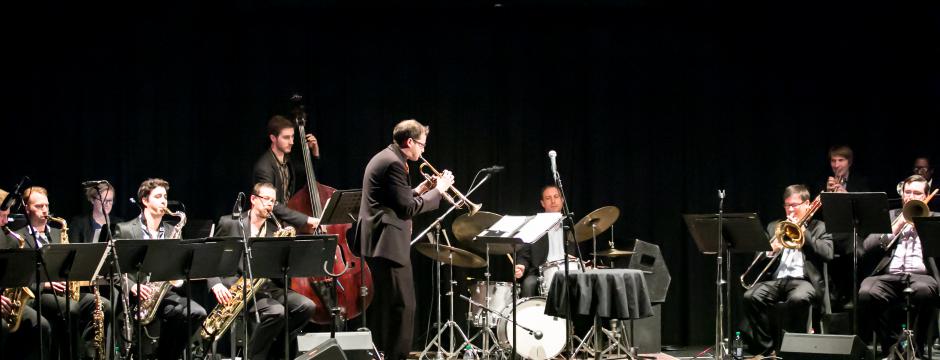
The album does cover a wide swath of musical territory. Promane (pictured left) contributes two original pieces. "The Icemaker's Mistress" suggests the music of Christine Jensen and Maria Schneider in its long melodic lines and sweeping arrangement. Pianist Jacob Thompson creates a lovely solo over the splendid brush work and bass counterpoint while trumpeter Brad Eaton flies over lush sounds from the sections. After the solos, the piece opens up for a short interaction with the rhythm section and Ms. Teh plus a call-and-response from the sections. The director also contributed the title track, another "open" piece, that features a flowing melody and strong solos from Harrison Argatoff and flugelhornist Emily Denison. The ensemble swings mightily on Promane's arrangement of "Witchcraft", the drummer leading the way while tenor saxophonists Kieran Murphy and Harrison Argatoff share the main melody and the solos. UofT graduate Noam Lemish contributes "Song for Lia" (he also plays piano on the piece), a song that has a Brazilian feel in its rhythmic flow, a lovely melody that rises and falls with various voices moving in and out in the style of Maria Schneider, and smart solos from Anthony Argatoff and Pitt.
The album closes with "Hat Music", composed by Swedish saxophonist Nils Berg (for his quartet The Stoner) and arranged here by trumpeter Denison. She captures the playfulness of the original, especially the bounce in the bass line and the rapid-fire exclamations from the drums. The full ensemble plays at the beginning of the song, drops out for Harrison Argatoff's tenor solo and returns in the middle of pianist Thompson's excellent solo (which opens with just the accompaniment of bassist Lakusta).
What stands out when listening to "Trillium Falls" is that The University of Toronto 12TET, this small "big" band, is not only talented and full of promise but also willing to experiment and follow the vision of director Terry Promane. While jazz has moved out of clubs and mentorship has changed from learning on the bandstand to classrooms, there is often critical reaction that "institutionalizing" the music has made it stale. You certainly do not hear that on these recordings - there is life, joy, experimentation, and community, all necessary elements to move music forward.
Personnel: Jacqueline Teh – Vocals Emily Denison – Trumpet/Flugelhorn/arrangement Brad Eaton – Trumpet/Flugelhorn Anthony Argatoff – Alto Saxophone Harrison Argatoff – Tenor Saxophone Kieran Murphy – Tenor Saxophone Modibo Keita – Trombone Zach Smith – Trombone Dan Pitt – Guitar Jacob Thompson – Piano Alex Lakusta – Bass, arrangements Mike Rajna – Drums, arrangement Noam Lemish – Piano, arrangement ("Song for Lia") + Terry Promane– Director, compositions, arrangements

 Posts