Showing posts with label 11-piece Band. Show all posts

Monday, May 30, 2016

Large Ensemble Music Spring '16 (Part II)

Los Guachos has been composer, pianist, and arranger Guillermo Klein's main vehicle of musical expression for over two decades. He started a big band in New York City after graduating from Berklee College of Music in Boston but soon scaled that down to 11 pieces. The personnel has stayed fairly constant over the past 15 years; the reed section consists of Bill McHenry (tenor saxophone), Chris Cheek (soprano, tenor, and baritone saxes), and Miguel Zenon (alto sax) while Diego Urcola (trumpet, trombone), Taylor Haskins (trumpet, flugelhorn), Sandro Tomasi (trombone), and Richard Nant (percussion, trumpet) make up the brass section.  Ben Monder (guitar), Klein (piano), Fernando Huergo (electric bass), and Jeff Ballard (drums) are the rhythm section (with Nant).

"V" is Klein's eighth recording for Sunnyside Records (6th as leader) and is comprised of two suites plus two more songs.  The program opens with the three-part "Suite Indiana" which combines two original compositions and a fascinating rearrangement of Miles Davis's "Donna Lee."  The latter tune, made famous by Charlie Parker, has its melody spread among the brass and reeds and broken into rhythmic fragments.  That track is bookended by "Back Home Again" (with a melody line and arrangement reminiscent of Steve Reich) and "Patria Espiral" which expands upon the two previous melodies and rhythmic patterns.

The centerpiece of the album is the 34+ minute, seven-part, "Suite Jazmin." The music displays the versatility of the ensemble right from the opening seconds of "Symmetry I" as the composer spreads the melody lines throughout the band, from the versatile bassist Huergo to the reeds while Ballard moves from a martial beat to a modified swing.  "Si No Sabes 4/4" has a lilting melody plus a raucous solo from Monder and is immediately followed by "Si No Sabes 9/8" which takes the melody down a much different path inspired by the sensuous rhythms. "Burrito Hill Mirror" follows, its spiky rhythm created by the opening interactions of guitar and piano (mirroring each other) yet the handsome melody flows easily over the halting percussion (Nant and Ballard mirroring as well) whereas the following track, "Human Feel Mirror" is more upbeat, it's circular melodic fragments creating a percussive feel from the entire ensemble.  "Jazmin" is a lovely ballad with a striking melody line (played by Zenon and Cheek on soprano and echoed by the muted trumpets), lovely harmonies, and a fine solo from Cheek.  "Symmetry II (Si No Sabes Que No Sabes)" is a quiet reiteration of the beginning of the "Suite" as well as a charming close.

The album closes with "Ashes" (an Andrew Hill piece composed for the album "The Invisible Hand" that he recorded with Greg Osby and Jim Hall) and "Quemando Velas" (Burning Candles).  Both are ballads, the Hill composition retaining the spare quality of its original, a striking melody for flugelhorn with Klein's arrangement built right off the melody.  The latter piece begins immediately after the previous song, the melody carried by the alto and tenor saxophones but notice the echoes behind the front lines as well as Monder's shimmering accompaniment. The melody shifts to the brass, quietly pushed forward by percussion.  The delicacy of the music is matched by the emotional content, there's a feeling of peace and contentment as the song slowly concludes.

"V" is a work that demands your attention and rewards the listener many times over.  Like the previous recordings of Los Guachos, the seamless blend of melody with harmony, the way the Argentinean rhythms permeate so much of the music as well as the impressive ensemble arrangements, all those factors and more illustrate the artistry of Guillermo Klein.  Highly recommended!

For more information and to sample the album, go to sunnysidezone.com/album/los-guachos-v.

Composer, arranger, pianist and educator Andy Jaffe has had a career that spans over four decades and, like many people involved in the jazz world, much of that time has been spent in academia. He has taught at many universities and colleges in the Northeast but mostly at Williams College for the past 29 years.  Jaffe has co-led a large ensemble with trombonist and educator Bill Lowe (writer's note: Mr. Lowe's Jazz class was the first course I took at Wesleyan University on the road to my Master's Degree and, for a music reviewer, far from a "gut course") that, with the exception of two CDs, remains woefully under-recorded.

His new CD, "Andy Jaffe Nonet + 4: Arc" (Playscape Recordings) looks backwards even as it moves forward.  The impetus for the program came from a semester that he spent teaching and performing in Taiwan.  Played by an impressive ensemble that includes the reed section of Kris Allen (alto saxophone), Jimmy Greene (tenor and soprano saxes), Bruce Williamson (bass clarinet, soprano sax), and Tom Olin (tenor, soprano, and baritone saxes) plus the unorthodox brass section of Wallace Roney (trumpet) and John Clark (French horn). Besides the leader on piano and all arrangements, the rhythm section consists of his son Marty Jaffe (bass) and Jonathan Barber (drums).   The "4" alluded to in the album title is the Interesting Quartet from Taiwan composed of Wei-jun Hwang (first violin), Wei-hsin Liu (second violin), Chiee Yeh (viola) and Jiro Yeh (cello) who appear on four of the nine cuts.

The program features five new pieces, three composed in the 1980s and a forceful yet gracious performance of the spiritual "Go Down Moses" arranged for saxophone quartet.  On the spiritual, Williamson leads the way on soprano while the others reeds dance and weave below him (which may remind some of Julius Hemphill's arrangements for the World Saxophone Quartet).  Greene and Allen take short but powerful solos; still, the ensemble arrangement truly shines.  Of the "older pieces, two were composed for Max Roach's Double Quartet (which included the Unknown String Quartet).  Jaffe considered the great drummer/educator as a mentor and these powerful pieces, "Steve Biko" and "Theme for the New 60s" pay tribute to how Mr. Roach knew that his music needed to reflect the political issues facing the world.  The latter piece swings with a vengeance with strong solos from Roney, Allen, the leader and Barber.  "...Biko" also has excellent solo work (especially the fiery exchange between Williamson's bass clarinet and Clark's French horn but it's the powerful melody that stands out and how Jaffe's arrangement uses the strings to echo the melody, supply harmony as well as serve as counterpoint.

The album includes two lovely ballads, "In Case This Is Goodbye" and "Now Then", both new works.  The title of the former gives the piece its emotional foundation, the melody, colored by the strings and the deep sounds of the bass clarinet, its heart, and the soloists its true expression.  Allen's alto rises high above the rhythm section whereas the strings accompany the excellent soprano solo. Clark's solo is so understated but powerful while Marty Jaffe's bowed solo is pleasingly melodic. The strings return for the piano solo with an arrangement that leads back to the opening theme.  The album's final track, "Now Then", is lovely with fine percussion from Barber, sweet underpinning from the bass clarinet and other reeds while the French horn plays the theme and has the first solo.

Roney shines as a member of the ensemble plus his expressive set as a soloist. He fires on all cylinders on the highly-swinging "Brainworm" (Barber is the driving force here) and during a lengthy solo on "Fleurette Chinoise" (Greene's soprano solo on this track is wonderfully playful). Roney's muted solo and ensemble playing on the title track also stands out.

"Arc" is a collection of pieces that contain so many delightful elements, from melodies that sing in one's ears to arrangements that fill out the sound without cluttering the aural landscape to solos, many of them short, that are creative and direct.  Andy Jaffe Nonet + 4 is a long-awaited gem from this classy composer, arranger, and first-class pianist.

For more information, go to andyjaffe.com.

Wednesday, December 25, 2013

Little Big Bands & Bright Moments + Gift From Paris

When I first discovered the recordings of drummer Shelly Manne, the scope and breadth of the music was quite impressive. Tucked away in his discography on Contemporary Records with his group, "The Men", is "Volume 6" featuring an expanded group (10 musicians) performing "Concerto for Clarinet and Combo." Composed by clarinetist Bill Smith, the music mines the rich veins of jazz, blues and classical music.  Smith, born in Sacramento, California, in 1926, studied at Mills College, University of California/Berkeley and the Juilliard School, has spent much of career teaching at the University of Washington but did perform and record with pianist Dave Brubeck off and on for several decades.

Clarinetist/composer Mike McGinnis (The Four Bags, OK|OK) first learned about Smith's "Concerto.." from WNYC-FM host and composer David Garland.  McGinnis visited Smith in Seattle and sowed the seeds that has resulted in "Road*Trip" (RKM Music), the debut CD by Mike McGinnis + 9. With an ensemble that features Jeff Hermanson (trumpet), Justin Mullens (french horn), Brian Drye (trombone), Matt Blostein (alto saxophone), Peter Hess (tenor saxophone), Barry Saunders (baritone saxophone) plus the rhythm section of Jacob Sacks (piano), Dan Fabricatore (bass) and Vinnie Sperrazza (drums), McGinnis illustrates how the 3-part "Concerto" does seamlessly evoke the "big band sound" that the composer grew up idolizing but also how an intelligent arranger could create a piece that so wonderfully blends the excitement of a strong soloist with ensemble parts that truly move the music forward.

To make his discovery of Smith's music come full circle, McGinnis composed "Road*Trip For Clarinet & 9 Players" - in the liner notes, the composer notes the influence of Smith's composition as well as his work with Anthony Braxon on his visionary "Trillium E" opera. One can hear how McGinnis's work updates the ideas behind the "Concerto", how it gives more space and importance to the rhythm section (Sperrazza's work is exemplary) and this composer's voicings make the band musch larger than 10 pieces.

The best way to listen to "Road*Trip" is to first concentrate on the fascinating arrangements, then the rhythm section and finally to revel in the luxurious solo work of Mike McGinnis.  As a closing treat, "Road*Trip III: Up and Out" features short solos by the entire ensemble plus a brilliant call-and-response for clarinet and 9 players.  It's a wonderful way to complete a "wonder-filled" trip!  For more information, go to www.mikemcginnis.com.

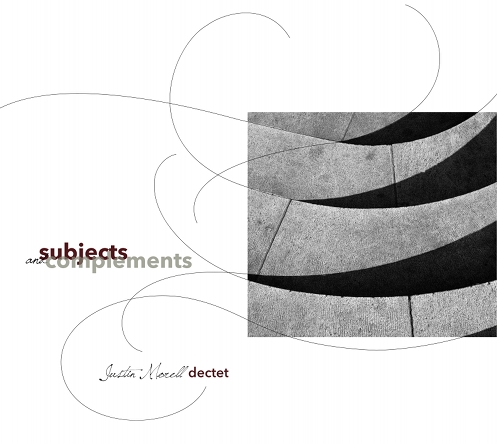
Composer/guitarist/arranger Justin Morell also creates a fusion between classical forms and jazz ensemble on his new recording "Subjects and Complements" (Sonic Frenzy"). Credited to the Justin Morell Dectet, the majority of the pieces feature Bob Sheppard (alto and soprano saxophones), Ben Wendel (tenor saxophone, bassoon), Phil O'Connor (bass clarinet, tenor and soprano saxophone), John Daversa (trumpet, flugelhorn), Alan Ferber (trombone), George Thatcher (bass trombone), Leonard Thompson (piano), Damian Erskine (electric bass) and Mark Ferber (drums) - tenor saxophonist Matt Otto is featured on 5 tracks, standing in for either Wendel or O'Connor.

The 12-song program opens with the longest track (nearly 11 minutes), "Noun Ember", a finely constructed piece that has well-defined sections, an active arrangement and several smart solos.  Morell follows that expansive work with the first of 5 fugues that are spread across the program. "Fugue in B, in three voices"; this uncluttered work truly illustrates what a fugue is, in many ways related to the call-and-response of blues and jazz but with the added element of a third "voice" playing "counterpoint" to the original melody (read a good definition here).  Morell's "Fugue in B-flat, in three voices" is set to an infectious and often beat while "Fugue in E-flat, in five voices" opens with Mark Ferber's drums as the first "voice" and the rest of the instruments build from his part. "Fugue in E, in three voices" has the feel of progressive rock while "Fugue in C, in 3 voices" reminds this listener of a work by Erik Satie with its gentle melody lines.

Other highlights include the sweet blues/pop feel of "O", Morell's handsome guitar leading the way.  "The Straight Man" has a melody line reminiscent of "With a Little Help From My Friends" but has its roots firmly in the blues.  The sauntering rhythms support short yet sparkling solos from Wendel and Sheppard but the composer takes his time getting there, allowing for a long introduction and smart counterpoint.  The electric bass work of Damian Erskine (the nephew of drummer Peter Erskine) is exemplary throughout; whether he's holding down the bottom or playing counterpoint, his warm tones and rich melodic phrases are a delight. Having Ferber as a partner allows plenty of room move about as the drummer is ever-so-solid. There's a touch of Bob Brookmeyer in the melody and arrangement of "Sun Subtle"; one can hear in the "open spaces" of the horn voicings and the loping rhythm section (excellent piano work from Thompson.)

"Subjects and Complements" was issued in November of this year and the music has posited itself in my ears ever since.  The subtlety of the arrangements, the mature melodies, and the seemingly ego-less playing of the Dectet make this a joyous listen.  Justin Morell is a voice and musician who gives one much for the future of creative music and this CD is well worth exploring time and again.  For more information, go to justinmorell.com.


Received a complimentary note plus CD from Paris-based composer/ vocalist Loïs Le Van, "The Other Side" (Hevhetia) a few weeks after Thanksgiving. Turns out M. Levan is an up-and-coming star on the European jazz scene, a vocalist who has studied with Roger Letson and David Linx, taken "Master Classes" with people such as Kurt Elling and saxophonist Mark Turner, and won the 2012 "Voicingers" contest held in Poland.  Levan is a member of the a cappella sextet Ego-System, leads duos with guitarist Aliocha Thevenet and pianist Sandrine Marchetti plus sings with Belgian jazz/rock group Canopee.  

"The Other Side" is his debut as a leader, fronting a Sextet that features Ms. Marchetti, Thomas Mayade (trumpet, flugelhorn), Manu Domergue (mellophone, french horn) and the splendid rhythm section of Leila Renault (double bass) and Roland Merlinc (drums). Levan composed 8 of the 11 tracks, all but 1 set to the lyrics of poet/songwriter Francois Vaiana.  The remaining songs "Old and Wise" (originally recorded in 1982 by the Alan Parsons Project) plus Tord Gustavsen's "Home" and Wayne Shorter's "Ana Maria", both with lyrics by Vaiana.  M. Levan sings in English throughout and there is a vulnerability when he inhabits the lyrics of "Prophets and Sons" - "One day I'll have a son and he will be the unknown soldier,/ that's what the elder said,/he'll be forgotten" shadowed by Ms. Marchetti's piano and the quiet bass of Ms. Renault.  A long unaccompanied piano solo leads the listener into "Happenings Before Dawn", its impressionistic lyrics painting a picture of restless youth wandering the streets.  There's a palpable shock when the sextet enters for the bridge.  M. Merlinc's active percussion dances below the band then pushes and pokes at the brass during the short solo introduction to the title track.  One hears the influence of Kenny Wheeler coursing through a number of the pieces (and not just during the times when the horns are playing.)  Laura Karst's lyrics for "Venture" retell the Greek myth of Daedalus and his son Icarus make their escape by attempting to fly away above their captors. (Ms. Karst must have been introduced to M. Levan by Roger Letson, as they both were his students in California.)  Here, the floating feel of the chords and impressive flugelhorn solo is an excellent match for the vocal (meanwhile, the drums are exploding like fireworks beneath.)

The CD closes with "Are We The Unknown (Ana Maria)", opening with mesmerizing piano and lyrical french horn, before the vocal enters. The beautiful melody, composed by Mr. Shorter for his "Native Dancer" Lp", here retains its Brazilian roots but M. Vaiana's lyrics and Ms. Marchetti's arrangement inject a touch of melancholy.  

"The Other Side" serves as a fine introduction to the work and generous spirit of Loïs Le Van.  While the CD is not scheduled for release until well into 2014, be on the lookout for it as, hopefully, you'll be as moved by the music the way that I am.  To find out more, go to www.loislevan.com/english/