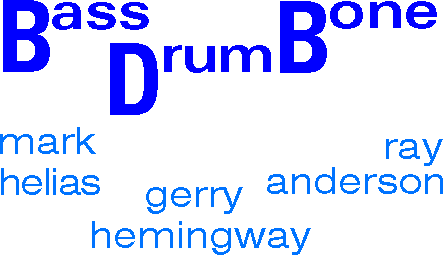
For the last four decades, these smiling gentlemen on the left - Mark Helias (bass), Gerry Hemingway (drums, percussion), and Ray Anderson (trombone) - have been touring this country, Europe, and beyond in an ensemble they smartly titled BassDrumBone. Over that time, they have released 10 Lps and/or CDs, each led his own group, took time off for illness, toured and/or recorded with other people/groups yet always came back to this trio configuration. Methinks that is because not only do they sound good playing together, they enjoy playing together.
Connecticut fans get a rare opportunity this week to see BDB twice in the midst of its 40th Anniversary Tour. Friday evening, Messrs. Helias, Hemingway, and Anderson return to Firehouse 12, 45 Crown Street in New Haven to play two sets. The trio last played the venue in May of 2008 - I was there and can assure you they "rocked the house." There's a strong steak of blues that runs through their music as well as ties to the avant-garde, to the "free" sounds of the late 1960s and '70s, to straight-ahead "blowing", to funk, and to the New Orleans roots of jazz. The band's most recent recording, 2016's "The Long Road" (Auricle Records), kicked off the group's Anniversary celebration: it's a 2-CD set with guest appearances from Joe Lovano (tenor sax) and Jason Moran (piano). It's a wonderful blend of original tunes by all three members of the group and closes with two live tracks from 2013
The New Haven show is the final one of the Firehouse 12 Spring 2017 Concert Series and is a perfect way to kick off the two-week long International Festival of Arts & Ideas (thought the series is not connected to IFA&I, BassDrumBone epitomizes the adventurous scope of the programs to over over the course of the Festival). The first set begins at 8:30 p.m. For more information about Friday's gig, call 203-785-0468 of go to firehouse12.com.
On Saturday, the trio ventures north on Route 91 to Hartford to play a concert at Real Art Ways, 56 Arbor Street. The event is free and open to the public. For more information, go to www.realartways.org or call 860-232-1006.
Mark Helias is also a member of Canadian-born saxophonist and composer Quinsin Nachoff's Ethereal Trio. Their self-titled debut album has just been issued on Whirlwind Recordings and is a joy to listen to. The bassist, who has led several trios over his long career, is the perfect fit for an ensemble of this size: he possesses a really powerful sound, is extremely melodic as well as percussive, is excellent at arco bass ("bowing"), and has a great sense of what his bandmates need from him. On this recording, he's paired in the rhythm section with drummer Dan Weiss who is also a fine accompanist with a strong sense of melody and forward motion. They provide Nachoff with such great support and counterpoint as well as a sense that he can play anything. And he gives them material to really dig into, not just rely on cliches but to truly explore the possibilities.
My personal touchstone for sax-bass-drums trios has always been Sonny Rollins's "Freedom Suite." One can hear a hint of the blueprint that 1958 recording created; still, this is definitely 2017 music. The funky beat Weiss produces on "Subliminal Circularity" has a hip hop feel but notice how the bass moves on his own around the beat while the tenor navigates in between the two "sonic" worlds. The opening track, "Clairvoyant Jest", might remind one of a groove that could be found on Dave Holland's "Conference of the Birds", the intelligent meshing of structure and freedom. That carries over to the second track, "Imagination Reconstruction" - here, the rhythm is more intense, the sound a bit more diffuse yet the piece does not boil over. Both the bassist and drummer take short solos that rise organically from the music.
The leader is no slouch. He, too, enjoys the freedom the open-ended music goes him, exploring so many different possibilities. Hear how he navigates the aptly-titled "Push-Pull Topology" with its odd-time meters, his melody actually hugging the beat while his solo dances along with Weiss's playful drums. The handsome ballad "Gravitas" is a lovely blend of tenor sax (played in a register not unlike Charles Lloyd and with a similar lightness), splendid brush work and cello-like tones from the bowed bass. This is dramatic music, the interactions displaying the trio's keen sense of listening to each other. That description is also apt for the final track, "Portrait in Sepia Tones" - Helias leads off the piece unaccompanied before Weiss tiptoes in (sounds like he's not holding sticks or brushes). After several minutes, the bass drops out for a moment for a statement from the drums before returning 25 seconds later to play counterpoint to the tenor melody (Nachoff sits out the first three minutes). Throughout the piece, Helias switches from bowed to plucked bass. At the six minute mark, the bassist fall into quite a walking bass line pursued by the drums and tenor - the frantic tempo and exciting interactions continue to close to the end of the 10 minute piece when they trio falls into a funky beat (like the afore-mentioned "Subliminal Circularity") to "dance" the piece to its close.
Quinsin Nachoff's Ethereal Trio has its exquisite moments but also many powerful moments as well. Messrs. Nachoff, Mark Helias, and Dan Weiss each contribute to the success of the music, each with an authoritative "voice" and an understanding how to make their interactions human and special.
Upon hearing of the death of Gregg Allman, I was transported back to the night I first heard The Allman Brothers Band in concert. Their first Lp had been released on Atco/Capricorn in late 1969 and they immediately went on tour supporting the J. Giels Band. Saw them at an old concert hall in Springfield, Massachusetts. When they hit the stage, there may have been 30 people in the audience but the ABB rocked as if the house was full. Gregg sat behind his Hammond B-3 organ, belting vocals, his brother Duane and Dickey Betts trading solos that roared through the auditorium while the rhythm section - drummers Jai Johanny Johanson and Butch Trucks plus bassist Berry Oakley - pounded away and played heart-thumping bass. I was covering the event for our campus newspaper so I got to go backstage to visit the band as the headliner was setting up. They were excited about how well the set went and that they were getting press coverage - they were fine Southern Gentlemen, offering my girlfriend and I beers. I talked about the Blues with Gregg for a few minutes, amazed that someone just 16 months older than me could sound a 60-year old bluesman. He laughed and pointed to the cigarette in his and try beer in his hand, stating that these were "two reasons I can shout." Got a minute to chat with a few others before they headed out to the tour bus - never did stay to hear the J Giels Band (though I did see them the following year).
After Duane died in 1971, I lost interest in the band (although I wore out the grooves on "Live at The Fillmore East"). Gregg carried on with the band until 1975, started a solo career that had its ups-and-downs (his 2011 collaboration with T-Bone Burnett, titled "Low Country Blues", is an excellent recording), rejoining the group in 1989, an ever-shifting lineup that lasted another 25 years.
Drummer Tiziano Tononi (pictured left) is one of the last people I expected to record a tribute to The Allman Brothers Band but his new album "Trouble No More...All Men Are Brothers" (Long Song Records) is a loud and loving tribute to the group with a focus on the earlier recordings mixed in with a pair of Dickey Betts songs and three originals. Tononi has assembled quite a group - what's interesting on first glance about Southbound is that there are no guitars or keyboards (save for Carmelo Massimo Torre who plays accordion) and the lead instruments are Emanuele Parrini (violin, viola) and Emanuele Passerini (tenor and soprano saxophones) plus Piero Bittolo Bon (alto sax, bass clarinet, flutes). The rhythm section features Joe Fonda (electric and acoustic bass) and Pacho (congas, bongos, and percussion). The majority of the tracks also feature the voice of Marta Riviglia, who has worked with all sorts of ensembles from symphony orchestra to jazz quartets to duos and more (and working a lot with electronics).
If all you know of Tiziano Tononi is the work he has done with tenor saxophonist Daniele Cavallanti (on albums dedicated to Ornette Coleman, Roland Kirk, and Don Cherry, among others with original works), this music will probably surprise you as well. The album opens with an explosive reading of "Whipping Post" which has such an exciting forward motion created by the bass and drums) - there's also a tumultuous soprano sax solo (the "reprise" shows up after the second track and is more diffuse). On tracks such as "It's Not My Cross to Bear", "Don't Want You No More", and Willie Cobb's "You Don't Love Me", it's a treat to hear the drummer lock in Fonda and play such high-energy blues (the latter song feature a smashing interchange between viola and accordion!) Bittolo Bon opens "...Cross to Bear" with a rip-roaring alto sax solo followed by Ms. Riviglia digging into the lyrics shadowed by Parrini hard-edged violin. Passserini's tenor plays a hardy solo in the middle before the bands quiets down for a delightful accordion spotlight. Listen to the ensemble rip through "Hot 'Lanta" featuring burning solos from Parrini, Passerini (soprano), and Bittolo Bon (bass clarinet) fired up by the blazing drums, congas, and the hard-edged bass playing.
Arguably the best track on the album is the Eastern-sounding take of "Midnight Rider" (video below), replete with droning accordion, lively bongos, urdu drums, double-tracked vocals, and haunting bass flute solo. The exotic sounds carry over to the drummer's original piece "For Berry O." but here it's just gongs, shaken percussion, cymbals, steel drums, accordion, congas, and drum set but no voice, strings, or reeds. Another original work in "Requiem For Skydog", a deep blues dedicated to Duane Allman that features solos from alto and tenor saxophones plus violin as well as impressive acoustic bass melodies.
Mr. Cavallanti shows up on a rousing take of King Curtis's "Soul Serenade" joined by the squalling soprano sax. The best part may be Cavallanti's unaccompanied coda, the only time the main melody of the song is played.
The only misstep (to me) is the final track, "You Don't Love Me (glorious ending)" with Ms. Riviglia riffing on the lyrics in a duet with herself while the band initially wails away. Everyone drops out but the vocalist and the leader, then the voice departs and it's just the drums taking the album to its conclusion. However, "Trouble No More...All Men Are Brothers" (subtitled "A Tribute to the Spiritual Unity of The Allman Brothers Band") is quite an exciting project. Starting with the powerful rhythms, adding Marta Riviglia's expressive vocals punctuated by the reeds, strings, and accordion, Tiziano Tononi and Southbound give their all to honor a band that has quite an effect on the United States and beyond.
This Saturday June 3, vocalist, lyricist, and composer Allegra Levy performs at 8 p.m. in the Polish National Home, 60 Charter Oak Avenue/Pulaski Plaza, in Hartford. The West Hartford native is celebrating the release of her second album, "Cities Between Us" (Steeplechase Records), a delightful album that finds the vocalist fronting a ensemble that features Kirk Knuffke (cornet), Stephen Riley (tenor saxophone), Carmen Staff (piano), Jay Anderson (bass) and Billy Drummond (drums).
I spoke with Ms. Levy around the time (late 2014) of the release of her Steeplechase debut. She was living and working in Hong Kong China. That nearly year-long residency was her "dues-paying" gig (she now lives in New York City) and one can hear in the songs she wrote for the new album. Her mentor at The New England Conservatory, where she studied before going overseas, was trumpeter John McNeil, who has worked with a number of fine musicians and vocalists - it's clear from the start that Ms. Levy knows what she wants from her musicians and herself, setting challenges such as writing lyrics to the songs by Duke Jordan ("Lullaby of the Orient") and Dexter Gordon ("Soy Califa") and deciding that the majority of the material are original pieces. Also, many of the songs stretch out so that not only are the melodies well-constructed but also the solos have time to develop. The lyrics speak of her separation from her friends, family, and lover and are extremely mature for someone who is but 27 years-old. Despite the sadness inherent in the much of her lyrics, the music has various moods ("Misery Makes the Music" is a pleasing tango while the delightful "Soy Califa" is a hard-bop delight).
Ms. Staaf will be on piano for the Hartford concert along with West Hartford native Tim Norton (bass) and former West Hartford residents Richie Barshay (drums) and Joel Frahm (tenor saxophone) both of whom graduated from Hall High School (as did Ms. Levy). It should be a delight to hear the vocalist working with Mr. Frahm as he is one of the best and sensitive accompanist a singer would ever want.
I was fourteen when I first became aware of The Beatles. In the Summer of 1963, Del Shannon (whose "Runaway" was a huge #1 in 1961) hit the lower end of the Pop charts in June with his rendition (basically note-for-note) of "From Me To You", the original version of which had been released a month earlier by Vee-Jay Records to little or no reaction. I was curious about the composers listed on the 45 r.p.m., a duo known Lennon-McCartney. The group's first appearance on American television took place on November 18, 1963 on NBC-TV's "Huntley-Brinkley Report" with a report by Edwin Newman. They showed up three days later on "CBS Evening News" but they soon were forgotten due to the assassination of President Kennedy not to reappear until January of 1964 on "The Jack Paar Show" in a report the late-night host had recorded several months earlier. Capitol Records has passed up releasing the early singles by the quartet but, at the end of 1963 knowing that the band was coming to the US the coming February, the label issued "I Want To Hold Your Hand" paired with "I Saw Her Standing There" - perhaps it was the shock of the Kennedy death and the need for something bright and different but the music caught on. The multiple appearances on "The Ed Sullivan Show", the concert tour, the screaming girls, the curious boys, whatever, by the end of 1964, the British has reconquered the Colonies and popular music was changed forever.
Fast forward three years. So much has changed in the popular music. "Scenes" from cities such as San Francisco, Los Angeles, Memphis, Chicago, and Detroit created music that jockeyed for the position on the airwaves with The Rolling Stones and The Who from England. The Beatles had stopped touring, tired of not being able to hear themselves and the lack of privacy. "Revolver" had been released in August of 1966, showing a band in transition, moving from "pop stars" to "artists", experimenting in the studio with new sounds and approaches was well as outside with drugs. By early 1967, the band was being pressured to create a follow-up but they seemed to be in no hurry. In February, The Beatles released "Strawberry Fields Forever" and "Penny Lane" as a "Double A-side" single. Many of their early fans were put off by Lennon's experimentation on the first track while others embraced the snappy McCartney tune.
Here are the official videos for the two tracks, among the first of the "serious" music videos:
Word leaked out through the "pop music" press (especially the British papers "Melody Maker" and "New Music Express") that the band was creating more new work, their most experimental to date (not that the songs above were slouches in the experimental category).
On June 2, 1967, the album, titled "Sgt. Pepper's Lonely Hearts Club Band" was issued to great reviews save for Richard Goldstein (and a few others) in the New York Times (read morehere). But my friends and I were intrigued on initial lesson. They loved the drug references and the "weird" sounds; I was the only one who loved the George Harrison song "Within You, Without You" as well as the vaudevillian "When I'm Sixty-Four." Even though I was about to enter my second year of college, I was not "into" the growing drug culture. I was "into the music." No need for marijuana or LSD when sitting between my speakers on the floor. I was told that the drugs would really help me to focus on the sounds hidden to the "regular" mind. Truth to be told, drugs scared me. I had seen the effects of a "bad trip", watched people get so wrapped up in being "wasted" that they got lost. Many of them recovered, some of them never had issues with bad reactions; but, try to be one of the only people at at a party that does not partake when the joint is being passed or the cocaine is laid out in lines. But, that is another story.
rollingstone.com
"Sgt. Pepper" is not my favorite Beatles album (it's a toss-up between the afore-mentioned "Revolver" and its predecessor "Rubber Soul") but I still enjoy much of it. The Beatles were never the same afterwards although there were great songs produced in the years before finally splitting in 1970. As a cultural artifact, the 1967 album lost its power in the maelstrom of the Vietnam war, American ghettoes burning, and the fact that "peace and love" did not take over the world. The music on the album is good if a bit "twee" at times but the world need more reality than surreality, more soul and less soul-searching. Yet, music changes all the time and people love nostalgia. For people like me who loved - and still loves - to explore where music can take me, can take an audience when artists are willing to take chances, The Beatles remain an important part of my life's soundtrack.
Music has always had the power to move me out of the doldrums, to lift my spirits especially when musicians take chances, ask hard questions, go beyond the cliche or just soothe the anger caused by an increasingly (my opinion) uncaring world. Now I know there are good, caring people everywhere and, though our political views may be miles apart, can still carry on conversations without resorting to name-calling and/or "hate speech." But, what passes for public demeanor nowadays surprises and saddens me. Whether one believes in global warming/climate change or not, to hear that the United States is pulling out of the Paris Climate Accord shows short-sightedness of the highest order (my opinion), a lack of vision for a better future for our nation and the rest of the world. To see an entertainer holding up a severed head in the name of political satire crosses the boundary of good taste - no matter what you feel about the President, he commands the respect of the office (despite the subject matter of his numerous "tweets").
Still, I am not in a position to whine, I'm neither a Congressman nor a lobbyist. I write about music, believing to my soul that music does have the power to change the world or to, at least, inform us of issues that we keep ignoring (or keep choosing to ignore).
For his third album as a leader, pianist, synthesist, composer, and conceptualist Fabian Almazan has composed an hour-long suite for eight musicians, an ensemble he has dubbed Rhizome. He has worked extensively with these people, his friends. They include Camila Meza (guitar, vocals), Linda Oh (bass), Henry Cole (drums) plus a string quartet that is composed of violinists Tomoko Omura and Megan Gould (who was not present on 2014's Blue Note/Artists Share album titled "Rhizome" as she was giving birth at the time of the sessions), violist Karen Waltuch, and cellist Noah Hoffield.
"Alcanza" (Spanish for "reach") is available on Almazan's Biophilia label and only as a digital download. However the album package is a sight to behold. It includes a code to download the music from the label's Bandcamp page and is a 20-panel work of origami that opens to reveal portraits of the ensemble, the lyrics, the artist's message, and more. The program is divided into the nine-part "AlcanzaSuite"and three interludes that individually put the spotlight on the pianist, Ms. Oh, and Mr. Cole.
If you take the time to speak to Fabian Almazan, you'll find an earnest, thoughtful, and well-informed person. You hear all that in his music, in the stories that four tracks of the "Suite" tell, of the composer's search for answers to the issues that have plagued and puzzled mankind throughout his/her existence, especially homelessness caused by war, occupation, and famine. Sounds frightfully serious (and it is) but Ms. Meza's sparkling vocals help the listener navigate the message. And the music calls upon influences from 19th and 20th Century classical music, from the Cuban and Afro-Cuban the composer heard growing up in Cuba and, later, Miami, from the Black composers of the 1960s and 70s, even "heavy metal." You must listen to the entire program each time you enter the music (in fact, the download comes with 12 separate tracks plus the entire program without any breaks).
Now, go listen. Check out the brilliant drumming of Cole (a long-time member of the Miguel Zenon Quartet), the wonderfully melodic work of Ms. Oh, the fascinating string arrangements which are an organic part of the music (and not tacked on for color), and the wonderful and wonder-filled piano. There is not one stand-out track but 12! Whether it's the rapid-fire opening of "I: Vida Absurda Y Bella" or the whisper-soft strings on "III: Verla" or Ms. Meza's lovely and soulful vocal on "IV: Mas" or the intelligent interaction of synthesizers, voice, strings, and active rhythm section on "VII: Pater Familias" (not to forget how memorable the melody is), or the psychedelic feel of the final movement ("IX: Marea Alta", which may remind some of Peter Townsend's arrangement of "Love Reign O'er Me" from "Quadrophenia"), the landscapes created on "Alcanza" are unforgettable.
Yes, I believe this is a necessary, rewarding, and highly enjoyable listening experience. The music will challenge you even as it soothes. Fabian Almazan cares deeply about the survival of the human race, believing the human race is all connected no matter our religion, politics, gender, color, or language. Music is his vehicle and we are the better for his choice.
"Find the Common, Shine a Light" is a call to action, one that reverberates throughout the new Greenleaf recording of the same name by Ryan Keberle & Catharsis, the band's fourth for the label and third to feature the lineup of Michael Rodriguez (trumpet), Jorge Roeder (acoustic and electric basses, bass FX), Eric Doob (drums), Camila Meza (voice, guitar, guitar FX), and Mr. Keberle (trombone, Fender Rhodes, melodica, vocals). The album comes 15 months after "Azul Infinito", a recording that paid tribute to the various Latin and Central American bands the leader played with after moving to New York City from Spokane, Washington where he grew up (although was born in Bloomington, Indiana).
The new album, recorded a week before Inauguration Day in the United States, is certainly a reaction to the pronouncements of the Trump campaign and the comments after Election Day. The opening track, "Become The Water" is part of the refrain from where the album's title comes from; composed by Keberle with lyrics from Mantsa Miro, the song asks questions such as "Why don’t we fight
for greater common?
Are we not here to elevate us all?"and "Why do we let our fear be greater than our greatness?
In times of fear, compassion
is an orphan." Urging the listener to be awake and aware of the changes and challenges, the refrain dances through the brain like an earworm. Yet, listen to smart arrangement of the brass, the use of Fender Rhodes mesmerizes as the voice soothes and trumpet calls us to pay attention.
Listen to how Bob Dylan's "The Times They Are A-Changein'" (written in the months after President Kennedy was assassinated, the Civil Rights Act was passed, the Vietnam War was escalating, and the Free Speech Movement was starting on college campuses) sounds as if it could have been written last month. Jorge Drexler's Academy Award-winning composition from "The Motorcycle Diaries" (2004) "Al Otro Lado Del Rio" (On the Other Side of the River) addresses a person looking for "a light" because "In this edge of the world /What is not taken is up for grabs." One can argue about who Paul McCartney was referring when he wrote the lyrics to "The Fool on the Hill" but one could argue that, in a number of Williams Shakespeare's plays, The Fool was the one who could get away with telling the hard truths. The final cut on the album, "I Am A Stranger", composed by Vito Aiuto and recorded by his group The Welcome Wagon features the verse "Tis seldom I can ever see/ Myself as I would wish to be; What I desire I can't attain/ From what I hate, I can't refrain." This call for introspection and empathy in troubled time closes with the mantra "Everything's alright, yes" but that can be a question as a plea.
Ms. Meza's wordless vocals on "Ancient Theory" dance along with her guitar lines - she did not play guitar on the other recordings with the band yet listen to how she moves aside as the melodica moves out in front on "...Theory" framing Roeder's electric bass solo. Pay attention to strong trumpet work of Rodriguez and how he blends so well with the leader's hardy 'bone work. Door and Roeder are powerhouses throughout driving the music even as they support the soloists and the melodies. Notice the extra voices on several pieces, creating a chorus in support of both Ms. Meza and the band. As easy it is to focus on the lyrical aspect of this program, do not neglect the music. This is a "working band" and they speak as "one." "Find the Common, Shine a Light" comes out on June 16 and can be ordered on Amazon, iTunes, and from the ensemble's Bandcamp page through Greenleaf Music (go to ryankeberlecatharsis.bandcamp.com/album/find-the-common-shine-a-light). Ryan Keberle & Catharsis ask us to be diligent in the face of tyranny, to be intelligent in the face of belligerence, and to be united in these contentious times. While you're at it, see and hear this group live as they have developed into one of the more impressive ensembles in contemporary music. For more information, go to ryankeberle.com. Here's the song that opens the album:
"Jazz Up Close", the series that pianist, composer, and educator Noah Baerman has produced at The Russell Library, 123 Broad Street in Middletown over the past several years, continues on Thursday June 1 with guests Meg Okura (violin) and Sam Newsome (soprano) joining Mr. Baerman, bassist Henry Lugo, and drummer Paul Wells. Over the past two decades, Ms. Okura has been busy playing in multiple ensembles and multiple genres, from composing string quartets to performing with Cirque du Soleil to being a featured soloist with artists such as Dianne Reeves and Lee Konitz. She's also the leader of the Pan Asian Jazz Ensemble (an ensemble with 2 CDs released so far), a Trio, and the J Orchestra, a big band dedicated to playing the music of Japanese and Jewish composers (the latter two ensembles have yet to record).
Mr. Newsome first came to critical in the late 1980s when he joined trumpeter and compose Terence Blanchard's group. He went off on his own in 1995 and also decided to concentrate on soprano saxophone. Mr. Newsome is now considered one of the masters of the instrument. His solo concerts and recordings are brilliant, each in their own right. His breath control, intelligent use of amplification and prepared saxophone, plus the various ways he employs the saxophone keys, stand out. Since 2007, he has released six CDs of solo performances with performances that are as musical as they are challenging, amazing and earthy music that defies labels. Sam Newsome is also a fine blogger; on his "Soprano Sax Talk", he writes about many aspects of his chosen instrument and some of the people who play it. Go to sopranosaxtalk.blogspot.com to check it out.
If you have attended these events in the past, you know the host leaves time inside the concert and after for the audience to ask questions of the artists. In that way (and others), Mr. Baerman does much to demystify the music, making it accessible to those who shy away from what they consider a challenge.
The concert takes place at 7 p.m. in the Hubbard Room. Best of all, the event is free and open to the public. For more information, go to www.russelllibrary.org.
Here's a taste of Ms. Okura's wonderful violin work:
Here's Sam Newsome from his 2014 album, "The Straight Horn of Africa":
Leo Sidran has a great, informative podcast called "The Third Story"; he recently ran a delightful interview with trombonist, composer, and bandleader Ryan Keberle. Among the many points made in the discussion was that (and I am paraphrasing Keberle here) the trombone is enjoying new-found popularity, especially with trombonists (such as him) leading their own groups and not just big bands. Below are reviews of three new recordings that prove his point.
When trombonist and composer Nick Finzer entered the studio to record his third album as a leader, the United States was embroiled in a contentious Presidential election, a time when the country was facing serious choices about its mission and future. The album, "Hear & Now" (Outside In Music), is a musical reaction to those events and the malaise that the composer saw spreading over the country. Pieces such as "We The People", "The Silent One", "Race To The Botton", and "Dance of Persistence" display Finzer's concerns as does the urgency of the musical performances. The power in the music comes as much from those song titles, much the way Charles Mingus provoked his audiences, forcing us to think of the conditions all around.
The sextet for the session includes Lucas Pino (tenor saxophone, bass clarinet), Alex Wintz (guitar), and Glenn Zaleski (piano) plus the powerful rhythm section of Dave Baron (bass) and Jimmy Macbride (drums). The blend of trombone and reeds makes for an excellent contrast on pieces such as "Again and Again" where the bass clarinet plays the harmony behind the melody while the rhythm section simmers underneath, the piano serving as a go-between. Wintz's guitar rises up for the first solo, slowly the intensity rises, reminiscent of Herbie Hancock's music on his Blue Note recordings "Speak Like a Child" and "The Prisoner." Then Finzer and Pino solo together, pushing the piece forward before stepping aside for Macbride's short, powerful solo. Subtle overdubbing creates a reed and brass choir at the onset of Duke Ellington's "Single Petal of a Rose" (the only non-original piece in the program); it's quite beautiful and leads into the emotional piano solo over the whisper-soft bass and drums. Zaleski's solo opening on the final track, "Love Wins", introduces the poetic ballad. Pino's swirling bass clarinet and Wintz's impressionist chords frame Finzer's handsome melody as Baron's spare bass notes serves as the foundation while Macbride dances over his cymbals and drum kit.
The blend of power and gentleness, of reeds, strings, and piano atop an exemplary rhythm section makes "Hear & Now" stand out. One can not ignore the agenda Nick Finzer has on this album, showing how music can reflect the times, how jazz has always been and remains protest music, how the stance of the musicians can call the audience to action, and how much we need to be pro-active in these days of "reaction without reflection." The musicians are not revolutionary in the way that the late Fred Ho and the late Charlie Haden were but this music fights against complacency and blanket acceptance, calling for "presence, vision, passion, inspiration, reflection, dialogue, evolution, action, and change", the words printed on the inner sleeve of the album. Pay attention!
Glenn Zaleski also shows up on the new release from trombonist, trumpeter, and composer Nick Vayenas. "Flow Motion" (self-released) is Vayenas's fourth album as a leader (since 2008) - he's such a busy sideman, working with Michael Bublé, Josh Groban, Lady Antebellum, Patrick Cornelius, and Kendrick Scott (on whose label he released his debut CD, "Synesthesia." Besides Zaleski, the sextet on the recording includes Dayna Stephens (tenor saxophone), Peter Slavov (bass), Colin Stranahan (drums), and the afore-mentioned Cornelius (alto saxophone).
photo by Angela Sowon Vayenas
Although there is a track titled "Anarchy", the majority of the material seems to have no political agenda. That particular track swings with a vengeance, featuring strong solos from the alto saxophonist, the leader, and Stranahan. Zaleski's work in the background is notable for its strength and subtlety, which is true throughout the entire program. In fact, it's his short but rich chordal work that leads off the title track that leads off the album. The song swings with a gentle yet firm rhythm - Vayenas plays in a buttery style, quite melodic, setting the tone for Stephen's handsome solo and the pianist's earthy explorations. The rhythm section moves the music forward in a playful manner, especially the drummer whose accents are a delight.
Vayenas switches to trumpet for "Premonition", sharing the melody with the tenor sax. The piano chords, at times, suggest McCoy Tyner but, like the opening track, there is a gentleness to the proceedings. The leader's tone on trumpet is clear, his notes crisp, and his attack adds intensity to the track. The influence of Herbie Hancock is evident on "The Final Frontier"; again, the trumpet takes the lead and Vayenas's bluesy solo spurs the rhythm section to react with stops-and-starts as well as keeping the flow moving.
Another highlight is "Velvet Mystery", a handsome ballad whose melody is carried by the mellow trombone and breathy tenor sax. Zaleski creates an impressionistic opening solo that opens up to Vayenas's heart-felt improvisation - he's "writing a story", inviting the listener to get lost along the way to come out on a reiteration of the main melody that's now has a quiet intensity, not so much as a mystery. The final track, "Change", is also a ballad with only trombone and piano. The opening features Vayenas on melody and Zaleski on counterpoint with the pianist taking the first solo. Various melodic fragments show up before the trombone reenters. His "singing" lines over the chordal accompaniment intimate a "classic" ballad and serves as a lovely closing to the album.
"Flow Motion" is an album to get lost in. The program never forces its way into your brain yet invites you to relax, settle down - even the funky "Red Stripe" has a good natured gentility. The music Nick Vayenas and crew creates on the album is truly for early morning reveries and late-night meditations.
"Tight Rope", a funky, hard-edged, tune opens "Presence" (See Tao Recordings), the fourth recording from trombonist and composer John Yao. The Chicago native has worked in numerous ensembles including the Afro-Latin Jazz Orchestra, the Vanguard Jazz Orchestra, the Brooklyn Big Band, and the Jeff Fairbanks Orchestra. His previous album, ""Flip-Flop", was created for his 17-piece Instrument but the new recording is with his Quintet, a return to the smaller-group ensemble of his 2012 Innova recording.
This group includes Jon Irabagon (soprano and sopranino saxes), Randy Ingram (piano, Fender Rhodes), Peter Brendler (bass), and Shawn Baltazor (drums); the music Yao gives to them play to their strengths. Irabagon, whose noted for his tenor work, is limited to the higher range reeds here yet it's a smart juxtaposition to the trombone. Plus, he has developed into such a fine player. Listen to the elegiac "M. Howard" (the album is dedicated to the memory of one of the leader's best friends and how the soprano melody lifts up as it sings. The lovely, melodic bass solo (Brendler is one of the most sensitive players on the scene) leads into an intense piano solo that also rises, this time over the rhythm section and the horns. Yao then steps out, the intensity picks up even more, and one hears his sorrow transformed into (musical) action.
I like the audacity of "Fuzzy Logic", the opening moments featuring trombone, bass, and sopranino on melody while the drummer and piano create a raucous scene. As the piece moves into its fiery stop-start pace, Yao and Ibragon wail away, Ingram provides counterpoint to their intense soloing and the rhythm section gives chase. There's also an intensity to "Nightfall" but with a melodic flair. Ingram's forceful solo inspires the rhythm section as well as Yao to really get deeper into the music. The title track is calmer, even more melodic, a work for quartet sans saxophone, becoming a spotlight for trombone and piano. The bass and drums stay active, producing dancing rhythms for the soloists. The closing track, "Bouncy's Bounce", does have a jaunty feel. Pay attention to Brendler as he moves from the melody to his solid walking bass line. Notice also how Irabagon takes the title to heart, his playful solo dancing - yes, even bouncing - above the rhythm section. Yao starts out quieter but soon gets into the playful spirit, goosed by Baltazor's active bass drum and interjections.
Such good music, such strong compositions, such a good ensemble, "Presence" has all the ingredients to please and challenge an active listener. John Yao created this life-affirming music in the aftermath of a sudden loss. Many of us turn to art, to music, in times of stress. This album by The John Yao Quintet gives one hope in the face of tragedy, inspiring us to continue to move forward.

 Posts
Posts


 The New Haven show is the final one of the Firehouse 12 Spring 2017 Concert Series and is a perfect way to kick off the two-week long International Festival of Arts & Ideas (thought the series is not connected to IFA&I, BassDrumBone epitomizes the adventurous scope of the programs to over over the course of the Festival). The first set begins at 8:30 p.m. For more information about Friday's gig, call 203-785-0468 of go to firehouse12.com.