Wednesday, November 21, 2012

Life of Wadada

2012 has been a stellar year in the life and career of composer/educator/trumpeter Wadada Leo Smith.  Actually, the last decade had been mighty impressive, what with commissions, awards and numerous impressive recordings with various ensembles.


Here's the latest, an announcement that "The Fromm Music Foundation at Harvard University has selected trumpeter/composer/musical innovator Wadada Leo Smith as one of fourteen composers to receive a 2012 Fromm commission."

"With the commission, Smith will write a new work to commemorate the 50th anniversary of the March on Washington and Dr. Martin Luther King, Jr.'s "I Have a Dream" speech. Tentatively titled "The March on Washington D.C. - August 28, 1963," this will be the 22nd composition in Smith's highly acclaimed civil rights opus Ten Freedom Summers, which the trumpeter has written over the past 34 years and calls "one of my life's defining works."

The new work - composed for Smith's Golden Quartet, along with string quartet and harp - will premiere on the final evening of a three-night performance of the complete "Ten Freedom Summers" collection at Roulette in Brooklyn, New York on May 1 - 3, 2013."

Another factor in this stellar 2012 is the release of "Ancestors", a duo recording with drum master Louis Moholo-Moholo released on the Finnish TUM Records label.  One might expect that Messrs. Smith and Moholo-Moholo would create an Africa-centric performance, filled with rhythmic excitement, not unlike the classic "Mu" recordings of Don Cherry and Ed Blackwell. Yes, that music is honored here but this wide-ranging dialogue covers a wide swath of territory.  And, one can hear Moholo-Moholo is a drummer in the Blackwell style, a musician who "conversed" with his bandmates on record and on the bandstand.  He does not pound away nor attempt to drown out the trumpet - instead, the 9 tracks display how 2 individual voices work together to create a coherent statement. The opening 4 tracks are dedications to the drummer and James Baldwin  (composed by Smith), a duo composition honoring artist Jackson Pollock and the drummer's piece for his father Siholaro Moholo. 
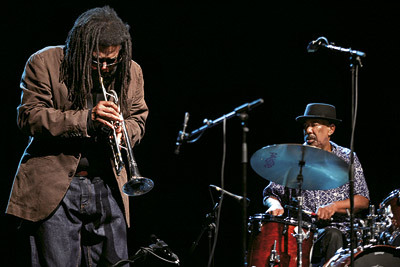
The remainder of the CD contains the 5-part "Ancestors" that is a musical journey into creativity, spirit, interaction and joy.  This is music not anchored in a particular time period, as much contemporary as it is contemplative of the musicians' separate influences.  Whether it's the shimmering, clanging, bells and shakers shower that opens "Part 1"leading to a long yet vibrant drum solo or the muted trumpet atop active drums that make up "Part 3" or the dancing rhythms that introduce "Part 4", the music draws one in and closer.  The percussion shower returns for "Part 5", a piece during which the musicians shout out "We Love You" to fellow travelers 
such as Chris McGregor, Jack DeJohnette, Art Blakey, Max Roach, Miriam Makeba and others.   

"Ancestors" shines brightly, a sensuous, thrilling and emotional musical adventure that warms the heart while it stimulates the mind.  Thanks go to both musicians and the fine people at TUM Records who brought this project to life.  For more information, go to tumrecords.com.  

Thursday, November 15, 2012

Gravity Defying + Musical Notes

Firehouse 12, 45 Crown Street in New Haven, continues its impressive Fall 2012 Concert Series on Friday November 16 with the Donny McCaslin Quartet.  The tenor saxophonist/composer, whose recent Greenleaf CD "Casting for Gravity" is one of the strongest of his career, is bringing a group that includes Fima Ephron (bass), Connecticut native Kevin Hays (piano, keyboards) and Nate Wood (drums).  McCaslin is also known for his work with the Maria Schneider Orchestra, Mingus Dynasty and the Dave Douglas Quintet.  Over the past decade, he has developed into one of the more recognizable and reliable voices in creative music.

The group will play 2 sets - 8:30 and 10 p.m. - call 203-785-0468 or go to firehouse12.com for reservations and more information.  To hear music from the new CD (and more), go to www.greenleafmusic.com.

School and extra-curricular activities have forced me to put aside reviewing for a while.  That does not mean I have not been listening to music. In fact, there are 5-10 recordings in rotation on my iPod and car CD player.  Here's a quick look at 2 of my recent favorites:

Nils Winther of SteepleChase Productions has started a new subsidiary of his productive main label.  SteepleChase/LookOut's initial release features the Brooklyn, New York-based quartet Old Time Musketry;  their debut is titled "Different Times" and features 9 tracks, 4 composed by keyboard player JP Schlegelmilch, 4 by saxophonist/clarinetist Adam Schneit and a group arrangement of Henry Cowell's "Anger Dance", a piece originally for solo piano. The band, rounded out by bassist Phil Rowan and drummer Max Goldman, plays Americana music with a jazz twist, with influences from New Orleans (the raucous "Parade"), Charles Ives ("Cadets"), folk ballads ("Hope for Something More", which sounds like a piece by The Band) and the high-energy, "free jazz" take on the Cowell piece.  There are moments, especially on the opening "Star Insignia", that remind me of the music Jeremy Udden has created for his "Plainville" project but OTM is more energetic and quite playful.  To my mind, the most exciting music looks back yet continually moves forward.  "Different Times" does just that and more; Old Time Musketry makes joyful music filled with strong melodies and fine solos.  To find out more, go to oldtimemusketry.com.

I only wished I had been listening to "Of One's Own", the new CD by the Jeff Holmes Quartet (Miles High Records) during the weeks right before the Presidential election. The  music is joyous, uplifting, supremely melodic, well-played and puts a wide smile on my face, setting my mind at ease.  Holmes is a Professor of Music and Director of Jazz & African-American Music Studies at the University of Massachusetts at Amherst - if you go to his University webpage, you'll see a picture of him holding a trumpet, the instrument he plays in the New England Jazz Ensemble and the classical outfit Solid Brass.  He's also the drummer in the Amherst Jazz Orchestra.  His Quartet features Adam Kolker (tenor and soprano saxophones, bass clarinet), James Cammack (bass) and Steve Johns (drums) - the surprise here is that Professor Holmes is featured exclusively on piano and he's quite the player. While these 9 songs are filled with fine solos from all involved, what stands out for me is the emphasis on melody all the way through, from the 5 originals to the covers to the lovely "Waltz #3", a work by the pianist's brother Toby Holmes. The wonderful arrangement of Nat Simon's quite recognizable melody "Poinciana" is so intelligent (great bass clarinet work from Kolker) and there's a catchy take of guitarist John Abercrombie's "Labour Day" (from his 1988 "Getting There" CD - Holmes recorded a version with the New England Jazz Ensemble.)  Drummer Johns (who I saw a number of times backing bassist Mario Pavone in the 1990s) shines brightly, whether pushing the beat on "Macaroons" (a Holmes original that reflects the influence of the Keith Jarrett/Jan Garbarek band from the 1970s) or swinging with glee on "So Long, Farewell." Cammack, long time associate of pianist Ahmad Jamal, is the foundation on which all the others swing.  Kolker never overplays; his gentle tenor saxophone work on "The Senses Delight" has such emotional depth while his soprano sax dances with abandon on the Abercrombie tune.  His bass clarinet weaves in and out of the piano lines like a dancer on "One for C.J."

I am certainly not a doctor but, if I were, my patients would be prescribed "Of One's Own" as a panacea for what ails you.  This splendid CD definitely worked wonders for me. For more information, go to www.jwholmesmusic.com.  

Sunday, November 4, 2012

Very Live Music + CD Picks

This past Friday (11/03), Firehouse 12, 45 Crown Street in New Haven, was dark due to the cancellation of the Fred van Hove/Lou Grassi concert.  The performance space/ recording studio is back in action this week (11/09) with a performance featuring pianist/composer Michele Rosewoman and her Time in Textures Trio. A native of Oakland, CA, Ms. Rosewoman has been active on the creative music scene for over 25 years. With her blend of complex rhythmic patterns and exciting melodies (plus very smart arrangements), her music has excited audiences around the world.  This new group matches her piano with acoustic guitarist Liberty Ellman (Henry Threadgill's Zooid) and percussionist /Wesleyan University graduate Tyshawn Sorey (Fieldwork).  They'll play 2 sets - 8:30 and 10 p.m. - you can make a reservation by going to firehouse12.com or calling 203-785-0468.  You can find out more about the pianist and hear examples of her music by going to www.michelerosewoman.com.

Guitarist-composer Sinan Bakir is about to release his second CD as a leader. Like his debut, "Tales & Stories" (Aslan Records), features all original music as well as the excellent rhythm section of Thomson Kneeland (bass) and Mark Ferber (drums).  This time around, Bakir adds the exceptional piano work of Warren Byrd to the mix.  Having the piano allows Bakir the freedom to experiment with compositional forms, dynamics and more (my review will be posted in several weeks.)

This Saturday (11/10), Mr. Bakir will hold a "CD Release Concert" at 7:30 p.m. in the intimate performance space of The Buttonwood Tree, 605 Main Street in Middletown.  Joining him will be pianist Jen Allen, bassist Matt Dwonszyk and the fine young drummer Cemre Dogan.  Like Bakir, Dogan is a native of Turkey - he's been in  Connecticut for the last decade, taking up the trap set as a freshman in high school.  He's an integral member of the guitarist's Trio.

For concert information, go to www.buttonwood.org - to find out more about Sinan Bakir, go to www.sinanbakir.com.

************************************************
Canadian-born tenor saxophonist/composer Michael Blake has been a resident of New York City for the past 2 &1/2 decades but his music has always been global in its vision.  He's recorded music inspired by Vietnam ("Kingdom of Champa"), blues/rock (2 releases with the group Slow Poke), saxophonist Lucky Thompson and much more.  He can play with fire or grace, he can roar and he can whisper; his music is never dull.

"In the Grand Scheme of Things" (Songlines Records) features his Canadian group of JP Carter (trumpet, electronics), Chris Gestrin (Fender Rhodes, miniMoog synthesizer) and Dylan van der Schyff (drums). The music is a fascinating blend of melody, noise, clutter, swing and subtlety (often within the same track.)  Take a piece like "Willie (the Lonely Cowboy)" with its scrappy trumpet noises, tolling synth bells and tenor sax/drums duet; one can hear quite a story unfold through the course of the song. "Cybermonk" bounces along on van der Schyff's snappy drums and Gestrin's walking "bass" lines while "A View of Oblivion" rises slowly on the long tones from the sax and trumpet, shimmering cymbals and minimalist Fender  Rhodes.  There's a ever-so-slow reading of Roy Head's 1965 mega-smash "Treat Her Right" (the arrangement is credited to Otis Redding) with a blues-drenched solo from Blake, under control but emotionally rich.

There is a track called "The Searchers" and that's a good description of this band and its approach to Blake's music.  Also, when you return to listen, you realize that each track is a story, has its own personality. Carter's trumpet work is often textural, Gestrin is a master at providing colors, support and direction while van der Schyff drumming is never rushed or cluttered.  This music has space and the 4 musicians complement each other handsomely. Michael Blake has never seemed interested in musical fashion; "In the Grand Scheme of Things" goes its own way and does so quite well.  For more information, go to www.michaelblake.net.

David Virelles, pianist/composer/arranger, has a fascinating new recording; it's called "Continuum" (Pi Recordings) and the music is inspired by the pianist's study of Cuban folklore, especially ritual music.  Fueled by the percussion, poetry and vocals of Roman Diaz (an expert in and practitioner of Afro-Cuban music) and splendid drum work of Andrew Cyrille, this program blends short statements (9 of the 12 tracks) are under 4 minutes with several longer works that explore various facets of storytelling.  With bassist Ben Street supporting the music, Virelles works in and around the percussionists, with rhythmically-charged piano figures.  "Our Birthright" adds the reeds of Roman Filiu (alto and tenor saxophones) and Mark Turner (tenor saxophone, bass clarinet) plus the trumpet of Jonathan Finlayson to create a piece that has the feel of John Coltrane's "Ascension" as filtered through the Cuban experience.  "Threefold" is a work for Cyrille, Street and Virelles that moves quietly forward with intelligent interaction, spurred by the pianist's lines that stop, start, then move forward.  Cyrille leads the way on "Manongo Pablo", happily dancing while Virelles fills on harmonium and organ.  Piano clusters and bouncing percussion drive "Royalty", Virelles' staccato left hand supporting Diaz's congas.

Though "Continuum" clocks in at just under 42 minutes, the music is alluring, rewarding and worthy of exploring deeper.  If you are looking for piano recording that is technically facile and filled with long solos, look elsewhere.  If you are willing to be enchanted, David Virelles has created music that cries out for the concert hall where one can really lose him or her self in the journey.  For more information, go to www.pirecordings.com.

Wednesday, October 31, 2012

Playing Catch-up Again (Part 1)


"Triveni II" (Anzic Records) is the long-awaited further installment of the December 2009 recording session led by trumpeter Avishai Cohen and featuring bassist Omer Avital and drummer Nasheet Waits. By now, the surprise and joy that I felt from hearing "Introducing Triveni" in September 2010 (read review here) has matured into respect and deep appreciation.  I remain impressed by Cohen's maturation as a musician;  he swings with abandon and his ballad work is emotionally strong.  As of the rhythm section, they push the trumpeter and each other, avoiding cliches and giving their all to make this music original.

"Safety Land" opens the CD on a hard-driving beat and nothing "safe" in the trio's attack.  Also "unsafe" is the bluesy, New Orleans, take on "Willow Weep For Me", perhaps the "hardest" version of this standard I have ever encountered.  The influence of the blues is evident throughout this music including the handsome ballad "Nov. 30th (dedicated to my mother)" - the piece rides in on Avital's shuffle-rhythm, Waits' quiet drum rolls and cymbal splashes while Cohen creates a melody in the trumpet's mid-range, muted, soft yet heartfelt. The rhythm "opens up" in the middle and Cohen's solo is more abstract but the final minute of the piece is a return to the gentle feel of the beginning.

Other highlights include the "deep" feeling of "Get Blue", the fiery take of Dizzy Gillespie's "Woody 'n' You" powered by Waits' insistent drums and Avital's great support plus 2 short pieces from Ornette Coleman, including the unrecorded "Follow The Sound."

If you liked "Introducing Triveni", you'll be greatly pleased by "Triveni II". If you have never heard Avishai Cohen, he's been busy this past decade either as a leader, with his sister Anat and brother Yuval in 3 Cohens, in Third World Love, or a member of the SF Jazz Collective.  If you are a fan of intimate, well-played and exciting creative music, check out the 2 volumes of "Triveni" - this music will make you smile, tap your feet and caress you.  For more information, go to www.avishaicohenmusic.com.

I, for one, have learned never to be surprised by multi-instrumentalist Scott Robinson's imagination.  Over the course of his career, he has played music that ranges from Traditional jazz to bop to orchestral music to electronic music.  He plays just about every reed instrument he puts his hands on as well as synthesizers, various forms of percussion and his trusty theremin.

His new recording, "Bronze Nemesis" (Doc-Tone Records/ScienSonic Laboratories) is a musical portrait of Doc Savage. In the 1930s and 40s, Savage was a "righter of wrongs" who appeared in pulp novels. He was a scientist, inventor, pilot and jazz clarinetist who, while not a "super hero" (with other-worldly powers), used his intelligence and wits to battle evil-doers.  Robinson's musical project made its initial appearance in 2001 as part of a concert sponsored by the New York City-based Jazz Composers Collective. It was not until 2008 that Robinson began recording the CD and 4 more years before its release.

This music is performed by the Scott Robinson Doctette, an ensemble that includes Randy Sandke (trumpet), Ted Rosenthal (piano), Pat O'Leary (bass) and Dennis Mackerel (drums, percussion) - the group's original bassist, Dennis Irwin, who died in 2008, just days before the ensemble was scheduled to record, is featured on "The Golden Man", a solo piece recorded in 2001.

The program opens with the dramatic "Man of Bronze", a classical-influenced rubato piece with sudden shifts in dynamics, powered by Mackerel's drums and Robinson's percussion.  The leader's clarinet and Sandke's trumpet interact with the theremin's mysterious sound on "The Secret In the Sky", an Ellington-style tune that also displays the influence of Sun Ra. Rosenthal shines on "Fortress of Solitude" (yes, Superman had his but Doc Savage had one first) with a fine solo that leads into Robinson's handsome bass sax feature. The leader unleashes a slew of synthesized sounds on "Mad Eyes" before Sandke, Rosenthal and the rhythm section take the piece "out" even further. The interaction of Robinson's slide saxophone (!) and theremin is as fascinating as it is bizarre.

Land of Always-Night" is a quartet piece (no trumpet), a lovely classical-style (think Debussy) melody for flute with smart piano counterpoint.  The flute cadenza is particularly striking.  The 69-seconds of "The Living Fire" features a ferocious tenor and drum dialogue before the Doctette literally explodes into (musical) shards at the end. Robinson unleashes his huge contrabass sax and wind machine plus the massive "treme terra" drum for "The Man Who Shook The Earth", a piece that also includes excellent drums from Mackerel during the very hard-bop section that ends the tune.  The CD closes with "The Mental Wizard", a piece the composer describes as "entirely through-composed, no two measures are the same." Yet, the song has a bass solo, a propulsive swing section with the drums leading, another section where Sandke and Robinson (tenor sax) initially trade "4's" before coming together, an impressionistic piano solo (sans accompaniment) and a blazing full-band finish.

Chances are strong you've not heard a jazz "concept" recording like "Bronze Nemesis" before - yes, there have been numerous concept recordings in jazz since the Paul Whiteman Orchestra's recording of George Gershwin's "Rhapsody In Blue" (1924) but few with such a range of themes and odd instruments.  Scott Robinson knows how to shake and stir the imagination of the listener so, be brave and search out this wondrous aural world.  For more information, venture forth to www.sciensonic.net.

Monday, October 29, 2012

Jazz Composers Collective Celebrates 20th Anniversary

Hard to believe it's 2 decades since the New York City-based Jazz Composers Collective first organized (and that's not only because bassist/composer Ben Allison doesn't look a day over 33.) But, he and pianist Frank Kimbrough, saxophonists Michael Blake and Ted Nash plus trumpeter Ron Horton came together not only to present new original music but also to spotlight young or forgotten composers (the picture above is courtesy of Lourdes Delgado.)  Out of their actions came the Herbie Nichols Project, helping to bring that composer's music (he passed in 1963) to a wider audience.  The quintet came together in Allison's Medicine Wheel  and often worked with each other in different-sized groups. During the organization's busiest years (1992-2005), the JCC presented numerous concerts featuring musicians from throughout New York City and the world - best of all, at a time when many critics complained about the dearth of quality creative music, over 300 new works had their premiere at JCC concerts.

Though the organization has been quiet for a while, the founding "fathers" continue to be quite busy.  Kimbrough is a member of The Maria Schneider Orchestra, works with vocalists Mary Anne DeProphetis and Kendra Shank, leads his own Trio and teaches.  Nash is a member of the Lincoln Center Jazz Orchestra plus leads an exciting new quartet.  Blake leads several bands in New York City as well as Vancouver, British Columbia, while Horton also works with Ms. DeProphetis, with the Will Holhouser Trio and leads his own group.  As for Ben Allison, he not only continues to lead his own bands but works with The Millennial Territory Orchestra (led by trumpeter Steven Bernstein), has been working in a duo setting with poet Robert Pinsky and recently testified before the US House Committee on Energy and Commerce concerning performer's rights (read about his work by going to benallison.com/blog/.)

To celebrate the JCC's 20 years, they are throwing...what else... a 20th Anniversary Festival in New York City from November 6-11.  Over the course of the 6 days at The Jazz Standard, 11 groups will appear, including the Herbie Nichols Project who, according to Frank Kimbrough, will be playing several newly-discovered works from Mr. Nichols (40 new tunes! found in a trunk long considered lost.) 212-576-2232.

You can see the great lineup by checking out the poster on the left but, better yet, go to benallison.com/collective/ and see who is performing and what they will be playing (each night is worth going to see.)  Medicine Wheel will reunite, Ron Horton plays 2 shows as a leader, one with his rarely-seen Eleventet (co-led with drummer Tim Horner) and Ted Nash reunites with his Double Quartet (the Nonet includes a string quartet.)  For reservations, go to jazzstandard.net or call 212-576-2232.

I can't think of a better way to end this (endless) election season than by enjoying what looks to be one of the best concert series of the year!


Sunday, October 28, 2012

Improv Night at the Firehouse + Soothing Sounds

The Fall Concert Series at Firehouse 12, 45 Crown Street in New Haven, takes a fine turn towards free improvisation when the performance space hosts the duo of Fred van Hove (piano, pictured left) and Lou Grassi (drums).  Van Hove, born and still living in Belguim, has been an active member of the European Free Music scene since the mid-1960s, first recording with tenor saxophonist Peter Brötzmann as a member of his Octet in 1968.  He went on to perform with American ex-patriate Don Cherry (trumpet) and German trombonist Albert Mangelsdorff.  All the while, van Hove had a busy solo career, one that has seen perform in various sized groups, from duos to big bands as well as a solo artist.  New Jersey-native Lou Grassi has been active in music since the early 1970s, in ensembles that, as he has described them, play "Ragtime to No-Time." He, also has written music for dance ensembles including ones led by the late Richard Bull and the still active Bill T. Jones.  Grassi's series of PoBand recordings for the CIMP label feature guest artists such as saxophonists Joseph Jarman (The Art Ensemble of Chicago), Marshall Allen (Sun Ra Arkestra) and John Tchicai.  

The dynamic duo will play 2 sets - 8:30 and 10 p.m. - and it's the first gig in a tour that will take the musicians to Brooklyn and Riverdale NY and Baltimore, MD. For more information, go to firehouse12.com or call 203-785-0468. To check out their itinerary, go to www.lougrassi.com/PerformanceSchedule.html. 

***********************************************************

As I write this (approximately 4 p.m. on Sunday October 28), the Northeast Corridor of the United States awaits the arrival of Hurricane Sandy, possibly one of the most dangerous storms to ever hit the United States.  If that's not sobering enough, the storm arrives 14 months after Hurricane Irene devastated a good part of coastal, central and northern Connecticut and 365 days after a late October snowstorm left much of the state as well as a large swath of Massachusetts without power for upwards to 14 days.  For this storm, we have been warned of power outages that could last just as long.  

My musical choices for such times are usually quieter recordings (uploaded to my iPod), often classical or jazz piano trio, and always soothing. 2 new recordings plus a newly-reissued favorite that are quite enjoyable are among many that are in the queue for Sandy.


Pianist Frank Kimbrough, bassist Jay Anderson and drummer Matt Wilson came together on 2 nights in July of 2011 to create the songs that make up "Live At Kitano" (Palmetto Records).  As is the pianist's custom, the Trio did not rehearse, had no set lists and there was little discussion of the songs that were to play. One might imagine that is a scary prospect but, when you have been playing music as long as these gentlemen, the results are often magical.

The 60+ minutes on this disc features 3 Kimbrough originals, several jazz standards, and one piece each by Paul Motian and Andrew Hill.  Pieces such as Oscar Pettiford's "Blues In The Closet" swing with a joyous bounce (provided by the bassist for 3 minutes before Wilson enters to provide punch.) Duke Ellington's "Single Petal of a Rose" begins with the bassist reading the splendid melody as Kimbrough colors the music behind him.  Their interplay lasts over half the 9:35 of the tune before Wilson adds even more colors from his drummer's palette.


Kimbrough shines on Paul Motian's "Arabesque" (first released in 2002 on the drummer's Electric BeBop Band's "Holiday For Strings" CD), a beautiful ballad in the drummer/composer's "floating" style.  Anderson's counterpoint and support plus Wilson's "conversational" drumming pulls the listener in.  "Dusk", an Andrew Hill composition from the 2000 Palmetto CD of the same name, allows the Trio to explore the melodic, harmonic and, especially, the rhythmic aspects of the piece.  The program closes with a new Kimbrough composition.  Titled "Hymn", the tune is a soulful, bluesy, even joyous work, that again illustrates the wonderful interplay of the friends and musicians.

"Live at Kitano" is a CD that will give the avid listener much to explore.  From the richly melodic piano of Frank Kimbrough to the splendid bass playing of Jay Anderson to the playful, intelligent, and arresting percussion of Matt Wilson, this is creative, modern yet timeless, music of the highest order.  For more information, go to home.earthlink.net/~fkimbrough/.


The Luce Trio, an ensemble formed by saxophonist Jon De Lucia, has issued its first CD, "Pieces, Vol. 1" (Museum Clausum Recordings); 4 of the 9 works are adaptations of Baroque works by J.S. Bach (3 pieces) and G.F. Handel (1 piece) plus one 2-song medley from the Elizabethan composer John Dowland as well as 3 originals.  The alto saxophonist (he also opens the proceedings on Sruti Box) creates music that moves deliberately, with melodies that are as rich as they are gentle. Joining  him is electric guitarist (co-producer and Mixer) Ryan Ferreira and acoustic bassist Chris Tordini.  The songs, recorded at St. Ann and the Holy Trinity Church in Brooklyn Heights, have an airy feel yet are never insubstantial.  

The program opens with the De Lucia original "Chant", which, until I checked the CD cover, sounded to this listener as a variation of Irving Berlin's "Let's Face the Music and Dance" ( I rarely look at the liners or the publicity material until after listening "blind" to the music.) The drone of the Sruti Box sets the tone for the proceedings; no sound is going to be too loud or overplayed.  The Bach pieces are stunning in the Trio's execution.  The descending melody of "Sinfonia 11", with its generous interplay of guitar and bass supporting the alto saxophone, dazzles while "Es Ist Vollbracht" starts as a solo saxophone melody, the notes sustained in the open air of the church.  When the bass and guitar enter, the piece slows down to to the pace of a prayer (the work does comes from the "St. John Passion".)  The CD closes with a short yet wonderful reading of "Jesu Meine Passion."  

Luce Trio ("luce" is Italian for light) is anything but light-weight.  This music, so finely created by Messrs. De Lucia, Ferreira and Tordini, shines with intelligence and spirit.  Baroque in many ways (in the years that Bach composed and performed, the ability to improvise was greatly valued), "Pieces, Vol. 1" seems an inappropriate name for music as special as this but do not pass over this gem.  For more information, go to www.jondelucia.com
Here is "Sinfonia 11" courtesy of BandCamp and Luce Trio:

Originally released in 1986 on the long-defunct Black Hawk label, "Life's Magic" is one of the more buoyant releases of pianist Steve Kuhn's career.  Credited to the Steve Kuhn Trio, the CD (now re-issued on Sunnyside Records with 2 additional tracks) was recorded "live" at The Village Vanguard with the sublime rhythm section of Ron Carter (bass) and Al Foster (drums.)  Carter has a big tone which really supports the pianist on his fanciful solos and gives Foster the room to play with abandon (tastefully but definitely playfully.) You can't miss his glee on "Mr. Calypso Kuhn", the effervescent track that closed the original recording. Notice his flashy brush work on Hoagy Carmichael's "Little Old Lady" - his "swing" is contagious and the pianist gladly solos with abandon.   Kuhn has recorded Fats Waller "Jitterbug Waltz" a number of times; this version starts sweetly, going into a long solo from Carter and, when he emerges, he lays down a "walking line" that Kuhn and Foster begin to build upon throughout the rest of the tune.  

A short piano solo titled "Ulla" leads into "Trance", a mesmerizing piece Kuhn first recorded in 1974 for an ECM Lp of the same name. Here, the song starts like a lullaby steeped in the blues before taking off on the power of Foster's martial snare drum work and the pianist's staccato chords.  "Yesterday's Gardenias", originally recorded in the early 1940s by Glenn Miller (and another piece Kuhn has recorded several times), is a breezy swing piece that displays both the pianist's wonderful ear for melodic lines and his "bop chops."
The new CD closes with a long (nearly 14 minutes) but musically exciting romp through "Softly, As In a Morning Sunrise" - everybody gets to solo and Foster shines throughout, whether "swinging" with abandon or keeping the tempo flowing, as he does during the bass solo.

I have always enjoyed "Life's Magic" since I first heard it 26 years ago.  It's been a while since I dug out the Lp so this Sunnyside release is like meeting an old friend. If you've never checked it out and you like Steve Kuhn, this is one of his best releases.  If you have never listened to Mr. Kuhn, play this alongside his work with Sheila Jordan, the original "Trance" recording and his 2009 "Mostly Coltrane" release; it will give you a fine overview of a classy pianist who is still in his prime.

Here is Steve Kuhn, Ron Carter and Al Foster playing "Little Old Lady", courtesy of Sunnyside Records;

Saturday, October 27, 2012

Saying Goodbye and Thank You

Read recently of the passing of Anna Barron; she died in August 15 in Stockholm, Sweden (her birthplace.)  Before moving home, she had lived in Middletown, Connecticut for nearly 4 decades. She came to town with her husband, saxophonist/educator William "Bill" Barron, when he joined the Music faculty of Wesleyan University. She stayed even after Professor Barron passed in 1989, performing (as a violinist) in orchestras and chamber groups) but even more so to make sure that the musical legacy of her husband didn't disappear from the memories of jazz fans, writers and historians all over the world.  To that end, Ms. Barron helped co-ordinate the releases and re-releases of Bill Barron's music on labels such as Steeplechase and Jo-Ken (a label owned by Kenny Barron, the saxophonist's younger brother.)  She sent letters and emails to writers and reviewers the world over to remind them to listen and write about these recordings. She did interviews on jazz shows - Anna Barron never lost her belief in the relevance of her husband's music and life's work.

In her memory, her family asks that, if you wishplease make a donation to the Nature Conservancy, 55 High Street, Middletown, CT 06457. To find out more about her husband, go to www.allmusic.com/artist/bill-barron-mn0000059950.

Also, it's hard not to be saddened on October 18 by the loss of saxophonist David S. Ware at the age of 62. It was 3 years ago that Mr. Ware had the long-awaited kidney transplant;  his illness and the operation had slowed him down but never doused his desire to create music of the highest order.  His tenor saxophone playing, at times, could be ferocious and, at a time when jazz was giving way to more moderate sounds, he stayed on his own path, one developed from working in ensembles led by pianist Cecil Taylor and drummer Beaver Harris.  He formed his first ensemble, a trio, in 1981, adding pianist Matthew Shipp in 1989 to form the David S. Ware Quartet.  Bassist William Parker and Shipp plus a series of drummers (including Whit Dickey, Susie Ibarra, Guillermo Brown) helped Mr. Ware create a body of work on labels such as AUM Fidelity, Thirsty Ear, Silkheart, DIW and Columbia (signed by Branford Marsalis) that stands the test of time.  As good as most of these CDs are, the Quartet truly shone in concert where one could see the the concentration of the musicians, feel their passion and enjoy the interactions.

There have been several fine remembrances posted; here's one from friend and band member Matthew Shipp -  www.newmusicbox.org/articles/david-s-ware-1949-2012-beyond-time/.

Finally, Jason Crane will post the ultimate edition of The Jazz Session, Episode 417, on Monday October 29.  Happily, Mr. Crane is still among us, living and working in Auburn, Alabama and planning a new show for sometime in the future.  That written, The Jazz Session will continue to be available online for those people interested in hearing about musicians and their music, recorded during a time when jazz has been quite creative while it continues to be relegated to the sideline. Many people will tell you that jazz is best understood in the concert or nightclub setting where you can see the musicians interact.  Yet, it's rare that you can ask these musicians about their creative process, influences, likes, dislikes, frustrations, successes, education, etc. - over the course of 400+ interviews, Jason Crane was able to be that person for those of us who feel we can't talk to the musicians who we admire and often idolize.  He illuminated the human side of musicians or, you might say, the musical side of human beings.  Good luck to Mr. Crane - read his poetry and missives at jasoncrane.org.  Catch up on the interviews at thejazzsession.com.