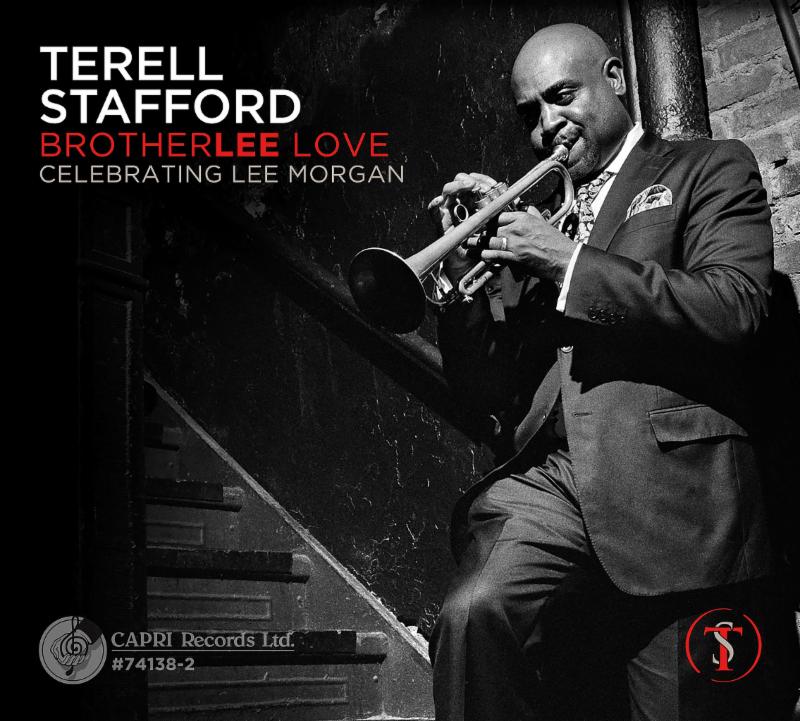
Trumpeter Lee Morgan (1938 - 1972) came out of the creative Philadelphia PA jazz scene like a firecracker. Joining Art Blakey's Jazz Messengers at the age of 18 drew the attention of Dizzy Gillespie who invited the young man to join his Big Band within 2 weeks of his gig with Blakey. By the late 1950s, Morgan was leading his own groups, had signed to Blue Note Records and was battling the addictions that would follow the rest of his life. But, when he was "right", his inspired playing caught the ears of many people.
Trumpeter Terell Stafford, while not born in the City of Brotherly Love, came of "musical age" in that city under the tutelage of Shirley Scott and Mickey Roker. Stafford settled in the city, is on the faculty of Temple University and recently established the Jazz Orchestra of Philadelphia. He pays tribute to the music of Lee Morgan on his new CD, "BrotherLee Love" (Capri Records). Fronting a quintet that features Tim Warfield (tenor saxophone), Bruce Barth (piano), Peter Washington (bass) and Dana Hall (drums), Stafford plays a program that features 7 tunes by Morgan, a sweet piano - bass - trumpet version of Alex Kramer's "Candy" (the title track of Morgan's first release on Blue Note in 1958, and one original from the leader. Morgan's music was usually quite rhythmical much of the time (hard-bop and bluesy ballads), and he played many great solos. That can be said about this project as well. Right from the opening track. "Hocus Pocus", the listener gets pulled into the music. The excitement of Hall's drive, Washington's swift walking lines and Barth's active chording creates a fine bed for Stafford's splendid solo and Warfield's rich tenor sounds. There's no letup on "Mr. Kenyatta" with Barth's strong opening statement setting the table for the melody. Stafford is quite the articulate player, his sound and attack reminding this listener of another Philly native, Clifford Brown. The bluesy swagger of "Petty Larceny" (do I hear a much of "The Pink Panther Theme" in there?) is the perfect vehicle for Warfield's tenor, Barth's two-handed attack, the leader's sly, yet classy, strut. Check out Stafford's fine mute work on the afore-mentioned "Candy" and how he and Warfield caress the melody on the other ballad, "Carolyn." "Favor" is Stafford's contribution to the program and is a "deep blues" that allows everyone but Hall to stretch out. Pay attention to Barth's brilliant solo, especially how he interacts with Hall to raise the intensity level.
By the time you finish grooving to the final track, Morgan's "Speedball", you'll probably be thinking a couple of different thoughts. First, why don't more people cover Lee Morgan material and second, this is one "hot" quintet. Terell Stafford is a generous leader, making sure every one gets the spotlight. He also makes quite sure that the listener gets his-or-her money's worth. Honestly, 77 minutes of music seems to go by so quickly. "BrotherLee Love" is aptly titled and well worth your time.
For more information, go to www.terellstafford.com.
Here's that final track for your listening pleasure:
For his new PosiTone release "Three On Two" (his second for the label), trumpeter Joe Magnarelli and producer Marc Free assembled a splendid quintet, put together a program of originals and standards, then let them loose. The rhythm section includes Brian Charette (organ) and Rudy Royston (drums) while the front line includes "Mags", Mike DiRubbo (alto saxophone), and the only holdover from 2014's "Lookin' Up", trombonist Steve Davis. The first 4 tracks are originals with 2 by the leader and one each from Davis and DiRubbo. With the organ burbling underneath and Royston's razor-sharp drumming pushing the beat, the title track "burns" from the get-go. Davis's "Easy" follows, a sweet shuffle, that's as smooth as barrel-aged bourbon; that tracks leads into DiRubbo's energetic "The Step-Up." Later in the program, the trumpeter's "Outlet Pass" creates quite a fast break for the quintet, driven by Royston at his best.
Other highlights include John Coltrane's "26-2" and "Central Park West" with the former displaying a real be-bop feel and the latter delivered as a sweet ballad. On the second cut, Magnarelli blends his mellow flugelhorn with Davis's trombone and the alto sax to not only play the melody but also supply a fine cushion for the organ solo.
The program closes with a very bluesy take of "My Reverie", a piece from French composer Claude DeBussy that's been a favorite of jazz musicians since it was recorded in 1938 by Larry Clinton. It's a gentle but swinging way to end the show.
"Three On Two" doesn't break new ground but it sure sounds fresh and lively. Everyone plays well, the solos are short but always right on the money, and - really - the rhythm section of Messrs. Charette and Royston can't be beat. Joe Magnarelli is in good form and even better company.
For more information, go to www.joemagnarelli.com.
Showing posts with label trumpets. Show all posts
Wednesday, August 12, 2015
Monday, June 23, 2014
Trumpet Front and Center
It's been 20 years since trumpeter Joe Magnarelli released his debut on the Criss Cross label. In 1994, "Mags" was already an established voice on the music scene having worked with the Glenn Miller Orchestra, Brother Jack McDuff and Lionel Hampton. Since then, he has worked with a plethora of groups and artists, from the Vanguard Orchestra to Harry Connick Jr. to Jane Monheit to the Lincoln Center Orchestra.
His 10th CD as a leader, "Lookin' Up", is his debut for Posi-Tone Records and is a highly attractive session from beginning to end. With the rhythm section of bassist Mike Karn (Vanguard Jazz Orchestra, Harold Mabern) and drummer Jason Brown (Wayne Escoffery, David Hazeltine) plus the articulate pianist Anthony Wonsey, Magnarelli (who plays his mellow flugelhorn on several cuts) weaves his way through a 10-song program evenly split between originals and standards.
Trombonist Steve Davis joins the group on 6 cuts, serving as both a harmony voice and counterpoint to the leader's trumpet. Their interaction on the original "Third Set" includes both call-and-response as well as harmony. The tune is infused with the feel of Art Blakey's Jazz Messengers, from Wonsey's "bouncing" chordal accompaniment to the drive of Karn and Brown. The blend of Davis's rich and burnished tones with Mags' muted trumpet give "Blue Key" (a Magnarelli original) a pleasing sound. Wonsey's pleasing solo exploration sets up the handsome trumpet solo. Karn's splendid walking bass leads in the rest of the band on "In Walked Lila" (composed by saxophonist John Handy - there's a voice one needs to her more often); everybody gets to "strut his stuff" and does so without going on too long (Brown's joy-filled bass kick and snare rolls jump out of the speakers.) The pianist gives a lively "Satin Doll"-flavored opening to Magnarelli's "Easy Transition", a medium-tempo bluesy romp. Davis displays his formidable yet amiable "blues" chops while the trumpeter lets fly several lively phrases
The flugelhorn makes an appearance on the lovely original ballad, "Inner Beauty." Magnarelli weaves the melody and solo around the delicate piano chords and Karn's intelligent counterpoint while Brown's brushes sweep the piece along. Wonsey's introduction to Jimmy Van Heusen's "Darn That Dream" opens with a slight flourish before he states the melody and sets the stage for the leader to come in on flugelhorn and repeats the melody. The rhythm section tiptoes in at the close of the second verse while Magnarelli repeats the melody once more before taking a well-fashioned solo.
"Lookin' Up" breaks no new ground, all the while showing the listener how 5 musicians can have fun in the studio while making meaningful music. Each player contributes to the overall excellence of the performances with a special tip of the hat to the active and engaged rhythm section (including Anthony Wonsey.) Joe Magnarelli's move to Posi-Tone Records makes great sense - this is a label keeping the spirit of hard-bop alive and well into the 21s Century (while not ignoring newer developments). To learn more about the leader, go to www.joemagnarelli.com. To find out more about this and other Posi-Tone releases, go to www.posi-tone.com.
Over the past 2 decades, Israel, for all of its political and social issues, has produced a number of impressive musicians, some of whom are making quite an impression on the international scene.
Trumpeter/composer Itamar Borochov, raised in Jaffa, the port city out of which the modern metropolis of Tel Aviv took shape, moved to New York City in 2006 to study at the New School. He took instruction from the likes of Junior Mance, Cecil Bridgewater and Joe Chambers. He has since toured and recorded with Aaron Goldberg, Candido Camero, Curtis Fuller and fellow Israeli Omer Avital. In May of 2011, Borochov gathered his Quartet - older brother Avri (bass), Hagai Amir (alto saxophone), and Aviv Cohen (drums) - to record its debut CD in Tel Aviv's DB Studios. The results, "Outset" (Real Bird Records), show a group steeped in the traditions of 1950 and 60s American jazz, especially the sounds of the Miles Davis Quintet pre-"In A Silent Way." With the exception of the handsome ballad "Boston Love Affair" (4:50) and the dark, rubato, "Opening" (1:46 - with a cantorial quality to the low trumpet tones), the tracks are over 8 minutes with three of the seven over 10. The extended length gives the pieces time to develop and allows for the soloists to take their time. "Pain Song" opens the disk, its languid yet hypnotic rhythm suggesting late-60s Herbie Hancock, has a quiet melody played only by the trumpet. Saxophonist Amir enters on the second chorus, playing harmony on the Hebraic sounding melody. The trumpeter builds his solo patiently, like a lament until his phrases grow longer and more agitated, spurring Cohen to loosen up. As Amir reenters, the trumpeter fades out and the pace slows but soon begins to ramp up once more on the strength of the interactions.
"Samsara" is much faster, lighter, reminiscent of the Clifford Brown-Max Roach Quintet, especially in the driving rhythms and speedy walking bass lines. The leader again shows his more melodic side until the fire beneath spurs him to greater heights. Amir's solo is bluesy, showing the influence of Julian "Cannonball" Adderley and he plays with great abandon. Avri leads the group in on the Middle-Eastern flavored "Bgida" (translates to treason); the piece displays the darkness of the opening track and brother Itamar's solo is understated even as the tempo doubles near the close of the piece. "Ovadia" also has a Middle-Eastern flavor but a more sensuous feel, with the rhythm section taking the spotlight and being the sparkplug for a splendid alto solo.
Itamar Borochov shows much promise on his debut CD, especially as a composer/arranger; there are moments when one wished he would let loose like the other members of the Quartet. "Outset" is honest music, a fusion of many influences, that begs to be heard live. For more information, go to
itamarborochov.com.
Here's "Samsara", the "hottest" track on the disk:
His 10th CD as a leader, "Lookin' Up", is his debut for Posi-Tone Records and is a highly attractive session from beginning to end. With the rhythm section of bassist Mike Karn (Vanguard Jazz Orchestra, Harold Mabern) and drummer Jason Brown (Wayne Escoffery, David Hazeltine) plus the articulate pianist Anthony Wonsey, Magnarelli (who plays his mellow flugelhorn on several cuts) weaves his way through a 10-song program evenly split between originals and standards.
Trombonist Steve Davis joins the group on 6 cuts, serving as both a harmony voice and counterpoint to the leader's trumpet. Their interaction on the original "Third Set" includes both call-and-response as well as harmony. The tune is infused with the feel of Art Blakey's Jazz Messengers, from Wonsey's "bouncing" chordal accompaniment to the drive of Karn and Brown. The blend of Davis's rich and burnished tones with Mags' muted trumpet give "Blue Key" (a Magnarelli original) a pleasing sound. Wonsey's pleasing solo exploration sets up the handsome trumpet solo. Karn's splendid walking bass leads in the rest of the band on "In Walked Lila" (composed by saxophonist John Handy - there's a voice one needs to her more often); everybody gets to "strut his stuff" and does so without going on too long (Brown's joy-filled bass kick and snare rolls jump out of the speakers.) The pianist gives a lively "Satin Doll"-flavored opening to Magnarelli's "Easy Transition", a medium-tempo bluesy romp. Davis displays his formidable yet amiable "blues" chops while the trumpeter lets fly several lively phrases
The flugelhorn makes an appearance on the lovely original ballad, "Inner Beauty." Magnarelli weaves the melody and solo around the delicate piano chords and Karn's intelligent counterpoint while Brown's brushes sweep the piece along. Wonsey's introduction to Jimmy Van Heusen's "Darn That Dream" opens with a slight flourish before he states the melody and sets the stage for the leader to come in on flugelhorn and repeats the melody. The rhythm section tiptoes in at the close of the second verse while Magnarelli repeats the melody once more before taking a well-fashioned solo.
"Lookin' Up" breaks no new ground, all the while showing the listener how 5 musicians can have fun in the studio while making meaningful music. Each player contributes to the overall excellence of the performances with a special tip of the hat to the active and engaged rhythm section (including Anthony Wonsey.) Joe Magnarelli's move to Posi-Tone Records makes great sense - this is a label keeping the spirit of hard-bop alive and well into the 21s Century (while not ignoring newer developments). To learn more about the leader, go to www.joemagnarelli.com. To find out more about this and other Posi-Tone releases, go to www.posi-tone.com.
Over the past 2 decades, Israel, for all of its political and social issues, has produced a number of impressive musicians, some of whom are making quite an impression on the international scene.
Trumpeter/composer Itamar Borochov, raised in Jaffa, the port city out of which the modern metropolis of Tel Aviv took shape, moved to New York City in 2006 to study at the New School. He took instruction from the likes of Junior Mance, Cecil Bridgewater and Joe Chambers. He has since toured and recorded with Aaron Goldberg, Candido Camero, Curtis Fuller and fellow Israeli Omer Avital. In May of 2011, Borochov gathered his Quartet - older brother Avri (bass), Hagai Amir (alto saxophone), and Aviv Cohen (drums) - to record its debut CD in Tel Aviv's DB Studios. The results, "Outset" (Real Bird Records), show a group steeped in the traditions of 1950 and 60s American jazz, especially the sounds of the Miles Davis Quintet pre-"In A Silent Way." With the exception of the handsome ballad "Boston Love Affair" (4:50) and the dark, rubato, "Opening" (1:46 - with a cantorial quality to the low trumpet tones), the tracks are over 8 minutes with three of the seven over 10. The extended length gives the pieces time to develop and allows for the soloists to take their time. "Pain Song" opens the disk, its languid yet hypnotic rhythm suggesting late-60s Herbie Hancock, has a quiet melody played only by the trumpet. Saxophonist Amir enters on the second chorus, playing harmony on the Hebraic sounding melody. The trumpeter builds his solo patiently, like a lament until his phrases grow longer and more agitated, spurring Cohen to loosen up. As Amir reenters, the trumpeter fades out and the pace slows but soon begins to ramp up once more on the strength of the interactions.
"Samsara" is much faster, lighter, reminiscent of the Clifford Brown-Max Roach Quintet, especially in the driving rhythms and speedy walking bass lines. The leader again shows his more melodic side until the fire beneath spurs him to greater heights. Amir's solo is bluesy, showing the influence of Julian "Cannonball" Adderley and he plays with great abandon. Avri leads the group in on the Middle-Eastern flavored "Bgida" (translates to treason); the piece displays the darkness of the opening track and brother Itamar's solo is understated even as the tempo doubles near the close of the piece. "Ovadia" also has a Middle-Eastern flavor but a more sensuous feel, with the rhythm section taking the spotlight and being the sparkplug for a splendid alto solo.
Itamar Borochov shows much promise on his debut CD, especially as a composer/arranger; there are moments when one wished he would let loose like the other members of the Quartet. "Outset" is honest music, a fusion of many influences, that begs to be heard live. For more information, go to
itamarborochov.com.
Here's "Samsara", the "hottest" track on the disk:
Monday, May 26, 2014
Trumpets + Guitar + Voice Live + 2 CD Picks
The Side Door Jazz Club in Old Lyme opens its door this Friday and Saturday nights to 2 fine trumpeters. First up is Jeremy Pelt (pictured left) and his Face Forward ensemble. Pelt, who is on the faculty of the Jackie McLean Institute at the Hartt School, is a fine player who blends numerous styles into his original music. The California native studied at the Berklee School of Music and went on to work with groups led by Roy Hargrove, Greg Osby, and Ravi Coltrane as well as the Mingus Big Band. Since his 2002 debut CD, Pelt has produced 11 recordings for labels such as MaxJazz, Criss Cross, Smalls Live and, most recently, HighNote. The Face Forward ensemble, named for his latest release, mixes electronic and acoustic instruments plus elements of jazz, r'n'b, soul music and more into a highly listenable stew. To find out more and the talented trumpeter/composer, go to www.jeremypelt.net.
On Saturday, Etienne Charles returns to The Side Door (he was member of Rene Marie's band that appeared just a few weeks ago). Born in Trinidad and raised in Florida, Charles, who is still in his 20s, studied with Marcus Roberts and has worked with saxophonist Benny Golson, Roberta Flack, Wynton Marsalis, and Maria Schneider. He has created 3 CDs for his own Culture Shock label, the latest being 2013's "Creole Soul".
Charles possesses a bright tone, a sound which serves his music, a delicious gumbo of Caribbean, New Orleans, blues and jazz, so well. He's now on the faculty of Michigan State University while maintaining a busy performance schedule. To learn more about the musician, go to www.etiennecharles.com.
For tickets to either one or both of these shows, go to thesidedoorjazz.com or call 860-434-0886.
Firehouse 12 in New Haven presents the duo of Brandon Ross (guitars, banjo) and Stomu Takeishi (acoustic bass guitar) in concert this Friday May 30. They are touring under the name of For Living Lovers and in support of their debut CD "Revealing Essence" (Sunnyside Records). The album, much of which was recorded in the Firehouse 12 studios by Nick Lloyd, is filled with haunting melodies, quiet solos, fine supportive work from Takeishi and intriguing ideas from Ross. The music is dream-like, rarely forceful but emotionally powerful. Ross, who has worked with Henry Threadgill and Cassandra Wilson (among others), plays acoustic guitar in ways that suggest both Derek Bailey and James Emery without sounding like either one. Takeishi, who played alongside Ross in Mr. Threadgill's ensemble, has also worked with pianist Myra Melford and cellist Erik Friedlander. His bass lines are clear and clean, with round tones that fill the tunes.
For Living Lovers plays 2 sets - 8:30 and 10 p.m. - for more information, go to firehouse12.com or call 203-785-0468.
Vocalist Karen Frisk, a native of Cromwell, CT, brings her fine Quartet to The Buttonwood Tree, 605 Main Street in Middletown this Saturday (5/31) for an 8 p.m. performance. Ms. Frisk, who possesses a 5-octave range, started singing at a young age in her church choir and in community theater productions. She went on to study both piano and voice, moving to Cape Cod, MA, performing there and in Boston. She's living in Connecticut again and performing throughout the Northeast. Her excellent band includes pianist Kent Hewitt, the great bassist Brian Torff, and drummer Rich Tortorigi. To find out more about Ms. Frisk, go to www.karenfrisk.com. For reservations and ticket information, go to www.buttonwood.org or call 860-347-4957.
Bassist Jeff Denson, who has worked and recorded with Lee Konitz plus is 1/3rd of the trio Minsarah (with pianist Florian Weber and drummer Ziv Ravitz, has issued a most uplifting duo recording with pianist Joshua White. "I'll Fly Away" (pfMENTUM Records) is a album of gospel tunes, several of which the bassist played at the funerals of his grandmother and father. The title tracks - 3 versions of the Alfred Brumley tune - range from the opening Fats Waller meets Charles Ives version to the deep blues of the second reading to the manic all-out swing version that closes the CD. It's not that White or Denson are being facetious but more that they are celebrating the joy that the music brings and the good memories of the people who passed. Denson's bowed bass reading of "Amazing Grace" stresses the beauty of the melody while going on to give the tune the feel of an Appalachian folk tune. His other solo piece, "Crying In The Chapel", is wonderfully melodic, getting quite bluesy at times. The duo is pensive on "What A Friend We Have In Jesus" and take "When The Saints Go Marching In" on a jaunt that runs the gamut from hard-bop to traditional.
Joshua White, a native of Southern California, is a splendid pianist who has worked with bassist Mark Dresser, trumpeter Ambrose Akinmusire and guitarist Anthony Wilson - he currently leads a quartet that features saxophonist David Binney as well as drummer Mark Ferber. He and Jeff Denson have an excellent rapport, supporting each other and sometimes playing independently. "I'll Fly Away" is filled with fine religious music but should appeal to music lovers of all faiths. For more information, go to www.jeffdenson.com.
Saxophonist Rich Halley lives in Oregon and enjoys hiking through the mountains in the central part of the state, understanding the majesty of nature and man's role in both destroying and protecting his environment. He also leads the Rich Halley 4, a group that features Michael Vlatkovich (trombone), Clyde Reed (bass) and his son Carson (drums). "The Wisdom of Rocks" (Pine Eagle Music) is the quartet's 4th CD in 4 years and may be the best of a very strong bunch of recordings. There are 2 short group improvisations, a duo for tenor and drums, and some of the strongest rhythms you'll hear this or any year. The band comes blasting out for the chute with "The Atoll" that has the drive of the music created by the Vandermark 5, a hearty tenor solo and a forceful trombone solo. The rhythm section pushes with great intensity without losing its focus. The title track has a "cool" feel and a wonderful blowsy 'bone solo. One can see the band contemplating the heavens on "Faint Scattered Lights", a short ballad with an insistent throbbing beat and moaning sounds from the sax, 'bone and bowed bass. There's a ton of funk on "The Get-Go" and a deep sense of the blues on "Heat In May", featuring a subdued tenor sax solo. More blues can be felt and heard on "Radial Symmetry" but this time it burns with a fever; the saxophonist certainly can stoke the fire while the trombonist gets pretty hot himself. The program closes with the group composition "Conversation In Blue", a short piece that reminds this listener of the mid-50s work of Jimmy Guiffre and Bob Brookmeyer but with a bit of an edge.
The music on "The Wisdom of Rocks" feels both new and familiar. The has worked together long enough now to know each other's strengths, understand how to support and egg each other on, and feel that that the music does not need to be complicated to be creative. The music of the Rich Halley 4 does satisfy the soul - to find out more, go to www.richhalley.com.
On Saturday, Etienne Charles returns to The Side Door (he was member of Rene Marie's band that appeared just a few weeks ago). Born in Trinidad and raised in Florida, Charles, who is still in his 20s, studied with Marcus Roberts and has worked with saxophonist Benny Golson, Roberta Flack, Wynton Marsalis, and Maria Schneider. He has created 3 CDs for his own Culture Shock label, the latest being 2013's "Creole Soul".
Charles possesses a bright tone, a sound which serves his music, a delicious gumbo of Caribbean, New Orleans, blues and jazz, so well. He's now on the faculty of Michigan State University while maintaining a busy performance schedule. To learn more about the musician, go to www.etiennecharles.com.
For tickets to either one or both of these shows, go to thesidedoorjazz.com or call 860-434-0886.
Firehouse 12 in New Haven presents the duo of Brandon Ross (guitars, banjo) and Stomu Takeishi (acoustic bass guitar) in concert this Friday May 30. They are touring under the name of For Living Lovers and in support of their debut CD "Revealing Essence" (Sunnyside Records). The album, much of which was recorded in the Firehouse 12 studios by Nick Lloyd, is filled with haunting melodies, quiet solos, fine supportive work from Takeishi and intriguing ideas from Ross. The music is dream-like, rarely forceful but emotionally powerful. Ross, who has worked with Henry Threadgill and Cassandra Wilson (among others), plays acoustic guitar in ways that suggest both Derek Bailey and James Emery without sounding like either one. Takeishi, who played alongside Ross in Mr. Threadgill's ensemble, has also worked with pianist Myra Melford and cellist Erik Friedlander. His bass lines are clear and clean, with round tones that fill the tunes.
For Living Lovers plays 2 sets - 8:30 and 10 p.m. - for more information, go to firehouse12.com or call 203-785-0468.
Vocalist Karen Frisk, a native of Cromwell, CT, brings her fine Quartet to The Buttonwood Tree, 605 Main Street in Middletown this Saturday (5/31) for an 8 p.m. performance. Ms. Frisk, who possesses a 5-octave range, started singing at a young age in her church choir and in community theater productions. She went on to study both piano and voice, moving to Cape Cod, MA, performing there and in Boston. She's living in Connecticut again and performing throughout the Northeast. Her excellent band includes pianist Kent Hewitt, the great bassist Brian Torff, and drummer Rich Tortorigi. To find out more about Ms. Frisk, go to www.karenfrisk.com. For reservations and ticket information, go to www.buttonwood.org or call 860-347-4957.
Bassist Jeff Denson, who has worked and recorded with Lee Konitz plus is 1/3rd of the trio Minsarah (with pianist Florian Weber and drummer Ziv Ravitz, has issued a most uplifting duo recording with pianist Joshua White. "I'll Fly Away" (pfMENTUM Records) is a album of gospel tunes, several of which the bassist played at the funerals of his grandmother and father. The title tracks - 3 versions of the Alfred Brumley tune - range from the opening Fats Waller meets Charles Ives version to the deep blues of the second reading to the manic all-out swing version that closes the CD. It's not that White or Denson are being facetious but more that they are celebrating the joy that the music brings and the good memories of the people who passed. Denson's bowed bass reading of "Amazing Grace" stresses the beauty of the melody while going on to give the tune the feel of an Appalachian folk tune. His other solo piece, "Crying In The Chapel", is wonderfully melodic, getting quite bluesy at times. The duo is pensive on "What A Friend We Have In Jesus" and take "When The Saints Go Marching In" on a jaunt that runs the gamut from hard-bop to traditional.
Joshua White, a native of Southern California, is a splendid pianist who has worked with bassist Mark Dresser, trumpeter Ambrose Akinmusire and guitarist Anthony Wilson - he currently leads a quartet that features saxophonist David Binney as well as drummer Mark Ferber. He and Jeff Denson have an excellent rapport, supporting each other and sometimes playing independently. "I'll Fly Away" is filled with fine religious music but should appeal to music lovers of all faiths. For more information, go to www.jeffdenson.com.
Saxophonist Rich Halley lives in Oregon and enjoys hiking through the mountains in the central part of the state, understanding the majesty of nature and man's role in both destroying and protecting his environment. He also leads the Rich Halley 4, a group that features Michael Vlatkovich (trombone), Clyde Reed (bass) and his son Carson (drums). "The Wisdom of Rocks" (Pine Eagle Music) is the quartet's 4th CD in 4 years and may be the best of a very strong bunch of recordings. There are 2 short group improvisations, a duo for tenor and drums, and some of the strongest rhythms you'll hear this or any year. The band comes blasting out for the chute with "The Atoll" that has the drive of the music created by the Vandermark 5, a hearty tenor solo and a forceful trombone solo. The rhythm section pushes with great intensity without losing its focus. The title track has a "cool" feel and a wonderful blowsy 'bone solo. One can see the band contemplating the heavens on "Faint Scattered Lights", a short ballad with an insistent throbbing beat and moaning sounds from the sax, 'bone and bowed bass. There's a ton of funk on "The Get-Go" and a deep sense of the blues on "Heat In May", featuring a subdued tenor sax solo. More blues can be felt and heard on "Radial Symmetry" but this time it burns with a fever; the saxophonist certainly can stoke the fire while the trombonist gets pretty hot himself. The program closes with the group composition "Conversation In Blue", a short piece that reminds this listener of the mid-50s work of Jimmy Guiffre and Bob Brookmeyer but with a bit of an edge.
The music on "The Wisdom of Rocks" feels both new and familiar. The has worked together long enough now to know each other's strengths, understand how to support and egg each other on, and feel that that the music does not need to be complicated to be creative. The music of the Rich Halley 4 does satisfy the soul - to find out more, go to www.richhalley.com.
Subscribe to:
Posts (Atom)