Showing posts with label sax trio. Show all posts

Sunday, May 25, 2014

Look Into Inner Circle Music

Since the beginning of 2014, Inner Circle Music, the label saxophonist/composer Greg Osby started in 2007, has issued 5 CDs.  Four of them are reviewed below, each one unique and well worth listening to. To find out more about the artists Mr. Osby has recorded, go to www.innercirclemusic.net.

Upon listening through "Primavera" several times, one is struck by a number of impressions; most of all, the wife-and-husband collaboration of Sara Serpa (voice, keyboards) and Andre Matos (guitars, bass) is so bright and full of life.  Not surprising because when the recording process began, Ms. Serpa was pregnant and, by the time the duo completed the sessions, their first child was born.
14 songs make up the program, 2 with lyrics by Portuguese poet Fernando Pessoa and 1 by e.e. cummings, 1 each by Gullermo Klein and the duo of Jeanne Lee & Ran Blake (with whom Ms. Serpa has recorded 2 lovely CDs) and the rest by either the vocalist or her husband.

I hear John Lennon's "Julia" in the lovely and deliberate melody of "Tempo" as well as XTC's Andy Partridge on "Song for a Sister"  The duo substitute guitar for piano on Lee & Blake's "Vanguard" (which Ms. Serpa also recorded with pianist Blake), making the piece less mysterious but still moving.  Label head Greg Osby appears on Matos' "Choro" where he wraps his flowing lines around the duo. There are moments when either the guitar or the saxophone shadows the vocal and that give-and-take makes the piece stand out.  Leo Genovese appears on 3 tracks playing a variety of instruments - his lovely melodica rises out of the wordless vocal lines on "Rios" sounding like Toots Thielemans.  He also adds bomba leguero and piano to the sweet Serpa ballad "Nuvem" plus toy guitar to the uptempo "Kubana."  Ms. Serpa takes the e.e. cummings' poem "i Thank You God for most this amazing" for the final track, "Earth" where her simple yet effective Fender Rhodes lines give Matos the room to add counterpoint.

Throughout the album, Andre Matos complements Sara Serpa's vocals with his expressive guitar lines.  He's not out to show his technical skills but to be a painter of the scenes that the melodies and harmonies create.  In Portuguese, "Primavera" means "in spring", the season of renewal and creation.  Listening to this music, you'll say "yes" to all counts.  For more information, go to www.saraserpa.com. Also, listen to Sara and Andre on "The Jazz Session" - go to thejazzsession.com/2014/05/19/the-jazz-session-437-sara-serpa-and-andre-matos/. Check out the CD below.


Alto saxophonist Alex LoRe, a native of Tarpon Springs, Florida, is a young saxophonist/composer whose Inner Circle debut, "Dream House", will thrill fans of the saxophone trio. LoRe, who graduated from the New England Conservatory of Music in 2009 and the Manhattan School of Music in 2011, has studied with George Garzone, Bunky Green, James Moody, Lee Konitz, Frank Carlberg, Dave Liebman and Steve Wilson (and others).  For his debut CD, his Trio mates include the thoughtful supportive bassist Desmond White and the delightful drummer Colin Stranahan plus former teacher Garzone appears on 3 of the 8 tracks.

The rhythm section gives LoRe plenty of support throughout the program.  Case in point - the lovely ballad "Tonight I Shall Sleep."  The melody feels like a Bach sonata filtered through an Ellingtonian lens (it actually is an Ellington composition from 1945 that he recorded with trombonist Tommy Dorsey) with the leader's handsome alto sax sounding like a young Johnny Hodges.  Stranahan stays with brushes throughout and, boy, can he dance.  White's rich bass lines offering a counterpoint through the melody and the alto solo. "Too Soon" also has a classical feel, especially in the long arc of the melody line and the bouncing bass lines.The airy alto leads in "Here Comes Tomorrow" (composed by White) but the rhythm section really pushes against the limpid sax lines with more strong counterpoint from White and very active but not intrusive pal from the drummer.

George Garzone joins forces on the front line and the blend of the 2 saxophones suits the ballad "Forward" just fine.  LoRe's melody unfolds slowly with the teacher weaving his lines in and around the student.  Stranahan's playing actually has a strong melodic bent while his cymbal work shimmers.  White, a native of Perth, Australia (who is also a fine singer-songwriter), makes all the right moves, all of which makes the music so compelling. The dual saxes also the opening and closing tracks additional urgency; "Amnesia" opens the proceedings in modified bop fashion but it's the splendid insistent bass lines that truly moves the piece forward while the program closes with the high energy "Buto." Stranahan gets to step out, playing with a joyous fire that is so inviting.  Garzone rides atop the waves of percussion and the motoring walking bass lines. The title track has a stunning melody line accentuated by White's droning bowed bass and Stranahan's subtle drive.

Alex LoRe rarely shortchanges a piece, letting the music unfold logically.  His alto lines  develop intelligently, making many of the tracks sounds as if one was watching the creative process in real time.  The trio plays with great freedom yet never loses sight of the importance of the melodies.  "Dream House" is a lovely abode, one in which the listener can relax and open up to a delightful experience.  For more information, go to www.alexlore.com.


If you enjoy the stew that can be created when jazz comes in contact with music from diverse cultures, place "Visions" in the player.  Vocalist Kavita Shah, a native of Manhattan, approaches her debut recording as a leader with no trepidation.  Opening with Cape Verdean composer/performer Amandio Cabral's "Sodade", one must be prepared to be surprised.  The blend of co-producer Lionel Loueke's acoustic guitar, the koto of Yacouba Sissoko, acoustic bass of Linda Oh, the tabla of Stephen Cellucci and hand percussion of Rogerio Boccato, the song floats in on Ms. Shah's rich voice (overdubbed later to create a sweet chorus).  When the string quartet enters, it's the perfect touch.  The title track, the Stevie Wonder song with such hopeful lyrics, has a strong drum track (Guilhem Flouzat) and percussive guitar (Michael Valeanu) plus atmospheric piano (Steve Newcomb - Ms. Shah is the vocalist in his Orchestra).  The overdubbed vocals create an orchestra of its own. The 3rd track, Joni Mitchell's "Little Green" (from 1971's "Blue") builds on the original with Ms. Shah's showing the influence of the composer's elastic voice but using the koto, piano, percussion bass, and Flouzat's sensitive brushwork creates a dream-like background.

That's just the first 3 tracks.  Then, there is the tabla-driven reading of M.I.A's "Paper Planes" (the original version used a sample from The Clash) that also features strong work from Valeanu and Steve Wilson (soprano saxophone) followed by a lovely take on A. C. Jobim's "Triste" driven by more fine brushwork, Ms. Oh's melodic/percussive bass work, Valeanu's strong rhythm guitar and the alto flute of Wilson (whose other appearance is on "Deluge", Ms. Shah's take on the Wayne Shorter composition from his "Juju" Lp). Loueke's voice and guitar join Ms. Shah on the exciting reading of "Oju Oba", a Brazilian tune from composers Edil Pacheco and Paulo César Pinheiro made popular by Gilberto Gil. The string quartet is employed to great effect on the 3-part "Rag Desh" that not only shows the vocalist's wonderful range and understanding of South Indian music but her creative arranging skills as she adds koto and a full rhythm section as the piece (based on a composition by percussionist Samir Chatterjee from his collaboration with wood flue master Steve Gorn)  By the time  you reach the playful down-tempo remix of the beautiful ballad "My Time Is When" that closes the CD (as a bonus track), it's hard to suppress the smile spreading across your face.

Some may consider the variety of styles that appear on "Visions" as overreach on the part of Kavita Shah.  Ignore any comments such as those and dive right into this music.  Like the Serpa/Matos duo CD above, there is such a feeling of the joy that comes from the creativity and the collaboration of the vocalist and musicians, the recording serves as a panacea to the sadness that creeps into everyday life. Of course, that can be considered as one of the underlying purposes in Stevie Wonder's lyrics on the title track.  If so, dream on.  For more information, go to www.kavitashahmusic.com.
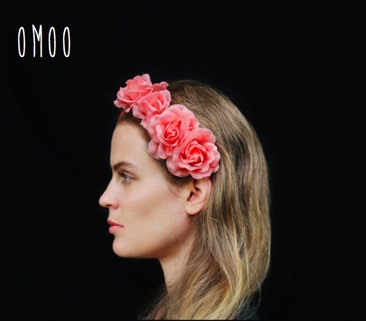

For her debut recording, Emilie Weibel decided to go it alone in the studio.  "Omoo" features her lovely soprano voice surrounded by sound samples, percussion, electronics, keyboards and, on the transcendent "L'Heure Exquiste" (a poem of Paul Verlaine set to music by Reynaldo Hahn), a music box.

Ms. Weibel, a native of Lausanne, Switzerland, has studied with Gretchen Parlato, Jen Shyu and Ralph Alessi. On pieces such as "River Song", one can hear the influence of Ms. Parlato in both the lead and backing vocals.  That influence shows again in the sweet reading of Wayne Shorter's "Footprints" (the arrangement is based on Marc Copland's 2005 version of the track while the lyrics are original) - here, the melody is supported by a thunderstorm and vocal percussion.  The title track, inspired by the Herman Melville novel and a song from the Babinga tribe of the Congo, also use water - here, the sound of waves lapping the shore - to support the vocal.  The overdubbed voices swell like waves striking the side of a boat.  "Hello Lea" shows the influence of Bobby McFerrin in her choice of sounds in the backing wordless vocals.  She has worked with French violinist Scott Tixier and based "Tu Dis (to my Dad)" on one of his compositions. The influence of "downtempo" music is evident on several cuts including the opening song "Lemania" where the synthesized drums rise out of the sounds of a quiet bay, complete with the wind pushing the water.

"Omoo", at just over 28 minutes, is still quite a fulfilling experience.  The voices, the delicate melodies, the incidental sounds, the richness of the aural soundtrack and the honesty of the creator's intent all stand out.  This music will not bowl you over but will seduce you; enter the world of Emilie Weibel and you'll be in a unique Wonderland.  For more information, go to www.emilieweibel.com.

Give a listen:

Saturday, March 15, 2014

The Next Roundup (Part 3 - Eric, Donald & Jon)

As an artist, bassist Eric Revis does not sit still.  He has been a member of the Branford Marsalis Quartet since 1997, has been touring and recording with guitarist Kurt Rosenwinkel for the past several years and is, with pianist Orrin Evans and drummer Nasheet Waits, an integral member of the cooperative Tarbaby.

Revis has also issued 3 CDs for Portugal's Clean Feed and each is different from the other. In 2012, he released "Parallax" with his 11:11 group featuring Ken Vandermark (reeds), Jason Moran (piano) and Mr. Waits.  2013 brought "City of Asylum", a trio date with pianist Kris Davis and drum master Andrew Cyrille, recorded the first time they got together.  For his new Clean Feed release, he recruited Bill McHenry (tenor saxophone), Darius Jones (alto saxophone) and Chad Taylor (drums, vibes) and created "In Memory of Things Yet Seen".  The results are attractive, blending fiery improvisations with introspective ballads, wailing saxophones with a thunderous rhythm section, and stately melodies with smart interplay.  Branford even shows up for a pair of tracks, the hard-driving "Unknown" and the rubato "FreeB."  The former features a solid beat from the rhythm section with the 3 saxophonists blowing strong while the latter is a short (2:37) but hot "free-for-all."

Revis's composition, "The Tulpa Chronicles", comes in 3 parts (cuts 1, 6 and 11) with the first, "Proem", opening the program on a meditative note, Taylor creating a trance-like feel with a 4-note figure on the vibes while striking a cymbal and the reeds delivering a quiet melody.  Part 2, "Ephemeral Canvas", builds off the simple cymbal rhythm for a handsome bass solo; halfway through the 2-minute piece, Taylor slams the tune into high gear and the reeds play an entrancing melody.  Part 3, "For Cordel "Boogie" Mosson", takes the forceful rhythm from Part 2 and expands upon it with great bowed bass and that fine melody line. (Cordel "Boogie" Mosson was the bassist in George Clinton's Parliament/Funkadelic, joining the band in 1971 - he passed in April of 2013 at the age of 60.)

The interplay of McHenry's tenor and Jones' alto works smartly atop the forceful bass presence and Taylor's hard-edged drumming. A piece such as "Son Seals" give the saxophonists plenty of room to blow but the arrangement leaves room for a bass solo and several tempo changes.  "Somethin's Cookin'" (composed by drummer Sunny Murray for his Untouchable Factor ensemble - the tune appears on 1976's "Wildflowers: The New York Jazz Loft Sessions") has the bass taking the lead and horns playing counterpoint while the drums dance and cymbals shimmer. McHenry composed the sweet ballad "3 Voices", notable for the conversational drum work and its quiet melody.  He also contributed the CD closer, "If You're Lonesome, Then You're Not Alone", another fine ballad with a melody one might hear coming from an Americana group.  Jones sole composition is "Hold My Snow Cone", an ironic title for such a melancholy tune. Taylor's funky "A Lesson Earned" has a soulful saxophone melody line, a throbbing bass line and a wicked beat.

The quartet fires on all cylinders as they attack Sun Ra's "The Shadow World." The piece opens with a forceful bass solo over Taylor's complimentary percussion. Just over 60 seconds into the song, the rhythm section sets a furious pace over which the saxophonists present the melody in a calm fashion before both men deliver incendiary solos.

"In Memory of Things Yet Seen" will certainly wake all your senses.  Eric Revis has proven over the course of his 5 releases as a leader that he can mesh strong melodic lines with rhythms that push the boundaries yet rarely dissolve into mere noise.  His new group and recording matches 2 saxophonists, each with his own individual "sound", with a rhythm section that works great together, whether "locked in" or working in counterpoint.  The quartet is currently on tour in Europe; when they return, the bassist hits the road with the Marsalis Quartet for 5 weeks.  Let's hope Eric Revis gets to take this fine group out to many cities in the US.  For more information, go to ericrevis.com.


Drummer Donald Edwards, born in New Orleans, studied music at Southern University in Baton Rouge and went on to be one of the more sought-after musicians in Louisiana.  After moving to New York City, he began working with musicians such as Tom Harrell, Conrad Herwig, Dave Holland, Stefon Harris and many others.  In the past few years, Edwards has recorded with pianist Orrin Evans, The Mingus Big Band, the Criss Cross label supergroup Opus 5 (with Seamus Blake, Alex Sipiagin, Boris Kozlov and David Kikoski) and pianist Joey Calderazzo.

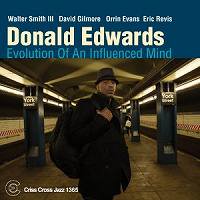
"Evolution of An Influenced Mind" is his debut as a leader for the Criss Cross label (his 3rd overall.)   The Quintet on the album includes pianist Evans, bassist Eric Revis, tenor saxophonist Walter Smith III and guitarist David Gilmore.   10 of the 11 tunes are composed by Edwards (the lone exception is "When", composed by the pianist) but don't expect this to be a loose conglomeration of jams linked by drum solos.  Edwards has a good ear for melody, making excellent use of his band.  One major exception is the opening track, "American Drum Call to Mama", which utilizes an overdubbed gospel choir with Edwards improvising below them.  "History of the Future" is next, an uptempo piece that utilizes electric piano to fill out the sound.  The rhythm section is quite active under the fine solos with Edwards getting his own spotlight 90 seconds before the close of the tune.

What's most impressive over multiple listenings is how each player is integral to the songs, whether it be the blend of electric guitar and tenor saxophone on the melody line of "Niecee" as well as Revis's strong support or the beautiful melody of "The Dream", with Evans' piano lines wrapping around the acoustic guitar.  The latter track is such a quiet piece yet the interplay is intense and shimmering.  The funky and sly "Dock's House" (Dock is the drummer's dad, a classical pianist) is a slippery dance piece with strong solos from Smith III, Evans and Gilmore.  "Not Really Gumbo" is a tribute to the Crescent City, more influenced by Astral Project than The Meters, displaying Edwards' mastery of poly rhythms.    During Evans' hearty piano solo, the drummer really drives the beat.  Gilmore's distorted guitar blends well with the electric piano and sax on "Nightmare of Fun" - there are several moments when Edwards joins in on the melody.  The rhythm section gets to romp on "The Essential Passion", Revis's hard-driving walking bass lines pushing the beat along with the leader's ride cymbal.   There's a strong r'n'b feel to "Culmination for Now", Smith III's smoky tones a good match for the sustained tones of Gilmore's electric guitar.

"Evolution of An Influenced Mind" may not take hold on your first listen but you'd be wise to let the music soak in.  The pieces that Donald Edwards composed and arranged for this session favors no one player and it's the sense that this is a unified group that clearly comes through.  On top of all that, Edwards is a mighty fine drummer and, when paired with bassist Eric Revis, truly commands your attention.  For more information, go to donaldedwards.com.  


Saxophonist Jon Irabagon is one busy musician.  Over the past 2 years, he has toured and recorded with Mostly Other People Do The Killing, done the same with trumpeter Dave Douglas, with Mike Pride's From Bacteria To Boys, guitarist Mary Halvorson's Septet, drummer Rudy Royston's 303, and drummer Barry Altschul's 3Dom Factor.  He has started his own label - Irabbagast Records - and released 2 different yet entertaining CDs.

In June of 2013, he traveled to Germany with Mr. Altschul and bassist Mark Helias to play at the Peitz Jazz Festival.  Armed with 8 of his compositions, the band played a strong set which is now being released on the saxophonist's label in conjunction with the German Jazzwerkstatt label. Irabagon is no stranger to the trio setting, having recorded "Foxy" with Mr. Altschul and bassist Peter Brendler, a multi-sectioned 79-minute CD with no breaks.  The new album,
"It Takes All Kinds", is not as "hard-core" as "Foxy" but just as fiery.  The rhythm section is electric, with Mr. Helias providing a solid foundation (and excellent melodic work) and Mr. Altschul at the top of his game.  The drummer can be subtle (his kit work on "Elusive" is stunning, especially when he enters in the middle of the long bass solo) and he can forceful (as he displays on the opening "Wherewithal".) The manner in which the drummer drives "Pause and Flip" is exhilarating. When the song breaks for the bass solo, Mr. Altschul "colors" beneath Mr. Helias and then allows him to go it alone.  When he and the saxophonist re-enter, the energy level immediately fires back up and then slowly dissipates - the 3-way conversation is a highlight of the concert.  The bassist is often cast here in the role of the timekeeper, allowing the drummer to accent, insinuate, and act as counterpoint to the leader's solo work.  Mark Helias is one of the more melodic players on the scene but he also has a percussive side - listen how he opens "Sunrise", going from an intense series of phrases to becoming so quiet. When Irabagon enters, the rhythm section is so restrained, just right for the lovely melody.

The cover image of Don Quixote with Sancho Panza might make one think that the music contained on "It Takes All Kinds" is fraught with peril, loaded with pitfalls.  But, Jon Irabagon, along with Barry Altschul and Mark Helias, has created music that is full of life, with close interactions, with humor and and fun.  This is living music that deserves to be heard live.  In the meantime, grab ahold and enjoy the ride.  For more information, go to www.jonirabagon.com.