Showing posts with label Jim McNeely. Show all posts

Monday, June 24, 2024

Challenges, Changes, and New Avenues for Expression


Photo: Shervin Lainez
In 2021, in the midst of the Pandemic, composer and producer Ryan Truesdell was worried about the future of the Big Band, a genre he has been quite committed to for a long time.  He changed his focus and decided to commission a number of big band composers to write pieces for string quartet.  Truesdell then worked with cellist Jody Redhage Ferber to help him think through the project and to advise on which musicians to invite into the studio to record what turned out to be 17 new pieces for string quartet plus, in several instances, additional instrumentation. He did not give the composers any restrictions but did invite them into the studio to work with the musicians who were interpreting their work.

The results of the experiment can be heard on "Ryan Truesdell Presents: Synthesis: The String Quartet Sessions" released through ArtistShare. Besides recording three of of his own string quartet pieces, the producer, who is the Manager of the Bob Brookmeyer Music Estate, used a work that the St. Louis Symphony had commissioned from the late trombonist-composer (1929-2011) but never recorded. Anyone who listens to contemporary Big Band music will recognize Jim McNeely, John Clayon, Christine Jensen, John Hollenbeck, Alan Ferber, Dave Rivello, and, perhaps, Miho Hazama but Truesdell also invited younger composers such as Joseph Borsellino III, Nathan Parker Smith, Vanessa Perica, and Asuka Kakitani. Producer and arranger extraordinaire Oded Lev-Ari debuts a new work as does bassist Rufus Reid, who premieres his "String Quartet #1". 

Photo: Leo Mascaro
How should one approach "Synthesis", a three-CD set containing nearly three hours of music? One obvious answer is with "open ears and an open mind" but that's too easy. You literally have to set aside that these composers, many of whom you've heard in large instrumental ensembles are working with a much different palette. As stated above, there are a few additions to the Quartet; clarinetist Anat Cohen is the main soloist on Truesdell's "Suite for Clarinet and String Quartet", bassist Jay Anderson joins a Quartet on Truesdell's "Heart of Gold", composer Borsellino III uses pre-recorded synth tracks on his "Paper Cranes", and Hollenbeck adds marimba, drums, and piano (not all on the same movements) to different movements of his seven-part "Grey Cottage String Quartets" that closes the album.  The Brookmeyer piece was written for and is performed by a string trio.

Photo: Leo Mascaro
There are pieces that have impressive rhythmic flow (the album opener "Where Can You Be" by Mr. Parker Smith Ms. Hazama's "Chipmunk Timmy's Funny Sunny Day", and Ms. Jensen's "Tilting World") and others that have moments where time is suspended or fractured (the "#1 Movement" of Mr. Reid's "String Quartet #1", Mr. Lev-Ari's "Copycat" movement of "Playground", and Mr. Rivello's "1. "Sorry" section of "Two Reflections for String Quartet". Several of the works jump out on first listening including Mr. McNeely's "Murmuration and Adagio", the leader's lovely "Dança de Quarto" and his four-part "Suite for Clarinet and String Quartet", and Ms. Kakitani's "Melt".

Photo: Dina Regine
This project owes much of its success to the brilliant musicians who interpreted the variety of styles, genres, ideas, and desires of the composers.  Violinist Sara Caswell appears on every track while cellist Redhage Ferber appears on all but two (she's replaced by Noah Hoffeld). The second violin chair features either Joyce Hammann or Lady Jess (who tours with Beyoncé as well as with her husband Jay-Z). Violist Lois Martin performs on the majority of the album save for the three times she is replaced by Orlando Wells.  

Perhaps that's the best way to enter into this glorious project: just listen to the musicians. Throw aside expectations and comparisons. Dive in, test the musical waters – take your time but also make the time to go back and really allow the music to move you out of the everyday and into its special worlds. 

As stated above, "Ryan Truesdell Presents: Synthesis: The String Quartet Sessions" is only available through ArtistShare.  Go to www.synthesissqs.com/ for more information. To learn more about Ryan Truesdell, go to https://ryantruesdell.com/.

Here's a little morsel:


Monday, April 22, 2019

Saturday's Sounds (Live 4/27/19)

Photo: Ben Knabe
Composer, arranger, educator, and pianist Jim McNeely is one of the busier people in jazz.  Currently, he serves as music director for the Frankfurt Radio (HR) Big Band and teaches at both the Manhattan School of Music (NYC) and William Paterson University in New Jersey.  He has played and composed for the Thad Jones-Mel Lewis Orchestra which became the Mel Lewis Jazz Orchestra (after the drummer's death, the organization became the Vanguard Jazz Orchestra). He toured with Stan Getz plus had tenures leading the Danish Radio Big Band and the Swiss Jazz Orchestra.

Hard to believe but it's nearly two decades since Jim McNeely created "Group Therapy" for his Tentet. Released on the forward-looking OmniTone label, the composer and pianist gathered 10 New York City-based musicians and recorded the eight-song program that includes five McNeely originals plus three exciting arrangements of songs by Bud Powell, John Coltrane, and the oft-recorded standard "Body and Soul" (music composed in 1930 by Johnny Green).  The ensemble included saxophonists Billy Drewes, Dick Oatts, and Scott Robinson, two trumpets (Tony Kadleck, Greg Gisbert or Scott Wendholt), Tom Varner on French horn, trombonist Ed Neumeister, bassist Cameron Brown, drummer John Hollenbeck (a veteran of Bob Brookmeyer's New Art Orchestra and the Meredith Monk Ensemble as well as his own groups), and the leader on piano.

Photo: New Jersey Star-Ledger
Jim McNeely brings the 2019 version of the Tentet to Wesleyan University's Center for the Arts/Crowell Concert Hall this Saturday as the featured group for the Wesleyan Jazz Weekend. The concert begins at 7:30 pm. The festivities open the night before with a free concert featuring the Wesleyan Jazz Orchestra, Jay Hoggard director, and the Wesleyan Jazz Ensemble, Noah Baerman director. The WJO will also open Saturday's show.

For tickets and more information, go to wesleyan.universitytickets.com/w/event.aspx?id=2924&p=1.

Give a listen to an interview with Mr. McNeely, Jay Hoggard, and CFA Director of Arts Communication Andy Chatfield.


Brian Charette, a native of Meriden, CT, returns to the state Saturday with his "electric" trio Kürrent to play two sets at The Side Door Jazz Club in Old Lyme. Charette and Kürrent - Jordan Young (drums) and Ben Monder (guitar) - released its debut album in July of 2017.  The "fusion-jazz" recording, with Charette on organ, synths, electric keyboards, was a departure from his organ trio recordings on Posi-Tone and his Sextette disks for SteepleChase.  Young and Charette are old friends and musical partners so the drummer is not afraid to challenge the leader to "go for it."  Monder, who plays such tasty accompaniments, steps out now and then to great effect; he does not always "shred" yet there is great energy in his playing.

For the Old Lyme gig, Vic Juris steps in for Monder bringing his own delightful take on jazz guitar.  Juris, who has worked alongside Dizzy Gillespie, Jimmy Smith, Sarah Vaughan, Nancy Wilson, and Dave Liebman, has recorded numerous albums as a leader and sideman for SteepleChase including the organist's collaboration with tenor saxophonist George Coleman.  He plays with both power and elegance so he should fit right in with Charette and Young.

Kürrent will play two sets with the first starting at 8:30 p.m.  For more information, go to thesidedoorjazz.com  or call 860-434-2600.

To learn about Brian Charette, go to www.briancharette.com.


Tuesday, October 16, 2018

Impressive Music from Earlier this Year (Pt 1)

The joy of teaching (for me, it is quite a joy) always gets in the way of reviewing. With the weekly influx of albums, worthwhile music gets pushed to the back of the shelf.  Such is the case with these two albums. As the great Charlie Parker so nicely stated on his 1945 Savoy recording, "Now's the Time"!

Photo: The Fresno Bee
As someone who has been a fan of poet Philip Levine (1928-2015) for over three decades, when the album "The Poetry of Jazz" (Origin Records) arrived in the mail in early March of this year, I was thrilled. This collaboration with alto saxophonist and composer Benjamin Boone began in 2010 when Boone met the poet on the campus of Fresno State University in California.  Levine was a "jazz poet" throughout his career, his collections peppered with poems about Erroll Garner, Charlie Parker, John Coltrane, and others.  I once saw and heard Levine read at Wesleyan University in a duo setting with a vibraphonist, a fascinating combination of melody, words, and rhythm.

For their collaboration, Boone composed music to fit Levine's words and his voice. He surrounds that voice on most tracks with the fine rhythm section of David Aus or Craig Von Berg (piano), Spee Kosloff or Nye Morton (acoustic bass), and Brian Hamada or Gary Newmark (drums) plus a slew of guests.  Many listeners will be attracted by the appearance of tenor saxophonist Chris Potter on "The Unknowable (Homage to Sonny Rollins)", trumpeter Tom Harrell on "I Remember Clifford (Homage to Clifford Brown)", alto saxophonist Greg Osby on "Call It Music (Homage to Charlie Parker)", and tenor saxophonist Branford Marsalis on "Soloing (Homage to John Coltrane)" - those songs are fascinating with great playing from all involved supporting poems that speak to the joy of the musicians they pay tribute to.

Yet, there are many other treasures on this 14-song program.  The sweet homage to "Yakov", an immigrant whom the poet met as a young man working in an automobile factory in Detroit. Boone contributes a wonderful soprano saxophone solo, keening high above the band withy support from the trumpet of Max Hembo.  One of Levine's most famous poems (a poem he wrote in 1968, a year after the riots in Detroit), "They Feed They Lion", arrives in a frenzy of soprano saxophone, trumpet, and French horn (the brass played by Boone's sons Atticus and Asher) - it's a riot of sound and fury.

Nat'l Endowment for the Arts
The album closes with "What Work Is" (another of Levine's most famous works as well as the title of one of collections), a lovely recollection of the poet's older brother who worked on the third shift at the Cadillac factory while studying opera during the day.  It's a stunning piece, especially with Boone's alto saxophone wrapping around Levine's voice, a handsome way to end a powerful program.

If you have never encountered the poetry and essays of Philip Levine, please check him out. Benjamin Boone is a new name to me.  A native of North Carolina, he studied at the University of Tennessee and did graduate work at Boston University and University of South Carolina. He has performed in many countries around the world and did work as a Fulbright Scholar in both the former Soviet Republic of Moldova and in Ghana.  This album was recorded at four different sessions over the course of two years (2012-2014), then took a while to find a home and was finally released in late March of this year.  Find the album, dig into the program, go back to the music and to the poetry, and celebrate this brilliant collaboration.

For more information, go to www.benjaminboone.net.  To learn more about Philip Levine, go to www.poetryfoundation.org/poets/philip-levine.

Here's a listen:


"New York Stories" (Sunnyside Records) is a delicious collaboration featuring the words and voice of Judy Niemack, the arrangements of Jim McNeely, and the powerful playing of the Danish Radio Big Band. The nine-song program was actually recorded/broadcast in November of 2013 but not released until August of this year (Ms. Niemack's second CD for Sunnyside).  Her supple voice, fine scat singing, and intelligent lyrics pay homage to how the blues influenced jazz, telling stories splendidly framed by McNeely.

The title track is an episodic journey to the vocalist's current residence. Note how the beat changes from the bluesy, even sultry opening section, getting "funky" in the middle as the brass and reeds play phrases from the oeuvre of Thelonius Monk and Charlie Parker. Five of the nine come from Monk. First, the ensemble digs into "In Walked Bud" which carries the name "Suddenly" and spotlights the lyrics of the late Jon Hendricks. It's one of the first arrangements McNeely wrote for Ms. Niemack (1993) and one can understand why the vocalist loves it.  It allows her to be sassy and for her voice to move in and out of the sections before and after the solos.  Elsewhere, Ms. Niemack and Mr. McNeely turn "Misterioso" into "A Crazy Song to Sing"; the opening would fit one of Alfred Hitchcock's movies but once the vocalist enters, the piece turns brighter. Slowly but surely, the music becomes a journey into the blues and then into big band euphoria.

The album also includes the vocalist's take on Clifford Brown's "Daahoud", here titled "I Should Have Told You Goodbye" - she most certainly captures the joy in Brown's music and joins in on the soloing with her vocal flight of fancy. The ensemble inhabits the reading of Sting's "Fragile", a plea for peace in the war-torn areas of Central America.  Accompanying Ms. Niemack's articulate vocal is an arrangement that lifts off from the rhythm section to places where the brass and reeds dance together that is both emotionally and melodically rich.

The album closes with the appropriately placed "It's Over Now", a delight-filled journey through Monk's "Well You Needn't".  Everybody jumps from the get-go with the rhythm section kicking along as the sections respond and retort to the soloists.  It's so much fun that it makes this listener want to go back to the beginning of the disc and start the 75-minute merry-go-round one more time.

"New York Stories" is an aural treat, a celebration of music that puts the spotlight on the voice and words of Judy Niemack and the delightful arrangements of Jim McNeely.  Kudos to the Danish Radio Big Band (musicians listed below) whose involvement helps to make this journey such an excellent one!

For more information, go to www.judyniemack.com.

Here's the closing track:


Personnel:

Jim McNeely - arranger, conductor 
Judy Niemack - vocals 
Anders Gustafsson - 1st trumpet 
Christer Gustafsson - 2nd trumpet 
Thomas Kjaergaard - 3rd trumpet 
Mads La Cour - 4th trumpet 
Lars Vissing - 5th trumpet 
Vincent Nilsson - 1st trombone 
Steen Nikolaj Hansen - 2nd trombone 
Peter Jensen - 3rd trombone 
Annette Saxe - 4th trombone 
Jakob Munck Mortensen - 5th trombone 
Nicolai Schultz - 1st alto sax 
Peter Fuglsand - 2nd alto sax 
Hans Ulrik - 1st tenor sax 
Frederick Menzies - 2nd tenor sax 
Anders Gaardmand - baritone sax 
Per Gade - guitar 
Nikolaj Bentzon - piano 
Kaspar Vadsholt - bass 
Søren Frost - drums

Monday, January 29, 2018

Visions, Dreams, and Realities

What a treat to immerse oneself in a big band recording!  To hear how the different sections work together and independently, how the solos are built upon such elegant and intelligent foundations, how melody leads to counterpoint, how rhythm leads to interaction, how the composer and arranger utilizes all these voices to tell his or her story, all this and more is exciting to these ears.  The sound of the big band in jazz has grown from the primitive yet really sophisticated work of Edward Kennedy "Duke" Ellington and Fletcher Henderson in the 1920s and 30s, from the "territory" dance bands of Benny Moten and Count Basie, the high-powered swing of Benny Goodman and Chick Webb, the smoother sounds of the Dorsey Brothers (together and separately) and Glen Miller and beyond.  The work of Gil Evans with and without Miles Davis in the 1950s and 60s as well Gerry Mulligan and Bob Brookmeyer paved the way to the work of Maria Schneider, John Hollenbeck, Alan Ferber, Ryan Truesdell (in his case, Gil Evans) and a number of younger voices such as Darcy James Argue, Ayn Inserto, and more.

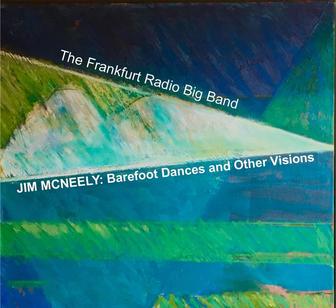
 Jim McNeely (born 1949) grew up (musically) in the 1970s, working with the likes of the Thad Jones/Mel Lewis Orchestra, Phil Woods, and Stan Getz.  After Thad Jones moved to Europe, he began working with the Mel Lewis Orchestra and soon discovered how much he loved arranging and writing for big bands.  Mentored and employed as a pianist by Bob Brookmeyer, McNeely learned much and soon began working with big bands such as the Vanguard Jazz Orchestra, the Carnegie Hall Jazz Band, the Danish Radio Big Band, and, since 2008, has been the chief conductor of the Frankfurt Radio (HR) Big Band. That group is featured on his new album "Barefoot Dances and Other Visions" (Planet Arts), a stunning and highly enjoyable seven-song suite that speaks to the composer's relationship with these musicians and their myriad abilities.

What composer McNeely envisioned was a song cycle that pulled together a number of story-lines, from the celebration of Mr. Brookmeyer that opens the album, the playful and ebullient "Bob's Here", to the somber, wistful yet a bit bouncy ballad "A Glimmer of Hope" to the wondrous swing of "Redman Rides Again" (a tribute to the arranging style and adventurous nature of Don Redman (1900-1964) - the stunning interaction on the last track mentioned between the clarinets of Heinz-Deiter Sauerborn, Stefan Weber, and Rainier Heute with the electronically manipulated clarinet of Oliver Leicht is flat-out brilliant.


When you listen to program, notice the brilliant foundations laid down by bassist Thomas Heidepriem, how the electric guitar work of Martin Scales is so important to both the power and direction of certain pieces, the amazing work of the brass and reeds, and how drummer Jean Paul Höchstäder is the linch-pin for so much of the music - his power, his push, his fills - just the way he dances underneath trombonist Günter Bollman and the rest of the band on the title track is life-affirming. As you work your way back through the music, you'll hear soloists such as trombonist Peter Fell, tenor saxophonist Tony Lakatos, and trumpeter Axel Schlosser maneuver through the arrangements to create memorable solos.

With exception of his work with the Vanguard Jazz Orchestra (also released on Planet Arts as well as New World Records), "Barefoot Dances and Other Visions" is only other large ensemble work by Jim McNeely to be issued on an American label. This is music that should be heard - like the best work of the afore-mentioned composers and arrangers (Ellington, Brookmeyer, Schneider), the music builds off the past but is clearly of its day. This is also music that speaks of the creativity of the American musical experience, when freedom, creativity, talent, and the curiosity to see how one can continue to move forward collide to create art.  Plus, it's great fun from the opening minute right to the end!

For more information, go to www.jim-mcneely.com and to www.hr-bigband.de/english/index.html. The latter site has several concert videos (not of the music on the new CD but of collaborations with bassist Dave Holland and vocalist Gretchen Parlato).  

Personnel:
​THE BAND
Heinz-Dieter Sauerborn--Alto Sax, Soprano Sax, Flute, Alto Flute, Bass Flute, Clarinet
Oliver Leicht--Alto Sax, Clarinet, Flute, Alto Clarinet, Alto Flute
Tony Lakatos--Tenor Sax, Flute, Alto Flute
Steffen Weber--Tenor Sax, Flute, Clatinet, Bass Flute
Rainer Heute--Baritone Sax, Bass Clarinet, Alto Flute
 
Frank Wellert--Trumpet, Flügelhorn
Thomas Vogel--Trumpet, Flügelhorn
Martin Auer--Trumpet, Flügelhorn
Axel Schlosser--Trumpet, Flügelhorn
 
Günter Bollman--Trombone
Peter Feil--Trombone
Christian Jaksjø--Trombone, Valve Trombone
Manfred Honetschläger--Bass Trombone
 
Martin Scales--Guitar
Peter Reiter--Piano
Thomas Heidepriem--Bass
Jean-Paul Höchstädter—Drums


The Diva Jazz Orchestra, founded in 1992 by Stanley Kay after he conducted a band with Sherry Maricle as its drummer, is celebrating its birthday and continued existence with the "25th Anniversary Project", a smashing new recording produced and released through ArtistShare.  Instead of focusing on earlier works or standards, music director Ms. Maricle asked members of the all-women group to submit new works.  She brought two pieces to the project and eight other members have one each.  A number of these musicians and composers have busy careers outside the band but they have brought their best to this effort.


By this time, most people have gotten over the novelty of the "all female big band" and can concentrate on how good this music (besides, when one is listening to a recording, can you tell if it's a woman or a man playing - and does it matter at all?)  The program opens with the rollicking "East Coast Andy" composed and arranged by baritone saxophonist Leigh Pilzer (also a member of the Smithsonian Jazz Masterworks Orchestra) - the song is a spunky romp a la the Basie Orchestra with fine solos from the composer and trumpeter Jami Dauber. Clarinetist/tenor saxophonist Janelle Reichman blends Eastern European sounds and chords with a lively Latin rhythm on "Middleground" (co-arranged with bassist Noriko Ueda) - it's a delight to hear how the sections add to the melody section before pianist Tomoko Ohno dances over the rhythm section. Then, Ms. Reichman takes off with the reeds and brass playing counterpoint.  All the while, the bass and drums keep the piece percolating.

Every track as its standout moments. There is the delightful double trumpets solo (Leisl Whitaker and Barbara Laronga) on "Jami's Tune" and the powerful tenor saxophone statement by Erica von Kleist on "Darkness of the Matter" (composer Sara Jacovino adds a hardy trombone solo as well).  Ms. Maricle's lovely ballad "Forever in My Heart" features a handsome melody by Rachel Therrien on flugelhorn plus intelligent fills from the reeds and brass (excellent baritone sax work from Ms. Pilzer underneath).  The drummer also contributed the final track, aptly titled "The Rhythm Changes", which has a dazzling opening theme that breaks into exciting solos from trumpeter Laronga and alto saxophonist Mercedes Beckman.  Both bassist Ueda and drummer Maricle take short solos with the reeds and brass adding occasional "shout" phrases or bluesy riffs - the scramble at the end of the piece that leads back into the opening melody takes the album on a triumphant note.

Diva Jazz Orchestra may be 25 years old but this album sounds fresh and on target.  There's neither a weak tune nor boring solo in the 65-minute program. Yes, you can hear echoes of Count Basie, touches of Duke Ellington, a bit of Woody Herman but they are just that - echoes.  What truly stands out is how strong this music, how much fun the musicians are having as an ensemble, and how positive the listening experience is.  Happy "25th Anniversary Project"!  Here's to many more.

For more information, go to divajazz.com.

Personnel:
Alexa Tarentino: alto and soprano saxophones
Mercedes Beckman: alto saxophone, flute, clarinet
Janelle Reichman: tenor saxophone, clarinet
Erica von Kleist: tenor saxophone
Leigh Pilzer: baritone saxophone, bass clarinet
Leisl Whitaker: trumpet, flugelhorn
Jami Dauber: trumpet, flugelhorn
Rachel Therrien: trumpet, flugelhorn
Barbara Laronga: trumpet, flugelhorn
Jennifer Krupa: trombone
Sara Jacavino: trombone
Leslie Havens: bass trombone
Tomoko Ohno: piano
Noriko Ueda: acoustic bass
Sherry Maricle: drums, music director
with guest soloist Marcia Gallas on one track