Friday, March 8, 2013

Winter Afternoon Reverie

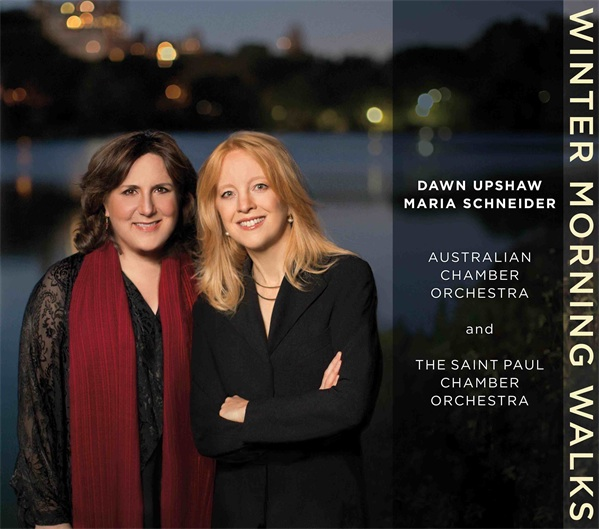
Several years ago, I read that soprano Dawn Upshaw has commissioned composer/band leader Maria Schneider to write new pieces for her.  The 2 suites, "Winter Morning Walks" and "Carlos Drummond de Andrade Stories", are written for voice and chamber orchestra with the first work also featuring bassist Jay Anderson, pianist Frank Kimbrough and Scott Robinson (alto clarinet, bass clarinet.) The works were debuted in 2008 and, in 2011, Ms. Schneider launched an ArtistShare campaign to commit the pieces to record.

For those who participated in the campaign, the recording, also titled "Winter Morning Walks", arrived this week.  If you are familiar with the music Ms Schneider creates for her orchestra, this is quite a different experience. Not just because this music for voice or that the majority of the musicians come from either the Australian Chamber Orchestra or the Saint Paul Chamber Orchestra; no, the 14 tracks are fairly compact (only 2 clock in at over 6 minutes and there are 2 under 2 minutes.)  The title suite features 9 poems from Ted Kooser (born 1939 in Ames, Iowa, he now lives in Nebraska) written in 1998-99 as the poet was recovering from cancer surgery and the subsequent radiation treatments.  The poems Ms.Schneider selected do not deal with illness or recovery but with living and love.  The 4 poems that make up the second suite come from the Brazilian poet Carlos Drummond de Andrade (1902-87) - there is also a "Prologue" on which Ms. Upshaw supplies the wordless vocal.  The vocalist, whose career has been put on hold twice in the last 7 years as she, too, recovered from cancer surgery, is in wonderful voice throughout.

This is a not a review but I felt the need to write about the recording in the aftermath of having to cancel classes today as our state was hit with 12 inches of snow.  I found the time to sit and absorb the music and then, as I surfed the web later in the day, came across an October 2012 interview (audio and video) from Minnesota Public Radio. Taped as Ms. Schneider was in Minnesota recording the "...de Andrade Stories", the (nearly) 60 minutes she spends with interviewer Daniel Gilliam is filled with talk of birds, composing, her influences, the new music for the recording, ArtistShare and much more.  It's quite delightful - see and hear the conversation by going to ht.ly/ix1RP.  To find out more about Maria Schneider and her wonderful and wonder-filled music, go to www.mariaschneider.com.

Here are 2 poems, one each from Ted Kooser and Carlos Drummond de Andrade:


Spring, the Sky Rippled with Geese
Spring, the sky rippled with geese,
but the green comes on slowly,
timed to the ticking of downspouts.
The pond, still numb from months
of ice, reflects just one enthusiast
this morning, a budding maple
whose every twig is strung with beads
of carved cinnabar, bittersweet red.
(Ted Kooser, from "Winter Morning Walks: 100 Postcards to Jim Harrison", Carnegie Mellon University Press, 2001)
Quadrille
John loved Teresa who loved Raymond
who loved Mary who loved Jack who loved Lily
who didn’t love anybody.
John went to the United States, Teresa to a convent,
Raymond died in an accident, Mary became an old maid,
Jack committed suicide and Lily married J. Pinto Fernandez
who didn’t figure into the story.


(Carlos Drummond de Andrade, translated by Mark Strand, from "Looking For Poetry: Poems by Carlos Drummond de Andrade and Rafael Alberti and Songs from the Quechua" Knopf Publishing, 2002

Thursday, March 7, 2013

More Pianos and A Touch of Classy Saxophone

After listening several times to the fine new recording from pianist Aaron Diehl, "The Bespoke Man's Narrative" (Mack Avenue), I realized how much this project reminds me of the work of the late composer/pianist John Lewis (1920-2001).  Lewis, perhaps best known as the founder of the Modern Jazz Quartet, had a long and illustrious career.  He wrote and performed with Dizzy Gillespie's Big Band in the 1940s and recorded with Miles Davis on "The Birth of the Cool." He played "Third-Stream" music with Gunther Schuller, helped to form the American Jazz Orchestra in 1985 and taught students through most of his adult life.

The instrumentation of Diehl's group mirrors that of the MJQ with Warren Wolf (vibraphone on 7 of the 10 tracks) and the highly-interactive rhythm section of David Wong (bass) and Rodney Green (drums).  The material is a blend of originals, standards and a trio arrangement of the "Forlane" or "3rd" section of Maurice Ravel's "Le Tombeau de Couperin."  That final piece is the longest on the CD, nearly 11 minutes, and is a tour-de-force, especially the interaction of the piano, bass and drums.  The trio also offers a stately version of George Gershwin's "Bess, You Is My Woman Now"; the blend of Diehl's articulate piano lines and Wong's bowed bass atop the strong brush and cymbal work of Green is dynamically charged and so arresting. There is a sparkling quartet performance of "Moonlight in Vermont", with Wong's bass leading the way once more in the "intro" and chorus sections.   To heighten the comparison with the MJQ, there's a bluesy romp through Milt Jackson's "The Cylinder" (Jackson was the vibraphonist in that band, though this piece was not part of its repertoire.)

The young pianist (26 at the time of this recording) offers a splendid solo version of Duke Ellington's "Single Petal of a Rose" (from "The Queen's Suite".)  The dynamic variation, the intelligent use of silence in the verses, and the stunning, rippling, piano lines in the bridge of the song can put the listener in a reverie.

Among the original works are the playful "Stop and Go" (replete with abrupt changes of tempo), the driving "Generation Y" (the rhythm section work is exemplary) and the sweet ballad "Blue Nude."  On that last track, Wolf's sustained notes ring out over the piano, bass and drums. Diehl's elegant comping and stately solo, Green's "conversational" drums work and Wong's "walking" bass lines are as sweet as they are subtle.  "Prologue" and "Epilogue" (logically) open and close the program, first setting up the dynamics between the players and then serving to sum up the proceedings.  The bluesy and playful quality of the final track makes one want to go right back to the beginning.

"The Bespoke Man's Narrative" looks good, sounds good and is good.  Aaron Diehl, who has won a number of awards, could have made this recording all about his magnificent technique; instead, this is a definitely a "group" recording with all the musicians having their say in the success of this musical effort. I did not read the "press packet" until after I wrote the first draft of the review but the interview with the pianist mentions his connections to John Lewis, Ahmad Jamal, Kenny Kirkland and others. One can certainly hear those connections but one also hears a fresh, young and creative musician at work and play, adding his "voice" to the continuum of the tradition.  For more information, go to www.aarondiehl.com.


Although "Fun House" (Songlines Recordings) carries the by-line of the Benoît Delbecq and Fred Hersch Double Trio, one can and should view this fine program as a sextet date.  Yes, there are 2 rhythm sections - Steve Argüelles (drums, live electronics) and Jean-Jacques Avenel (bass) +  Mark Helias (bass) and Gerry Hemingway (drums) - but this is neither a "blowing" or "cutting" session.  Don't expect classy or clever re-arrangements of standards; Delbecq is the producer, he composed or co-composed all the material save for Ornette Coleman's "Lonely Woman" that closes the session and it's his vision that sets the pace.That's not to intimate that Hersch is either a bystander or session player. The arrangement is such that one can not tell who is playing what at any given time (save for the instances of Argüelles' electronics.   So, toss away those expectations, relax and dig into this program.  

These pieces are more than songs, more than melodies - they are "creative conversations", musical
interactions that blur the lines between compositions and improvisations so one should not listen for particular solos but how the music moves - literally - flows from beginning to end.  One can concentrate on the bass counterpoint alongside the pianos in 'Ronchamp" and the blues-drenched piano intro to  "Fun House" that opens to a piece that seems like a meditation on the music of George Gershwin (but 
don't miss the playful percussion or the 2 bassists conversing after the halfway point.)

That's the approach to take with this CD. Let it play through, then go back, if you like, to concentrate on how Delbecq and Hersch interact or the interplay of the bassists or how both percussionists take different but complementary approaches to their contributions.  Remember that musicians "play" as they create and it's that sense of "playing" that inhabits "Fun House" - there are many serious moments but no angst, no over-wrought emotions.  For more information, go to www.songlines.com and search for this CD on the "Catalogue" page - release date is March 12, 2013 but it is already available on iTunes, Amazon.com and emusic.com.


Saxophonist Eric Alexander is a musician who has, to my ears, has absorbed a myriad of influences and truly found his own sound.  Critics may point to his slew of recordings as a leader (34 in 21 years) or his work in One For All (17 CDs in 16 years) and say he rarely steps outside his comfort zone - I say "so what?"  If you pay close attention to his playing, his choice of material and the arrangements, what stands out is his consistency and lack of cliche (not easy for a tenor saxophonist playing "mainstream" jazz.

"Touching" (HighNote Records) is CD #35 and features his long-time associates John Webber (bass), Joe Farnsworth (drums) and the irrepressible Harold Mabern on piano (who never allows this music to become maudlin or predictable.) The program, all ballads per request of Executive Producer Joe Fields, ranges from works by Michel LeGrand to John Coltrane to the r'n'b classic "Oh Girl."  Typical to their personal traditions, Alexander and Mabern (who first encountered the saxophonist as a student over 2 decades ago), the material and arrangements are anything but staid. "Central Park West", the beautiful Coltrane melody, has a pleasing "soul music" feel (although the bass solo seems out of place) and Alexander truly digs into his solo. "I'm Glad There is You" is from the pen of Jimmy Dorsey has been recorded by a slew of artists.  After a long reading of the theme, Mabern steps out over Farnsworth's classy brush work and delivers a joyful and playful solo.  Alexander's solo is also playful but really builds off the melody.  "Gone Too Soon", first recorded by Dionne Warwick in 1983 and made even more popular by Michael Jackson in 1991 (the song appears on the "Dangerous" album), is a lovely piece; Alexander finds the emotional heart of the piece and plays without over-sentimentalizing the music.

One of the highlights of the recording is the piano/saxophone duet on "Dinner for One Please James", a piece long associated with Nat "King" Cole.  Mabern's stride-like piano backing is the perfect accompaniment for the saxophonist's handsome and, yes, playful romp through the verses.

Recorded by legendary engineer Rudy Van Gelder in his classic New Jersey studios, "Touching" has much to recommend it to the fan of good music (although the mix tends to be obscure Webber's bass lines in the favor of Farnsworth's drums and cymbals.)  Messrs. Alexander and Mabern make these songs come alive by respecting the melody and injecting their improvisatory spirit.  For a taste of this music, go to soundcloud.com/highnote-savant-records/.

Wednesday, March 6, 2013

March Lions and Lambs (on record and on-stage)

New York Voices - Kim Nazarian, Lauren Kinhan, Damon Meader and Peter Eldridge - celebrates its 25th anniversary this year. Over the past quarter-century, the quartet has toured the world playing with big bands, orchestras and small combos and conducting vocal workshops.  They've only released 1 CD in the 21st Century while pursuing individual careers but, when they come together, magic occurs. Give a listen to "Live With the WDR Big Band Cologne" (Palmetto Records), a 76 minute live concert recorded in May of 2008, and you'll be impressed by NYV's range. Also impressive are the excellent arrangements, courtesy of Michael Abene, and the splendid musicians who appear on all but 1 of the 10 tracks (the Voices do a wonderful a cappella take of "Almost Like Being In Love.")

The repertoire ranges from 2 pieces from the pen of Paul Simon, several "standards", 2 originals and 1 piece from Annie Lennox. The program opens with a bluesy take of Simon's "Baby Driver", complete with distorted guitar (Paul Shigihara) and a rousing lead vocal from Eldridge. Though the lyrics are a touch "space-y", every one swings the heck out of the piece.Following that is a sweet take on Oliver Nelson's "Stolen Moments" (lyrics by Mark Murphy) with the Voices blending and several fine solos (trombonist Ludwig Nuss and alto saxophonist Heiner Wiberny).  Ms. Nazarian leads the Voices and the Band through a high-powered reading of "In the Wee Small Hours of the Morning", the highlight of the first half is an exciting tenor solo from Paul Heller; then, the piece slows down for the Voices to caress the melody and harmonies. Swing reappears on a rousing reading of Jimmy Van Heusen's "Darn That Dream".  After Eldridge's take on the lyrics, there are 3 strong solos including a hearty "scat" from Meader.  The CD closes in a Latin vein with a long, high-powered, romp through "The Sultan Fainted" (an Eldridge-Meader original), complete with fiery solos from Olivier Peters on EWI, Meader scatting once more, and Frank Chastenier on acoustic piano, followed by a solo exchange featuring Hans Dekker on drums and percussionist Pernell Saturnio.

The way the New York Voices work together is mighty impressive, weaving their individual voices in and out of the mix, never sounding phony or academic.  Abene's arrangements work seamlessly alongside the vocals and the 18-member WDR Cologne execute his charts with aplomb.  Recorded in 2008 (during NYV's 20th anniversary), this music is both timeless and fun.  For more information and to have a listen, go to www.palmetto-records.com/album.php?album=191.

The Uncertainty Music Series continues this Saturday (March 9) with a bassists double-bill at 8 p.m. in Never Ending Books, 810 State Street in New Haven. Opening the show will be UMS curator Carl Testa who will play a solo set (acoustic bass and electronics) - following him will be the Shayna Dulberger Quartet.  Ms. Dulberger, bassist and composer, has worked with fellow bassist William Parker's Large Ensemble, with percussionist Warren Smith, tubist Joe Daley and others.  She has led and recorded with the Kill Me Trio while this ensemble features her music played by guitarist Chris Welcome, saxophonist Yoni Kretzmer and drummer Carlo Costa.  To find more about her music, go to www.shaynadulberger.com.  To find out more about this show and upcoming concerts, go to uncertaintymusic.com.


Sunday, March 3, 2013

March Lions and Lambs (Part 1)

Drummer/composer Ches Smith can be heard in many different settings as a sideman, adding his "guerrilla percussion" to ensembles led by Tim Berne, Marc Ribot and Mary Halvorson.  As a leader, he's involved in a number of projects.  His band, These Arches, has just issued its 2nd CD, "Hammered" (Clean Feed Records) - composed of Smith, Andrea Parkins (accordion, electronics), Ms. Halvorson (electric guitar) plus the saxophones of Tony Malaby (tenor) and Tim Berne (alto), the quintet creates music that is adventurous, built on collective improvisation, and filled with many twists and turns.  The forward motion is relentless on the opening 2 tracks, "Frisner" and "Wilson Phillip".  The former opens with what sounds like the band "stretching" until they drop into a rollicking groove.  Malaby and Berne spar over the hard-edged drums while Ms. Parkins electronics grumble and Ms. Halvorson's guitar ripples, growls and scratches.  The second track might be dedicated to the original drummer of the Art Ensemble of Chicago, Phillip Wilson - Malaby holds down the bottom along with the guitarist while Berne spills out the melody.  There's a frantic musical conversation of guitar, alto and drums before a return to the theme and then the tenor saxophonist gets the spotlight to wail, screech and roil over the rest of the band.

What's so much fun about this music is its crazy blend of melody and chaos. The title track lives up to its name with Smith's steamroller drums driving the quintet through a piece that blends the sounds of Captain Beefheart's Magic Band with Ornette Coleman's Prime Time. The short ballad track, "Limitations", is a rubato piece filled with melodic fragments, loud and soft noises, the drummer on what could be a glockenspiel. The playful "This Might Be a Fade Out" starts as frenetic noise before dropping into a rocking groove and catchy melody for a short time, then a drum solo, then noise, back and forth through numerous changes and moods.

Ches Smith & These Arches will surprise you with inventiveness, catch you off-guard with spontaneous changes of direction, and please you because these musicians hold no allegiances except to each other (no commercial sell-outs they!) So, get (purchase) "Hammered" for a real good new-fashioned romp.  For more information, go to chessmith.com. CT readers, be aware that Ches Smith brings this band to New Haven on June 14, 2013, as the final show in the Firehouse 12 Spring 2013 Concerts series - go to firehouse12.com for ticket information.

As I write this review, pianist Dick Hyman is several days away from his 86th birthday (born March 8, 1927). With a career that has now entered its 7th decade, Mr. Hyman has composed film scores and orchestral compositions, toured as a solo artist and recorded well over 100 albums. Vocalist Heather Masse, born in Maine and trained at the New England Conservatory of Music, first came to public acclaim as a member of The Wailin' Jennys, a fine acoustic folk trio.  Her 2009 Red House Records debut, "Bird Song", showed that the young lady also had some fine jazz "chops."

"Lock My Heart" (Red House Records) is the result of Ms. Masse and Mr. Hyman being paired by Garrison Keillor for his "Prairie Home Companion" weekly radio show. This "match made in Lake Woebegon" is an absolute treat as the blend of voice and piano with songs that range from Broadway to rhythm 'n' blues to jazz standards to a pair of fine originals by Ms. Masse.  Among the highlights is the bluesy take on Buddy Johnson's "Since I Fell For You".  While the vocal is emotionally rich, the pianist moves from simple yet sweet accompaniment to a verse with "doo-wop" inspired triplets. That seems to kick the temperature several degrees and Ms. Masse really digs into the vocal. There is a smart pairing of 2 pieces by the team of Maxwell Anderson (lyrics) and Kurt Weill (music).  "September Song" has a lovely vocal that Mr. Hyman supports ever-so-melodically (and dramatically) before taking a short solo.  The second track, "Lost In The Stars", has more dramatic piano and an understated yet handsome vocal.

Of the 2 originals, "If I Called You" is a most lovely ballad.  In the beginning, the sparse piano work is the perfect accompaniment for the emotion in the vocal. There's a touch of "country music" in the vocal and the shimmering piano lines.  The blues creeps right into "Morning Drinker" but it's a playful piece about the intoxication that sleep and love-making can bring.

Mr. Hyman's blues-drenched piano riffs leads into a sweet reading of "I Got It Bad and That Ain't Good" (composed by Duke Ellington with lyrics by Paul Francis Webster) and this blues, also about love, allows the pianist to shine as he caresses the vocal lines.   The duo turns to Billy Strayhorn for his "A Flower Is A Lovesome Thing", a Debussy-inspired piece written for the Ellington Orchestra.  Ms. Masse embraces the lyrics, her voice gentle with an intimate huskiness that comes out now and again.

The program closes with a rollicking run-through of "I'm Gonna Lock My Heart (And Throw Away the Key)", a piece that Jimmy Eaton and Terry Shand composed and that Billie Holiday had a hit with. Ms. Masse "gooses" up her voice, in a "Betty Boop" fashion while Mr. Hyman strides delightfully through the choruses.  It's a fanciful and fun finish to a classy recording.

Heather Masse and Dick Hyman sound as if they've been partners for decades (Ms. Masse first encountered the pianist through his book "Dick Hyman's Professional Chord Changes and Substitutions for 100 Tunes Every Musician Should Know").  "Lock My Heart" is wonderful music to wake up to and to help ease the strain of a busy day - you really ought to let this fine collection into your life. For more information, go to www.redhouserecords.com.

Thursday, February 28, 2013

Potpourri for February

Drummer/composer Antonio Sanchez may be best-known for his work with guitarist/composer Pat Metheny but his work has graced the bands of Gary Burton, Chick Corea, Miguel Zenon, Joshua Redman and a slew of other contemporary musicians.  "New Life" (CamJazz) is his 3rd releases as a leader and it displays his continuing maturity as a composer.  Donny McCaslin (tenor) and David Binney (alto) share the front line while bassist Matt Brewer anchors the rhythm section - both of Sanchez's previous releases features 2 saxophonists but the difference here is the addition of pianist John Escreet.

From the rubato opening moments of the first track, "Uprisings and Revolutions", to the gospel/funk-inspired rhythms and splendid saxophone sounds of the final cut, "Family Ties", this music has substance as well as many fine solos.  McCaslin's solos start with a wealth of melodic possibilities, allowing him to follow his muse.  On that first track, he jumps aboard the fiery drumming, the excellent bass counterpoint and the rich piano chords to produce a brilliant statement. Binney is also an adventurous soloist, digging into the rich chords on the title track and taking his lines high above the thunderous rhythm section. That cut also features the wordless vocals of Thana Alexa; her work is reminiscent of the vocals one hears in the Metheny band. On the second, slower, half of the track (at 14:19, it's the longest on the disk), Escreet creates an emotionally rich solo, with melodic phrases falling like rainwater off a pitched roof. As the energy level rises, the song takes on an urgency that draws in the listener.

The funky trio of saxophones and drums lead one into "The Real McDaddy" - after that New Orleans-inspired interaction, the band maneuvers the tricky, odd-meter, melody line.  Escreet's Fender Rhodes work si slippery and sly as are the bass lines and the leader's dancing drum accompaniment. The driving rhythms and twin saxophone attack of "Medusa" are yet another highlight, with both McCaslin and Binney pushing the energy levels. McCaslin switches to soprano for the handsome ballad "Air", blending his voice on the closing reading of theme with Binney's expressive alto.

"New Life" is contemporary music at its best. Antonio Sanchez is a generous composer and arranger, with melodies ripe with harmonic variations for the soloists.  He allows those soloists time to build coherent, fiery and joyous statements; listeners can get lost in their fine work or get lost in just effortless the rhythm section lends its support. Hard not to imagine this quintet being wonderful in a live setting - in the meantime, grab hold of "New Life" and enjoy the ride.  For more information, go to www.antoniosanchez.net.


New York City-native Jonathan Kresiberg has an impressive resume - the guitarist has played classical music with Michael Tilson Thomas, jazz with Lee Konitz and Joe Locke (to name but 2) and worked with Dr. Lonnie Smith. His new CD, "One" (New for Now Music) is his ninth release as a solo artist and his first solo CD.  The 11 cuts, with the exception of 2 originals (both of which use effects to make the guitar sound like an organ), are all standards. The guitarist goes for the heart of each piece - the melody - making sure to state that before heading into his solo. He caresses the Johnny Mercer melody for "Skylark", imbuing the sweet song with a touch of longing.  The solo has a dancing quality, as if Kresiberg was having a sense memory of a happier time. He emphasizes the bluesy side of the oft-recorded "Summertime" with a solo that seems to rise off the words "you'll spread your wings and you'll take to the sky".  The sprightly version of "My Favorite Things" may remind some of the work of Joe Pass in the way Kresiberg seamlessly blends melody and solo. Leonard Cohen's "Hallelujah" has become a modern "standard", perhaps beyond the point of redundancy.  Yet, Kresiberg makes the song anew, emphasizing the folk-music quality of the melody as well as adding a touch of atonality at one point.  The program ends with an original, "Escape From Lower Formant Shift", an effects-laden piece that sounds like heavy metal among the folky and jazzy melodies that precede it.  It's, admittedly, a jarring finish.

Despite that oddity, "One" is quite enjoyable, a well executed program that shows the many and varied sides of Jonathan Kreisberg.  If you have paid attention to his music, you'll know that he has always embraced melody and built his solos organically from them.  He can play but, even better, his music has heart.  For more information, go to www.jonathankresiberg.com.

Giacomo Gates is a vocalist with a history like few that have come to jazz.  Toiling on oil pipelines in Alaska, he did not return to his home state of Connecticut until his late 30s and has been perfecting his craft for the past 2 decades.  His previous Savant recording was dedicated to the music of Gil Scott-Heron, issued right about the time the poet/performer passed away.  "Miles Tones" looks at the music of Miles Davis, features a top-notch band (trumpeter Freddie Hendrix, pianist John Di Martino, guitarist Dave Stryker, bassist Lonnie Plaxico and drummer Vincent Ector) and excellent arrangements.  To his credit, Gates blends well-known Miles classics, such as "All Blues", "Milestones" and "So What", with several surprising choices as "Be-Bop Blues" (based on "Boplicity" from "Birth of the Cool") and "'Long Come Tutu" from "Tutu." The latter is quite funky with a wonderful muted trumpet support while the former swings ever-so-smoothly, Gates' "vocalese" solo a real treat.  Di Martino's classy piano lines support the vocal on "'Round Midnight" - here, Hendrix's muted trumpet lines weave beneath the vocal. The afore-mentioned "So What" is a perfect match for Gates voice, which dances like Cannonball Adderley's alto sax did on the original version.  Ector's "swinging" drums set the pace on "Four" and the "groove" is strengthened by Plaxico's active walking bass lines.

Also to the leader's credit, these songs do not overstay their welcome with only one over 6 minutes and most under 5.  The solos are concise but impressive; it's the wonderful support of the musicians that stand out as does Giacomo Gates's "easy" approach to the vocals.He does not force his way through the material, making the experience all the more satisfying.  To find out more, go to www.giacomogates.com.

Sunday, February 24, 2013

A Time To Dance, A Time to Grow

Tenor saxophonist Sean Nowell, born in Alabama, educated in Boston and New York, has, over the course of his recording career for Positone Records, shown that he can not only swing but also bring the funk.  "The Kung-Fu Masters" is his 4th CD for the Los Angeles, California-based label and it would not be out of place that Nowell and his group display their considerable "chops" and that the music has a real kick.

Bad puns aside, Nowell's new CD channels the sounds of The Crusaders (circa late 1970s), Chicago and The Headhunters into a most delightful mash-up.  With the driving rhythm section of Evan Marien (electric bass) and Marko Djordjevic (drums) plus the twin keyboards of Art Hirahara and Adam Klipple (he doubles on Hammond organ), the front line of Nowell, Brad Mason (trumpet) and Michael Dease (trombone) play music inspired by martial arts, breakdancing and comic books.  And this music is quite good fun.  With the exception of the explosive opening track, a ripping version of Jimi Hendrix's "Crosstown Traffic", Nowell composed and arranged the material.  It's impossible not to snap your fingers to the crackling funk of "The 55th Chamber" and "In the Shikshteesh", the former riding on Hirahara's rippling electric piano while the latter features the rich trombone sounds of Dease (one can hear the influence of Crusaders bone-man Wayne Henderson on this track.) Funk oozes out of the speakers on "Song of the Southland", with the languid melody lines drifting over the keyboard washes, the throbbing bass lines and the "fatback" drums.  Klipple's burbling organ ushers in the handsome layered melody lines of "Prosperity" - the organist (who leads The Drive-by Leslies) takes the only solo and it drips with soulful conviction.

Other highlights include the rambunctious "The Outside World", the propulsive excitement of "Uncrumplable" and the fiery overdrive of "Can Do Man" that takes the program out, leaving the listener breathless.  Through it all, Sean Nowell's tenor, whether electronically altered (there's even a bit of "wah-wah") or clean, leads the charge.  He is generous in ceding the spotlight to his fellow players, preferring to blend in with the brass (though he stands on several tracks, including the aptly-titled "For All Intensive Purposes").  If you're looking to shake off the winter doldrums and just have a good listen, "The Kung-Fu Masters" "kicks out the jams" in fine style.  For more information, go to www.thekungfumasters.com.


Born in Russia, raised in Israel, saxophonist/composer Ilia Skibinsky is a young man who has not rushed onto the scene.  While still under 30, Skibinsky has played in pit bands for numerous Israeli productions, toured with Cirque du Soleil, written soundtracks for television documentaries, and studies at the New School in New York City (he also studies with Joel Frahm). "The Passage" (Mythology Records) is his debut as a leader and is quite a mature statement.  The core band features Glenn Zaleski (piano), Edward Perez (bass) and Colin Stranahan (drums) plus the trumpet of Matt Jodrell and tenor saxophone of Matthew Silberman on 3 tracks as well as contributions from guitarist Mike Moreno on 3 cuts.  Russian-born violinist Joe Deninzon (leader of the fusion-jazz group Stratospheerius) plays Skibinsky's lovely string arrangement on the handsome ballad "When We Forget."  " Handsome" is the proper word to describe the bulk of this music; these are well-constructed compositions that have strong melody lines and smart arrangements. Yet, there is a fire burning beneath the 2-part title track that opens the program.  Zaleski's hypnotic piano chords lead in bass and drums while Skibinsky's alto shares the melody line with Moreno's guitar.  Jodrell and Silberman add their "voices" to the mix. The first solo belongs to Moreno, his rippling lines moving easily over the active rhythm section (Stranahan stokes the energy here without great volume.)  "Part 2" comes in like a lion, the propulsive bass and drums driving the soloists (arranged in a round-robin "call-and-response").

The leader does not really step into the solo spotlight until the 3rd track, "Seven Skies."  Here, Skibinsky overdubs alto and soprano saxophones for the opening melody before stepping out on the higher reed for his solo.  Zaleski's excellent counterpoint and Stranahan's active drumming stand out as does the pianist's exploratory solo.  When the leader returns, he executes a short but sparkling dialogue/dance with the drummer before taking off for a second excellent solo.  The spirit of Ralph Towner's music floats through "Distant Lights", the melody rising over the rhythm section before stopping for Perez's fine bass solo;  Zaleski is next and his melodic phrases usher in the alto solo which occurs over a Brazilian-influenced rhythm. Skibinsky's phrases hop, skip and fly above the rhythm section, reminding this listener of Miguel Zenon.  Moreno's guitar weaves around the alto on the slow yet intense "Beyond the Sun" - in the midst of both the guitar and flowing alto solos, one should also pay close attention to the "conversation" in the rhythm section. Skibinsky returns to soprano saxophone for "Dorian Ways", a multi-sectioned piece with an irresistible rhythmic drive, rippling melody line (more overdubbing from the leader) and outstanding piano work.  The soprano solo moves effortlessly over the dynamic rhythms, the pure sound of the higher notes dancing along with the drums.  The program closes with "What Words Cannot Express", an emotional ballad with another fine bass spotlight as well as excellent cymbal and brushwork.

The more one listens to "The Passage", the more impressive the project becomes.  Ilia Skibinsky shows his ability to compose, arrange, play and direct in a way that stands out among the myriad releases of the early weeks of 2013.  This excellent CD stands up well next to the new releases from Chris Potter and Wayne Shorter, displaying a maturity of musical understanding similar to those fine musicians. I'd love to hear this music live.  For more information, go to www.iliaskymusic.com.

Saturday, February 23, 2013

Firehouse 12 Welcomes Spring

Firehouse 12, 45 Crown Street in New Haven, has announced its Spring 2013 Concerts schedule and, for many of us, that's a welcome sign.  Beginning on March 15th and running for 14 Fridays (until June 14th), the performance space/recording venue (created by Nick Lloyd, pictured by the front door) plays hosts to a wide array of musicians, from the well-known to the up-and-coming, from local residents to international travelers, all of whom share a love of exploratory music and creative interaction.

First up (3/15) is Wethersfield. CT, resident Stephen Haynes whose new Quintet is called Pomegranate: New Music for Bill Dixon. Cornetist/composer Haynes, who studied and played with the late conceptualist/trumpeter Dixon (1925-2010) for several decades, organized this ensemble around the brilliant rhythm section of William Parker (bass), Ben Stapp (tuba) and the great percussionist Warren Smith and is joined on the front line by his partner in the monthly Real Art Ways "Improvisations" series, guitarist Joe Morris. The group recently played its initial gig as a Quintet at The Stone in New York City and the plans are to record this music the day after the concert.  And, you can help make the recording come to fruition - go to www.indiegogo.com/projects/pomegranate-new-music-for-bill-dixon and find out more about Mr. Haynes's relationship with Bill Dixon and how you can support this project.

The following Friday (3/22), the Matthew Shipp Trio comes to the Elm City.  Pianist/composer Shipp, one of the more creative and outspoken voices in creative music, has been a vital force for nearly 3 decades and his Trio - bassist Michael Bisio and drummer Whit Dickey - support, push, prod and elevate his music with great energy.  Shipp's new CD, "Greatest Hits" (Thirsty Ear Blue Series), is a compilation culled from a decade of recordings, ranging from solo to quintet, all acoustic to groups with electronic augmentation.  One should expect this evening of music to be nothing short of exhilarating.

The season continues with concerts from the Lisa Mezzacappa Trio featuring vocalist Fay Victor (3/29), drummer Tomas Fujiwara and the Hook Up (April 5) and the inventive quartet Conference Call (4/12).  That quartet (pictured left) brings together the fertile imaginations of Michael Jefry Stevens (piano) and Gebhard Ullmann (reeds) with the dynamic rhythm section of Joe Fonda (bass) and George Schuller (drums, percussion).

On April 19, the duo of Dan Tepfer (piano) and Ben Wendel (reeds) will celebrate the release of their new CD by coming to the performance space.  On 4/26, former New Haven resident Wayne Escoffery (pictured left) brings his Quintet to town for an evening of exciting sounds.  May is an especially exciting month of music starting on 5/3 with pianist Craig Taborn and his Trio.  Trumpeter/composer/ Hartt School of Music Senior Teacher Jeremy Pelt brings a group down to New Haven on 5/10 while the following week (5/17) pianist Armen Donellian returns with his Trio (bassist David Clark and drummer George Schuller) for an evening of classy melodies and swirling improvisations. Memorize The Sky - the cooperative trio of Aaron Siegel (percussion), Matt Bauder (reeds) and Zach Wallace (bass) - brings its improvisational magic to the Firehouse on Memorial Day weekend (5/24).

Mark your calendar for May 31 because the Dave Douglas Quintet will be performing in the series.  Composer/trumpeter Douglas released his most personal recording in 2012, "Be Still" (Greenleaf Music) - dedicated to the memory of his mother, the program combined hymns, folk songs and classical music with quiet improvisations and the delicate voice of Aoife O'Donovan.  The Quintet - Douglas, Jon Iraagon (saxophones), Matt Mitchell (piano), Linda Oh (bass) and Rudy Royston (drums) - has recorded an all-instrumental CD, "Time Travel", that is set to be released in April.  By the time they get to New Haven, they'll have finished a series of dates at the Jazz Standard in New York City as well as a short tour of the Southwest.  To find out more about Mr. Douglas and his myriad projects, go to www.davedouglas.com.

The final 2 concerts of the Series take place in June with the penultimate show featuring the Amina Figarova Sextet on 6/07.  Ms. Figarova, a native of Azerbaijan, has been slowly and steadily making a name in the contemporary jazz scene with original music that blends a world of influences.  Last but certainly not least, the Series comes to a close on 6/14 with the appearance of Ches Smith & These Arches (pictured left). Built upon Smith's percussive barrage, the Quintet blends the saxophones of Tony Malaby (tenor) and Tim Berne (alto) with the creative sounds of Andrea Parkins (accordion, electronics) and Mary Halvorson (guitar). The room will definitely be shaking on that night.

Each show features 2 sets (separate admissions) - 8:30 and 10 p.m. - and you can buy a Series pass or individual tickets by going to firehouse12.com.  If you claim to be a fan of creative music, you'll find something to tickle your fancy down at the Firehouse.